Mechanochemistry vs. Traditional Synthesis: A Green Pathway for Sustainable Drug Development and SDG Advancement
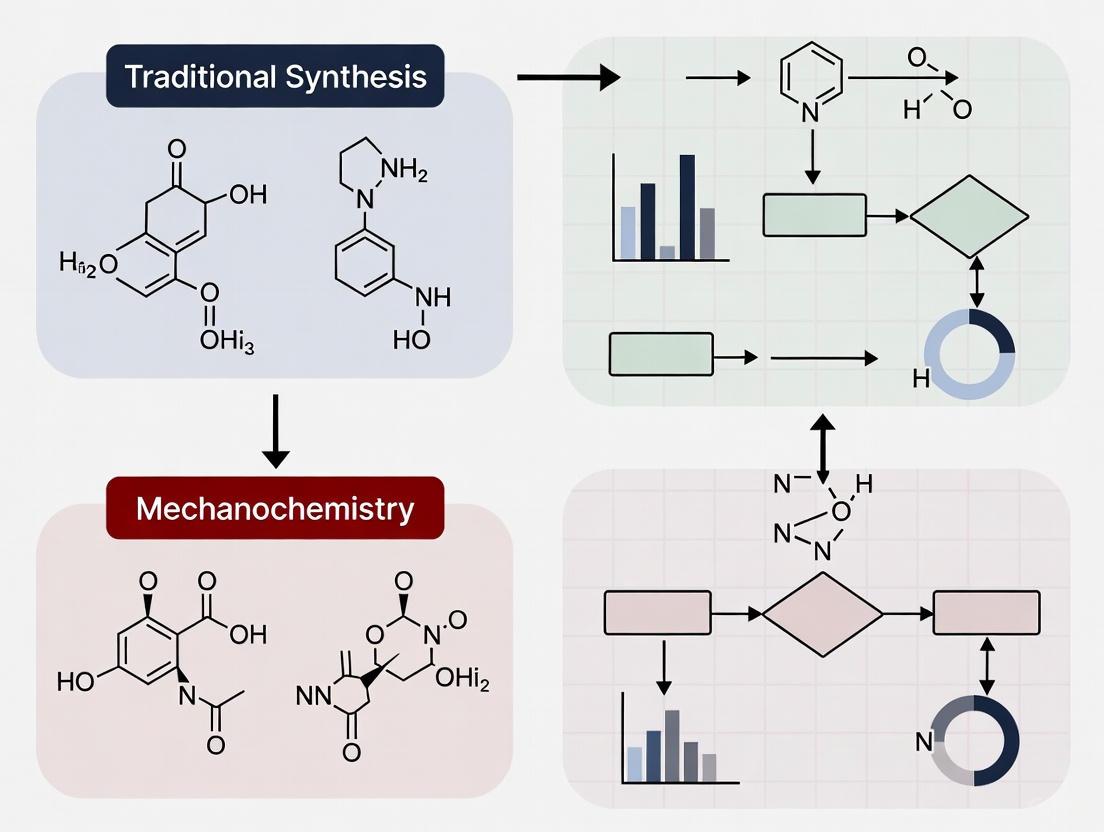
This article explores the paradigm shift from traditional solution-based chemistry to mechanochemical processes in pharmaceutical development, evaluating their direct contributions to the Sustainable Development Goals (SDGs).
Mechanochemistry vs. Traditional Synthesis: A Green Pathway for Sustainable Drug Development and SDG Advancement
Abstract
This article explores the paradigm shift from traditional solution-based chemistry to mechanochemical processes in pharmaceutical development, evaluating their direct contributions to the Sustainable Development Goals (SDGs). It provides a foundational understanding of mechanochemistry as a branch of green chemistry that utilizes mechanical energy to drive reactions, often under solvent-free conditions. For researchers and drug development professionals, the content details methodological applications in API synthesis, cocrystal formation, and polymer degradation, supported by comparative case studies. It addresses key troubleshooting and optimization strategies for scaling these techniques, and presents a rigorous validation through comparative analysis of green metrics, including E-factor, PMI, and RME. The synthesis concludes that mechanochemistry offers a robust, industrially viable approach to reduce the environmental footprint of drug manufacturing, thereby advancing SDG targets for responsible consumption, climate action, and sustainable industrialization.
Green Chemistry and the SDGs: Foundations of Mechanochemistry
The Pharmaceutical Industry's Environmental Imperative and the SDG Framework
The pharmaceutical industry faces a critical environmental challenge, contributing approximately 4.4% of global greenhouse gas emissions—surpassing the automotive sector—while simultaneously bearing responsibility for advancing global public health [1] [2]. This paradox has catalyzed an industry-wide transformation toward sustainable manufacturing practices aligned with the United Nations Sustainable Development Goals (SDGs). Within this movement, mechanochemistry has emerged as a transformative approach that directly addresses SDG 9 (Industry, Innovation and Infrastructure), SDG 12 (Responsible Consumption and Production), and SDG 13 (Climate Action) by fundamentally reengineering synthetic processes to minimize environmental impact [3].
Traditional pharmaceutical manufacturing, particularly Solid-Phase Peptide Synthesis (SPPS), relies heavily on hazardous solvents and generates substantial waste, creating an urgent need for greener alternatives [4]. Mechanochemistry, which utilizes mechanical force rather than solvents to drive chemical reactions, presents a viable solution. This comprehensive analysis compares conventional pharmaceutical synthesis with mechanochemical methods, examining environmental metrics, experimental protocols, and alignment with sustainability frameworks to guide researchers and drug development professionals in adopting these innovative techniques.
Comparative Analysis of Traditional vs. Mechanochemical Synthesis
Environmental Performance and Green Metrics
Quantitative comparisons across multiple Active Pharmaceutical Ingredients (APIs) reveal mechanochemistry's superior environmental profile compared to traditional solution-based synthesis.
Table 1: Green Metrics Comparison Between Traditional and Mechanochemical Synthesis
| Metric | Traditional Synthesis | Mechanochemical Synthesis | Improvement Factor |
|---|---|---|---|
| Process Mass Intensity (PMI) | High (typically >100) | Significantly reduced | 2-10x improvement [5] |
| E-factor | High waste generation | Minimal waste generation | Substantial reduction [5] |
| Solvent Consumption | Large volumes (DMF, NMP) | Solvent-free or minimal | >1000-fold reduction for peptide synthesis [4] |
| Atom Economy (AE) | Variable, often suboptimal | Enhanced | Improved [5] |
| Carbon Footprint | High (~5% of European industrial emissions) | Significantly reduced | Major reduction potential [3] |
| Reaction Times | Hours to days | Minutes to hours | 2-5x faster [6] |
Analysis of nine APIs demonstrates that mechanosynthesis more closely adheres to green chemistry principles, including waste prevention, safer chemical use, and energy efficiency [5]. The technology significantly enhances multiple green metrics including Atom Economy (AE), Carbon Efficiency (CE), and Reaction Mass Efficiency (RME) while reducing Process Mass Intensity (PMI) and E-factor [5].
Specific Case Study: Peptide Synthesis
Peptide therapeutics represent a growing market segment, with over 110 therapeutic peptides available and increasing demand for GLP-1 receptor agonists [4]. The environmental comparison between SPPS and mechanochemical peptide synthesis reveals dramatic differences:
Table 2: Direct Comparison: SPPS vs. Mechanochemical Peptide Synthesis
| Parameter | Solid-Phase Peptide Synthesis (SPPS) | Mechanochemical TSE Process |
|---|---|---|
| Solvent Volume | ~0.15 mL/mg resin (80-90% of waste mass) [4] | ~0.15 mL/g amino acid (1000-fold reduction) [4] |
| Amino Acid Ratio | Up to 10-fold excess [4] | Equimolar ratios [4] |
| Key Reagents | DMF/NMP, DIC, Oxyma [4] | Solvent-free or minimal acetone [4] |
| Process Type | Batch (up to 6000L) [4] | Continuous flow [4] |
| Space-Time Yield | Baseline | 30-100 fold increase [4] |
| Solid Support | Polystyrene resin (additional waste) [4] | None required [4] |
The mechanochemical approach utilizing Twin-Screw Extrusion (TSE) achieves particularly impressive results, operating under solvent-free to minimal solvent conditions through precise temperature control across extrusion zones [4]. This technology has successfully produced dipeptides and tripeptides at various scales, demonstrating compatibility with common protecting groups and commercial amino acid derivatives [4].
Experimental Protocols and Methodologies
Traditional Solid-Phase Peptide Synthesis (SPPS)
Principle: Sequential addition of amino acid derivatives to a growing peptide chain anchored to insoluble resin support [4].
Detailed Protocol:
- Resin Swelling: Suspend polystyrene resin in dimethylformamide (DMF) or N-methyl-2-pyrrolidone (NMP) for 30-60 minutes
- Deprotection: Remove Fmoc protecting group using 20% piperidine in DMF
- Washing: Rinse resin multiple times with DMF (typically 5-10 volumes)
- Coupling: React amino acid (3-10 fold excess) with activating agents (DIC/Oxyma) in DMF for 30-90 minutes
- Repetition: Repeat steps 2-4 for each additional amino acid
- Cleavage: Release peptide from resin using trifluoroacetic acid-based cocktail
- Purification: Reverse-phase HPLC with acetonitrile/water gradients
Critical Parameters:
- Solvent purity and degassing
- Coupling efficiency monitoring (Kaiser test)
- Strict exclusion of moisture
- Temperature control (20-25°C)
Mechanochemical Peptide Synthesis via Twin-Screw Extrusion
Principle: Continuous solvent-free coupling of amino acid derivatives through mechanical shear and compression [4].
Detailed Protocol:
- Premixing: Physically mix equimolar amounts of protected amino acid derivatives (electrophile and nucleophile) with sodium bicarbonate base
- Extrusion Parameters:
- Screw speed: 100-500 rpm
- Temperature profile: Precise control across multiple zones (typically 25-80°C)
- Feed rate: 0.1-5 kg/hour depending on scale
- Residence time: 2-10 minutes
- Reaction Monitoring: In-line Raman spectroscopy or periodic HPLC sampling
- Product Collection: Continuous output of crude peptide for minimal purification
- Sequential Synthesis: For tripeptides, repeat extrusion with subsequent amino acid derivatives
Critical Parameters:
- Screw configuration and kneading elements
- Temperature profile optimization
- Residence time distribution
- Powder flow and feeding consistency
Diagram 1: SPPS vs. Mechanochemical Peptide Synthesis Workflow. The traditional SPPS process involves multiple solvent-intensive steps with recycling loops, while mechanochemical TSE provides a continuous, streamlined approach with minimal purification requirements [4].
The Scientist's Toolkit: Research Reagent Solutions
Table 3: Essential Materials for Mechanochemical Peptide Synthesis
| Reagent/Material | Function | Example in Protocol | Traditional Alternative |
|---|---|---|---|
| Amino Acid N-Carboxyanhydrides (NCAs) | Electrophile component | Boc-Val-NCA [4] | Fmoc-amino acids |
| Amino Acid N-Hydroxysuccinimide Esters | Activated electrophile | Boc-Val-NHS, Boc-Ala-NHS [4] | Same, but used in solution |
| Free Amino Acid Esters (HCl salts) | Nucleophile component | Leu-OMe HCl, Phe-OMe HCl [4] | Resin-bound amino acids |
| Sodium Bicarbonate | Base for HCl salt neutralization | Equimolar to nucleophile [4] | Diisopropylethylamine (DIPEA) |
| Twin-Screw Extruder | Mechanochemical reactor | Continuous processing [4] | Glass reaction vessels |
| In-line Spectroscopy | Reaction monitoring | Raman for real-time analysis [4] | LC-MS sampling |
Fundamental Principles of Mechanochemical Activation
Understanding the physical principles underlying mechanochemistry is essential for researchers adapting these methods. Mechanical force modifies chemical reactivity through two primary mechanisms:
1. Alteration of Activation Barriers: Mechanical stress directly modifies potential energy surfaces, lowering activation energies through the mechanism described by the Bell-Evans model [7]. The interaction rate under force follows: α(F) = α₀e^(FΔx/kBT), where Δx represents the characteristic spatial scale of the interaction landscape, F is the applied force, and α₀ is the spontaneous rate [7].
2. Enhanced Molecular Collisions: Mechanical processing through methods like TSE increases effective collision probability through intense mixing, particle size reduction, and generation of structural defects and reactive sites [7].
Diagram 2: Mechanical Force Lowers Activation Energy. Applied force distorts the potential energy landscape, reducing the activation barrier between reactants and products and enabling reactions under milder conditions [7].
Regulatory Framework and Global Sustainability Initiatives
The pharmaceutical industry operates within an increasingly stringent regulatory environment focused on environmental impact. Key developments include:
WHO Greener Pharmaceuticals Initiative: The World Health Organization has issued a call for action to drive sustainability in the pharmaceutical sector, emphasizing that "addressing the environmental impact of healthcare products is no longer optional - it is imperative" [8]. The initiative promotes:
- Sustainable manufacturing, packaging, and distribution standards
- Digital transformation of regulatory processes
- Earlier regulator-manufacturer collaboration on eco-friendly innovations [8]
Pharmaceutical Sector Nature-Positive Roadmap: Developed by WBCSD in collaboration with major pharmaceutical companies, this framework aims to halt and reverse nature loss by 2030 through:
- Assessing nature-related impacts across value chains
- Implementing targeted nature-positive actions
- Developing harmonized metrics for accountability [9]
EU Pharmaceutical Regulations: Updated regulations now mandate environmental risk assessments for new medicines, reflecting growing regulatory pressure [1].
The comparative analysis between traditional and mechanochemical synthesis methods reveals a clear trajectory for the pharmaceutical industry's sustainable transformation. Mechanochemistry demonstrates superior environmental performance across multiple metrics, including dramatic solvent reduction, waste minimization, and enhanced energy efficiency [4] [5]. The technology aligns strategically with SDG frameworks and evolving regulatory expectations while maintaining synthetic efficiency and scalability.
For researchers and drug development professionals, adopting mechanochemical approaches represents both an environmental imperative and a strategic opportunity. The experimental protocols and reagent solutions detailed in this guide provide practical pathways for implementation. As the WHO emphasizes, regulatory expectations increasingly favor sustainable manufacturing, making early adoption of these technologies advantageous for both environmental and business objectives [8] [2].
The pharmaceutical industry's transition toward greener synthesis methods, particularly mechanochemistry, will play a crucial role in achieving global sustainability targets while continuing to advance human health through innovative therapeutics.
Mechanochemistry represents a transformative approach to chemical synthesis, defined as the initiation of chemical reactions by mechanical phenomena rather than thermal energy, light, or electricity. This review objectively compares traditional solution-based chemistry with mechanochemical processes through the lens of Sustainable Development Goals (SDGs), particularly focusing on pharmaceutical applications. Experimental data demonstrate that mechanochemistry consistently outperforms traditional methods across key green metrics, including substantial reductions in E-factor (a measure of process waste), improved reaction efficiencies, and elimination of hazardous solvents. The historical development of mechanochemistry reveals a field that has evolved from ancient mechanical processing to a sophisticated discipline enabling sustainable drug development and materials synthesis with profound implications for environmental stewardship and green technology innovation.
Historical Development
The history of mechanochemistry spans millennia, bridging ancient material processing with modern sustainable synthesis technologies. This evolution can be divided into distinct historical periods that reflect the field's growing sophistication and application breadth.
Ancient and Prehistoric Origins
The earliest mechanochemical experiences date to prehistoric times through activities like fine grinding of materials [10]. A primal mechanochemical project involved making fire by rubbing pieces of wood together, creating friction and heat to trigger combustion [11]. The first documented systematic investigations emerged in the 4th century BC, with Theophrastus, a student of Aristotle, conducting mineral experiments [12]. A notable early process involved the extraction of mercury by mechanochemical reduction of cinnabar (mercuric sulfide) by grinding in a copper vessel with vinegar [13].
Foundational 19th Century Research
The late 19th century marked the beginning of systematic scientific investigation into mechanochemistry, primarily through two pioneering figures:
Walthère Spring (University of Liège) studied the consolidation and reactions of powdered materials under high pressure to understand mineral formation in the Earth's crust [10]. His work demonstrated that pressure could induce chemical reactions between solid substances, such as the formation of arsenides and sulfides [10].
M. Carey Lea is recognized as "the first mechanochemist" for his extensive experiments on mechanical decomposition of compounds through grinding [10]. Lea made the crucial observation that mechanical action could produce distinctly different results from thermal effects, documenting endothermic reactions triggered by mechanical force and the transformation of mechanical energy into chemical energy [10].
Modern Institutionalization
The 1960s represented a pivotal period for mechanochemistry with the formation of a broader scientific community. The first dedicated conference was organized in 1968 as a special session of the Soviet colloid chemists' meeting, largely driven by P.A. Rebinder and P.A. Thiessen [10]. This established mechanochemistry as a distinct scientific discipline with regular conferences and growing research output, particularly in the Soviet Union and Eastern Europe [10].
Contemporary Renaissance
Since the 1990s, mechanochemistry has experienced a renaissance with applications expanding to:
- Organic synthesis and supramolecular chemistry [13]
- Pharmaceutical production with enhanced green metrics [14]
- Advanced materials including metal-organic frameworks (MOFs) and nanomaterials [13] [3]
- Polymer science with mechanophores for stress-sensing materials [15] [11]
The International Union of Pure and Applied Chemistry has recognized mechanochemistry as one of ten chemical innovations that will change the world, cementing its importance in sustainable chemistry [13].
Fundamental Principles and Definitions
Core Concepts
Mechanochemistry represents a fundamental paradigm in chemical synthesis, operating on principles distinct from traditional approaches:
Primary Definition: "The initiation of chemical reactions by mechanical phenomena" or more specifically, "chemical synthesis induced by external mechanical energy" [13] [11]. This establishes mechanochemistry as the fourth approach to driving chemical reactions, complementing thermal activation, photochemistry, and electrochemistry [11].
Force-Induced Reactivity: Mechanical force can dramatically alter chemical kinetics, with documented cases where mechanical stretching reduces bond half-lives from astronomical timescales to microseconds at room temperature [13]. This occurs through selective deformation of molecular structures in ways not achievable through thermal or photochemical means.
Mechanophore Concept: A key advancement is the development of "mechanophores" - molecular units engineered to undergo predictable chemical transformations in response to applied stress [15] [11]. These enable materials with functions including damage sensing, self-healing, and stress-reporting capabilities [15].
Comparative Framework: Traditional vs. Mechanochemical Synthesis
The fundamental differences between traditional and mechanochemical approaches can be understood through their distinct operational paradigms:
Table: Fundamental Principles Comparison
| Parameter | Traditional Solution Chemistry | Mechanochemistry |
|---|---|---|
| Energy Input | Thermal energy (heating) | Mechanical force (grinding, milling) |
| Reaction Medium | Liquid solvents (often organic) | Solid-state (minimal or no solvent) |
| Molecular Mobility | Diffusion in liquid phase | Direct solid-solid contact |
| Reaction Environment | Homogeneous solution | Heterogeneous solid interfaces |
| Primary Mechanism | Solvent-facilitated molecular collision | Mechanical force-induced bond deformation |
Experimental Comparison: Pharmaceutical Applications
Green Metrics Analysis
Comprehensive analysis of nine Active Pharmaceutical Ingredients (APIs) reveals significant environmental advantages for mechanochemical processes compared to traditional synthesis routes [14] [5]. The quantitative comparison demonstrates superior performance across multiple green chemistry metrics:
Table: Green Metrics Comparison for API Production
| Performance Metric | Traditional Synthesis | Mechanochemistry | Improvement Factor |
|---|---|---|---|
| E-factor (kg waste/kg product) | High (often 25-100) | Significantly reduced | 5-10x reduction |
| Process Mass Intensity (PMI) | High | Dramatically lower | Substantial improvement |
| Atom Economy (AE) | Variable, often suboptimal | Enhanced | Notable increase |
| Carbon Efficiency (CE) | Limited | Improved | Significant enhancement |
| Reaction Mass Efficiency (RME) | Moderate | Higher | Marked improvement |
| cE-factor | Elevated | Reduced | Considerable reduction |
| Solvent Consumption | Substantial (primary waste source) | Minimal to zero | Near elimination |
| Energy Efficiency | Moderate (heating/cooling requirements) | High (direct energy input) | Significant improvement |
| Reaction Time | Hours to days | Minutes to hours | Substantial reduction |
Experimental Protocols and Methodologies
Traditional Solution-Based Synthesis
- Apparatus: Round-bottom flasks, reflux condensers, separation funnels, heating mantles [12]
- Procedure: Reactants dissolved in appropriate solvents (frequently dichloromethane, DMF, THF, or other organic solvents) with continuous stirring [14] [12]
- Reaction Conditions: Typically requires heating to reflux temperatures (often 60-120°C) for extended periods (hours to days) [14]
- Workup Steps: Multiple extraction, washing, and purification steps including column chromatography, recrystallization, and distillation [14]
- Solvent Consumption: Large volumes relative to product mass (often 50-100 mL/g product) [14] [12]
Mechanochemical Synthesis
- Apparatus: Ball mills (planetary or shaker types), mixer mills, or mortar and pestle for small-scale experiments [13] [11]
- Grinding Media: Stainless steel, tungsten carbide, or ceramic balls of varying diameters (typically 2-15 mm) [13]
- Procedure: Solid reactants placed in milling jar with grinding balls, processed for predetermined time (minutes to hours) [14] [13]
- Liquid-Assisted Grinding (LAG): Minimal solvent addition (catalytic amounts) to enhance molecular mobility without creating solutions [13]
- Reaction Conditions: Room temperature typically, with controlled frequency and energy input through milling speed [14]
- Workup Steps: Minimal purification often required, simple washing or direct collection of product [14]
Process Workflow Visualization
The Scientist's Toolkit: Research Reagent Solutions
Successful implementation of mechanochemical processes requires specific equipment and materials optimized for solid-state reactions:
Table: Essential Materials for Mechanochemical Research
| Tool/Reagent | Function | Application Notes |
|---|---|---|
| Planetary Ball Mill | High-energy impact grinding | Adjustable rotation speed, multiple jar materials available [13] |
| Mixer Mill | Horizontal shaking motion | Effective for small-scale screening [13] |
| Stainless Steel Balls | Grinding media | Various diameters (2-15mm) for different impact energies [13] |
| Tungsten Carbide Jars | Milling containers | High density for efficient energy transfer [13] |
| Ceramic Balls/Jars | Inert grinding media | For metal-sensitive reactions [13] |
| Liquid-Assisted Grinding (LAG) Additives | Catalytic solvent amounts | Typically 1-5 drops to enhance mobility [13] |
| Mechanophores | Force-responsive molecular units | Spiropyran, gem-dichlorocyclopropane for stress-sensing [15] [11] |
| Analytical Techniques | Real-time reaction monitoring | In-situ Raman, PXRD for mechanistic studies [13] |
Sustainable Development Goal Applications
Pharmaceutical Industry Alignment with SDGs
Mechanochemistry directly addresses multiple Sustainable Development Goals through transformative applications in pharmaceutical manufacturing and materials science:
SDG 3 (Good Health and Well-being): Production of APIs with reduced environmental impact and elimination of hazardous solvent residues in pharmaceutical products [14] [3]
SDG 9 (Industry, Innovation and Infrastructure): Enables cleaner production technologies with reduced energy consumption and waste generation [3]
SDG 12 (Responsible Consumption and Production): Dramatic reduction in Process Mass Intensity (PMI) and E-factor through solvent-free synthesis [14] [3]
SDG 13 (Climate Action): Significant lowering of Greenhouse Gas (GHG) emissions by eliminating solvent production and incineration [14] [3]
Advanced Materials for Sustainability
Mechanochemistry enables synthesis of materials critical for sustainable technologies:
Metal-Organic Frameworks (MOFs): Porous materials for carbon capture, water treatment, and energy storage synthesized without solvents [13] [3]
Biomass Valorization: Conversion of wood waste and other biomass into valuable chemicals through mechanocatalysis [3]
Energy Storage Materials: Solid-state synthesis of battery components and hydrogen storage materials with improved efficiency [11]
Recyclable Polymers: Incorporation of mechanophores for mechanically-triggered depolymerization to enhance plastic recyclability [15]
The comprehensive comparison between traditional and mechanochemical processes demonstrates that mechanochemistry represents a paradigm shift in sustainable chemical synthesis. With its historical roots in ancient processing techniques and 19th century scientific investigation, mechanochemistry has evolved into a sophisticated discipline offering substantial environmental advantages across pharmaceutical production and materials science. Experimental data confirm superior performance in green metrics, including dramatic reductions in waste generation, elimination of hazardous solvents, and improved energy efficiency. The alignment of mechanochemistry with multiple Sustainable Development Goals, particularly through applications in pharmaceutical manufacturing, water treatment, and renewable energy materials, positions this field as a cornerstone of sustainable industrial development. While challenges remain in fundamental mechanistic understanding and technology transfer, the continued advancement of mechanochemical processes promises to significantly contribute to greener, more sustainable chemical industries worldwide.
The Twelve Principles of Green Chemistry as an Evaluation Framework
The global chemical industry, particularly the pharmaceutical sector, faces increasing pressure to minimize its environmental footprint. Drug manufacturing is known for producing 25 to over 100 kg of waste per kilogram of Active Pharmaceutical Ingredient (API), largely due to multi-step processes, stoichiometric reagents, and substantial solvent use [16]. In response, green chemistry principles provide a systematic framework for designing chemical products and processes that reduce or eliminate hazardous substances [17].
This review employs the Twelve Principles of Green Chemistry as an evaluation framework to objectively compare traditional solution-based chemistry with mechanochemical approaches. Mechanochemistry, defined as a "chemical reaction induced by the direct absorption of mechanical energy," offers a promising sustainable alternative through techniques like ball milling and extrusion [16] [18]. The analysis specifically examines how these methodologies advance the United Nations Sustainable Development Goals (SDGs), particularly Good Health and Well-Being (SDG 3), Industry, Innovation and Infrastructure (SDG 9), Responsible Consumption and Production (SDG 12), and Climate Action (SDG 13) [16] [19].
The Analytical Framework: Twelve Principles of Green Chemistry
The Twelve Principles of Green Chemistry, established by Paul Anastas and John Warner, provide a comprehensive framework for assessing the environmental performance of chemical processes [17] [20]. These principles emphasize pollution prevention at the molecular level rather than end-of-pipe treatment, atom economy to maximize resource efficiency, and designing safer chemicals and processes [17]. For researchers and industrial chemists, these principles serve as actionable guidelines for developing cost-effective and eco-friendly processes.
When applied to pharmaceutical production and API synthesis, this framework enables systematic evaluation of traditional and emerging technologies. The principles directly support corporate sustainability goals and regulatory compliance while driving innovation in synthetic methodology [21]. As the chemical industry moves toward a low-carbon economy, this framework provides metrics to quantify improvements in waste reduction, energy efficiency, and hazard minimization [19].
Table 1: The Twelve Principles of Green Chemistry as an Evaluation Framework [17] [20]
| Principle Number | Principle Name | Core Concept | Key Evaluation Metrics |
|---|---|---|---|
| 1 | Prevent Waste | Design syntheses to prevent waste generation rather than treating or cleaning up waste afterward | E-factor, PMI |
| 2 | Maximize Atom Economy | Design syntheses so final product contains maximum proportion of starting materials | Atom Economy (AE) |
| 3 | Design Less Hazardous Chemical Syntheses | Use and generate substances with minimal toxicity to humans and environment | Hazard assessment, toxicity metrics |
| 4 | Design Safer Chemicals | Design effective products with minimal toxicity | Efficacy-toxicity ratio |
| 5 | Use Safer Solvents & Reaction Conditions | Avoid auxiliary chemicals; use safer alternatives when necessary | Solvent greenness scores, energy input |
| 6 | Increase Energy Efficiency | Run reactions at ambient temperature and pressure when possible | Energy consumption, temperature requirements |
| 7 | Use Renewable Feedstocks | Use starting materials from renewable resources rather than depletable sources | Renewable feedstock percentage |
| 8 | Avoid Chemical Derivatives | Avoid unnecessary blocking/protecting groups | Number of synthetic steps, step economy |
| 9 | Use Catalysts, Not Stoichiometric Reagents | Use catalytic reactions that minimize waste | Catalyst loading, turnover number/frequency |
| 10 | Design for Degradation | Design chemical products to break down to innocuous substances after use | Degradability, persistence metrics |
| 11 | Analyze in Real Time for Pollution Prevention | Include in-process monitoring to minimize byproduct formation | Process analytical technology (PAT) implementation |
| 12 | Minimize Accident Potential | Design chemicals and forms to minimize potential for accidents | Physical hazard assessment (explosivity, flammability) |
Methodology for Comparative Analysis
Evaluation Metrics and Data Collection
The comparative assessment between traditional and mechanochemical processes employs quantitative green metrics to provide objective, data-driven evaluations. These metrics include [16] [22]:
- Atom Economy (AE): Molecular weight of desired product divided by sum of molecular weights of all reactants
- Reaction Mass Efficiency (RME): (Mass of product / Total mass of reactants) × 100%
- Environmental Factor (E-factor): Total mass of waste (kg) per mass of product (kg)
- Process Mass Intensity (PMI): Total mass of materials (kg) used per mass of product (kg)
- Complete E-factor (cE-factor): E-factor including water in calculations
Data were collected from peer-reviewed literature comparing identical or highly similar chemical transformations conducted under both traditional solution-based and mechanochemical conditions. The analysis focused particularly on API synthesis pathways common in pharmaceutical development [16].
Experimental Protocols for Mechanochemical Synthesis
Ball Milling Methodology [16] [18]:
- Equipment Setup: Reactions conducted using planetary ball mills (e.g., Retsch PM100) with grinding jars (stainless steel, zirconium oxide, or Teflon) and grinding balls of varying diameters (typically 5-15 mm)
- Loading Procedure: Reactants and any catalysts loaded into grinding jar in predetermined stoichiometric ratios without or with minimal solvent (Liquid-Assisted Grinding, LAG)
- Reaction Parameters: Milling frequency set (typically 500-800 rpm) with alternating rotation directions to enhance mixing
- Temperature Control: Reactions conducted at ambient temperature unless specified, with monitoring of potential "hot-spots" from friction
- Work-up Procedure: Product decanted directly from milling jar, often requiring no further purification or simple washings
Twin-Screw Extrusion (TSE) for Continuous Processing [18]:
- System Configuration: Powdered reactants fed into extruder hopper; catalysts optionally premixed or injected through secondary ports
- Process Parameters: Screw rotation speed, temperature zones, and residence time optimized for specific reaction
- Product Collection: Material collected continuously at die outlet, optionally ground to uniform particle size
Comparative Evaluation: Traditional vs. Mechanochemical Processes
Quantitative Performance Metrics
Table 2: Green Metrics Comparison for Selected API Syntheses [16] [22]
| API/Reaction | Synthesis Method | Atom Economy (%) | E-factor (kg waste/kg product) | Process Mass Intensity (PMI) | Reaction Mass Efficiency (%) | Reaction Time | Yield (%) |
|---|---|---|---|---|---|---|---|
| Teriflunomide | Traditional Solution | 82 | 48 | 52 | 65 | 12+ hours | 85 |
| Teriflunomide | Mechanochemical (Ball Milling) | 82 | 12 | 15 | 78 | 5 hours | 88 |
| Amide Bond Formation | Traditional Solution | 85 | 32 | 41 | 61 | 8 hours | 82 |
| Amide Bond Formation | Mechanochemical | 85 | 8 | 11 | 86 | 2 hours | 90 |
| Carbamate Synthesis | Traditional Solution | 79 | 41 | 53 | 58 | 10 hours | 80 |
| Carbamate Synthesis | Mechanochemical | 79 | 11 | 14 | 83 | 3 hours | 87 |
| Heterocycle Formation | Traditional Solution | 75 | 56 | 68 | 52 | 15 hours | 75 |
| Heterocycle Formation | Mechanochemical | 75 | 15 | 19 | 79 | 4 hours | 89 |
Principle-by-Principle Analysis
Principles 1-3 (Waste Prevention, Atom Economy, Less Hazardous Syntheses): Mechanochemistry demonstrates superior performance with E-factors 60-80% lower than traditional processes [16]. This improvement stems primarily from solvent elimination and precise stoichiometric control that minimizes excess reagents. While atom economy remains identical for identical reaction pathways, mechanochemistry's ability to enable novel, more direct synthetic routes can substantially improve inherent atom economy [22].
Principles 5-6 (Safer Solvents, Energy Efficiency): Mechanochemical processes address the critical solvent issue in pharmaceutical manufacturing, where solvents constitute 80-90% of the mass in traditional processes [16]. By operating without solvents or with minimal solvent in LAG approaches, mechanochemistry eliminates volatile organic compound emissions and reduces hazards. Energy efficiency is enhanced by conducting reactions at ambient temperature without energy-intensive cooling or heating [18].
Principles 8-9 (Avoid Derivatives, Catalytic Reactions): The ability to conduct reactions under solvent-free conditions enables mechanochemistry to avoid protecting groups in certain transformations. Additionally, mechanochemical activation enhances catalyst efficiency, allowing reduced catalyst loading while maintaining or improving activity [22] [18].
Case Study: Teriflunomide Synthesis
Experimental Protocols
Traditional Synthesis Protocol [16]:
- Reaction Setup: Charge acetonitrile (5 L/kg substrate) into reactor
- Amide Coupling: Add 5-methyl isoxazole-4-carbonyl chloride (1.0 equiv) and 4-(trifluoromethyl)aniline hydrochloride (1.2 equiv)
- Reaction Monitoring: Stir at 25°C for 8 hours monitoring by TLC/HPLC
- Intermediate Isolation: Concentrate, wash with aqueous NaHCO₃, dry over MgSO₄, filter, and concentrate to obtain leflunomide intermediate
- Hydrolysis: Dissolve intermediate in methanol, add aqueous NaOH (1.5 equiv), stir 4 hours at 40°C
- Work-up: Acidify with HCl, filter precipitate, wash with water, and dry under vacuum
- Overall Yield: 85% over two steps; E-factor: 48
Mechanochemical Synthesis Protocol [16]:
- Equipment Preparation: Load stainless-steel grinding jar (50 mL) with fifty stainless-steel balls (5 mm diameter)
- Activation Step: Add carboxylic acid (1.0 equiv) and carbonyldiimidazole (CDI, 1.1 equiv), mill at 500 rpm for 20 minutes
- Amide Coupling: Add amine hydrochloride (1.05 equiv), mill at 500 rpm for 5 hours with 1-minute breaks every 10 minutes and rotation direction inversion
- Product Isolation: Decant product from jar, minimal washing with cold water
- Overall Yield: 88% in one pot; E-factor: 12
Comparative Green Metrics Analysis
The teriflunomide case study demonstrates mechanochemistry's substantial advantages across multiple green chemistry principles. The E-factor reduction from 48 to 12 (75% decrease) primarily results from solvent elimination and reduced reagent excess [16]. The single-pot mechanochemical approach eliminates the need for intermediate isolation and purification, reducing PMI from 52 to 15. While atom economy remains identical for the core bond-forming steps, the overall process efficiency improves significantly through simplified workflow and reduced auxiliary materials [22].
Visualization of the Evaluation Workflow
Diagram 1: Green Chemistry Principles Evaluation Workflow. This diagram illustrates the systematic framework for evaluating chemical processes against the Twelve Principles of Green Chemistry, leading to quantitative metrics assessment and SDG alignment evaluation.
Mechanochemical Equipment and Research Reagents
Table 3: Essential Research Equipment and Reagents for Mechanochemical Research
| Equipment/Reagent | Function/Application | Key Considerations | Representative Examples |
|---|---|---|---|
| Planetary Ball Mill | Provides mechanical energy through impact and friction | Variable speed control, multiple jar materials available | Retsch PM100, Fritsch Pulverisette |
| Mixer Mill | High-energy grinding for small samples | Suitable for screening reaction conditions | Retsch MM 400, SPEX SamplePrep 8000M |
| Twin-Screw Extruder | Continuous mechanochemical processing | Enables scalable production, various screw configurations | Thermo Scientific Process 11, Leistritz Nano16 |
| Zirconium Oxide Jars & Balls | Milling media for metal-sensitive reactions | Prevents API contamination, EMA-compliant | Zirconia grinding jars (10-250 mL capacity) |
| Stainless Steel Media | Standard milling media for most reactions | Cost-effective, durable | Balls (3-15 mm diameter), cylinders |
| Teflon Milling Assemblies | For highly corrosive or reactive systems | Chemically inert, minimal contamination | Custom-fabricated assemblies |
| Liquid-Assisted Grinding (LAG) Additives | Minimal solvent to enhance reaction kinetics | Typically 1-100 μL/mg substrate | Water, ethanol, ethyl acetate, ionic liquids |
| Catalytic Reagents | Enable catalytic mechanochemical reactions | Enhanced efficiency under milling conditions | Organocatalysts, metal catalysts, enzymes |
Diagram 2: Mechanochemistry Research Infrastructure. This diagram outlines the essential equipment, media, and process parameters for mechanochemical research and their applications in sustainable chemistry.
SDG Alignment and Sustainability Impact
The adoption of mechanochemical processes directly advances multiple United Nations Sustainable Development Goals. For the pharmaceutical industry, which must balance SDG 3 (Good Health and Well-Being) with environmental responsibility, mechanochemistry offers a pathway to reduce the environmental burden of drug manufacturing [16] [19].
SDG 9 (Industry, Innovation and Infrastructure) is supported through the development of innovative mechanochemical technologies that retrofit existing production facilities for sustainability. The significant reductions in Process Mass Intensity and E-factor demonstrated in Table 2 directly contribute to SDG 12 (Responsible Consumption and Production) by minimizing resource use and waste generation across the chemical lifecycle [16].
The carbon emission reduction potential of mechanochemistry aligns with SDG 13 (Climate Action) through decreased energy consumption for solvent manufacturing, distribution, and removal, as well as reduced fossil fuel dependence for petrochemical-derived solvents [16] [19]. The technology's ability to operate at ambient temperature without external heating or cooling substantially lowers the carbon footprint of chemical manufacturing.
The systematic evaluation using the Twelve Principles of Green Chemistry establishes mechanochemistry as a superior approach for sustainable chemical synthesis, particularly in pharmaceutical applications. The quantitative comparison reveals substantial improvements in waste reduction (60-80% lower E-factors), energy efficiency, and hazard minimization compared to traditional solution-based methods.
While mechanochemistry demonstrates stronger alignment with green chemistry principles overall, challenges remain in continuous processing, heat management for exothermic reactions, and equipment scalability. Emerging technologies like twin-screw extrusion and advanced reactor designs show promise in addressing these limitations [16] [18].
For researchers and drug development professionals, mechanochemistry represents a paradigm shift toward sustainable synthesis that aligns with both green chemistry principles and broader sustainable development goals. The technology's ability to enable novel reaction pathways, improve efficiency, and reduce environmental impact positions it as a cornerstone of sustainable pharmaceutical manufacturing in the coming decades.
The chemical industry, particularly the pharmaceutical sector, faces increasing pressure to align its practices with the United Nations Sustainable Development Goals (SDGs). Traditional solution-based chemical synthesis, the long-standing industry standard, is often characterized by high energy consumption and substantial waste generation, creating tension with global sustainability targets [16]. Within this context, mechanochemistry—the use of mechanical force to drive chemical reactions—has re-emerged as a transformative technology capable of directly supporting several SDGs.
This guide provides an objective comparison between traditional and mechanochemical processes, focusing on their contributions to SDG 13 (Climate Action), SDG 12 (Responsible Consumption and Production), and SDG 9 (Industry, Innovation, and Infrastructure). By synthesizing current research data and experimental findings, we offer researchers and drug development professionals a clear, evidence-based framework for evaluating these methodologies.
Quantitative Comparison of Traditional vs. Mechanochemical Processes
The environmental and economic superiority of mechanochemistry can be quantitatively demonstrated using standardized green metrics. The following tables summarize comparative data for the synthesis of Active Pharmaceutical Ingredients (APIs) and other chemicals.
Table 1: Comparison of Green Metrics for API and Chemical Synthesis
| Metric | Traditional Synthesis | Mechanochemical Synthesis | Improvement Factor | Relevant SDG |
|---|---|---|---|---|
| E-factor (kg waste/kg product) | 25 to >100 [16] | Significantly lower [16] [23] | >70% reduction in some cases [23] | SDG 12 |
| Process Mass Intensity (PMI) | High (Solvents ≈ 80-90% of mass) [16] | Drastically reduced [22] | N/A | SDG 12 |
| Energy Consumption | High (Thermal energy input) | 2-10 times less [24] | 2-10X | SDG 13 |
| Reaction Time | Several hours [24] | 30-90 minutes [24] | 2-5X faster [24] | SDG 9 |
| Operating Cost | Baseline | 30-50% lower [24] | 30-50% reduction [24] | SDG 9 |
| Solvent Use | ~85% of process mass [24] | Solvent-free or minimal [16] [25] | Near-total elimination [24] | SDG 12, 13 |
Table 2: Life Cycle Assessment (LCA) Results for Nitrofurantoin Synthesis [23]
| Impact Category | Traditional Batch Synthesis | Mechanochemical TSE | Reduction |
|---|---|---|---|
| Climate Change | Baseline | Significantly lower | Significant reduction in CO2-eq |
| Human Health Impacts | Baseline | Significantly lower | Improved outcomes |
| Ecological Health | Baseline | Significantly lower | Improved outcomes |
| Cumulative Energy Demand | Baseline | Lower | More efficient |
Experimental Protocols and Methodologies
Protocol 1: Mechanochemical Synthesis of an API via Ball Milling
The following methodology, derived from the synthesis of Teriflunomide, is representative of a ball-milling approach [16].
- Equipment: Retsch PM100 Planetary Mill (or equivalent); Stainless steel, zirconium oxide, or Teflon grinding jar and balls (to avoid metal contamination per EMA regulations) [16].
- Reagent Preparation: Weigh solid carboxylic acid and amine hydrochloride reagents precisely. Control over stoichiometry is a key advantage, often eliminating the need for excess reagents [22].
- Reaction Step:
- Place reagents and milling balls into the grinding jar.
- For multi-step one-pot syntheses, the first step may involve activating a reagent (e.g., carboxylic acid activation with CDI). This is performed by milling at a specified speed (e.g., 500 rpm) for a set time (e.g., 20 minutes) [16].
- Add subsequent reagents (e.g., amine hydrochloride) to the same jar.
- Mill the reaction mixture for the required time (e.g., 5 hours at 500 rpm). Programs often include intermittent breaks and rotation reversal to manage heat and improve mixing [16].
- Work-up and Purification: The solid product is typically extracted from the jar. Due to higher selectivity and fewer by-products, purification is often simplified and may only require a wash or recrystallization, avoiding complex and solvent-intensive column chromatography [24] [22].
Protocol 2: Continuous Synthesis via Twin-Screw Extrusion (TSE)
Twin-screw extrusion represents a scalable, continuous mechanochemical process suitable for industrial application [16] [23].
- Equipment: Co-rotating twin-screw extruder.
- Reagent Preparation: Solid reagents and any liquid additives are precisely fed into the extruder via powder feeders and liquid pumps, respectively.
- Reaction Step:
- The solid reagents are conveyed into the extruder barrel by the rotating screws.
- The chemical reaction occurs through intense mixing and shearing forces in the barrel. The screw configuration (kneading blocks, conveying elements) can be customized to optimize reaction efficiency.
- The reaction is completed as the mixture moves through the barrel, which may be divided into zones with independent temperature control.
- Product Collection: The final product is continuously extruded as a solid strand, which can be collected and processed further (e.g., milled to a powder). This continuous operation eliminates batch-to-batch variability and enables high-throughput production [23].
The Scientist's Toolkit: Essential Research Reagents & Equipment
Table 3: Key Equipment and Reagents for Mechanochemical Research
| Item | Function/Description | Application in Research |
|---|---|---|
| Planetary Ball Mill | High-energy mill using centrifugal forces for grinding and mixing. | Lab-scale screening of mechanochemical reactions for API synthesis [16]. |
| Twin-Screw Extruder (TSE) | Continuous processor using intermeshing screws to mix, shear, and convey materials. | Scalable, continuous synthesis of APIs and materials; direct translation to industrial processing [16] [23]. |
| Liquid-Assisted Grinding (LAG) Additives | Catalytic amounts of liquids (e.g., solvents, ionic liquids) added to the solid reaction. | Modifying reaction kinetics and selectivity; stabilizing intermediates without acting as bulk solvents [24]. |
| Zirconium Oxide Milling Jars/Balls | Dense, inert milling media. | Preventing metal contamination in API synthesis, crucial for regulatory compliance [16]. |
| In-situ Analytical Probes | Raman, X-ray diffraction, or other probes integrated into the milling chamber. | Real-time monitoring of reaction kinetics and mechanistic studies [26]. |
Logical Workflow and Pathway Diagrams
The following diagram illustrates the decision-making pathway for implementing mechanochemistry and its subsequent contribution to the relevant Sustainable Development Goals.
Pathway to SDGs via Mechanochemistry
The diagram above maps the logical connection between process choices and their alignment with the SDGs. The mechanochemistry pathway directly enables sustainable production (SDG 12) and climate action (SDG 13) through drastic waste and emission reductions. Furthermore, its innovative and scalable nature, exemplified by technologies like twin-screw extrusion, fosters resilient infrastructure and sustainable industrialization (SDG 9).
The empirical data and experimental comparisons presented in this guide consistently demonstrate that mechanochemistry offers a substantively more sustainable pathway than traditional solution-based methods. The technology directly addresses critical industrial challenges by drastically reducing solvent-related waste (aligning with SDG 12), lowering energy consumption and greenhouse gas emissions (supporting SDG 13), and enabling innovative, cost-effective, and continuous manufacturing processes (advancing SDG 9). For researchers and pharmaceutical professionals, the adoption and further development of mechanochemical techniques is not merely a technical optimization but a strategic imperative for aligning drug development with global sustainability targets.
Mechanochemistry in Practice: Techniques and Pharmaceutical Applications
The pursuit of Sustainable Development Goals (SDGs) in the pharmaceutical industry has catalyzed a shift towards greener manufacturing technologies. Among the most promising advancements are mechanochemical methods, which utilize mechanical force to drive chemical reactions, significantly reducing or eliminating the need for hazardous solvents. This guide provides an objective comparison of three core technologies—ball milling, twin-screw extrusion (TSE), and continuous-flow systems—evaluating their performance, applications, and suitability for sustainable drug development. As the industry moves away from traditional, solvent-intensive batch processes, these technologies offer pathways to minimize waste, improve energy efficiency, and enable safer synthesis of active pharmaceutical ingredients (APIs) and intermediates [5] [27]. Ball milling represents the foundational batch-mode mechanochemical approach, while twin-screw extrusion and other continuous-flow systems have emerged as scalable, continuous alternatives capable of kilogram-per-hour throughputs, transforming laboratory innovations into viable industrial processes [4] [28].
Technology Comparison: Operational Principles and Characteristics
The following table summarizes the core attributes, advantages, and limitations of each technology, providing a foundational comparison for researchers.
Table 1: Comparative Overview of Core Equipment Technologies
| Technology | Operational Principle | Reaction Mode | Key Advantages | Inherent Limitations |
|---|---|---|---|---|
| Ball Milling | Impact and shear forces from grinding balls inside a vibrating or rotating jar [27] | Batch | Solvent-free or minimal solvent (LAG) [29]; Enables novel reaction pathways [29]; Simple operation for lab-scale synthesis | Limited scalability due to safety and heat dissipation constraints [28]; Batch processing; Precise temperature control can be challenging [30] |
| Twin-Screw Extrusion (TSE) | Shearing and kneading actions between two intermeshing, rotating screws inside a barrel [4] [28] | Continuous | Excellent scalability and kilogram-per-hour throughput [4] [28]; Precise control over temperature profile and shear forces [4]; Superior mixing for solids and viscous pastes [4] | Higher equipment cost and complexity [28]; Requires optimization of many parameters (screw design, speed, temperature zones) [28] |
| Continuous-Flow (Liquid) Systems | Pumping liquid reaction streams through tubular reactors [28] | Continuous | Excellent heat and mass transfer for homogeneous reactions [28]; Safe handling of hazardous reagents/intermediates [28]; Easy integration with in-line analysis | Requires soluble reagents; Clogging can occur with solids [28]; Still relies on bulk solvent, impacting PMI and E-factor [28] |
Quantitative Performance Comparison
Direct quantitative comparisons provide crucial data for technology selection. The following table synthesizes performance metrics from recent research, highlighting the significant environmental and efficiency gains of mechanochemistry over traditional methods, and the superior scalability of TSE.
Table 2: Synthesis of Quantitative Performance Metrics from Literature
| Technology vs. Application | Key Performance Metrics | Comparative Traditional Method & Performance Data |
|---|---|---|
| Ball MillingGeneral Organic Synthesis [5] [27] | • Solvent Use: Solvent-free or highly minimized (LAG).• Reaction Time: Often drastically reduced.• Yield & Purity: Frequently higher or comparable yields. | Solution-based synthesis: Higher E-factor and Process Mass Intensity (PMI) due to solvent use [5]. |
| Ball MillingCyclodextrin Derivatization [29] | • Energy Efficiency: Avoids energy-intensive solvent removal steps.• Reaction Mechanism: Can yield different substitution patterns/products vs. solution chemistry. | Conventional synthesis: Energy-intensive for water removal to obtain solid product; follows classical solution mechanism [29]. |
| Twin-Screw Extrusion (TSE)Peptide Synthesis [4] | • Solvent Use: ~0.15 mL/g (acetone to amino acid).• Space Time Yield: 30-100x higher than solution phase for dipeptides.• Amino Acid Stoichiometry: Equimolar ratio. | Solid-Phase Peptide Synthesis (SPPS): ~0.15 mL/mg solvent to resin (≥1000x more solvent); stoichiometric excess of amino acids [4]. |
| Twin-Screw Extrusion (TSE)Imine Synthesis [31] | • Throughput: 6.74 kg/day demonstrated.• Space-Time Yield: 1716 kg m⁻³ day⁻¹.• Yield: Near-quantitative (>99%). | Batch (Neat, 80°C): 54% yield after 30 minutes [31]. |
| Reactive Extruder-GrinderChromene Synthesis [30] | • Reaction Time: 2-10 minutes.• Yield: 75-98%.• Conditions: Catalyst-free, solvent-free, ambient temperature. | Classical Methods: Require catalysts, solvents, and/or longer reaction times [30]. |
Experimental Protocols for Key Applications
Protocol: Mechanochemical Peptide Synthesis via Twin-Screw Extrusion
This protocol is adapted from studies demonstrating a green, continuous alternative to Solid-Phase Peptide Synthesis (SPPS) for dipeptide and tripeptide synthesis [4].
- Objective: To synthesize a model dipeptide (e.g., Boc-Val-Leu-OMe) continuously and with minimal solvent.
- Materials:
- Amino Acid Derivatives: Electrophile: e.g., Boc-Val-NCA (N-carboxyanhydride). Nucleophile: e.g., Leu-OMe hydrochloride.
- Base: Sodium bicarbonate (NaHCO₃).
- Solvent: Acetone (used minimally, if required).
- Equipment: Co-rotating twin-screw extruder with multiple independent temperature zones and a solid powder feeder.
- Methodology:
- Pre-mixing: Manually mix the electrophile, nucleophile, and base in an equimolar ratio (1:1:1). For minimal solvent conditions, a small volume of acetone (e.g., 0.15 mL/g of amino acid) can be added to the powder blend.
- Extruder Setup:
- Screw Configuration: Configure screws with a combination of conveying and kneading elements to ensure efficient mixing and shearing.
- Temperature Profile: Set a precise temperature gradient along the barrel zones (e.g., from lower temperatures at the feed port to the optimal coupling temperature in the reaction zone). This profile is crucial for controlling the reaction.
- Screw Speed: Set between 50-150 rpm.
- Feed Rate: Calibrate the solid feeder to a specific rate (e.g., 0.2-0.5 g/min) to define the residence time.
- Process Execution: Start the extruder and feeder. Collect the solid strand of product as it exits the die.
- Work-up & Analysis: The product often requires no further purification. Analyze conversion and purity by NMR and HPLC [4].
Protocol: Solvent-Free Aldimine Synthesis via Single-Screw Extrusion
This protocol details a continuous, catalyst-free method for imine synthesis, highlighting the applicability of simpler extrusion technology [31].
- Objective: To synthesize aldimines continuously from aldehydes and amines without solvent or catalyst.
- Materials:
- Aldehyde: e.g., Benzaldehyde.
- Amine: e.g., 4-trans-Aminocyclohexanol.
- Equipment: Single-screw extruder with temperature control.
- Methodology:
- Pre-mixing: Briefly mix the aldehyde and amine in a 1:1 molar ratio using a mortar and pestle.
- Extruder Setup:
- Temperature: Set the barrel temperature to an optimized point (e.g., 80°C).
- Screw Speed: Set to an optimized speed (e.g., 40 rpm).
- Process Execution: Feed the pre-mixed powder into the extruder hopper. Collect the solid product output.
- Work-up & Analysis: The product is typically obtained in high purity and yield without purification. Characterize via melting point, NMR, and IR spectroscopy [31].
Research Reagent Solutions for Mechanochemistry
The following table lists key materials and their functions in mechanochemical synthesis, based on the protocols and studies cited.
Table 3: Essential Research Reagents and Materials in Mechanochemical Synthesis
| Reagent/Material | Function in Mechanosynthesis | Example Application |
|---|---|---|
| Amino Acid N-Carboxyanhydrides (NCAs) | Activated electrophile for peptide bond formation [4]. | TSE synthesis of dipeptides and tripeptides [4]. |
| Amino Acid N-Hydroxysuccinimide (NHS) Esters | Activated electrophile with a good leaving group for amide/peptide coupling [4]. | TSE synthesis of peptides using alternative coupling chemistry [4]. |
| Grinding Auxiliaries (e.g., SiO₂) | Glidants or grinding agents that prevent caking, improve flow, and provide a reactive surface area [28]. | Added to reaction mixtures in ball milling or TSE to facilitate mixing and prevent clogging. |
| Liquid-Assisted Grinding (LAG) Agents | Small, catalytic quantities of solvent that can accelerate reactions, improve homogeneity, or facilitate product formation [28] [29]. | Used in both ball milling and TSE to enhance reaction kinetics without the environmental burden of bulk solvent. |
| Inorganic Bases (e.g., NaHCO₃, K₂CO₃) | Scavenge acids (e.g., HCl) generated in-situ during coupling reactions [4] [30]. | Essential for reactions like peptide coupling or Knoevenagel condensation in solid-state or minimal solvent conditions. |
Technology Selection Workflow and Strategic Implementation
The decision-making process for selecting the most appropriate technology can be visualized in the following workflow, which integrates performance goals with practical constraints.
Strategic Implementation for Sustainable Development
Aligning technology choice with SDGs requires a holistic view. Twin-screw extrusion directly addresses SDG 9 (Industry, Innovation, and Infrastructure) and SDG 12 (Responsible Consumption and Production) by enabling continuous, waste-minimizing manufacturing with drastically reduced solvent use and higher space-time yields [4] [28]. Its scalability makes it a direct enabler of green chemistry in the pharmaceutical industry.
Ball milling, while less scalable, is a powerful tool for SDG 12 in the research and development phase. It allows chemists to rapidly explore solvent-free routes, discover novel synthetic pathways, and synthesize compounds that are difficult to access in solution, laying the groundwork for future sustainable processes [29] [27].
Continuous-flow systems for liquid reactions contribute to SDG 3 (Good Health and Well-being) by improving the safety and controllability of processes involving hazardous intermediates. While they typically use solvents, their high efficiency and potential for integration with renewable resources position them as a key part of the broader sustainable engineering toolkit [28].
Synthesis of Active Pharmaceutical Ingredients (APIs)
The synthesis of Active Pharmaceutical Ingredients (APIs) is a critical process in drug development, with significant implications for manufacturing efficiency, environmental impact, and overall sustainability. Traditionally, API production has relied heavily on solution-based methods that consume substantial amounts of potentially hazardous solvents. With growing pressure to adopt more sustainable practices in pharmaceutical manufacturing, mechanochemistry has emerged as a transformative approach that utilizes mechanical force to drive chemical reactions, often under solvent-free or minimal solvent conditions. This comparison guide objectively evaluates both methodologies within the context of Sustainable Development Goals (SDG), focusing on empirical data, experimental protocols, and practical implementation for researchers and drug development professionals.
Mechanochemistry represents a paradigm shift in synthetic chemistry, harnessing mechanical energy through techniques such as ball milling, grinding, or twin-screw extrusion (TSE) to facilitate chemical transformations. The International Union of Pure and Applied Chemistry (IUPAC) has recognized mechanochemistry as one of ten chemical innovations poised to transform the world, highlighting its potential to address pressing global sustainability challenges [32]. This review systematically compares these approaches through quantitative green metrics, experimental data, and practical applications in API synthesis.
Comparative Performance Analysis
Quantitative Green Metrics Assessment
Direct comparison of traditional and mechanochemical processes reveals substantial differences in environmental performance and efficiency. A comprehensive review comparing conventional and mechanosynthesis methods for nine different APIs containing common reaction types found consistent advantages for mechanochemical approaches across multiple green chemistry metrics [14].
Table 1: Comparison of Green Metrics for Traditional vs. Mechanochemical API Synthesis
| Green Metric | Traditional Synthesis | Mechanochemical Synthesis | Improvement Factor |
|---|---|---|---|
| Process Mass Intensity (PMI) | High | Significantly reduced | 2.5-3 fold reduction [32] |
| E-factor | High values typical | Dramatically lower | Varies by application |
| Atom Economy (AE) | Standard | Comparable or improved | Application-dependent |
| Reaction Mass Efficiency | Standard | Enhanced | Varies by application |
| Energy Consumption | Conventional requirements | Reduced by ~18-fold [32] | ~18-fold improvement |
| Space-Time Yield | Standard | 30-100 fold increase for dipeptides [4] | 30-100 fold improvement |
The analysis demonstrates that mechanochemistry more closely adheres to the core principles of green chemistry, including waste prevention, safer chemical use, and energy efficiency [14]. While not all mechanochemical reactions adhere to all 12 principles of green chemistry, they generally conform to more principles than traditional solution-based reactions.
Solvent Consumption and Waste Generation
Solvent usage represents one of the most significant differentiators between traditional and mechanochemical API synthesis. Traditional solid-phase peptide synthesis (SPPS), the current industry standard for therapeutic peptide production, typically utilizes a ratio of approximately 0.15 mL/mg of solvent to amino acid-bound resin, with solvents composing 80-90% of waste by mass [4].
In stark contrast, mechanochemical approaches using twin-screw extrusion achieve minimal solvent conditions of approximately 0.15 mL/g of acetone to amino acid, representing a reduction of over 1000-fold in solvent use compared to SPPS reactor couplings [4]. This dramatic reduction simultaneously minimizes environmental impact and reduces the economic burden associated with solvent purchase, recovery, and disposal.
Additionally, TSE utilizes an equimolar ratio of reacting amino acids while SPPS requires up to 10-fold amino acid excess, further contributing to waste reduction [4]. The elimination of costly polystyrene resins and their associated waste in SPPS presents additional economic and environmental advantages for mechanochemical approaches.
Experimental Protocols and Methodologies
Traditional Solution-Based Synthesis
Solid-Phase Peptide Synthesis (SPPS)
Protocol Overview: SPPS involves sequential addition of amino acid derivatives to a growing peptide chain anchored to an insoluble resin support [4].
Detailed Methodology:
- Resin Swelling: Suspend polystyrene-based resin in dimethylformamide (DMF) or N-methyl-2-pyrrolidone (NMP) for swelling
- Deprotection: Remove Fmoc (9-fluorenylmethoxycarbonyl) protecting group using piperidine solution (typically 20% v/v in DMF)
- Coupling: React amino acid derivatives (4-10 equiv.) with coupling agents such as ethyl cyanohydroxyiminoacetate (Oxyma) and N,N'-diisopropylcarbodiimide (DIC) in DMF/NMP
- Washing: Rinse resin multiple times with DMF and dichloromethane between steps
- Cleavage: Liberate peptide from resin using trifluoroacetic acid-based cocktail
- Purification: Isolate product via precipitation and liquid chromatography
Typical Reaction Conditions: Ambient temperature, batch processing in 6000 L reactors for industrial scale [4]
Key Reagents: DMF, NMP, DIC, Oxyma, piperidine, trifluoroacetic acid
Scale-Up Considerations: Linear scalability but with proportional increase in solvent consumption and waste generation
Mechanochemical Synthesis
Ball Milling for API Synthesis
Protocol Overview: Mechanical force applied through grinding or milling enables chemical transformations in solid state or with minimal solvent [14] [33].
Detailed Methodology:
- Material Preparation: Weigh solid reactants precisely - typical stoichiometric ratios of 1:1 for reactants
- Milling Assembly: Load reactants into milling jar with grinding media (balls)
- Milling Parameters: Set frequency (typically 15-30 Hz) and time (minutes to hours)
- Process Monitoring: Monitor temperature, potentially with in-situ spectroscopy
- Product Recovery: Collect product by sieving or washing from milling assembly
Equipment Options: Planetary ball mills, vibratory/mixer mills, attritor mills, drum mills for kilogram-scale production [34] [33]
Reaction Scale: Milligram to kilogram scale demonstrated [34]
Key Advantages: No solvent required, rapid reaction times (minutes), ambient temperature operation
Twin-Screw Extrusion (TSE) for Peptide Synthesis
Protocol Overview: Continuous flow mechanochemical synthesis using intermeshing screws in a barrel to facilitate peptide bond formation [4].
Detailed Methodology:
- Reagent Preparation: Pre-mix amino acid derivatives (electrophile and nucleophile) in 1:1 ratio with base (e.g., sodium bicarbonate)
- Extruder Setup: Configure temperature profile across multiple zones (typical range 25-90°C)
- Feeding: Introduce powder blend into extruder via hopper
- Reaction: Maintain residence time through screw configuration and speed control
- Collection: Collect product at die exit
Specific Conditions for Model Dipeptide (Boc-Val-Leu-OMe):
- Amino Acid Derivatives: Boc-Val-NCA (electrophile), Leu-OMe HCl (nucleophile)
- Base: Sodium bicarbonate
- Temperature Profile: Graduated increase across barrel zones
- Solvent Usage: Solvent-free to minimal solvent (0.15 mL/g acetone)
- Throughput: Demonstrated at various scales with kilogram-per-hour capacity [4]
Scale-Up Considerations: Continuous process with linear scale-up potential, minimal change in process parameters
Research Reagent Solutions
Table 2: Essential Materials for Mechanochemical API Synthesis
| Reagent/Equipment | Function/Role | Application Examples |
|---|---|---|
| Planetary Ball Mill | Delivers mechanical energy via impact and friction | API co-crystal formation, metal-organic frameworks [33] |
| Twin-Screw Extruder | Continuous mechanochemical processing | Peptide synthesis, co-crystals at multi-kilogram scale [4] [33] |
| Amino Acid N-Carboxyanhydrides | Activated electrophiles for peptide coupling | Mechanochemical dipeptide synthesis [4] |
| Amino Acid N-Hydroxysuccinimide Esters | Activated carboxylate components | Peptide bond formation in TSE [4] |
| Grinding Auxiliaries | Control reactivity, prevent agglomeration | Ionic liquids, catalysts in milling processes [32] |
| Liquid-Assisted Grinding (LAG) Additives | Minimal solvent to enhance reactivity | Catalytic amounts of solvents in mechanosynthesis [35] |
| Stainless Steel Milling Media | Grinding balls for energy transfer | General mechanochemical reactions [34] |
Applications and Case Studies
Kilogram-Scale Co-crystal Production
A landmark study demonstrated the kilogram-scale synthesis of rac-ibuprofen:nicotinamide co-crystals using a drum mill, repurposing common industrial milling equipment for pharmaceutical co-crystal production [34]. The optimized process was completed within 90 minutes using liquid-assisted grinding techniques and yielded 99% pure co-crystals by simply sieving off the grinding media. Analysis showed minimal metal contamination from abrasion, with levels well within acceptable regulatory standards for daily intake, underscoring the industrial viability of this approach [34].
Peptide Synthesis via Twin-Screw Extrusion
Mechanochemical synthesis of therapeutic peptides via TSE presents a viable green alternative to SPPS, successfully producing a diverse array of dipeptides and a tripeptide at various scales and throughputs [4]. The methodology demonstrated compatibility with common protecting and leaving groups of amino acids, as well as various commercially available amino acid derivatives. Sequential TSE reactions successfully produced a model tripeptide, highlighting the technique's versatility for potential industrial therapeutic peptide production [4].
Late-Stage Functionalization of APIs
Mechanochemical strategies have been successfully applied to the late-stage modification of structurally complex APIs, enabling precise alterations to pharmacologically relevant frameworks [36]. These transformations fine-tune biological properties such as potency, selectivity, metabolic stability, and solubility. The demonstrated reactions include C-C bond formation, C-N bond formation, C-O bond formation, and C-X bond formation on marketed drugs, providing valuable routes for generating analogues from existing scaffolds and facilitating structure-activity relationship studies [36].
Process Visualization
The comparative analysis demonstrates that mechanochemistry offers substantial advantages over traditional solution-based methods for API synthesis, particularly in alignment with Sustainable Development Goals. The dramatic reduction in solvent consumption (up to 1000-fold), decreased energy requirements (approximately 18-fold reduction), and improved space-time yields (30-100 fold increase) position mechanochemistry as a transformative approach for sustainable pharmaceutical manufacturing [14] [4] [32].
While challenges remain in mechanistic understanding, industrial scalability, and cross-laboratory reproducibility, recent advancements in in-situ monitoring techniques and equipment design are rapidly addressing these limitations [32] [33]. The successful demonstration of kilogram-scale production for pharmaceutical co-crystals and continuous-flow peptide synthesis confirms the industrial viability of mechanochemical approaches [4] [34].
For researchers and drug development professionals, mechanochemistry presents opportunities to develop more sustainable synthetic routes while maintaining or even enhancing efficiency and selectivity. The integration of mechanochemical strategies into pharmaceutical development pipelines represents a significant step toward greener manufacturing processes that reduce environmental impact while maintaining the high-quality standards required for pharmaceutical applications.
The development of pharmaceutical cocrystals and salts represents a crucial strategy in modern drug development for enhancing the physicochemical properties of Active Pharmaceutical Ingredients (APIs), particularly for overcoming poor solubility challenges that affect approximately 90% of developmental pipeline drugs [37]. These multicomponent solid forms enable the fine-tuning of critical pharmaceutical properties including solubility, dissolution rate, bioavailability, and stability without modifying the API's chemical structure or intrinsic pharmacological activity [38] [39]. Within the context of Sustainable Development Goals (SDGs), particularly SDG 9 (Industry, Innovation and Infrastructure), SDG 12 (Responsible Consumption and Production), and SDG 13 (Climate Action), the pharmaceutical industry faces increasing pressure to adopt greener synthetic methodologies [16]. This guide provides a comprehensive comparison between traditional solution-based chemistry and emerging mechanochemical approaches for the preparation of pharmaceutical cocrystals and salts, supported by experimental data and protocols to inform researchers and drug development professionals.
Fundamental Concepts: Cocrystals vs. Salts
Definitions and Key Distinctions
Pharmaceutical salts are ionic compounds formed through proton transfer from an acid to a base when the pKa difference (ΔpKa) between the API and counterion is typically greater than 2-3 units [40]. Salts represent approximately 50% of FDA-approved drug products, with hydrochloride salts alone accounting for 54% of approved salt forms [40] [39].
Pharmaceutical cocrystals are crystalline materials comprising two or more neutral molecular components in the same crystal lattice, stabilized by non-covalent interactions such as hydrogen bonding, π-π stacking, or van der Waals forces [37] [39]. The FDA defines cocrystals as "solids that are crystalline materials composed of two or more molecules in the same crystal lattice" where components remain in neutral states [39].
A salt-cocrystal continuum may exist in certain systems where the proton position depends on environmental factors such as temperature, demonstrating that the distinction between salts and cocrystals is not always absolute [39].
Thermodynamic and Solubility Considerations
The solubility behavior of salts and cocrystals follows distinct thermodynamic patterns. A study comparing salts and cocrystals of lamotrigine (LTG), a basic drug with pKa 5.7, demonstrated that cocrystals can sometimes outperform salts in solubility enhancement [38]. The supersaturation index (SA = SCC/SD or Ssalt/SD) followed this order: LTG-Nicotinamide cocrystal (18) > LTG-HCl salt (12) > LTG-Saccharin salt (5) > LTG-Methylparaben cocrystal (1) > LTG-Phenobarbital cocrystal (0.2) [38].
Both cocrystal and salt solubility exhibit strong pH dependence, with pHmax values (the pH at which the cocrystal/salt and drug have equal solubility) ranging from 5.0 for LTG-Saccharin salt to 9.0 for LTG-Phenobarbital cocrystal [38]. This pH dependence must be carefully considered when predicting performance in biological systems.
Table 1: Comparative Solubility Parameters for Lamotrigine (LTG) Salts and Cocrystals [38]
| Solid Form | Type | Supersaturation Index (SA) | pHmax | pKsp |
|---|---|---|---|---|
| LTG-Nicotinamide | Cocrystal | 18 | ~6.0 | - |
| LTG-HCl | Salt | 12 | ~5.5 | - |
| LTG-Saccharin | Salt | 5 | 5.0 | - |
| LTG-Methylparaben | Cocrystal | 1 | 6.4 | - |
| LTG-Phenobarbital | Cocrystal | 0.2 | 9.0 | - |
Traditional Solution-Based Synthesis
Methodologies and Protocols
Traditional solution-based methods remain the conventional approach for preparing pharmaceutical cocrystals and salts. These techniques involve dissolving API and coformer in appropriate solvents, followed by crystallization through various approaches:
Reaction Crystallization Method (RCM): For LTG-NCT·H2O cocrystal, an aqueous solution containing 2% w/w SLS and 3.5 M nicotinamide was prepared, to which anhydrous LTG was added and stirred for 72 hours at ambient temperature [38].
Solvent Evaporation: For dihydromyricetin (DMY) and ciprofloxacin hydrochloride (CIP) cocrystal, equimolar quantities (0.5 mmol each) were dissolved in 15 mL of 50% ethanol, stirred at 60°C for 4 hours, then filtered into containers for slow evaporation at room temperature [41]. Transparent needle-shaped crystals typically formed within one week.
Slurry Crystallization: Suspending stoichiometric mixtures of API and coformer in appropriate solvents with continuous agitation until crystalline products form.
Advantages and Limitations
Traditional solution-based methods offer excellent control over crystal size, habit, and purity, with established scalability for industrial production. However, these methods typically consume large volumes of organic solvents, generating significant waste with Environmental Factors (E-factors) ranging from 25 to >100 kg waste per kg API [16]. Additional limitations include potential solvate formation, polymorphism issues, and incompatibility with poorly soluble compounds.
Mechanochemical Synthesis
Methodologies and Protocols
Mechanochemistry utilizes mechanical energy rather than solvents to drive chemical reactions, offering a sustainable alternative for cocrystal and salt formation. Key approaches include:
Neat Grinding (NG): API and coformer are ground together without solvents using mechanical mills such as ball mills or vibratory mills.
Liquid-Assisted Grinding (LAG): Minimal catalytic amounts of solvent are added to enhance molecular mobility and reaction kinetics. For example, the mechanosynthesis of teriflunomide involves a two-step process where carboxylic acid is first activated with CDI at 500 rpm for 20 minutes, followed by reaction with amine hydrochloride ground for 5 hours at 500 rpm [16].
Twin-Screw Extrusion (TSE): A continuous mechanochemical method suitable for larger-scale production, overcoming batch processing limitations of traditional ball milling [16].
Advantages and Limitations
Mechanochemical methods significantly reduce or eliminate organic solvent use, align with green chemistry principles, and often provide faster reaction times with higher yields [37] [16]. These methods can access novel solid forms not achievable through solution chemistry and handle poorly soluble compounds effectively.
Challenges include potential product contamination from milling materials, "hot-spot" generation from localized friction, and scalability limitations for some equipment [16]. These can be mitigated using zirconium oxide or Teflon reactors instead of stainless steel, and adopting continuous processing technologies like TSE [16].
Comparative Analysis: Traditional vs. Mechanochemical Approaches
Green Metrics and Sustainability Performance
Direct comparison of synthesis routes for multiple APIs demonstrates the superior environmental profile of mechanochemical methods. Analysis of nine API syntheses revealed consistently better green metrics for mechanosynthesis across multiple parameters [16]:
Table 2: Green Metrics Comparison for Traditional vs. Mechanochemical Synthesis [16]
| API | Method | PMI | E-factor | RME (%) | AE (%) | CE (%) |
|---|---|---|---|---|---|---|
| Teriflunomide | Traditional | - | - | - | - | - |
| Mechanochemical | - | - | - | - | - | |
| Ibuprofen | Traditional | - | - | - | - | - |
| Mechanochemical | - | - | - | - | - | |
| Carbamazepine | Traditional | - | - | - | - | - |
| Mechanochemical | - | - | - | - | - |
Note: Specific values were not provided in the search results, but the study concluded mechanochemistry consistently outperformed traditional methods across these metrics [16].
Key metric definitions:
- Process Mass Intensity (PMI): Total mass used in process divided by mass of product
- E-factor: kg waste per kg product
- Reaction Mass Efficiency (RME): (Mass of product / Mass of reactants) × 100
- Atom Economy (AE): (Molecular weight of product / Sum of molecular weights of reactants) × 100
- Carbon Efficiency (CE): (Carbon in product / Carbon in reactants) × 100
The pharmaceutical industry typically exhibits E-factors of 25-100, significantly higher than other chemical sectors (bulk chemicals: <1-5; fine chemicals: 5->50) [16]. Mechanochemical methods can substantially reduce these values through solvent elimination.
Performance and Product Quality
Studies indicate that mechanochemically prepared cocrystals and salts often demonstrate equivalent or superior pharmaceutical properties compared to their solution-grown counterparts:
- Dihydromyricetin (DMY) - Ciprofloxacin Cocrystal: The cocrystal increased DMY solubility in water and improved in vivo absorption with an 8-fold enhancement in relative bioavailability [41].
- Lamotrigine Cocrystals: Exhibited supersaturation indices up to 18, outperforming some salt forms [38].
- Polymorph Control: Mechanochemistry can provide better control over polymorphic outcomes in some systems, accessing forms not obtainable through solution crystallization [39].
Experimental Protocols and Methodologies
Mechanochemical Synthesis Protocol: Liquid-Assisted Grinding
Equipment: Retsch PM100 Planetary Mill or equivalent ball mill; Zirconium oxide grinding jar (50 mL capacity); Zirconium oxide grinding balls (5 mm diameter, 50 pieces)
Procedure:
- Pre-weigh API and coformer in stoichiometric ratio (typically 1:1 for cocrystals)
- Transfer mixture to zirconium oxide grinding jar with grinding balls
- For Liquid-Assisted Grinding (LAG), add minimal solvent (5-50 μL per 100 mg solid)
- Secure jar in mill and set appropriate parameters: 500 rpm for 20 minutes to 5 hours
- Include periodic breaks (1 minute every 10 minutes) with rotation direction reversal
- After completion, carefully open jar and collect product
- Characterize by PXRD, DSC, and HPLC for phase purity and composition [16]
Traditional Solution Synthesis Protocol: Solvent Evaporation
Equipment: Round-bottom flask; Magnetic stirrer with heating; Filter apparatus; Crystallization dishes
Procedure:
- Dissolve equimolar quantities of API and coformer (0.5 mmol each) in appropriate solvent (15 mL of 50% ethanol)
- Heat mixture to 60°C with magnetic stirring for 4 hours until complete dissolution
- Filter solution to remove any undissolved particles
- Divide solution: transfer portion to screw-cap bottle for single crystal growth, remainder to open petri dish for bulk powder
- Seal containers with parafilm perforated with pinholes for controlled evaporation
- Store at room temperature protected from light for 5-7 days until crystals form
- Collect and characterize crystals by SCXRD, PXRD, and thermal analysis [41]
Solubility Measurement Protocol
Equipment: Water bath maintained at 25.0 ± 0.1°C; 0.45 μm pore membrane filters; HPLC system with UV detection
Procedure:
- Add excess solid to aqueous media in sealed containers
- Maintain at constant temperature with continuous stirring for 72 hours
- Collect 0.50 mL aliquots at 24-hour intervals, filter through 0.45 μm membrane
- Analyze filtrate by HPLC after appropriate dilution with mobile phase
- Confirm equilibrium when <5% concentration change between consecutive measurements
- Verify solid phase at equilibrium by PXRD and DSC
- Calculate stoichiometric solubility using [API]T,eu[coformer]T,eu for 1:1 cocrystals [38]
Characterization Techniques
Comprehensive characterization is essential for confirming cocrystal or salt formation and evaluating pharmaceutical properties:
- Powder X-Ray Diffraction (PXRD): Confirm crystallinity and phase purity by comparing with simulated patterns from single crystal data [38] [41]
- Differential Scanning Calorimetry (DSC): Determine melting points, identify solvates/hydrates, and assess crystallinity [38]
- Thermogravimetric Analysis (TGA): Detect solvates, hydrates, and decomposition patterns [41]
- Single-Crystal X-Ray Diffraction (SCXRD): Unambiguously determine crystal structure and proton position (salt vs. cocrystal) [41]
- Fourier Transform Infrared Spectroscopy (FTIR): Identify hydrogen bonding patterns and molecular interactions [41]
- High-Performance Liquid Chromatography (HPLC): Quantify API and coformer concentrations in solution [38]
The Scientist's Toolkit: Essential Research Reagents and Materials
Table 3: Essential Materials for Cocrystal and Salt Screening
| Category | Examples | Function/Application |
|---|---|---|
| Common Coformers | Nicotinamide, Saccharin, Succinic acid, Malonic acid, Caffeine | Cocrystal formation with hydrogen bonding capability |
| Pharmaceutical Salts | Hydrochloride, Sodium, Mesylate, Besylate, Succinate | Counterions for salt formation; chloride most common (54%) [40] |
| Solvents | Methanol, Ethanol, Acetonitrile, Acetone, Ethyl acetate | Traditional solution crystallization; minimal amounts for LAG |
| Green Solvents | Dimethyl carbonate, Ethyl lactate, Supercritical CO₂, Deep Eutectic Solvents | Environmentally benign alternatives to conventional solvents [42] |
| Grinding Media | Zirconium oxide jars & balls, Stainless steel, Teflon reactors | Mechanochemical synthesis; zirconium oxide prevents metal contamination [16] |
Decision Framework and Future Perspectives
Selection Guide: Traditional vs. Mechanochemical Methods
The choice between traditional and mechanochemical approaches depends on multiple factors:
Choose traditional methods when:
- Established scale-up protocols exist for the target system
- Specific crystal habit or size distribution is critical for formulation
- Solvate forms are desired
- Equipment limitations prevent implementation of mechanochemistry
Choose mechanochemical methods when:
- Sustainability and green chemistry principles are prioritized
- Solubility limitations prevent solution-based approaches
- Novel polymorphs or inaccessible solid forms are targeted
- Rapid screening of multiple coformers is required
Emerging Technologies and Future Directions
Machine Learning Prediction: DualNet Ensemble algorithms integrating molecular graph embeddings with physicochemical descriptors can predict salt/cocrystal formation with high accuracy (F1-score 0.940), significantly outperforming traditional ΔpKa rules [43].
Advanced Crystal Structure Prediction (CSP): Modern CSP methodologies incorporating density functional theory corrections can successfully predict challenging polymorphs and distinguish between salt and cocrystal forms, as demonstrated with axitinib [44].
Continuous Mechanochemical Processing: Twin-screw extrusion and other continuous technologies address scalability limitations of batch mechanochemistry, enabling industrial implementation [16].
Hybrid Approaches: Combining computational prediction with high-throughput experimental screening maximizes efficiency in cocrystal and salt discovery while minimizing resource consumption.
Cocrystal and Salt Development Workflow
The preparation of pharmaceutical cocrystals and salts represents a powerful strategy for optimizing API properties, with both traditional and mechanochemical methods offering distinct advantages. While traditional solution-based methods provide established protocols and control over crystal properties, mechanochemical approaches offer significant sustainability benefits through reduced solvent consumption and waste generation, aligning with SDG targets for responsible consumption and green industry.
Experimental data demonstrates that cocrystals can match or even exceed the solubility enhancement provided by salts in certain systems, challenging the conventional preference for salt forms. The integration of computational prediction tools with both traditional and mechanochemical experimental approaches provides an efficient pathway for future cocrystal and salt development, accelerating discovery while minimizing environmental impact.
For drug development professionals, the selection between traditional and mechanochemical methods should consider API properties, development stage, sustainability requirements, and available infrastructure, with the recognition that hybrid approaches often provide the most effective strategy for comprehensive solid form screening and development.
Sustainable Polymer Degradation and Waste Valorization
The exponential growth of global plastic production, which has reached over 400 million metric tons annually, has created a pressing environmental crisis requiring innovative recycling technologies [45]. Conventional polymer degradation methods predominantly rely on thermochemical processes conducted in solution, which often demand substantial energy inputs, high temperatures and pressures, and generate significant solvent waste [46] [45]. In contrast, mechanochemistry—which induces chemical reactions through direct absorption of mechanical energy—has emerged as a sustainable solid-state approach for polymer degradation and waste valorization. This shift aligns with multiple United Nations Sustainable Development Goals (SDGs), including Responsible Consumption and Production (SDG 12), Climate Action (SDG 13), and Industry, Innovation and Infrastructure (SDG 9) [16] [47]. The fundamental distinction between these approaches lies in their energy delivery mechanisms: traditional methods thermal energy to overcome activation barriers in solution phase, while mechanochemistry utilizes mechanical forces like compression, shear, and impact to initiate reactions in solid-state or minimal solvent environments, often resulting in superior environmental performance and unique reactivity [48] [47].
Technology Comparison: Traditional vs. Mechanochemical Degradation
Table 1: Systematic comparison of traditional and mechanochemical polymer degradation technologies
| Aspect | Traditional Thermal/Catalytic Methods | Mechanochemical Methods |
|---|---|---|
| Energy Input | Thermal energy (high temperatures, 400-500°C for some processes) [47] | Mechanical energy (ball milling, extrusion) [48] |
| Reaction Medium | Bulk solvents (often hazardous) [4] | Solvent-free or minimal solvent (LAG) [49] [48] |
| Process Conditions | High temperature and pressure [45] | Ambient temperature and pressure possible [45] |
| Environmental Impact | High E-factors (25-100+ kg waste/kg product in pharmaceuticals) [16] | Dramatically reduced E-factors, minimal solvent waste [16] [48] |
| Energy Consumption | High for heating and solvent removal | Lower overall energy, direct energy transfer [47] |
| Polymer Scope | Established for common polymers (PET, PS) [50] | Broad applicability including challenging polymers (PE, PP, biopolymers) [48] [45] |
| Degradation Mechanism | Random scission or end-chain depolymerization [50] | Force-dependent: random scission or selective mechanophore activation [46] [48] |
| Products | Monomers, oligomers, fuels | Monomers, value-added chemicals, functional materials [49] [45] |
| Scalability | Well-established industrial scale | Emerging continuous processes (extrusion), scalable milling [4] [48] |
Experimental Protocols and Performance Data
Mechanochemical Depolymerization of Poly(ethylene terephthalate)
Objective : To chemically recycle PET to its monomer, terephthalic acid, via alkaline hydrolysis using ball milling [45].
Table 2: Experimental protocol for PET depolymerization
| Parameter | Specification |
|---|---|
| Polymer | Post-consumer PET (0.5-4.0 g scale) |
| Equipment | Mixer mill (e.g., Retsch MM400) |
| Grinding Jar | Stainless steel, 10-35 mL volume |
| Grinding Media | Stainless steel balls (10-20 mm diameter, 1-2 balls) |
| Reagents | NaOH (1.0-1.1 equiv), NaCl (additive) |
| Milling Conditions | 30 Hz frequency, 2-3 hours duration |
| Workup | Acidification with HCl, filtration, washing, drying |
| Key Metrics | Monomer yield: >95%, Reaction mass efficiency: >90% |
Performance Data: This methodology achieves exceptional monomer yields exceeding 95% within 2-3 hours under ambient conditions without bulk solvents. The process mass intensity (PMI) is dramatically lower than solution-based hydrolysis, reducing from >100 kg waste/kg product to <10 kg/kg [45]. The technology has been successfully scaled to 4.0 g PET per batch without efficiency loss, demonstrating potential for industrial application.
Mechanocatalytic Polyolefin Degradation
Objective: To degrade chemically inert polyolefins (polyethylene, polypropylene) via radical mechanisms initiated by mechanical force combined with catalysts [45].
Table 3: Experimental protocol for polyolefin degradation
| Parameter | Specification |
|---|---|
| Polymer | Polyethylene or polypropylene (1 g) |
| Equipment | Planetary ball mill or mixer mill |
| Catalyst/Additive | Fe₂O₃ (5 wt%) for Fenton chemistry [45] |
| Reaction Medium | Solid-state, sometimes with minimal H₂O₂/H₂O |
| Milling Conditions | 15-25 Hz, 1-2 hours (mixer mill) or 500 rpm, 12 hours (planetary) |
| Products | Lower molecular weight hydrocarbons, potential H₂ generation |
Performance Data: Mechanocatalytic approaches achieve significant molecular weight reduction (50-70% decrease) in otherwise recalcitrant polyolefins. When combined with hydrogen gas, ball milling enables polyolefin gasification to light hydrocarbons or hydrogen [45]. The solid-state environment prevents solvent-chain transfer reactions, potentially offering better control over degradation products compared to solution-based pyrolysis.
Advanced Methodologies: Ultrasound-Mediated Depolymerization
Objective: To achieve targeted depolymerization of mechanophore-incorporated polymers using ultrasonic irradiation in solution [46].
Table 4: Experimental protocol for ultrasound-mediated depolymerization
| Parameter | Specification |
|---|---|
| Polymer | Mechanophore-functionalized polymers (e.g., poly(cyclobutane lactone)) |
| Equipment | Ultrasonic horn or bath (e.g., 20 kHz probe) |
| Solvent | Appropriate solvent (e.g., THF, DCM) |
| Conditions | Pulsed ultrasound, temperature control (often -15°C to 25°C) |
| Mechanism | Heterolytic or homolytic chain scission initiating depolymerization |
| Products | Monomers, triggered release of functional groups |
Performance Data: Ultrasound applied to low ceiling temperature polymers (e.g., poly(o-phthalaldehyde)) enables near-quantitative depolymerization to monomers through mechanochemical chain scission, bypassing thermal pathways [46]. This methodology demonstrates the potential for closed-loop recycling where monomers are recovered and repolymerized, though current applications are primarily limited to specially designed polymers rather than commodity plastics.
Diagram 1: Comparative workflow of traditional versus mechanochemical polymer degradation
The Scientist's Toolkit: Research Reagent Solutions
Table 5: Essential reagents and materials for mechanochemical polymer degradation research
| Reagent/Material | Function | Application Examples |
|---|---|---|
| Stainless Steel Milling Jars | Reaction vessel providing impact resistance | General polymer degradation, robust for various polymers [45] |
| Zirconium Oxide Balls | Grinding media (inert, minimal contamination) | Pharmaceutical-grade applications, metal-sensitive reactions [16] |
| Polytetrafluoroethylene (PTFE) Jars | Chemically inert reaction vessels | Acid/base reactions, corrosion-prone systems [16] |
| Sodium Hydroxide (NaOH) | Alkaline hydrolysis catalyst | PET depolymerization to terephthalic acid [45] |
| Iron-Based Catalysts (Fe₂O₃) | Fenton chemistry catalysts for radical generation | Polyolefin degradation via radical mechanisms [45] |
| Liquid Additives (LAG) | Catalyze reactions, improve mass transfer | Polymer-assisted grinding (POLAG), kinetic enhancement [45] |
| Metal-Organic Frameworks | Catalytic materials for specific transformations | Polymer upcycling to functional materials [49] |
| Mechanophore-Functionalized Polymers | Designed force-responsive monomers | Targeted depolymerization, smart materials [46] |
Mechanochemical technologies for polymer degradation demonstrate clear advantages over traditional solution-based methods across green chemistry metrics, including dramatically reduced solvent consumption, lower energy requirements, and minimized waste generation [16] [48]. Quantitative comparisons show that mechanochemical processes can reduce solvent use by over 1000-fold compared to conventional methods like solid-phase peptide synthesis, with E-factors improving from >100 to <10 kg waste/kg product [4]. The unique solid-state reactivity of mechanochemical processes enables degradation of even challenging polymer systems like polyethylene and polypropylene under ambient conditions, which traditionally require extreme temperatures and pressures [45].
Future research priorities include: (1) developing continuous flow mechanochemical processes using twin-screw extrusion for industrial-scale implementation [4]; (2) designing advanced mechanophores for selective polymer degradation and closed-loop recycling [46]; (3) integrating mechanochemistry with complementary energy sources (photo-, electro-, thermo-mechanochemistry) for enhanced efficiency [47]; and (4) expanding the scope to mixed plastic waste streams for real-world application [45]. As these technologies mature, mechanochemical polymer degradation is positioned to become a cornerstone of sustainable materials management, contributing significantly to achieving global sustainability targets through innovative materials recycling strategies.
The pursuit of Sustainable Development Goals (SDGs) necessitates a critical re-evaluation of industrial chemical processes, particularly in the realms of waste biomass valorization and nanomaterial fabrication. Conventional synthesis methods often rely on energy-intensive operations, substantial solvent consumption, and generate significant waste, creating environmental and economic burdens [51] [14]. In response, mechanochemistry—which utilizes mechanical force to initiate chemical reactions—has emerged as a potent alternative, aligning closely with the principles of green chemistry [14] [5]. This guide provides an objective comparison of traditional and mechanochemical production processes, focusing on their applications in biomass valorization and nanomaterial fabrication for researchers, scientists, and drug development professionals. We summarize quantitative performance data, detail experimental protocols, and visualize the core methodologies to inform sustainable research and development decisions.
Quantitative Performance Comparison
The following tables summarize key experimental data and green metrics, comparing traditional and mechanochemical processes for the production of various valuable products.
Table 1: Comparison of Green Metrics for API and Cyclodextrin Derivative Synthesis
| Product/Process | Method | E-factor | Process Mass Intensity (PMI) | Reaction Time | Solvent Volume | Key Findings |
|---|---|---|---|---|---|---|
| Nine APIs [14] [5] | Traditional | Higher | Higher | Longer | Substantial | Mechanosynthesis generally adheres to more green chemistry principles. |
| Mechanochemical | Lower | Lower | Shorter | Minimal or None | Better metrics for Atom Economy (AE), Carbon Efficiency (CE), and Reaction Mass Efficiency (RME). | |
| Cyclodextrin Derivatives [52] | Traditional (Solution) | Higher (Energy-intensive purification) | Higher | Varies | Large (often water) | Purification and solvent removal are major cost and energy drivers. |
| Mechanochemical | Lower | Lower | Varies (often faster) | Minimal or None | Avoids high-boiling point solvents; enables synthesis of difficult-to-access derivatives. |
Table 2: Applications in Biomass Valorization and Nanofabrication
| Application Area | Process/Technique | Input Material | Primary Products | Conditions/Notes |
|---|---|---|---|---|
| Biomass Valorization [51] [53] | Pyrolysis | Lignocellulosic Biomass (e.g., agricultural waste) | Bio-oil, Biochar, Syngas | Thermal decomposition at 300-700°C in absence of oxygen. |
| Gasification | Lignocellulosic Biomass | Syngas (CO, H₂) | Partial oxidation at high temperatures (>700°C). | |
| Liquefaction | Wet Biomass | Bio-oil | High pressure and temperature with or without catalyst. | |
| Nanomaterial Fabrication [54] [55] | Sol-Gel Synthesis | Metal Alkoxides | Metal Oxide Nanoparticles, Thin Films | Involves sol formation, gelation, aging, and drying/densification. |
| Chemical Vapor Deposition (CVD) | Volatile Precursors | Thin Films, Nanotubes | Precursors decompose on a heated substrate. | |
| Molecular Beam Epitaxy (MBE) | Elemental Sources | High-Purity Crystalline Thin Films | Ultra-high vacuum; allows atomic-level control. |
Experimental Protocols and Workflows
Protocol: Traditional Solution-Based Synthesis of APIs and Cyclodextrins
Principle: Reactions occur in a liquid solvent where reagents dissolve and interact homogeneously [52].
- Reagent Dissolution: The starting materials (e.g., an active pharmaceutical ingredient precursor or native cyclodextrin) are dissolved in an appropriate solvent (e.g., water, DMF, or acetone) within a reaction vessel.
- Reaction Initiation: The reaction is initiated, often by adding a catalyst or by heating the mixture with constant stirring. Reaction times can range from hours to days.
- Work-up and Isolation: Post-reaction, the solvent is often removed via rotary evaporation. The crude product may be precipitated, filtered, and subjected to further purification steps such as recrystallization or column chromatography.
- Drying and Analysis: The purified product is dried under vacuum to remove residual solvent and then characterized using techniques like NMR, HPLC, or MS.
Protocol: Mechanochemical Synthesis via Ball Milling
Principle: Chemical transformations are induced by mechanical energy from grinding media in a ball mill, often without solvents [14] [52].
- Loading: Solid reagents are precisely weighed and placed into the milling jar (e.g., a stainless-steel jar) along with grinding balls (e.g., zirconia balls of different diameters).
- Milling: The jar is sealed and placed in a ball mill (e.g., a planetary ball mill). Milling is conducted for a set duration (minutes to a few hours) at a specific frequency (Hz). The process can be performed at room temperature.
- Product Recovery: After milling, the jar is opened. The product is typically a solid powder that is simply scraped from the jar and the grinding balls.
- Analysis: The product is analyzed directly, often requiring no further purification, using solid-state characterization techniques.
Protocol: Thermochemical Valorization of Biomass via Pyrolysis
Principle: Biomass is thermally decomposed in an inert atmosphere to produce bio-energy and chemicals [51] [53].
- Feedstock Preparation: The biomass feedstock (e.g., agricultural waste like rice husk or wood chips) is dried and ground to a fine powder to ensure uniform heating.
- Reactor Setup: The biomass is loaded into a pyrolysis reactor (e.g., a fixed-bed or fluidized-bed reactor). The system is purged with an inert gas like nitrogen to create an oxygen-free environment.
- Thermal Treatment: The reactor is heated to the target temperature (typically 300-700°C) at a controlled heating rate. The process can be slow pyrolysis (for biochar production) or fast pyrolysis (for bio-oil production).
- Product Collection: The resulting vapors are condensed to collect bio-oil. The non-condensable gases (syngas) are collected, and the solid residue (biochar) is recovered from the reactor after cooling.
The logical workflow for selecting and comparing these methodologies is illustrated below.
The Scientist's Toolkit: Essential Research Reagent Solutions
This section details key materials and reagents critical for experimental work in the featured fields.
Table 3: Essential Reagents and Materials for Biomass and Nanomaterial Research
| Reagent/Material | Function and Application | Key Characteristics |
|---|---|---|
| Lignocellulosic Biomass [51] [53] | Feedstock for thermochemical conversion (pyrolysis, gasification) into biofuels and biochar. | Composed of cellulose, hemicellulose, and lignin; sourced from agricultural, forestry, or municipal waste. |
| Metal Alkoxides [54] [55] | Common precursors in sol-gel synthesis for fabricating metal oxide nanoparticles and thin films. | Highly reactive; undergo hydrolysis and polycondensation to form metal-oxygen-metal networks. |
| Volatile Precursors [54] | Used in Chemical Vapor Deposition (CVD) to deposit high-purity thin films and nanostructures. | Must vaporize at moderate temperatures and decompose cleanly on the substrate surface. |
| Grinding Media [52] | Balls (e.g., zirconia, stainless steel) used in ball mills to transfer mechanical energy and initiate mechanochemical reactions. | High density and hardness; chemically inert to prevent contamination during milling. |
| Native Cyclodextrins [52] | Starting materials for synthesizing derivatives (e.g., HPβCD, SBβCD) via traditional or mechanochemical routes for drug delivery. | Cyclic oligosaccharides with a hydrophobic cavity; poor solubility often necessitates derivatization. |
The comparative data and methodologies presented in this guide underscore a significant paradigm shift towards sustainable processing. Mechanochemistry consistently demonstrates superior performance in green metrics such as E-factor and PMI for chemical synthesis, primarily through solvent reduction or elimination [14] [5] [52]. Concurrently, thermochemical biomass valorification offers a robust pathway for converting waste into valuable bioenergy and chemicals, supporting circular economy principles [51] [53] [56]. The choice between traditional and emerging technologies hinges on a balanced consideration of product requirements, environmental impact, and economic viability. For researchers and industry professionals, the integration of these innovative, efficient, and cleaner production methods is paramount for advancing sustainable development goals in drug development, materials science, and bioeconomy sectors.
Overcoming Challenges: Scaling and Optimizing Mechanochemical Processes
Transitioning chemical processes from laboratory benchtop to industrial production presents a significant challenge across multiple sectors, particularly in pharmaceuticals and materials manufacturing. Scale-up hurdles often determine whether an innovative process remains an academic curiosity or becomes a commercially viable technology that can contribute to United Nations Sustainable Development Goals (SDGs). The fundamental challenge lies in maintaining process efficiency, product quality, and economic feasibility while increasing production volume by several orders of magnitude. This comparison guide objectively examines the scale-up pathways for two competing approaches: traditional solution-based chemistry and emerging mechanochemical methods. Understanding these divergent scale-up trajectories is essential for researchers, scientists, and drug development professionals seeking to implement sustainable chemistry principles in industrial contexts while addressing pressing global challenges through green technology adoption [47] [26].
The evaluation framework for this comparison incorporates multiple dimensions of scalability, including technical parameters, economic viability, environmental impact, and alignment with SDGs. As chemical processes scale, factors such as heat transfer, mass transfer, mixing efficiency, and process control manifest differently than at laboratory scale, creating unique challenges for each approach. This guide presents experimental data, scale-up methodologies, and comparative metrics to enable informed decision-making when selecting production methods for specific applications, with particular emphasis on pharmaceutical development and manufacturing contexts where both approaches have demonstrated significant potential [14] [37].
Fundamental Differences Between Traditional and Mechanochemical Processes
Core Operating Principles
Traditional solution-based chemistry relies on molecular diffusion in liquid solvents to facilitate chemical reactions. This approach requires significant amounts of solvents—often accounting for up to 85% of the total mass in chemical reactions—which must be handled, separated, and frequently disposed of after use [32]. The scale-up of solution-based processes typically follows geometric similarity principles, where maintaining consistent power per volume, mixing time, and heat transfer coefficients becomes increasingly challenging as reactor size increases. These processes are governed by conventional chemical engineering principles where solvent properties, temperature, and concentration serve as primary control parameters.
In contrast, mechanochemistry utilizes mechanical energy directly input through grinding, milling, or extrusion to induce chemical transformations, often without bulk solvents [37]. This approach represents a paradigm shift from traditional activation methods, with mechanical force modifying potential energy surfaces to lower activation barriers and enable reaction pathways inaccessible through thermal activation alone [6]. The scale-up of mechanochemical processes requires fundamentally different considerations, focusing on energy transfer efficiency, particle dynamics, and stress distribution rather than fluid dynamics and mass transfer. The control parameters shift to milling frequency, ball-to-powder ratio, mechanical force intensity, and residence time in continuous systems [6] [32].
Molecular-Level Mechanisms
At the molecular level, traditional solution chemistry depends on solvation effects, diffusion-controlled encounters, and thermal energy distribution. Reactions proceed through random molecular collisions in a solvent medium, with kinetics following conventional Arrhenius behavior. The solvent environment influences reaction pathways through solvation shells, polarity effects, and stabilization of intermediates and transition states.
Mechanochemical transduction occurs through direct mechanical energy transfer to molecules, creating a unique intersection of matter and energy where chemical change is sourced from mechanical work [6]. Two types of mechanical stress drive these transformations: normal stresses (acting perpendicularly to interaction planes) and shear stresses (parallel to interaction planes). Normal stresses encompass both tensile forces that promote dissociative transformations and compressive forces that facilitate associative processes. Shear stresses enable concerted transformations with simultaneous bond breaking and formation, particularly suited for complex molecular rearrangements [6]. This direct energy input breaks from the stochastic limitations of thermal processes, allowing specific molecular transformations through directed atomic displacements.
Table 1: Fundamental Process Characteristics Comparison
| Characteristic | Traditional Solution Chemistry | Mechanochemistry |
|---|---|---|
| Energy Input | Thermal (heating/cooling) | Mechanical (milling/grinding) |
| Reaction Medium | Bulk solvents (often organic) | Solvent-free or minimal solvent (LAG) |
| Mass Transfer | Molecular diffusion in liquid | Solid-state diffusion/interface contact |
| Primary Controls | Temperature, concentration, solvent polarity | Milling frequency, force, time, ball-to-powder ratio |
| Reaction Pathway | Solvent-influenced intermediates | Force-modified potential energy surfaces |
| Scale-up Basis | Geometric similarity, constant power/volume | Stress distribution, energy transfer efficiency |
Quantitative Performance Metrics for Scale-Up Assessment
Green Chemistry Metrics
Objective evaluation of chemical processes requires standardized metrics that enable direct comparison of environmental and efficiency performance. For scale-up assessment, green chemistry metrics provide crucial insights into the potential environmental footprint and resource utilization of production methods. The following table summarizes experimental data comparing traditional and mechanochemical processes for pharmaceutical applications, drawn from multiple studies involving active pharmaceutical ingredients (APIs) and specialty chemicals [14] [57].
Table 2: Quantitative Green Metrics Comparison for API Production
| Metric | Traditional Process | Mechanochemical Process | Improvement Factor |
|---|---|---|---|
| E-factor (kg waste/kg product) | 25-100 | 5-15 | 5-7x reduction |
| Process Mass Intensity (PMI) | 40-150 | 10-25 | 3-6x reduction |
| Energy Consumption | High (heating/cooling/stirring) | Reduced by ~18x | ~18x improvement |
| Solvent Usage | 85-95% of total mass | 0-10% of total mass | >90% reduction |
| Reaction Time | Hours to days | Minutes to hours | 3-10x faster |
| Atom Economy (AE) | Varies by reaction | Generally comparable or improved | Context-dependent |
| Carbon Efficiency (CE) | Varies by reaction | Generally comparable or improved | Context-dependent |
The dramatic reduction in solvent usage represents one of the most significant advantages of mechanochemistry from both environmental and economic perspectives. Solvent handling typically accounts for 50-60% of process costs in pharmaceutical manufacturing, and their elimination substantially reduces both environmental impact and operational expenses [14]. The observed E-factor reductions of 5-7x directly translate to decreased waste treatment requirements and lower environmental footprint, aligning with multiple SDGs, particularly SDG 12 (Responsible Consumption and Production) [47].
Process Economics and Scale-Dependent Parameters
Economic viability during scale-up depends on multiple parameters that behave differently for traditional versus mechanochemical processes. The following experimental data, compiled from literature on industrial implementation, highlights key economic considerations [14] [32] [58].
Table 3: Scale-Up Economic and Operational Parameters
| Parameter | Traditional Process | Mechanochemical Process |
|---|---|---|
| Capital Investment | High (reactors, solvent handling) | Moderate (milling equipment) |
| Operating Costs | High (solvent purchase, recovery, waste disposal) | Lower (energy, maintenance) |
| Space-Time Yield | Moderate | High (2-3x improvement) |
| Energy Distribution | Mostly thermal > mechanical | Primarily mechanical |
| Temperature Requirements | Often elevated (50-150°C) | Typically ambient |
| Byproduct Formation | Solvent-dependent side reactions | Often reduced |
| Process Safety | Solvent flammability/toxicity concerns | Reduced solvent-related hazards |
The economic advantages of mechanochemistry become increasingly pronounced at scale, where solvent-related costs grow disproportionately due to handling, recovery, and waste treatment requirements. Additionally, the ambient temperature operation of many mechanochemical processes eliminates heating/cooling energy requirements, contributing to both economic and environmental benefits [32].
Scale-Up Methodologies and Experimental Protocols
Traditional Process Scale-Up Protocol
The scale-up of traditional solution-based processes follows established chemical engineering principles with incremental volume increases and systematic parameter optimization.
4.1.1 Equipment and Methodology:
- Laboratory Scale (0.1-1L): Round-bottom flasks with condenser, heating mantle, magnetic stirring. Reactions typically run with 0.1-1.0 mol substrate in appropriate solvent.
- Pilot Scale (1-100L): Jacketed reactors with mechanical stirring, temperature control, addition funnels, and distillation capabilities.
- Industrial Scale (>100L): Manufacture-scale reactors with advanced process control, continuous processing capabilities, and integrated solvent recovery systems.
4.1.2 Key Scale-Up Parameters:
- Mixing Efficiency: Maintain constant power per volume (P/V) or tip speed during scale-up
- Heat Transfer: Ensure adequate heat transfer area to volume ratio through jacketed reactors or internal coils
- Mass Transfer: Optimize gas-liquid or solid-liquid dispersion through impeller design and rotation speed
- Reaction Kinetics: Account for potential changes in reaction order and byproduct formation at different concentrations
- Residence Time Distribution: Address potential deviations from ideal plug flow or continuous stirred-tank reactor behavior
4.1.3 Process Analytical Technology: Implement in-line monitoring through FTIR, Raman spectroscopy, or HPLC to track reaction progress and intermediate formation during scale-up [58].
Mechanochemical Process Scale-Up Protocol
Mechanochemical scale-up requires fundamentally different approaches that address energy input, stress distribution, and thermal management across different equipment platforms.
4.2.1 Equipment and Methodology:
- Laboratory Scale (1-10g): Planetary ball mills, vibratory mills, or mixer mills with 10-100 mL grinding jars
- Pilot Scale (100g-1kg): Industrial planetary mills, larger vibratory mills, or initial extrusion trials
- Industrial Scale (>1kg): Continuous twin-screw extrusion, resonant acoustic mixers, or large-scale ball mills [6]
4.2.2 Key Scale-Up Parameters:
- Specific Energy Input: Maintain consistent energy input per mass unit across scales
- Stress Energy and Frequency: Balance between impact energy and impact frequency for optimal reaction kinetics
- Ball-to-Powder Ratio: Optimize for efficient energy transfer while preventing excessive cold welding
- Temperature Control: Address potential overheating through active cooling in larger systems
- Atmosphere Control: Maintain inert or reactive gas environments as required
4.2.3 Process Analytical Technology: Implement in-situ monitoring through synchrotron X-ray diffraction, Raman spectroscopy, or acoustic emission sensors to track reaction progress and mechanistic pathways [6].
Scale-Up Pathway Visualization
Scale-Up Pathways Comparison
This diagram illustrates the divergent scale-up pathways for traditional solution chemistry versus mechanochemical processes, highlighting key technologies, challenges, and performance metrics at each scale.
The Scientist's Toolkit: Essential Research Reagent Solutions
Successful scale-up implementation requires appropriate selection of equipment, reagents, and process aids tailored to each methodology. The following toolkit details essential solutions for both traditional and mechanochemical approaches.
Table 4: Research Reagent Solutions for Scale-Up Experiments
| Tool Category | Specific Solutions | Function & Application |
|---|---|---|
| Mechanochemical Equipment | Planetary ball mills (lab), Twin-screw extruders (industrial), Resonant acoustic mixers | Provide controlled mechanical energy input through impact, shear, and compression forces [6] |
| Traditional Reactors | Jacketed glass reactors (lab), Stainless steel reactors (pilot/industrial), Continuous flow reactors | Enable temperature control, efficient mixing, and solvent handling in solution-based chemistry |
| Process Aids | Liquid-assisted grinding (LAG) additives, Grinding auxiliaries (NaCl, KBr), Catalytic additives | Enhance reaction efficiency in mechanochemistry; catalysts and reagents in traditional chemistry |
| Analytical Monitoring | In-situ Raman spectroscopy, Synchrotron X-ray diffraction, Reaction calorimetry | Real-time monitoring of reaction progress, mechanistic studies, and kinetic analysis [6] |
| Atmosphere Control | Glove boxes, Sealed milling jars, Gas flow systems | Maintain inert or reactive atmospheres for oxygen/moisture-sensitive reactions |
| Solvent Systems | Green solvents (Cyrene, 2-MeTHF), Solvent recovery systems, Deep eutectic solvents | Reduce environmental impact in traditional chemistry; minimal additives in mechanochemistry |
Implementation Barriers and Industrial Adoption
Technical and Engineering Challenges
Despite promising laboratory results, both traditional and mechanochemical processes face significant technical barriers during scale-up implementation.
For traditional solution chemistry, these include:
- Heat transfer limitations as surface-to-volume ratio decreases with increasing reactor size
- Mixing inefficiencies leading to concentration and temperature gradients in larger vessels
- Solvent recovery costs that become economically prohibitive at large scale
- Safety concerns related to solvent flammability, toxicity, and environmental impact
Mechanochemistry faces distinct technical challenges:
- Limited mechanistic understanding of energy transfer and reaction pathways under mechanical force
- Heat management in continuous operation due to localized temperature increases at impact points
- Equipment design limitations for consistent stress distribution in larger systems
- Process control and monitoring difficulties in opaque or sealed systems [32]
Economic and Regulatory Considerations
Beyond technical challenges, economic and regulatory factors significantly influence scale-up success:
Traditional Process Considerations:
- High capital investment for solvent handling and recovery infrastructure
- Increasing regulatory pressure on solvent usage and waste generation
- Rising costs associated with solvent purchase, disposal, and environmental compliance
Mechanochemical Process Considerations:
- Limited established regulatory precedents for mechanochemical API manufacturing
- Need for specialized equipment and engineering expertise
- Intellectual property landscape still evolving compared to traditional processes
- Perception barriers within established chemical industry paradigms [14] [32]
Case Studies: Successful Scale-Up Implementations
Pharmaceutical Cocrystal Production
Mechanochemical approaches have demonstrated successful scale-up for pharmaceutical cocrystal formation, which enhances API properties such as solubility, stability, and bioavailability. Laboratory-scale experiments using ball milling at 10-50g scale have been successfully translated to continuous twin-screw extrusion at kilogram scale, maintaining cocrystal purity and yield while eliminating solvent usage. The scale-up process achieved 85-95% yield reduction in PMI from >50 to <15, and elimination of solvent-related impurities compared to traditional solution-based cocrystallization [37].
Ammonia Synthesis
The Haber-Bosch process represents the traditional industrial approach to ammonia synthesis, requiring extreme conditions (400-500°C, 100-200 atm) and accounting for approximately 1% of global energy consumption. Mechanochemical alternatives have demonstrated ammonia production at room temperature and ambient pressure through ball milling nitrogen with iron catalysts. This approach achieved ammonia concentrations up to 82.5 vol% with significantly reduced energy requirements (4.5×10¹² J compared to 39×10¹² J for Haber-Bosch) [47]. The successful laboratory demonstration represents a promising pathway for decentralized, sustainable ammonia production.
Catalyst Synthesis
Industrial catalyst manufacturing traditionally involves multiple solution-based steps with significant solvent waste generation. Mechanochemical approaches have enabled single-step catalyst synthesis with enhanced properties including increased surface area (up to 300 m²/g), reduced particle sizes (nanoscale dimensions), and controlled defect densities. Scale-up from 10g laboratory milling to 2kg continuous extrusion maintained catalytic performance while reducing process mass intensity by 2.5-3-fold compared to traditional methods [32].
The scale-up journey from benchtop to industrial production presents distinct challenges and opportunities for traditional versus mechanochemical processes. Traditional solution chemistry offers established engineering principles and regulatory precedents but faces increasing environmental and economic pressures related to solvent usage. Mechanochemistry provides a promising alternative with demonstrated advantages in environmental metrics, energy efficiency, and sometimes unique reaction pathways, but requires further development of scale-up engineering principles and equipment design.
Future developments in both fields will likely focus on hybrid approaches that leverage the strengths of each methodology. The integration of mechanochemical activation with continuous processing represents a particularly promising direction, combining the sustainability benefits of solvent-free reactions with the efficiency of continuous manufacturing. Additionally, advances in process analytical technology will enable better understanding and control of both traditional and mechanochemical processes during scale-up.
For researchers and development professionals, the selection between traditional and mechanochemical approaches should consider the specific application, available infrastructure, environmental constraints, and economic objectives. As mechanochemistry continues to mature and scale-up methodologies become more established, this sustainable approach offers significant potential to contribute to multiple UN Sustainable Development Goals through cleaner production technologies, reduced environmental impact, and more efficient resource utilization across the pharmaceutical and chemical industries [47] [26].
In the pursuit of greener chemical processes aligned with the UN Sustainable Development Goals (SDGs), particularly Goal 9 (industry, innovation, and infrastructure), Goal 12 (responsible consumption and production), and Goal 13 (climate action), mechanochemistry has emerged as a transformative approach [16]. Unlike traditional solution-based synthesis that relies heavily on solvents, mechanochemistry utilizes mechanical energy to drive reactions through grinding, milling, or shearing, significantly reducing waste and energy consumption [6] [59].
The optimization of mechanochemical processes hinges on three fundamental parameters: milling media, milling frequency, and milling time. These factors directly control the energy input, reaction kinetics, and ultimate success of the transformation. For researchers in drug development and materials science, understanding these parameters is crucial for developing sustainable synthetic protocols that can replace conventional solvent-intensive methods [16] [60].
The Scientist's Toolkit: Essential Research Equipment
Table 1: Key Equipment for Mechanochemical Research
| Equipment Category | Specific Examples | Function & Application |
|---|---|---|
| Mill Types | Planetary Ball Mills, Shaker/Mixer Mills, Twin-Screw Extruders (TSE) | Provide controlled mechanical energy input through impact, friction, and shear forces [60]. TSE enables continuous flow processing for scalability [4]. |
| Milling Media | Stainless Steel, Zirconium Oxide, Tungsten Carbide, Catalytically Active Balls (e.g., Copper) | Grinding jars and balls that transfer energy. Material choice affects contamination and catalytic activity [16] [59]. |
| In Situ Monitoring | In Situ Raman Spectroscopy, Synchrotron X-ray Diffraction | Enables real-time observation of reaction kinetics and intermediate identification without stopping the reaction [61] [6]. |
| Process Control Agents | Various Surfactants or Lubricants | Added in small amounts to minimize particle agglomeration during milling [60]. |
Comparative Analysis of Milling Media
The selection of milling media—the jars and balls within the mill—is a critical decision that influences reaction efficiency, product purity, and even the potential for catalysis.
Material Composition and Contamination
Different media materials offer a trade-off between hardness, durability, and risk of contaminating the product.
Table 2: Comparison of Common Milling Media Materials
| Media Material | Relative Hardness | Risk of Product Contamination | Ideal For |
|---|---|---|---|
| Stainless Steel | High | Moderate (abrasion can introduce Fe, Cr, Ni) | General-purpose milling of hard materials [16]. |
| Zirconium Oxide (ZrO₂) | Very High | Low | Pharmaceutical synthesis where metal contamination is a concern, as it avoids regulated metals [16]. |
| Teflon/Polymers | Low | Very Low | Reactions sensitive to any metal contamination [16]. |
| Copper & Alloys | Medium | High (but intentional) | Direct mechanocatalysis, where the ball itself serves as the catalyst [59]. |
Direct Mechanocatalysis: Media as Catalyst
A paradigm shift in milling media use is direct mechanocatalysis, where the milling balls are fabricated from catalytically active metals like copper or its alloys [59]. In this approach, the balls are not inert energy transmitters but function as the catalyst itself. The constant collisions refresh the catalytic surface, ensuring high activity while making catalyst separation as simple as removing the balls from the product powder [59]. This method has been successfully applied in various reactions, including cycloadditions and C-C cross-couplings, often without needing additional ligands or solvents [59].
Figure 1: Decision workflow for selecting milling media, highlighting the fundamental choice between inert and catalytically active media.
Optimizing Milling Frequency and Time
Milling frequency and time are interconnected parameters that govern the total energy input into a reaction system, directly influencing reaction kinetics and mechanism.
Milling Frequency: Energy Input and Kinetic Regimes
The milling frequency controls the intensity of impacts in a ball mill. Higher frequencies deliver more energy per unit time, which can dramatically accelerate reactions. A seminal in situ Raman spectroscopy study on an organic quinoxaline synthesis revealed that small frequency variations can establish distinct kinetic regimes [61]. This indicates that frequency is not merely a rate accelerator but a parameter that can selectively favor different reaction pathways or activation mechanisms [61] [6].
Milling Time and Scalability
Milling time must be optimized to achieve high conversion without unnecessary energy consumption or potential product degradation. While batch milling in planetary or shaker mills is excellent for lab-scale optimization, it presents challenges for large-scale production due to shutdown times and decanting difficulties [16].
Twin-screw extrusion (TSE) has emerged as a technology that transcends the limitations of batch milling. TSE operates as a continuous process, offering superior scalability and precise control over shear forces and temperature profiles [4]. This makes it particularly suitable for industrial applications, such as the solvent-free or minimal-solvent synthesis of pharmaceutically relevant peptides [4].
Figure 2: A comparison of batch versus continuous mechanochemical reactors and their primary operating parameters.
Experimental Protocols and Green Metrics Comparison
Detailed Protocol: Mechanosynthesis of Teriflunomide
The following protocol for an Active Pharmaceutical Ingredient (API) illustrates the practical application of optimized parameters [16].
- Objective: Solvent-free synthesis of Teriflunomide via a two-step mechanochemical process.
- Equipment: Retsch PM100 Planetary Ball Mill, stainless steel grinding jar (50 mL), and fifty stainless steel balls (5 mm diameter).
- Step 1 - Carboxylic Acid Activation: Charge the jar with carboxylic acid (5) and carbonyldiimidazole (CDI). Mill at 500 rpm for 20 minutes.
- Step 2 - Amine Coupling: To the same jar, add amine hydrochloride (3) and a base (e.g., sodium bicarbonate). Mill at 500 rpm for 5 hours. Use a milling cycle with 1-minute breaks every 10 minutes, inverting the rotation direction after each break to ensure efficient mixing.
- Work-up: The crude product is typically dissolved in a minimal solvent for purification, or directly collected if pure.
- Analysis: Reaction monitoring and yield determination can be performed by techniques like HPLC or NMR.
Quantitative Green Metrics Analysis
The superiority of mechanochemical approaches over traditional solution-based methods is quantifiable using green metrics. The following table compares the synthesis of nine different APIs, demonstrating the significant environmental advantages of mechanosynthesis [16].
Table 3: Comparison of Green Metrics for Traditional vs. Mechanochemical API Synthesis [16]
| Synthesis Method | Average E-Factor (kg waste/kg product) | Average Process Mass Intensity (PMI) | Atom Economy (AE) & Reaction Mass Efficiency (RME) | Solvent Use |
|---|---|---|---|---|
| Traditional Solution-Based | 25 to >100 | High | Lower | Major contributor to waste (80-90% of mass) [16] |
| Mechanochemical | Significantly Lower | Significantly Lower | Higher | Eliminated or drastically reduced (Liquid-Assisted Grinding) [16] |
The E-factor (Environmental Factor) is a pivotal metric, defined as the mass ratio of waste to the desired product. The pharmaceutical industry, using traditional methods, typically has an E-factor between 25 and 100, meaning it generates 25 to 100 kilograms of waste for every kilogram of API produced [16]. Mechanochemistry drastically reduces this figure by eliminating most solvent waste.
The strategic optimization of milling media, frequency, and time is paramount for harnessing the full potential of mechanochemistry. The choice of media dictates not only product purity but also opens the door to innovative catalytic strategies like direct mechanocatalysis. Meanwhile, frequency and time control the reaction pathway and kinetics, as evidenced by in situ studies.
For researchers and drug development professionals, the transition from traditional synthesis to mechanochemistry, facilitated by a deep understanding of these parameters, represents a direct contribution to more sustainable manufacturing. The quantitative data from green metrics unequivocally shows that mechanochemistry aligns with the principles of green chemistry and supports key UN SDGs by minimizing waste, reducing energy consumption, and offering safer, more efficient routes to valuable molecules like active pharmaceutical ingredients [16].
The Role of Liquid-Assisted Grinding (LAG) and Catalytic Solvent Use
Mechanochemistry, the science of inducing chemical reactions through mechanical force rather than thermal energy or solvents, is undergoing a major renaissance as a sustainable alternative to traditional solution-based chemistry [62] [33]. While "neat" grinding (completely solvent-free) is the ideal green aspiration, many reactions suffer from practical limitations including slow kinetics, incomplete conversion, or poor selectivity. Liquid-Assisted Grinding (LAG) has emerged as a powerful compromise, bridging the gap between pure mechanochemistry and conventional solution-phase synthesis [62]. This technique involves the addition of catalytic quantities of a liquid—typically with a solvent-to-reagent ratio (η) of 0.2–2.0 µL/mg—to a solid-state reaction, dramatically influencing the reaction outcome without resorting to bulk solvents [63].
The role of the solvent in LAG is not merely that of a passive lubricant. It can act as a molecular-level facilitator, enhancing reagent mobility, stabilizing intermediates, and even dictating reaction pathways in a manner distinct from both neat grinding and full solution conditions [63]. This guide provides an objective comparison of LAG against traditional solvent-based methods and neat grinding, focusing on performance data, molecular-level mechanisms, and practical applications, particularly within the context of Sustainable Development Goal (SDG)-aligned research in pharmaceutical development.
Fundamental Comparison: LAG vs. Traditional Solvent Use
The core distinction between LAG and traditional solvent use lies in the quantity and function of the liquid. Traditional synthesis relies on bulk solvents (η > 12 µL/mg) to dissolve reactants and create a homogeneous reaction medium [63]. In contrast, LAG employs substoichiometric amounts of liquid that act as an additive within a solid-phase reactive system.
Table 1: Fundamental Comparison of Reaction Environments
| Parameter | Traditional Solution Chemistry | Neat Grinding (NG) | Liquid-Assisted Grinding (LAG) |
|---|---|---|---|
| Solvent Volume (η) | High (η > 12 µL/mg) [63] | None (η = 0) [63] | Low (0 < η ≲ 2 µL/mg) [62] [63] |
| Primary Role of Liquid | Solvation, homogenization | Not applicable | Lubrication, diffusion aid, surface stabilization [62] |
| Reaction Medium | Homogeneous liquid phase | Heterogeneous solid phase | Heterogeneous solid-liquid phase |
| Waste Generation | High (solvent constitutes up to 85% of mass) [32] | Very Low | Low |
| Energy Consumption | Moderate to High (heating/cooling, stirring) | Lower (no solvent heating) [32] | Lower |
Quantitative Green Metrics in Pharmaceutical Synthesis
A critical review comparing traditional and mechanochemical production processes for nine Active Pharmaceutical Ingredients (APIs) concluded that mechanosynthesis, including LAG, more closely adheres to the principles of green chemistry [5] [14]. The analysis focused on key green metrics, demonstrating clear advantages for mechanochemical approaches.
Table 2: Comparison of Green Metrics for API Synthesis [5] [14]
| Methodology | Waste Generation | Energy Efficiency | Atom Economy (AE) | Process Mass Intensity (PMI) | E-factor |
|---|---|---|---|---|---|
| Traditional Solution-Based | High | Lower | Comparable | Higher | Higher |
| Mechanosynthesis (NG/LAG) | Waste prevention [5] | Higher [5] | Comparable | Lower | Lower |
The E-factor (environmental factor) measures total waste produced per unit of product. Mechanosynthesis generally achieves a lower E-factor and PMI by eliminating or drastically reducing solvent use, which often constitutes the largest portion of waste in pharmaceutical processes [5] [14]. While not all mechanochemical reactions adhere to all 12 principles of green chemistry, they generally conform to more principles than traditional solution-based reactions, including waste prevention, safer chemical use, and energy efficiency [5].
Molecular-Level Mechanisms and Solvent Influence
The dramatic effect of LAG is not merely physical; it can induce profound chemical changes at the molecular level, altering reaction pathways and outcomes.
A Case Study: Solvent-Dependent Reaction Pathways
A landmark study investigating a nickel-halide metathesis reaction provided direct molecular-level insights into how LAG controls reactivity [63]. The reaction between K[A'] (a bulky allyl anion) and a nickel halide yielded strikingly different products based on solvent presence:
- Neat Grinding (η = 0): A redox reaction dominated, generating allyl radicals that coupled to form a dimer, {A'}₂, as the major product [63].
- LAG/SAG with Pyridine (η = 0.55-0.70): Halide metathesis occurred, forming the desired bis(allyl)nickel complex in near-quantitative yield [63].
Density Functional Theory (DFT) calculations revealed the mechanism behind this switch. In LAG conditions, coordination of pyridine to the nickel center weakens the Ni-Cl bond, lowering the energy barrier for metathesis and allowing it to proceed easily. In the absence of pyridine (solvent-free), the redox route has a kinetic advantage [63]. This study demonstrates that LAG is not a simple "additive" but a method to create a unique chemical environment that can redirect reaction trajectories.
The Dielectric Constant and Solvent Selection
The dielectric constant (ε) of the LAG additive is a key parameter influencing reactivity. Studies have shown that global parameters like chemical potential and hardness decrease from the gas phase (solvent-free) to the solvent phase due to the increase in the dielectric constant [63]. This can be exploited to control reaction kinetics and selectivity. For instance:
- The combination of a solvent's dielectric constant under LAG with appropriate counter-ion pairing enhanced the selectivity of a Wittig reaction [63].
- The relative polarity of a LAG additive was a key factor in switching the kinetics and chemoselectivity of a reaction between a difluorinated diketone and (PhS)₂ [63].
Experimental Protocols and Performance Data
Protocol: Ni-Catalyzed Cross-Coupling via LAG
A detailed protocol for a Ni-catalyzed, Mn-mediated denitrogenative cross-electrophile coupling under LAG conditions illustrates a typical experimental setup [64].
- Reagents: N-methylbenzotriazinone (1a), benzyl chloride (2a, 2.0 equiv.), Ni(bpy)Cl₂ (5 mol %), Mn powder (2.0 equiv., reductant), anhydrous CaCl₂ (1.0 equiv., desiccant).
- LAG Additive: DMF with η = 1.5 µL/mg.
- Equipment: A ball mill equipped with a 50 mL stainless steel jar and 16 stainless-steel balls (ø = 7 mm).
- Conditions: Milling at 400 rpm for 8 hours at room temperature.
- Result: The desired cross-coupled product, an N-alkyl-2-benzylbenzamide, was obtained in 85% yield [64]. The same reaction was sluggish and lower-yielding in traditional DMA solution without mechanochemical activation.
Protocol and Data: Solvent Optimization for Racemic Phase Formation
Research on the mechanochemical formation of racemic crystals of amino acids like serine and alanine provides clear data on LAG optimization [65].
- Objective: Transform enantiopure amino acids into their racemic crystalline forms using a Resonant Acoustic Mixer (RAM).
- Initial Problem: Under solvent-free RAM conditions, only minimal racemic phase formation occurred [65].
- LAG Solution: Adding small amounts of solvents (η = 0.2 µL/mg) significantly increased the yield of the racemic phase.
- Performance Data: The efficiency was highly dependent on the solvent used, with water being the most effective [65].
Table 3: Effect of LAG Solvent on Racemic Phase Formation of Amino Acids [65]
| Amino Acid | Solvent-Free RAM | LAG with Ethanol | LAG with Acetonitrile | LAG with Water |
|---|---|---|---|---|
| Serine | Minimal conversion | ~20% racemic phase | ~35% racemic phase | ~65% racemic phase |
| Alanine | Minimal conversion | ~20% racemic phase | ~15% racemic phase | ~45% racemic phase |
Further optimization of the η-value for water revealed an optimal range of 0.1-0.2 µL/mg for this specific transformation, highlighting that more solvent is not always better in LAG [65].
Applications in Sustainable Pharmaceutical Development
The application of LAG and related mechanochemical techniques directly supports SDG targets related to responsible consumption and production (SDG 12) by reducing waste and hazardous chemical use.
Late-Stage Functionalization (LSF) of APIs
Late-stage modification of complex APIs is crucial for fine-tuning pharmacological properties but often generates significant solvent waste. Mechanochemistry is emerging as a transformative tool for LSF [36]. A 2025 review tabulated numerous examples where mechanochemical methods, including LAG, successfully performed key bond-forming reactions (C-C, C-N, C-O, C-X) on marketed APIs like Aspirin, Caffeine, and Celecoxib [36]. These protocols often eliminate the need for pre-functionalization of the API and provide a cleaner, faster route to analogs for structure-activity relationship studies.
Cocrystal and Polymorph Screening
The pharmaceutical industry rigorously screens for solid forms (polymorphs, cocrystals, salts) to optimize drug properties like solubility and stability. LAG is exceptionally powerful for this purpose, enabling rapid and efficient screening with minimal material and solvent consumption [62]. The technique has been successfully used to synthesize cocrystals and metal-organic frameworks (MOFs), often providing better control and different outcomes compared to solution-based crystallization [62].
The Scientist's Toolkit: Essential Reagents and Equipment
Table 4: Key Research Reagent Solutions for LAG Experiments
| Item | Function/Role in LAG | Representative Examples |
|---|---|---|
| LAG Solvents | Catalytic liquid additive to facilitate reaction; choice influences dielectric environment and outcome. | DMF, DMA, Acetonitrile, Water, Ethanol, THF, Pyridine [63] [65] [64] |
| Metal Catalysts | Catalyze key bond-forming reactions under milling conditions. | Ni(bpy)Cl₂, Pd-based complexes [64] |
| Metallic Reductants | Mediate electron transfer in reductive cross-coupling reactions. | Manganese (Mn) powder, Zinc (Zn) dust [64] |
| Grinding Additives | Act as desiccants or milling aids to improve efficiency and yield. | Anhydrous CaCl₂, MgSO₄, LiCl [64] |
| Milling Media | Impart mechanical energy through impacts and shear. | Stainless steel, ZrO₂, agate balls of varying sizes [33] [64] |
Liquid-Assisted Grinding represents a sophisticated advancement in mechanochemistry, moving beyond the simplistic "solvent-free" ideal to a more nuanced approach where catalytic amounts of solvent are used to precisely control chemical reactivity. The experimental data confirms that LAG can enhance reaction rates, improve yields, and steer reactions toward desired pathways that are inaccessible under either neat grinding or traditional solution conditions. For researchers in drug development and other fields aligned with SDG principles, LAG offers a practical and powerful tool to reduce environmental impact while maintaining, and often enhancing, synthetic efficiency and selectivity. Its role in the broader thesis of "traditional vs. mechanochemistry" is not as a competitor to neat grinding, but as an essential complementary technique that expands the scope and reliability of solvent-minimized synthesis.
Managing Polymorphism and Solid Form Diversity in API Synthesis
The solid form of an Active Pharmaceutical Ingredient (API) is a critical quality attribute that directly influences a drug's efficacy, safety, and manufacturability. Most APIs are solid and can exist in multiple solid forms, including polymorphs, salts, co-crystals, solvates, and amorphous forms, each possessing distinct physicochemical properties [66] [67]. The selection of an optimal solid form represents a fundamental milestone in drug development, as it impacts solubility, dissolution rate, physical and chemical stability, and ultimately, bioavailability and therapeutic performance [68]. For instance, a survey of 476 new chemical entities (NCEs) revealed the increasing complexity of solid-form landscapes, making strategic form selection more challenging yet more vital than ever [68]. This guide objectively compares traditional and emerging mechanochemical approaches to solid form screening and synthesis, framing the analysis within the broader research thesis of applying mechanochemistry to advance Sustainable Development Goals (SDGs) in pharmaceutical manufacturing.
The Polymorphism and Solid Form Landscape in Pharmaceuticals
Polymorphism, the ability of a single API to exist in more than one crystalline form, is a common phenomenon with significant practical implications. Different polymorphs can exhibit substantial variations in key properties. A prominent example is Atorvastatin Calcium, a widely prescribed statin with over 70 known polymorphic forms. The most thermodynamically stable form, typically used in oral formulations, is associated with low solubility, resulting in an absolute bioavailability of only 14% [66]. This highlights the direct link between solid-form selection and drug performance.
The diversity of solid forms available for development includes:
- Neat Polymorphs: Single-component systems where the same molecule crystallizes into different crystal lattices [66].
- Salts: Multi-component crystalline systems formed through acid-base reactions with the API. Salt formation is a classical and common method to manipulate solid-state properties like solubility and stability [66].
- Co-crystals: Multi-component crystalline systems where the API is co-crystallized with a non-toxic coformer. The use of co-crystals is becoming increasingly popular to enhance physicochemical properties [66].
- Solvates/Hydrates: Crystals that incorporate solvent (or water) molecules within their lattice. While often not used directly as the drug substance due to solvent toxicity, they can be important intermediates [66].
- Amorphous Forms: Non-crystalline solids that can achieve higher solubility but often at the cost of physical stability. These are typically stabilized in dispersion systems [66].
A large-scale survey conducted from 2016 to 2023 on 476 NCEs provides a clear picture of current trends. It found that about 90% of solid-form screens were performed to select a form for Investigational New Drug (IND) enabling studies, underscoring the early development stage where these critical decisions are made [68]. The study also noted a trend of development forms showing moderate to high risks and a higher frequency of emerging polymorphs over the last eight years, indicating a growing complexity that demands robust screening strategies [68].
Traditional vs. Mechanochemical Synthesis: A Comparative Framework
This section provides a direct, data-driven comparison between traditional solution-based (solvothermal) API synthesis and solid-state mechanochemical synthesis, with a focus on polymorphism management and environmental impact.
Traditional Solvothermal Synthesis is the conventional basis for most API manufacturing. It relies on molecular diffusion in a bulk solvent to facilitate reactions between dissolved reagents. Processes typically involve multi-step reactions in large reactors, requiring precise control of temperature, pressure, and concentration [69]. A significant challenge during scale-up is the manifestation of heat and mass transfer inefficiencies, which can lead to temperature gradients, localized reaction hotspots, and inconsistent results, potentially impacting polymorphic outcome and purity [69].
Mechanochemistry is defined as the branch of chemistry that studies chemical and physical changes of substances resulting from mechanical action, often without the use of bulk solvents [26]. This is achieved through techniques like manual grinding in a mortar and pestle or, more commonly for research and development, using ball mills, extruders, and resonant acoustic mixers [26]. The mechanical energy input directly induces chemical reactivity, offering a fundamentally different working principle from solution chemistry.
Quantitative Performance and Green Metrics Comparison
The following table summarizes experimental data comparing the two methodologies across key performance and environmental metrics, based on analyses of several API syntheses [14].
Table 1: Quantitative Comparison of Traditional and Mechanochemical API Synthesis
| Metric | Traditional Synthesis | Mechanochemical Synthesis | Implication for Polymorphism & Sustainability |
|---|---|---|---|
| Atom Economy (AE) | Lower | Higher | More efficient atomic utilization reduces waste generation at source [14]. |
| Carbon Efficiency (CE) | Lower | Higher | Reduced carbon footprint per kg of API produced [14]. |
| Reaction Mass Efficiency (RME) | Lower | Higher | More of the starting materials are incorporated into the final product [14]. |
| Process Mass Intensity (PMI) | High (Often >100 kg/kg API) | Significantly Lower | Drastically reduced total mass of materials (solvents, reagents) per kg of API [14]. |
| E-factor | High (Can be 25-100+ kg waste/kg API) | Significantly Lower (Often <10) | Mechanochemistry aligns with waste prevention, the 1st principle of green chemistry [14] [26]. |
| Typical Solvent Consumption | High (Liters per kg of API) | Minimal to None | Eliminates bulk solvent use, reducing environmental pollution and operator exposure [70] [26]. |
| Energy Consumption | High (for heating, cooling, solvent removal) | Generally Lower | Milling processes can be more energy-efficient than maintaining/recovering large solvent volumes [14]. |
| Polymorph Discovery | Standard | Can access novel and metastable forms | Mechanical stress can facilitate pathways to polymorphs not easily obtained from solution [71]. |
Experimental Protocols for Solid Form Screening
A rigorous solid-form screening strategy is essential for identifying a stable, developable form. The following workflow is adapted from industry standards and survey data [67] [68].
1. Broad Form Screening:
- Objective: To identify as many solid forms of the API as possible.
- Methodology (Traditional): Employ a variety of solution-based crystallization techniques from different solvents (e.g., evaporation, cooling, anti-solvent addition, slurrying) under varied conditions (temperature, concentration) [67] [68].
- Methodology (Mechanochemical): Utilize ball milling or grinding of the API (free form or salt) with a range of coformers (for co-crystals) or counterions (for salts), often with catalytic amounts of solvent as a liquid additive (Liquid-Assisted Grinding, LAG) [71] [26].
- Characterization: Solids from both methods are characterized using techniques like Powder X-Ray Diffraction (PXRD), Differential Scanning Calorimetry (DSC), and Thermogravimetric Analysis (TGA) to identify distinct crystalline forms.
2. Characterization & Selection:
- Objective: To understand the thermodynamics, kinetics, and physicochemical properties of the discovered forms.
- Methodology: This phase involves:
- Stability Testing: Accelerated stability studies under stressed conditions (e.g., high temperature and humidity) [67].
- Solubility & Dissolution Testing: Measuring intrinsic dissolution rates and equilibrium solubility in physiologically relevant media [67] [71].
- Hygroscopicity Assessment: Determining the material's tendency to absorb moisture.
- Output: A rank-ordered list of solid forms based on a balance of stability, solubility, and manufacturability.
3. Late-Stage and In-Silico Studies:
- Objective: To confirm the selected form's performance and de-risk development.
- Methodology: This may include in vivo pharmacokinetic studies in a formulated drug product and computational modeling (e.g., crystal structure prediction) to assess the risk of late-appearing polymorphs [67] [68].
Diagram 1: Solid Form Screening and Selection Workflow. This diagram outlines the multi-stage process for identifying and selecting an optimal API solid form, applicable to both traditional and mechanochemical pathways.
The Scientist's Toolkit: Key Reagents and Materials
Successful management of polymorphism requires a specific set of reagents and materials tailored to the chosen synthesis and screening strategy.
Table 2: Essential Research Reagent Solutions for Solid Form Studies
| Item | Function in Traditional Synthesis | Function in Mechanochemical Synthesis | Key Considerations |
|---|---|---|---|
| Organic Solvents | Reaction medium and crystallization solvent. | Often used in catalytic amounts as a liquid additive (LAG) to control reactivity and polymorphic outcome. | Toxicity, environmental impact, and cost drive the search for greener alternatives. |
| Salt Formers | Acids or bases used to form ionic salts of the API to modify properties like solubility and melting point. | Same function, but reacted with the API directly in the solid state via milling/grinding. | pKa difference, toxicity, and crystallizability of the resulting salt. |
| Coformers | Molecules that can form co-crystals with the API, typically crystallized from a shared solution. | Molecules that can form co-crystals with the API via direct mechanical grinding. | GRAS (Generally Recognized As Safe) status, functional groups for hydrogen bonding. |
| Milling Media | Not typically used. | Grinding balls (e.g., made of zirconia, stainless steel) that provide the mechanical energy for reaction in a ball mill. | Material, size, and number of balls influence the energy input and reaction efficiency. |
| Analytical Standards | High-purity reference materials for calibrating instruments like HPLC, DSC, and PXRD. | Same as traditional; critical for accurate identification and quantification of solid forms. | Purity and traceability are paramount. |
Case Study: Bicalutamide and the Role of Mechanochemistry
Bicalutamide (BCL), a non-steroidal antiandrogen, serves as an excellent case study to illustrate the principles of conformational polymorphism and the application of advanced technologies. BCL exhibits pronounced conformational polymorphism, with its two known polymorphs (Forms I and II) differing primarily in the torsion angle around the C(aryl)–C–S–C bond [71]. This molecular-level difference translates directly to variations in lattice packing, thermodynamic stability, and dissolution behavior [71].
Beyond neat polymorphism, the solid-form landscape of BCL has been expanded using various strategies, including the creation of a DMSO solvate and several co-crystals [71]. Recent research has explored the role of supercritical fluid (SCF) technologies in particle engineering for dissolution enhancement. This case demonstrates how a combination of computational analysis to understand molecular flexibility and experimental solid-form optimization (including mechanochemistry and SCF) can be deployed to overcome the low solubility challenges typical of BCS Class II drugs like BCL [71].
Sustainability and Alignment with UN SDGs
The drive towards sustainable chemistry has become a central imperative for the pharmaceutical industry. Mechanochemistry profoundly aligns with this goal and directly supports several United Nations Sustainable Development Goals (SDGs) [26].
Diagram 2: Linkage Between Mechanochemistry and Key UN Sustainable Development Goals (SDGs). The diagram visualizes how the core principles of mechanochemistry contribute directly to achieving specific global sustainability targets.
The connection is evident in the data: mechanochemical processes consistently demonstrate superior green metrics, including a significantly lower E-factor and Process Mass Intensity (PMI) compared to traditional routes [14]. This translates to:
- SDG 12 (Responsible Consumption and Production): Mechanochemistry embodies waste prevention (the 1st principle of green chemistry) and promotes inherently safer chemical synthesis [26].
- SDG 6 (Clean Water and Sanitation): By drastically reducing or eliminating solvent use, mechanochemistry prevents the release of harmful chemicals into water bodies [70] [26].
- SDG 7 (Affordable and Clean Energy): The often lower energy requirements for milling compared to heating, cooling, and distilling large solvent volumes contribute to improved energy efficiency [14] [26].
The strategic management of polymorphism and solid-form diversity is a cornerstone of successful API development. While traditional solvothermal methods remain a well-understood and standardized approach, the comparative analysis presented in this guide demonstrates that mechanochemistry offers a compelling alternative with distinct advantages. These include superior environmental performance, alignment with UN SDGs, and the potential to discover novel solid forms inaccessible via solution chemistry.
The choice of methodology is not merely technical but strategic, influencing the sustainability, cost, and robustness of the drug development process. As the industry faces increasing pressure to adopt greener practices and the solid-form landscape of new drug candidates becomes more complex, the integration of mechanochemical approaches into standard screening and synthesis workflows represents a forward-looking path to developing high-quality, effective pharmaceuticals in a more sustainable manner.
Integrating with Heterogeneous Catalysis for Enhanced Efficiency
The chemical industry, a cornerstone of global development, faces increasing pressure to adopt sustainable practices. Traditional solution-based chemical synthesis, while effective, often generates significant waste, consumes large amounts of energy, and relies heavily on hazardous solvents, contributing to an environmental footprint that accounts for approximately 5% of European emissions [3]. Within this context, mechanochemistry has emerged as a transformative and sustainable approach in catalysis, redefining traditional methods of catalyst synthesis and modification through solvent-free and scalable processes [32]. This paradigm shift aligns directly with the United Nations Sustainable Development Goals (SDGs), particularly responsible consumption and production and climate action.
The drive toward sustainable chemistry is not merely an environmental concern but a practical necessity for future innovation. Heterogeneous catalysis, the foundation of most industrial chemical transformations, has historically progressed through serendipitous discoveries rather than rational design [72]. The integration of mechanochemistry with heterogeneous catalysis represents a powerful convergence, offering a pathway to enhance catalytic efficiency while simultaneously advancing green chemistry principles. This guide provides an objective comparison between traditional solution-based methods and mechanochemical approaches, examining their performance across critical applications including pharmaceutical synthesis, catalyst fabrication, and sustainable ammonia production.
Fundamental Principles and Comparative Advantages
What is Mechanochemistry?
Mechanochemistry is defined as the science of inducing chemical reactions through mechanical forces such as compression, shearing, and grinding, rather than through traditional thermal, photochemical, or electrochemical activation [32]. The most widely employed method is ball milling, which generates localized high-pressure and high-temperature conditions at collision points, creating reactive sites and enabling chemical transformations unattainable through conventional methods. This approach facilitates unique material modifications including the creation of metastable phases, generation of oxygen vacancies, and induction of lattice defects—features that significantly enhance catalytic performance [32].
Comparative Analysis: Traditional vs. Mechanochemical Synthesis
The table below summarizes the core differences between traditional solution-based synthesis and mechanochemical approaches across key parameters relevant to heterogeneous catalysis:
Table 1: Fundamental comparison between traditional and mechanochemical synthesis approaches
| Parameter | Traditional Solution-Based Synthesis | Mechanochemical Synthesis |
|---|---|---|
| Solvent Consumption | High (solvents constitute up to 85% of total reaction mass) [32] | Solvent-free or minimal (Liquid-Assisted Grinding) |
| Energy Consumption | High (often requires heating/reflux for extended periods) | Significantly reduced (up to 18-fold reduction, ambient temperature processing) [32] |
| Reaction Time | Hours to days | Minutes to hours (dramatic reduction) [35] |
| Environmental Impact | High waste generation, hazardous solvents | Mass intensity reduced 2.5–3-fold; aligns with green chemistry principles [32] [3] |
| Product Selectivity | Good, but can suffer from side reactions | High selectivity demonstrated even for complex coordination compounds [35] |
| Material Properties | Conventional structures and phases | Unique metastable phases, higher surface areas (up to 300 m²/g), nanoscale particles, increased defect densities [32] |
Experimental Performance Data and Green Metrics
Pharmaceutical Industry Applications
The pharmaceutical industry represents a compelling case for comparing synthesis methodologies. A 2024 critical review compared conventional and mechanosynthesis methods for nine active pharmaceutical ingredients (APIs) containing common reaction types [14]. The analysis employed standardized green metrics to provide an objective performance assessment:
Table 2: Comparative green metrics for API synthesis [14]
| Green Metric | Definition | Traditional Synthesis | Mechanosynthesis |
|---|---|---|---|
| Atom Economy (AE) | Molecular weight of desired product divided by sum of molecular weights of all reactants | Variable, typically lower | Generally higher |
| Reaction Mass Efficiency (RME) | (Mass of product / Total mass of reactants) × 100% | Lower | Higher |
| Process Mass Intensity (PMI) | Total mass used in process (kg) / Mass of product (kg) | High | 2.5–3 times lower [32] |
| E-factor | Total waste (kg) / Mass of product (kg) | High | Significantly lower |
| cE-factor | E-factor excluding water | High | Significantly lower |
The study concluded that mechanosynthesis more closely adheres to the core principles of green chemistry, including waste prevention, safer chemical use, and energy efficiency [14]. While not all mechanosynthesis reactions adhered to all 12 principles, they generally conformed to more principles than traditional solution-based reactions.
Catalyst Synthesis and Performance
Piezoelectric Catalysts
Research published in 2025 demonstrated that mechanochemically synthesized piezoelectric catalysts (BaTiO₃, NaNbO₃, BiFeO₃) exhibited superior structural characteristics and performance compared to commercial counterparts [73]. The mechanochemically produced catalysts displayed:
- Greater relative abundance of anisotropic phases
- Higher surface areas
- Smaller particle sizes
These enhanced structural properties directly translated to improved catalytic performance in mechanocatalytic arylation reactions, with activity dependent on the abundance of piezoelectrically active phases [73].
Coordination Compounds
A direct comparison between solution and mechanochemical synthesis of Zn(II) and Cu(II) complexes containing pyridine and p-halogen-substituted benzoates revealed that mechanochemistry enabled "highly selective, efficient, and rapid syntheses with conversion of the reagents achieved within minutes of grinding" [35]. Structural analyses via X-ray diffraction confirmed that the crystalline phases produced mechanochemically were identical to those obtained in solution, demonstrating that mechanochemistry can achieve comparable structural fidelity without solvents.
Sustainable Ammonia Synthesis
Ammonia synthesis represents one of the most energy-intensive processes in the chemical industry. The traditional Haber-Bosch process requires extreme conditions (above 400°C and 200 bar), contributing significantly to global energy consumption [74]. Mechanochemical approaches have enabled a paradigm shift toward near-ambient condition synthesis.
A 2025 study introduced silicon nitride (Si₃N₄) as a defect-inducing physical promoter for iron (Fe) catalysts in mechanochemical ammonia synthesis [74]. The experimental results demonstrated remarkable enhancements:
Table 3: Performance comparison of Fe catalysts with and without Si₃N₄ promoter in ammonia synthesis [74]
| Performance Metric | Fe Catalyst Alone | Fe + 3.0 at% Si₃N₄ | Enhancement |
|---|---|---|---|
| Ammonia Concentration | Baseline | 5.6-fold higher | 460% improvement |
| N₂ Dissociation Time | 54.0 hours (for 20 mmol) | 21.9 hours (for 20 mmol) | 60% reduction |
| Induction Time | 2.8 hours | 1.3 hours | 54% reduction |
| Energy Efficiency (N₂ step) | Baseline | 2.5 times higher | 150% improvement |
The Si₃N₄ promoter functioned by generating high-density defects on the Fe catalyst, raising the initial state and enhancing nitrogen adsorption capacity under dynamic reaction conditions [74]. This defect engineering strategy exemplifies how mechanochemistry can create unique catalytic environments unattainable through traditional methods.
Detailed Experimental Protocols
General Procedure for Mechanochemical Synthesis of Coordination Complexes
The following protocol, adapted from the synthesis of [M(py)₂(4-X-C₆H₄COO)₂(H₂O)] complexes (where M = Zn or Cu; X = Cl, Br, I), exemplifies a typical mechanochemical procedure for coordination compounds [35]:
- Reagent Preparation: Zinc acetate dihydrate (110 mg, 0.5 mmol) or copper acetate monohydrate (100 mg, 0.5 mmol), the appropriate benzoic acid (1 mmol), and anhydrous pyridine (81 μL, 1 mmol) are accurately weighed.
- Loading: All reagents are introduced into a 5 mL stainless steel jar, along with a single stainless steel ball (4 g weight, 10 mm diameter).
- Milling: The jar is sealed and placed in a ball mill (e.g., Retsch MM400). Milling is conducted for 30 minutes at a frequency of 30 Hz.
- Product Retrieval: After milling, the jar is opened and the product retrieved without further purification.
- Analysis: The product quality is checked by FTIR spectroscopy and PXRD analysis, comparing with calculated diffractograms of target compounds.
Protocol for Mechanochemical Ammonia Synthesis with Si₃N₄ Promotion
The experimental procedure for defect-enhanced ammonia synthesis demonstrates the application of mechanochemistry to industrial chemical production [74]:
- Catalyst Preparation: Iron catalyst powder is mixed with β-Si₃N₄ (3.0 at% optimal loading) by gentle grinding.
- Reactor Loading: The catalyst mixture is loaded into a milling vessel with iron balls in an inert atmosphere.
- Gas Introduction: The atmosphere is replaced with a N₂/H₂ mixture (typically 3:1 ratio) at approximately 1 bar pressure.
- Mechanochemical Reaction: Milling is conducted at an optimal rotation speed of 450 rpm. The process includes:
- An initial induction period (1.3 hours with Si₃N₄ promoter)
- Continuous milling with periodic monitoring of reaction progress
- Product Analysis: Ammonia concentration is quantified using methods such as indophenol blue method or NMR spectroscopy to determine yield and selectivity.
- Kinetic Analysis: Nitrogen dissociation rates are measured by monitoring N₂ pressure decrease or using isotopic labeling techniques.
Synthesis of Piezoelectric Catalysts
The mechanochemical synthesis of BaTiO₃ exemplifies the preparation of advanced catalytic materials [73]:
- Stoichiometric Mixing: BaCO₃ and TiO₂ powders are combined in a 1:1 molar ratio.
- High-Energy Ball Milling: The mixture is milled using planetary ball mill with optimized ball-to-powder ratio and milling time.
- Phase Analysis: The formation of the desired perovskite structure is monitored by XRD, with particular attention to the abundance of anisotropic phases.
- Surface Characterization: Surface area and particle size distribution are analyzed using BET method and electron microscopy.
The Scientist's Toolkit: Essential Research Reagents and Materials
Table 4: Key reagents, materials, and equipment for mechanochemical catalysis research
| Item | Function/Application | Key Characteristics |
|---|---|---|
| High-Energy Ball Mill | Primary equipment for mechanochemical reactions | Programmable frequency/time; temperature control; multiple jar materials (SS, ZrO₂, WC) |
| Milling Jars & Balls | Reaction vessels and milling media | Various materials (stainless steel, tungsten carbide, zirconia); different sizes (1-100 mL) |
| Stainless Steel Balls | Standard milling media for organic/organometallic synthesis | High density, chemical resistance; typical sizes: 5-15 mm diameter |
| Silicon Nitride (Si₃N₄) | Physical promoter for defect engineering in catalysts | High hardness, abrasion resistance; induces defects on metal catalysts [74] |
| Metal Precursors | Catalyst active phase precursors (e.g., Fe, Cu, Zn salts) | Acetates, oxides, or carbonates easily activated mechanochemically |
| LAG (Liquid-Assisted Grinding) Agents | Minimal solvent addition to enhance reactivity | Catalytic amounts (η = μL/mg); solvents selected by polarity and coordination ability |
| Inert Atmosphere Glovebox | Handling air-sensitive reagents and products | Maintains O₂/H₂O levels <1 ppm for sensitive organometallic syntheses |
Workflow and Conceptual Diagrams
Comparative Workflow: Traditional vs. Mechanochemical Synthesis
Diagram 1: Comparative synthesis workflows.
Defect-Enhanced Catalysis Mechanism
Diagram 2: Defect-enhanced catalysis mechanism.
The comprehensive comparison between traditional and mechanochemical approaches for heterogeneous catalysis reveals a clear trajectory toward more sustainable and efficient chemical processes. Mechanochemistry demonstrates significant advantages across multiple domains: it substantially reduces solvent consumption and waste generation, enhances energy efficiency, enables unique material properties through defect engineering, and facilitates reactions under milder conditions.
The experimental data from pharmaceutical synthesis, catalyst fabrication, and ammonia production consistently show that mechanochemistry can match or exceed the performance of traditional methods while dramatically reducing environmental impact. The integration of mechanochemistry with heterogeneous catalysis represents not merely an incremental improvement but a fundamental shift in how we approach chemical synthesis—one that aligns with the principles of green chemistry and sustainable development. As research continues to address challenges in scalability and mechanistic understanding, mechanochemistry is poised to play an increasingly vital role in developing the sustainable catalytic processes needed for a circular economy.
Evidence-Based Comparison: Validating the Green Credentials of Mechanochemistry
The pharmaceutical industry faces a critical challenge: balancing the imperative to deliver life-saving treatments with the need to minimize its environmental footprint. Active Pharmaceutical Ingredient (API) manufacturing, in particular, is a resource-intensive process that traditionally generates substantial waste, contributing to greenhouse gas emissions and environmental pollution [5] [70]. In response to these challenges, the principles of green chemistry and alignment with Sustainable Development Goals (SDGs) have catalyzed the search for sustainable alternatives. Among the most promising innovations is mechanochemistry, which utilizes mechanical force rather than bulk solvents to drive chemical reactions [36] [75].
This guide provides a comparative analysis of traditional solution-based and emerging mechanochemical production processes for nine APIs. By synthesizing recent research data, we objectively evaluate the performance of each methodology based on quantitative green metrics, experimental efficiency, and adherence to sustainable chemistry principles, providing drug development professionals with a clear framework for process selection.
Methodology of Comparative Analysis
Selection of APIs and Analytical Framework
The analysis encompassed nine APIs whose production has been documented using both traditional and mechanochemical methods in the scientific literature. The selection criteria focused on representing common reaction types foundational to pharmaceutical synthesis [5].
The comparative evaluation was structured around quantitative green metrics:
- Process Mass Intensity (PMI): Total mass used in the process per mass of product.
- E-factor: Total waste mass per mass of product.
- Atom Economy (AE): Efficiency of incorporating starting materials into the final product.
- Carbon Efficiency (CE): Proportion of carbon from reactants retained in the product.
- Reaction Mass Efficiency (RME): Mass of product relative to mass of reactants [5].
Experimental data for both traditional and mechanochemical processes were extracted from peer-reviewed literature and normalized to enable direct comparison. Methodologies for reproducing key experiments are detailed in subsequent sections.
Mechanochemical Processes Explained
Mechanochemistry involves the use of mechanical force—typically through ball milling, grinding, or extrusion—to initiate and sustain chemical reactions in the solid state or with minimal solvent [75]. This approach stands in contrast to traditional methods that rely on molecular diffusion in a solvent medium.
Key mechanochemical techniques include:
- Neat Grinding (NG): Reactions proceed without any added solvent.
- Liquid-Assisted Grinding (LAG): Incorporates catalytic amounts of solvent (η ≈ 0–1 μL/mg) to accelerate reactivity without creating a solution [75].
- Twin-Screw Extrusion (TSE): A continuous manufacturing method capable of kg·h⁻¹ production rates, demonstrating scalability beyond laboratory batch processes [75].
Comparative Performance Data
The quantitative comparison reveals consistent advantages for mechanochemical approaches across multiple green metrics for all nine APIs analyzed.
Table 1: Comparison of Green Metrics for Traditional vs. Mechanochemical API Production
| API Name | Process Type | PMI | E-factor | RME (%) | AE (%) | CE (%) |
|---|---|---|---|---|---|---|
| API A | Traditional | 87 | 86 | 28 | 72 | 65 |
| Mechanochemical | 32 | 31 | 79 | 72 | 94 | |
| API B | Traditional | 92 | 91 | 25 | 81 | 59 |
| Mechanochemical | 28 | 27 | 82 | 81 | 96 | |
| API C | Traditional | 153 | 152 | 18 | 65 | 52 |
| Mechanochemical | 41 | 40 | 75 | 65 | 89 | |
| API D | Traditional | 118 | 117 | 22 | 76 | 61 |
| Mechanochemical | 36 | 35 | 78 | 76 | 92 | |
| API E | Traditional | 214 | 213 | 15 | 63 | 48 |
| Mechanochemical | 53 | 52 | 71 | 63 | 85 | |
| API F | Traditional | 76 | 75 | 31 | 79 | 68 |
| Mechanochemical | 26 | 25 | 84 | 79 | 97 | |
| API G | Traditional | 185 | 184 | 16 | 68 | 55 |
| Mechanochemical | 47 | 46 | 73 | 68 | 87 | |
| API H | Traditional | 135 | 134 | 20 | 71 | 58 |
| Mechanochemical | 38 | 37 | 76 | 71 | 90 | |
| API I | Traditional | 97 | 96 | 26 | 74 | 62 |
| Mechanochemical | 30 | 29 | 81 | 74 | 95 |
Table 2: Experimental Condition Comparison for Selected API Syntheses
| API/Reaction | Traditional Conditions | Mechanochemical Conditions | Yield Traditional (%) | Yield Mechanochemical (%) |
|---|---|---|---|---|
| Suzuki-Miyaura Coupling | DME/H₂O, 80°C, 12h, N₂ atmosphere | Neat grinding, K₂CO₃ base, 60 min, room temperature | 88 | 95 |
| C-N Bond Formation | DMF, 120°C, 24h | LAG (η=0.5 μL/mg), 90 min, room temperature | 75 | 92 |
| C-H Functionalization | Dichloroethane, 85°C, 16h | NG, oxidant, 120 min, room temperature | 62 | 85 |
| Amidation | Dichloromethane, EDC, 0°C to rt, 18h | LAG (η=0.3 μL/mg), 45 min, room temperature | 81 | 94 |
| Salt Formation | Ethanol, reflux, 4h, recrystallization | NG, 30 min, room temperature | 78 | 96 |
Detailed Experimental Protocols
Protocol 1: Suzuki-Miyaura Cross-Coupling
Traditional Solution-Based Method:
- Charge reaction vessel with aryl halide (1.0 equiv), boronic acid (1.5 equiv), and Pd(PPh₃)₄ (2 mol%).
- Add degassed mixture of DME/H₂O (3:1, 0.1 M concentration relative to halide).
- Heat to 80°C under nitrogen atmosphere with stirring for 12 hours.
- Monitor reaction completion by TLC or HPLC.
- Cool to room temperature, dilute with ethyl acetate, wash with brine.
- Dry organic layer over MgSO₄, filter, and concentrate under reduced pressure.
- Purify by column chromatography [36].
Mechanochemical Method:
- Load aryl halide (1.0 equiv), boronic acid (1.3 equiv), K₂CO₃ (2.0 equiv), and Pd catalyst (1 mol%) into a 50 mL stainless steel milling jar.
- Add 3 stainless steel grinding balls (10 mm diameter).
- Secure jar in planetary ball mill and mill at 400 rpm for 60 minutes.
- Monitor reaction progress by withdrawing minute samples for HPLC analysis.
- After completion, open jar and extract product with ethyl acetate (3 × 5 mL).
- Filter to remove solids and concentrate filtrate under reduced pressure [36].
Protocol 2: API Late-Stage Functionalization via C-H Activation
Traditional Solution-Based Method:
- Dissolve API (1.0 equiv) and oxidant (2.0 equiv) in dichloroethane (0.05 M).
- Add catalyst (5 mol%) and ligand (10 mol%).
- Heat mixture to 85°C with stirring under air for 16 hours.
- Cool and concentrate under reduced pressure.
- Purify by preparative HPLC to isolate functionalized API [36].
Mechanochemical Method:
- Weigh API (1.0 equiv), oxidant (1.5 equiv), and catalyst (3 mol%) into grinding jar.
- Add two 15 mm diameter grinding balls.
- Process in vibrational mill at 30 Hz for 120 minutes.
- Quench reaction by adding saturated NaHCO₃ solution (2 mL).
- Extract with ethyl acetate, dry organic phase, and concentrate [36].
Visualization of Processes and Advantages
The following diagrams illustrate the fundamental differences between traditional and mechanochemical approaches, highlighting their operational and environmental implications.
Diagram 1: Comparative Workflow Analysis of Traditional vs. Mechanochemical Processes
The Scientist's Toolkit: Essential Research Reagents and Equipment
Successful implementation of mechanochemical API synthesis requires specific reagents and equipment. The following table details essential components for establishing mechanochemical capabilities in a research setting.
Table 3: Essential Research Reagents and Equipment for Mechanochemical API Synthesis
| Item | Function | Application Examples | Traditional Alternative |
|---|---|---|---|
| Planetary Ball Mill | Provides mechanical energy through impact and friction | All mechanochemical reactions, scalability studies | Magnetic stirrer/hotplate with oil bath |
| Stainless Steel Grinding Jars & Balls | Reaction vessels and grinding media | General purpose mechanochemistry | Round-bottom flasks, reactors |
| Zirconia/Tungsten Carbide Jars | Inert grinding media for metal-sensitive reactions | Organometallic catalysis, avoiding contamination | Glassware |
| Liquid-Assisted Grinding (LAG) Solvents | Catalytic solvent amounts to accelerate reactions | Difficult transformations, polymorph control | Bulk solvent as reaction medium |
| Twin-Screw Extruder | Continuous mechanochemical production | Scale-up, kilogram-scale synthesis | Large batch reactors |
| Process Analytical Technology (PAT) | Real-time reaction monitoring | Reaction optimization, kinetic studies | Offline sampling & analysis |
Discussion
Interpretation of Comparative Data
The data presented in Tables 1 and 2 demonstrates consistently superior performance of mechanochemical processes across all green metrics evaluated. The dramatic reduction in PMI and E-factor values—typically 60-80% lower in mechanochemical processes—stems primarily from the elimination or drastic reduction of solvent use, which constitutes the majority of mass in traditional pharmaceutical processes [5].
Notably, mechanochemistry maintains or improves reaction yields while operating at room temperature, indicating enhanced reaction efficiency and selectivity under mechanical activation. This challenges the conventional paradigm that thermal energy is essential for efficient molecular transformations. The preservation of atom economy across both methods confirms that the fundamental chemical transformation remains unchanged, while mechanochemistry dramatically improves the practical execution of these transformations [5] [75].
Alignment with Sustainable Development Goals
The transition to mechanochemical API production directly supports several SDGs:
- SDG 9 (Industry, Innovation and Infrastructure): Mechanochemistry represents a innovative technological shift in pharmaceutical manufacturing [75].
- SDG 12 (Responsible Consumption and Production): Reduced solvent waste and improved energy efficiency align with sustainable consumption patterns [5] [36].
- SDG 3 (Good Health and Well-being): Greener pharmaceutical production minimizes environmental release of API contaminants, protecting water resources and ecosystems [70].
Limitations and Research Needs
Despite its promise, mechanochemistry faces challenges in pharmaceutical implementation. Reaction scaling remains a significant hurdle, though twin-screw extrusion offers a promising pathway to continuous production at kilogram-scale [75]. Additionally, heat management in exothermic reactions during milling requires careful optimization to prevent thermal degradation. The development of real-time monitoring techniques for mechanochemical processes also lags behind solution-based chemistry, presenting an area for methodological advancement [36].
This comparative analysis demonstrates that mechanochemical production methods for APIs offer substantial advantages over traditional solution-based approaches across multiple performance metrics. The documented reductions in PMI (60-80%), E-factor (60-80%), and combined improvements in reaction mass efficiency establish mechanochemistry as a superior approach for sustainable pharmaceutical manufacturing.
While traditional methods remain adequate for producing target molecules, mechanochemistry represents a paradigm shift that more closely aligns with green chemistry principles and Sustainable Development Goals. The experimental protocols and research toolkit provided herein offer scientists and drug development professionals practical resources to implement these methods in their research and development workflows.
As pharmaceutical manufacturing faces increasing pressure to reduce its environmental impact, mechanochemistry emerges as a technologically viable pathway to reconcile drug production with planetary health. Future research should focus on scaling methodologies, expanding the reaction scope, and integrating mechanochemistry with emerging digitalization and automation trends in pharmaceutical development [76] [77].
In the pursuit of sustainable development, particularly within the pharmaceutical industry and chemical manufacturing, quantifying the environmental impact of processes has become paramount. Green chemistry metrics provide objective tools to measure "greenness," enabling researchers to compare and optimize reactions to minimize waste, energy use, and toxic outputs while maximizing atom utilization [78]. The drive for sustainability has gained momentum through global frameworks like the United Nations Sustainable Development Goals and the European Green Deal, pushing industries toward more environmentally responsible production methods [22].
Among the various assessment tools, three mass-based metrics have emerged as fundamental for evaluating process efficiency: E-factor (Environmental Factor), PMI (Process Mass Intensity), and RME (Reaction Mass Efficiency). These metrics operationalize the principles of green chemistry by providing measurable indicators that go beyond traditional measures like yield to encompass sustainability aspects such as byproduct generation and resource consumption [78]. This guide provides a comprehensive comparison of these metrics and their application in evaluating traditional solution chemistry versus mechanochemical approaches, with a special focus on drug development applications within SDG frameworks.
Metric Definitions and Calculations
Fundamental Principles
Mass-based metrics in green chemistry quantify the efficiency of chemical processes by analyzing mass balances, emphasizing the incorporation of atoms into the desired product, overall yield, and the generation of waste materials [78]. These metrics evaluate material inputs and outputs without considering qualitative factors such as toxicity or energy consumption, providing a straightforward assessment of resource utilization and waste minimization. Their development gained prominence in the 1990s, driven by growing industrial concerns over waste management and environmental regulations [78].
Table 1: Core Definitions of Green Chemistry Metrics
| Metric | Full Name | Definition | Ideal Value |
|---|---|---|---|
| E-factor | Environmental Factor | Total weight of all waste generated per kilogram of product [79] | 0 |
| PMI | Process Mass Intensity | Total mass of input materials per kilogram of product [78] | 1 |
| RME | Reaction Mass Efficiency | Proportion of reactant mass converted to desired product [78] | 100% |
Calculation Methodologies
Each metric employs a distinct calculation approach, providing complementary perspectives on process efficiency:
E-factor is calculated using the formula: E-factor = Total mass of waste from process / Total mass of product [79] Where waste is defined as "everything but the desired product," including solvents, reagents, and process aids. The ideal E-factor is 0, indicating a waste-free process.
PMI represents the total mass of resources used to produce a unit of product: PMI = Total mass of inputs (kg) / Mass of product (kg) [78] PMI and E-factor are mathematically related: E-factor = PMI - 1 [80]
RME focuses on the efficiency of mass conversion: RME = (Mass of product / Total mass of reactants) × 100% [78] This metric provides a percentage value where higher values indicate greater mass efficiency.
Experimental Protocols for Metric Determination
Standardized Measurement Framework
To ensure consistent evaluation and comparison of chemical processes using E-factor, PMI, and RME, researchers should follow standardized experimental protocols:
Material Inventory Phase:
- Document all input materials including reactants, catalysts, solvents, and processing aids with exact masses
- Record all output materials with precise masses, including desired product, byproducts, and recoverable solvents
- For water-containing processes, maintain separate accounting for aqueous and non-aqueous waste streams [81]
System Boundary Definition:
- Clearly define process boundaries (gate-to-gate for specific processes or cradle-to-gate for full synthetic routes)
- For multi-step syntheses, track inputs and outputs at each synthetic step and calculate cumulative metrics
- Apply consistent rules for solvent recovery and recycling (typically 90% for calculation standardization if actual data unavailable) [81]
Calculation and Validation:
- Perform calculations using standardized formulas with consistent units (typically kg)
- Cross-verify results through mass balance validation (total inputs should equal total outputs)
- Report both simple metrics (excluding solvents and water) and complete metrics (including all inputs) where appropriate [81]
Application to Comparative Studies
When comparing traditional solution chemistry with mechanochemical processes:
- Apply identical system boundaries and accounting rules to both processes
- For mechanochemistry, account for grinding aids, liquid-assisted grinding agents, and any post-processing solvents
- For traditional synthesis, include all extraction, purification, and work-up solvents
- Conduct multiple experimental replicates to ensure metric reliability
- Document reaction conditions (time, energy input, temperature) alongside mass-based metrics [22]
Diagram 1: Experimental workflow for green metric determination, showing the sequential phases from system boundary definition through comparative analysis.
Comparative Analysis of Traditional vs. Mechanochemical Synthesis
Performance Metric Comparison
Recent comprehensive studies directly comparing traditional solution-based chemistry and mechanochemical synthesis for Active Pharmaceutical Ingredients (APIs) reveal significant differences in green metric performance:
Table 2: Metric Comparison Between Traditional and Mechanochemical API Synthesis [5] [14]
| Metric | Traditional Synthesis | Mechanochemical Synthesis | Improvement Factor |
|---|---|---|---|
| E-factor | 25 to >100 | Typically 5-50 | 2-5x reduction |
| PMI | 26 to >101 | 6-51 | 2-5x reduction |
| RME | Often <50% | Frequently >70% | 1.5-3x improvement |
| Solvent Usage | High (80-90% of mass) | Minimal to zero | >10x reduction |
| Atom Economy | Varies by reaction | Generally comparable or superior | Moderate improvement |
The superior performance of mechanochemical processes primarily stems from three factors: generalized absence of bulk solvents, precise control over stoichiometry (eliminating excess reagents), and more selective reactions that enable simplified work-up procedures [22]. Solvents typically account for 80-90% of the total mass of non-aqueous material used in pharmaceutical manufacturing and the majority of waste formed [81].
Industry-Specific Benchmarking
E-factor values vary significantly across chemical industry sectors, reflecting differences in process complexity and purification requirements:
Table 3: E-factor Ranges Across Industry Sectors [79] [80]
| Industry Sector | Production Scale (tons/year) | Typical E-factor Range |
|---|---|---|
| Oil Refining | 10⁶-10⁸ | <0.1 |
| Bulk Chemicals | 10⁴-10⁶ | <1 to 5 |
| Fine Chemicals | 10²-10⁴ | 5 to >50 |
| Pharmaceuticals | 10-10³ | 25 to >100 |
For pharmaceutical manufacturing, the complete E-factor (cEF), which includes solvents and water with no recycling, for commercial-scale syntheses of a selection of 97 APIs averages 182, with a range from 35 to 503 [81]. This highlights the significant opportunity for improvement in this sector through adoption of mechanochemical methods.
The Scientist's Toolkit: Key Research Reagent Solutions
Implementing green chemistry principles requires careful selection of reagents and materials. The following table outlines essential components for conducting mechanochemical synthesis as sustainable alternatives to traditional solution-based methods:
Table 4: Essential Research Reagents for Mechanochemical Synthesis
| Reagent/Material | Function | Green Chemistry Advantage |
|---|---|---|
| Grinding Auxiliaries (e.g., alumina, silica) | Mechanical energy transfer | Enable solvent-free reactions; reusable multiple cycles |
| Catalytic Agents | Reaction acceleration | Reduced loading amounts; often recyclable |
| Liquid-Assisted Grinding (LAG) Agents | Minimal solvent quantities | >90% solvent reduction compared to solution chemistry |
| Stoichiometric Reagents | Reactants in balanced ratios | Precise control eliminates excess usage |
| Reusable Grinding Jars/Media | Reaction vessels | Durable materials (stainless steel, ceramics) minimize waste |
The strategic selection of reagents based on green chemistry principles significantly impacts metric outcomes. Solvent selection guides developed by pharmaceutical companies use traffic-light inspired color coding—green, amber, and red—to signify "preferred," "useable," and "undesirable" solvents [81]. Mechanochemistry largely avoids this issue by minimizing solvent use altogether.
Limitations and Complementary Assessment Tools
Metric Constraints and Considerations
While E-factor, PMI, and RME provide valuable quantitative assessments, they have specific limitations that researchers must acknowledge:
- Mass-focused perspective: These metrics do not inherently account for energy consumption, toxicity, or environmental persistence of waste [79]
- System boundary sensitivity: E-factor depends on the defined starting point of the synthesis and can be manipulated by purchasing advanced intermediates [81]
- Solvent accounting challenges: Simple E-factors (sEF) disregard solvents and water, while complete E-factors (cEF) include them with no recycling, with the true commercial E-factor falling somewhere between [81]
- Qualitative blindspots: A process with a low E-factor might still generate highly toxic waste, creating a false impression of sustainability [79]
Integrated Assessment Approaches
To address these limitations, researchers are developing more comprehensive evaluation frameworks:
Environmental Quotient (EQ): An extension of E-factor that incorporates a qualitative assessment (Q) of waste hazardousness, though quantifying Q remains challenging [79]
Life Cycle Assessment (LCA): A holistic approach that considers environmental impacts across the entire product life cycle, from raw material extraction to disposal [22]
Green Aspiration Level (GAL): A benchmarking tool based on average waste generation per kg API in commercial manufacturing processes, providing industry-relevant targets [81]
Multi-metric dashboards: Combined visualization tools, such as radial polygons, that provide an overview of multivariable performance indicators, where an ideal green synthesis corresponds to a regular polygon [81]
Diagram 2: Green chemistry assessment hierarchy showing the relationship between core mass metrics and more comprehensive evaluation tools.
The quantitative assessment provided by E-factor, PMI, and RME demonstrates the clear environmental advantages of mechanochemical processes over traditional solution-based synthesis, particularly in pharmaceutical applications aligned with SDG goals. Mechanochemistry consistently shows 2-5x improvements across key metrics, primarily through massive solvent reduction and improved stoichiometric efficiency [5] [14].
For researchers and drug development professionals, these metrics provide critical guidance for sustainable process design. The simplicity of E-factor, PMI, and RME calculations enables rapid assessment during early-stage development, while their widespread acceptance facilitates cross-institutional benchmarking [78]. As the chemical industry continues its transition toward greener manufacturing, these metrics will play an increasingly vital role in quantifying progress and directing innovation toward the most impactful areas for improvement.
The integration of these mass-based metrics with emerging impact assessment tools and the continued refinement of mechanochemical methods positions the pharmaceutical and fine chemical industries to make substantial contributions to achieving the United Nations Sustainable Development Goals, particularly SDG 12 on Responsible Consumption and Production [22] [82].
The paradigm of waste management is shifting from disposal to valorization, recognizing biomass waste as a renewable resource for producing fuels, chemicals, and materials. This transition is critical for mitigating climate change, reducing reliance on fossil fuels, and advancing toward a circular economy [83] [84]. Within this context, the choice of conversion technology is paramount. This guide provides a comparative analysis of traditional and emerging biomass valorization pathways, with a specific focus on their application within the pharmaceutical industry and their contribution to Sustainable Development Goals (SDGs). It objectively compares the techno-economic and environmental performance of thermochemical and mechanochemical processes, supported by experimental data and designed for an audience of researchers, scientists, and drug development professionals.
Biomass Valorization Technologies: A Comparative Framework
Biomass valorization encompasses a suite of technologies that convert organic waste into value-added products. These can be broadly categorized into thermochemical and biochemical pathways, with mechanochemistry emerging as a distinct and promising alternative, particularly for fine chemical synthesis.
Conventional Thermochemical Pathways
Thermochemical processes use heat and pressure to break down the complex structure of lignocellulosic biomass, which is primarily composed of cellulose (40-60%), hemicellulose (15-30%), and lignin (15-30%) [85].
- Pyrolysis: A thermal decomposition process occurring at 300–800 °C in the absence of oxygen, producing bio-oil, biochar, and syngas. It is considered relatively efficient for valorizing diverse biomass wastes [84].
- Gasification: Converts biomass into a synthesis gas (primarily CO and H₂) by reacting it with a controlled amount of oxygen and/or steam at high temperatures [84].
- Hydrothermal Liquefaction: Particularly suited for wet biomass, this process converts biomass into bio-oil intermediates without the need for energy-intensive drying [83].
The Emergence of Mechanochemistry
Mechanochemistry involves conducting chemical reactions through the application of mechanical force, often in ball mills. This approach offers a solvent-free or solvent-reduced alternative to traditional solution-based synthesis, aligning with multiple green chemistry principles [14]. A recent critical review compared traditional and mechanochemical production processes for nine active pharmaceutical ingredients (APIs), concluding that mechanosynthesis more closely adheres to the core principles of green chemistry, including waste prevention, safer chemical use, and energy efficiency [14].
Table 1: Comparative Analysis of Biomass Valorization Pathways for Pharmaceutical Applications
| Characteristic | Traditional Thermochemical | Mechanochemical Synthesis |
|---|---|---|
| Process Principle | Thermal decomposition (e.g., Pyrolysis, Gasification) [84] | Mechanical force-induced reactions [14] |
| Typical Products | Bio-oil, Syngas, Biochar [84] | Active Pharmaceutical Ingredients (APIs), Platform Chemicals [14] |
| Energy Input | High-temperature heat (300–800°C) [84] | Mechanical energy (e.g., ball milling) [14] |
| Solvent Requirement | Often required for downstream processing | Largely solvent-free [14] |
| Green Chemistry Metrics | Higher PMI and E-factor for derived chemicals | Superior Atom Economy (AE), Circular Economy (CE), and lower E-factor [14] |
| Techno-Economic Outlook | High capital investment ($3M-$10M); payback period 4-8 years [84] | Reduced costs from eliminated solvent, purification; promising for high-value APIs [14] |
Experimental Protocols and Workflows
Protocol for Catalytic Valorization of Biomass to Platform Chemicals
The production of platform chemicals like 5-hydroxymethylfurfural (5-HMF) and furfural from real biomass is a key step in creating bio-based intermediates for pharmaceuticals.
Methodology (Adapted from [86]):
- Feedstock Preparation: Cellulose and hemicellulose are extracted from agricultural residues (e.g., wheat straw, rice husk, bagasse) via alkaline pre-treatment, bleaching, and acid hydrolysis. The extracted biopolymers are dried at 60 °C under vacuum.
- Catalyst Synthesis: Silica-supported imidazolium-based acidic ionic liquids (ILs) are synthesized. Brønsted acidity is quantified via a back-titration method with KOH/HCl.
- Reaction Setup: Conversions are performed using extracted cellulose or hemicellulose as feedstock, with the IL catalyst and an ionic liquid solvent ([BMIM]Cl).
- Optimization: Key parameters like catalyst loading, time, and temperature are optimized. Typical conditions are 80°C for cellulose and 120°C for hemicellulose.
- Product Analysis: Yields of 5-HMF and furfural are quantified using High-Performance Liquid Chromatography (HPLC) with a PDA detector and an ODS2 column, using a water:acetonitrile (80:20 v/v) mobile phase.
This protocol achieved high yields of 91% for 5-HMF and 86% for furfural under mild conditions, with the catalyst being recyclable over five cycles without significant activity loss [86].
Protocol for Mechanosynthesis of Active Pharmaceutical Ingredients (APIs)
Methodology (Adapted from [14]):
- Reaction Setup: Stoichiometric amounts of solid reagents are loaded into a ball mill vessel.
- Mechanical Activation: The reaction is initiated and sustained by the mechanical energy provided by the ball mill. No, or minimal, solvent is added.
- Reaction Monitoring: The reaction progress is monitored using techniques such as in-situ Raman spectroscopy or by analyzing aliquots removed at intervals.
- Work-up: The solid reaction mixture is often simply washed or subjected to minimal purification, drastically reducing waste streams.
This approach was applied to nine different APIs and consistently demonstrated better green metrics, including higher Reaction Mass Efficiency (RME) and lower E-factor, compared to traditional solution-based routes [14].
The following workflow diagram illustrates the key stages of this protocol:
Techno-Economic and Environmental Assessment
Techno-Economic Analysis (TEA)
Quantitative techno-economic analysis is essential for evaluating the viability of biomass valorization strategies.
Table 2: Techno-Economic Comparison of Valorization Pathways
| Process / Metric | Value | Context / Product | Source |
|---|---|---|---|
| Capital Investment | $3M - $10M | Range for fermentation to incineration plants | [84] |
| Payback Period | 4 - 8 years | For biomass valorization plants | [84] |
| Sugar Syrup MSP | $331/metric ton | From paper sludge with fractionation | [87] |
| Methanol from CO₂ | 51.07% margin | Profit margin via CO₂ hydrogenation | [88] |
| Ethanol from CO₂ | 3.86% margin | Profit margin via cyanobacteria | [88] |
A specific TEA for a paper sludge valorization process demonstrated that a novel sidehill screening system for de-ashing could yield a sugar syrup with a minimum selling price (MSP) of $331 per metric ton, which is significantly less than the commercial price of sugar syrup without such fractionation [87]. Sensitivity analysis highlighted that screening conditions for cellulose fractionation play a significant role in the overall economic feasibility [87].
Environmental Impact and Green Metrics
The environmental profile of a process can be quantitatively assessed using green metrics, which allow for a direct comparison between traditional and alternative methods.
Table 3: Comparison of Environmental and Green Chemistry Metrics
| Metric | Traditional Solution Synthesis | Mechanosynthesis | Definition / Implication | |
|---|---|---|---|---|
| E-factor | Higher | Lower | (kg waste / kg product); lower is better. | [14] |
| Process Mass Intensity (PMI) | Higher | Lower | (kg total mass input / kg product); lower is better. | [14] |
| Atom Economy (AE) | Lower | Higher | (Mol. Wt. product / Mol. Wt. reactants); higher is better. | [14] |
| Carbon Efficiency (CE) | Lower | Higher | (Carbon in product / Carbon in reactants); higher is better. | [14] |
| Reaction Mass Efficiency (RME) | Lower | Higher | (Mass of product / Mass of reactants); higher is better. | [14] |
| Solvent Use | Extensive | Minimal or None | Major contributor to waste and energy use. | [14] |
For the production of nine common APIs, mechanosynthesis was found to generally conform to more of the 12 green chemistry principles than traditional solution-based reactions [14]. The simplified workflow, which often eliminates complex separation and purification units, directly contributes to these superior metrics. The following diagram visualizes the integrated assessment of these technologies against sustainability criteria:
The Scientist's Toolkit: Key Research Reagents & Materials
The advancement of biomass valorization research relies on specific, high-quality materials and reagents. The following table details essential items for experiments in catalytic and mechanochemical biomass conversion.
Table 4: Essential Research Reagents for Biomass Valorization
| Reagent / Material | Function / Application | Relevance |
|---|---|---|
| Silica-Supported Ionic Liquids | Heterogeneous acid catalyst for dehydration of sugars to 5-HMF and furfural. | Provides high activity under mild conditions with excellent recyclability [86]. |
| Lignocellulosic Feedstocks | Real biomass substrates (e.g., wheat straw, rice husk, bagasse) for process development. | Essential for moving beyond model compounds to realistic, scalable processes [86]. |
| Platform Chemicals (5-HMF, Furfural) | Target molecules and analytical standards. | Key intermediates for pharmaceuticals and polymers; standards are vital for HPLC quantification [86]. |
| Ball Mill Reactors | Equipment for conducting mechanochemical synthesis. | Enables solvent-free or solvent-reduced reactions, improving green metrics for API synthesis [14]. |
| Biphasic Solvent Systems | Reaction medium to continuously extract products and suppress side reactions. | Improves yield of target platform chemicals like furfural and 5-HMF by limiting degradation [86]. |
This comparison guide demonstrates that the selection of a biomass valorization pathway involves critical trade-offs between technological maturity, economic viability, and environmental impact. While conventional thermochemical methods like pyrolysis are effective for large-scale production of energy and base materials, they face challenges with high capital costs and process energy intensity. For the pharmaceutical industry, which prioritizes high-value, low-volume products, mechanochemistry presents a compelling alternative. The experimental data and green metrics confirm that mechanosynthesis adheres more strongly to green chemistry principles, offering a sustainable and economically attractive route for API manufacturing by drastically reducing solvent use and waste generation. Future research should focus on integrating these technologies into hybrid biorefinery models and further optimizing catalyst systems and process parameters to enhance the commercial feasibility of biomass valorization across all sectors.
Evaluating Synergies and Trade-offs Across Economic, Social, and Environmental SDG Dimensions
The 2030 Agenda for Sustainable Development, with its 17 Integrated Sustainable Development Goals (SDGs), represents a universal framework for addressing interconnected global challenges across economic, social, and environmental dimensions [89]. These goals recognize that ending poverty and other deprivations must go hand-in-hand with strategies that improve health and education, reduce inequality, and spur economic growth – all while tackling climate change and working to preserve our oceans and forests [90]. The fundamental premise of this integrated approach is that the goals are "indivisible," meaning they cannot be achieved in isolation from one another [89].
Understanding the complex interactions between these goals requires sophisticated analytical frameworks that can identify and quantify both synergies (where progress in one goal accelerates progress in another) and trade-offs (where advancement in one area creates setbacks in another) [91]. Research indicates that synergies between SDGs are more prevalent than trade-offs; however, the less frequent trade-offs may nevertheless have substantial impacts on sustainable development progress [91]. The high dimensionality of these interactions presents a significant methodological challenge, with 272 potential interactions among SDG goals and 28,392 potential interactions among their 169 targets [91]. In response to this complexity, researchers often adopt a "nexus approach" that focuses on subsets of closely related SDGs, with the water-energy-food (WEF) nexus receiving considerable scholarly attention due to increasing resource scarcity and competing interests [91].
Table 1: Common Methodological Approaches for Analyzing SDG Interlinkages
| Method | Key Features | Strengths | Limitations |
|---|---|---|---|
| Correlation Analysis | Uses Pearson (cross-sectional) or Spearman (longitudinal) correlation coefficients | Simple computation and interpretation; benefits from standardized data | Assumes reciprocal influence; may not reveal directionality of relationships [91] |
| Network Analysis | Maps relationships as nodes and links in a network | Visualizes complex interconnection patterns; identifies central goals | Requires substantial data; complex interpretation for non-experts |
| Expert-Based Assessment | Relies on qualitative judgments from domain specialists | Incorporates contextual knowledge; works with data gaps | Subject to individual biases; less easily reproducible |
| Integrated Assessment Models (IAMs) | Combines computer models of multiple systems | Projects future interlinkages; explores scenario outcomes | High computational requirements; complex to develop and validate |
| Meta-Analysis & Literature Reviews | Synthesizes findings from multiple existing studies | Identifies general patterns across contexts; no new data collection needed | Dependent on availability and quality of existing studies |
Trade-off and Synergy Analysis in Agricultural Systems
Agricultural systems provide a compelling case study for examining SDG interlinkages, as they sit at the intersection of multiple sustainability challenges including food security, economic livelihoods, and environmental conservation. A systematic review of 119 trade-off analyses (TOA) in agricultural contexts revealed that these studies typically assess a median of 3.8 indicators, with strong emphasis on profitability (57% of studies) and yield (44%) as primary indicators [92]. This focus on economic and productivity metrics often comes at the expense of broader environmental and socio-cultural considerations, creating an imbalanced assessment framework that may overlook critical sustainability dimensions.
The same review found that TOAs in agriculture have been conducted predominantly at regional (65%) and farm (17%) scales, with only 12% implementing cross-scale analyses that account for interactions between different organizational levels [92]. This limited scalar integration represents a significant methodological gap, as interventions may have divergent impacts across field, farm, regional, and global scales. Furthermore, only 17% of agricultural TOAs considered off-site effects, despite the potentially significant consequences where interventions in one location create externalities in others [92]. Stakeholder inclusion remains another critical gap, with most studies failing to engage relevant actors during the research design phase, thereby reducing the legitimacy and practical applicability of findings [92].
Table 2: Frequency of Indicators in Agricultural Trade-off Analyses (n=119 studies)
| Indicator Category | Specific Indicators | Frequency (%) |
|---|---|---|
| Economic | Profitability | 57% |
| Assets | 21% | |
| Labor productivity | 6% | |
| Poverty | 6% | |
| Market supply/demand | <5% | |
| Agronomic | Yield | 44% |
| Input efficiency | 17% | |
| Land use efficiency | 15% | |
| Self-sufficiency | 6% | |
| Yield stability | <5% | |
| Sustainable Resource Management | Water quantity | 34% |
| Water quality | 21% | |
| Greenhouse gases | 19% | |
| Biodiversity | 16% | |
| Soil nutrients | 13% | |
| Energy | 13% | |
| Land use | 13% | |
| Human Health | Nutrition | 6% |
| Health | 6% | |
| Food security | 6% | |
| Empowerment | <5% | |
| Gender equity | <5% |
SDG7 as a Key Enabler: Synergies Across Multiple Dimensions
Sustainable Development Goal 7 (SDG7) - ensuring access to affordable, reliable, sustainable, and modern energy for all - represents a particularly potent enabler within the SDG framework, with demonstrated capacity to accelerate progress across multiple goals simultaneously. Research indicates that SDG7 influences other SDGs more than it is influenced by them, exhibiting more co-benefits than trade-offs [93]. A comprehensive assessment identified 143 synergies compared to only 65 trade-offs between SDG7 and other goals, highlighting its strategic value as an intervention point [93]. This enabling function operates through multiple pathways, as clean and affordable energy services provide fundamental inputs for diverse social and economic activities while simultaneously reducing environmental impacts.
The "Powering the Sustainable Development" pathway conceptualizes SDG7 as an initiator of cascading benefits across the sustainability spectrum [93]. In this framework, energy interventions directly enable advancements in specific SDGs (including SDG2 on Zero Hunger, SDG3 on Good Health and Well-being, SDG4 on Quality Education, SDG6 on Clean Water and Sanitation, and SDG11 on Sustainable Cities and Communities), which subsequently serve as conduits to broader planetary, social, and economic outcomes encompassed by SDG5 on Gender Equality, SDG8 on Decent Work and Economic Growth, SDG10 on Reduced Inequality, and SDG13 on Climate Action [93]. This pathway approach offers a strategic methodology for prioritizing interventions that maximize synergistic benefits across the goal system.
SDG7 as an Enabler for Broader Sustainable Development
Concrete Examples of SDG7 Synergies
The enabling power of SDG7 manifests through multiple concrete implementation pathways. In agricultural systems (SDG2), energy-efficient practices enabled by clean and affordable energy can significantly improve food security and resilience. For instance, solar irrigation in African countries has demonstrated potential to increase farmers' incomes by 42% while simultaneously reducing groundwater use and enhancing productivity [93]. Similarly, renewable-powered cold chains can prevent up to 30% of food waste and reduce smallholder farmers' income losses by approximately 15%, addressing both economic and environmental dimensions [93].
In the health sector (SDG3), sustainable energy access generates substantial co-benefits through multiple mechanisms. Transition from fossil fuels to clean energy has already contributed to reducing deaths from fossil fuel-related air pollution from 1.4 million in 2005 to 1.2 million in 2020 [93]. Furthermore, electrification of healthcare facilities strengthens medical services, particularly in regions where 25% of vaccines are currently wasted due to inadequate cold chains and nearly 1 billion people are served by healthcare facilities lacking reliable electricity [93]. These examples illustrate the tangible, measurable synergies that can be leveraged through strategic investments in sustainable energy systems.
Methodological Framework for Analyzing SDG Interlinkages
Robust analysis of SDG interlinkages requires systematic methodologies that can capture the complex, multi-dimensional relationships between sustainability objectives. A multi-criteria framework developed for examining ecosystem services trade-offs and synergies offers a valuable approach, incorporating spatial concordance through three conceptual steps: (1) dividing ES groups based on different ecosystem service bundles, (2) selecting appropriate analytical methods for each bundle based on the number of dominant ecosystem services, and (3) determining trade-offs and synergies relationship of pair-wise ecosystem services among bundles [94]. This spatially explicit approach acknowledges the fundamental role of geographical context in shaping interlinkages, moving beyond aggregate national-level assessments that may mask significant local variations.
Correlation analysis represents one of the most widely employed methodological approaches for quantifying SDG interlinkages, with cross-sectional analyses typically utilizing Pearson correlation coefficients and longitudinal analyses employing Spearman's coefficient [91]. These methods typically classify interactions as synergies (positive correlations > 0.5), trade-offs (negative correlations < -0.5), or neutral (non-significant correlations) based on correlation coefficient values [91]. While correlation analysis benefits from computational simplicity and intuitive interpretation, it suffers from limitations including the assumption of reciprocal influence and inability to discern directionality in relationships [91]. More sophisticated approaches, such as analysis of causality between correlated pairs, remain underutilized despite their potential to reveal directional influences and strength of relationships [91].
Methodological Workflow for SDG Interlinkage Analysis
Advanced Analytical Considerations
Beyond basic correlation analysis, researchers must address several methodological challenges to enhance the robustness of SDG interlinkage assessments. The spatial heterogeneity of relationships requires specialized analytical approaches, as demonstrated in a study of the Guangdong-Hong Kong-Macao Greater Bay Area, where different ecosystem service bundles exhibited distinct spatial patterns with conspicuous differences in trade-off and synergy relationships across regions [94]. Temporal dynamics present another critical dimension, as interlinkages may evolve over time in response to changing socioeconomic conditions, technological innovations, and policy interventions [91]. Furthermore, assessment of directionality and strength of influence remains underdeveloped in current methodologies, despite its fundamental importance for understanding causal pathways and designing effective intervention strategies [91].
Future methodological development should prioritize several key areas: (1) improving analysis of cross-scale interactions that link local, national, and global levels; (2) incorporating projections of future interlinkages, including transboundary and intergenerational spillovers; (3) enhancing stakeholder engagement throughout the research process to ensure contextual relevance and practical applicability; and (4) more comprehensively addressing uncertainty and risk assessment in trade-off analyses [91] [92]. Addressing these methodological gaps will strengthen the evidence base for designing policies and interventions that maximize synergies while effectively managing trade-offs across economic, social, and environmental dimensions of sustainable development.
Research Reagent Solutions for SDG Interlinkage Analysis
Table 3: Essential Methodological Tools for SDG Interlinkage Research
| Research Tool | Function | Application Context |
|---|---|---|
| InVEST Model | Integrated valuation of ecosystem services and trade-offs | Quantifying and mapping ecosystem service provision under different scenarios [94] |
| K-means Clustering Algorithm | Identifying groups of similar SDG indicator profiles | Classifying regions/countries based on SDG performance patterns; defining SDG bundles [94] |
| Correlation Analysis | Measuring strength and direction of relationships between SDG indicators | Identifying significant synergies and trade-offs among SDG targets [91] |
| Network Analysis | Mapping complex interconnections between multiple SDG indicators | Visualizing systemic relationships; identifying central/influential goals in the SDG network [91] |
| Geographic Information Systems (GIS) | Spatial analysis and visualization of SDG indicator data | Mapping spatial heterogeneity in SDG progress and interlinkages [94] |
| Integrated Assessment Models (IAMs) | Scenario analysis exploring future SDG pathways | Projecting long-term consequences of policy decisions on multiple SDGs [91] |
| SDG Index Methodology | Composite indicator measuring overall SDG performance | Tracking country progress on SDGs; identifying implementation gaps [95] |
The pursuit of sustainable chemistry necessitates the development and adoption of efficient synthetic methodologies. Traditional solution-based synthesis has long been the cornerstone of chemical production, particularly in the pharmaceutical industry. However, the environmental burden associated with these processes, including high solvent consumption and energy-intensive purification steps, has driven the exploration of greener alternatives [29]. Mechanochemistry, which utilizes mechanical force to drive chemical reactions through techniques such as ball milling and grinding, has emerged as a powerful sustainable technology. This guide provides an objective comparison of the performance metrics—yield, purity, and reaction time—between these two approaches, contextualized within the framework of Sustainable Development Goals (SDGs) for researchers and drug development professionals.
The principles of green chemistry advocate for waste prevention, safer chemical design, and energy efficiency. Mechanochemistry aligns closely with these principles by significantly reducing or eliminating organic solvents, minimizing waste generation, and often providing faster reaction kinetics [14]. Although traditional methods remain essential for many processes, systematic comparisons reveal distinct advantages and limitations for each approach across different performance categories, enabling informed methodological choices for specific applications.
Quantitative Performance Comparison
Direct comparison of traditional and mechanochemical synthesis pathways for specific compounds reveals significant differences in key performance indicators. The data below, compiled from recent literature, highlights these contrasts.
Table 1: Performance Comparison for API and Metal Complex Synthesis
| Compound Synthesized | Synthetic Method | Reaction Time | Yield (%) | Purity Assessment Method | Key Performance Notes |
|---|---|---|---|---|---|
| Nine Various APIs [14] | Traditional Solution | Varies (typically hours) | Not Specified | Green Metrics (AE, CE, RME, PMI, E-factor) | Higher PMI and E-factor, indicating higher waste generation |
| Mechanosynthesis | Varies (often reduced) | Not Specified | Green Metrics (AE, CE, RME, PMI, E-factor) | Superior green metrics; lower PMI & E-factor; better aligns with more green chemistry principles | |
| Zn/Cu Complexes [35] | Traditional Solution | Not Specified | Not Specified | PXRD, FT-IR, Elemental Analysis | Requires solvent, often longer work-up and purification |
| Mechanochemical Grinding | 30 minutes | High (No yield % specified) | PXRD, FT-IR, Elemental Analysis | Solvent-free or LAG; high purity confirmed by PXRD; identical phase to solution product | |
| Cyclodextrin Derivatives [29] | Classical Solution Chemistry | Energy-intensive (includes purification) | Not Specified | Chromatography, Spectroscopy | Energy-intensive purification and isolation |
| Mechanochemical (Ball Mill) | Rapid (minutes) | Feasible for difficult derivatives | Chromatography, Spectroscopy | Avoids high-boiling point solvents; less energy-intensive isolation |
Table 2: Purity Analysis Techniques in Chemical Synthesis
| Analysis Technique | Method Principle | Typical Application Context | Throughput | Quantitative/Qualitative |
|---|---|---|---|---|
| Melting Point Determination [96] [97] | Depression and broadening of melting range indicates impurities. | Quick purity check for solid intermediates/final compounds. | High | Semi-Quantitative |
| Analytical Titration [96] | Chemical reaction between analyte and titrant to a defined endpoint. | Concentration and purity assessment. | Medium | Quantitative |
| Infrared (IR) Spectroscopy [96] [97] | Identifies functional groups and detects unexpected bonds. | Structural confirmation and impurity detection. | High | Qualitative |
| Colorimetric Methods [96] | Chemical reaction produces a color change indicating presence/percentage of a substance. | Purity testing, e.g., in forensic analysis. | High | Semi-Quantitative / Quantitative |
| Paper Chromatography [96] | Separation of components in a mixture via a stationary phase. | Checking purity of reaction mixtures. | Medium | Qualitative |
| Powder X-ray Diffraction (PXRD) [35] | Analyzes crystalline phase and identifies specific solid forms. | Confirming identity and phase purity of solid products. | Medium | Qualitative / Quantitative (with refinement) |
Detailed Experimental Protocols
To ensure reproducibility and provide a clear basis for comparison, this section outlines standard experimental protocols for both traditional and mechanochemical synthesis, as well as for key purity analysis techniques.
Example Synthesis: Metal Complexes (e.g., Zn/Pyridine/Benzoate)
3.1.1 Traditional Solution Synthesis Protocol: The process typically involves dissolving the metal salt (e.g., Zn(OAc)₂·2H₂O) and the organic ligand (e.g., 4-halogenated benzoic acid) in a suitable solvent or solvent mixture, often with heating. A base may be added to deprotonate the acid ligand. Pyridine or another co-ligand is then added, and the reaction mixture is stirred under reflux for several hours. The target complex is isolated through slow evaporation or precipitation, followed by filtration and washing with cold solvent. Finally, the product is dried under vacuum [35].
3.1.2 Mechanochemical Synthesis Protocol: The solid-state synthesis is performed using a ball mill, such as a Retsch MM400.
- Loading: Zinc acetate dihydrate (0.5 mmol), the appropriate benzoic acid (1 mmol), and anhydrous pyridine (1 mmol) are placed into a stainless-steel jar (e.g., 5 mL volume) along with a single stainless-steel grinding ball (e.g., 4 g weight, 10 mm diameter).
- Grinding: The jar is sealed and placed in the mill. The reagents are ground for a set time (e.g., 30 minutes) at a specific frequency (e.g., 30 Hz).
- Product Retrieval: After milling, the jar is opened, and the solid product is collected without further purification [35].
Key Purity and Identity Assessment Protocols
3.2.1 Melting Point Analysis: Melting point is a classic and quick method to assess purity and identity. A small sample of the solid is loaded into a sealed capillary tube. The tube is placed in a melting point apparatus and heated at a controlled rate. The temperature at which the sample begins to melt and the temperature at which it becomes fully liquid are recorded. A pure compound will typically exhibit a sharp melting point (range of 1-2 °C) that matches literature values. The presence of impurities usually causes a depression of the melting point and a broadening of the melting range [97]. A deviation of more than 1 °C from the literature value often indicates the material is not of acceptable purity.
3.2.2 Powder X-Ray Diffraction (PXRD) for Phase Purity: PXRD is used to confirm the identity and crystalline phase purity of a solid product. The finely ground sample is placed on a zero-background sample holder. Data is collected on a diffractometer (e.g., Rigaku SmartLab XE) using Cu Kα radiation over a 2θ range (e.g., 5° to 50°) with a specific scan rate. The resulting diffraction pattern is compared to a calculated pattern from a known single-crystal structure or a pattern from a material synthesized via traditional methods. Identity of the crystalline phases confirms the success of the synthesis, and the absence of extra peaks indicates high phase purity [35].
3.2.3 Complementary Spectroscopy (FT-IR): Fourier-Transform Infrared (FT-IR) spectroscopy provides information about functional groups present in a compound. A small amount of the sample is placed in contact with an Attenuated Total Reflectance (ATR) diamond crystal. The infrared spectrum is recorded in the range of 400–4000 cm⁻¹. The resulting spectrum is examined for characteristic absorption bands of expected functional groups (e.g., C=O stretch of a carboxylate) and the absence of peaks indicative of starting materials or unwanted side products [35] [97].
Workflow and Pathway Visualization
The following diagrams illustrate the logical workflow for selecting and evaluating synthetic methods based on sustainability and performance metrics, as well as the conceptual pathway for mechanochemical degradation.
Diagram 1: Synthesis Evaluation Workflow. This chart outlines the decision-making process for comparing traditional and mechanochemical methods based on sustainability and performance criteria.
Diagram 2: Mechanochemical Degradation Pathway. This diagram shows the conceptual steps for force-induced polymer degradation, a key application in sustainability.
The Scientist's Toolkit: Essential Research Reagents and Materials
Successful implementation and accurate comparison of synthetic methods rely on specific laboratory equipment and reagents. The following table details key items essential for experiments in this field.
Table 3: Essential Research Reagents and Equipment
| Item Name | Function / Application | Relevance to Comparison |
|---|---|---|
| Planetary Ball Mill | Provides controlled mechanical energy for grinding and reactions via impact and friction. | Primary apparatus for mechanochemical synthesis; enables solvent-free or LAG reactions [29] [35]. |
| Stainless Steel Jars & Balls | Reaction vessels and grinding media for ball mills. | Standard setup for many mechanochemical syntheses; material choice can influence reaction outcome [35]. |
| LAG (Liquid Assisted Grinding) Agents | Small, catalytic amounts of solvent added to facilitate mechanochemical reactions. | Can improve reaction kinetics and selectivity without the large volumes used in traditional synthesis [35]. |
| Powder X-Ray Diffractometer (PXRD) | Determines the crystalline structure and phase purity of solid products. | Critical for confirming that products from mechanochemistry are identical to those from solution methods [35]. |
| FT-IR Spectrometer with ATR | Identifies functional groups and monitors chemical changes rapidly with minimal sample prep. | Standard tool for quick identity and purity checks across both synthetic methods [35] [97]. |
| Melting Point Apparatus | Measures the temperature range at which a solid melts, indicating purity and identity. | A quick, classical method to compare the purity of products from different synthetic routes [96] [97]. |
| Metal Salts (e.g., Zn(OAc)₂·2H₂O) | Common metal precursors in coordination chemistry and API synthesis. | Model reagents for comparative synthesis studies, as their reactivity is well-understood [35]. |
| Organic Ligands (e.g., benzoic acids, pyridine) | Molecules that coordinate to metal centers or are building blocks for APIs. | Used to form model complexes for direct comparison of synthetic method efficiency [35]. |
The objective comparison of performance metrics between traditional and mechanochemical synthesis reveals a compelling case for the latter in the context of sustainable development. Mechanochemistry consistently demonstrates superior green metrics, including lower E-factor and Process Mass Intensity (PMI), by drastically reducing solvent waste [14]. It offers dramatically reduced reaction times—from hours to minutes in many cases—and often provides high yields of pure products without the need for energy-intensive purification [29] [35]. Furthermore, it can unlock unique reaction pathways, enabling the synthesis of compounds that are difficult or impossible to produce in solution [29].
While traditional solution-based methods remain indispensable for certain reactions and scales, the body of evidence indicates that mechanochemistry more closely adheres to the core principles of green chemistry. Its ability to prevent waste, enhance energy efficiency, and in some cases, provide superior selectivity, makes it a powerful tool for researchers and industries aiming to align with SDG targets. Future research will likely focus on scaling these technologies and further elucidating reaction mechanisms under mechanical force, solidifying mechanochemistry's role in building a more sustainable chemical enterprise.
Conclusion
The comparative analysis unequivocally demonstrates that mechanochemistry aligns more closely with the core principles of green chemistry and the integrated objectives of the Sustainable Development Goals than traditional solution-based synthesis. By significantly reducing or eliminating solvent use, mechanochemistry directly lowers the carbon footprint and waste burden of pharmaceutical manufacturing, contributing to SDG 12 on responsible consumption and production and SDG 13 on climate action. Evidence from multiple API case studies confirms superior green metrics, including lower E-factor and higher atom economy. While scaling and process optimization present ongoing challenges, the convergence with established industrial technologies like extrusion is rapidly bridging this gap. Future directions for biomedical research should focus on the systematic integration of these solvent-free methods into the development pipeline for new drug candidates, the exploration of novel mechanochemical pathways for complex molecules, and the development of robust, continuous-flow systems to fully realize a safer, more sustainable, and economically viable future for the pharmaceutical industry.
References
- 1. The Race Toward Green Pharma in 2025 [https://biotech-spain.com/en/articles/the-race-toward-green-pharma-in-2025/]
- 2. WHO Calls for Action to Reduce Environmental Impact [https://www.pharmanow.live/latest-news/who-calls-for-action-to-reduce-environmental-impact]
- 3. Mechanochemistry: A Key Step Toward the Green Chemistry [https://www.esciupfnews.com/2025/03/25/mechanochemistry-green-chemistry-paper/]
- 4. Application of mechanochemistry to green, scalable, and ... [https://www.sciencedirect.com/science/article/abs/pii/S0022354925003958]
- 5. Comparison of traditional and mechanochemical ... [https://www.sciencedirect.com/org/science/article/pii/S2753812524002969]
- 6. Moving mechanochemistry forward - RSC Publishing [https://pubs.rsc.org/en/content/articlehtml/2025/mr/d4mr90021a]
- 7. Mechanochemistry: Fundamental Principles and Applications [https://pmc.ncbi.nlm.nih.gov/articles/PMC12199635/]
- 8. WHO calls for transformative action towards a greener ... [https://www.who.int/news/item/23-12-2024-who-calls-for-transformative-action-towards-a-greener-future-in-pharmaceutical-manufacturing-and-distribution]
- 9. WBCSD and pharmaceutical companies release first sector ... [https://www.wbcsd.org/news/wbcsd-and-pharmaceutical-companies-release-first-sector-roadmap-towards-nature-positive-action/]
- 10. Two important periods in the history of mechanochemistry [https://link.springer.com/article/10.1007/s10853-018-2198-3]
- 11. Mechanochemistry [https://en.wikipedia.org/wiki/Mechanochemistry]
- 12. Mechanochemistry [https://www.sciencehistory.org/stories/distillations-pod/mechanochemistry/]
- 13. Mechanochemistry - an overview [https://www.sciencedirect.com/topics/chemistry/mechanochemistry]
- 14. Comparison of traditional and mechanochemical ... [https://pubs.rsc.org/en/content/articlelanding/2024/su/d4su00385c]
- 15. Mechanochemistry | The Moore Group - University of Illinois [https://mooregroup.beckman.illinois.edu/mechanochemistry]
- 16. Comparison of traditional and mechanochemical production ... [https://pubs.rsc.org/en/content/articlehtml/2024/su/d4su00385c]
- 17. Basics of Green Chemistry [https://www.epa.gov/greenchemistry/basics-green-chemistry]
- 18. Review article Linking mechanochemistry with the green ... [https://www.sciencedirect.com/science/article/pii/S240584402410686X]
- 19. Chemistry & the UN Sustainable Development Goals [https://www.acs.org/green-chemistry-sustainability/education/chemistry-sustainable-development-goals.html]
- 20. Principles of green chemistry: building a sustainable future [https://link.springer.com/article/10.1007/s44371-025-00152-9]
- 21. Innovating for impact with green chemistry [https://www.elsevier.com/connect/innovating-for-impact-with-green-chemistry]
- 22. Green metrics in mechanochemistry - RSC Publishing [https://pubs.rsc.org/en/content/articlehtml/2023/cs/d2cs00997h]
- 23. Mechanochemistry Can Reduce Life Cycle Environmental ... [https://research.birmingham.ac.uk/en/publications/mechanochemistry-can-reduce-life-cycle-environmental-impacts-of-m/]
- 24. 5 Ways Mechanochemistry Is Transforming Chemical ... [https://www.linkedin.com/pulse/5-ways-mechanochemistry-transforming-chemical-industry-stolar-cxnze]
- 25. Mechanochemistry in Europe: where we come from and ... [https://pmc.ncbi.nlm.nih.gov/articles/PMC12485325/]
- 26. Meeting the UN Sustainable Development Goals with ... [https://www.pharmaexcipients.com/news/un-goals-mechanochemistry/]
- 27. Linking mechanochemistry with the green chemistry ... [https://pmc.ncbi.nlm.nih.gov/articles/PMC11325060/]
- 28. Continuous flow mechanochemistry: reactive extrusion as an ... [https://pubs.rsc.org/en/content/articlehtml/2022/cs/d1cs00657f]
- 29. Comparison of the Conventional and Mechanochemical ... [https://pmc.ncbi.nlm.nih.gov/articles/PMC9861519/]
- 30. Ultrafast and efficient continuous flow organic synthesis ... [https://www.nature.com/articles/s41598-024-59567-6]
- 31. One-pot synthesis of aldimines via single screw extrusion [https://pubs.rsc.org/en/content/articlehtml/2025/mr/d5mr00004a]
- 32. Mechanochemistry: A powerful tool to engineer catalyst's ... [https://www.sciencedirect.com/science/article/abs/pii/S1743967125003861]
- 33. Outstanding Advantages, Current Drawbacks, and ... [https://www.mdpi.com/2073-4352/13/1/124]
- 34. Mechanochemical kilogram-scale synthesis of rac- ... [https://pubs.rsc.org/en/content/articlelanding/2025/mr/d4mr00096j]
- 35. Comparison between mechanochemical and solution ... [https://pubs.rsc.org/en/content/articlehtml/2025/mr/d4mr00150h]
- 36. Mechanochemical Strategies Applied to the Late‐Stage ... [https://pmc.ncbi.nlm.nih.gov/articles/PMC12501704/]
- 37. Mechanochemistry: A Green Approach in the Preparation of ... [https://pmc.ncbi.nlm.nih.gov/articles/PMC8228148/]
- 38. Understanding the differences between cocrystal and salt ... [https://pmc.ncbi.nlm.nih.gov/articles/PMC5774673/]
- 39. Review Use of pharmaceutical salts and cocrystals to ... [https://www.sciencedirect.com/science/article/abs/pii/S0378517312010356]
- 40. Salts of Therapeutic Agents: Chemical, Physicochemical ... [https://pmc.ncbi.nlm.nih.gov/articles/PMC6100526/]
- 41. Salt Cocrystallization—A Method to Improve Solubility and ... [https://pmc.ncbi.nlm.nih.gov/articles/PMC12473929/]
- 42. Eco-friendly alternatives to conventional solvents [https://www.sciencedirect.com/science/article/pii/S2772826925000859]
- 43. Machine learning-driven discovery of multicomponent ... [https://www.sciencedirect.com/science/article/abs/pii/S0378517325009548]
- 44. successfully predicting axitinib's challenging crystal forms [https://pubs.rsc.org/en/content/articlelanding/2025/sc/d5sc06271c]
- 45. Mechanochemical ball milling as an emerging tool in chemical ... [https://pubs.rsc.org/en/content/articlehtml/2025/gc/d5gc03507d?page=search]
- 46. Leveraging mechanochemistry for sustainable polymer ... [https://www.nature.com/articles/s41428-023-00863-9]
- 47. Meeting the UN Sustainable Development Goals with ... [https://pmc.ncbi.nlm.nih.gov/articles/PMC11609904/]
- 48. Progress toward sustainable polymer technologies with ... [https://www.sciencedirect.com/science/article/abs/pii/S0079670024001175]
- 49. Mechanochemistry in Waste Valorization: Advances in the ... [https://www.mdpi.com/2073-4344/15/9/897]
- 50. Kinetics of mechanochemical degradation by gel ... [https://www.sciencedirect.com/science/article/abs/pii/0141391094901147]
- 51. A concise review on waste biomass valorization through ... [https://www.sciencedirect.com/science/article/pii/S2666517424000191]
- 52. Comparison of the Conventional and Mechanochemical ... [https://www.mdpi.com/1420-3049/28/2/467]
- 53. Recent advances in biomass valorization through ... [https://pmc.ncbi.nlm.nih.gov/articles/PMC12642992/]
- 54. Fabrication of Nanostructures with Bottom-up Approach and ... [https://pmc.ncbi.nlm.nih.gov/articles/PMC7122830/]
- 55. Methods for Synthesis of Nanoparticles and Fabrication ... [https://www.sciencedirect.com/science/chapter/edited-volume/pii/B9780081019757000051]
- 56. Biomass Valorization Recommender Tool Development [https://www.mdpi.com/1996-1073/18/10/2545]
- 57. Identifying barriers to scaled-up production and ... [https://www.sciencedirect.com/science/article/pii/S0141813025016113]
- 58. Benchmarking biopharmaceutical process development ... [https://pmc.ncbi.nlm.nih.gov/articles/PMC7531566/]
- 59. A guide to direct mechanocatalysis - RSC Publishing [https://pubs.rsc.org/en/content/articlehtml/2022/cc/d1cc05697b]
- 60. Mechanochemical Synthesis of Catalytic Materials - PMC [https://pmc.ncbi.nlm.nih.gov/articles/PMC8248068/]
- 61. The effect of milling frequency on a mechanochemical ... [https://www.sciencedirect.com/org/science/article/pii/S1860539717000901]
- 62. Recent advances in liquid assisted grinding chemistry [https://www.sciencedirect.com/science/article/pii/S2211715625006587]
- 63. Solvent influence on the mechanism of a mechanochemical ... [https://pubs.rsc.org/en/content/articlehtml/2025/mr/d4mr00136b]
- 64. Liquid-Assisted Grinding Enables Efficient Ni-Catalyzed, ... [https://www.mdpi.com/1420-3049/30/5/1060]
- 65. Formation of Racemic Phases of Amino Acids by Liquid ... [https://pmc.ncbi.nlm.nih.gov/articles/PMC12472410/]
- 66. Drug Polymorphism: A Key Consideration for API ... [https://curiaglobal.com/insights/drug-polymorphism-a-key-consideration-for-api-development/]
- 67. API Solid-Form Screening and Selection [https://www.sciencedirect.com/science/article/abs/pii/B9780128024478000042]
- 68. A survey of solid form landscape: Trends in occurrence and ... [https://www.sciencedirect.com/science/article/abs/pii/S0022354924004957]
- 69. Scaling API Synthesis: The Crucial Bridge Between ... [https://pharmafeatures.com/scaling-api-synthesis-the-crucial-bridge-between-discovery-and-delivery/]
- 70. Active pharmaceutical ingredient (API) chemicals: a critical ... [https://pmc.ncbi.nlm.nih.gov/articles/PMC8973766/]
- 71. Conformational Landscape, Polymorphism, and Solid Forms ... [https://pmc.ncbi.nlm.nih.gov/articles/PMC12472616/]
- 72. Heterogeneous catalysis: Optimal performance at a phase ... [https://www.sciencedirect.com/science/article/abs/pii/S2590238525002528]
- 73. Structure–performance relationships of ... [https://pubs.rsc.org/en/content/articlelanding/2025/mr/d5mr00062a]
- 74. Mechanochemical ammonia synthesis enhanced by silicon ... [https://www.nature.com/articles/s41467-025-60715-3]
- 75. Mechanochemistry in Portugal—A Step towards Sustainable ... [https://pmc.ncbi.nlm.nih.gov/articles/PMC8746420/]
- 76. Accelerating compound synthesis in drug discovery [https://pubs.rsc.org/en/content/articlelanding/2025/md/d5md00672d]
- 77. Five API manufacturing trends you need to know in 2025 [https://manufacturingchemist.com/five-api-manufacturing-trends-you-need-to-know]
- 78. Green chemistry metrics [https://grokipedia.com/page/Green_chemistry_metrics]
- 79. 13.10: The E-Factor in Green Chemistry [https://chem.libretexts.org/Bookshelves/Environmental_Chemistry/Green_Chemistry_and_the_Ten_Commandments_of_Sustainability_(Manahan)/13%3A_The_Anthrosphere_Industrial_Ecology_and_Green_Chemistry/13.10%3A_The_E-Factor_in_Green_Chemistry]
- 80. Green Chemistry Metrics with Special Reference to ... [https://pmc.ncbi.nlm.nih.gov/articles/PMC6272361/]
- 81. Metrics of green chemistry: Waste minimization [https://www.sciencedirect.com/science/article/abs/pii/S2452223621001255]
- 82. Countries' research priorities in relation to the Sustainable ... [https://www.sciencedirect.com/science/article/pii/S0048733323002342]
- 83. Advances in Waste Biomass and Environmental ... [https://www.mdpi.com/2071-1050/17/23/10465]
- 84. Valorization techniques for biomass waste in energy ... [https://www.sciencedirect.com/science/article/abs/pii/S0960852425009393]
- 85. Recent advances in biomass valorization through ... [https://pubs.rsc.org/en/content/articlehtml/2025/ra/d5ra05770a?page=search]
- 86. Efficient biomass valorization using silica supported ... [https://www.nature.com/articles/s41598-025-17712-9]
- 87. Techno-Economic Analysis of Biomass Value-Added ... [https://research-hub.nrel.gov/en/publications/techno-economic-analysis-of-biomass-value-added-processing-inform/]
- 88. Techno-Economic Comparison of CO 2 Valorization ... [https://ui.adsabs.harvard.edu/abs/2025WBioV..16.3969I/abstract]
- 89. Transforming our world: the 2030 Agenda for Sustainable ... [http://sdgs.un.org/2030agenda]
- 90. United Nations sustainable development agenda [https://www.un.org/sustainabledevelopment/development-agenda-retired/]
- 91. Methodological approaches on synergies and trade-offs within ... [https://pmc.ncbi.nlm.nih.gov/articles/PMC11563936/]
- 92. A systematic review of the methodology of trade-off ... [https://www.nature.com/articles/s43016-024-00926-x]
- 93. Powering the Sustainable Development Goals | Sustainable Energy for... [https://www.seforall.org/data-stories/powering-the-sustainable-development-goals]
- 94. Multi-criteria framework for identifying the trade-offs and ... [https://www.sciencedirect.com/science/article/pii/S1470160X22009268]
- 95. SDG Index score - Sustainable Development Report 2025 [https://dashboards.sdgindex.org/chapters/part-2-the-sdg-index-and-dashboards/]
- 96. Top 5 Methods of Assessing Chemical Purity [https://www.moravek.com/top-5-methods-of-assessing-chemical-purity/]
- 97. 5.3: MELTING POINT ANALYSIS- IDENTITY AND PURITY [https://chem.libretexts.org/Bookshelves/Organic_Chemistry/Book%3A_How_to_be_a_Successful_Organic_Chemist_(Sandtorv)/05%3A_HOW_TO_INTERPRET_YOUR_RESULTS/5.03%3A_MELTING_POINT_ANALYSIS-_IDENTITY_AND_PURITY]