SPE-LC/MS/MS vs. ELISA for Cyanotoxin Analysis: A Comprehensive Performance Evaluation for Biomedical Research
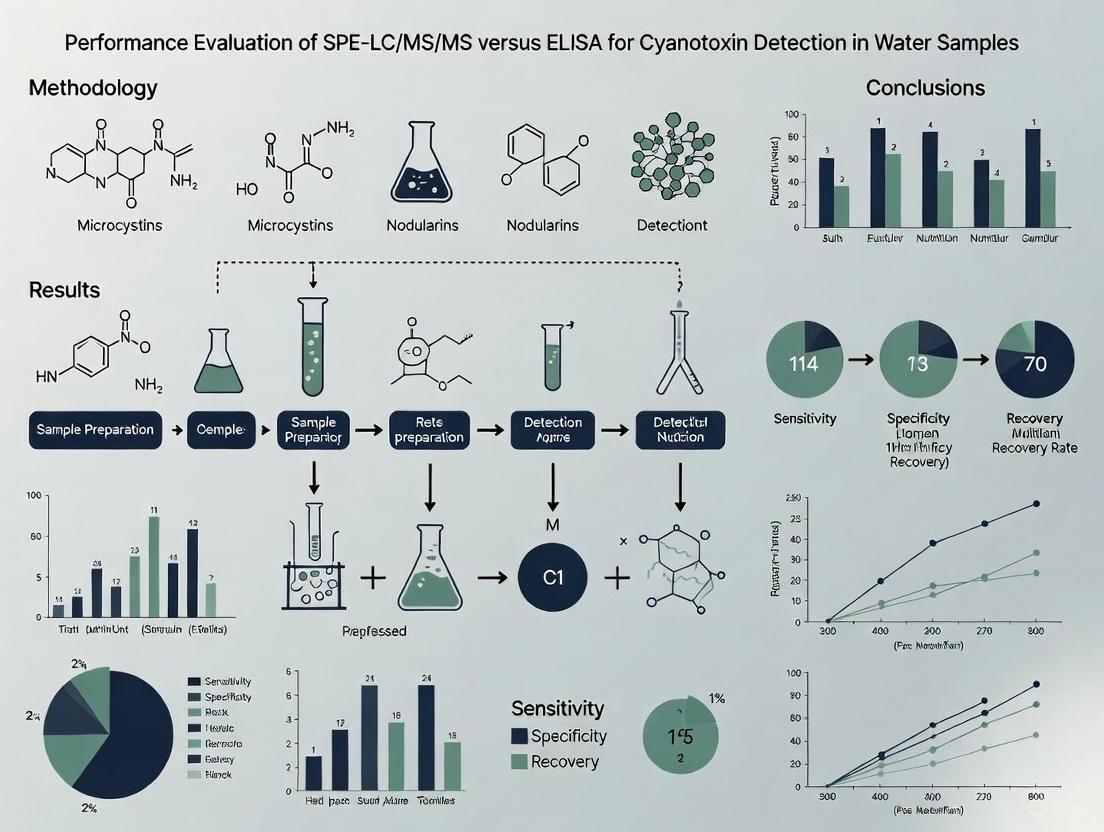
This article provides a critical evaluation of Solid-Phase Extraction coupled with Liquid Chromatography-Tandem Mass Spectrometry (SPE-LC/MS/MS) and Enzyme-Linked Immunosorbent Assay (ELISA) for the detection and quantification of cyanotoxins.
SPE-LC/MS/MS vs. ELISA for Cyanotoxin Analysis: A Comprehensive Performance Evaluation for Biomedical Research
Abstract
This article provides a critical evaluation of Solid-Phase Extraction coupled with Liquid Chromatography-Tandem Mass Spectrometry (SPE-LC/MS/MS) and Enzyme-Linked Immunosorbent Assay (ELISA) for the detection and quantification of cyanotoxins. Tailored for researchers, scientists, and drug development professionals, the content explores the foundational principles of both techniques, their methodological workflows, and key application scenarios. It delves into troubleshooting common issues, optimizing procedures for high-quality data, and presents a rigorous comparative analysis of validation parameters, including sensitivity, specificity, and throughput. By synthesizing findings from recent interlaboratory studies and methodological comparisons, this review serves as a definitive guide for selecting the appropriate analytical platform based on specific research objectives, from high-throughput screening to congener-specific confirmation.
Cyanotoxin Threats and Analytical Foundations: Understanding the Core Principles of SPE-LC/MS/MS and ELISA
The Critical Need for Cyanotoxin Monitoring in Water and Biomedical Research
Cyanotoxins are toxic secondary metabolites produced by cyanobacteria during harmful algal blooms (CyanoHABs). These toxins pose significant risks to public health and aquatic ecosystems, with increasing prevalence linked to eutrophication and climate change [1] [2]. Traditionally studied for their harmful effects, cyanotoxins are now recognized for their dual nature—while they cause serious health issues through contamination of water supplies, they also hold promising biotechnological potential as anticancer agents, antimicrobials, and neurochemical tools [1] [3].
The complex nature of cyanotoxins presents substantial analytical challenges. With nearly 300 known cyanotoxins and over 2,000 cyanobacterial secondary metabolites identified, effective monitoring requires sophisticated methodologies capable of detecting diverse chemical structures at low concentrations [1]. This article provides a comprehensive performance evaluation of two predominant analytical platforms: Solid-Phase Extraction coupled with Liquid Chromatography-Tandem Mass Spectrometry (SPE-LC/MS/MS) and Enzyme-Linked Immunosorbent Assay (ELISA).
Analytical Face-Off: SPE-LC/MS/MS Versus ELISA
Fundamental Principles and Mechanisms
SPE-LC/MS/MS combines physical separation with highly specific mass-based detection. The process involves: (1) sample preparation and concentration using solid-phase extraction; (2) liquid chromatographic separation of analytes; (3) electrospray ionization to create charged particles; and (4) tandem mass spectrometry detection using multiple reaction monitoring for identification and quantification [4] [5] [6]. This technique directly measures analyte mass-to-charge ratios and fragmentation patterns, providing structural information.
ELISA operates on biochemical recognition principles. The assay uses antibodies specific to target cyanotoxins or common structural motifs (e.g., the ADDA moiety in microcystins). Detection occurs through enzyme-mediated color change reactions, with intensity proportional to analyte concentration [7] [5]. This method relies on molecular recognition rather than physical separation or mass analysis.
Performance Comparison: Quantitative Data Analysis
Table 1: Comprehensive Method Comparison for Cyanotoxin Analysis
| Performance Parameter | SPE-LC/MS/MS | ELISA |
|---|---|---|
| Analytical Principle | Separation + mass fragmentation | Antibody-antigen interaction |
| Multiplexing Capacity | High (18+ cyanotoxins simultaneously) [4] | Low (typically class-specific) |
| Analysis Time | 8 minutes for 18 cyanotoxins [4] | 2-4 hours per assay [5] |
| Specificity | High (distinguishes congeners and isoforms) [5] | Moderate (cross-reactivity issues) [7] [5] |
| Sensitivity (Detection Limit) | 0.1 ng/mL for cotinine [8] | 0.15 ng/mL for cotinine [8] |
| Dynamic Range | Wide linear range for most cyanotoxins [4] [2] | Limited by standard curve [5] |
| Congener Differentiation | Excellent (identifies specific variants) [7] | Poor (detects classes, not individual congeners) [7] |
| Sample Throughput | Moderate (requires skilled operation) [5] | High (amenable to automation) [7] |
| Method Complexity | High (requires specialized expertise) [5] | Low (minimal training required) [7] [5] |
| Equipment Cost | High (significant capital investment) [5] | Low (minimal equipment needs) [7] [5] |
| Matrix Effects | Manageable with internal standards [2] | Significant (cross-reactivity concerns) [5] [2] |
Table 2: Experimental Recovery Data for Cyanotoxins in Complex Matrices
| Cyanotoxin Class | Representative Analytes | SPE-LC/MS/MS Recovery (%) | ELISA Recovery (%) | Matrix Interference Impact |
|---|---|---|---|---|
| Microcystins | MC-LR, MC-RR, MC-YR | 70-120% [2] | Variable due to cross-reactivity [7] | Moderate for both methods |
| Anatoxins | Anatoxin-a, Homoanatoxin-a | <70% but stable [2] | Not well characterized | High for ELISA due to phenylalanine [6] |
| Cylindrospermopsin | CYL, deoxy-CYL | Quadratic regression needed [2] | Limited data | Low for SPE-LC/MS/MS, unknown for ELISA |
| Nodularin | NOD | <70% but stable [2] | Cross-reacts with microcystin antibodies [7] | Moderate for both methods |
| Saxitoxins | GTX-1&4, GTX-2&3, GTX-5 | Precisely quantified [4] | Detected but not differentiated [7] | High for ELISA, low for SPE-LC/MS/MS |
Experimental Protocols for Cyanotoxin Analysis
SPE-LC/MS/MS Methodology for Multi-Class Cyanotoxin Detection
Sample Preparation Protocol:
- Extraction: Lyophilized cyanobacterial biomass or water samples are extracted using water-based extraction methods, eliminating traditional solid-phase extraction cartridges for biomass samples [4]. Water samples typically require solid-phase concentration.
- Cleanup: Centrifuge at 14,000 × g for 10 minutes to remove particulate matter. Transfer supernatant to LC vials.
- Internal Standards: Add stable isotope-labeled internal standards when available. For cyanotoxins without commercial labeled standards, structural analogs like nodularin may be employed [6].
Instrumental Analysis Conditions:
- Chromatography: Utilize reversed-phase C18 column (sub-2μm particles for UPLC) with gradient elution using water-acetonitrile or water-methanol mixtures, both containing 0.1% formic acid [4] [6].
- Mass Spectrometry: Employ electrospray ionization in positive and/or negative mode with multiple reaction monitoring (MRM). Specific transitions for 18 cyanotoxins can be completed in 8 minutes [4].
- Quantification: Use external calibration curves with internal standard correction for matrix effects. Linear range typically 3.12-200 μg/kg for most cyanotoxins in tissue matrices [2].
ELISA Protocol for Cyanotoxin Screening
Assay Procedure:
- Plate Preparation: Coat microplate with cyanotoxin-specific antibodies (e.g., ADDA-antibody for microcystins) and block with protein-based buffer [7].
- Sample Incubation: Add samples and standards to wells followed by enzyme-conjugated cyanotoxin tracer. Incubate 1-2 hours at room temperature with gentle shaking.
- Washing: Remove unbound materials by washing 3-5 times with phosphate-buffered saline with Tween-20.
- Detection: Add enzyme substrate solution and incubate 20-30 minutes for color development. Stop reaction with acid solution.
- Measurement: Read absorbance at appropriate wavelength (e.g., 450 nm) using plate reader [7] [5].
Quality Control Measures:
- Run standards in duplicate with each plate
- Include positive and negative controls
- Ensure calibration curve R² value >0.98
- Note that samples may require dilution to fit within quantitative range [7]
The Researcher's Toolkit: Essential Reagents and Materials
Table 3: Essential Research Reagents for Cyanotoxin Analysis
| Reagent/Material | Function | Application Notes |
|---|---|---|
| Cyanotoxin Standards | Quantification reference | Limited availability for many congeners; certified reference materials essential [7] |
| Stable Isotope-Labeled Internal Standards | Matrix effect correction | Not commercially available for all cyanotoxins; analogs may be used [6] |
| Solid-Phase Extraction Cartridges | Sample concentration/cleanup | C18 for most cyanotoxins; mixed-mode for complex matrices [4] |
| LC-MS Grade Solvents | Mobile phase preparation | Low UV cutoff acetonitrile/methanol with 0.1% formic acid [6] |
| Specific Antibodies | Molecular recognition | ADDA-antibody detects >100 microcystin variants [7] |
| Enzyme Conjugates | Signal generation | Horseradish peroxidase or alkaline phosphatase common [5] |
| Chromogenic Substrates | Visual detection | TMB (tetramethylbenzidine) common for HRP [5] |
Technological Advances and Future Directions
Recent innovations in SPE-LC/MS/MS have significantly expanded monitoring capabilities. A 2023 method demonstrated simultaneous detection of 18 cyanotoxins—including anatoxin-a, homoanatoxin-a, cylindrospermopsin, deoxy-cylindrospermopsin, nodularin, guanitoxin, seven microcystin variants, and five saxitoxins—in a remarkable 8-minute acquisition window [4]. This method notably introduced simplified water-based extraction for cyanobacterial biomass, eliminating traditional solid-phase extraction requirements and representing a significant efficiency improvement.
The evolving applications of cyanotoxin research extend beyond environmental monitoring to promising biomedical applications. Cyanotoxins show significant potential as anticancer agents (apratoxin, cryptophycin), antimicrobials, local anesthetics (saxitoxin), neuroplasticity promoters, and antifouling agents [1] [3]. These diverse applications create additional demands for precise, congener-specific analytical methods, as slight structural variations can dramatically alter biological activity and toxicity profiles.
The choice between SPE-LC/MS/MS and ELISA methodologies depends on specific research objectives, resource constraints, and data requirements. SPE-LC/MS/MS provides unparalleled specificity, sensitivity, and multi-toxin capability, making it ideal for comprehensive exposure assessment, congener-specific toxicity studies, and biomedical applications where precise quantification is critical. The technology's ability to distinguish between molecular isoforms and modifications far exceeds ELISA capabilities [5], and it reveals associations in epidemiological studies that may be missed by immunoassays [8].
ELISA remains valuable for high-throughput screening, rapid risk assessment, and resource-limited settings where equipment costs and technical expertise may be constrained [7] [5]. Its utility is greatest when monitoring for a single toxin class in large sample sets or when quick field-based decisions are needed regarding water safety.
For comprehensive cyanotoxin research programs, a tiered approach utilizing both methods provides optimal efficiency—employing ELISA for initial screening followed by confirmatory SPE-LC/MS/MS analysis for positive samples. This integrated strategy balances throughput with specificity, ensuring both comprehensive monitoring and precise quantification to address the complex challenges posed by cyanotoxins in water and biomedical research.
The accurate detection and quantification of cyanotoxins, particularly the diverse family of microcystins (MCs), is a critical challenge in environmental and public health research. With over 200 structurally similar variants identified, these hepatotoxic compounds pose significant risks when they contaminate water supplies [9]. Two principal analytical methodologies have emerged to address this challenge: Solid Phase Extraction coupled with Liquid Chromatography-Tandem Mass Spectrometry (SPE-LC/MS/MS) and Enzyme-Linked Immunosorbent Assay (ELISA). The core principle of SPE-LC/MS/MS lies in its ability to provide congener-specific separation and detection, offering a level of precision that is paramount for comprehensive risk assessment. This guide provides an objective performance evaluation of these techniques, framing the comparison within the broader context of method selection for cyanotoxin research and monitoring.
Core Principles and Methodologies
The SPE-LC/MS/MS Workflow: A Mechanism for Specificity
SPE-LC/MS/MS operates through a multi-stage process designed to isolate, separate, and identify individual toxin congeners with high specificity.
- Solid Phase Extraction (SPE): The analytical workflow begins with SPE, a sample preparation step that concentrates the target analytes and purifies them from a complex sample matrix like water or biological tissue. This process enhances the overall sensitivity of the method and reduces potential interference during analysis [10] [11].
- Liquid Chromatography (LC): The purified extract is then introduced into a liquid chromatography system. Here, the various cyanotoxin congeners are physically separated based on their unique chemical affinities between a stationary phase (the LC column) and a mobile phase (the solvent gradient). This congener-specific separation is fundamental, as it allows isomers and structurally similar toxins to be resolved into distinct peaks before they enter the mass spectrometer [12] [13].
- Tandem Mass Spectrometry (MS/MS): Finally, the separated compounds eluting from the LC column are analyzed by the mass spectrometer. The first mass analyzer selects the precursor ion of a specific toxin. This ion is then fragmented, and a second mass analyzer filters a characteristic product ion. This "multiple reaction monitoring" (MRM) mode provides a highly specific fingerprint for each compound, enabling confident identification and accurate quantification at trace levels (e.g., low ng/L) [10] [4].
The ELISA Principle: A Immunoassay-Based Screen
In contrast, ELISA is an immunoassay that relies on the binding interaction between an antibody and its target antigen. For total microcystin analysis, a broad-spectrum antibody directed against the common Adda moiety of microcystins and nodularins is typically employed [9] [14]. The assay quantifies the toxins based on the degree of colorimetric signal inhibition caused by the toxins in a sample competing with a toxin-enzyme conjugate for a limited number of antibody binding sites. While this makes ELISA an excellent high-throughput screening tool for measuring the "total MC" load, it provides no information on the individual toxin variants present [5] [15].
Comparative Performance Data
The fundamental differences in the operating principles of SPE-LC/MS/MS and ELISA lead to distinct performance characteristics, as summarized by data from controlled studies and interlaboratory comparisons.
Table 1: Comparative Performance Metrics for Cyanotoxin Analysis
| Performance Characteristic | SPE-LC/MS/MS | ELISA |
|---|---|---|
| Principle of Detection | Physical separation and mass-based fragmentation [10] [4] | Antibody-antigen binding and signal inhibition [9] [14] |
| Congener Specificity | High; identifies and quantifies individual variants [10] | Low; reports total microcystins as MC-LR equivalents [9] |
| Sensitivity (Detection Limit) | Low ng/L range [10] | ~0.15 µg/L for MC-LR [14] |
| Analytical Throughput | Moderate (method runtime ~8.5 min) [10] | High; suitable for batch analysis [15] |
| Impact of Cross-reactivity | Negligible; specific MRM transitions used [5] | Significant; can react with degradation products, overestimating toxin concentration [10] |
| Quantitative Agreement | Considered the reference method for confirmation [9] | Results 26% closer to theoretical values after cross-reactivity correction [16] |
Table 2: Experimental Data from Comparative Monitoring Studies
| Study Context | Key Finding Related to SPE-LC/MS/MS | Key Finding Related to ELISA | Source |
|---|---|---|---|
| Michigan Lakes Survey (122 samples) | Detected MCs in 33 samples; 13 samples had >20% of total MC from congeners not in EPA Method 544. | Seasonal data deviations suggested cross-reactivity with MC degradation products. | [10] |
| Interlaboratory Comparison | Served as the reference method for congener-specific quantification. | When microcystin cross-reactivities were considered, results matched 26% closer to LC-MS/MS/theoretical values. | [16] |
| Surface Water Analysis (Pretreatment) | N/A | Concentrations measured using U.S. pretreatment (cell lysis) were 1-5 times higher than Chinese approach (extracellular only). | [14] |
| Method Sensitivity | A rapid LC-MS/MS method detected 18 cyanotoxins in 8 minutes, including guanitoxin. | A streptavidin-enhanced ELISA achieved a Minimum Reporting Level (MRL) of 0.1 µg/L, providing early warning capability. | [4] [9] |
Detailed Experimental Protocols
To illustrate how the comparative data is generated, below are outlines of representative experimental protocols from the literature.
Protocol for SPE-LC/MS/MS Analysis of Microcystins
A high-throughput online SPE-LC/MS/MS workflow was developed for the quantitation of 12 microcystins and nodularin in water samples [10].
- Sample Collection and Preservation: Water samples are collected from relevant water bodies and typically frozen to lyse cyanobacterial cells and release intracellular toxins.
- Online Solid Phase Extraction: Particulates are removed, and the sample is directly loaded onto an online SPE loading column for concentration and purification.
- Liquid Chromatography: The concentrated analytes are eluted from the SPE column and separated on an analytical LC column. The total method runtime was reported as 8.5 minutes.
- Tandem Mass Spectrometry Detection: Analysis is performed using multiple reaction monitoring (MRM). The method achieved detection limits in the low ng/L range, with minimum reporting levels between 5 and 10 ng/L.
Protocol for ELISA-Based Detection of Total Microcystins
Researchers have validated ELISA performance for the determination of total microcystins and nodularins in drinking and ambient water [9] [14].
- Sample Pretreatment: A critical step that significantly influences results. The U.S. EPA Method 546 recommends three freeze-thaw cycles of water samples to lyse cells and measure both intracellular and extracellular toxins [14].
- Analysis: The pretreated sample is added to a well plate coated with antibodies specific to the Adda moiety of microcystins. A toxin-enzyme conjugate is added, and the mixture incubates, allowing the toxins in the sample and the conjugate to compete for antibody binding sites.
- Signal Development and Quantification: After a wash step, a substrate is added to produce a colorimetric signal. The signal intensity is inversely proportional to the toxin concentration in the sample. Concentration is interpolated from a standard curve, with results reported as total microcystin-LR equivalents.
Visualizing the Workflows
The following diagrams illustrate the core procedural and logical differences between the two analytical techniques.
SPE-LC/MS/MS Analytical Workflow
Diagram 1: SPE-LC/MS/MS Workflow. This process emphasizes physical separation and specific mass-based detection for individual congener analysis.
ELISA Analytical Principle
Diagram 2: ELISA Competitive Principle. This immunoassay relies on antibody binding and signal competition to report a total toxin value.
The Scientist's Toolkit: Essential Research Reagents and Materials
Successful implementation of either analytical strategy requires specific, high-quality reagents and materials.
Table 3: Key Research Reagent Solutions for Cyanotoxin Analysis
| Item | Function in SPE-LC/MS/MS | Function in ELISA |
|---|---|---|
| Certified Analytical Standards | Essential for calibration, method development, and confirming congener identity and retention time. | Used to generate the standard curve for quantifying total microcystins as MC-LR equivalents. |
| Stable Isotope-Labeled Internal Standards | Added to samples to correct for matrix effects and losses during sample preparation; critical for accuracy [11]. | Not typically used. |
| SPE Cartridges/Columns | Used for offline or online concentration and purification of samples to remove matrix interference [11]. | Not used in standard protocols. |
| LC Columns (e.g., C18, Polar-Embedded) | Achieves the critical separation of individual cyanotoxin congeners before mass analysis [12] [13]. | Not used in standard protocols. |
| Broad-Spectrum Antibody | Not used in the analytical principle. | The core critical reagent; binds the common Adda moiety, determining the assay's cross-reactivity profile and specificity [9] [15]. |
| Toxin-Enzyme Conjugate | Not used in the analytical principle. | The reporting reagent that generates the detectable signal in competition with free toxins in the sample [15]. |
The choice between SPE-LC/MS/MS and ELISA is not a matter of identifying a superior technique, but rather of selecting the right tool for the specific research or monitoring objective. SPE-LC/MS/MS is unequivocally the gold standard for congener-specific separation and detection. Its core principle of chromatographic separation followed by mass-based detection provides unrivalled specificity, sensitivity, and the ability to characterize complex toxin profiles, which is indispensable for advanced toxicological studies and regulatory confirmation.
Conversely, ELISA serves as a powerful, high-throughput screening tool for estimating total microcystin load. Its value is greatest in applications where speed, cost-effectiveness, and the ability to process large sample volumes are prioritized, such as initial bloom assessments and routine monitoring programs. Researchers and professionals must weigh these performance characteristics—specificity versus throughput, and detailed profiling versus summary data—against their project goals to make an informed methodological selection.
The core principle of the Enzyme-Linked Immunosorbent Assay (ELISA) hinges on specific immunological recognition between an antibody and its target antigen, providing a foundational technology for toxin screening. This biochemical technique utilizes enzyme-labeled antibodies that specifically bind to target antigens, with subsequent addition of a chromogenic substrate that produces a measurable color change, fluorescence, or luminescence to indicate the presence of the antigen [17]. The exceptional specificity of this antibody-antigen interaction forms the basis for ELISA's reliability in detecting toxic substances, including cyanotoxins, in complex environmental and biological samples.
Among the various ELISA formats, the sandwich ELISA represents one of the most specific configurations for antigen detection. This method employs two antibodies: a capture antibody immobilized to a solid surface (typically a microplate well) that binds the target antigen, and a second enzyme-conjugated detection antibody that binds to a different epitope on the captured antigen [18]. This dual-antibody approach significantly enhances specificity by requiring two distinct binding events for detection, effectively minimizing false-positive results from non-specific binding in complex sample matrices. The workflow involves multiple critical steps including plate coating, sample incubation, washing to remove unbound material, addition of detection antibodies, and final substrate addition with signal measurement [18].
For cyanotoxin detection, particularly microcystins (MCs) and nodularins (NODs), ELISA kits often utilize antibodies targeting the conserved Adda amino acid moiety common to these toxins [17]. This strategic targeting allows for broad-spectrum detection of multiple toxin variants simultaneously, making ELISA particularly valuable for total toxin screening where the complete toxicological profile may be unknown. The Adda side chain, a unique C20 β-amino acid found in most microcystins and nodularins, provides an ideal antigenic target for developing antibodies with cross-reactivity across numerous toxin congeners [14]. This cross-reactivity is a defining feature that positions ELISA as a powerful tool for comprehensive risk assessment of cyanotoxin contamination.
Comparative Analysis: ELISA versus SPE-LC/MS/MS for Cyanotoxin Research
| Parameter | ELISA | SPE-LC/MS/MS |
|---|---|---|
| Analytical Principle | Immunological recognition based on antibody-antigen binding [17] | Chromatographic separation with mass-based detection [4] |
| Detection Capability | Total toxin content (as equivalents) [14] | Congener-specific identification and quantification [7] |
| Throughput | High-throughput, suitable for batch processing [14] | Lower throughput, sequential analysis [10] |
| Limit of Detection (LOD) for MC-LR | 0.15 μg/L [14] | Low ng/L range [10] |
| Quantification Range for MC-LR | 0.27 - 1.87 μg/L [14] | Wide dynamic range with instrumentation-dependent upper limits |
| Sample Preparation | Relatively simple, may require dilution or freeze-thaw for intracellular toxins [14] | Complex, requires solid-phase extraction (SPE) and concentration [10] |
| Analysis Time | Approximately 90 minutes to several hours [18] | 8-8.5 minutes runtime plus extensive sample prep [10] [4] |
| Cost per Sample | Low to moderate | High (equipment, maintenance, expertise) |
| Equipment Requirements | Microplate reader, washer [18] | LC-MS/MS system, SPE equipment |
| Multiplexing Capability | Single toxin class per assay | Multi-class cyanotoxin detection in one run (up to 18 toxins) [4] |
| Data Output | Total toxic equivalents | Specific congener concentrations |
| Matrix Effects | Can be significant, requires mitigation strategies [14] | Reduced through chromatographic separation |
| Applicability to Early Warning | Excellent for rapid screening [17] | Better for confirmatory analysis |
The comparative analysis between ELISA and Solid-Phase Extraction Liquid Chromatography with Tandem Mass Spectrometry (SPE-LC/MS/MS) reveals complementary strengths that position each technology for specific roles in cyanotoxin research. ELISA excels in scenarios requiring rapid screening of multiple samples where total toxin load assessment is sufficient for decision-making. Its capacity to detect multiple congeners within a toxin class simultaneously makes it particularly valuable for initial risk assessment [19]. The technology provides a practical solution for monitoring programs with limited resources, as it requires less specialized equipment and technical expertise compared to mass spectrometry-based approaches.
Conversely, SPE-LC/MS/MS offers unparalleled specificity in identifying and quantifying individual toxin congeners, providing exact compositional data essential for detailed exposure assessments and toxicological studies [7]. Modern LC-MS/MS methods can simultaneously detect up to 18 cyanotoxins within an 8-minute acquisition window, encompassing multiple microcystin variants, nodularin, anatoxins, cylindrospermopsin, and saxitoxins [4]. This comprehensive profiling capability comes with superior sensitivity, with detection limits in the low ng/L range for many cyanotoxins [10], significantly below health advisory levels established by regulatory agencies.
The choice between these methodologies fundamentally depends on the research question. For compliance monitoring against established guidelines where total microcystin concentrations are the regulatory metric, ELISA provides adequate data with greater efficiency [14]. For mechanistic studies, source tracking, or investigations requiring precise congener identification, SPE-LC/MS/MS remains the gold standard despite higher operational costs and complexity [2].
Experimental Protocols for Cyanotoxin Detection
ELISA-Based Detection Protocol
The standardized protocol for detecting total microcystins and nodularins in water samples using ELISA involves several critical steps to ensure analytical reliability. According to the U.S. EPA Method 546, proper sample pretreatment is essential for accurate quantification of both intracellular and extracellular toxin fractions [14]. The recommended procedure begins with sample homogenization followed by three freeze-thaw cycles to lyse cyanobacterial cells and release intracellular toxins into solution. This step is crucial as it captures the total toxic potential of a water sample, whereas methods that only analyze filtered water significantly underestimate toxin concentrations by ignoring the cell-bound fraction [14].
For the immunoassay procedure, a typical sandwich ELISA protocol employs the following steps [18]:
- Plate Preparation: Coat microplate wells with capture antibody specific to the Adda moiety of microcystins/nodularins and incubate overnight at 4°C
- Blocking: Add blocking buffer (typically containing protein like BSA) to cover unbound sites on the plastic surface
- Sample Incubation: Add prepared samples and standards to wells, incubate to allow antigen-antibody binding
- Washing: Remove unbound materials using wash buffer (typically PBS with Tween-20)
- Detection Antibody Addition: Add enzyme-conjugated detection antibody and incubate
- Secondary Washing: Remove unbound detection antibodies
- Signal Development: Add enzyme substrate solution and incubate for color development
- Signal Measurement: Measure absorbance at appropriate wavelength using a microplate reader
- Data Analysis: Calculate toxin concentrations from standard curve using four-parameter logistic regression
Matrix effects represent a significant challenge in environmental sample analysis and can be mitigated through either sample dilution or the use of specialized anti-interference buffers. Studies have demonstrated optimal dilution factors of 2:1 for tap water and 4:1 for lake and river water when using an anti-interference buffer containing 10× phosphate buffer solution (PBS), 1% bovine serum albumin (BSA), and 0.5% ethylenediaminetetraacetic acid (EDTA) [14]. The performance characteristics of a properly validated ELISA show a detection limit of 0.15 μg/L for MC-LR with a quantitative range of 0.27-1.87 μg/L, sufficient to meet health advisory limits for drinking water [14].
SPE-LC/MS/MS-Based Detection Protocol
The comprehensive protocol for multi-class cyanotoxin detection using SPE-LC/MS/MS involves more extensive sample preparation but provides congener-specific data. A representative method for detecting 18 cyanotoxins in water samples includes the following stages [4]:
- Sample Preparation: Filter water samples to remove particulate matter
- Solid-Phase Extraction: Pass samples through preconditioned SPE cartridges (typically C18 or polymeric sorbents) to concentrate analytes
- Extract Elution: Elute captured toxins with methanol or acidified methanol
- Extract Concentration: Evaporate eluent under gentle nitrogen stream and reconstitute in initial mobile phase
- LC-MS/MS Analysis: Inject samples into LC system coupled to tandem mass spectrometer
Chromatographic separation typically employs reversed-phase C18 columns with gradient elution using water and acetonitrile, both modified with 0.1% formic acid to enhance ionization [4]. The mass spectrometric detection utilizes Multiple Reaction Monitoring (MRM) for selective identification and quantification of target cyanotoxins based on characteristic precursor ion → product ion transitions. This method provides excellent sensitivity with detection limits in the low ng/L range for most cyanotoxins, significantly below established health advisory levels [10].
For complex matrices like bivalve tissues, additional extraction and clean-up steps are necessary. One validated protocol for mussel and oyster tissues includes lyophilization followed by water-based extraction, eliminating the need for traditional solid-phase extraction methods while maintaining effective toxin recovery for 17 cyanotoxins comprising 13 microcystins, nodularin, anatoxin-a, homoanatoxin, and cylindrospermopsin [2]. The method performance for this approach demonstrated linearity over a calibration range of 3.12-200 μg/kg for most analytes, though some lipophilic microcystins (MC-LA, MC-LF, MC-LW) showed slightly lower recovery rates (<70%) [2].
Workflow Visualization
Essential Research Reagent Solutions
| Reagent/Material | Function | Application Notes |
|---|---|---|
| Capture Antibody | Binds to target antigen; immobilized on solid phase | Often monoclonal for specificity; targets conserved epitopes like Adda moiety for cyanotoxins [14] |
| Detection Antibody | Binds to captured antigen; conjugated to enzyme for signal generation | Polyclonal often used; enzyme conjugates include HRP or AP [18] |
| Microplates | Solid surface for assay reaction | 96-well plates most common; high protein-binding plates preferred [18] |
| Blocking Buffer | Prevents non-specific binding | Typically contains BSA (1%) or other proteins in PBS [14] |
| Wash Buffer | Removes unbound reagents | Typically PBS with Tween-20 (0.05%) [14] |
| Enzyme Substrate | Generates detectable signal | TMB for colorimetric, others for fluorescent/chemiluminescent detection [18] |
| Anti-Interference Buffer | Mitigates matrix effects | Contains 10× PBS, 1% BSA, 0.5% EDTA for complex samples [14] |
| C18 SPE Cartridges | Concentrates analytes from water | Used in sample prep for LC-MS/MS; various sizes depending on sample volume [10] |
| LC-MS/MS Mobile Phases | Chromatographic separation | Water and acetonitrile with 0.1% formic acid common for cyanotoxins [4] |
The selection of appropriate research reagent solutions is critical for obtaining reliable data in both ELISA and SPE-LC/MS/MS methodologies. For ELISA-based detection, the antibody specificity fundamentally determines assay performance, with antibodies targeting the conserved Adda moiety providing the broad cross-reactivity necessary for total toxin screening of microcystins and nodularins [14]. The inclusion of specialized anti-interference buffers containing PBS, BSA, and EDTA has demonstrated significant improvement in assay robustness when analyzing complex environmental matrices like surface waters [14].
For SPE-LC/MS/MS applications, the solid-phase extraction materials represent a crucial component for effective analyte concentration and clean-up. Modern approaches have simplified traditional protocols through implementation of lyophilization with water-based extraction, eliminating the need for solid-phase extraction while maintaining effective recovery of multiple cyanotoxin classes [2]. The chromatographic separation of cyanotoxins with varying physicochemical properties requires optimization of mobile phase composition and gradient profiles to achieve resolution of both hydrophilic (e.g., cylindrospermopsin) and lipophilic (e.g., microcystin-LA, -LF, -LW) variants within a single analytical run [4] [2].
Regulatory Landscape and Health Advisory Levels for Common Cyanotoxins
Cyanotoxins are potent natural toxins produced by cyanobacteria during harmful algal blooms (HABs), posing significant risks to public health and aquatic ecosystems. The accelerated eutrophication of surface waters coupled with climate change has increased the frequency and intensity of these blooms globally [14]. Among the various cyanotoxins, microcystins (MCs) and nodularins (NODs) represent the most widely concerning groups due to their structural diversity and potent hepatotoxicity, with over 240 MC variants and 10 NOD variants identified to date [14]. Other concerning cyanotoxins include the neurotoxic anatoxins (ATX-a and h-ATX) and the cytotoxic cylindrospermopsin (CYN), each exhibiting distinct mechanisms of toxicity and associated health risks [2].
In response to these threats, regulatory agencies worldwide have established guidelines and health advisories to manage cyanotoxin risks. The U.S. Environmental Protection Agency (EPA) has developed Health Advisories for cyanotoxins in drinking water, which, while not legally enforceable federal standards, provide technical guidance to protect public health [20] [21]. The table below summarizes the current EPA Health Advisories for a 10-day exposure:
Table 1: EPA Drinking Water Health Advisories for Cyanotoxins (10-day)
| Cyanotoxin | Bottle-fed Infants & Pre-school Children (µg/L) | School-age Children & Adults (µg/L) |
|---|---|---|
| Microcystins | 0.3 | 1.6 |
| Cylindrospermopsin | 0.7 | 3.0 |
Beyond federal guidelines, individual U.S. states have implemented their own thresholds for cyanotoxins in drinking and recreational waters. These thresholds vary significantly by state, with some adopting EPA values directly and others establishing more stringent or alternative criteria [22]. For instance, Minnesota has set a very conservative threshold of 0.1 µg/L for both anatoxin-a and microcystins in drinking water, while California uses a tiered approach for recreational waters with "Warning" values of 6 µg/L for microcystins and 4 µg/L for cylindrospermopsin [22]. This patchwork of regulations underscores the need for reliable analytical methods to ensure compliance and protect public health across different jurisdictions.
Analytical Methodologies: SPE-LC/MS/MS versus ELISA
Principle and Workflow Comparison
The accurate quantification of cyanotoxins relies primarily on two analytical approaches: Solid Phase Extraction Liquid Chromatography-Tandem Mass Spectrometry (SPE-LC/MS/MS) and Enzyme-Linked Immunosorbent Assay (ELISA). These methods differ fundamentally in their underlying principles, workflows, and the type of information they provide.
SPE-LC/MS/MS is a chromatographic technique that separates individual cyanotoxin congeners based on their chemical properties before detection and quantification using mass spectrometry. The process typically involves several steps: sample preparation (often including filtration and concentration), solid-phase extraction to clean up and concentrate analytes, liquid chromatographic separation, and finally mass spectrometric detection using multiple reaction monitoring (MRM) [10] [2]. This method provides congener-specific identification and can simultaneously quantify multiple cyanotoxin classes, including microcystins, nodularins, anatoxins, and cylindrospermopsin in a single analysis [4] [2].
In contrast, ELISA is an immunoassay-based method that utilizes antibodies designed to recognize specific structural features of cyanotoxins. The most common format for cyanotoxin detection is the Adda-ELISA, which targets the conserved Adda moiety present in microcystins and nodularins [10] [7]. This method does not separate individual congeners but rather provides a total toxin concentration expressed as microcystin-LR equivalents (MC-LR eq.), based on the cross-reactivity of the antibodies with different variants [7]. The workflow typically involves minimal sample preparation (often just filtration and freeze-thaw cycles to release intracellular toxins), followed by incubation with specific antibodies in microplate wells and colorimetric detection [14].
Table 2: Fundamental Characteristics of SPE-LC/MS/MS and ELISA Methods
| Characteristic | SPE-LC/MS/MS | ELISA |
|---|---|---|
| Principle | Chromatographic separation with mass spectrometric detection | Antibody-antigen interaction with colorimetric detection |
| Target Specificity | Congener-specific | Class-specific (e.g., Adda-containing microcystins) |
| Sample Throughput | Moderate (8.5-8 min/sample) [10] [4] | High |
| Sample Preparation | Complex (often requires SPE) [10] | Simple (filtration, freeze-thaw) [14] |
| Detection Capability | Targeted and untargeted analysis possible | Targeted to antibody recognition |
| Primary Output | Concentration of individual congeners | Total MC-LR equivalents |
Key Research Reagents and Materials
Both SPE-LC/MS/MS and ELISA methods require specific reagents and materials to function effectively. The following table outlines essential research solutions for each methodology:
Table 3: Essential Research Reagent Solutions for Cyanotoxin Analysis
| Reagent/Material | Function | Application in |
|---|---|---|
| Cyanotoxin Reference Standards | Quantification and method calibration | SPE-LC/MS/MS |
| Deuterated Internal Standards | Correction for matrix effects and recovery losses | SPE-LC/MS/MS |
| Solid Phase Extraction Cartridges | Sample clean-up and analyte concentration | SPE-LC/MS/MS |
| LC-MS/MS Grade Solvents | Mobile phase preparation | SPE-LC/MS/MS |
| Broad-Spectrum ELISA Kits | Total microcystin/nodularin quantification | ELISA |
| Anti-Microcystin Antibodies | Recognition of Adda moiety in microcystins/nodularins | ELISA |
| Anti-Matrix Interference Buffer | Reduction of matrix effects in complex samples | ELISA |
| Coating Antigens | Immobilization of toxin analogs for competitive ELISA | ELISA |
Experimental Protocols and Workflows
SPE-LC/MS/MS Methodology
The SPE-LC/MS/MS method for cyanotoxin analysis involves a multi-step protocol designed to achieve precise congener-specific quantification. A high-throughput online concentration LC/MS/MS workflow developed for 12 microcystin congeners and nodularin exemplifies this approach [10]. The method features a short run time of 8.5 minutes with detection limits in the low ng/L range and minimum reporting levels between 5 and 10 ng/L [10]. This rapid analysis enables less than 24-hour turnaround for quantification, which is crucial for timely public health decision-making during bloom events.
The sample preparation protocol typically begins with the collection of water samples, which are filtered to remove particulate matter. For comprehensive toxin assessment, intracellular toxins must be released through cell lysis, often accomplished via three freeze-thaw cycles as specified in U.S. EPA Method 546 [14]. The samples then undergo solid-phase extraction using cartridges such as Oasis HLB or equivalent, which efficiently capture cyanotoxins with a wide range of polarities. After extraction and washing, the analytes are eluted with a solvent such as methanol and concentrated under a gentle stream of nitrogen [10].
For LC-MS/MS analysis, the extracts are reconstituted in appropriate mobile phase and injected into the system. Chromatographic separation is achieved using reversed-phase C18 columns with gradient elution employing water and acetonitrile, both containing 0.1% formic acid to enhance ionization [4] [2]. Mass spectrometric detection is performed using triple quadrupole instruments operated in multiple reaction monitoring (MRM) mode, monitoring specific precursor-to-product ion transitions for each cyanotoxin [4]. This targeted approach provides high sensitivity and excellent selectivity, allowing for the unambiguous identification and quantification of individual congeners.
SPE-LC/MS/MS Workflow
ELISA Methodology
The ELISA protocol for cyanotoxin analysis offers a more streamlined approach focused on rapid screening of total toxin concentrations. A typical broad-spectrum ELISA kit achieves a detection limit of 0.15 μg/L for MC-LR with a linear detection range from 0.27 μg/L to 1.87 μg/L [14]. This method is particularly valuable for initial screening and monitoring programs requiring high sample throughput.
The experimental protocol begins with sample collection and pretreatment. According to U.S. EPA Method 546, water samples undergo freeze-thaw cycles to lyse cyanobacterial cells and release intracellular toxins, a critical step that differentiates it from some international approaches [14]. For instance, the pretreatment approach recommended by China only measures extracellular toxins, potentially underestimating total toxin concentrations by 1-5 times compared to the U.S. approach [14].
Following pretreatment, samples are typically diluted to mitigate matrix effects, which can significantly interfere with assay performance. Alternatively, anti-interference buffers containing phosphate buffer solution (10×), bovine serum albumin (1%), and ethylene diamine tetraacetic acid (0.5%) can be used to dilute antibodies and reduce matrix effects [14]. The actual ELISA procedure involves adding samples and standards to microplate wells coated with capture molecules, followed by incubation with specific antibodies. After washing to remove unbound components, enzyme-conjugated secondary antibodies are added, followed by another incubation and washing step. Finally, a substrate solution is added, producing a colorimetric signal inversely proportional to the cyanotoxin concentration in the sample [14].
ELISA Workflow
Performance Evaluation and Comparative Experimental Data
Sensitivity, Specificity, and Cross-Reactivity
When evaluating the performance of SPE-LC/MS/MS and ELISA methods, significant differences emerge in their sensitivity, specificity, and susceptibility to cross-reactivity. SPE-LC/MS/MS demonstrates exceptional sensitivity with detection limits in the low ng/L range (0.003-0.01 μg/L), substantially lower than the 0.15 μg/L detection limit typically achieved by ELISA [10] [14]. This heightened sensitivity makes SPE-LC/MS/MS particularly valuable for detecting cyanotoxins at concentrations relevant to the stringent EPA health advisories for vulnerable populations.
The specificity of these methods represents a fundamental differentiator. SPE-LC/MS/MS provides congener-specific identification and quantification, allowing researchers to distinguish between toxicologically distinct variants. For instance, a Michigan prevalence study identified a congener frequency pattern of MC-LA > LR > RR > D-Asp3-LR > YR > HilR > WR > D-Asp3-RR > HtyR > LY = LW = LF, with MC-RR exhibiting the highest concentrations despite not being the most prevalent [10]. This level of structural specificity is crucial for accurate risk assessment, as cyanotoxin congeners display markedly different toxicities, with LD50 values in mouse studies ranging from 50 μg/Kg for MC-LR and LA to >100 μg/Kg for MC-WR, D-Asp3-LR, D-Asp3-RR, and RR [10].
In contrast, ELISA methods are susceptible to cross-reactivity with structural analogs and potential interference from degradation products. Studies have documented that Adda-ELISA can cross-react with microcystin degradation products, leading to discrepancies when compared with LC/MS/MS data [10]. This cross-reactivity can result in either overestimation or underestimation of total toxin concentrations depending on the specific congeners present and their recognition by the antibodies used in the assay.
Table 4: Performance Comparison of SPE-LC/MS/MS and ELISA Methods
| Performance Parameter | SPE-LC/MS/MS | ELISA |
|---|---|---|
| Detection Limit | Low ng/L range (0.003-0.01 μg/L) [10] | 0.15 μg/L for MC-LR [14] |
| Specificity | High (congener-specific) | Moderate (class-specific, cross-reactivity concerns) [10] |
| Recovery Efficiency | Variable (70-100%, congener-dependent) [2] | Generally high and consistent |
| Matrix Effect Resistance | High (compensated with internal standards) | Low (requires dilution or special buffers) [14] |
| Interference from Degradation Products | Minimal (specific detection) | Significant (cross-reactivity reported) [10] |
Method Agreement and Discrepancies in Environmental Monitoring
Comparative studies evaluating SPE-LC/MS/MS and ELISA performance in environmental monitoring reveal both correlations and significant discrepancies between the two methods. A comprehensive analysis of 122 samples from 31 Michigan waterbodies found that microcystins were detected in 33 samples, with 13 of these samples having more than 20% of their total microcystin concentration comprised of congeners not included in U.S. EPA Method 544 [10]. This finding highlights a critical limitation of targeted LC/MS/MS methods that focus on a limited number of congeners.
The agreement between methods also exhibits seasonal variations, with deviations between LC/MS/MS and Adda-ELISA data suggesting that Adda-ELISA cross-reacts with microcystin degradation products that may fluctuate seasonally [10]. Furthermore, sample pretreatment approaches significantly impact measured toxin concentrations. Research demonstrates that the U.S. pretreatment approach (including intracellular toxins via freeze-thaw cycles) detects cyanotoxin concentrations 1-5 times higher than the Chinese approach (measuring only extracellular toxins) [14]. This discrepancy underscores the importance of standardized pretreatment protocols for meaningful comparisons between studies and monitoring programs.
Beyond cyanotoxin analysis, comparative studies in other fields reinforce these methodological differences. In lipid biomarker analysis, LC/MS/MS has proven more sensitive and specific in differentiating PGE2 levels in central nervous system tissues compared to ELISA, with the added advantage of eliminating cross-reactivity between isomeric species that have the same molecular weight but different structural configurations [23]. Similarly, in amyloid beta peptide quantification, traditional ELISA methods face limitations including "high costs, labor intensity, lengthy processes, and the possibility of cross-reactivity" [24], challenges that similarly affect cyanotoxin analysis.
The comparative analysis of SPE-LC/MS/MS and ELISA methods for cyanotoxin detection reveals a clear complementarity between these approaches. SPE-LC/MS/MS offers unparalleled specificity and sensitivity for congener-specific identification and quantification, making it indispensable for comprehensive risk assessment and research applications. Its ability to simultaneously monitor multiple cyanotoxin classes in a single analysis provides a holistic view of contaminant profiles, though it requires sophisticated instrumentation and specialized expertise [4] [2].
Conversely, ELISA provides a rapid, cost-effective screening tool ideally suited for high-throughput monitoring programs and initial bloom assessments. Its simplicity and minimal sample preparation requirements enable timely public health decisions during bloom events, though its limitations in specificity and potential for cross-reactivity must be acknowledged [14] [7]. The seasonal deviations observed between LC/MS/MS and Adda-ELISA data suggest that Adda-ELISA may cross-react with microcystin degradation products, indicating that an untargeted approach is necessary in certain situations [10].
For researchers and regulatory agencies, the choice between these methods should be guided by specific monitoring objectives, available resources, and required data quality. A tiered monitoring approach that utilizes ELISA for initial screening followed by confirmatory SPE-LC/MS/MS analysis for positive samples represents an optimal strategy that balances efficiency with comprehensive risk assessment. As cyanobacterial blooms continue to increase in frequency and intensity globally, the refinement and appropriate application of these analytical tools will be essential for protecting public health and aquatic ecosystems.
Methodological Deep Dive: Workflows, Applications, and Throughput for SPE-LC/MS/MS and ELISA
Standardized SPE-LC/MS/MS Workflow for Targeted Congener Quantification
The increasing global prevalence of toxic freshwater cyanobacteria blooms has intensified the need for accurate, reliable monitoring of cyanotoxins, particularly microcystins (MCs), in water sources. With over 150 documented congeners exhibiting varying toxicities, the selection of analytical methodology significantly impacts public health risk assessment. This guide provides a performance evaluation comparing Solid-Phase Extraction coupled with Liquid Chromatography-Tandem Mass Spectrometry (SPE-LC/MS/MS) against Enzyme-Linked Immunosorbent Assay (ELISA) for cyanotoxin analysis, presenting experimental data to inform researchers, scientists, and drug development professionals in their methodological selections.
Methodological Principles: Fundamental Differences
SPE-LC/MS/MS: Separation and Fragmentation
SPE-LC/MS/MS combines chromatographic separation with highly specific mass-based detection. Online SPE concentrator columns enable analyte purification and pre-concentration, after which the analytical column separates compounds based on chemical properties [10] [25]. The triple quadrupole mass spectrometer then identifies target analytes through unique mass-to-charge ratios and fragmentation patterns, providing congener-specific quantification [4].
ELISA: Antibody-Based Recognition
ELISA operates on antibody-antigen interaction principles, utilizing antibodies directed against the Adda moiety common to many microcystins [10] [25]. This immunoassay provides a cumulative measure of "total MCs" expressed as MC-LR equivalents but cannot distinguish between individual congeners, with cross-reactivity to degradation products potentially affecting accuracy [10] [25] [16].
Comparative Performance Data: Quantitative Analysis
Direct Method Comparison
The table below summarizes key performance characteristics of SPE-LC/MS/MS and ELISA methods based on experimental data from cyanotoxin monitoring studies.
Table 1: Performance Comparison of SPE-LC/MS/MS and ELISA for Cyanotoxin Analysis
| Performance Characteristic | SPE-LC/MS/MS | ELISA |
|---|---|---|
| Principle of Detection | Separation and mass fragmentation [5] | Antibody-antigen interaction [5] |
| Congener Specificity | High (can distinguish individual variants) [10] [4] | Low (measures total MCs as MC-LR equivalents) [10] [25] |
| Sensitivity (Detection Limits) | Low ng/L range (e.g., 5-10 ng/L for MCs) [10] | Varies; generally higher than LC/MS/MS for total MCs [26] |
| Cross-Reactivity Concerns | Minimal; specific to targeted masses | Significant with MC degradation products and disinfection byproducts [10] [25] [16] |
| Sample Throughput Time | <24 hours for complete workflow [10] | Rapid; can be performed on-site [25] |
| Method Complexity | High; requires specialized expertise [5] | Low; minimal technical overhead [5] |
Experimental Congener Prevalence Data
A 2019 Michigan monitoring study utilizing online SPE-LC/MS/MS analyzed 122 samples from 31 waterbodies, revealing the following congener prevalence and concentration data.
Table 2: Microcystin Congener Prevalence in Michigan Waterbodies by SPE-LC/MS/MS [10]
| Microcystin Congener | Prevalence Frequency | Typical Concentration Range | Included in US EPA Method 544 |
|---|---|---|---|
| MC-LA | Most frequent | Not specified | No |
| MC-LR | Second most frequent | Not specified | Yes |
| MC-RR | Third most frequent | Highest concentrations observed | Yes |
| MC-YR | Fourth most frequent | Not specified | No |
| D-Asp³-LR | Fifth most frequent | Not specified | No |
| Other Congeners | Decreasing frequency | Generally lower | Variably included |
A critical finding was that 33% of samples with detectable MCs had more than 20% of their total MC concentration from congeners not present in US EPA Method 544 [10]. This highlights a significant limitation of targeted methods lacking comprehensive congener coverage and the advantage of expanded SPE-LC/MS/MS panels.
Experimental Protocols: Detailed Methodologies
SPE-LC/MS/MS Workflow for Cyanotoxins
Recent methodological advances have optimized SPE-LC/MS/MS protocols for cyanotoxin analysis. A 2023 multi-class cyanotoxin method demonstrates simultaneous quantification of 18 cyanotoxins, including multiple MC variants, anatoxin-a, cylindrospermopsin, and saxitoxins in a rapid 8-minute acquisition time [4]. The protocol employs a simplified water-based extraction of lyophilized cyanobacterial biomass, eliminating traditional solid-phase extraction cartridges while maintaining sensitivity [4]. The method incorporates online concentration techniques, loading large sample volumes (typically 1-2 mL) onto a trapping column for analyte focusing before back-flushing onto the analytical column for separation and detection [10]. This approach achieves detection limits in the low ng/L range with minimum reporting levels between 5-10 ng/L for most MC congeners [10].
ELISA Protocol with SPE Preconcentration
For ambient antibiotic detection, researchers have developed a standardized SPE-ELISA procedure with rigorous optimization using an overall performance index and three-dimensional recovery response surface [26]. The protocol involves solid-phase extraction for sample purification and concentration, followed by ELISA analysis with careful attention to matrix effects. To address nonlinear calibration curves inherent to ELISA, the method incorporates standard addition and calibration curve linearization, achieving precision with relative standard deviation of 0.3% and recoveries >90% for sulfamethoxazole in water matrices [26]. While applied to antibiotics in this study, the approach demonstrates general principles applicable to cyanotoxin analysis.
Method Workflow Diagram
The following diagram illustrates the comprehensive SPE-LC/MS/MS workflow for targeted congener quantification of cyanotoxins, from sample preparation to data analysis:
Diagram Title: SPE-LC/MS/MS Cyanotoxin Analysis Workflow
Critical Reagents and Materials
Table 3: Essential Research Reagents for SPE-LC/MS/MS Cyanotoxin Analysis
| Reagent/Material | Function/Purpose | Specification Notes |
|---|---|---|
| Cyanotoxin Standards | Quantification reference | Certified reference materials for target congeners (e.g., MC-LR, RR, YR, LA) [10] [4] |
| Isotope-Labeled Internal Standards | Correction for matrix effects and recovery | Deuterated or ¹³C-labeled analogs of target cyanotoxins [27] |
| SPE Sorbent/Columns | Online sample cleanup and concentration | Polymer-based or C18 sorbents in trap column format [10] [28] |
| LC Analytical Columns | Chromatographic separation | C8 or C18 stationary phases (e.g., 2-3μm particle size) [4] [28] |
| Mass Spectrometry Solvents | Mobile phase components | LC-MS grade methanol, acetonitrile, water with formic acid/ammonium acetate modifiers [4] [27] |
| Sample Preservation Reagents | Analyte stability | Often acidification to pH ~4 or freezing for storage stability [16] |
Discussion: Applications and Limitations
Comparative Analysis in Research Settings
Interlaboratory comparisons reveal that ELISA and LC/MS/MS can provide comparable results for total microcystin quantification when cross-reactivities are properly considered [16]. One study demonstrated that adjusting ELISA results for known microcystin cross-reactivities provided data 26% closer to theoretical values on average when compared to LC/MS/MS [16]. However, significant discrepancies emerge in specific scenarios. Seasonal variations in environmental samples show deviations between LC/MS/MS and Adda-ELISA data, suggesting Adda-ELISA cross-reacts with MC degradation products [10]. Furthermore, studies have identified situations where ELISA results show less accuracy at lower analyte concentrations compared to LC/MS/MS [29].
Advantages and Limitations in Practice
SPE-LC/MS/MS offers congener-specific data essential for accurate risk assessment, given the varying toxicities of different MC variants (e.g., LD50 values ranging from 50 µg/Kg for MC-LR and MC-LA to >100 µg/Kg for MC-RR) [10]. The technique also enables discovery and identification of novel congeners, as demonstrated when researchers identified [d-Asp3, Dhb7]-MC-LR and tentative [Dhb7]-MC-YR in Indiana impoundment samples [25]. However, this methodology requires sophisticated instrumentation, specialized expertise, and has higher operational costs [5]. Conversely, ELISA provides rapid, cost-effective screening with minimal infrastructure requirements, making it valuable for initial bloom assessment and high-throughput monitoring [25] [5].
The selection between SPE-LC/MS/MS and ELISA methodologies should be guided by specific research objectives and resource constraints. SPE-LC/MS/MS is unequivocally superior for comprehensive risk assessment requiring congener-specific data, method development for new variants, and situations demanding high specificity and accuracy at low concentrations. ELISA remains valuable for rapid screening, initial bloom assessment, and monitoring programs where total microcystin load is sufficient for decision-making. For comprehensive cyanotoxin research, many experts employ a hybrid approach: utilizing ELISA for high-throughput screening with SPE-LC/MS/MS confirmation and detailed characterization of samples exceeding action thresholds. This integrated methodology balances practical monitoring needs with the analytical precision required for accurate health risk assessment.
High-Throughput ELISA Procedures for Rapid Total Toxin Screening
The accurate and efficient detection of cyanotoxins in environmental samples represents a critical challenge for researchers and public health professionals. Within this field, high-throughput ELISA (Enzyme-Linked Immunosorbent Assay) has emerged as a pivotal technology for rapid total toxin screening, particularly when compared to more sophisticated instrumental techniques such as Solid Phase Extraction Liquid Chromatography-Tandem Mass Spectrometry (SPE-LC/MS/MS). This comparison guide objectively evaluates the performance characteristics of these competing methodologies, drawing upon recent scientific studies to provide experimental data and validation metrics. The assessment focuses on key parameters including analytical throughput, sensitivity, specificity, and operational practicality, with particular emphasis on their application in cyanotoxin monitoring and research.
The fundamental distinction between these approaches lies in their underlying detection principles. ELISA operates on immunoassay principles utilizing antibody-antigen interactions to provide a collective measure of toxin concentrations, often reported as total toxin equivalents [10]. In contrast, LC-MS/MS employs physical separation followed by mass-based detection, enabling precise identification and quantification of individual toxin congeners [30]. This methodological divergence creates significant implications for their application in research and monitoring contexts, which this guide explores through experimental data and protocol analysis.
Experimental Protocols and Methodologies
High-Throughput ELISA Procedures
The development of high-throughput ELISA workflows has significantly advanced toxin screening capabilities. Traditional ELISA formats typically require 3-5 hours with multiple wash steps, but newer approaches have streamlined this process considerably [31].
SimpleStep ELISA Protocol: A notable advancement in high-throughput ELISA is the 90-minute, single-wash protocol that can be adapted to 384-well formats. This semi-homogeneous assay uses an immobilized capture antibody and a detector antibody added simultaneously to the sample in a single mixture. The procedure involves:
- Sample Preparation: 50μL of sample or standard added per well in duplicate or triplicate
- Incubation: 90-minute incubation at room temperature with gentle shaking
- Wash Step: Single wash procedure to remove unbound material
- Detection: Addition of TMB substrate for 5-10 minutes followed by stop solution
- Measurement: Absorbance reading at 450 nm using a microplate reader [31]
Sequential ELISA Methodology: For valuable samples of limited volume, researchers have developed sequential ELISA procedures to minimize freeze-thaw cycles and plasma usage. This approach allows quantification of multiple protein targets from a single 150μL plasma aliquot through careful planning of dilution factors and assay order. The workflow includes:
- Day 0: Sample preparation and test plate coating with capture antibody
- Day 1: Performance of first ELISA (e.g., IL-2Rα) with sample reclamation
- Subsequent Days: Sequential execution of additional ELISAs (e.g., REG3α, HGF, Elafin, TNFR1, IL-8) using appropriately diluted aliquots from the original sample [32]
Precipitating Colorimetric Sandwich ELISA: For toxin detection, researchers have developed specialized ELISA formats such as the high-throughput antibody microarray for Shiga toxins. This method immobilizes toxins between capture antibodies and HRP-conjugated detection antibodies, using a precipitating chromogenic substrate (metal enhanced 3,3-diaminobenzidine tetrahydrochloride) to form a quantitatively measurable colored product. The assay achieves detection limits of ~4.5 ng/mL within ~2 hours total assay time [33].
SPE-LC/MS/MS Methodologies
Online concentration LC/MS/MS represents a technological advancement for comprehensive toxin analysis, offering both qualitative and quantitative capabilities.
Online SPE-LC/MS/MS Workflow for Microcystins: A validated high-throughput method for 12 microcystin congeners and nodularin features:
- Sample Preparation: Particulate removal via filtration followed by direct injection
- Online Concentration: Analyte trapping and concentration using an SPE loading column
- Chromatographic Separation: Reverse-phase LC separation with gradient elution
- Mass Spectrometric Detection: Tandem mass spectrometry with electrospray ionization
- Method Performance: Complete runtime of 8.5 minutes with detection limits in the low ng/L range and minimum reporting levels between 5-10 ng/L [10]
Comparison with Official Methods: This online SPE approach contrasts with US EPA Method 544, which involves manual SPE and requires at least 1.5 days for analysis [10]. The online concentration provides economic advantages through reduced solvent consumption, decreased use of disposables, and minimized sample handling and workforce hours.
LC-MS/MS Technical Operation: Modern LC-MS/MS systems typically employ:
- Separation Mechanism: Liquid chromatography with reverse-phase columns for compound separation
- Ionization Source: Atmospheric pressure ionization (API), most commonly electrospray ionization (ESI)
- Mass Analysis: Triple quadrupole (QQQ) instruments operating in selected reaction monitoring (SRM) mode for optimal sensitivity and specificity
- Data Acquisition: Monitoring of specific precursor-to-product ion transitions for target compounds [30]
Table 1: Key Experimental Parameters for High-Throughput Toxin Screening Methods
| Parameter | High-Throughput ELISA | SPE-LC/MS/MS |
|---|---|---|
| Total Analysis Time | 90 minutes - 5 hours [31] | 8.5 minutes per sample [10] |
| Sample Volume | 50μL (384-well format) [31] | Small injection volume (typically 0.1-100μL) [30] |
| Detection Principle | Antibody-antigen interaction with colorimetric detection [34] | Physical separation followed by mass-based detection [30] |
| Throughput Capacity | High (96- or 384-well plates) [31] | Moderate (sequential analysis) [10] |
| Sample Preparation | Minimal (often direct analysis) [32] | Filtration and online concentration [10] |
Performance Comparison and Experimental Data
Sensitivity and Detection Limits
Both techniques offer exceptional sensitivity, though their detection capabilities differ in significant ways.
ELISA Performance Characteristics:
- Microcystin Detection: Commercial Adda-ELISA provides detection capabilities suitable for regulatory compliance monitoring, with the US EPA recreational water guidance values of 4 μg/L and WHO guidance of 10-20 μg/L [10]
- Anabaenopeptins Determination: ELISA method detection limit of 0.10 μg/L for total anabaenopeptins [35]
- Shiga Toxins: Precipitating colorimetric sandwich ELISA detects Stx1 and Stx2 at levels as low as ~4.5 ng/mL [33]
LC/MS/MS Sensitivity:
- Microcystin Congeners: Detection limits in the low ng/L range with minimum reporting levels between 5-10 ng/L for individual microcystin variants [10]
- Anabaenopeptins: Method detection limits of 0.011 and 0.013 μg/L for AP-A and AP-B respectively, demonstrating significantly improved sensitivity compared to ELISA [35]
Specificity and Cross-Reactivity
A critical differentiator between these techniques lies in their specificity and potential for cross-reactivity.
ELISA Cross-Reactivity Issues:
- Microcystin Congeners: Studies found that 13 of 33 detected samples had more than 20% of their total microcystin concentration from congeners not present in US EPA Method 544 [10]
- Anabaenopeptins: Six different cyanopeptides showed cross-reactivity with anabaenopeptin ELISA, with average overestimation ranging from 25% to 66% at equal concentrations [35]
- Degradation Products: Seasonal deviations between LC/MS/MS and Adda-ELISA data suggest Adda-ELISA cross-reacts with microcystin degradation products [10]
LC/MS/MS Specificity Advantages:
- Congener-Specific Detection: Capable of distinguishing between individual microcystin variants (MC-LA, LR, RR, D-Asp3-LR, YR, HilR, WR, D-Asp3-RR, HtyR, LY, LW, LF) [10]
- Structural Confirmation: Provides confirmation of compound identity through retention time matching and fragmentation patterns [30]
Table 2: Quantitative Comparison of Method Performance in Cyanotoxin Analysis
| Performance Metric | ELISA | SPE-LC/MS/MS |
|---|---|---|
| Congener Specificity | Limited (total equivalents) | Excellent (individual congener quantification) |
| Cross-Reactivity | Significant (25-2261% overestimation documented) [35] | Minimal (specific mass transitions) |
| Precision | CV <10% optimal [36] | High reproducibility |
| Accuracy in Complex Matrices | Matrix effects may require standard curve in same matrix [36] | Excellent with isotopic internal standards |
| Multi-Toxin Panels | Limited to targeted antibody specificity | Comprehensive (multi-analyte methods) |
Throughput and Operational Efficiency
The operational characteristics of each method determine their suitability for different monitoring scenarios.
ELISA Throughput Advantages:
- Parallel Processing: 96- or 384-well formats enable simultaneous analysis of multiple samples [31]
- Rapid Results: SimpleStep ELISA provides results within 90 minutes [31]
- Minimal Training: Less technical expertise required compared to LC/MS/MS operation
- Equipment Cost: Significantly lower initial investment than MS-based systems
LC/MS/MS Operational Considerations:
- Analysis Time: 8.5 minutes per sample but sequential analysis [10]
- Automation Potential: Online SPE enables automated sample processing
- Labor Requirements: Higher technical expertise needed for operation and maintenance
- Turnaround Time: Less than 24-hour turnaround for quantification from sample receipt [10]
Diagram 1: Comparative Workflows for Toxin Screening
Applications and Method Selection Guidelines
Context-Dependent Method Performance
The performance evaluation of ELISA versus SPE-LC/MS/MS reveals significant context-dependent advantages for each technique.
ELISA Superiority Cases:
- Routine Screening: When monitoring for total toxin burden against established regulatory thresholds
- High-Throughput Needs: When analyzing large sample batches with limited resources
- Rapid Decision Making: When time-sensitive public health decisions are required
- Budget-Constrained Environments: When capital equipment funds are limited
SPE-LC/MS/MS Advantage Scenarios:
- Research Applications: When congener-specific information is scientifically valuable
- Method Development: When establishing new monitoring protocols or validating ELISA kits
- Complex Matrices: When analyzing samples with potential interferences
- Unknown Toxin Identification: When non-targeted analysis is necessary [10]
Comparative Data from Validation Studies
Direct comparison studies provide compelling evidence for method selection:
Anabaenopeptin Study Findings:
- Overestimation by ELISA: Thirteen of fifteen lake samples showed higher concentrations by ELISA with overestimation values up to 2261% compared to LC-MS [35]
- Cross-Reactivity Issues: Cyanopeptolin A, nodularin-R, microcystin-RR, [Asp3]RR, and HilR showed cross-reactivity with anabaenopeptin ELISA [35]
- Blank Subtraction Requirement: APtot ELISA required blank subtraction due to systematic signal response in blanks [35]
Microcystin Monitoring Data:
- Congener Prevalence: Frequency of microcystin occurrence in Michigan lakes was MC-LA > LR > RR > D-Asp3-LR > YR > HilR > WR > D-Asp3-RR > HtyR > LY = LW = LF [10]
- Toxin Profile Complexity: MC-RR had the highest concentrations despite not being the most frequently detected [10]
Table 3: Research Reagent Solutions for Toxin Screening Applications
| Reagent/Equipment | Function | Example Specifications |
|---|---|---|
| SimpleStep ELISA Kits | Pre-coated plates for rapid toxin detection | 90-minute protocol, 384-well format [31] |
| Capture Antibodies | Antigen immobilization in sandwich ELISA | 1-12 μg/mL for affinity-purified monoclonal [34] |
| Detection Antibodies | Signal generation in ELISA | 0.5-5 μg/mL for affinity-purified monoclonal [34] |
| HRP Enzyme Conjugate | Enzyme for colorimetric detection | 20-200 ng/mL for colorimetric systems [34] |
| TMB Substrate | Chromogenic substrate for HRP | 5-30 minute development time [31] |
| Online SPE Columns | Sample concentration and cleanup | Various chemistries for different analytes [10] |
| LC Analytical Columns | Compound separation | Reverse-phase C18, sub-2μm particles [30] |
| Mass Spectrometer | Molecular detection and quantification | Triple quadrupole for SRM detection [30] |
Diagram 2: Method Selection Decision Pathway
The comparative analysis of high-throughput ELISA procedures and SPE-LC/MS/MS for rapid total toxin screening reveals complementary rather than strictly competitive roles. ELISA technologies excel in scenarios demanding rapid results, high sample throughput, and operational simplicity, particularly when monitoring for regulatory compliance against established health advisories. The documented issues with cross-reactivity and potential overestimation, however, necessitate careful method validation and interpretation of results. Conversely, SPE-LC/MS/MS provides unparalleled specificity, sensitivity, and congener differentiation capabilities essential for research applications and method development, albeit with higher operational complexity and cost.
The optimal approach for comprehensive cyanotoxin monitoring may involve strategic deployment of both technologies, utilizing ELISA for initial screening and LC/MS/MS for confirmatory analysis and research applications. This integrated framework leverages the respective strengths of each methodology while mitigating their limitations, ultimately advancing the scientific understanding and public health protection against cyanotoxin threats.
The accurate quantification of cyanotoxins in environmental and biological samples is a critical component of public health protection and ecological risk assessment. Researchers and analysts must choose between sophisticated, high-sensitivity instrumentation and rapid, cost-effective screening methods. This guide provides a detailed comparison between Solid Phase Extraction coupled with Liquid Chromatography-Tandem Mass Spectrometry (SPE-LC/MS/MS) and Enzyme-Linked Immunosorbent Assay (ELISA), two prominent techniques in cyanotoxin analysis. By examining their fundamental principles, performance metrics, and ideal application scenarios, this document aims to support informed methodological decisions for researchers, scientists, and drug development professionals.
SPE-LC/MS/MS: Hyphenated Separation and Detection
SPE-LC/MS/MS is a hyphenated analytical technique that combines the purification and concentration capabilities of solid-phase extraction with the high separation efficiency of liquid chromatography and the exquisite specificity of tandem mass spectrometry. The process begins with SPE, which purifies and concentrates target analytes from complex sample matrices, reducing ion suppression and improving detection limits in subsequent analysis [37]. The extracted samples are then separated by LC, where analytes partition between a stationary phase and a liquid mobile phase. Finally, MS/MS detection involves ionizing the separated compounds and quantifying them based on their mass-to-charge ratio ((m/z)) using specific precursor-product ion transitions, providing confirmatory analysis with high degrees of certainty [2] [38].
ELISA: Immunoassay-Based Screening
ELISA is a biochemical assay that relies on the specificity of antibody-antigen interactions. For cyanotoxin analysis, it typically utilizes antibodies developed against the common Adda amino acid side-chain present in microcystins and nodularins [10] [39]. The assay involves an enzyme-labeled antibody that binds specifically to the target antigen (cyanotoxin). After washing away unbound antibodies, a chromogenic substrate reacts with the enzyme, producing a measurable signal (color or fluorescence change) proportional to the toxin concentration [17]. While offering high throughput, ELISA is susceptible to cross-reactivity with structurally similar compounds and degradation products, which can lead to overestimation of toxin concentrations [10] [17].
Visual Workflow Comparison
The diagram below illustrates the fundamental procedural differences between the two techniques, highlighting the more complex, multi-step nature of SPE-LC/MS/MS versus the streamlined workflow of ELISA.
Performance Comparison: Quantitative Data
The choice between SPE-LC/MS/MS and ELISA is often dictated by the required performance for a specific application. The following tables summarize key quantitative metrics for both techniques, drawing from recent methodological studies and validation reports.
Table 1: Overall Method Performance Characteristics
| Performance Metric | SPE-LC/MS/MS | ELISA |
|---|---|---|
| Analytical Scope | Targeted quantification of specific congeners; untargeted screening possible with HRMS [10] [40] | Class-specific total toxin measurement (e.g., total Microcystins as MC-LR eq.) [39] [17] |
| Specificity | High (based on MRM transitions and retention time) [2] | Moderate (subject to cross-reactivity with metabolites and related structures) [10] [17] |
| Sample Throughput | Moderate (requires longer analysis time, e.g., 8.5 min/sample) [10] | High (capable of parallel analysis of many samples) [17] |
| Operational Complexity | High (requires specialized training and infrastructure) | Low (standardized, kit-based procedures) |
| Capital & Operational Cost | Very High | Low to Moderate |
Table 2: Validation Data from Representative Studies
| Parameter | SPE-LC/MS/MS for Cyanotoxins | ELISA for Microcystins |
|---|---|---|
| Limit of Detection (LOD) | Low ng/L in water [10]; µg/kg (ppb) range in bivalves [2] [38] | ~0.15 µg/L for MC-LR in water [17] |
| Recovery (%) | Variable (41-93% in lettuce [37]; can be <70% for some MCs in bivalves but stable [38]) | >90% achievable with optimized SPE-ELISA [26] |
| Precision (% RSD) | Robust and specific [38] | RSD can reach 0.3% with rigorous optimization [26] |
| Linearity | Linear over wide calibration ranges (e.g., 3.12–200 µg/kg) [38] | Non-linear calibration curve; requires linearization for accurate quantification [26] |
Experimental Protocols: Detailed Methodologies
SPE-LC/MS/MS for Cyanotoxins in Complex Matrices
The following protocol is adapted from methods used for the analysis of cyanotoxins in bivalve mollusks [2] [38].
- Step 1: Sample Preparation. Homogenize the tissue sample (e.g., mussel or oyster). Precisely weigh 2.0 ± 0.1 g of homogenate into a centrifuge tube. Add an appropriate internal standard (if available) to correct for recovery losses.
- Step 2: Extraction. Add 10 mL of a suitable extraction solvent (e.g., 75% methanol acidified with 0.1% formic acid). Vortex mix vigorously for 1 minute and then place on a mechanical shaker for 15 minutes. Centrifuge at 4,500 × g for 10 minutes at 4°C. Transfer the supernatant to a clean tube. Repeat the extraction once on the pellet and combine the supernatants.
- Step 3: Solid Phase Extraction (SPE). Dilute the combined extract with ultrapure water to reduce the methanol content to <10%. Condition a reversed-phase SPE cartridge (e.g., C18 or a dual-phase system) with 10 mL methanol followed by 10 mL water. Load the diluted sample extract onto the cartridge. Wash with 10-20 mL of water or a mild aqueous wash (e.g., 10-20% methanol). Elute the toxins with 10-15 mL of methanol containing 0.1% formic acid. Evaporate the eluate to dryness under a gentle stream of nitrogen and reconstitute in 200 µL of initial LC mobile phase.
- Step 4: LC-MS/MS Analysis. Inject the reconstituted extract into the LC-MS/MS system. Use a reversed-phase C18 column (e.g., 100 mm x 2.1 mm, 1.8 µm) maintained at 40°C. The mobile phase consists of (A) water and (B) methanol or acetonitrile, both with 0.1% formic acid. Employ a gradient elution from 20% B to 95% B over 8-10 minutes. The tandem mass spectrometer, operated in positive electrospray ionization (ESI+) mode, monitors specific Multiple Reaction Monitoring (MRM) transitions for each cyanotoxin. For example:
- Step 5: Quantification. Quantify samples using a solvent-based calibration curve, bracketed with quality control samples. Apply recovery correction using the internal standard.
Optimized ELISA Protocol with SPE for Ambient Levels
This protocol, informed by standardized procedures for antibiotics, can be adapted for high-quality quantification of cyanotoxins in water samples [26].
- Step 1: SPE Pre-concentration. Acidify the water sample (e.g., 1 L of surface water) to pH ~3. Condition a reversed-phase SPE cartridge with methanol and water. Load the sample at a controlled flow rate (e.g., 5-10 mL/min). Dry the cartridge under vacuum for 15-20 minutes. Elute toxins with 5-10 mL of methanol.
- Step 2: ELISA Sample Preparation. Gently evaporate the methanol eluate to dryness and reconstitute in the ELISA assay buffer. The reconstitution volume is determined based on the desired pre-concentration factor and the need to keep the organic solvent concentration low (<10%) to avoid damaging the antibodies [26].
- Step 3: ELISA Procedure. Pipette standards (calibrants) and prepared samples into the wells of the antibody-coated microtiter plate. Incubate according to the kit's instructions (e.g., 1 hour at room temperature). Wash the plate thoroughly to remove unbound substances. Add the enzyme-conjugated antibody and incubate. Wash again. Add the chromogenic substrate solution and incubate for color development. Stop the reaction with the stop solution.
- Step 4: Data Analysis. Measure the absorbance of each well with a microplate reader. To address matrix effects and non-linear calibration, use the standard addition method: spike the sample with known concentrations of the analyte and plot the signal response to determine the original concentration [26]. Linearize the nonlinear calibration curve for more accurate quantification.
Application Scenarios: A Decision Guide
When to Prioritize SPE-LC/MS/MS
Deploy SPE-LC/MS/MS in scenarios demanding the highest level of analytical certainty, detailed congener-specific data, or compliance with stringent regulatory methods.
- Regulatory Compliance and Official Monitoring: When data is used for regulatory reporting or compliance with health advisories that specify congener-specific limits [39].
- Congener-Specific Risk Assessment: For studies requiring knowledge of the specific toxin profile due to the varying toxicities of different congeners (e.g., MC-LR vs. MC-RR) [10].
- Method Development and Research: In discovery-phase research, method validation, and incidents where unknown or unexpected toxins may be present [10] [2].
- Complex Matrices: For analyzing tissues (bivalves, fish), vegetables, or other complex samples where high specificity is needed to overcome matrix interferences [37] [38].
When to Prioritize ELISA
ELISA is the preferred tool for high-throughput screening, rapid field assessment, and projects with budget or infrastructure constraints.
- High-Throughput Screening: For monitoring programs involving a large number of samples where rapid turnaround is critical for initial risk assessment, such as routine screening of recreational water bodies [39] [17].
- Preliminary Screening and Early Warning: To quickly determine if toxin levels are above or below a specific action threshold, triggering further confirmatory analysis if needed.
- Budget- and Infrastructure-Limited Settings: In laboratories lacking access to expensive LC-MS/MS instrumentation or highly trained mass spectrometry specialists [26].
- Total Toxin Load Estimation: When the primary question relates to the total concentration of a toxin class (e.g., total microcystins) and cross-reactivity is not a primary concern [17].
Visual Decision Pathway
The following flowchart provides a structured guide for selecting the appropriate analytical method based on key project parameters.
The Scientist's Toolkit: Key Research Reagent Solutions
Successful implementation of either SPE-LC/MS/MS or ELISA requires specific reagents and materials. The following table outlines essential items and their functions.
Table 3: Essential Reagents and Materials for Cyanotoxin Analysis
| Item | Function/Application | Key Considerations |
|---|---|---|
| Certified Cyanotoxin Standards | Calibration and quantification in LC-MS/MS; spiking for recovery studies [10] [38] | Purity and stability are critical. A mix of prevalent congeners (e.g., MC-LR, -RR, -YR) is recommended. |
| Stable Isotope-Labeled Internal Standards | Correct for analyte loss during sample preparation in LC-MS/MS, improving accuracy [2] | e.g., (^{15})N- or (^{13})C-labeled MC-LR. Not applicable for ELISA. |
| SPE Cartridges (C18, Mixed-Mode) | Pre-concentration and cleanup of samples for both SPE-LC/MS/MS and SPE-ELISA [37] [26] | The sorbent type must be selected based on the polarity of the target cyanotoxins. |
| LC Columns (C18, 100+ mm, sub-2 µm) | High-resolution chromatographic separation of cyanotoxin congeners prior to MS detection [4] [37] | Column chemistry and dimensions impact sensitivity and separation efficiency. |
| ELISA Kit | Immunoassay-based quantification of total toxin classes (e.g., total microcystins, anatoxin-a) [39] [17] | Verify the kit's cross-reactivity profile with common congeners and check for matrix effect compatibility. |
| Antibodies (Adda-specific) | Core component of microcystin/nodularin ELISA kits; recognizes the common Adda moiety [10] [39] | May cross-react with degradation products containing the Adda group, potentially causing overestimation [10]. |
| Chromogenic Substrate (TMB, etc.) | Produces a measurable color change in ELISA proportional to the amount of bound toxin [17] | Stability and sensitivity of the substrate are key for assay performance. |
Comparative Analysis of Sample Throughput, Cost, and Operational Complexity
The accurate quantification of cyanotoxins is critical for assessing environmental and public health risks associated with harmful algal blooms. Researchers face significant methodological choices between immunoassays and chromatographic techniques when designing monitoring programs and toxicity studies. This guide provides an objective comparison between Solid Phase Extraction Liquid Chromatography-Tandem Mass Spectrometry (SPE-LC-MS/MS) and Enzyme-Linked Immunosorbent Assay (ELISA) methods, focusing on the critical performance parameters of throughput, cost, and operational complexity within cyanotoxins research. The evaluation is grounded in experimental data and practical methodologies to support researchers, scientists, and drug development professionals in selecting appropriate analytical approaches for their specific applications.
Technical Comparison: SPE-LC-MS/MS vs. ELISA
The fundamental principles of SPE-LC-MS/MS and ELISA methods lead to significant differences in their operational characteristics. SPE-LC-MS/MS combines physical separation using liquid chromatography with highly specific mass-based detection, while ELISA relies on antibody-antigen interactions for molecular recognition [5]. These foundational differences create distinct performance profiles that influence their suitability for different research scenarios.
Table 1: Direct Comparison of Technical Characteristics between ELISA and SPE-LC-MS/MS for Cyanotoxin Analysis
| Feature | ELISA | SPE-LC-MS/MS |
|---|---|---|
| Principle | Antibody-antigen interaction | Separation and fragmentation by mass spectrometry |
| Complexity | Simple, single-step assay | Multistep, complex technique |
| Cost-effectiveness | Relatively inexpensive | More expensive |
| Sensitivity | Good for moderate concentrations | Excellent for trace-level detection |
| Specificity | Can be affected by cross-reactivity | Highly specific |
| Multiplexing Capability | Limited to single or few analytes per assay | Simultaneous quantification of multiple cyanotoxins |
The specificity advantage of LC-MS/MS is particularly relevant for cyanotoxins research, as it can differentiate between molecular isoforms, modifications, and structurally similar compounds that may cross-react in ELISA formats [5]. For example, a higher-throughput LC-MS/MS method was shown to be more sensitive and specific in differentiating PGE2 levels in CNS tissues compared with ELISA, demonstrating its utility for complex biological matrices [23].
Quantitative Performance Data
Throughput and Sensitivity Metrics
Throughput and sensitivity are critical factors in method selection, particularly for large-scale environmental monitoring studies. Experimental comparisons demonstrate that SPE-LC-MS/MS offers significant advantages in analysis speed and detection capabilities for cyanotoxin applications.
Table 2: Quantitative Performance Comparison of SPE-LC-MS/MS and ELISA Methods
| Performance Metric | SPE-LC-MS/MS | ELISA | Experimental Context |
|---|---|---|---|
| Run Time | <5 minutes for multiple lipids in single injection [23] | 18 minutes per hormone for ECLIA [41] | Method development for biomarker quantification |
| Sensitivity (LLOQ) | 0.078 ng/ml for LTB4 [23] | 0.2 ng/ml for LTB4 in other studies [23] | Lipid quantification in neuropathic pain models |
| Measurement Accuracy | 1.4 ± 0.3 nmol/mmol creatinine for 8-oxodG [42] | 7.6- to 23.5-fold higher values than LC-MS/MS for 8-oxodG [42] | Urinary oxidative stress biomarker analysis |
| Multiplexing Capacity | 6 lipids simultaneously in single 5-min run [23] | Typically single analyte | Simultaneous detection of prostaglandins, leukotrienes, and thromboxanes |
The throughput advantage of SPE-LC-MS/MS is particularly evident in methods that can monitor multiple lipids in both positive and negative polarity in a single injection in less than 5-minute run time without compromising sensitivity [23]. This capability is invaluable for comprehensive cyanotoxin profiling where multiple analogs need to be monitored simultaneously.
Cost and Operational Considerations
The economic aspects of analytical method selection encompass both direct instrumentation costs and operational expenses. While SPE-LC-MS/MS requires substantial initial investment, its operational advantages may provide better value for complex analytical requirements.
Table 3: Cost and Operational Complexity Comparison
| Factor | SPE-LC-MS/MS | ELISA |
|---|---|---|
| Instrumentation Cost | High (specialized equipment) [5] | Relatively low (standard plate readers) |
| Operational Expertise | Requires specialized technical training [5] | Simpler to implement and perform |
| Sample Preparation | Often requires extensive cleanup (e.g., SPE) [23] [43] | Minimal sample preparation required |
| Reagent Costs | Solvents, columns, internal standards | Commercial kits, antibodies |
| Batch Size | Limited by instrument time | High (96-well plate format) |
| Data Analysis | Complex, requires specialized software [5] | Straightforward, standard curve analysis |
The specialized expertise required for LC-MS/MS operation and method development represents a significant consideration for research teams. However, this investment in expertise enables precise quantification of drug concentrations in clinical trials and advanced biomarker discovery with exceptional sensitivity and accuracy [5].
Experimental Protocols for Cyanotoxin Analysis
SPE-LC-MS/MS Methodology for Cyanotoxins
The application of SPE-LC-MS/MS for cyanotoxin analysis follows a well-established workflow that ensures precise and accurate quantification. A recent recreational freshwater lake study demonstrates a typical protocol:
Water Sample Processing: Collect water samples in high-density polyethylene bottles and preserve at 4°C during transport. Pre-filter with a cloth coffee filter to remove large debris, followed by vacuum filtration through Glass Microfiber Filters (47 mm, 1.2-μm pore size) [43].
Solid-Phase Extraction: Perform SPE using Waters Sep-Pak tC18 Plus Light Cartridge (37-55 μm) for microcystins (MCs) and nodularin (NOD). For highly polar cyanotoxins like cylindrospermopsin (CYL), analyze directly using filtered water samples due to different chemical properties [43].
UPLC-MS/MS Analysis: Utilize ultraperformance liquid chromatography-tandem mass spectrometry (UPLC-MS/MS) with multiple reaction monitoring for selective and accurate quantification. Employ a triple quadrupole mass spectrometer for optimal sensitivity in detecting trace-level cyanotoxins in aquatic samples [43].
Instrument Parameters: Apply optimized chromatographic separation on appropriate column chemistry (e.g., pentafluorophenyl column) with mobile phases consisting of 0.1% formic acid in water (pH 4) and 0.1% formic acid in methanol. This setup has demonstrated effectiveness in separating structurally similar compounds [41].
ELISA Protocol for Cyanotoxin Detection
The ELISA methodology for cyanotoxin analysis provides a more streamlined approach suitable for high-throughput screening:
Sample Preparation: Thaw and centrifugate samples at 16,000×g for 10 minutes. For complex matrices, preliminary purification using solid-phase extraction may be necessary to improve correlation with chromatographic methods [42].
Assay Procedure: Conduct competitive ELISA according to manufacturer's instructions. Dissolve residues obtained from SPE purification in EIA buffer to appropriate dilution (typically 1:150 to 1:600 of original urine) to achieve optimal assay accuracy [42].
Quantification: Measure optical density using a microplate reader and calculate concentrations against a standard curve. Perform analyses in duplicate to ensure reproducibility [42].
Analytical Workflow Visualization
The procedural differences between SPE-LC-MS/MS and ELISA methodologies can be visualized through their distinct operational workflows. The following diagram illustrates the complex, multi-step nature of SPE-LC-MS/MS compared to the streamlined ELISA process:
Cross-Reactivity Challenges in Immunoassays
A fundamental limitation of ELISA methods stems from antibody cross-reactivity, which can lead to inaccurate quantification of target analytes. The following diagram illustrates this challenge compared to the specific detection mechanism of LC-MS/MS:
The cross-reactivity issue is particularly problematic for cyanotoxin analysis, where multiple structural analogs often coexist in environmental samples. ELISA's reliance on antibodies introduces vulnerabilities including batch-to-batch variability, cross-reactivity, and limited detection of specific protein isoforms or modifications [5]. This drawback can impede accuracy, particularly in complex biological matrices where subtle differences between closely related molecules are critical for accurate risk assessment.
Essential Research Reagent Solutions
Successful implementation of either analytical approach requires specific reagents and materials. The following table details essential research solutions for cyanotoxin analysis using both methodologies:
Table 4: Essential Research Reagents and Materials for Cyanotoxin Analysis
| Item | Function | Application |
|---|---|---|
| Waters Sep-Pak tC18 Plus Light Cartridge | Solid-phase extraction for toxin enrichment | SPE-LC-MS/MS sample preparation [43] |
| Authenticated Cyanotoxin Reference Standards | Method calibration and quantification | Both SPE-LC-MS/MS and ELISA |
| Deuterated Internal Standards | Compensation for matrix effects and recovery variations | SPE-LC-MS/MS quantification [23] |
| Pentafluorophenyl (F5) Chromatography Column | Separation of structurally similar cyanotoxins | LC-MS/MS analysis [41] |
| Commercial ELISA Kits (Cyanotoxin-Specific) | Antibody-based detection | ELISA analysis [42] |
| Oasis HLB SPE Columns | Sample cleanup for complex matrices | SPE-LC-MS/MS [44] |
| Mobile Phase Additives (Formic Acid) | Enhancement of ionization efficiency | LC-MS/MS analysis [23] [41] |
The selection of appropriate reference materials is particularly critical for cyanotoxin analysis. For SPE-LC-MS/MS, stable isotope-labeled internal standards are essential for accurate quantification, as they compensate for matrix effects and variations in extraction efficiency [23]. For ELISA, commercial kits must be carefully validated for cross-reactivity with structurally similar compounds that may be present in environmental samples [42].
The choice between SPE-LC-MS/MS and ELISA for cyanotoxin analysis involves careful consideration of throughput, cost, and operational complexity relative to research objectives. SPE-LC-MS/MS offers superior specificity, sensitivity, and multiplexing capabilities, making it ideal for comprehensive cyanotoxin profiling and research requiring precise quantification of multiple analogs. However, these advantages come with higher operational complexity and cost. ELISA provides a cost-effective, simpler alternative suitable for high-throughput screening of single cyanotoxins when ultimate specificity is not required. The decision framework should prioritize SPE-LC-MS/MS when accurate quantification of specific cyanotoxin congeners is critical, while considering ELISA for surveillance applications where resources are constrained and absolute specificity is less vital. Understanding these performance characteristics enables researchers to select the most appropriate methodology for their specific cyanotoxin research requirements.
Troubleshooting and Optimization Strategies: Enhancing Accuracy and Reliability in Cyanotoxin Analysis
Addressing Matrix Effects in Complex Environmental and Biological Samples
The accuracy of analytical measurements in environmental and biological research is fundamentally challenged by matrix effects—the alteration of an analyte's signal by co-extracted substances from the sample itself. These effects can cause significant suppression or enhancement of the signal, leading to inaccurate quantification, especially at trace levels. For researchers and drug development professionals working with complex samples such as cyanobacterial blooms, urine, or plasma, selecting an analytical technique that effectively mitigates these interferences is paramount for data reliability. This guide provides a comparative evaluation of two cornerstone technologies: Solid Phase Extraction coupled with Liquid Chromatography-Tandem Mass Spectrometry (SPE-LC/MS/MS) and Enzyme-Linked Immunosorbent Assay (ELISA). By examining their performance through experimental data and detailed methodologies, this article aims to equip scientists with the knowledge to choose the most appropriate platform for their specific application, with a particular focus on cyanotoxins analysis.
Understanding Matrix Effects and Their Impact
Matrix effects arise from the presence of non-target matrix components, such as salts, lipids, proteins, and humic acids, which can co-elute with the analytes of interest during chromatographic or immunoassay procedures. In mass spectrometry, these components can alter the ionization efficiency of the analyte in the electrospray source, a phenomenon known as ion suppression or enhancement [23]. In ELISA, cross-reactivity of the antibody with structural analogues or matrix components can lead to either overestimation or false positives [35] [45].
The consequences of unaddressed matrix effects are severe, including:
- Inaccurate Quantification: Results that do not reflect the true concentration in the sample, compromising risk assessments.
- Poor Reproducibility: Inconsistent results between different sample matrices or even between batches of the same matrix.
- Reduced Method Sensitivity: An effectively higher limit of detection due to signal suppression.
The following diagram illustrates how sample matrices influence the two analytical techniques and the pathways through which matrix effects manifest.
Comparative Analysis: SPE-LC/MS/MS vs. ELISA
The choice between SPE-LC/MS/MS and ELISA involves a trade-off between specificity, throughput, cost, and the ability to manage matrix complexity. The following sections provide a detailed, data-driven comparison.
A direct comparison of the two techniques across key performance metrics reveals distinct advantages and limitations, as summarized in the table below.
Table 1: Quantitative Performance Comparison of SPE-LC/MS/MS and ELISA
| Performance Metric | SPE-LC/MS/MS | ELISA |
|---|---|---|
| Specificity | High. Can distinguish between individual microcystin congeners (e.g., MC-LR, MC-RR, MC-YR) and their variants [10]. | Moderate. Cross-reactivity with structurally similar compounds (e.g., MC degradation products, other cyanopeptins) can lead to overestimation [10] [35]. |
| Sensitivity (LOD) | Very High (sub ng/L or ng/g). e.g., LOD for MCs: low ng/L range [10]; LOD for cyanotoxins in vegetables: 0.06–0.42 ng/g [37]. | High (ng/L or ng/g). e.g., LOD for total Anabaenopeptins: 0.10 μg/L (100 ng/L) [35]. |
| Multiplexing Capability | Excellent. Can simultaneously quantify dozens of analytes in a single run (e.g., 12 MCs + nodularin) [10] [46]. | Typically limited to a single analyte or a class with cross-reactivity. |
| Throughput | High, especially with online SPE automation (e.g., <24 hr turnaround for 122 samples) [10]. | Very High. Amenable to 96-well plate formats for rapid screening [26]. |
| Tolerance to Matrix Effects | Managed via sophisticated clean-up (SPE), internal standards (isotope-labeled), and matrix-matched calibration [47]. | Susceptible; requires matrix-specific optimization and standard addition methods for accurate results [26] [35]. |
| Data Quality Evidence | In a cyanotoxin study, LC/MS/MS identified that 13 of 33 samples had >20% of total MCs from congeners not covered by a standard EPA method [10]. | In the same study, Adda-ELISA showed seasonal deviations, suggesting cross-reactivity with MC degradation products [10]. Anabaenopeptin ELISA showed overestimation up to 2261% vs. LC-MS [35]. |
Detailed Experimental Protocols
To illustrate how these methods are implemented in practice, here are detailed protocols for each, highlighting steps critical for managing matrix effects.
Protocol for SPE-LC/MS/MS Analysis of Cyanotoxins
This protocol, adapted from methods used for analyzing microcystins in water and vegetable samples, showcases a robust approach to sample clean-up and quantification [10] [46] [37].
1. Sample Preparation:
- Water Samples: Filter through glass fiber filters (e.g., 0.45 μm) to remove particulates. Adjust sample pH to optimize SPE retention [46].
- Complex Matrices (e.g., Lettuce): Homogenize the tissue. Extract toxins using a solvent like methanol/water mixture. Centrifuge and collect the supernatant [37].
2. Solid Phase Extraction (Clean-up and Pre-concentration):
- Sorbent Selection: Use a hydrophilic-lipophilic balanced (HLB) copolymer sorbent for broad-spectrum retention of cyanotoxins with varying polarities [47] [37]. For some applications, a dual-cartridge assembly (e.g., HLB + C18) may be employed for comprehensive coverage [46].
- Procedure: Condition the SPE cartridge with methanol followed by water. Load the prepared sample. Wash with a mild organic solvent (e.g., 5% methanol) to remove weakly retained matrix interferences. Elute toxins with a strong organic solvent like methanol containing a small percentage of formic acid (e.g., 0.1%) [46] [37].
- Evaporation and Reconstitution: Evaporate the eluent to dryness under a gentle stream of nitrogen. Reconstitute the dry residue in the initial mobile phase for LC-MS/MS analysis, ensuring compatibility with the chromatographic system.
3. LC-MS/MS Analysis:
- Chromatography: Utilize a C18 reversed-phase column with a gradient elution of water and acetonitrile (both with 0.1% formic acid) to separate the different cyanotoxin congeners. A typical run time can be less than 10 minutes [10] [23].
- Mass Spectrometry: Operate the tandem mass spectrometer in Multiple Reaction Monitoring (MRM) mode. For each toxin, a specific precursor ion > product ion transition is monitored. For example, for MC-LR: m/z 995.5 > 135.0 [10] [37]. The use of stable isotope-labeled internal standards (e.g., MC-LR-d4) is critical for correcting for losses during sample preparation and for compensating for matrix-induced ion suppression [23].
Protocol for ELISA Analysis of Cyanotoxins
This protocol outlines a standardized procedure for ELISA, incorporating steps to improve its quantitative reliability in complex matrices [26] [35].
1. Sample Preparation (Minimal or SPE-based):
- Direct Analysis: For samples with expected high toxin concentrations and simple matrices, a simple filtration or dilution may suffice.
- SPE-ELISA: For trace-level analysis in complex matrices, employ SPE pre-treatment similar to the LC/MS/MS protocol to concentrate the analyte and remove interfering matrix components. Reconstitute the SPE eluent in a buffer compatible with the ELISA (e.g., PBS), carefully managing the methanol content to avoid damaging the antibody [26].
2. Immunoassay Procedure:
- Follow the kit manufacturer's instructions. Typically, this involves adding standards and prepared samples to wells coated with a capture antibody.
- Add a detector antibody (and sometimes an enzyme-conjugated toxin analog) to initiate competitive binding.
- Incubate, wash to remove unbound components, and add a chromogenic enzyme substrate.
3. Data Analysis and Matrix Effect Correction:
- Calibration: Measure the absorbance of the standards and generate a calibration curve. ELISA curves are typically non-linear (logistic or 4-parameter logistic), which introduces higher uncertainty in quantification if not properly handled [26].
- Matrix Effect Elimination: To achieve high-quality quantification comparable to MS, employ the standard addition method. This involves spiking the sample with known concentrations of the analyte and running these alongside the unspiked sample. The resulting data can be linearized to calculate the true native concentration of the sample, effectively correcting for matrix interferences [26].
The Scientist's Toolkit: Essential Research Reagents and Materials
Successful implementation of either methodology requires a set of core reagents and materials. The following table lists key solutions for setting up these analyses.
Table 2: Key Research Reagent Solutions for Cyanotoxin Analysis
| Item | Function in SPE-LC/MS/MS | Function in ELISA |
|---|---|---|
| HLB SPE Cartridges | A mixed-mode sorbent for the broad-spectrum extraction and clean-up of diverse cyanotoxins from aqueous and complex matrices [47] [46]. | Used for sample pre-concentration and purification to lower the limit of detection and protect antibodies from matrix damage [26]. |
| Cyanotoxin Analytical Standards | Essential for instrument calibration, quantification, and confirming chromatographic retention times. A cocktail of standards (e.g., MC-LR, -RR, -YR, nodularin) is needed for multi-toxin analysis [10] [46]. | Used to generate the calibration curve. The standard's purity is critical as it defines the reference for all measurements. |
| Stable Isotope-Labeled Internal Standards | Added to each sample at the start of preparation to correct for analyte loss during extraction and for matrix-induced signal suppression/enhancement during MS analysis [23]. | Not typically used, as they cannot distinguish mass differences in an immunoassay. Standard addition is used as an alternative [26]. |
| Commercial ELISA Kit | Not applicable. | A ready-to-use kit containing pre-coated plates, antibodies, enzyme conjugates, and buffers. Provides a standardized, convenient workflow for targeted screening [35] [23]. |
| UPLC-MS/MS Grade Solvents | High-purity solvents (acetonitrile, methanol, water) are mandatory to minimize background noise and contamination in highly sensitive MS detection. | High-purity solvents are recommended for sample preparation to avoid interference with antibody-antigen binding. |
Both SPE-LC/MS/MS and ELISA are powerful analytical platforms, but their suitability depends heavily on the research objectives and the sample complexity.
- SPE-LC/MS/MS is the unequivocal choice when high specificity, multiplexing, and definitive confirmation of analytes are required. Its ability to use isotope-labeled internal standards provides a robust mechanism to correct for matrix effects, making it the gold standard for quantitative analysis in complex matrices like biological tissues and environmental solids [10] [23]. The trade-off is often higher instrumentation cost and operational complexity.
- ELISA excels as a high-throughput, cost-effective screening tool. Its simplicity and rapid turnaround time make it ideal for monitoring programs where a large number of samples need to be processed quickly to assess total toxin classes. However, its vulnerability to cross-reactivity and matrix effects necessitates careful validation and the use of techniques like standard addition for accurate quantification in challenging matrices [26] [35].
In summary, for comprehensive cyanotoxin research and risk assessment where understanding the precise congener profile is critical, SPE-LC/MS/MS is the superior performer. For surveillance and screening where the goal is to rapidly identify "hot spots," ELISA provides an efficient and valuable first line of defense.
Mitigating ELISA Cross-Reactivity with Non-Target Cyanopeptides and Degradation Products
The accurate quantification of cyanotoxins in water samples is a critical challenge for environmental researchers and public health officials. The enzyme-linked immunosorbent assay (ELISA), particularly the US EPA Method 546, has become a widely deployed tool for monitoring total microcystins and nodularins due to its high throughput, relatively low cost, and operational simplicity [9]. This method employs an antibody directed against the ADDA moiety, a common structural component in most microcystin congeners and nodularins, theoretically enabling the detection of over 100 different variants [7]. However, this very strength constitutes its primary analytical vulnerability: the antibody cannot distinguish between congeners and may cross-react with non-target cyanopeptides and degradation products, leading to potential overestimation of toxin concentrations [10] [35].
This guide objectively evaluates the performance of ELISA against the more specific solid-phase extraction liquid chromatography-tandem mass spectrometry (SPE-LC-MS/MS) platform within the broader thesis of performance evaluation for cyanotoxins research. We present experimental data demonstrating the scope of cross-reactivity, provide detailed protocols for both techniques, and offer evidence-based mitigation strategies to improve the reliability of ELISA-based monitoring.
Experimental Protocols for Cyanotoxin Analysis
ELISA-Based Workflow for Total Microcystins and Nodularins
Principle: A competitive assay where cyanotoxins in a sample compete with an enzyme-conjugated toxin for binding sites on an ADDA-specific antibody [9].
Key Materials and Reagents:
- Broad-Spectrum ELISA Kit: Contains plates pre-coated with anti-ADDA antibody, toxin-enzyme conjugate, substrate, and stop solution [14] [9].
- Phosphate Buffered Saline (PBS): For sample dilution and buffer preparation.
- Anti-Interference Buffer: May contain PBS, Bovine Serum Albumin (BSA), and ethylenediaminetetraacetic acid (EDTA) to mitigate matrix effects [14].
- Microplate Reader: For measuring absorbance, ideally automated for precision [9].
Detailed Procedure:
- Sample Pretreatment: The choice of pretreatment significantly impacts results.
- China's Approach (GB/T 20466-2006): Filters and centrifuges water samples, analyzing only the supernatant containing extracellular cyanotoxins [14].
- US EPA Method 546 Approach: Subjects samples to three freeze-thaw cycles to lyse cyanobacterial cells, releasing intracellular toxins, thus measuring total (intra- and extracellular) microcystins and nodularins [14]. Studies show concentrations measured with the US approach can be 1–5 times higher than with China's approach [14].
- Matrix Effect Mitigation: Choose one method.
- Assay Execution: Add prepared samples and standards to the antibody-coated wells. Introduce the toxin-enzyme conjugate. After incubation and washing, add substrate. The reaction is stopped, and absorbance is measured [9]. The signal is inversely proportional to the toxin concentration in the sample.
- Calculation: Concentrations are determined from a standard curve, typically using MC-LR for calibration, and reported as total microcystins (MC-LR equiv.) [9].
SPE-LC-MS/MS Method for Congener-Specific Quantification
Principle: Cyanotoxins are concentrated via solid-phase extraction, separated by liquid chromatography, and identified and quantified by tandem mass spectrometry based on their unique mass-to-charge ratios and fragmentation patterns [10] [48].
Key Materials and Reagents:
- SPE Cartridges: Various chemistries (e.g., C18) are used for online or offline extraction [49].
- LC Columns: Reversed-phase C18 columns for analytical separation [10] [48].
- Mobile Phases: Typically acetonitrile or methanol and water, often with modifiers like formic acid or ammonium acetate.
- Cyanotoxin Standards: Pure analytical standards for target cyanotoxins (e.g., MC-LR, -RR, -LA; anatoxin-a; cylindrospermopsin) [10].
Detailed Procedure:
- Sample Preparation: Filter and/or centrifuge samples. For total cyanotoxin analysis, a cell lysis step (freeze-thaw) is included [14]. The sample pH may be adjusted to 3-4 for optimal SPE recovery [49].
- Solid-Phase Extraction (SPE):
- Offline SPE: Large sample volumes (e.g., 100-1000 mL) are passed through SPE cartridges manually or with an autosampler. Analytes are eluted with a strong solvent like methanol or ethanol [49].
- Online SPE: An automated system loads a smaller sample volume (e.g., 0.9-10 mL) onto a SPE cartridge, elutes the analytes directly onto the LC column, offering higher throughput and reduced manual intervention [10] [48].
- Liquid Chromatography (LC): The extracted sample is injected into the LC system. Cyanotoxins are separated on the analytical column using a gradient of water and organic solvent.
- Tandem Mass Spectrometry (MS/MS): The eluted compounds are ionized (e.g., by electrospray ionization) and analyzed. The mass spectrometer is set to Multiple Reaction Monitoring (MRM) mode, where specific precursor ions are selected and fragmented, and unique product ions are quantified. This provides high selectivity and sensitivity, with detection limits often in the low ng/L range [10] [48].
Comparative Performance Data: Cross-Reactivity and Overestimation
The fundamental limitation of ELISA is its lack of specificity, which becomes critically evident when comparing data with LC-MS/MS. The following tables summarize key experimental findings.
Table 1: Documented Cross-Reactivity of ELISA with Non-Target Cyanopeptides
| Cross-Reactive Compound | Class | Average Overestimation by ELISA | Experimental Context |
|---|---|---|---|
| Cyanopeptolin A [35] | Cyanopeptide | 66% | Anabaenopeptins (APs) ELISA kit evaluation |
| Nodularin-R [35] | Cyanotoxin | 60% | Anabaenopeptins (APs) ELISA kit evaluation |
| Microcystin-RR [35] | Microcystin | 45% | Anabaenopeptins (APs) ELISA kit evaluation |
| [Asp³]MC-RR [35] | Microcystin | 35% | Anabaenopeptins (APs) ELISA kit evaluation |
| MC-HilR [35] | Microcystin | 25% | Anabaenopeptins (APs) ELISA kit evaluation |
Table 2: Comparative Analysis of ELISA and LC-MS/MS Results in Environmental Samples
| Sample Type | Number of Samples | ELISA Result vs. LC-MS/MS | Key Findings |
|---|---|---|---|
| Lake Water (Anabaenopeptins) [35] | 15 | Up to 2261% higher with ELISA | 13 of 15 samples showed higher ELISA concentrations; overestimation attributed to cross-reactive cyanopeptides. |
| Michigan Lakes (Microcystins) [10] | 122 | Deviations vary seasonally | Seasonal shifts suggest Adda-ELISA cross-reacts with MC degradation products; 13 samples had >20% total MC from congeners not in EPA Method 544. |
| Fortified Samples [16] | N/A | 26% closer match after cross-reactivity correction | When microcystin congener-specific cross-reactivities were factored in, ELISA results aligned more closely with LC-MS/MS and theoretical values. |
The Researcher's Toolkit: Essential Reagent Solutions
Table 3: Key Research Reagents and Materials for Cyanotoxin Analysis
| Item | Function in Analysis | Example/Note |
|---|---|---|
| ADDA-Specific ELISA Kit | Broad-spectrum detection of microcystins and nodularins. | Kits from Abraxis, Enzo Life Sciences, or self-produced [14] [9]. |
| Anti-Interference Buffer | Mitigates matrix effects in ELISA, improving accuracy. | Contains PBS, BSA, and EDTA [14]. |
| Certified Cyanotoxin Standards | Essential for LC-MS/MS calibration, qualification, and quantification. | Pure MC-LR, -RR, -LA, Anatoxin-a, Cylindrospermopsin, etc. [10]. |
| Solid-Phase Extraction (SPE) Sorbents | Pre-concentrates toxins and cleans up sample matrix for LC-MS/MS. | C18 cartridges for offline SPE; various chemistries for online SPE [49]. |
| LC-MS/MS Mobile Phase Modifiers | Enhances ionization efficiency and chromatographic separation. | Formic acid or ammonium acetate are commonly used [10] [48]. |
The experimental data unequivocally demonstrate that ELISA cross-reactivity with non-target cyanopeptides and potential degradation products is a significant source of inaccuracy, leading to substantial overestimation in environmental samples [10] [35]. While mitigation strategies like matrix dilution and the use of anti-interference buffers can improve performance [14], they do not address the core issue of analytical specificity.
The choice between ELISA and SPE-LC-MS/MS should be guided by the research or monitoring objective.
- ELISA serves as an excellent rapid screening tool for providing a conservative, early warning of total toxin presence, especially with newer, more sensitive kits pushing detection limits lower [9].
- SPE-LC-MS/MS is indispensable when congener-specific data, high accuracy, and definitive identification are required for risk assessment, toxicological studies, or regulatory compliance [10] [7]. Its ability to quantify individual congeners with varying toxicities provides a much more refined picture of the potential health risk [50].
For a robust cyanotoxin monitoring program, an integrated approach is recommended. ELISA can be effectively deployed for high-frequency screening. Any samples triggering positive results above a certain threshold, or those used for critical decision-making, should be confirmed with the highly specific and quantitative SPE-LC-MS/MS method. This two-tiered strategy leverages the strengths of both techniques while mitigating their respective weaknesses, ensuring both operational efficiency and scientific rigor.
Optimizing SPE Procedures for Improved Recovery and Sensitivity
The accurate monitoring of cyanotoxins, such as microcystins (MCs) and nodularins, in water and biological matrices is a critical public health issue due to their potent hepatotoxicity and widespread occurrence in freshwater systems worldwide [10] [7]. The performance of any analytical method for these toxins is fundamentally dependent on the efficacy of the sample preparation technique. Solid-phase extraction (SPE) has emerged as a cornerstone pre-concentration and clean-up procedure, directly influencing the recovery, sensitivity, and robustness of subsequent analysis. The choice between coupling SPE with advanced techniques like liquid chromatography-tandem mass spectrometry (LC-MS/MS) or relying on immunoassays like the enzyme-linked immunosorbent assay (ELISA) has significant implications for data quality in research and drug development. This guide provides an objective comparison of these platforms, focusing on how optimized SPE procedures enhance performance, supported by experimental data and detailed protocols.
Analytical Platform Comparison: SPE-LC/MS/MS vs. ELISA
The selection of an analytical platform involves balancing factors such as specificity, sensitivity, throughput, and cost. The table below summarizes the core characteristics of SPE-LC/MS/MS and ELISA for cyanotoxin analysis.
Table 1: Core Analytical Platform Comparison
| Feature | SPE-LC/MS/MS | ELISA |
|---|---|---|
| Principle | Chromatographic separation followed by mass-based detection [7] | Antibody-antigen binding with enzymatic signal detection [7] |
| Specificity | High; can distinguish between individual toxin congeners [10] [37] | Moderate; cross-reactivity with similar compounds and degradation products can occur [10] [35] [14] |
| Sensitivity | High (low ng/L range) [10] [48] | Moderate to High; newer kits achieving sub-µg/L levels [14] [9] |
| Multiplexing | Excellent for multiple analytes in a single run [48] [37] | Typically limited to a single toxin class (e.g., total microcystins) [7] |
| Sample Throughput | Moderate; analysis times can be longer but are improved with online SPE [10] [48] | High; suitable for rapid screening of many samples [7] [51] |
| Data Output | Congener-specific quantification [10] | Total toxin concentration as "equivalents" [7] [9] |
Quantitative Performance Data
Beyond the general characteristics, direct comparisons and validation studies reveal critical performance differences. The following table consolidates experimental data from method development and application studies.
Table 2: Comparative Quantitative Performance from Experimental Studies
| Study Focus / Analyte | SPE-LC/MS/MS Performance | ELISA Performance | Key Finding |
|---|---|---|---|
| Microcystins in Water [10] | Detection limits: Low ng/L rangeMinimum Reporting Levels: 5–10 ng/L | Used for comparison; showed seasonal deviations suggesting cross-reactivity with degradation products | LC/MS/MS provides congener-specific data; ELISA may overestimate due to cross-reactivity. |
| Anabaenopeptins in Blooms [35] | Method Detection Limit (MDL): 0.011–0.013 µg/L for AP-A and AP-B | MDL: 0.10 µg/L for total APsOverestimation: Up to 2261% due to cross-reactive cyanopeptides | LC-MS is superior for sensitivity and specificity, preventing false overestimates. |
| Pharmaceuticals in Wastewater [48] | LOD Range: 1.30 to 10.6 ng/LRecovery: 78.4–111.4%Run Time: 15 min (with online SPE) | Not Applicable | Online SPE-LC/MS/MS offers high sensitivity, good recovery, and rapid, automated analysis. |
| Total Microcystins (SAES ELISA) [9] | Not Applicable | Calibration Range: 0.05 to 5.0 µg/LMDL: 0.016 µg/L | New, more sensitive ELISA kits can provide early warning capabilities for drinking water systems. |
Experimental Protocols for SPE Optimization
The performance of SPE-LC/MS/MS is highly dependent on the optimization of the SPE procedure. The following protocols are derived from cited methodologies.
Protocol 1: Online SPE-LC/MS/MS for Microcystins in Water
This high-throughput workflow was developed for the quantification of 12 microcystins and nodularin in surface and drinking waters [10].
- Sample Pre-treatment: Water samples are filtered to remove particulates. For total toxin analysis (intracellular and extracellular), cells are lysed via three freeze-thaw cycles to release intracellular toxins [14].
- SPE Procedure: An online SPE system is employed, automating the pre-concentration and clean-up step. The sample is directly loaded onto an SPE loading column integrated with the LC system. This eliminates manual SPE steps, reducing sample handling, solvent use, and overall analysis time to less than 24 hours.
- LC-MS/MS Analysis: The analytes are eluted from the SPE column onto the analytical column for separation. The method uses a run time of 8.5 minutes with detection limits in the low ng/L range and minimum reporting levels between 5 and 10 ng/L [10].
Protocol 2: Optimized Off-line SPE for Micropollutants Using RSM
This protocol highlights the use of Response Surface Methodology (RSM) to systematically optimize SPE conditions for a broad range of compounds [49].
- Experimental Design: A design of experiments (DoE) approach is used to investigate the influence of multiple parameters simultaneously. Key variables include sample pH, sample volume, and eluent composition.
- Optimized Conditions: The RSM model determined the following optimal conditions:
- Sample pH: 3–4
- Sample Volume: 375 mL
- Eluent: 3.5 mL of Ethanol (EtOH)
- Performance Outcomes: This optimized protocol achieved an average extraction efficiency of 65%, a matrix effect of 8%, and an absolute recovery of 73% for 32 target micropollutants [49].
Protocol 3: Dual-SPE for Cyanotoxins in Complex Vegetable Matrices
Analyzing complex matrices like lettuce requires a robust clean-up. This method uses a dual SPE system for simultaneous determination of MCs and cylindrospermopsin (CYN) [37].
- Extraction: Vegetable tissue is homogenized and extracted with a suitable solvent.
- Dual-SPE Clean-up: The extract is passed through a cartridge system containing two different sorbents to effectively capture the diverse cyanotoxins despite their differing physicochemical properties.
- UPLC-MS/MS Analysis: The eluted toxins are analyzed via UPLC-MS/MS. The method was validated in lettuce, showing linearity from 5–50 ng/g fresh weight, LODs of 0.06–0.42 ng/g, and recoveries ranging from 41% to 93% [37].
The following workflow diagram illustrates the key decision points and steps in a robust cyanotoxin analysis method.
The Scientist's Toolkit: Essential Research Reagent Solutions
Successful implementation of the aforementioned protocols relies on key laboratory materials and reagents. The following table details these essential components and their functions.
Table 3: Key Research Reagent Solutions for SPE-based Cyanotoxin Analysis
| Item | Function | Application Notes |
|---|---|---|
| Online SPE Cartridges | Integrated pre-concentration and clean-up directly coupled to the LC system. | Enables high-throughput analysis with minimal sample handling and reduced solvent consumption [10] [48]. |
| Mixed-Mode or Dual SPE Sorbents | Sample clean-up for complex matrices. | Crucial for multitoxin analysis where target analytes have diverse physicochemical properties (e.g., simultaneous MC and CYN extraction) [37]. |
| RSM Software (e.g., Design-Expert, JMP) | Statistical optimization of SPE parameters. | Systematically identifies optimal conditions for pH, sample volume, and elution solvent, improving efficiency and recovery while reducing costs [49]. |
| Broad-Spectrum ELISA Kits (ADDA-based) | Immunoassay for detecting total microcystins and nodularins. | Useful for high-volume screening; detects over 100 congeners but cannot distinguish between them [7] [9]. |
| Anti-Interference Buffer | Mitigates matrix effects in ELISA. | Contains PBS, BSA, and EDTA; improves accuracy in complex water samples by reducing nonspecific binding [14]. |
| Certified Cyanotoxin Standards | Calibration and quantification for LC-MS/MS. | Essential for accurate, congener-specific quantification; availability is limited to a subset of known toxins [7]. |
The optimization of SPE procedures is undeniably a pivotal factor in achieving high recovery and sensitivity in cyanotoxin analysis. While ELISA offers a rapid, cost-effective solution for screening total toxin levels, its limitations in specificity due to cross-reactivity can lead to significant overestimation [35] [14]. The SPE-LC/MS/MS platform, particularly with modern online SPE and optimization techniques like RSM, provides unparalleled specificity, sensitivity, and the ability to conduct multiplexed analysis. The choice between these methods should be guided by the research objectives: SPE-LC/MS/MS is indispensable for congener-specific profiling, accurate risk assessment, and method development, whereas ELISA remains a valuable tool for high-throughput monitoring and early-warning screening where a total toxin value is sufficient.
Strategies for Linearizing Non-Linear Calibration Curves in Immunoassays
In the rigorous field of cyanotoxins research, the choice between Solid Phase Extraction Liquid Chromatography-Tandem Mass Spectrometry (SPE-LC/MS/MS) and Enzyme-Linked Immunosorbent Assay (ELISA) often hinges on the reliability of their respective calibration curves. Immunoassays, particularly ELISAs, are renowned for their high throughput and specificity but are frequently plagued by inherent non-linear dose-response relationships [52]. This non-linearity, if unaddressed, can compromise the accuracy of quantification, leading to significant errors in determining toxin concentrations in environmental and clinical samples [10]. The performance evaluation of these two methodologies is therefore not complete without a thorough examination of the strategies employed to transform non-linear calibration data into a reliable, linearized format, ensuring that data integrity is maintained from the laboratory to the final analytical report.
This guide objectively compares the practical strategies for linearizing non-linear calibration curves in immunoassays, with supporting experimental data, within the broader context of evaluating SPE-LC/MS/MS and ELISA for cyanotoxin analysis.
Theoretical Foundation: Linearity and Its Challenges
A fundamental assumption in quantitative bioanalysis is that the relationship between the instrumental response and the analyte concentration is linear. This linearity indicates positive proof of assay performance within a validated range [53]. However, this ideal is often not met in practice, particularly for immunoassays.
The four-parameter logistic (4PL) model is commonly used to describe the non-linear sigmoidal curve typical of many immunoassays [52] [53]. This model is defined by its upper and lower asymptotes, the slope factor, and the point of inflection. While non-linear regression can fit this curve directly, a linearized relationship is often desired for simpler, more robust quantification and easier detection of outliers.
A primary cause of non-linearity in immunoassays like ELISA is the "high-dose hook effect," where analyte concentrations are so high that they saturate the capture and detection antibodies, leading to an underestimation of the true concentration [54]. Furthermore, matrix effects from components in serum, plasma, or cell lysates can interfere with antibody binding, distorting the dose-response curve [52] [55]. Recognizing these challenges is the first step in selecting an appropriate linearization strategy.
Linearization Strategies: Methodologies and Protocols
Several well-established strategies can be employed to linearize non-linear calibration curves. The choice of method depends on the nature of the non-linearity and the specific assay format.
Data Transformation Techniques
Logarithmic Transformation is one of the most straightforward and widely used methods for handling sigmoidal curves. By applying a log transform to the concentration (x-axis), the sigmoidal curve often becomes linear over a significant portion of its range.
The transformed model can be represented as:
Response = a + b * log(Concentration)
Weighted Least Squares Regression is critical when data exhibits heteroscedasticity—a scenario where the variance of the instrument response is not constant across the concentration range [53] [56]. In analytical methods with a broad dynamic range, larger deviations at higher concentrations can unduly influence the regression line, leading to inaccuracies at the lower end. Applying a weighting factor (e.g., 1/x or 1/x²) counteracts this by giving more importance to data points with lower variance [53] [56].
Experimental Dilution Techniques
For immunoassays, physical dilution of samples is a primary experimental strategy to address non-linearity.
Dilutional Linearity experiments are conducted to establish the quantitative range of the assay and identify the Minimum Required Dilution (MRD). The process involves performing serial dilutions of a sample with a high known concentration of the analyte and then assaying these dilutions [54] [55]. The corrected concentration should remain constant across dilutions. A sample is considered to have acceptable dilutional linearity when the dilution-corrected concentrations vary by no more than ±20% between doubling dilutions [54]. The MRD is the lowest dilution at which this acceptable linearity is consistently achieved, ensuring that all analytes are within the antibody's range of excess [54].
Parallelism testing is another critical validation step. It determines if the endogenous analyte in a real sample behaves identically to the purified standard used to generate the calibration curve [55]. This is done by serially diluting a sample with high endogenous analyte levels and comparing the obtained curve to the standard curve. A %CV within 20-30% between dilutions generally indicates successful parallelism, confirming comparable immunoreactivity [55].
The following diagram illustrates the logical workflow for addressing non-linearity in immunoassays, incorporating both data transformation and experimental techniques.
Detailed Experimental Protocol: Dilutional Linearity
This protocol is adapted from established immunoassay guidance [54] [55].
Spike and Dilute:
- Spike the sample matrix (e.g., buffer, stripped serum, or culture medium) with a known concentration of the target analyte (calibrator) at a level expected to be above the assay's upper limit of quantification.
- Perform a series of doubling dilutions (e.g., 1:2, 1:4, 1:8...) using an appropriate assay diluent until the predicted concentration falls below the lower limit of quantification.
Assay and Calculate:
- Run all diluted samples in the immunoassay alongside the standard calibration curve.
- For each dilution, record the observed concentration from the standard curve.
- Calculate the dilution-corrected concentration by multiplying the observed concentration by the dilution factor.
Analyze and Determine MRD:
- Calculate the percentage change between successive dilution-corrected values. The formula is:
% Change = [(Corrected Conc.(n) - Corrected Conc.(n+1)) / Corrected Conc.(n+1)] * 100% - Identify the MRD as the first dilution in the series where the % change from the next higher dilution is ≤ ±20%, and the observed concentration (before correction) is at least two times the assay's limit of quantification (LOQ) [54].
- Calculate the percentage change between successive dilution-corrected values. The formula is:
Comparative Performance in Cyanotoxin Analysis
The application of these linearization strategies is critical when comparing the performance of ELISA and SPE-LC/MS/MS for cyanotoxin analysis. The following table summarizes key comparative data and findings from relevant studies.
Table 1: Comparative Performance of ELISA and LC/MS/MS for Cyanotoxin Analysis
| Method | Target Analytes | Key Performance Findings | Linearity & Calibration Considerations |
|---|---|---|---|
| Adda-ELISA | Total Microcystins (MC-LR eq.) | - Can cross-react with MC degradation products, leading to potential overestimation [10]. - Provides a total MC value but lacks congener-specific information [10]. | - Inherently non-linear; requires 4PL curve fitting [52] [53]. Relies on dilutional linearity to ensure accuracy outside the standard curve range [54]. |
| SPE-LC/MS/MS (US EPA 544) | 6-12 Specific MC Congeners | - High selectivity and specificity for individual congeners [10]. - Can miss congeners not included in the targeted panel [10]. | - Typically uses linear or quadratic calibration with weighted least squares to manage heteroscedasticity [53] [4]. - Broader linear range can be achieved with proper weighting [53]. |
| Online SPE-LC/MS/MS | 12+ MCs, Nodularin, other cyanotoxins [10] [4] | - High-throughput (e.g., <8.5 min run time) with low ng/L detection limits [10]. - Provides precise congener profile, revealing prevalence of non-targeted MCs [10]. | - Employs multi-point linear calibration. - Requires careful attention to matrix effects, often mitigated using stable isotope-labeled internal standards [4] [56]. |
The data reveals a fundamental trade-off. While ELISA offers a rapid, cost-effective screen for total toxin load, its reliance on antibody cross-reactivity and the necessity of dilutional linearity can introduce inaccuracy. A study on Michigan lakes found that 13 of 33 samples had more than 20% of their total MC concentration from congeners not present in the US EPA Method 544, and seasonal deviations between LC/MS/MS and Adda-ELISA suggested ELISA cross-reacted with degradation products [10]. In contrast, LC/MS/MS provides unequivocal identification and quantification of specific congeners. Its calibration, while more complex to establish, is generally more robust and less susceptible to matrix interference when internal standards are used, providing a more reliable linear quantitative range [56].
The Scientist's Toolkit: Essential Reagents and Materials
Successful linearization and reliable quantification depend on high-quality reagents and materials. The following table details key solutions required for developing and validating immunoassays like ELISA.
Table 2: Key Research Reagent Solutions for Immunoassay Development
| Reagent / Material | Function / Purpose | Examples / Components |
|---|---|---|
| Coating Buffers | Adsorb the capture antibody or antigen to the solid phase of the microtiter plate. | 50 mM sodium bicarbonate (pH 9.6); PBS (pH 8.0) [52]. |
| Blocking Buffers | Cover non-specific binding sites on the solid phase to reduce background signal and improve signal-to-noise ratio. | 1% BSA or 10% host serum in TBS; casein-based buffers; protein-free blockers [52]. |
| Wash Buffers | Remove unbound reagents and sample matrix components between assay steps to minimize non-specific binding. | PBS or Tris-buffered saline (TBS) with a surfactant like 0.05% Tween-20 [52]. |
| Antibody Diluents | Prepare working solutions of detection antibodies while maintaining their stability and immunoreactivity. | Buffers (e.g., TBS, PBS) containing a protein base (e.g., 1% BSA) and often a surfactant [52]. |
| Stable Isotope-Labeled Internal Standards (SIL-IS) | (For LC/MS/MS) Correct for analyte loss during sample prep and matrix effects during ionization, improving accuracy and precision [56]. | e.g., ¹³C₄-(+)-anatoxin-a; deuterated microcystins [56] [57]. |
| Matrix-Matched Calibrators | Prepare calibration standards in a matrix that closely resembles the sample (e.g., stripped serum, blank water) to compensate for matrix effects [56]. | Analyte-spiked into the sample matrix of interest. |
The strategic linearization of non-linear calibration curves is not merely a statistical exercise but a fundamental requirement for ensuring data accuracy in immunoassays. Within the context of cyanotoxin analysis, the choice between ELISA and SPE-LC/MS/MS is guided by the required level of specificity and the success of applied linearization strategies. While ELISA depends heavily on dilutional linearity and parallelism to validate its non-linear 4PL model, SPE-LC/MS/MS achieves robust linearity through weighted regression and internal standardization.
The experimental data clearly demonstrates that SPE-LC/MS/MS offers superior congener-specific accuracy and is less susceptible to the interferences that complicate ELISA quantification. For research demanding high specificity, such as elucidating toxin profiles and fate, SPE-LC/MS/MS is the unequivocally more reliable platform. ELISA remains a powerful, high-throughput tool for screening, provided its non-linear nature is rigorously managed and validated through the strategies outlined in this guide.
Validation and Comparative Performance: Sensitivity, Specificity, and Correlation in Real-World Scenarios
The accurate monitoring of cyanotoxins in water sources is a critical public health issue, necessitating reliable analytical methods for environmental and drinking water surveillance. Two primary platforms—Solid-Phase Extraction Liquid Chromatography-Tandem Mass Spectrometry (SPE-LC-MS/MS) and Enzyme-Linked Immunosorbent Assay (ELISA)—are prominently used for cyanotoxin analysis. The choice between these methods involves critical trade-offs between specificity, sensitivity, throughput, and cost. Interlaboratory comparison studies provide the empirical foundation for assessing the reproducibility and real-world performance of these analytical platforms. This guide objectively compares the performance of SPE-LC-MS/MS and ELISA, drawing upon recent interlaboratory studies and validated experimental data to inform researchers, scientists, and drug development professionals in their methodological selections.
Principles and Workflows
Fundamental Methodological Principles
Understanding the core principles of each technique is essential for interpreting comparative data.
ELISA operates on the principle of antibody-antigen interaction. It is a biochemical assay where an enzyme-labeled antibody specifically binds to the target cyanotoxin antigen. After washing away unbound antibodies, a chromogenic substrate reacts with the enzyme, producing a measurable color or fluorescence change proportional to the toxin concentration [5] [17]. Most cyanotoxin ELISAs are designed against the common Adda moiety found in microcystins and nodularins, which can lead to cross-reactivity with various congeners [58] [17].
SPE-LC-MS/MS is a two-part physicochemical technique. First, Solid-Phase Extraction (SPE) preconcentrates target analytes and purifies them from complex sample matrices. Subsequently, Liquid Chromatography (LC) separates individual cyanotoxins, which are then detected and quantified by Tandem Mass Spectrometry (MS/MS) based on their specific mass-to-charge ratio and fragmentation pattern [59] [60]. This platform offers direct, congener-specific measurement.
Visualized Workflows
The following diagrams illustrate the standard operational workflows for both methods in cyanotoxin analysis, highlighting key stages where methodological differences arise.
Figure 1: The ELISA workflow involves sequential biochemical reactions, culminating in a colorimetric readout that represents the total toxin load, inclusive of cross-reactive compounds.
Figure 2: The SPE-LC-MS/MS workflow involves sample cleanup, chromatographic separation, and highly specific mass-based detection, allowing for multiplexed, congener-specific quantification.
Performance Comparison
Data from interlaboratory studies and method validation experiments provide a direct, quantitative comparison of the two platforms' capabilities.
Table 1: Quantitative Performance Metrics from Interlaboratory and Validation Studies
| Performance Metric | SPE-LC-MS/MS | ELISA | Comparative Study Findings |
|---|---|---|---|
| Limit of Detection (LOD) | Picogram/Liter range (e.g., 4–150 pg/L for multi-toxin panel [59]) | Microgram/Liter range (e.g., 0.10 µg/L for Anabaenopeptins [17]) | LC-MS/MS offers 1,000-fold higher sensitivity for certain toxins [59] [17]. |
| Specificity & Cross-Reactivity | High. Measures specific mass transitions, differentiating congeners [5] [60]. | Moderate. Cross-reacts with structurally similar congeners (e.g., Adda-based antibodies) [61] [17]. | An interlaboratory study found "no statistical difference" between platforms for TTX, but ELISA results require careful interpretation due to cross-reactivity [62] [61]. |
| Multi-toxin Analysis | Excellent. Can simultaneously quantify multiple toxin classes (e.g., MCs, ATX, CYN) in one run [59]. | Limited. Typically targets a single toxin group or requires separate kits for each. | SPE-LC-MS/MS is the preferred method for comprehensive toxin profiling and discovery [59]. |
| Analysis Time | Longer (includes sample prep, separation, and analysis) [60]. | Shorter. A typical test incubation takes ~90 minutes [62]. | ELISA is superior for high-throughput screening where rapid results are critical [62] [17]. |
| Interlaboratory Reproducibility | High. HorRat values for LC-MS/MS methods in a TTX study were below the 2.0 acceptability limit [62]. | Acceptable. The same TTX study showed ELISA was capable of "accurate and reproducible quantitation" [62]. | Both methods can demonstrate excellent between-lab reproducibility when properly validated [62]. |
Table 2: Operational and Economic Considerations for Method Selection
| Characteristic | SPE-LC-MS/MS | ELISA |
|---|---|---|
| Instrument/Kit Cost | High capital cost [41] [5] | Relatively inexpensive [5] [17] |
| Operational Expertise | Requires specialized technical expertise [5] | Simpler to operate, minimal training [5] |
| Sample Throughput | Lower throughput due to longer run times [60] | High throughput, suitable for many samples [17] |
| Data Richness | Congener-specific identification and quantification [5] [59] | Total load of a toxin group (e.g., Microcystins) [61] [58] |
| Ideal Application | Regulatory compliance, method development, toxin discovery, and congener-specific research [62] [59] | Rapid screening, field testing, and initial bloom assessment where cost-effectiveness is key [62] [17] |
Detailed Experimental Protocols
To ensure reproducibility, detailed protocols from key cited studies are outlined below.
SPE-LC-MS/MS Protocol for Multi-class Cyanotoxins
Filatova et al. (2020) developed a highly sensitive method for ten cyanotoxins, achieving detection limits in the picogram-per-liter range [59].
- Sample Preparation: A dual-SPE procedure is employed. Samples are first passed through an Oasis HLB cartridge (500 mg, 6cc), which effectively retains microcystins and nodularin. The effluent is then loaded onto a Supelclean ENVI-Carb cartridge (500 mg, 6cc), optimized for retaining cylindrospermopsin and anatoxin-a [59].
- Elution and Concentration: The Oasis HLB cartridge is eluted with 10 mL of methanol. The ENVI-Carb cartridge is eluted with 5 mL of methanol acidified with 0.5% formic acid. The combined eluents are evaporated to dryness under a gentle nitrogen stream and reconstituted in a small volume of methanol-water mixture for injection [59].
- Chromatography and Detection:
- LC System: Ultra-High-Performance Liquid Chromatography (UHPLC).
- Column: Reversed-phase column (specific type can vary).
- Mass Spectrometer: High-Resolution Mass Spectrometer (HRMS) operated in positive electrospray ionization mode.
- Acquisition: Full-scan and targeted MS/MS modes are used for confident identification and quantification based on accurate mass and fragmentation patterns [59].
ELISA Protocol for Microcystins in Complex Matrices
Dietrich et al. (2014) evaluated ELISA kits for detecting microcystins in human blood serum, a complex matrix, highlighting critical protocol steps [58].
- Sample Pretreatment: For liquid samples like water, a freeze-thaw cycle is recommended to lyse cyanobacterial cells and release intracellular toxins, allowing for the quantification of total microcystins. For complex matrices, dilution with an anti-matrix buffer (e.g., containing PBS, BSA, and EDTA) is crucial to minimize matrix interference. Optimal dilution factors are 2:1 for tap water and 4:1 for lake and river water [58] [17].
- Assay Procedure:
- Add prepared standards and samples to the antibody-coated microtiter plate.
- Add the enzyme (e.g., peroxidase)-labeled microcystin conjugate (competes with free toxin for antibody binding sites).
- Incubate, then wash thoroughly to remove all unbound materials.
- Add a chromogenic substrate (e.g., TMB) and incubate for color development.
- Stop the reaction with an acid stop solution.
- Measure the absorbance with a plate reader at a specified wavelength (e.g., 450 nm) [58].
- Data Interpretation: A standard curve is generated from the absorbance of the standards. Sample concentrations are interpolated from this curve. Results are often reported as "Microcystin-LR Equivalents" due to congener cross-reactivity [58].
The Scientist's Toolkit
Table 3: Essential Research Reagent Solutions for Cyanotoxin Analysis
| Item | Function/Application | Example from Literature |
|---|---|---|
| Oasis HLB SPE Cartridge | A polymeric sorbent for broad-spectrum extraction of mid-polar to polar cyanotoxins (e.g., MCs, NOD) from water samples. | Used as the primary cartridge for MC retention in a dual-SPE UHPLC-HRMS method [59]. |
| Supelclean ENVI-Carb SPE Cartridge | A graphitized carbon sorbent for effective retention of very polar, planar molecules like cylindrospermopsin and anatoxin-a. | Used as the secondary cartridge in a dual-SPE setup to complement Oasis HLB [59]. |
| Certified Reference Material (CRM) | Essential for instrument calibration, method validation, and ensuring quantitative accuracy. | Sourced from providers like Cifga (Spain) or the National Research Council Canada (NRCC) in interlaboratory studies [62]. |
| Adda-Based ELISA Kit | Immunoassay kit for the detection of total microcystins and nodularins based on the conserved Adda moiety. | Used for the analysis of microcystins in blood serum and environmental water samples [58] [17]. |
| LC-MS Grade Solvents | High-purity solvents (MeOH, ACN, water with modifiers like formic acid) for mobile phases and sample preparation to minimize background noise. | Critical for achieving ultra-trace detection limits in LC-MS/MS [62] [59]. |
Interlaboratory comparisons robustly demonstrate that both SPE-LC-MS/MS and ELISA are capable of accurate and reproducible cyanotoxin quantification [62]. The choice between them is not a matter of which is universally superior, but which is fit-for-purpose.
SPE-LC-MS/MS is the unequivocal choice when the application demands maximum specificity, sensitivity, and comprehensive multi-toxin data. It is indispensable for congener-specific research, regulatory compliance where specific toxins must be identified, and method development. Its higher cost and operational complexity are justified by the rich, definitive data it produces [5] [59].
ELISA provides a rapid, cost-effective, and high-throughput solution for screening and monitoring total toxin loads of a specific class, such as total microcystins. Its utility is highest in early warning systems and resource-limited settings. Users must, however, remain cognizant of its limitations, particularly the potential for overestimation due to antibody cross-reactivity, and should interpret results as a measure of "toxic potential" rather than a precise congener profile [61] [17].
For many monitoring programs, an integrated approach is optimal: using ELISA for high-volume screening and SPE-LC-MS/MS for confirmatory analysis of positive samples. Furthermore, innovative data interpretation approaches, such as the Effective Concentration-Equivalent Concentration (EC-EQ) model, are emerging to better reconcile data from both platforms, thereby enhancing the reliability of risk assessments and public health decisions [61].
The accurate detection and quantification of cyanotoxins are critical for protecting public health and managing water quality. Researchers and scientists primarily rely on two analytical techniques: Solid Phase Extraction coupled with Liquid Chromatography-Tandem Mass Spectrometry (SPE-LC-MS/MS) and Enzyme-Linked Immunosorbent Assay (ELISA). Each method offers distinct advantages and limitations concerning sensitivity, specificity, and operational throughput. This guide provides an objective, data-driven comparison of these techniques, focusing on their Limits of Detection (LOD) and Quantification (LOQ) to inform method selection for environmental monitoring and toxicological research.
The core difference between the techniques lies in their operational principle: SPE-LC-MS/MS is a chromatographic technique that separates and identifies individual toxin congeners, while ELISA is an immunoassay that provides a broad-spectrum measure of total toxin classes, reported as equivalents of a standard (e.g., MC-LR eq).
Table 1: Comparative Methodologies: SPE-LC-MS/MS vs. ELISA
| Feature | SPE-LC-MS/MS | ELISA |
|---|---|---|
| Basic Principle | Chromatographic separation followed by mass-based detection [63] [60] | Immunological reaction using antibodies against a common toxin moiety (e.g., ADDA) [14] [9] |
| Target Specificity | Congener-specific; can identify and quantify individual variants [10] [7] | Broad-spectrum; measures total toxin class (e.g., total microcystins) without distinguishing congeners [7] [9] |
| Sample Throughput | Lower throughput due to longer sample preparation and analysis time [10] | High throughput; suitable for rapid screening of many samples [14] [26] |
| Technical Expertise | Requires significant expertise and training [10] | Relatively simple; does not require extensive training [7] |
| Equipment Cost | High capital and operational cost [26] | Lower cost; minimal equipment required [7] |
Table 2: Comparison of Reported Sensitivity for Microcystins
| Method Type | Specific Method or Context | Reported Limit of Detection (LOD) | Limit of Quantification (LOQ) / Minimum Reporting Level (MRL) | Reference |
|---|---|---|---|---|
| ELISA | Standard EPA Method 546 (for total microcystins) | - | 0.3 µg/L (MRL) [9] | [9] |
| ELISA | Streptavidin-enhanced Sensitivity (SAES) Kit | 0.016 µg/L [9] | 0.1 µg/L (MRL) [9] | [9] |
| ELISA | Self-produced broad-spectrum kit | 0.15 µg/L (for MC-LR) [14] | 0.27 - 1.87 µg/L (for MC-LR) [14] | [14] |
| Online SPE-LC-MS/MS | Multi-toxin workflow for 12 MCs in water | Low ng/L range [10] | 5 - 10 ng/L (Minimum Reporting Levels) [10] | [10] |
Note on Units: 1 µg/L = 1000 ng/L. The data shows that modern LC-MS/MS methods consistently achieve sensitivity in the ng/L range, while ELISA methods typically operate in the µg/L range, though next-generation ELISA kits are closing this gap.
Detailed Experimental Protocols
SPE-LC-MS/MS Methodology
The protocol for SPE-LC-MS/MS involves sample preparation, extraction and concentration, chromatographic separation, and highly specific mass spectrometric detection.
Figure 1: SPE-LC-MS/MS Workflow for Cyanotoxins. The process involves extensive sample cleanup and concentration to achieve low detection limits [10] [60].
- Sample Preparation: Water samples are typically filtered to remove particulate matter. Acidification or pH adjustment may be performed to optimize subsequent extraction efficiency. Stable isotope-labeled internal standards are often added at this stage to correct for matrix effects and procedural losses [10].
- Solid Phase Extraction (SPE): This is a critical pre-concentration step. Sample volumes of hundreds of milliliters to a liter are passed through SPE cartridges (e.g., C18 or polymeric sorbents). The cartridges are then washed with a buffer or water to remove interfering salts and polar matrix components. The target cyanotoxins are eluted with a small volume (e.g., 1-2 mL) of an organic solvent like methanol or acetonitrile [10].
- Concentration and Reconstitution: The organic eluent is gently evaporated under a stream of nitrogen. The dried residue is then reconstituted in a smaller volume (e.g., 100 µL) of the initial mobile phase used for LC, thereby concentrating the analytes and improving detection limits [10].
- LC-MS/MS Analysis:
- Chromatography: The reconstituted extract is injected into the LC system. Analytes are separated on a reversed-phase column (e.g., C18) using a gradient of water and acetonitrile or methanol, often with modifiers like formic acid or ammonium acetate to enhance ionization [10] [60].
- Mass Spectrometry: Detection occurs in a tandem mass spectrometer. The MS is operated in Multiple Reaction Monitoring (MRM) mode, where a specific precursor ion for each toxin is selected, fragmented, and a specific product ion is monitored. This two-stage mass selection provides high selectivity and minimizes chemical noise, allowing for accurate quantification at ultratrace levels (ng/L) [10] [60].
ELISA Methodology
ELISA protocols are more straightforward, relying on an antibody's ability to recognize a common structural feature across a toxin class.
Figure 2: Indirect Competitive ELISA Workflow for Total Cyanotoxins. This common format uses competition between free toxins in the sample and immobilized toxins for a limited amount of antibody [14] [9].
- Plate Coating and Blocking: Microtiter plate wells are coated with a toxin-protein conjugate (e.g., MC-LR conjugated to a carrier protein). Remaining protein-binding sites are then "blocked" with an inert protein like Bovine Serum Albumin (BSA) to prevent non-specific antibody binding [14].
- Competitive Reaction: A measured amount of the sample (or a standard solution) is added to the wells simultaneously with a fixed amount of the specific, toxin-targeting antibody. A competition occurs between the free toxins in the sample and the immobilized toxins on the plate for the limited number of antibody binding sites [14] [9].
- Washing and Detection: The plate is washed to remove all unbound components. An enzyme-linked secondary antibody that recognizes the primary antibody is then added. After another wash, a substrate solution is added. The enzyme converts the substrate into a colored product [14].
- Signal Measurement and Quantification: The intensity of the developed color, measured as absorbance, is inversely proportional to the concentration of toxin in the sample. The absorbance values of the standards are used to generate a calibration curve, from which the concentration of toxins in the unknown samples is interpolated. Results are reported as total microcystins (or nodularins) in MC-LR equivalents (µg/L) [14] [9].
The Scientist's Toolkit: Essential Research Reagents and Materials
Table 3: Key Reagents and Materials for Cyanotoxin Analysis
| Item | Function in SPE-LC-MS/MS | Function in ELISA |
|---|---|---|
| C18 or Polymeric SPE Cartridges | Extract and concentrate cyanotoxins from large water volumes; crucial for achieving low LODs [10]. | Not typically used in standard protocols, though SPE can be coupled with ELISA (SPE-ELISA) for enhanced sensitivity [26]. |
| Methanol & Acetonitrile (HPLC Grade) | Act as elution solvents in SPE and as components of the mobile phase in LC [60]. | Used for sample pretreatment, particularly for cell lysis to release intracellular toxins [14] [10]. |
| Formic Acid / Ammonium Formate | Mobile phase additives that improve chromatographic peak shape and enhance analyte ionization in the MS [60]. | Not used. |
| Certified Cyanotoxin Standards | Essential for constructing congener-specific calibration curves and confirming analyte identity [10]. | Used to prepare calibration standards for generating the reference curve [14]. |
| Internal Standards (e.g., Isotope-Labeled) | Correct for matrix effects and losses during sample preparation; critical for accurate quantification [10]. | Not used. |
| Toxin-Protein Conjugate | Not used. | Coated onto the microtiter plate to capture the specific antibody during the competitive assay [14]. |
| Specific Monoclonal/Polyclonal Antibody | Not used. | The core reagent that recognizes the ADDA moiety of microcystins/nodularins, providing the assay's specificity [14] [9]. |
| Enzyme-Linked Secondary Antibody | Not used. | Binds to the primary antibody and, through enzyme activity, produces a measurable signal [14]. |
The choice between SPE-LC-MS/MS and ELISA for cyanotoxin analysis involves a direct trade-off between sensitivity/specificity and throughput/cost.
- SPE-LC-MS/MS is the unequivocal choice when the research demands congener-specific identification and quantification at ultratrace levels (ng/L). Its superior sensitivity and specificity make it essential for detailed exposure assessments, toxicokinetic studies, and investigating the fate of specific toxins in the environment. The main constraints are its higher operational complexity, cost, and lower sample throughput [10] [7].
- ELISA serves as an excellent high-throughput screening tool for monitoring total toxin classes. Its simplicity, speed, and lower cost make it ideal for surveying large numbers of samples to identify potential hotspots or for rapid risk assessment. Its limitations include the inability to distinguish between congeners and generally higher detection limits compared to LC-MS/MS, though next-generation kits are improving [7] [9].
For a comprehensive monitoring program, a tiered approach is often most effective: using ELISA for initial rapid screening of many samples, followed by confirmatory, congener-specific analysis of positive samples via SPE-LC-MS/MS.
The accurate quantification of cyanotoxins is a critical requirement in water quality management and public health protection. Researchers and analysts primarily rely on two fundamental techniques: enzyme-linked immunosorbent assay (ELISA) and solid-phase extraction coupled with liquid chromatography-tandem mass spectrometry (SPE-LC-MS/MS). Each method possesses distinct advantages and limitations, with a fundamental trade-off existing between analytical throughput and congener-specificity. This guide provides a detailed, objective comparison of these methodologies, focusing specifically on the challenge of congener cross-reactivity in ELISA versus the targeted detection capabilities of SPE-LC-MS/MS. The performance evaluation is framed within the context of cyanotoxin research, particularly the analysis of microcystins (MCs), a large class of cyclic peptide hepatotoxins with over 246 identified congeners exhibiting varying toxicities [64].
Methodology Comparison: Core Principles and Workflows
The two techniques are founded on vastly different principles, which directly dictates their specificity and application.
ELISA Workflow and Principle
The ELISA method operates on an immunoassay principle. It uses antibodies designed to recognize a specific common structure within a toxin family. For microcystins, the most common format is the Adda-ELISA, which targets the conserved Adda side-chain present in most MC congeners [10] [7]. While this allows for the detection of a broad range of MCs, the antibody can also bind to structurally similar compounds, leading to cross-reactivity. The workflow involves immobilizing the sample on a plate, adding the enzyme-conjugated antibody, and then quantifying the bound antibody through a colorimetric reaction.
SPE-LC-MS/MS Workflow and Principle
SPE-LC-MS/MS is a chromatographic and mass-based technique. The process begins with sample cleanup and concentration via solid-phase extraction (SPE). The extract is then separated using high-performance liquid chromatography (HPLC), which resolves individual toxin congeners based on their chemical properties. Finally, detection and quantification occur in a mass spectrometer, which identifies compounds based on their specific mass-to-charge ratio ((m/z)) and unique fragmentation patterns [10] [37]. This provides a high degree of specificity for each congener for which a standard is available.
The following diagram illustrates the core logical difference in how the two techniques handle a mixed sample.
Performance Comparison: Specificity and Cross-Reactivity
The core difference between the two techniques lies in their specificity, which directly impacts the accuracy of quantification in complex samples.
Cross-Reactivity in ELISA Methods
The antibody-based nature of ELISA leads to a fundamental limitation: it cannot distinguish between individual congeners and may react with non-target compounds.
- Microcystin Adda-ELISA: The Adda-ELISA is designed to detect over 100 microcystin congeners but cannot distinguish between them, reporting a single value as "total MC-LR equivalents" [7]. Furthermore, seasonal deviations between LC-MS/MS and Adda-ELISA data suggest the Adda-ELISA antibody also cross-reacts with MC degradation products, potentially leading to overestimation [10].
- Anabaenopeptin ELISA: A comparative study evaluating an ELISA for anabaenopeptins (APs) found significant cross-reactivity from other cyanopeptides. Cyanopeptolin A, nodularin-R, MC-RR, [Asp³]RR, and MC-HilR showed cross-reactivity, leading to an average overestimation of 25% to 66% at equal concentrations. In environmental samples, this resulted in APtot ELISA concentrations being up to 2261% higher than concentrations determined by LC-MS [35].
- Ochratoxin A ELISA: While not a cyanotoxin, a comparison of ELISA for other toxins illustrates that cross-reactivity is a common immunoassay challenge. A highly sensitive ELISA for Ochratoxin A (OTA) showed 96.67% cross-reactivity with OTB and 22.02% with OTC, meaning it effectively measures total ochratoxins rather than OTA alone [65].
Targeted Specificity in SPE-LC-MS/MS
In contrast, SPE-LC-MS/MS excels in specificity by separating and individually quantifying toxins.
- Congener-Specific Resolution: LC-MS/MS methods can precisely identify and quantify specific microcystin congeners (e.g., MC-LA, -LR, -RR, -YR) for which analytical standards are available [10] [7]. This is critical because congeners like MC-LR, MC-LA, MC-YR, and MC-RR have significantly different toxicities, with reported mouse LD₅₀ values varying from 50 µg/kg to over 100 µg/kg [10].
- Limitation of Targeted Analysis: A key limitation of targeted LC-MS/MS is its reliance on available standards. Over 246 MC congeners have been identified [64], but standards are commercially available for only a fraction. The US EPA Method 544, for example, includes only a limited number of MCs. One study found that 13 out of 33 samples had more than 20% of their total MC concentration comprised of congeners not present in EPA Method 544 [10]. This highlights the need for complementary untargeted approaches when novel or unmonitored congeners are suspected.
Quantitative Data Comparison
The following table summarizes key performance characteristics and comparative results from the cited studies.
Table 1: Comparative Performance Data for Cyanotoxin Analysis
| Metric | ELISA (Adda and Related) | SPE-LC-MS/MS (Targeted) |
|---|---|---|
| Fundamental Principle | Immunoassay (Antibody binding) | Chromatography & Mass Spectrometry |
| Specificity | Group-specific (e.g., Adda-epitope); cross-reactivity common [7] [35] | Congener-specific; high selectivity based on mass and fragmentation [7] |
| Reported Result | Total MC-LR equivalents | Concentration of individual congeners |
| Key Advantage | High throughput, rapid screening, cost-effective for many samples [7] | High specificity and accuracy, identifies individual congeners [7] |
| Key Limitation | Cannot distinguish congeners; cross-reactivity can cause over/under-estimation [10] [35] | Limited to analytes with available standards; can miss un-targeted congeners [10] |
| Reported Cross-reactivity/Discrepancy | Anabaenopeptin ELISA overestimation up to 2261% vs. LC-MS [35] | Serves as the reference method for quantifying specific congeners [61] |
| Sample Throughput | High (can process many samples in parallel) | Lower (serial analysis with longer run times, e.g., 8.5-40 min/sample) [10] [66] |
Detailed Experimental Protocols
To illustrate the practical application of these methods, here are detailed protocols derived from the cited literature.
Protocol: Online SPE-LC-MS/MS for Microcystins
This protocol is adapted from a study developing a high-throughput workflow for 12 MCs and nodularin in water samples [10].
- Sample Preparation: Water samples are filtered to remove particulates. An internal standard can be added at this stage if using isotopic dilution.
- Solid-Phase Extraction (Online): The filtered sample is directly loaded onto an online SPE loading column for automated concentration and cleanup, eliminating manual SPE steps.
- Liquid Chromatography: The concentrated analytes are eluted from the SPE column onto the analytical column for separation. The method uses a reversed-phase C18 column with a gradient elution of water and acetonitrile, both modified with acid (e.g., 0.1% formic acid).
- Mass Spectrometry Detection: Analysis is performed using a triple quadrupole mass spectrometer with electrospray ionization (ESI) in positive mode. Detection is via Multiple Reaction Monitoring (MRM), where specific precursor ion → product ion transitions are monitored for each MC congener and the internal standard.
- Quantification: The method achieved a run time of 8.5 minutes with detection limits in the low ng/L range and minimum reporting levels between 5 and 10 ng/L [10].
Protocol: ELISA for Total Microcystins
This protocol outlines the standard procedure for a commercial Adda-ELISA kit, as referenced by the EPA [7].
- Kit Preparation: Allow all kit components (microtiter plates, standards, antibody, enzyme conjugate, substrates) to reach room temperature.
- Plate Setup: Add MC-LR standard solutions (for calibration curve) and prepared samples to the designated wells of the antibody-coated microtiter plate.
- Competitive Reaction: Add the enzyme-conjugated MC antibody to each well. Incubate. During this step, free MCs from the sample and the immobilized MCs on the plate compete for binding sites on the enzyme-conjugated antibody.
- Wash and Develop: Wash the plate to remove unbound reagents. Add a substrate solution which reacts with the bound enzyme to produce a colored product.
- Signal Measurement: Stop the reaction and measure the absorbance of each well with a plate reader. The intensity of color is inversely proportional to the concentration of MC in the sample.
- Data Analysis: Generate a standard curve from the absorbance of the known standards and interpolate the concentration of MCs in samples as MC-LR equivalents.
The Scientist's Toolkit: Essential Research Reagents and Materials
Table 2: Key Reagent Solutions for Cyanotoxin Analysis
| Item | Function/Application | Key Considerations |
|---|---|---|
| Certified Cyanotoxin Standards (e.g., MC-LR, -RR, -YR) | Calibration and quantification in LC-MS/MS; quality control for ELISA. | Purity and traceability are critical. Limited availability for many congeners [10]. |
| Stable Isotope-Labeled Internal Standards (e.g., (^{13}\text{C})-MC-LR) | Used in isotope-dilution LC-MS/MS to correct for matrix effects and analyte loss. | Improves analytical precision and accuracy [67] [61]. |
| Adda-ELISA Test Kit | Immunoassay for total microcystins and nodularins. | Ideal for rapid screening. Verify cross-reactivity profile for target congeners [7] [35]. |
| SPE Cartridges (e.g., C18, Graphitized Carbon) | Offline sample clean-up and concentration for LC-MS analysis. | Choice of sorbent depends on the physicochemical properties of the target toxins [37]. |
| Online SPE System | Automated, integrated sample preparation for LC-MS/MS. | Enables high-throughput analysis with less manual intervention and potentially higher recovery [10] [66]. |
| UPLC/MS-MS Grade Solvents | Mobile phase preparation for LC-MS. | High purity is essential to minimize background noise and ion suppression. |
The choice between ELISA and SPE-LC-MS/MS for cyanotoxin analysis is fundamentally governed by the analytical question.
- ELISA serves as an excellent rapid screening tool when a total toxin load estimate is sufficient, and high throughput is a priority. However, researchers must be acutely aware of its inherent limitation: the potential for cross-reactivity can lead to significant overestimation or underestimation of true toxicity, especially in samples with complex congener profiles or the presence of degradation products [10] [35].
- SPE-LC-MS/MS is the unequivocal choice when congener-specific data is required for accurate risk assessment, as it provides definitive identification and quantification of individual toxins. Its primary limitation is the targeted nature of most analyses, which may miss novel or unmonitored congeners not included in the analytical scope [10].
For a comprehensive monitoring program, an integrated approach is often most effective. Using ELISA for initial screening followed by confirmatory, congener-specific analysis via SPE-LC-MS/MS for positive samples provides a balance of efficiency and analytical rigor. Furthermore, the emerging "EC-EQ" (Effective Concentration-Equivalent Concentration) approach, which uses LC-MS/MS congener data and known cross-reactivities to model and correct ELISA results, represents a promising advancement for reconciling data between these two powerful techniques [61].
The accurate quantification of cyanotoxins in environmental samples is a critical public health issue, necessitating reliable analytical methods for monitoring water quality. Two principal techniques dominate this field: solid-phase extraction coupled with liquid chromatography-tandem mass spectrometry (SPE-LC/MS/MS) and enzyme-linked immunosorbent assay (ELISA). The selection between these methods involves careful consideration of their performance characteristics, including specificity, sensitivity, throughput, and cost. This guide provides an objective comparison of these technologies, focusing on their quantitative correlation, sources of discrepancy, and appropriate applications within cyanotoxin research. The performance evaluation is framed within the context of ensuring accurate risk assessment and public health protection from cyanobacterial harmful algal blooms (cyanoHABs).
Methodological Principles and Experimental Protocols
SPE-LC/MS/MS Methodology
Liquid chromatography-tandem mass spectrometry is a chromatographic technique that separates individual analytes which are then detected and quantified by their mass-to-charge ratio.
- Sample Preparation: For cyanotoxin analysis in water, samples are typically concentrated and purified using solid-phase extraction (SPE). This step is crucial for achieving low detection limits and removing matrix interferences [10].
- Online SPE-LC/MS/MS: Advanced workflows utilize online SPE concentration, which automates the extraction process directly coupled to the LC system. This high-throughput approach can achieve method run times as short as 8-8.5 minutes with detection limits in the low nanogram per liter (ng/L) range [10] [4].
- Multiclass Methods: Modern LC-MS methods are capable of simultaneous detection of multiple cyanotoxin classes. One recently developed method can analyze 18 different cyanotoxins, including microcystins, nodularin, anatoxins, saxitoxins, and cylindrospermopsin, within an 8-minute acquisition window [4]. Another method expanded coverage to 17 microcystins, nodularin-R, three cylindrospermopsins, aetokthonotoxin, and 17 anatoxins [57].
ELISA Methodology
Enzyme-linked immunosorbent assay is an immunochemical method that uses antibodies to detect a specific antigen or a group of structurally similar antigens.
- Principle of Operation: The most common format for cyanotoxin detection is the Adda-ELISA. It uses antibodies directed against the conserved Adda moiety present in most microcystins and nodularin, allowing for the detection of a broad range of congeners [10].
- Sample Preparation: ELISA often requires minimal sample preparation compared to LC/MS/MS. For water analysis, samples may be directly analyzed or concentrated via SPE if ultra-low detection limits are required [68].
- Output: The assay provides a total microcystin concentration expressed as microcystin-LR equivalents (MC-LR eq.), which is a semi-quantitative measure of the overall immunoreactivity of a sample [10].
Comparative Performance Data
The quantitative correlation between SPE-LC/MS/MS and ELISA varies significantly depending on the sample composition, the specific cyanotoxin profile, and the presence of cross-reactive compounds.
Table 1: Summary of Comparative Performance from Case Studies
| Sample Type / Toxin Class | SPE-LC/MS/MS Results | ELISA Results | Observed Discrepancy & Primary Cause |
|---|---|---|---|
| Microcystins in Michigan Lakes [10] | Sum of 12 congeners; Variable congener profile (MC-LA most frequent) | Total MCs as MC-LR eq. | Moderate to strong correlation; Seasonal deviations; ELISA potential cross-reactivity with degradation products |
| Anabaenopeptins (APs) in Bloom Samples [35] | Specific quantification of AP-A and AP-B | Total APs (APtot ELISA) | Overestimation by ELISA up to 2261%; Significant cross-reactivity with other cyanopeptides (Nodularin, MC-RR, etc.) |
| Aflatoxins in Brown Rice [69] | Individual quantification of AFB1, AFB2, AFG1, AFG2 | Total Aflatoxins | Good overall agreement; HPLC/LC-MS/MS identified more contaminated samples due to lower detection limits |
Quantitative Correlation and Strength of Agreement
Evaluating the agreement between two quantitative methods requires specific statistical approaches. While the Pearson correlation coefficient (r) measures the strength of a linear relationship, the concordance correlation coefficient (r_c) is more appropriate for measuring agreement, as it assesses how well pairs of observations fall on the 45-degree line of perfect concordance [70].
- Interpretation of Correlation Coefficients: The strength of a correlation is often described qualitatively. For example, a Pearson's r value of 0.9 to 1.0 is typically considered "very strong," 0.7 to 0.9 "strong," 0.5 to 0.7 "moderate," and 0.3 to 0.5 "weak" [71].
- Measures of Precision: When reporting quantitative results, it is essential to distinguish between standard deviation (s.d.), which describes the variability of individual data points around the mean, and the standard error of the mean (s.e.m.), which estimates the variability of the sample mean itself. Confidence intervals (CIs), constructed using the s.e.m., provide a range of plausible values for the population mean and indicate the precision of the measurement [72].
Analysis of Discrepancies and Cross-Reactivity
A primary source of discrepancy between ELISA and LC/MS/MS is the fundamental difference in their detection principles: ELISA measures immunological reactivity whereas LC/MS/MS measures specific molecular mass.
- Cross-Reactivity: ELISA antibodies can bind to molecules structurally similar to the target analyte. In cyanotoxin analysis, Adda-ELISA can cross-react with microcystin degradation products [10]. Furthermore, anabaenopeptin ELISA shows significant cross-reactivity with unrelated cyanopeptides, including nodularin (66%), cyanopeptolin A (37%), and microcystin-RR (32%) [35].
- Congener-Specific vs. Total Toxin: LC/MS/MS provides congener-specific data, which is critical for risk assessment because different cyanotoxin variants possess widely varying toxicities (e.g., MC-LR LD50 = 50 µg/kg, while MC-RR > 100 µg/kg) [10]. ELISA reports a single summed value (MC-LR eq.), which may inaccurately represent the true toxicological risk if the sample contains congeners with different toxicities or cross-reactive compounds.
- Accuracy and Precision: In analytical chemistry, accuracy refers to the closeness of a measurement to the true value, while precision (often expressed as standard deviation) refers to the agreement between repeated measurements. A method can be precise without being accurate if systematic error (bias) is present [73]. The cross-reactivity of ELISA can introduce a systematic bias, leading to good precision but poor accuracy for specific analytes.
Workflow and Decision Pathways
The following diagram illustrates a logical framework for method selection based on analytical requirements and sample characteristics.
The Scientist's Toolkit: Essential Research Reagents and Materials
Successful cyanotoxin analysis requires a suite of specialized reagents and materials. The following table details key solutions and their functions.
Table 2: Essential Reagents and Materials for Cyanotoxin Analysis
| Item | Function / Description | Key Considerations |
|---|---|---|
| Certified Reference Materials (CRMs) | Pure chemical standards for instrument calibration, quantification, and method validation [57]. | Essential for both ELISA and LC/MS/MS to ensure accuracy and traceability. |
| SPE Cartridges/Columns | Solid-phase extraction media for concentrating and purifying toxins from water samples [10]. | Choice of sorbent (e.g., C18) is critical for recovery rates. Online SPE automates this process. |
| LC-MS/MS Grade Solvents | High-purity solvents (e.g., methanol, acetonitrile, water) for mobile phase preparation [4] [57]. | Minimizes background noise and ion suppression in mass spectrometry. |
| Adda-ELISA Kit | Commercial kit containing antibodies, enzyme conjugates, and substrates for total microcystin/nodularin analysis [10] [35]. | Provides a rapid, semi-quantitative screen; cross-reactivity patterns vary by kit manufacturer. |
| LC and MS Instrumentation | The core system for separation (liquid chromatography) and detection (tandem mass spectrometry) [10] [4]. | High-resolution systems enable untargeted screening and discovery of new analogues. |
| Passive Sampling Devices | Alternative to grab sampling; provides time-weighted average concentrations of cyanotoxins in water bodies [57]. | Useful for spatial and temporal monitoring; requires validation with specific analytical methods. |
Both SPE-LC/MS/MS and ELISA offer distinct advantages and limitations for cyanotoxin analysis. SPE-LC/MS/MS is the unequivocal choice when congener-specific data, high specificity, and broad multi-class detection are required. Its superior accuracy and ability to identify novel toxins make it indispensable for detailed risk assessment and research. Conversely, ELISA serves as an excellent high-throughput screening tool for estimating total toxin load, offering advantages in speed, cost, and operational simplicity. The observed discrepancies between the two methods are primarily attributable to the antibody cross-reactivity inherent in ELISA. Consequently, a synergistic approach, using ELISA for initial screening and SPE-LC/MS/MS for confirmatory analysis and precise quantification, often represents the most effective and reliable strategy for comprehensive cyanotoxin monitoring in environmental samples.
Conclusion
The performance evaluation of SPE-LC/MS/MS and ELISA reveals that the choice of method is not a matter of superiority, but of strategic application. SPE-LC/MS/MS is unequivocally the gold standard for applications demanding high specificity, congener identification, and precise quantification, particularly when dealing with complex toxin profiles or requiring metabolite differentiation. In contrast, ELISA offers an unparalleled advantage for high-throughput screening, rapid risk assessment, and situations where cost and operational simplicity are paramount, provided its limitations regarding cross-reactivity and lack of congener-specificity are well-understood. Future directions for biomedical and clinical research should focus on the development of hybrid approaches that leverage the screening power of ELISA for initial alerts, followed by confirmatory analysis with SPE-LC/MS/MS. Further work is needed to standardize procedures across laboratories, expand the availability of toxin standards for LC-MS, and develop next-generation immunoassays with reduced cross-reactivity to ensure accurate risk assessment of cyanotoxins in an evolving environmental landscape.
References
- 1. Recent Advances in Cyanotoxin Synthesis and Applications [https://pmc.ncbi.nlm.nih.gov/articles/PMC10673588/]
- 2. LC-MS/MS Analysis of Cyanotoxins in Bivalve Mollusks ... [https://pmc.ncbi.nlm.nih.gov/articles/PMC10221150/]
- 3. Harmful and beneficial properties of cyanotoxins [https://www.sciencedirect.com/science/article/pii/S0734975023001428]
- 4. A rapid LC-MS/MS method for multi-class identification and ... [https://www.sciencedirect.com/science/article/pii/S0041010123002684]
- 5. The advantages and the limitations of LC-MS/MS and Elisa ... [https://www.biotrial.com/bioanalysis-lc-ms-ms-vs-elisa/]
- 6. Detection of various freshwater cyanobacterial toxins using ... [https://www.sciencedirect.com/science/article/abs/pii/S0041010109004759]
- 7. Detection Methods for Cyanotoxins [https://www.epa.gov/ground-water-and-drinking-water/detection-methods-cyanotoxins]
- 8. Comparison of Liquid Chromatography Mass Spectrometry ... [https://pmc.ncbi.nlm.nih.gov/articles/PMC7068296/]
- 9. The Evaluation of a New ELISA-Based Kit for Total ... [https://pmc.ncbi.nlm.nih.gov/articles/PMC11861646/]
- 10. Comparative Analysis of Microcystin Prevalence in Michigan ... [https://pmc.ncbi.nlm.nih.gov/articles/PMC6356304/]
- 11. An Offline SPE-LC-MS/MS Method for Simultaneous ... [https://pmc.ncbi.nlm.nih.gov/articles/PMC12422614/]
- 12. Congener-specific determination of hydroxylated ... [https://www.sciencedirect.com/science/article/abs/pii/S0021967320306312]
- 13. Development of an Ultra-Performance Liquid ... [https://pmc.ncbi.nlm.nih.gov/articles/PMC9656064/]
- 14. Effect of pretreatment approach on the ELISA-based ... [https://www.sciencedirect.com/science/article/abs/pii/S0048969723006034]
- 15. Immunoassays and Mass Spectrometry for Determination ... [https://pmc.ncbi.nlm.nih.gov/articles/PMC11046482/]
- 16. Interlaboratory comparisons of cyanotoxin analysis by ... [https://ui.adsabs.harvard.edu/abs/2023AWWWS...5E1342P/abstract]
- 17. Early Detection Methods for Toxic Cyanobacteria Blooms [https://www.mdpi.com/2076-0817/13/12/1047]
- 18. What is ELISA: Assay and Applications [https://www.moleculardevices.com/applications/enzyme-linked-immunosorbent-assay-elisa]
- 19. Which detection technique for an optimum risk assessment? [https://www.sciencedirect.com/science/article/abs/pii/S0043135417302841]
- 20. EPA Drinking Water Health Advisories for Cyanotoxins [https://www.epa.gov/habs/epa-drinking-water-health-advisories-cyanotoxins]
- 21. Additional Information about Cyanotoxins in Drinking Water [https://www.epa.gov/ground-water-and-drinking-water/additional-information-about-cyanotoxins-drinking-water]
- 22. State & Tribal Toxin Thresholds and HAB Advisory ... [https://www.epa.gov/habs/state-tribal-toxin-thresholds-and-hab-advisory-decision-methods]
- 23. Quantitative analysis of lipids: a higher-throughput LC–MS/MS ... [https://pmc.ncbi.nlm.nih.gov/articles/PMC5351511/]
- 24. An LC-MS/MS-based platform for the quantification of ... [https://www.sciencedirect.com/science/article/pii/S2667145X24000026]
- 25. Dhb Microcystins Discovered in USA Using an Online ... [https://www.mdpi.com/2072-6651/11/11/653]
- 26. Developing a standardized procedure for SPE-enzyme ... [https://www.sciencedirect.com/science/article/abs/pii/S1001074225004000]
- 27. An isotope dilution-liquid chromatography-tandem mass ... [https://www.degruyterbrill.com/document/doi/10.1515/cclm-2022-1038/html?lang=en&srsltid=AfmBOorEJRXFMkYXQs1LKDTytCtSEAsrgOHkCWcdYO0mfi9BgOWOKuis]
- 28. Quantitative profiling of lipid mediators in sperm cells through ... [https://pubs.rsc.org/en/content/articlehtml/2025/ay/d5ay00250h]
- 29. Comparison of an ELISA and an LC/MS/MS method for ... [https://pubmed.ncbi.nlm.nih.gov/12352932/]
- 30. LC-MS – What Is LC-MS, LC-MS Analysis and LC-MS/MS [https://www.technologynetworks.com/analysis/articles/lc-ms-what-is-lc-ms-lc-ms-analysis-and-lc-msms-348238]
- 31. High-throughput ELISA using SimpleStep [https://www.bmglabtech.com/en/application-notes/high-throughput-elisa-ready-to-analyse-in-90-minutes-384-well-simplestep-elisa-with-the-pherastar-fsx/]
- 32. High Throughput Sequential ELISA for Validation of ... [https://pmc.ncbi.nlm.nih.gov/articles/PMC3499072/]
- 33. A high - throughput , precipitating colorimetric sandwich ELISA ... [https://pubmed.ncbi.nlm.nih.gov/24921195/]
- 34. ELISA Development and Optimization [https://www.thermofisher.com/us/en/home/life-science/protein-biology/protein-biology-learning-center/protein-biology-resource-library/pierce-protein-methods/overview-elisa/elisa-development-optimization.html]
- 35. Evaluation of ELISA-based method for total ... [https://www.sciencedirect.com/science/article/pii/S0039914020310936]
- 36. Data analysis for ELISA [https://www.abcam.com/en-us/technical-resources/guides/elisa-guide/calculating-elisa-data]
- 37. New Method for Simultaneous Determination of ... [https://www.mdpi.com/2072-6651/10/10/406]
- 38. LC-MS/MS Analysis of Cyanotoxins in Bivalve Mollusks— ... [https://www.mdpi.com/2072-6651/15/5/329]
- 39. – New Jersey Center For... - Montclair State University Cyanotoxins [https://www.montclair.edu/water-science/environmental-services/cyanotoxins/]
- 40. Recent Advances in Liquid Chromatography–Mass ... [https://pmc.ncbi.nlm.nih.gov/articles/PMC12204688/]
- 41. A direct comparison of liquid chromatography-mass ... [https://pmc.ncbi.nlm.nih.gov/articles/PMC6522465/]
- 42. Comparison of an HPLC-MS/MS Method with Multiple ... [https://openaccesspub.org/new-developments-in-chemistry/article/933]
- 43. A spatiotemporal study of a recreational freshwater lake ... [https://academic.oup.com/etc/advance-article/doi/10.1093/etojnl/vgaf227/8253362?searchresult=1]
- 44. Comparison of colorimetric, fluorometric, and liquid ... [https://pmc.ncbi.nlm.nih.gov/articles/PMC10312605/]
- 45. Evaluating the impact of matrix effects on biomarker assay ... [https://www.bioanalysis-zone.com/evaluating-the-impact-of-matrix-effects-on-biomarker-assay-sensitivity/]
- 46. New SPE - LC - MS / MS method for simultaneous determination of... [https://pubmed.ncbi.nlm.nih.gov/27453259/]
- 47. High-Throughput Solid Phase Extraction for Targeted and ... [https://pmc.ncbi.nlm.nih.gov/articles/PMC11948174/]
- 48. A Fully Automated Online SPE-LC-MS/MS Method for the ... [https://pmc.ncbi.nlm.nih.gov/articles/PMC8955396/]
- 49. SPE-LC-MS/MS optimisation using response surface ... [https://www.sciencedirect.com/science/article/pii/S0021967325004005]
- 50. Freshwater Cyanobacterial Toxins, Cyanopeptides and ... [https://pmc.ncbi.nlm.nih.gov/articles/PMC10057253/]
- 51. Beyond ELISA: the future of biomarker validation [https://www.drugtargetreview.com/article/154316/beyond-elisa-the-future-of-biomarker-validation/]
- 52. Immunoassay Methods - Assay Guidance Manual - NCBI - NIH [https://www.ncbi.nlm.nih.gov/books/NBK92434/]
- 53. Linearity of Calibration Curves for Analytical Methods [https://www.intechopen.com/chapters/58596]
- 54. Establishing Dilution Linearity for Your Samples in an ELISA [https://www.cygnustechnologies.com/establishing-dilution-linearity-for-your-samples-in-an-elisa?srsltid=AfmBOopzN8BMqJ8mRXgVDukkYTZPaqYgYjkPbZApx5d2tAK5IAz1gMNu]
- 55. Dilutional Linearity, Parallelism, Spike-and-Recovery in ... [https://www.enzo.com/note/dilutional-linearity-parallelism-spike-and-recovery-in-elisa-how-to-qc-your-results/]
- 56. Calibration Practices in Clinical Mass Spectrometry [https://pmc.ncbi.nlm.nih.gov/articles/PMC9467832/]
- 57. Development and validation of a multiclass LC–MS ... [https://link.springer.com/article/10.1007/s00216-025-05829-9]
- 58. Comparison of two ELISA-based methods for the detection ... [https://www.sciencedirect.com/science/article/abs/pii/S0009279714002464]
- 59. Ultra-Trace Analysis of Cyanotoxins by Liquid ... [https://pmc.ncbi.nlm.nih.gov/articles/PMC7232229/]
- 60. A Fully Automated Online SPE-LC-MS/MS Method for the ... [https://www.mdpi.com/2305-6304/10/3/103]
- 61. Improving the Quantification of Cyanotoxins Using a Mass ... [https://pubmed.ncbi.nlm.nih.gov/36194659/]
- 62. Interlaboratory Evaluation of Multiple LC–MS/MS Methods ... [https://pmc.ncbi.nlm.nih.gov/articles/PMC9978588/]
- 63. A Sensitive SPE-LC-MS/MS Method for Determination of ... [https://pmc.ncbi.nlm.nih.gov/articles/PMC12469592/]
- 64. The Diversity of Cyanobacterial Toxins on Structural ... [https://pmc.ncbi.nlm.nih.gov/articles/PMC6784007/]
- 65. An Extremely Highly Sensitive ELISA in pg mL [https://www.mdpi.com/1420-3049/28/15/5743]
- 66. Automatised online SPE-LC-MS/MS method for the ... [https://www.sciencedirect.com/science/article/pii/S000326702500546X]
- 67. Correlation between LC-MS/MS and ELISA methods for ... [https://pmc.ncbi.nlm.nih.gov/articles/PMC12536777/]
- 68. Validation of an enzyme-linked immunosorbent assay ... [https://www.sciencedirect.com/science/article/abs/pii/S0039914006004863]
- 69. a comparison of TLC, HPLC, LC-MS/MS and ELISA ... [https://pubmed.ncbi.nlm.nih.gov/25060806/]
- 70. 18.6 - Concordance Correlation Coefficient for Measuring ... [https://online.stat.psu.edu/stat509/lesson/18/18.6]
- 71. User's guide to correlation coefficients - PMC [https://pmc.ncbi.nlm.nih.gov/articles/PMC6107969/]
- 72. Measures of variability and precision in statistics [https://pmc.ncbi.nlm.nih.gov/articles/PMC7995880/]
- 73. Accuracy, Precision, Mean and Standard Deviation [https://www.inorganicventures.com/icp-guide/accuracy-precision-mean-and-standard-deviation]