From Field to Lab: Validating In-Situ Monitoring Against Laboratory Analysis for Environmental Samples
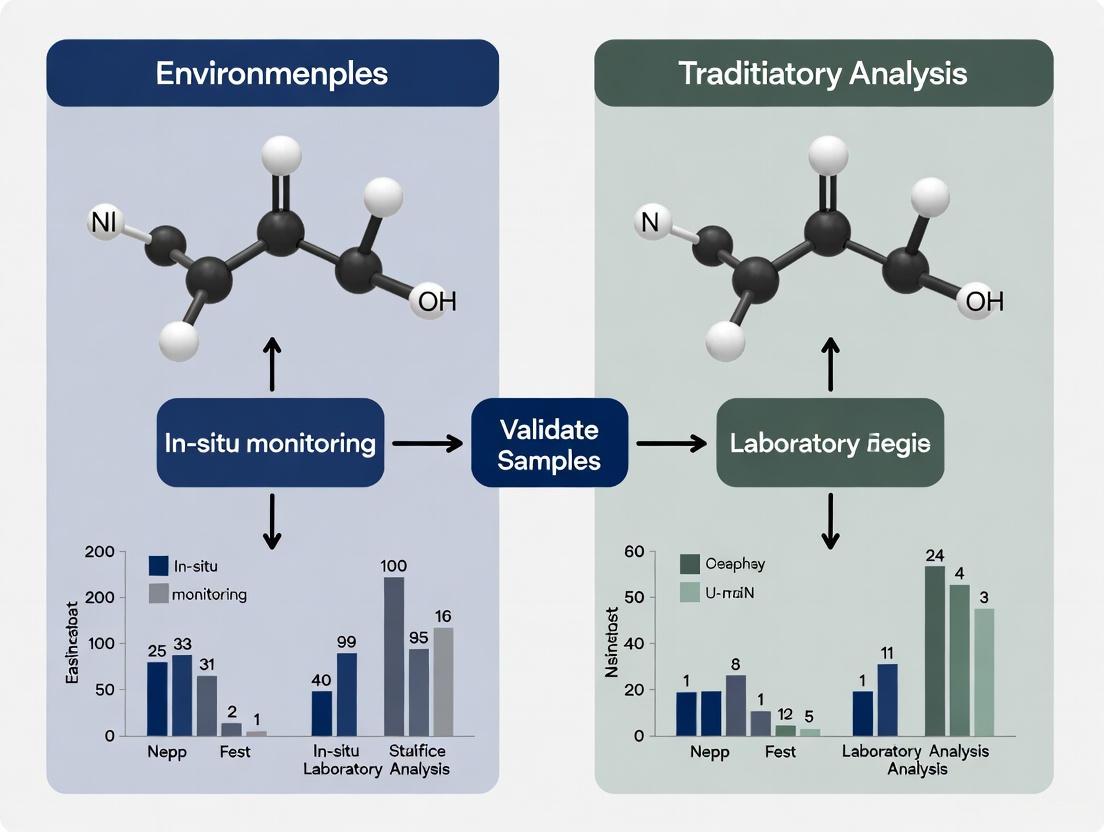
This article provides a comprehensive framework for researchers and drug development professionals on validating in-situ monitoring technologies against traditional laboratory analysis.
From Field to Lab: Validating In-Situ Monitoring Against Laboratory Analysis for Environmental Samples
Abstract
This article provides a comprehensive framework for researchers and drug development professionals on validating in-situ monitoring technologies against traditional laboratory analysis. It explores the fundamental principles of both approaches, details methodological applications across various environmental contexts, addresses common troubleshooting and optimization challenges, and establishes rigorous protocols for comparative validation. By synthesizing current research and real-world case studies, this guide aims to equip scientists with the knowledge to ensure data integrity, enhance measurement accuracy, and make informed decisions on integrating in-situ monitoring into quality assurance programs.
Understanding the Core Principles: In-Situ Monitoring and Laboratory Analysis
In-situ monitoring represents a paradigm shift in environmental data collection, enabling researchers to gather real-time information directly from a substance's native environment. This approach involves placing sensors or instruments at the exact location where measurements are needed, providing continuous data about environmental conditions, chemical processes, or physical changes without disturbing the system being studied. For researchers and drug development professionals working with environmental samples, understanding the capabilities and limitations of in-situ monitoring is crucial for designing effective sampling strategies and interpreting analytical results. This guide examines how in-situ monitoring compares with traditional laboratory analysis across multiple environmental matrices, supported by experimental data and methodological details from current research.
Core Principles and Key Comparisons
Fundamental Definitions
In-situ monitoring refers to on-site data collection that measures parameters directly where they occur, providing immediate results crucial for time-sensitive decisions [1]. This method captures real-world conditions precisely by avoiding sample degradation during transport [1]. By contrast, laboratory-based analysis involves collecting samples and testing them in a controlled laboratory setting, allowing for precise analysis of multiple parameters simultaneously and detection of trace contaminants [2].
Comparative Advantages and Limitations
The selection between in-situ and laboratory methodologies involves strategic trade-offs between temporal resolution and analytical precision, as summarized in the table below.
Table 1: Direct Comparison of In-Situ versus Laboratory-Based Analysis
| Aspect | In-Situ Monitoring | Laboratory-Based Analysis |
|---|---|---|
| Data temporal resolution | Real-time/continuous data streams [1] | Days to weeks delay for results [2] |
| Measurement context | Directly in native environment without disturbance [1] | Removed from environmental context [2] |
| Parameter range | Limited to sensor capabilities; typically physical parameters (temperature, pH, conductivity) and some chemicals [1] [2] | Broad range; can test multiple parameters simultaneously, including trace contaminants [2] |
| Accuracy concerns | Sensor drift, fouling, environmental interference [2] [3] | Controlled conditions minimize interference; can detect trace amounts [2] |
| Operational requirements | Lower long-term manpower; reduced sample transport [1] [2] | Specialized equipment, trained personnel, sample transportation [2] |
| Cost structure | Higher initial investment; lower operational costs [2] | Lower initial costs; higher per-sample operational costs [2] |
Experimental Validation: Methodologies and Data
Water Quality Monitoring in Lake Ecosystems
A 2020-2021 study on Lake Maggiore, Italy, implemented a high-frequency monitoring (HFM) system to complement long-term discrete sampling programs [4]. The research aimed to validate in-situ fluorometric sensors for chlorophyll-a measurement against traditional laboratory methods.
Table 2: Chlorophyll-a Measurement Comparison Across Methodologies
| Methodology | Technique Description | Frequency Capability | Limitations |
|---|---|---|---|
| In-situ fluorescence sensors | Cyclops7 sensor deployed on buoy system | Continuous high-frequency data | Influenced by phytoplankton community composition |
| Laboratory fluorescence | BBE FluoroProbe analysis | Discrete sampling intervals | Requires sample transport and processing |
| Spectrophotometry | UV-VIS analysis following extraction | Discrete sampling intervals | Time-consuming extraction protocols |
| Microscopy analysis | Taxonomic identification and enumeration | Discrete sampling intervals | Labor-intensive; requires specialist expertise |
The validation protocol involved regular comparison of chlorophyll-a data from in-situ fluorescent sensors with laboratory fluorescence analysis, UV-VIS spectrophotometry, and phytoplankton microscopy. Researchers found general agreement between methods, confirming in-situ sensors as a reliable approach for assessing seasonal phytoplankton dynamics and short-term variability [4]. However, phytoplankton community composition substantially affected method performance, necessitating regular validation against laboratory analyses.
Soil Property Analysis Using Mid-Infrared Spectroscopy
A 2022 investigation compared in-situ versus laboratory mid-infrared spectroscopy (MIRS) for predicting key soil properties including organic carbon, total nitrogen, clay content, and pH [3]. The study implemented multiple calibration strategies across three loess sites in Germany with different tillage treatments.
Experimental Protocol:
- Field MIRS: Surface measurements taken directly in the field at multiple locations
- Laboratory MIRS: Analysis of dried/ground soil samples (<0.2 mm) collected from same sites
- Reference analysis: Conventional determination of OC, TN, clay, and pH
- Model development: Partial least squares regression models with local and regional calibration strategies
Table 3: Performance Comparison of Lab vs. In-Situ MIRS for Soil Properties (RPIQ Values)
| Soil Property | Lab MIRS (Regional n=38) | Field MIRS (Regional n=150) | Field MIRS (Spiked Regional) |
|---|---|---|---|
| Organic Carbon | 4.3 | ≥1.89 | ≥1.89 |
| Total Nitrogen | 6.7 | ≥1.89 | ≥1.89 |
| Clay | Variable (0.89-2.8) | Lower accuracy | Improved with spiking |
| pH | Variable (0.60-3.2) | Lower accuracy | Improved with spiking |
The study demonstrated that laboratory MIRS consistently outperformed field MIRS across all properties and calibration strategies. Field MIRS required more complex calibration procedures, including "spiking" regional calibrations with local samples, to achieve satisfactory accuracy (RPIQ ≥ 1.89) [3]. Soil moisture content was identified as a major confounding factor, particularly affecting organic carbon prediction and sandier soils.
Antibiotic Measurement in Sediments
A 2023 study developed and validated a novel in-situ technique for high-resolution measurement of antibiotics in sediments using diffusive gradients in thin-films (DGT) probes [5].
Methodological Details:
- DGT Probe Design: Systematic development for organic contaminant measurement
- Spatial Resolution: Capability for millimeter-scale compound distribution mapping
- Comparison Method: Traditional Rhizon pore-water sampling
- Validation Environment: Controlled sediment system and intact sediment core from Chinese lake
The research demonstrated that DGT probes successfully resolved antibiotic distributions at millimeter scales and reflected fluxes from sediment pore-water plus remobilization from solid phases [5]. Antibiotic concentrations obtained by DGT probes were lower than pore-water concentrations from Rhizon sampling, as DGT measures only the labile (bioavailable) fraction rather than total concentrations.
Technical Workflows and Signaling Pathways
In-Situ Monitoring Validation Workflow
In-Situ Method Validation Workflow
This workflow illustrates the standardized approach for validating in-situ monitoring methods against laboratory benchmarks, as demonstrated across multiple environmental matrices in the cited studies.
The Scientist's Toolkit: Essential Research Reagent Solutions
Table 4: Key Instrumentation and Materials for In-Situ Environmental Monitoring
| Instrument/Material | Primary Function | Research Application |
|---|---|---|
| Multiparameter water quality probes | Simultaneous measurement of temperature, pH, dissolved oxygen, conductivity, turbidity [1] [2] | Continuous water quality monitoring in rivers, lakes, oceans [2] |
| DGT (Diffusive Gradients in Thin-films) probes | In-situ measurement of organic contaminants at high spatial resolution [5] | Antibiotic detection in sediments; mm-scale compound distribution mapping [5] |
| Mid-infrared spectroscopy (MIRS) sensors | Field-based soil property prediction using spectral analysis [3] | Soil organic carbon, total nitrogen, clay content, and pH estimation [3] |
| Fluorometric sensors (Cyclops7) | In-situ chlorophyll-a and algal pigment measurement via fluorescence [4] | Phytoplankton biomass monitoring; algal bloom detection [4] |
| TEROS 21/MPS-6 | Soil water potential (matric potential) measurement [6] | In-situ soil moisture release curves; irrigation management [6] |
| Open-source CTD sensors | Customizable conductivity, temperature, depth profiling [7] | Estuarine water quality monitoring; spatial and temporal variability assessment [7] |
| Cellular telemetry (VuLink) | Remote data transmission from field sensors [8] | Real-time data access from remote monitoring sites; global deployments [8] |
The validation studies comprehensively demonstrate that in-situ monitoring and laboratory analysis serve complementary roles in environmental research. In-situ techniques provide unprecedented temporal resolution and real-time detection of dynamic processes, while laboratory methods deliver higher analytical precision and broader contaminant detection capabilities. The optimal monitoring strategy incorporates both approaches, leveraging their respective strengths to create a comprehensive understanding of environmental systems. For researchers and drug development professionals, this integrated approach enables both immediate intervention capabilities and definitive analytical characterization, supporting evidence-based decision-making in environmental management and public health protection.
In the field of environmental monitoring, the choice between traditional laboratory analysis and in-situ testing represents a critical decision point for researchers and drug development professionals. For decades, traditional laboratory methods have been regarded as the gold standard for environmental testing, providing unparalleled accuracy, precision, and regulatory compliance for analyzing air, water, and soil samples [9]. This comprehensive guide objectively compares the performance characteristics of established laboratory protocols against emerging in-situ alternatives within the context of environmental sample validation research.
The global environmental testing market, projected to expand from USD 7.43 billion in 2025 to USD 9.32 billion by 2030, reflects the growing importance of both methodologies [9]. While laboratory analysis remains foundational for its definitive measurements, technological innovations are accelerating the development of rapid, field-deployable solutions. Understanding the appropriate application for each method—whether utilizing laboratory precision or in-situ immediacy—is essential for designing environmentally valid research studies.
Comparative Performance Analysis: Traditional Laboratory vs. In-Situ Methods
Accuracy and Precision Metrics
Traditional laboratory analysis maintains its gold-standard status through demonstrated performance characteristics across multiple environmental parameters. The controlled environment of laboratories enables the application of highly sensitive techniques such as chromatography, mass spectrometry, and molecular spectroscopy, which offer detection capabilities often surpassing field-deployable alternatives [10].
For soil analysis in raw earth construction, strong correlations (R² = 0.8863) have been established between field tests like the cigar test and laboratory-measured plasticity index, validating field methods while confirming laboratory analysis as the reference point [11]. Similarly, ring test scores show significant correlation with laboratory-measured clay-sized particle content percentages, though laboratory methods provide more granular data (detecting clay content ranging from 5% to 75%) essential for precise material specification [11].
When monitoring emerging contaminants like perfluoroalkyl compounds (PFAS) in water matrices, laboratory-based methodologies offer significant advantages in sensitivity, accuracy, and selectivity compared to sensor technologies [10]. This precision is particularly crucial for drug development professionals requiring definitive contaminant identification in water sources used for pharmaceutical production.
Analytical Scope and Detection Capabilities
Traditional laboratories provide comprehensive analytical profiles essential for complex environmental assessments. Where in-situ methods typically target specific parameters, laboratory analysis can simultaneously detect diverse pollutant classes including heavy metals, persistent organic pollutants, inorganic non-metallic pollutants, emerging contaminants, and biological agents [12].
Table 1: Comparative Analysis of Detection Capabilities
| Analytical Parameter | Traditional Laboratory Methods | In-Situ Testing Methods |
|---|---|---|
| Detection Range | Broad-spectrum pollutant identification | Targeted parameter measurement |
| Sensitivity | Parts-per-trillion for specific contaminants | Generally parts-per-million to parts-per-billion |
| Selectivity | High (can distinguish structurally similar compounds) | Variable (potential cross-sensitivity) |
| Multi-analyte Capacity | Simultaneous analysis of multiple contaminant classes | Typically focused on single or few parameters |
| Standardization | Well-established protocols (EPA, ISO) | Emerging standardization frameworks |
The establishment of environmental monitoring networks and data-sharing platforms further enhances laboratory capabilities by providing solid data support for public health initiatives [12]. This infrastructure enables researchers to contextualize their findings within larger environmental trends.
Experimental Protocols and Methodologies
Standardized Laboratory Protocols for Soil Analysis
Laboratory analysis of soil samples for construction applications follows rigorous standardized methodologies that enable reliable comparison across studies and locations [11]. The research integrating field tests with laboratory analyses for 39 soils from France's Nouvelle-Aquitaine region demonstrates the comprehensive nature of laboratory assessment.
The experimental protocol includes five standardized geotechnical tests:
- Particle size distribution analysis using sieve and hydrometer methods
- Atterberg limits determination (liquid limit, plastic limit, plasticity index)
- Methylene blue value (MBV) testing for clay activity assessment
- Organic matter content measurement through loss on ignition
- Density measurements using standardized compaction protocols
These laboratory methods provide quantitative data that validates field observations, with plasticity indices ranging from 0% to 50% across tested soils, enabling precise classification of material behavior [11]. The laboratory environment allows for careful control of testing conditions (temperature, humidity, sample preparation) that is not achievable in field settings.
Water Contaminant Analysis Protocols
For emerging water contaminants like PFAS, laboratory-based methodologies follow stringent protocols to ensure accuracy. Traditional approaches utilize liquid chromatography coupled with mass spectrometry (LC-MS/MS), which provides the sensitivity and selectivity required for regulatory compliance [10].
The experimental workflow involves:
- Sample preservation and transportation under controlled conditions
- Solid-phase extraction for analyte concentration and matrix clean-up
- Chromatographic separation using optimized mobile and stationary phases
- Tandem mass spectrometric detection with multiple reaction monitoring
- Quality control measures including blanks, spikes, and duplicates
These protocols enable detection at ng/L levels, which is essential for assessing contaminants of emerging concern that pose risks at minute concentrations [10]. While sensor technologies show promise for on-site screening, they currently lack the reliability for definitive quantification of emerging contaminants.
Protocol for Comparative Method Validation
Studies validating in-situ against laboratory methods follow rigorous experimental designs. The soil suitability assessment research employed statistical correlation analysis between field observations and laboratory measurements, establishing reliability metrics for traditional field tests [11]. This approach demonstrates how laboratory analysis serves as the reference method for validating alternative approaches.
Diagram 1: Method Validation Workflow
The Researcher's Toolkit: Essential Analytical Solutions
Laboratory Instrumentation and Reagents
Traditional laboratory analysis relies on sophisticated instrumentation and specialized reagents to achieve its gold-standard status. The environmental testing market encompasses various product categories that form the foundation of reliable analytical results [13].
Table 2: Essential Laboratory Research Reagents and Instruments
| Instrument/Reagent | Primary Function | Application in Environmental Analysis |
|---|---|---|
| Mass Spectrometers | Compound identification and quantification | PFAS, pesticide, and emerging contaminant analysis |
| Chromatography Systems | Separation of complex mixtures | VOC analysis, contaminant profiling |
| pH Meters | Acidity/alkalinity measurement | Water quality assessment, soil characterization |
| Molecular Spectroscopy Products | Structural analysis and concentration measurement | Organic matter characterization, contaminant identification |
| TOC Analyzers | Total organic carbon quantification | Water purity assessment, pollution tracking |
| Methylene Blue Reagent | Clay activity determination | Soil suitability for construction applications |
These instruments enable the precise measurements required for environmental research, particularly when assessing compliance with stringent regulatory limits for contaminants in various matrices [11] [13].
Emerging Sensor Technologies
While traditional laboratory methods provide definitive analysis, the scientific literature reveals growing development of alternative technologies for environmental monitoring. Printed sensors fabricated using techniques such as inkjet printing, screen printing, and roll-to-roll printing offer potential for cost-effective, large-scale deployment [14]. These sensors utilize advanced materials including graphene, carbon nanotubes, and conductive polymers to detect environmental parameters, though they face challenges in sensitivity, stability, and standardization compared to established laboratory techniques [14].
The integration of artificial intelligence and machine learning with both laboratory and field-deployable sensors represents a significant advancement, enabling more accurate predictions and enhanced data analysis capabilities [15]. AI-driven tools can process large volumes of data from sources such as satellite imagery, sensor networks, and historical datasets, offering insights that complement traditional laboratory findings [15].
Method Selection Framework for Environmental Research
Comparative Advantages and Limitations
The validation of in-situ monitoring against laboratory analysis requires understanding the distinct advantages and limitations of each approach. Traditional laboratory analysis provides definitive data for regulatory decisions, while in-situ methods offer temporal resolution and immediate insights [16] [10].
Table 3: Comprehensive Method Comparison
| Characteristic | Traditional Laboratory Analysis | In-Situ Testing |
|---|---|---|
| Accuracy & Precision | High (gold standard) | Variable (technology-dependent) |
| Cost Structure | High capital and operational expense | Lower initial investment |
| Time to Results | Days to weeks (including transport) | Minutes to hours (real-time potential) |
| Regulatory Acceptance | Well-established for compliance | Emerging acceptance for screening |
| Sample Integrity | Potential degradation during transport | Immediate analysis preserves sample state |
| Spatial Coverage | Limited by sampling logistics | Potential for dense sensor networks |
| Analytical Scope | Comprehensive contaminant profiling | Targeted parameter measurement |
| Quality Assurance | Established QC/QA protocols | Developing quality control frameworks |
Laboratory practices themselves face sustainability challenges, as they consume 5-10 times more energy than equivalent office space and generate an estimated 5.5 million tonnes of plastic waste annually [17]. These environmental impacts present additional considerations for researchers designing studies with significant laboratory components.
Integrated Methodologies for Comprehensive Assessment
Rather than positioning traditional laboratory analysis and in-situ monitoring as mutually exclusive alternatives, emerging research frameworks advocate for integrated approaches that leverage the strengths of each methodology. The development of systems like HeatSuite, which monitors local environmental conditions alongside physiological responses, demonstrates the value of combining precise environmental measurements with contextual data [18].
Diagram 2: Integrated Assessment Strategy
For soil characterization in construction applications, research demonstrates that while traditional field tests provide reliable preliminary assessment tools, laboratory testing remains essential for final material validation [11]. This hybrid approach maximizes efficiency while maintaining scientific rigor—using field methods for rapid screening and laboratory analysis for definitive characterization of critical parameters.
Traditional laboratory analysis maintains its position as the gold standard for accuracy and precision in environmental testing, providing the definitive measurements required for regulatory compliance, method validation, and complex contaminant characterization. The experimental data and performance comparisons presented in this guide demonstrate that laboratory methods offer unrivaled sensitivity, selectivity, and analytical scope for environmental samples.
Nevertheless, the evolving landscape of environmental research increasingly recognizes the value of integrated approaches that combine laboratory precision with in-situ monitoring capabilities. As sensor technologies advance and artificial intelligence enhances data interpretation, the scientific community moves toward frameworks that utilize each methodology's strengths—laboratory analysis for definitive quantification and in-situ methods for temporal resolution and spatial coverage.
For researchers, scientists, and drug development professionals, methodological selection should be guided by study objectives, regulatory requirements, and the specific performance characteristics needed. Traditional laboratory analysis remains indispensable when uncompromising accuracy and precision are paramount, while emerging technologies offer complementary capabilities that expand environmental monitoring possibilities.
Validating analytical methods is a cornerstone of environmental science, particularly in research supporting drug development where understanding the environmental fate of pharmaceuticals is critical. A central theoretical debate involves choosing between in-situ monitoring, which provides real-time, on-site data, and laboratory analysis, which offers high precision under controlled conditions. This framework objectively compares these paradigms by examining their performance across key metrics, supported by experimental data. The choice between them is not a matter of superiority but of strategic alignment with the specific research question, weighing factors such as required data precision, temporal resolution, and operational constraints [1].
Theoretical Foundations of the Two Paradigms
The theoretical distinction between in-situ and laboratory methods lies in their fundamental approach to data collection and the associated information each one captures.
In-Situ Monitoring is defined by its operation within the native environment of the sample. This paradigm prioritizes temporal resolution and contextual integrity, capturing dynamic processes like diurnal cycles or rapid pollutant pulses without the artifacts introduced by sample transport and storage [19] [1]. The core strength of this "seeing it happen" approach is its ability to provide a direct, real-time understanding of environmental systems.
Laboratory Analysis, in contrast, is built on the principle of controlled measurement. By removing samples from their environment and processing them under standardized, optimized conditions (e.g., controlled temperature, precise instrumentation, and specialized reagents), this paradigm maximizes analytical precision and accuracy [20] [3]. It is the benchmark for data quality, capable of detecting lower concentrations of a wider range of contaminants, including emerging pollutants analyzed via techniques like LC-MS/MS [21].
The following conceptual framework visualizes the decision-making logic for selecting the appropriate methodological paradigm.
Experimental Comparison and Performance Data
Direct comparisons in research studies reveal the quantifiable performance trade-offs between these two methodologies.
Case Study 1: Soil Spectroscopy
A 2022 study directly compared in-situ (field) and laboratory Mid-Infrared Spectroscopy (MIRS) for predicting key soil properties, using statistical metrics like the Ratio of Prediction to Interquartile distance (RPIQ) to gauge accuracy [3]. A higher RPIQ indicates a more accurate model.
Table 1: Performance Comparison of Lab vs. In-Situ MIRS for Soil Analysis [3]
| Soil Property | Laboratory MIRS (RPIQ) | In-Situ MIRS (RPIQ) | Key Influencing Factor |
|---|---|---|---|
| Organic Carbon (OC) | 4.3 (Highly Accurate) | 1.89 (Satisfactory) | Soil moisture content negatively impacted field accuracy, especially in sandier soils. |
| Total Nitrogen (TN) | 6.7 (Highly Accurate) | 1.89 (Satisfactory) | Field MIRS required complex "spiked" calibrations to match lab-detected tillage effects. |
| Clay Content | 0.89 - 2.8 (Variable) | Lower than OC/TN | Accuracy was more variable for both methods, but moisture had less negative impact than on OC. |
Experimental Protocol: Surface MIRS measurements were taken at three sites in Germany with different tillage treatments. Soil samples (0–2 cm) were then collected from the same spots for lab MIRS analysis on dried and ground material. Partial Least Squares Regression (PLSR) models were built using various calibration strategies, from purely local to regional models supplemented ("spiked") with a few local samples [3].
Theoretical Implication: This study demonstrates that while laboratory analysis provides superior accuracy, in-situ methods can achieve satisfactory results for specific properties (like OC and TN) but require more complex and arduous calibration procedures to compensate for environmental variables like moisture.
Case Study 2: Water Quality Monitoring
A 2025 study evaluated the feasibility of in-situ Ion-Selective Electrodes (ISEs) for monitoring nutrients in dynamic rivers, comparing them to online analysers and laboratory Ion Chromatography (IC) [19].
Table 2: Performance of In-Situ ISEs for River Water Monitoring [19]
| Analyte | In-Situ ISE Performance | Comparative Method |
|---|---|---|
| Chloride (Cl⁻) | Good agreement | Laboratory IC |
| Nitrate (NO₃⁻) | Good agreement | Optical UV Probe & Laboratory IC |
| Ammonium (NH₄⁺) | Not comparable at low concentrations | Photometric/Gas-Sensitive Analyser & Laboratory IC |
| All Parameters | Effective for qualitative "event detection" (e.g., pollution spikes) | All Methods |
Experimental Protocol: ISEs from three manufacturers were deployed at a river monitoring station for five months, collecting data at 5-minute intervals. Concurrently, grab samples were taken for laboratory IC analysis, and data from other online analysers (e.g., photometers, UV probes) was recorded. The ISE data was evaluated for challenges like temperature fluctuations, interfering ions, and long-term drift [19].
Theoretical Implication: The feasibility of in-situ sensors is highly analyte-dependent. They excel at tracking relative changes and detecting pollution events, but their accuracy for quantitative analysis, especially at low concentrations, can be compromised by environmental interferences, necessitating careful validation against laboratory standards.
The Scientist's Toolkit: Key Research Reagent Solutions
The execution of both in-situ and laboratory analyses relies on specialized materials and reagents. The following toolkit details essential items for the experiments cited in this framework.
Table 3: Essential Research Reagents and Materials
| Item Name | Function in Research | Application Context |
|---|---|---|
| Ion-Selective Electrode (ISE) | Potentiometric sensor for detecting specific ions (e.g., NH₄⁺, NO₃⁻) in water. | In-situ water quality monitoring [19] |
| Chitin-based Bioanode | A slow-release carbon source that sustains exoelectrogenic microbes in a Microbial Fuel Cell (MFC). | Used in self-powered in-situ dissolved oxygen sensors [22] |
| Polar Organic Chemical Integrative Sampler (POCIS) | A passive sampler that accumulates contaminants from water over time for laboratory analysis. | Provides time-weighted average concentrations for contaminants like pharmaceuticals [21] |
| LC-MS/MS Grade Solvents | High-purity solvents for Liquid Chromatography-Tandem Mass Spectrometry to prevent instrument contamination and ensure accuracy. | Essential for laboratory analysis of emerging contaminants (e.g., PFAS, pharmaceuticals) in environmental samples [21] |
| Mid-Infrared (MIR) Spectrometer | Instrument that measures molecular absorption of MIR light to characterize soil composition. | Used for both field (in-situ) and laboratory soil analysis [3] |
Integrated Workflow for Method Validation
Given their complementary strengths, a hybrid approach that strategically combines in-situ and laboratory methods provides the most robust validation. The following workflow diagrams a recommended protocol for such a study, derived from the cited experimental designs.
This theoretical framework demonstrates that the choice between in-situ monitoring and laboratory analysis is a strategic trade-off. In-situ monitoring provides unparalleled temporal resolution and context for dynamic systems, while laboratory analysis delivers superior precision and breadth of analytes for definitive quantification [20] [19] [3]. The most robust research outcomes are achieved not by choosing one paradigm over the other, but by implementing a hybrid approach. This integrated methodology uses high-frequency in-situ data to capture critical environmental events and patterns, which are then validated and quantified through targeted, high-precision laboratory analysis. This synergistic strategy ensures data integrity and provides a comprehensive understanding of environmental samples, ultimately supporting more informed decision-making in drug development and environmental health research.
The Critical Need for Validation in Regulatory and Research Contexts
In the realms of regulatory compliance and scientific research, the data generated from environmental monitoring forms the bedrock of decision-making, from pharmaceutical cleanroom control to watershed management. The unwavering quality of analytical output is not merely advantageous but essential, serving as the foundation for legal defensibility, research reproducibility, and ultimately, public and environmental health protection [24]. The credibility of an environmental laboratory rests upon a robust validation framework that proves its methods yield reproducible and accurate results [25]. This article provides a critical comparison between in-situ monitoring and laboratory analysis, presenting validation data and experimental protocols that highlight the necessity of a context-dependent approach to environmental sampling and analysis. As global challenges such as emerging contaminants like perfluoroalkyl substances (PFAS) intensify, the pressure on analytical infrastructure to provide accurate, timely, and contextually rich data has never been greater [10] [24].
Quantitative Comparison of Monitoring Approaches
The choice between in-situ and laboratory analysis involves navigating a complex landscape of trade-offs between accuracy, precision, cost, and operational feasibility. The following tables summarize critical performance and operational metrics based on comparative studies.
Table 1: Performance Comparison of In-Situ versus Laboratory Analysis
| Parameter | In-Situ Monitoring | Laboratory Analysis |
|---|---|---|
| Typical Accuracy (Example: pH) | Within ±0.2 units [26] | High sensitivity and accuracy on calibrated equipment [10] [26] |
| Precision & Data Variability | Higher variance, especially with short half-life contaminants [27] | Lower variability; tightly controlled conditions [27] [26] |
| Key Limiting Factors | Environmental interference (temp, humidity); instrument recalibration needs [26] | Sample stability during transport; chain-of-custody integrity [24] |
| Best Application Context | Quick decision-making, trend spotting, high-frequency screening [26] | Regulatory compliance, definitive quantification, method development [10] [25] |
Table 2: Operational and Economic Considerations
| Consideration | In-Situ Monitoring | Laboratory Analysis |
|---|---|---|
| Speed of Results | Minutes to hours [26] | 5-10 business days, plus shipping [26] |
| Cost Profile | Low-cost, high-frequency option; one-time instrument purchase [26] | Higher cost per sample; depth of insight can justify expense [26] |
| Analyte Range | Limited to pH, EC, DO, temperature; some semi-quantitative kits for nutrients [26] | Comprehensive: macronutrients, trace metals, pesticides, emerging contaminants [10] [26] |
| Data Documentation | Prone to human error; rarely meets strict audit trail requirements [26] | Standardized reports with QC; legally defensible; suitable for compliance [24] [26] |
Experimental Validation Protocols for Method Comparison
A rigorous, protocol-driven approach is fundamental to validating any monitoring method. The following sections detail specific experimental designs that have been employed to generate the comparative data discussed in this article.
Protocol 1: Modeling Pulsed Aquatic Exposure Scenarios
Objective: To quantitatively compare the accuracy of discrete grab sampling versus integrative passive sampling in estimating time-weighted average (TWA) concentrations of contaminants with short, pulsed aquatic half-lives [27].
- Exposure Scenario Design: A known peak 96-hour TWA concentration was modeled, simulating a single contamination pulse. The dissipation of the contaminant followed first-order kinetics with a range of aquatic half-lives (0.5, 2, and 8 days) [27].
- Sampling Method Simulation:
- Discrete Sampling: Simulated by taking single, instantaneous concentration measurements from the model.
- Integrative Sampling: Simulated as a continuous accumulation of the contaminant over the deployment period, providing a true TWA [27].
- Variable Testing: The modeling exercise was run with 1,000 iterations for each combination of sampling method (discrete vs. integrative), sampling frequency (1 to 7 samples over 96 hours), and contaminant half-life [27].
- Validation & Analysis: For each iteration, the measured or estimated TWA was compared to the known true TWA. Accuracy was assessed by calculating the percentage of results that fell within 50% and 10% of the true value [27].
Protocol 2: Field Validation of Low-Cost Colorimetric Kits
Objective: To evaluate the accuracy, precision, and bias of low-cost colorimetric phosphate and nitrate test kits used by citizen scientists against accredited laboratory methods [28].
- Paired Sample Collection: During mass sampling events on the River Wye, volunteers collected water samples and immediately performed in-situ analysis using three test kits: Hanna Phosphate Checker, Hach Nitrate Test Strips, and La Motte Phosphate Insta-Test Strips. A second, preserved sample was simultaneously collected from the same location for accredited (UKAS ISO/IEC 17025) laboratory analysis [28].
- Controlled Lab Testing: To understand bias in field kits, controlled laboratory tests were conducted to investigate the influence of water temperature and the time between test initiation and analysis on the reported results [28].
- Data Analysis: The performance of each low-cost test was quantified by comparing its result directly with the paired laboratory result. Agreement was defined based on the accuracy required for the monitoring context. Precision and systematic bias were also statistically assessed [28].
Protocol 3: Validation of a Predictive Model for API Concentrations
Objective: To develop and validate a new method combining emission and hydrodynamic modeling to predict spatiotemporal concentrations of Active Pharmaceutical Ingredients (APIs) in a lake, offering an alternative to resource-intensive monitoring [29].
- Model Development: An emission model predicted API concentrations in wastewater effluent based on Swedish prescription data, factoring in human metabolization and WWTP retention. This was coupled with a 3D hydrodynamic model of Lake Ekoln, Sweden, which simulated dilution, transport, and temperature-dependent biodegradation of over 500 APIs [29].
- Validation Against Physical Measurements: The model's predictions were validated against two datasets:
- WWTP Effluent: 103 monthly measurements of 10 different APIs at the treatment plant effluent.
- Lake Water: 321 historical measurements of 20 different APIs from various points in the lake [29].
- Acceptance Criteria: Predictive accuracy was measured by the percentage of results that fell within a factor of 10 and a factor of 100 of the empirically measured concentrations [29].
Visualizing the Method Validation Workflow
The following diagram illustrates a generalized validation workflow for evaluating an environmental monitoring method, integrating principles from the experimental protocols described above.
Validation Workflow
Essential Research Reagent and Material Solutions
The execution of reliable environmental monitoring and validation studies depends on a suite of specialized reagents and materials. The following table details key solutions used across the featured protocols.
Table 3: Key Research Reagent Solutions for Environmental Monitoring
| Item or Solution | Function and Application in Validation |
|---|---|
| Integrative Passive Samplers (e.g., POCIS) | Continuously accumulates freely dissolved contaminants from water over a deployment period, providing a Time-Weighted Average (TWA) concentration for validating against grab samples [27]. |
| Optical Sensor Spots (O₂/CO₂) | Affixed to growth surfaces in cell cultures or environmental vessels for in-situ, real-time, non-invasive monitoring of dissolved gas concentrations, validating environmental stability [30]. |
| Colorimetric Test Kits (Nitrate/Phosphate) | Low-cost, field-deployable reagents that produce a color change indicative of analyte concentration. Used for comparing performance (accuracy, bias) against reference lab methods [28]. |
| Sample Preservation Reagents | Chemicals (e.g., acid for metals, quenching agents for chlorine) added to samples during collection to maintain analyte stability from field to lab, ensuring integrity for reference analysis [24]. |
| Proficiency Testing (PT) Samples | Commercially provided samples of known but undisclosed concentration, used as an external audit to objectively validate a laboratory's analytical competence and method performance [24]. |
| Hydrodynamic & Emission Models | Computational tools (software and algorithms) that predict the fate and transport of contaminants in water bodies, serving as a supplement or guide for physical chemical monitoring [29]. |
The critical need for validation in regulatory and research contexts is unambiguous. Whether relying on rapid in-situ screens or definitive laboratory measurements, the data that informs decisions must be grounded in demonstrated competence and proven methodology. The comparative data and experimental protocols presented herein underscore that no single approach is universally superior; each has its place within a holistic monitoring strategy. The emerging integration of advanced technologies like artificial intelligence and machine learning with sensor innovations promises to further enhance real-time monitoring capabilities [10]. Ultimately, a rigorous, validated framework—whether for monitoring a pharmaceutical cleanroom, a river catchment, or a cell culture environment—is the indispensable link between raw data and trustworthy knowledge, ensuring that scientific outcomes remain relevant, reproducible, and legally defensible [24].
In environmental research and drug development, the choice between in-situ monitoring and laboratory analysis is fundamental, influencing data accuracy, temporal resolution, and operational cost. In-situ monitoring involves deploying sensors directly in the environment or process stream, providing real-time, high-frequency data that captures dynamic changes as they happen [31]. Conversely, laboratory techniques involve collecting discrete samples for subsequent, often more precise, analysis under controlled conditions using specialized instrumentation [32]. This guide objectively compares the performance of these two paradigms, providing a structured overview of common technologies, their capabilities, and their validation against reference methods.
Comparative Analysis of In-Situ and Laboratory Techniques
The following tables summarize key performance metrics and characteristics for a range of common monitoring technologies used in environmental science.
Table 1: Performance Comparison of In-Situ Sensor Technologies
| Technology | Typical Measured Parameters | Key Performance Characteristics | Common Applications |
|---|---|---|---|
| Gamma Spectrometry [32] | 226Ra, 40K, 137Cs | Higher minimum detectable activity; Major uncertainty from soil humidity (55%) [32] | Operational & emergency monitoring of nuclear facilities; environmental radioactivity [32] |
| X-Ray Fluorescence (XRF) [33] | Cu, Pb, Zn, and other metals | In-situ measurement in <5 minutes; Definitive quantitation after lab prep (R²>0.90) [33] | Rapid biomonitoring of metal pollution in mosses and other biological monitors [33] |
| Marine CO₂ Sensors [34] | pH, pCO₂ (partial pressure of CO₂) | Sufficient accuracy for short-term/seasonal studies; enables derived parameters (DIC within ±5 μmol/kg) [34] | Ocean acidification studies; air-sea CO₂ flux measurements; marine carbon cycle [34] |
| Soil Matric Potential Sensors [35] | Soil water potential (suction) | Enables field-derived soil water characteristic curves; wide measurement range beyond tensiometers [35] | Irrigation scheduling; geotechnical engineering studies; soil-plant-atmosphere continuum research [35] |
Table 2: Performance Comparison of Laboratory Analytical Techniques
| Technique | Typical Measured Parameters | Key Performance Characteristics | Common Applications |
|---|---|---|---|
| Laboratory Gamma Spectrometry [32] | 226Ra, 40K, 137Cs | Lower minimum detectable activity; Major uncertainty from net counting (71%) [32] | Validation of in-situ data; precise quantification of radionuclides in soil/water [32] |
| ICP-OES (Inductively Coupled Plasma Optical Emission Spectrometry) [33] | Multi-element metal analysis | Used as a reference method for validating other techniques like XRF; requires sample digestion [33] | High-accuracy determination of metal concentrations in environmental, biological samples [33] |
| Benchtop Seawater CO₂ Analysis [34] | pH, pCO₂, DIC, AT | High-precision measurements used to assess accuracy of autonomous in-situ sensors [34] | Climate and ocean acidification research; calibration of sensor networks [34] |
| Chilled Mirror Dewpoint Hygrometer / HYPROP [35] | Soil water potential | Laboratory benchmark for generating soil water characteristic curves (SWCC) [35] | Soil physics research; hydraulic property characterization [35] |
Table 3: Direct Comparison of Paired In-Situ and Laboratory Methods
| Comparison Aspect | In-Situ Gamma Spectrometry [32] | Laboratory Gamma Spectrometry [32] |
|---|---|---|
| Minimum Detectable Activity (MDA) | Higher | Lower |
| Repeatability & Reproducibility | Lower | Higher |
| Major Source of Uncertainty | Soil humidity (55% contribution) | Net counting rate (71% contribution) |
| Throughput & Cost | Faster, less costly per site | Slower, higher cost per sample |
| Agreement | Good agreement for 40K, 226Ra, 137Cs demonstrated | Good agreement for 40K, 226Ra, 137Cs demonstrated |
Experimental Protocols for Method Validation
This protocol outlines the steps for using portable XRF for direct field measurement and laboratory analysis of moss samples to monitor atmospheric metal pollution, with validation via ICP-OES.
A. Field Measurements (In-Situ XRF):
- Site Selection: Identify epiphytic moss (e.g., Orthotrichum lyelli) growing on tree trunks at least one meter off the ground to avoid contaminants.
- Instrument Setup: Use a portable XRF analyzer (e.g., Bruker Tracer III-SD) with a protective gridded window and a yellow filter (0.001″ Ti, 0.012″ Al). Settings: voltage 40 keV, current 25 µA, no vacuum.
- Measurement: Visually inspect the moss mat to ensure it is green and covers the instrument window. Place the nozzle directly against the moss to compact it. Acquire spectra for 60 seconds per assay. Take measurements from three different moss mats per tree to capture micro-scale variation.
- Quality Control: Wear powder-free nitrile gloves. Wipe the instrument nozzle with a lint-free tissue before each measurement.
B. Field Sample Collection (for Lab XRF and ICP-OES):
- Collection: Using gloves, collect approximately 30 g (dry weight) of moss from 3-10 mats on the same tree, including those measured in-situ.
- Storage: Place the material in sterile polyethylene bags, seal them, and store at 4°C until analysis.
C. Laboratory XRF Analysis:
- Sample Preparation: Clean, sort, and dry the moss. Grind the dried moss to a homogeneous powder and press it into a pellet using pure-aluminum oven dishes and ceramic tools to avoid contamination.
- Measurement: Analyze the pellet using the same portable XRF instrument with identical settings as used in the field.
D. Validation via ICP-OES:
- The moss pellets are subsequently digested using acid digestion protocols.
- The digestate is analyzed using ICP-OES to determine reference mass fractions of metals.
- XRF results (both in-situ and laboratory) are statistically compared (e.g., linear regression) against ICP-OES data to determine accuracy (with lab XRF achieving R² > 0.90 for definitive quantitation).
This protocol describes a systematic laboratory-based evaluation of the performance of autonomous sensors against benchtop reference measurements.
- A. Experimental Setup:
- Test Tank: A 5000 L seawater tank is used to create a controlled environment.
- Condition Variation: Tank conditions (e.g., Total Alkalinity (AT), pH, pCO₂, temperature, salinity) are artificially varied over a ~12-day period to encompass a wide range of values.
- B. Sensor Deployment:
- A suite of up to 10 autonomous in-situ sensors (e.g., for pH, pCO₂, AT) are immersed in the tank and set to log data according to their standard operating procedures.
- C. Reference (Benchmark) Measurements:
- Discrete water samples are collected from the tank throughout the experiment.
- These samples are analyzed using high-precision benchtop instrumentation (e.g., for pH, pCO₂, Dissolved Inorganic Carbon (DIC), and AT) to establish "ground truth" values.
- D. Data Analysis and Validation:
- Accuracy Assessment: Sensor readings are directly compared against the results from the discrete sample analysis.
- Internal Consistency Check: The marine CO₂ system parameters are cross-verified. For example, pCO₂ values measured directly by a sensor are compared against pCO₂ values calculated from measured AT and pH, to evaluate the internal consistency of the data.
Workflow and Signaling Pathways
The following diagram illustrates the typical workflows for in-situ monitoring and laboratory analysis, highlighting their parallel paths and the critical point of data comparison and validation.
The Scientist's Toolkit: Essential Research Reagents and Materials
This table details key materials and reagents essential for conducting the experiments described in the featured protocols.
Table 4: Essential Research Reagents and Materials
| Item Name | Function / Purpose | Example Context / Protocol |
|---|---|---|
| Portable XRF Analyzer [33] | Direct, non-destructive elemental analysis in the field or lab. | Measurement of Cu, Pb, Zn concentrations in epiphytic moss [33]. |
| ICP-OES Instrument [33] | High-accuracy, multi-element analysis of digested samples; used as a reference method. | Validation of XRF measurements for metal quantitation [33]. |
| Sterile Polyethylene Sampling Bags [33] | Inert container for sample collection and storage, preventing contamination. | Storage of collected moss samples after field measurement [33]. |
| Pure-Aluminum Oven Dishes / Ceramic Blades [33] | Metal-free tools for sample preparation to avoid introducing contaminants. | Grinding and pelletizing moss samples for laboratory XRF analysis [33]. |
| Powder-Free Nitrile Gloves [33] | Prevent contamination of samples from oils and particulates on hands. | Mandatory during field measurement and sample handling [33]. |
| Autonomous pH/pCO₂/AT Sensors [34] | Continuous, in-situ measurement of marine carbonate system parameters. | Inter-comparison study of ocean CO₂ measurements in a controlled tank [34]. |
| TEROS 21 / MPS 6 Sensor [35] | Measures soil water potential (matric potential) in situ over a wide range. | Generating field-derived soil water characteristic curves (SWCC) [35]. |
| Chilled Mirror Dewpoint Sensor / HYPROP [35] | Laboratory benchmark instruments for generating soil water characteristic curves. | Creating reference SWCCs for comparison with in-situ derived curves [35]. |
Deployment and Analysis: A Practical Guide to Methodologies
In environmental health research, particularly concerning hazardous drug contamination, accurately assessing exposure risk is paramount for protecting healthcare workers. A key challenge lies in the methodological divide between highly accurate, yet slow, laboratory analysis and rapid, on-site screening tools whose real-world performance must be validated. This guide objectively compares these two paradigms—conventional laboratory-based wipe sampling and a novel, in-situ lateral flow immunoassay—framed within a broader thesis on validating field methods against laboratory benchmarks. The necessity for such comparison is underscored by the deleterious health effects, including reproductive toxicity and genotoxic effects, associated with occupational exposure to hazardous drugs [36]. This guide provides a detailed comparison based on a side-by-side validation study, offering researchers a framework for evaluating analytical methods intended for environmental monitoring [36] [37].
Comparative Performance Data: Field Immunoassay vs. Laboratory LC-MS/MS
A controlled laboratory study directly compared the performance of a novel lateral-flow immunoassay (LFIA) system (HD Check) with the conventional wipe sampling and liquid chromatography with tandem mass spectrometry (LC-MS/MS) analysis for detecting hazardous drug contamination on surfaces [36]. The following tables summarize the key quantitative findings for the two drugs investigated, methotrexate (MTX) and cyclophosphamide (CP).
Table 1: Performance Comparison of Monitoring Methods for Methotrexate (MTX)
| Drug & HD Check LOD | Test Concentration (ng/cm²) | HD Check Result (Positive/Trials) | Conventional Method Result (Mean ng/cm²) |
|---|---|---|---|
| Methotrexate (LOD = 0.93 ng/cm²) [36] | 0 (Control) | 0/10 | Not Detected |
| 50% of LOD (0.465 ng/cm²) | 10/10 | 0.457 | |
| 75% of LOD (0.698 ng/cm²) | 10/10 | 0.690 | |
| 100% of LOD (0.93 ng/cm²) | 10/10 | 0.919 | |
| 200% of LOD (1.86 ng/cm²) | 10/10 | 1.854 |
Table 2: Performance Comparison of Monitoring Methods for Cyclophosphamide (CP)
| Drug & HD Check LOD | Test Concentration (ng/cm²) | HD Check Result (Positive/Trials) | Conventional Method Result (Mean ng/cm²) |
|---|---|---|---|
| Cyclophosphamide (LOD = 4.65 ng/cm²) [36] | 0 (Control) | 0/10 | Not Detected |
| 50% of LOD (2.325 ng/cm²) | 9/10 | Data Available in [36] | |
| 75% of LOD (3.488 ng/cm²) | 9/10 | Data Available in [36] | |
| 100% of LOD (4.65 ng/cm²) | 10/10 | Data Available in [36] | |
| 200% of LOD (9.30 ng/cm²) | 10/10 | Data Available in [36] |
Key Findings from Comparative Data
- High Reliability for MTX: The HD Check system demonstrated 100% detection across all tested concentrations for methotrexate, including levels below its stated limit of detection (LOD), showing high sensitivity for this drug [36].
- Variable Sensitivity for CP: For cyclophosphamide, the HD Check system showed 100% detection only at and above its LOD. At concentrations of 50% and 75% of the LOD, it detected the drug in 90% of trials (9 out of 10), indicating slightly less consistent sensitivity at lower concentrations [36].
- Quantitative Accuracy of Conventional Method: The conventional LC-MS/MS method accurately quantified the drug concentrations with a high degree of accuracy and reproducibility, serving as a reliable reference for the qualitative HD Check system [36].
Experimental Protocols for Side-by-Side Comparison
The following workflow and detailed methodology outline the protocol used for the direct comparison of the two monitoring methods, providing a template for researchers designing similar validation studies [36].
Detailed Methodology
1. Test Surface Preparation: The study used 10 cm x 10 cm stainless steel plates to simulate the work surface of biological safety cabinets where hazardous drugs are typically prepared [36].
2. Drug Concentration Ranges: For each drug (MTX and CP), five different concentrations were tested. These ranged from 0 ng/cm² (control) to 200% of the manufacturer's stated Limit of Detection (LOD) for the HD Check system (0.93 ng/cm² for MTX and 4.65 ng/cm² for CP). Intermediate concentrations of 50% and 75% of the LOD were also included [36].
3. Sample Collection Protocol:
- Application and Drying: A 50 µl volume of the known drug concentration was applied to each test plate and allowed to dry naturally for approximately 15 minutes [36].
- Wiping Procedure: A single trained individual performed all wiping to minimize variability. The wiping pattern consisted of a back-and-forth motion in the vertical direction, followed by a back-and-forth motion in the horizontal direction.
- For the conventional method, a Whatman filter moistened with a solution of water/methyl alcohol (20:80) with 0.1% formic acid was used. The wipe was folded to expose a fresh side before the horizontal wipe [36].
- For the HD Check system, the proprietary wiping materials and procedure supplied with the test kit were followed [36].
- Replication: For each drug and each concentration, 10 replicate samples were collected for each method, resulting in 100 test plates per drug [36].
4. Sample Analysis:
- Conventional Analysis: Wipes from the conventional method were transported to a laboratory and analyzed using high-performance liquid chromatography tandem mass spectrometry (HPLC-MS/MS) to obtain precise quantitative results (ng/cm²) [36].
- HD Check Analysis: The HD Check cassettes were inserted into the system's digital reader according to the manufacturer's instructions, which provided a qualitative positive or negative result within minutes [36].
The Scientist's Toolkit: Essential Research Reagents and Materials
Table 3: Key Materials and Reagents for Environmental Monitoring Validation Studies
| Item | Function / Description |
|---|---|
| Stainless Steel Test Plates | A non-porous, standardized surface (e.g., 10cm x 10cm) that mimics real-world workstations in biological safety cabinets for controlled contamination studies [36]. |
| Hazardous Drug Standards | Pure analytical standards of the target compounds (e.g., Methotrexate, Cyclophosphamide) used to create precise calibration curves and spiked samples for method validation [36]. |
| Conventional Wipe Samplers | Typically consisting of Whatman filters or similar wipes, moistened with a collection solvent (e.g., water/methanol with formic acid), for standardized surface sampling and subsequent lab analysis [36]. |
| HD Check System | A commercial lateral-flow immunoassay kit containing all necessary components (wipes, cassettes, digital reader) for near real-time, qualitative detection of specific hazardous drugs on surfaces [36]. |
| HPLC-MS/MS System | The gold-standard laboratory instrument for quantifying trace levels of chemical contaminants. It provides high sensitivity, accuracy, and reproducibility for validating the performance of field-based methods [36]. |
| Solvents for Extraction | High-purity solvents (e.g., methanol, water, formic acid) used to extract analytes from wipe samples and for mobile phases in chromatographic analysis [36]. |
In environmental research, the choice between in-situ monitoring and laboratory analysis represents a fundamental trade-off between ecological realism and experimental control. The validation of data derived from field-deployed sensors is paramount, as uncalibrated measurements are merely assumptions, while calibrated measurements constitute scientific truth [38]. Sensor calibration is a foundational practice that configures a sensor to output accurate and reliable readings that match known physical quantities, thereby minimizing measurement uncertainty [39]. This process is particularly crucial in environmental monitoring where data informs public health advisories, pollution control measures, and regulatory compliance [39] [38].
Environmental sensors are inherently susceptible to drift—a gradual deviation from their calibrated state—due to exposure to environmental stressors such as temperature fluctuations, humidity variations, and particulate accumulation [40]. Without proper calibration and maintenance, the data collected can be misleading, resulting in flawed analyses, ineffective mitigation strategies, and potentially harmful policies [39]. This guide objectively compares the performance of in-situ versus laboratory-based approaches, providing researchers with the experimental protocols and data validation frameworks necessary for generating defensible environmental data.
Comparative Analysis: In-Situ versus Laboratory-Based Sensing
The decision to deploy sensors in the field or conduct analyses in the laboratory significantly impacts the type, quality, and applicability of the resulting data. The table below summarizes the core characteristics of each approach.
Table 1: Comparison of In-Situ and Laboratory-Based Sensing Approaches
| Feature | In-Situ Sensing | Laboratory-Based Analysis |
|---|---|---|
| Data Collection Context | Real-time, in the actual environment [2] | Controlled laboratory conditions [2] |
| Temporal Resolution | Continuous, real-time data streams [2] | Discrete, with significant time delays (days to weeks) [2] |
| Ecological Representativeness | High, captures natural variability and site-specific conditions [16] [41] | Lower, may not reflect complex real-world interactions [2] [41] |
| Data Accuracy (Control) | Can be affected by fouling, drift, and environmental interference [2] [40] | High precision under controlled conditions; can detect trace contaminants [2] |
| Key Operational Challenges | Sensor drift, biofouling, required maintenance, and harsh environmental exposure [2] [40] | Sample transport and preservation, limited throughput, high cost per sample [2] |
| Best Suited For | Continuous monitoring, trend detection, and understanding real-world system behavior [2] [16] | Regulatory compliance, precise quantification, and research requiring extensive, controlled analysis [2] |
Environmental Stressors and Sensor Performance
Field-deployed sensors face a hostile environment that directly impacts their accuracy and longevity. Understanding these stressors is essential for designing robust monitoring campaigns and appropriate calibration intervals.
- Temperature Fluctuations: Temperature changes cause physical expansion or contraction of sensor materials and components, leading to misalignment, material stress, and electronic variability that disrupt the sensor's calibrated state [40].
- Humidity Variations: High humidity can cause condensation on sensor components, potentially resulting in short-circuiting or corrosion [40]. Conversely, low humidity can desiccate certain sensor elements, altering their chemical balance and responsiveness [40].
- Dust and Particulate Accumulation: Particulate matter (e.g., dust, pollen) can physically settle on and obstruct sensor elements, reducing their sensitivity and altering their response. This buildup is a common cause of calibration drift, particularly in arid or industrial environments [40].
Table 2: Impact of Environmental Stressors and Mitigation Strategies
| Environmental Stressor | Impact on Sensor Performance | Preventative Maintenance Strategies |
|---|---|---|
| Dust & Particulates | Obstructs sensor elements; reduces sensitivity; causes false readings [40] | Regular cleaning with soft brushes/air blowers; use of protective housings or filters; strategic sensor placement [40] |
| High Humidity | Condensation leading to short-circuiting or corrosion; chemical reactions within sensors [40] | Protective housings; use of dehumidifiers; regular calibration checks; robust sensor design [40] |
| Temperature Extremes | Physical expansion/contraction of components; misalignment; electronic signal variability [40] | Use of sensors with materials resistant to thermal stress; regular recalibration; seasonal calibration checks [40] |
Calibration Fundamentals and Advanced Protocols
Calibration is the process of configuring a sensor to output values that accurately reflect the true concentration of the target analyte [38]. It involves exposing the sensor to calibration standards—reference materials or instruments with known, traceable values—and adjusting the sensor's output to match these known values [39].
Core Calibration Methods
- Single-Point Calibration: A simple adjustment at a single reference point, suitable only for sensors with a linear response and minimal drift [39].
- Two-Point Calibration: Adjustment at two reference points (typically low and high ends of the measurement range), which compensates for both offset and gain errors [39].
- Multi-Point Calibration: Adjustment at multiple points across the sensor's range, providing the highest accuracy and compensating for non-linearities in the sensor's response [39].
Field-Based Calibration Protocols
For field-deployed sensors, several established protocols exist to ensure data quality, each with varying levels of robustness and resource requirements.
1. Co-location Calibration (Type A1) This is the most robust field calibration method. It involves placing the field sensor alongside a certified reference measurement station for a defined period (several days to weeks) [38].
- Procedure: Data is collected simultaneously from both the field sensor and the reference instrument. The differences are analyzed, and adjustments are made to the field sensor's baseline (zero point) and span (sensitivity) to minimize discrepancies [38].
- Application: Recommended for new critical installations, audits, and deployments in highly regulated environments [38].
2. Certified Gas Calibration (Type A2) This method uses certified gas cylinders with known concentrations of the target analyte, traceable to international standards (e.g., NIST) [38].
- Procedure: A gashood is used to channel the certified gas directly to the sensor. The sensor's response is then adjusted to match the known concentration, primarily allowing for span adjustment [38].
- Application: Ideal for laboratories, industrial facilities, or for recalibrating stations on-site without dismantling them [38].
3. Field Calibration Using Linear and Nonlinear Methods Advanced statistical techniques can further enhance the accuracy of field-calibrated sensors, particularly for complex pollutants like particulate matter (PM2.5).
- Experimental Protocol: A study evaluating low-cost PM2.5 sensors collected data from both the low-cost sensors and a research-grade DustTrak monitor at a roadside location. The data was processed at different time resolutions (e.g., 20-minute intervals) [42].
- Data Analysis: The raw sensor data was calibrated using both linear regression and nonlinear machine learning methods (e.g., Random Forest, Gradient Boosting). Key environmental factors such as temperature, wind speed, and heavy vehicle density were included in the nonlinear models [42].
- Performance Outcome: The study concluded that nonlinear models significantly outperformed linear models, achieving a coefficient of determination (R²) of 0.93 at a 20-minute resolution, thus meeting U.S. EPA calibration standards [42].
The following workflow diagrams illustrate the core calibration process and the decision framework for selecting a validation strategy.
Figure 1: The essential steps in the sensor calibration process, from standard selection to documentation [39].
Figure 2: A decision framework for selecting an appropriate calibration or analysis strategy based on availability and requirements [2] [38].
The Scientist's Toolkit: Essential Research Reagent Solutions
Successful deployment and validation of environmental sensors rely on a suite of essential tools and reagents. The following table details key items and their functions in calibration and monitoring experiments.
Table 3: Essential Research Reagents and Tools for Sensor Calibration
| Item | Function in Experimentation |
|---|---|
| Certified Gas Mixtures | Reference materials with known, traceable concentrations of target gases (e.g., CO, NOx, Ozone) used for calibrating gas sensors in the lab or field [39] [38]. |
| Standard Solutions | Aqueous solutions with known concentrations of specific parameters (e.g., pH, conductivity, dissolved oxygen) used for calibrating water quality sensors [39]. |
| Gashood | A device that channels certified gas from a cylinder directly to a sensor's inlet, ensuring controlled exposure during field calibration (Type A2) [38]. |
| Research-Grade Reference Monitor | A high-accuracy instrument (e.g., beta attenuation monitor, gravimetric sampler, DustTrak) used as a benchmark in co-location studies to calibrate lower-cost field sensors [39] [42]. |
| Traceable Calibration Standards | Reference materials or instruments whose accuracy is verified through an unbroken chain of comparisons to national or international standards, ensuring data comparability [39]. |
The validation of in-situ monitoring against laboratory analysis is not a matter of choosing one superior method, but of understanding their complementary strengths and limitations. In-situ sensors provide high-resolution, ecologically relevant data that captures the dynamic nature of environmental systems, while laboratory analysis offers definitive, high-precision measurements under controlled conditions [2] [16] [41].
The key to robust environmental research lies in integrated validation protocols. This includes establishing rigorous, statistically sound field calibration routines—such as co-location with reference instruments or the application of nonlinear calibration models—that are tailored to the specific environmental stressors of the deployment site [42] [38]. Furthermore, pairing a limited number of laboratory-grade analyses with continuous in-situ sensor data can create a powerful framework for validating and scaling environmental observations [41]. By adopting these best practices in sensor calibration and deployment, researchers can generate the accurate, reliable, and defensible data necessary to advance our understanding of complex environmental challenges.
In environmental research, the journey of a sample from the field to the laboratory is a critical period where its integrity can be compromised, potentially invalidating data and derailing projects. Chain-of-Custody (CoC) is the systematic, documented process that tracks a sample's chronological journey, creating a verifiable trail that demonstrates the sample has been collected, handled, and preserved in a manner that prevents tampering, loss, or contamination [43] [44]. For researchers validating in-situ monitoring against laboratory analysis, a robust CoC is not merely administrative; it is the foundational practice that guarantees the comparability and credibility of data generated by these two methods. It provides the documented assurance that any variances detected are due to analytical differences and not to mishandling during the sample's transit and storage.
The consequences of a broken chain are severe. A study by the Innocence Project found that improper handling of evidence contributed to approximately 29% of DNA exoneration cases, highlighting the very real risk of data corruption [43]. In environmental sampling, failures can lead to misguided conclusions about contamination, incorrect resource calculations, and regulatory non-compliance, with significant financial and legal repercussions [45]. This guide objectively compares the protocols that underpin sample integrity, providing researchers with the framework to ensure their data is beyond reproach.
Core Principles and Components of Chain of Custody
The integrity of the chain of custody is upheld by several interdependent pillars, each serving as a critical checkpoint in a sample's lifecycle [43].
- Documentation: Every interaction with a sample must be documented to create a transparent and traceable history. This includes the "who, what, when, where, and why" of each handling event [43] [44].
- Secure Storage: Samples must be stored in a secure environment that protects them from tampering, contamination, or environmental degradation. Standards often require physical safeguards and specific environmental controls, such as refrigeration for biological samples [43].
- Transfer Protocols: The movement of samples from one custodian to another is a critical vulnerability. Strict protocols, including the use of sealed containers, documented handovers, and secure transport methods, are essential during these transfers [43].
- Standard Operating Procedures (SOPs): Adherence to clear, concise, and established SOPs ensures consistency and reliability across all operations, significantly reducing the risk of human error [43].
- Personnel Training: All individuals involved in the chain must be adequately trained. They must understand the importance of the CoC, the specific procedures to follow, and the implications of any breaches [43].
Table 1: Core Components of a Chain of Custody Protocol
| Component | Description | Primary Function |
|---|---|---|
| Documentation | Chronological record of all sample interactions [43] [44]. | Creates an auditable paper trail for verification. |
| Secure Storage | A controlled-access environment with appropriate conditions [43]. | Prevents unauthorized access and sample degradation. |
| Transfer Protocols | Formalized procedures for moving samples between custodians [43]. | Ensures integrity is maintained during transit. |
| Standard Operating Procedures (SOPs) | Detailed, step-by-step instructions for all handling processes [43]. | Standardizes practice and minimizes human error. |
| Personnel Training | Education on the importance and execution of CoC protocols [43]. | Ensures all personnel are competent and aware of their role. |
Comparative Analysis: Field-Based vs. Laboratory-Based Integrity Measures
Validating in-situ monitoring against laboratory analysis requires an understanding of the different integrity challenges each method faces. The table below compares their key aspects, supported by data on common failure points.
Table 2: Comparison of Field vs. Laboratory Sample Integrity Management
| Aspect | Field Collection & In-Situ Monitoring | Laboratory Analysis |
|---|---|---|
| Primary Integrity Focus | Preventing contamination during collection and ensuring stabilization [45]. | Preventing mix-ups, cross-contamination, and ensuring proper storage conditions [43]. |
| Common Failure Modes | Improper container sealing; cross-contamination; lack of temperature control; incomplete field notes [45]. | Documentation gaps; mislabeling; improper storage temperatures; unauthorized access [43] [45]. |
| Quantitative Data on Failures | ~15% of evidence degradation incidents are due to improper environmental controls during storage/transit [43]. | Human error is the most pervasive challenge, with flaws like missing signatures being common [43] [46]. |
| Typical Technologies Used | Mobile apps with GPS; barcodes; tamper-evident bags; portable coolers [45]. | Laboratory Information Management Systems (LIMS); barcode scanners; secure, access-controlled freezers [43] [45]. |
| Key Documentation | Chain of Custody forms; sample log sheets; photographs of collection site [44] [47]. | Internal chain of custody forms; analysis worksheets; audit logs from LIMS [43] [48]. |
Experimental Protocols for Integrity Validation
To objectively compare and ensure the integrity of both field and lab processes, researchers can implement the following experimental quality control protocols:
- Sample Tracking Experiments: Purpose: To quantify the error rate in sample identification and tracking. Methodology: Process a batch of samples using traditional paper forms and a parallel batch using electronic tracking (e.g., barcodes or RFID). The metric for comparison is the number of transcription errors, misplaced samples, or documentation gaps per 100 samples [43] [45].
- Contamination Control Studies: Purpose: To assess the efficacy of contamination prevention protocols. Methodology: Introduce known quantities of a tracer compound into selected samples at the point of collection. During analysis in the lab, monitor control samples (blanks) for the presence of the tracer. The rate of tracer detection in blanks indicates the level of cross-contamination occurring during handling and analysis [45].
- Sample Stability Testing: Purpose: To validate storage and preservation conditions for specific analytes. Methodology: Collect a homogeneous set of samples and divide them. Analyze one subset immediately and store the others under different conditions (e.g., room temperature, 4°C, -20°C) for varying durations before analysis. The divergence of results over time establishes the allowable holding times and optimal storage conditions [43].
Visualization of the End-to-End Chain of Custody Workflow
The following diagram illustrates the complete lifecycle of a sample, from collection to final disposition, highlighting critical control points where integrity must be verified.
The workflow shows a linear process with three main phases: Field Operations (yellow), Transfer (blue), and Laboratory Operations (green), concluding with Reporting and Disposition (red). Each arrow represents a transfer of custody that must be documented on the CoC form to maintain an unbroken chain [43] [44].
The Scientist's Toolkit: Essential Materials for Sample Integrity
Maintaining sample integrity requires specific tools and reagents at each stage of the process. The following table details key solutions and their functions in the context of environmental sampling.
Table 3: Essential Research Reagent Solutions and Materials for Sampling
| Item/Solution | Function | Application Context |
|---|---|---|
| Tamper-Evident Bags & Seals | Provide physical security and visual evidence of unauthorized access [43] [44]. | Used to package samples immediately after collection in the field and for internal transfers within the lab. |
| Sample Preservation Reagents | Chemical stabilizers (e.g., acids, biocides) that prevent microbial growth or chemical degradation of target analytes [43]. | Added to water or soil samples at the time of collection to maintain the sample's original chemical state until analysis. |
| Certified Reference Materials (CRMs) | Samples with known, certified concentrations of analytes, used for quality control and calibration [45]. | Analyzed alongside field samples in the lab to verify the accuracy and precision of the analytical methods. |
| Sterile/Pre-Cleaned Containers | Sample vials, bottles, and jars that are guaranteed to be free of contaminants [45]. | Used for the initial collection of environmental samples to avoid introducing contaminants that would skew results. |
| Chain of Custody Forms (CCF) | The standardized document that records every custodian and handling event [44] [46]. | Accompanies the sample from collection to disposal, requiring signatures at every transfer point. |
| Blank Samples (Trip, Field) | Control samples containing no analytes of interest, used to detect contamination from sampling equipment, containers, or ambient air [45]. | Trip blanks travel to the site and back unopened; field blanks are exposed to the field environment during collection. |
For researchers comparing in-situ and laboratory analysis, the chain of custody is the critical, non-negotiable link that validates the entire experimental process. It transforms subjective samples into objective, defensible data. As technological solutions like electronic Chain of Custody (eCCF) forms, barcode systems, and cloud-based sample management platforms become more prevalent, the potential for human error diminishes, making the integrity assurance process more efficient and robust [43] [46] [45]. Ultimately, a rigorously maintained chain of custody does more than protect samples; it protects the investment in the research, the credibility of the scientists, and the validity of the conclusions drawn, whether for environmental monitoring, drug development, or forensic science.
In environmental science, the choice between in-situ monitoring and laboratory analysis represents a fundamental trade-off between immediacy and precision. In-situ monitoring involves deploying sensors directly in the environment, providing real-time data at the source, while laboratory analysis entails collecting samples for controlled, rigorous examination under optimized conditions. This comparison guide objectively evaluates the performance of these two paradigms within the broader context of validating methods for environmental sample research. The critical balance between operational efficiency and data integrity drives the need for this comprehensive analysis, particularly as technological advancements expand the capabilities of both approaches. Researchers, scientists, and drug development professionals must understand the specific strengths, limitations, and appropriate applications of each method to ensure the collection of defensible data for regulatory compliance, risk assessment, and scientific discovery.
Methodological Frameworks: Core Principles and Workflows
Foundational Principles of Laboratory Analysis
Laboratory analysis for environmental samples is characterized by controlled conditions and systematic quality control. This paradigm relies on the physical removal of environmental samples—whether water, soil, air, or biota—from their native context for examination in an optimized analytical environment. The core principle is that through standardized methodologies, calibrated instrumentation, and structured quality control, laboratories can generate data of known and defensible quality [49]. This process necessarily introduces delays between sample collection and data availability but offers superior control over analytical interferences and the ability to perform complex, multi-parameter analyses on a single sample.
The laboratory workflow is governed by rigorous quality assurance protocols that include method blanks, calibration verification, matrix spikes, and control samples. These procedures ensure that measurement systems are operating correctly and can detect and quantify analytes at the levels of concern for specific environmental decisions [49]. The laboratory environment allows for the use of sophisticated instrumentation that may be too delicate, power-intensive, or complex for field deployment, enabling detection of contaminants at trace levels that would be impossible to quantify with field equipment.
Foundamental Principles of In-Situ Monitoring
In-situ monitoring operates on the principle of minimal sample disturbance and temporal continuity. By placing sensors directly in the environmental matrix being studied, this approach eliminates the potential artifacts introduced by sample collection, preservation, and transport [2]. The foundational concept is that measurements made in real-time, without altering the natural context of the sample, provide a more authentic representation of environmental conditions as they exist dynamically in the field.
This paradigm excels at capturing temporal trends and transient events that might be missed by discrete sampling programs. For example, a rainfall event that causes a rapid change in water quality parameters or a contamination incident that produces a short-term spike in pollutant concentrations is more likely to be detected by continuous in-situ monitoring than by periodic grab sampling and laboratory analysis [2]. The immediate data availability also enables rapid response to changing conditions, which is particularly valuable in time-sensitive situations such as environmental emergencies or process control applications.
The following workflow diagram illustrates the parallel processes and key decision points for both methodological approaches:
Performance Comparison: Experimental Data and Validation Metrics
Quantitative Performance Metrics Across Environmental Matrices
Direct comparison studies reveal significant differences in performance characteristics between laboratory and in-situ methods. The following table summarizes key experimental findings across multiple environmental matrices and analytical parameters:
Table 1: Performance comparison of laboratory versus in-situ methods for environmental analysis
| Environmental Matrix | Target Parameter | Laboratory Method Performance (RPIQ/RPD/Accuracy) | In-Situ Method Performance (RPIQ/RPD/Accuracy) | Key Experimental Findings | Citation |
|---|---|---|---|---|---|
| Soil | Organic Carbon (OC) | RPIQ = 4.3 (Highly accurate) | RPIQ ≥ 1.89 (Satisfactory with rigorous calibration) | Laboratory MIRS significantly outperformed field MIRS; soil moisture dominated field spectral PCA | [3] |
| Soil | Total Nitrogen (TN) | RPIQ = 6.7 (Highly accurate) | RPIQ ≥ 1.89 (Satisfactory with rigorous calibration) | Field MIRS required spiking regional calibrations with local soils to achieve satisfactory accuracy | [3] |
| Soil | Clay Content | RPIQ = 0.89-2.8 (Variable accuracy) | Lower and more variable than OC/TN | Accuracy most negatively affected by moisture for sandier soils | [3] |
| Soil | Soil Water Characteristic Curves (SWCC) | High accuracy under controlled conditions | ±10% accuracy across range up to 80 kPa | Field-derived SWCCs possible but require accurate water potential sensors | [50] |
| Water | Multi-Parameter Sensing | Highly precise for multiple parameters simultaneously | Real-time data but affected by fouling and environmental conditions | Lab-based sensing can detect trace contaminants not detected by in-situ sensors | [2] |
Quality Control and Data Validation Frameworks
Laboratory analysis incorporates comprehensive quality control procedures that are challenging to implement with in-situ approaches. The EPA's quality control guidelines for environmental analysis specify that laboratories must conduct necessary QC to ensure measurement systems are in control and operating correctly, properly document results, and evaluate measurement system performance through analysis-specific QC [49]. These procedures include:
- Method Blanks: To identify contamination introduced during sample handling and analysis [49]
- Matrix Spikes/Matrix Spike Duplicates (MS/MSD): To identify and quantify measurement system accuracy for the specific media and at levels of concern [49] [51]
- Laboratory Control Samples (LCS/LCSD): To verify that the analytical procedure is operating in control [51]
- Continuing Calibration Verification: To ensure instrument calibration remains valid throughout analysis [49]
- Detection and Quantitation Limit Determinations: To verify measurement system sensitivity at levels of concern [49]
For in-situ monitoring, quality assurance typically relies on pre-deployment calibration, periodic field verification, and post-deployment validation. However, these procedures are generally less comprehensive than laboratory QC protocols and may not detect drift or fouling that occurs between verification events. The absence of standardized QC approaches for many in-situ monitoring technologies represents a significant challenge for data validation, particularly for regulatory decision-making [2].
Experimental Protocols: Detailed Methodologies for Method Comparison
Protocol for Soil Spectroscopy Comparison Study
A rigorous comparison of in-situ versus laboratory mid-infrared spectroscopy (MIRS) for soil analysis illustrates the methodological considerations for such evaluations [3]:
Sample Collection and Preparation:
- Surface soil samples (0-2 cm depth) collected from three loess sites in Germany, each featuring three tillage treatments
- Field MIRS measurements performed in situ at all sampling locations
- Soil material collected for laboratory MIRS measurements on dried and ground (<0.2 mm) soil
- Reference analysis for OC, TN, clay, and pH conducted using standard analytical methods
Spectral Measurement Conditions:
- Field MIRS: Direct measurement on undisturbed soil surface with portable spectrometer
- Laboratory MIRS: Measurement on dried, homogenized soil using bench-top spectrometer
- Identical spectral ranges and resolutions where possible to enable direct comparison
Data Analysis and Modeling:
- Principal Component Analysis (PCA) conducted on both field and laboratory spectral datasets
- Partial least squares regression (PLSR) models created for multiple calibration strategies:
- Local calibrations trained with n = 40 or 20 soils from the same site
- Regional calibrations trained with n = 150 or 38 soils from multiple sites
- "Spiked" regional calibrations incorporating weighted local samples
- Model performance evaluated using Ratio of Prediction to Interquartile Distance (RPIQ)
Protocol for Soil Water Characteristic Curves Comparison
A comparison of in-situ versus laboratory-generated soil water characteristic curves (SWCCs) demonstrates approaches for evaluating hydraulic properties [50]:
Field Measurement Protocol:
- TEROS 21 calibrated matric potential sensors and soil moisture sensors co-located at multiple depths (6 cm, 15 cm, 30 cm)
- Continuous monitoring over entire growing season (June through September)
- Installation in sidewall of carefully excavated trench with minimal soil disturbance
- Sensors buried and soil carefully replaced to preserve original structure and grass cover
Laboratory Measurement Protocol:
- Undisturbed soil cores collected from same locations and depths
- HYPROP system using Wind-Schindler technique for wet range (0 to ~100 kPa)
- WP4C chilled mirror dewpoint instrument for dry range (up to -1500 kPa)
- Standard balance measurements for water content determination
Data Processing and Curve Construction:
- Field-derived SWCCs: Matric potential and volumetric water content measurements paired temporally
- Laboratory-derived SWCCs: Direct measurement of water content at specific potential values
- Comparison of curve shape, air entry value, and water retention characteristics
Essential Research Reagent Solutions and Materials
The following table catalogizes key reagents, reference materials, and instrumentation essential for implementing both laboratory and in-situ environmental analysis methods:
Table 2: Essential research reagents and materials for environmental sample analysis
| Item Category | Specific Examples | Function/Purpose | Application Context |
|---|---|---|---|
| Certified Reference Materials | PACS-3 marine sediment [52], Fluka/SPEX CertiPrep dissolved analyte standards [52] | Method validation, accuracy assessment, instrument calibration | Laboratory analysis |
| Quality Control Samples | Matrix Spike (MS)/Matrix Spike Duplicate (MSD) [51], Laboratory Control Sample (LCS) [51] [52] | Monitor analytical accuracy and precision for specific sample matrices | Laboratory analysis |
| Calibration Standards | Initial calibration standards, continuing calibration verification solutions [49] | Establish instrument response relationship to analyte concentration | Laboratory and field instrument calibration |
| Sensor Systems | TEROS 21 matric potential sensors [50], GS3 soil moisture sensors [50], multi-parameter water quality sondes [2] | Continuous monitoring of environmental parameters in situ | In-situ monitoring |
| Spectral Instruments | Portable MIRS spectrometers [3], laboratory-grade MIRS instruments [3] | Rapid, non-destructive measurement of multiple soil properties | Laboratory and field spectroscopy |
| Preservation Reagents | Chemical preservatives (acid, base), freezing protocols [52] | Maintain sample integrity between collection and analysis | Sample collection and transport |
| Blind Audit Materials | Chesapeake Bay Blind Audit samples [52] | Independent assessment of laboratory performance and data comparability | Inter-laboratory comparison |
Technological Advances and Implementation Challenges
Emerging Technologies and Automation Trends
The environmental monitoring landscape is rapidly evolving with the integration of IoT sensors, AI-powered analytics, and automation transforming traditional approaches. These technological advances are particularly impactful for in-situ monitoring, where real-time data collection and predictive capabilities are overcoming previous limitations [53]. Companies implementing real-time monitoring systems report dramatic improvements in operational efficiency, including 60% reduction in contamination incidents, 40% improvement in compliance rates, and 25% increase in reporting accuracy [53].
For laboratory analysis, automation has streamlined data workflows, making them faster and more cost-effective. However, this introduces a significant trade-off: reduced professional judgment in the validation process. As noted in environmental data validation guidance, "Automation has streamlined data workflows, making them faster and often cheaper. However, automation also introduces a trade-off: less professional judgment in the process" [54]. This highlights the ongoing need for expert oversight even as analytical processes become increasingly automated.
Advanced data curation tools are also enhancing the utility of both laboratory and field data. The CleanGeoStreamR package addresses critical issues with spatial metadata, including missing values, formatting problems, and inconsistencies that limit usability for large-scale data analytics and AI applications [55]. Such tools are essential for making environmental monitoring data FAIR (Findable, Accessible, Interoperable, and Reusable) in the era of Big Data.
Implementation Challenges and Limitations
Both methodological approaches face significant implementation challenges that affect their suitability for specific research applications:
Laboratory Analysis Limitations:
- Time delays between sample collection and data availability [2]
- High costs associated with specialized equipment, trained personnel, and sample transportation [2]
- Potential for sample alteration during collection, preservation, and transport [2]
- Inability to capture transient events or real-time dynamics through discrete sampling [2]
In-Situ Monitoring Limitations:
- Sensor reliability issues due to fouling, drift, and environmental stresses [2]
- Generally lower accuracy and precision compared to laboratory methods [3]
- Complex calibration requirements, often needing local sample spiking for satisfactory accuracy [3]
- Limited analyte scope compared to comprehensive laboratory analysis [2]
- Data management challenges due to large volumes of continuous monitoring data [53] [55]
The financial case for transitioning to more automated approaches must balance these technical considerations. While real-time systems can reduce labor costs by 40-60% and decrease investigation expenses through faster contamination detection, the initial investment remains substantial [53]. Furthermore, the "more arduous calibration procedure" required for field methods to achieve satisfactory accuracy represents a significant operational consideration [3].
The comparison between laboratory analysis and in-situ monitoring for environmental samples reveals a complex performance landscape without a universally superior approach. Laboratory methods provide higher accuracy, comprehensive quality control, and broader analyte capabilities but sacrifice temporal resolution and incur greater time delays. In-situ monitoring offers real-time data, temporal continuity, and reduced sample disturbance but typically with lower accuracy and more challenging calibration requirements.
The optimal methodological approach depends fundamentally on the research objectives, decision context, and resource constraints. For applications requiring definitive quantitative data for regulatory compliance or litigation, laboratory analysis remains the gold standard. For situations demanding immediate detection of changing conditions or understanding system dynamics, in-situ monitoring provides irreplaceable benefits. The most robust environmental research programs increasingly integrate both approaches, leveraging their complementary strengths to develop a more complete understanding of environmental systems while ensuring data quality and defensibility.
Data Collection and Management Strategies for Correlating In-Situ and Laboratory Analysis for Environmental Samples
In environmental research, the choice between in-situ monitoring and laboratory analysis represents a fundamental strategic decision with profound implications for data quality, operational efficiency, and scientific validity. While in-situ testing provides immediate data from actual field conditions, laboratory analysis offers controlled precision under standardized conditions [16]. The emerging paradigm for robust environmental science recognizes that these approaches are not mutually exclusive but are instead complementary components of an integrated data collection strategy. Correlative studies that systematically pair these methodologies enable researchers to leverage the distinct advantages of each while mitigating their respective limitations, ultimately producing data of known and documented quality essential for confident decision-making [56].
This comparison guide objectively examines the performance characteristics of both approaches within environmental sampling contexts, providing researchers with experimental data and methodological frameworks for designing effective correlative studies. By understanding the precise performance differentials, capabilities, and limitations of each method, environmental scientists can develop optimized data collection strategies that maximize analytical value while minimizing operational constraints.
Performance Comparison: Quantitative Capabilities and Limitations
Accuracy and Operational Efficiency Metrics
Table 1: Comparative Performance of In-Situ Versus Laboratory Methods for Key Environmental Parameters
| Parameter | Methodology | Key Performance Metrics | Optimal Application Context | Notable Limitations |
|---|---|---|---|---|
| Soil Organic Carbon & Total Nitrogen | Lab MIRS (Dried/Ground) | RPIQ: 4.3 (OC), 6.7 (TN) [3] | Regional calibration models, tillage effect detection [3] | Requires sample transport, preparation, and processing delays |
| In-Situ MIRS (Field) | Satisfactory accuracy (RPIQ ≥1.89) only with 150 regional or 38 regional + 10 local soils [3] | Field-scale prediction when properly calibrated [3] | Performance heavily influenced by soil moisture; requires arduous calibration [3] | |
| Naturally Occurring Radioactive Materials (NORM) | Laboratory Analysis | Reference standard for validation [57] | Regulatory compliance, method validation [57] | Time delays, potential sample alteration during transport |
| In-Situ Virtual Sensors (Random Forest) | Estimation accuracy: 85% (238U), 80% (222Rn) with over-sampling techniques [57] | Real-time groundwater monitoring, early warning systems [57] | Requires model training with 2,387 samples; dependent on data quality for calibration [57] | |
| Dissolved Oxygen | Laboratory (Winkler Titration) | High precision under controlled conditions | Regulatory compliance, research requiring highest accuracy | Sample preservation challenges, time delays |
| In-Situ Microbial Fuel Cell | Operates for >6 months; linear response in low concentration range [22] | Long-term deployment in remote areas, real-time trend monitoring [22] | Requires energy management system; lower precision at high DO concentrations [22] | |
| Water Quality Parameters (Chlorophyll-a, Turbidity) | Laboratory Analysis | Gold standard for optically active parameters [58] | Method validation, regulatory compliance [58] | Limited spatial coverage, point-in-time measurements only |
| Satellite Remote Sensing | R² >0.75 for optically active parameters with Sentinel-2/Landsat-8 [58] | Large-scale spatial assessment, trend monitoring in inaccessible areas [58] | Limited to optically active parameters; atmospheric interference |
Operational and Economic Considerations
Table 2: Operational Characteristics and Resource Requirements
| Factor | In-Situ Monitoring | Laboratory Analysis |
|---|---|---|
| Time Requirements | Real-time data acquisition [16] | Days to weeks for sample transport, processing, and analysis [16] |
| Spatial Coverage | Continuous spatial assessment possible (e.g., remote sensing) [58] | Limited to discrete sample locations [58] |
| Capital Costs | Higher initial equipment investment | Lower initial equipment cost but recurring per-sample fees |
| Operational Costs | Lower long-term deployment costs [22] | Higher recurring costs for sample collection, transport, and analysis |
| Sample Integrity | Minimal disturbance to natural matrix [16] | Risk of alteration during transport and handling [16] [23] |
| Quality Assurance | Real-time verification possible | Systematic validation protocols established [56] |
| Environmental Context | Captures natural variability and site-specific conditions [16] | Controlled conditions eliminate environmental context |
Experimental Protocols for Correlative Studies
Protocol 1: Field-Based Mid-Infrared Spectroscopy with Laboratory Correlation
Objective: To establish calibration models between in-situ field spectroscopy and laboratory MIRS analysis for soil properties [3].
Materials: Portable mid-infrared spectrometer, GPS device, soil sampling tools, soil corers, sample bags, cooling boxes, laboratory MIRS instrument with dried/ground soil preparation capability.
Procedure:
- Select study sites representing the range of soil variability expected in the region.
- At each sampling location, collect field MIRS spectra following manufacturer protocols for in-situ measurement.
- Precisely document GPS coordinates and environmental conditions (soil moisture, temperature).
- Collect soil samples (0-2 cm depth) from the exact location of spectral measurement for laboratory analysis.
- Process laboratory samples by drying at 40°C and grinding to <0.2 mm particle size.
- Acquire laboratory MIRS spectra using standardized procedures.
- Analyze soil properties (OC, TN, clay, pH) using reference methods (e.g., dry combustion).
- Develop partial least squares regression models using multiple calibration strategies:
- Local calibrations (n=20-40 soils from single site)
- Regional calibrations (n=38-150 soils from multiple sites)
- Spiked calibrations (regional models weighted with local samples)
Validation: Test models with independent validation sets (n=110 soils); calculate Ratio of Prediction to Interquartile Distance (RPIQ) to evaluate accuracy [3].
Protocol 2: Virtual Sensor Development for Groundwater NORM Monitoring
Objective: To develop data-driven virtual sensors for estimating probabilities of high-concentration occurrence of NORMs in groundwater [57].
Materials: In-situ groundwater quality monitoring equipment, laboratory analytical capability for 238U and 222Rn analysis, geological data, computing resources with Python.
Procedure:
- Establish monitoring network across 201 groundwater wells with continuous data collection over 3-year period.
- Collect in-situ groundwater quality parameters (pH, ORP, specific conductance) and paired samples for laboratory NORM analysis.
- Analyze laboratory samples for 238U and 222Rn concentrations using standard methods.
- Preprocess data: Transform NORM concentrations to binary values based on threshold limit values (TLV); apply one-hot encoding to categorical variables (rock type).
- Address data imbalance using sampling techniques:
- Synthetic Minority Over-sampling Technique (SMOTE)
- Random under-sampling
- Complex sampling combinations
- Train Random Forest models using in-situ groundwater quality data, geological information (rock type, aquifer depth), and laboratory NORM concentrations.
- Validate model performance using F1-scores and estimation accuracy metrics with independent dataset.
Validation: Compare model performance across different sampling scenarios; conduct sensitivity analysis to identify relative importance of geochemical properties [57].
Protocol 3: Self-Driven Microbial Fuel Cell Sensor Deployment
Objective: To develop and validate a self-powered in-situ monitoring system for dissolved oxygen in remote aquatic environments [22].
Materials: Microbial fuel cell reactor (anode chamber: 23×15×20cm), carbon mesh anode, graphite plate cathode, chitin slow-release carbon source, marine sediment inoculum, simplified energy management system (DC-DC converter, rechargeable Li battery), low-power data logger.
Procedure:
- Construct MFC with anode chamber containing layered carbon mesh with chitin and marine sediment.
- Inoculate with marine sediment and operate in artificial seawater at 26°C with fixed external resistance during startup.
- Characterize current and power generation through polarization testing by varying resistance (1000Ω to 1Ω).
- Design simplified energy management system without capacitor, voltage comparator, or trigger switches to minimize power dissipation.
- Integrate rechargeable battery as backup power for low DO conditions (when MFC power is insufficient).
- Calibrate MFC current response against laboratory DO measurements across concentration gradient.
- Deploy system for continuous monitoring, using EMS to enable MFC to power data logger directly.
- Validate performance by comparing with concurrent laboratory measurements and AC-powered reference instrument.
Validation: Assess system operation across full DO range (0.8 mg/L to 7.6 mg/L); verify power generation capability and measurement accuracy against reference methods [22].
Conceptual Framework for Integrated Data Quality Assessment
The relationship between data collection methodologies and quality assessment follows a systematic pathway to ensure data integrity.
The Researcher's Toolkit: Essential Solutions for Environmental Monitoring
Table 3: Key Research Solutions for Correlative Environmental Studies
| Solution Category | Specific Products/Techniques | Primary Function | Application Context |
|---|---|---|---|
| Field Spectroscopy | Portable Mid-Infrared Spectrometers | In-situ measurement of soil properties | Rapid assessment of OC, TN, clay without sample transport [3] |
| Virtual Sensor Systems | NORMsPEst (Python-based) | Estimate probability of high NORM concentrations | Groundwater monitoring where continuous lab analysis is impractical [57] |
| Self-Powered Monitoring | Microbial Fuel Cell with EMS | Generate power while sensing dissolved oxygen | Remote deployment without external power requirements [22] |
| Remote Sensing Platforms | Sentinel-2 MSI, Landsat-8 OLI | Large-scale spatial monitoring of water quality | Optically active parameters (chlorophyll-a, turbidity) in inland waters [58] |
| Quality Assurance Tools | EPA Region 9 Data Validation Guidelines | Systematic assessment of laboratory data quality | Environmental site investigations requiring validated data [56] |
| Data Integration Methods | Random Forest Machine Learning | Model complex relationships between field and lab data | Predicting difficult-to-measure parameters from surrogate data [57] |
| Historical Analysis Tools | Trend Charts, Statistical Process Control | Identify anomalies by comparing with historical data | Detecting laboratory errors or contamination issues [23] |
The correlative analysis of in-situ monitoring and laboratory analysis reveals a nuanced landscape where methodological advantages are highly context-dependent. In-situ methods provide unparalleled capabilities for capturing real-time system dynamics, natural variability, and spatial patterns at reduced operational costs, particularly for long-term monitoring programs [16] [22]. Conversely, laboratory analysis remains indispensable for method validation, regulatory compliance, and parameters requiring precise quantification under controlled conditions [56] [3].
The most robust environmental studies strategically integrate both approaches, using correlative designs to leverage their complementary strengths. This integrated paradigm enables researchers to establish calibration relationships that extend the spatial and temporal coverage of high-quality data while maintaining the rigorous quality assurance that laboratory analysis provides. By implementing the experimental protocols and data management strategies outlined in this guide, environmental researchers can optimize their methodological approach to produce data of known and documented quality suitable for confident decision-making in research, regulatory, and resource management contexts.
The integration of low-cost air quality sensors (LCS) into environmental monitoring regimes presents a paradigm shift, offering high-resolution data to complement sparse regulatory networks. This case study objectively evaluates the performance of various LCS against reference analysers, synthesizing experimental data on calibration methodologies, environmental influences, and performance metrics. Framed within the broader thesis of validating in-situ monitoring, the analysis demonstrates that while significant potential exists for granular data collection, the reliability of LCS is contingent upon rigorous calibration and correction for environmental confounders to produce research-grade data.
Performance Comparison: Low-Cost Sensors vs. Reference Analysers
Empirical evaluations consistently reveal that raw data from low-cost sensors exhibit significant biases compared to Federal Reference Method (FRM) monitors. Performance, however, can be substantially improved through calibration, with studies showing that advanced data correction techniques can elevate LCS data quality to near-reference levels.
Table 1: Performance Metrics of Selected Low-Cost PM Sensors from EPA Evaluations
| Sensor Model | Detection Approach | Testing Environment | R² vs. Reference (Pre-Calibration) | Key Performance Notes |
|---|---|---|---|---|
| Alphasense OPC N2 | Optical Particle Counting | Field Test (1 month) | 0.007 (PM₂.₅) | Integrated into a multi-pollutant sensor pod. [59] |
| Dylos (Pro) | Optical Particle Counter | Field Test (min. 30 days) | 0.63 - 0.67 | Outputs particle counts; requires conversion to mass. [59] |
| AirBeam | Volume Scattering | Field Test (min. 30 days) | 0.65 - 0.66 | Designed as a highly portable handheld monitor. [59] |
| MetOne | Optical Particle Counter | Field Test (min. 30 days) | 0.32 - 0.41 | Outputs estimated mass concentrations. [59] |
| Air Quality Egg | Volume Scattering | Field Test (min. 30 days) | -0.06 to 0.40 | Demonstrates high variability and potential unreliability. [59] |
Table 2: Post-Calibration Performance of LCS Using Machine Learning Techniques
| Calibration Method | Test Scenario | Post-Calibration R² | RMSE Reduction | Reference |
|---|---|---|---|---|
| Gradient Boosting (GBR) | Controlled Chamber (Aerosol) | 0.91 - 1.00 | Up to 88% | [60] |
| Linear Regression | Controlled Chamber (Aerosol) | Improved (less than GBR) | Significant reduction | [60] |
| Neural Network | Field Calibration (PurpleAir) | Best performance among 10 tested algorithms | Not Specified | [61] |
| Multivariable Linear Regression | Field Calibration (PurpleAir) | Consistent and stable performance | Not Specified | [61] |
Experimental Protocols for Sensor Validation
A critical component of integrating LCS data into scientific research is the implementation of standardized validation protocols. These methodologies are designed to quantify sensor accuracy, identify drift, and develop robust calibration models.
Field Calibration via Co-Location
The most common validation approach involves co-locating LCS with a reference-grade instrument at a regulatory monitoring site or a controlled testing platform. [59] [62] The specific methodology includes:
- Duration: Co-location periods typically range from several weeks to months to capture a wide variety of meteorological and pollution conditions. [62] [61] One systematic study determined that a sample size equivalent to at least six weeks of continuously collected hourly data is optimal for building reliable calibration models. [61]
- Data Collection: Data from both the LCS and the reference analyser (e.g., GRIMM EDM 180, MetOne BAM 1020, TSI DustTrak) are logged simultaneously at a high frequency (e.g., 1-minute or 5-minute intervals). [63] [59]
- Model Development: Statistical or machine learning models are developed to predict the reference values using the raw LCS signals and, crucially, environmental parameters like temperature and relative humidity as predictor variables. [60] [61]
Laboratory Validation in Controlled Chambers
For foundational performance characterization, sensors can be tested in controlled laboratory chambers. This allows for isolating the impact of specific environmental factors. One cited study followed this protocol: [60]
- Setup: Thirty low-cost GeoAir2 monitors were divided into groups and collocated with a high-cost reference monitor in a controlled chamber.
- Environmental Simulation: The chamber simulated different environmental conditions using salt- (Aerosol A) and dust-based aerosols (Aerosol B).
- Model Training & Testing: Calibration models (Linear Regression, Random Forest, Gradient Boosting) were developed using data from Aerosol A. These models were then validated by applying them to data collected using Aerosol B, testing their transferability across different aerosol types.
Performance Assessment and Metrics
The agreement between calibrated LCS data and reference measurements is quantified using standard statistical metrics:
- Coefficient of Determination (R²): Measures the proportion of variance in the reference data explained by the sensor data. An R² of 1 indicates perfect agreement. [60] [59]
- Root Mean Square Error (RMSE): Quantifies the average magnitude of the prediction errors. Studies aim for significant RMSE reduction post-calibration, with one study reporting reductions of up to 88%. [60]
- Validation Sampling: After a period of routine monitoring, independent validation sampling can be conducted, based on statistical sample size calculations, to verify the ongoing effectiveness of the calibration and monitoring program. [64]
Key Challenges in Low-Cost Sensor Validation
The validation of LCS is not without significant hurdles, which must be acknowledged and addressed for their effective use in research.
- Environmental Interference: Sensor accuracy is significantly influenced by environmental conditions. Higher humidity and longer deployment durations have been shown to alter calibration slopes, while mean PM₂.₅ exposure levels affect calibration intercepts. [63] This non-linear responsiveness to the environment is a primary source of error. [61]
- Sensor Drift and Degradation: Over time, sensor performance can degrade due to continuous exposure to particulate matter, leading to reduced sensitivity. Longer deployment periods have been directly linked to reduced calibration reliability. [63]
- Lack of Standardization: A major limitation in the field is the absence of unified performance metrics and cross-validation methods, which hinders meta-analyses and direct comparison between different studies and sensor networks. [62]
- Data Quality and Equity: The placement of LCS networks is often not uniform. A study noted that sensors are disproportionately located in higher-income, predominantly white neighborhoods, which can create disparities in access to localized air quality information. [65]
The Researcher's Toolkit
Table 3: Essential Research Reagents and Materials for LCS Validation
| Item | Function in Validation | Example Models / Types |
|---|---|---|
| Reference Grade Monitor | Serves as the "gold standard" for calibrating LCS and providing ground-truth data. | GRIMM EDM 180, TSI DustTrak, MetOne BAM 1020. [63] [59] |
| Low-Cost Sensor | The device under test; provides high-resolution, localized data at a lower cost. | Plantower PMS series, Dylos DC1700/1100, Alphasense OPC N2. [59] [66] [61] |
| Temperature & Humidity Sensor | Critical for measuring confounding environmental variables that must be incorporated into calibration models. | HIH6130 sensor. [66] |
| Calibration Chamber | Provides a controlled environment for testing sensor response to specific aerosols and conditions. | Custom-built environmental chambers. [60] |
| Data Logging & Telemetry System | Enables collection, transmission, and storage of high-frequency data from both LCS and reference instruments. | Microcontrollers (e.g., Arduino), wireless internet modules. [66] [67] |
Workflow and Pathway Visualizations
DOT Language Diagram: LCS Validation Workflow
DOT Language Diagram: Calibration Algorithm Decision Pathway
Overcoming Challenges: Data Integrity and Performance Optimization
The validation of environmental monitoring data sits at the core of reliable scientific research and effective policy-making. Within this realm, a critical comparison exists between in-situ monitoring—conducted on-site in the native environment of the sample—and traditional laboratory analysis, which occurs under controlled conditions after sample transport. The central thesis of this guide is that while laboratory analysis provides high levels of control for specific parameters, in-situ monitoring offers superior ecological validity by capturing data in real-time within the actual environmental context, albeit while introducing a distinct set of challenges requiring mitigation [16] [68].
The choice between these methodologies is not merely logistical; it fundamentally influences the resolution, accuracy, and practical applicability of the data collected. In-situ testing provides immediate insights into the actual conditions of a site, eliminating the cost and time spent on transporting samples and facilitating faster decision-making [16]. Conversely, laboratory-based methodologies offer significant advantages, such as high sensitivity, accuracy, and selectivity, unattainable by many field-deployable instruments [10]. This guide objectively compares the performance of these two paradigms across various environmental domains, providing researchers with the experimental data and protocols necessary to inform their methodological choices.
Performance Comparison: Quantitative Data Across Domains
The following tables summarize key experimental data comparing the performance and validation outcomes of in-situ and laboratory methods across different scientific fields.
Table 1: Performance Comparison in Environmental and Radiation Monitoring
| Application Domain | Methodology | Key Performance Metric | Result / Discrepancy Noted | Citation |
|---|---|---|---|---|
| Urban Air Quality (PM2.5) | In-situ Low-Cost Sensor (16-channel, Physics Model) | Correlation vs. Reference (R²) | R² = 0.74 | [69] |
| Urban Air Quality (PM2.5) | In-situ Low-Cost Sensor (Machine Learning Model) | Correlation vs. Reference (R²) | R² = 0.57 | [69] |
| Underwater Radiation Detection | In-situ Gamma Spectrometry (MARK-U1) | Deviation from MCNP Simulation | 13.1% | [70] |
| Cardiorespiratory Fitness | Laboratory Tests for Wheelchair Users | Evidence for Reliability/Validity | Moderate Evidence for 2 tests | [68] |
| Cardiorespiratory Fitness | Field Tests for Wheelchair Users | Evidence for Reliability/Validity | Moderate Evidence for 2 tests | [68] |
Table 2: Advantages and Discrepancies of In-Situ vs. Laboratory Analysis
| Aspect | In-Situ Monitoring | Laboratory Analysis |
|---|---|---|
| Ecological Validity | High. Captures real-world, site-specific conditions and natural variability [16]. | Low. Removes samples from their environmental context. |
| Data Timeliness | Real-time or near-real-time data, enabling immediate adjustments [16] [10]. | Significant delay due to sample transport, preparation, and processing. |
| Parameter Control | Low. Exposed to dynamic, uncontrolled environmental factors (e.g., T, RH, interferents) [69]. | High. Strictly controlled conditions minimize external interference. |
| Sample Integrity | No risk of alteration during transport; measures undisturbed media [16]. | High risk of sample degradation or contamination during collection and transport. |
| Absolute Accuracy | Can be lower; requires robust on-site calibration [10] [69]. | Typically high, using calibrated, high-precision instruments (e.g., HPGe detectors) [70] [10]. |
| Cost & Scalability | Lower operational cost, higher spatial scalability [68]. | High cost per sample, limiting the scale of sampling campaigns. |
Experimental Protocols for Method Validation
Protocol for Validating In-Situ Air Quality Sensors
The following protocol, derived from a 2025 study, details the validation of low-cost particulate matter sensors, a common source of discrepancy requiring mitigation [69].
- Objective: To validate the reliability and accuracy of low-cost particulate matter (PM2.5 and PM10) sensors against a reference monitoring station and compare calibration models.
- Equipment: Low-cost sensor system (deploying 6, 16, and 32-channel versions for comparison), co-located with a certified urban standard air quality monitoring station. The system must also monitor ambient temperature and humidity.
- Deployment: Sensors are deployed adjacent to the reference station's inlet to ensure comparable air mass sampling. Data is collected concurrently over a defined period (e.g., one month).
- Data Processing & Calibration:
- Raw Data Collection: Log simultaneous PM concentration, temperature, and humidity data from both the low-cost sensors and the reference instrument.
- Model Comparison:
- Physics-based Calibration: Utilize the particle size distribution information (number of channels) from the sensor to build a calibration model that corrects for environmental interferences.
- Machine Learning Calibration: Employ a model like CatBoost, using the raw sensor output and environmental data as inputs to predict the reference values.
- Validation: Apply both calibrated models to a new, independent dataset (e.g., from a subsequent month). Compare the performance using correlation coefficients (R²) and other statistical metrics to determine which model generalizes better.
This protocol demonstrated that a 16-channel sensor calibrated with a physics-based model (R²=0.74 for PM2.5) outperformed a machine learning model (R²=0.57) in independent validation, showing greater robustness to changing environmental conditions [69].
Protocol for Correlating In-Situ and Laboratory Geotechnical Data
This protocol outlines a methodology for validating in-situ concrete strength testing, a critical step in construction, where discrepancies with lab tests can arise from natural variability [16].
- Objective: To correlate in-situ geophysical survey results with laboratory-based concrete strength analysis to ensure accurate on-site assessment.
- Equipment: In-situ geophysical survey equipment (e.g., for ultrasonic pulse velocity or rebound hammer tests), core drilling apparatus, and laboratory compression testing machine.
- Procedure:
- On-site Investigation: Conduct non-destructive in-situ testing at multiple predetermined locations on the concrete structure. Record all relevant environmental and curing conditions.
- Sample Extraction: Extract core samples from the exact locations where in-situ tests were performed. This ensures direct comparability and accounts for site heterogeneity.
- Laboratory Analysis: Transport the core samples to a controlled laboratory environment. Prepare the samples according to standard protocols and measure their ultimate compressive strength using the compression machine.
- Data Correlation & Model Building: Statistically correlate the in-situ geophysical measurements (e.g., wave velocity) with the destructive laboratory strength results. Develop a site-specific conversion model to translate future in-situ readings into accurate strength estimates.
This process provides a more precise understanding of the material's performance in its actual environment, capturing the impact of real-world curing methods, loading conditions, and environmental exposure, which lab tests on fabricated samples may miss [16].
Workflow Visualization: Pathways to Validated In-Situ Data
The following diagram illustrates the logical workflow for deploying and validating an in-situ monitoring system, highlighting critical steps for identifying and mitigating errors and discrepancies.
In-Situ Validation Workflow
The Researcher's Toolkit: Essential Reagents and Materials
The successful implementation and validation of environmental monitoring studies rely on a suite of essential tools and reagents. The following table details key solutions and materials used in the featured experiments.
Table 3: Research Reagent Solutions for Environmental Monitoring
| Item / Solution | Function / Description | Application Context |
|---|---|---|
| High-Purity Germanium (HPGe) Detector | A high-resolution gamma-ray spectrometer used for precise radionuclide identification and quantification. | Laboratory analysis of environmental samples (e.g., sediment cores) for radioactivity, serving as a reference method [70]. |
| Monte Carlo N-Particle (MCNP) Simulation | A computational code for simulating the interaction of radiation with matter. Used to model detector response and derive theoretical conversion factors. | Validating the performance of in-situ radiation detectors by comparing field results with simulated data [70]. |
| Physics-Based Calibration Model | A mathematical model that uses the physical properties of the measurement (e.g., particle size distribution) to correct sensor data. | Improving the accuracy and generalizability of low-cost particulate matter sensors in field deployments [69]. |
| Carrier & Shielding Gas (e.g., Argon) | Inert gas used to transport powder in additive manufacturing and to shield the process zone from atmospheric oxygen. | A controlled parameter in Directed Energy Deposition (DED-LB/M) processes, relevant for manufacturing sensor components [31]. |
| Low-Cost Particulate Matter (PM) Sensor | A compact, often optical, sensor for estimating PM2.5/PM10 concentrations. Requires field calibration for reliable data. | High-density, scalable networks for urban air quality mapping and personal exposure assessment [71] [69]. |
The comparison between in-situ monitoring and laboratory analysis reveals a landscape defined by trade-offs between ecological validity and controlled accuracy. The experimental data and protocols presented herein demonstrate that discrepancies are not merely errors but often consequences of fundamental methodological differences. Mitigating these discrepancies requires a rigorous, multi-faceted approach centered on robust calibration and validation protocols, such as co-location studies and physics-based modeling.
The future of accurate environmental monitoring lies not in choosing one method over the other, but in leveraging their synergies. Using laboratory analysis to benchmark and calibrate in-situ sensors creates a powerful framework where the strengths of both paradigms are fully exploited. This integrated approach, facilitated by advancements in AI and sensor technology, provides the most reliable pathway for generating data that is both precise and contextually relevant for researchers and drug development professionals.
Sensor Drift, Cross-Sensitivities, and Environmental Interferences
The validation of environmental monitoring data hinges on effectively managing the inherent limitations of sensor technologies. For researchers and drug development professionals, the choice between in-situ monitoring and laboratory analysis often involves balancing temporal resolution against data accuracy. Sensor drift, cross-sensitivities, and environmental interferences represent significant challenges that can compromise data reliability in environmental samples. This guide objectively compares the performance of various sensing technologies, providing experimental data on their response to these challenges, to inform robust monitoring framework design for scientific research.
Advances in low-cost air quality sensors and in-situ elemental analyzers are reshaping environmental monitoring paradigms, offering real-time data that traditional laboratory methods cannot provide. However, their performance varies considerably, and questions remain regarding their reliability and accuracy [72]. This comparison examines these technologies through the critical lens of sensor stability and susceptibility to interference, providing a foundation for their validated application in research.
Quantitative Performance Comparison of Environmental Sensors
Table 1: Performance Summary of Low-Cost Particulate Matter Sensors
| Sensor Model | Detection Approach | Key Performance Metrics | Noted Interferences/Issues |
|---|---|---|---|
| Alphasense OPC-N2 [59] | Optical particle counting (0.38 to 17 microns) | R²: 0.007 (PM₂.₅); 0.01 (PM₁₀) (1-h avg vs. Grimm EDM 180) | Performance details not included in source excerpt |
| Shinyei [59] | Volume scattering | R²: 0.45 to 0.60 (12-h avg vs. BAM 1020) | Performance details not included in source excerpt |
| Dylos [59] | Optical particle counter | R²: 0.58 to 0.67 (12-h avg vs. BAM 1020) | Performance details not included in source excerpt |
| Atmotube PRO (Sensirion SPS30) [73] | Laser scattering | R² > 0.7 (hourly avg); CoV: 28% (1-min), 15% (daily) | Substantial positive bias at RH > 80% |
| Plantower PMS5003 [74] | Optical | Information missing | Performance significantly affected by humidity |
| MetOne Model 831 [59] | Optical particle counter | R²: 0.77 (5-min avg vs. Grimm EDM 180) | Performance details not included in source excerpt |
Table 2: Performance Summary of Gaseous Pollutant Sensors
| Sensor Type/Model | Target Pollutants | Calibration Approach | Performance & Key Challenges |
|---|---|---|---|
| Electrochemical (Alphasense) [75] [74] | NO₂, NO, CO, O₃ | Dynamic baseline tracking; 5-7 day field calibration | Linear calibration sufficient (R² > 0.7); Cross-sensitivity, shorter lifespan |
| Metal Oxide Semiconductor (MOS) [76] | Broad range of gases | Routine manual calibration; Machine learning correction | Cross-sensitivity triggers false alarms; Drift requires frequent recalibration |
| MEMS (Sensirion SGP30) [74] | Multiple gases (indoor focus) | Factory calibration | Challenges with sensitivity and stability outdoors |
| Photoionization Detectors (PIDs) [74] | VOCs | Requires frequent maintenance/calibration | Highly sensitive to VOCs; Higher operational costs |
| Electrochemical (SPEC Sensors) [74] | SO₂, NO₂ | Integrated into multi-sensor platforms | Cross-sensitivity to other gases and environmental factors |
Table 3: In-Situ vs. Laboratory Analytical Techniques for Trace Elements
| Technique | Sample Preparation | Key Advantages | Key Limitations |
|---|---|---|---|
| ICP-MS / ICP-AES [77] | Extensive | High sensitivity, large dynamic range, multi-element | High cost, lacks portability, slow results, sample degradation |
| XRF Spectroscopy [78] [77] | Minimal (in-situ) | Portable, easy to use, rapid results (~5 min) | Poor sensitivity for light elements (Z < ~14), ionizing radiation |
| Laser-Induced Breakdown Spectroscopy (LIBS) [77] | Minimal to none | In-situ capability, sensitivity to light/heavy elements, real-time potential | Not as sensitive as ICP-MS; Still developing for some applications |
Experimental Protocols for Sensor Assessment
Field Collocation for Low-Cost Sensor Performance Evaluation
The performance evaluation of low-cost sensors requires rigorous collocation with reference-grade instruments under real-world conditions. A typical protocol involves:
- Collocation Setup: Deploy multiple sensor units (e.g., eight Atmotube PRO sensors) side-by-side with a reference monitor (e.g., Fidas 200S for PM or FEM analysers for gases) in the target environment [73] [75]. The deployment should cover a range of environmental conditions.
- Data Collection: Collect continuous measurements over an extended period (e.g., 14 weeks for PM sensors [73] or 2 years for gas sensors [75]) to capture seasonal variations and assess long-term drift.
- Data Averaging: Analyse data at different averaging intervals (e.g., 1-minute, 1-hour, 1-day, 5-minute) to determine the impact of temporal resolution on data quality [73] [75].
- Performance Metrics Calculation: Calculate statistical parameters including coefficient of determination (R²), coefficient of variation (CoV), root mean square error (RMSE), and bias against the reference instrument [73] [72].
- Environmental Interference Testing: Correlate sensor performance with concurrent temperature and relative humidity data to identify interference thresholds (e.g., RH > 80% for PM sensors) [73].
Protocol for In-Situ Elemental Analysis Using LIBS
The validation of Laser-Induced Breakdown Spectroscopy (LIBS) for in-situ groundwater monitoring follows a structured development and testing protocol [77]:
- System Design: Create a field-deployable prototype with a miniature, all-optical sensor head connected via fiber optics to a control unit, designed for operation in narrow boreholes.
- Laboratory Validation: Test the system under controlled high-pressure conditions to characterize the influence of pressure (e.g., hundreds of bar) on plasma formation and signal strength for target elements.
- Field Deployment: Install the prototype sensor in a monitoring well for continuous in-situ measurement. The system focuses a high-powered laser pulse into the water sample, creating a micro-plasma. The emitted light is spectrally analyzed to identify and quantify elements.
- Long-Term Tracking: Collect measurements over an extended period (e.g., 20 days) to track temporal variations in trace element concentrations (e.g., in the 0-3 ppm range) [77].
- Data Validation: Correlate LIBS measurements with independent environmental data (e.g., rainfall events) to confirm the system's ability to detect realistic concentration changes (e.g., dilution during precipitation) [77].
Workflow for Assessing Sensor Calibration Models
A mathematical workflow for assessing the accuracy and stability of low-cost sensors involves a structured calibration and validation process [72]:
Diagram 1: Sensor Calibration Workflow. This workflow evaluates different calibration models, from simple linear regression to complex machine learning, for optimizing sensor data accuracy.
Signaling Pathways in Sensor Response and Interference
The fundamental mechanisms of sensor operation and interference can be visualized as a series of signaling pathways where external stimuli produce measurable signals, but are susceptible to various interference pathways.
Diagram 2: Sensor Response and Interference Pathways. This diagram visualizes how target analytes and interference sources both contribute to a sensor's raw signal, and how calibration models attempt to correct for these effects.
The Scientist's Toolkit: Key Reagents and Materials
Table 4: Essential Research Reagents and Materials for Sensor Validation
| Item Name | Function/Application | Specific Examples/Notes |
|---|---|---|
| Reference Grade Monitors | Provide benchmark measurements for sensor collocation and calibration | Fidas 200S (PM) [73]; Federal Equivalent Method (FEM) analysers for gases [75] |
| Calibration Gas Cylinders | Manual calibration of gas sensors with known concentration standards | Portable cylinders with certified gas concentrations (e.g., for NO₂, CO) [76] |
| Passive Samplers | Cost-effective collection of pollutants for long-term, laboratory analysis | Used for subsequent lab analysis (e.g., ICP-MS) to validate in-situ sensors [74] |
| Zero Air Modules | Sensor baseline correction and drift assessment by providing pollutant-free air | Integrated into sensor systems (e.g., MAS) for auto-zeroing functions [75] |
| Teflon Dust Filters | Protect gas sensors from particulate contamination in field deployments | Requires regular replacement (e.g., monthly) to prevent measurement errors [75] |
| Moss Biomonitors | Low-cost biological monitors for accumulating metal pollutants over time | Used with XRF spectroscopy for metal pollution assessment [78] |
The validation of in-situ monitoring technologies against traditional laboratory methods reveals a complex trade-off between temporal resolution and data fidelity. Low-cost PM sensors can achieve good precision (e.g., 15% CoV for daily averages [73]), while electrochemical gas sensors with dynamic baseline tracking can provide reliable data with R² > 0.7 after proper field calibration [75] [72]. However, environmental interferences, particularly from humidity, and sensor drift remain significant challenges.
For researchers and drug development professionals, the selection of monitoring approaches must be guided by specific data quality objectives. In-situ sensors provide unparalleled spatial and temporal density for identifying pollution hotspots and trends, while laboratory methods like ICP-MS remain indispensable for definitive quantitative analysis. Future advancements in autonomous calibration, drift correction algorithms, and standardized validation protocols will further enhance the role of in-situ sensors in comprehensive environmental monitoring frameworks.
The Power of Historical Data Review for Identifying Systematic Issues
In the fields of environmental science and drug development, the ability to identify and understand systematic issues is paramount for ensuring data integrity, regulatory compliance, and public safety. Historical data, often collected routinely through environmental monitoring programs and research activities, represents a powerful yet frequently underexploited resource for uncovering these issues. When properly analyzed, historical data enables researchers to move beyond simple snapshot assessments to detect patterns, anomalies, and trends that emerge over extended periods. This capability is particularly valuable when comparing the performance of different analytical approaches, such as in-situ monitoring versus laboratory analysis for environmental samples.
The process of scanning historical data from industrial and environmental processes to find useful intervals for system identification has gained significant traction in recent years [79]. In manufacturing data analytics (MDA), comprehensive issue identification has emerged as a critical methodology for implementing data-driven approaches, with 29 distinct issues across technological, organizational, and environmental contexts identified through systematic review [80]. Similarly, in environmental and occupational health, systematic reviews of historical evidence have become powerful tools for drawing causal inferences for evidence-based decision-making [81]. This guide provides an objective comparison of in-situ and laboratory-based environmental monitoring methods through the lens of historical data analysis, offering researchers a framework for selecting appropriate methodologies based on empirical evidence and experimental data.
Methodological Framework for Historical Data Analysis
Systematic Approaches to Data Segmentation and Review
The analytical power of historical data review hinges on systematic methodologies that transform raw data into actionable insights. For environmental and pharmaceutical researchers, this begins with a structured approach to data segmentation and quality assessment. A viable method for choosing parameters allows the use of algorithms in massive datasets, enabling researchers to scan extensive historical records to identify intervals useful for system identification [79]. In environmental contexts, this involves scanning historical data to find periods where environmental variables manifested underlying dynamic responses without requiring deliberate process disturbance.
Advanced algorithms applied to historical data can employ different approaches: one using condition number to assess interval numerical conditioning with chi-squared tests to check signal correlation, and another using effective rank with scalar cross-correlation metrics to accomplish the same task [79]. The quality of identified intervals can be verified through segmentation method metrics, direct visualization, and resulting system identification metrics. For predominantly stationary historical records, specialized search methods exist for selecting informative data segments that support multivariable system identification [79]. These methodologies are particularly valuable for environmental researchers working with continuous monitoring data from multiple sampling sites or parameters.
Systematic review methodologies adapted from clinical epidemiology to environmental contexts provide another robust framework for historical data analysis. These approaches employ precise criteria for risk-of-bias domain ratings relevant to specific exposure-outcome relationships under study [81]. The initial steps involve identifying research questions and developing systematic review frameworks through iterative activities including scoping, problem formulation, systematic literature searches, and protocol development. This process defines clear inclusion/exclusion criteria using structured frameworks (e.g., PECO - Population, Exposure, Comparator, Outcome) and establishes guidelines for evaluating studies and evidence integration [81].
Quality Assessment and Bias Evaluation in Historical Data
A critical component of effective historical data review involves rigorous quality assessment and bias evaluation. In environmental and pharmaceutical contexts, this includes systematic evaluation of potential sources of selection bias, measurement error of exposures and outcomes, key potential confounders, and study sensitivity (the ability of a study to detect a true effect) [81]. Evaluating study quality includes assessment of internal validity (risk-of-bias) and study sensitivity, which encompasses whether the size of the exposed population is adequate to provide precise effect estimates, whether follow-up length allows sufficient induction time, and whether exposure level, duration, and timing in the population at risk is sufficient to detect an effect [81].
For environmental exposure studies, particular attention must be paid to information bias related to exposure measurement. As noted in systematic review methodologies, "exposure classification in RCTs is generally well-characterized, easily measurable, and administered in a controlled environment with pre-defined categories. However, when assessing observational studies, particularly the complex, real-world exposures in environmental and occupational studies, the challenge is to develop methods to accurately measure or assess exposure and classify subjects by exposure level or group" [81]. This challenge directly impacts the comparison between in-situ and laboratory-based methods, as each approach presents different measurement error profiles.
Table 1: Framework for Assessing Historical Data Quality in Environmental Monitoring
| Assessment Domain | Key Considerations | Application to In-situ vs. Laboratory Methods |
|---|---|---|
| Risk of Bias | Internal validity concerning selection, measurement, confounding, and analysis/reporting biases | Laboratory methods typically demonstrate lower selection bias; in-situ methods may have higher measurement bias but lower ecological bias |
| Study Sensitivity | Ability to detect true effects based on population size, follow-up duration, exposure adequacy | In-situ methods generally offer superior temporal sensitivity; laboratory methods provide better detection limits for specific analytes |
| Exposure Misclassification | Accuracy of exposure metrics and classification methods | Differential misclassification may vary between methods based on environmental stability of target analytes |
| Study Utility | Combined consideration of quality (bias) and sensitivity to inform hazard evaluation | Varies by research question, target analytes, and environmental context |
Comparative Analysis: In-Situ versus Laboratory-Based Methods
Fundamental Operational Differences
In-situ and laboratory-based water quality sensing represent two fundamentally different approaches to environmental monitoring, each with distinct operational characteristics, advantages, and limitations. In-situ testing refers to taking measurements of water quality at the location where the water is present using sensors and probes placed directly into the water body [2]. This method provides real-time data on parameters such as temperature, pH, dissolved oxygen, turbidity, and conductivity, enabling continuous monitoring and rapid detection of environmental changes [2]. The primary advantage of this approach lies in its ability to capture the dynamic nature of environmental systems without the alterations that can occur during sample transport and handling.
Laboratory-based analysis involves collecting water samples and testing them in a controlled laboratory environment [2]. This method allows for more precise analysis of multiple parameters simultaneously and can detect trace amounts of contaminants that might escape field sensors. Laboratory testing remains the standard for compliance monitoring and research requiring high analytical precision, particularly for complex chemical compounds or emerging contaminants that require sophisticated instrumentation. However, this approach introduces a time delay between sample collection and analysis, which can range from days to weeks depending on laboratory accessibility and workload [2].
In construction and geotechnical applications, in-situ testing outperforms laboratory analysis because it provides instant data, enabling quick adjustments that save money, reduce errors, and enhance structural quality [16]. This testing method offers immediate insights into actual site conditions, eliminating costs and time associated with sample transportation while facilitating faster decision-making. Additionally, in-situ testing reduces soil disturbance, offers a better understanding of the entire project site, and supplies accurate, real-world data for construction projects [16]. These advantages translate to environmental monitoring contexts where understanding site-specific conditions and natural variability is crucial for accurate assessment.
Performance Characteristics and Capability Comparison
The performance differences between in-situ and laboratory methods stem from their fundamental operational approaches. In-situ sensing provides real-time or near-real-time data, enabling immediate detection of environmental changes, while laboratory analysis involves a inherent time lag between sample collection and analysis [2]. This temporal aspect significantly impacts how each method contributes to identifying systematic issues in environmental systems. For detecting transient events or understanding diurnal patterns, in-situ monitoring provides clear advantages, while laboratory methods offer greater analytical precision for well-characterized sampling points.
In concrete performance assessment, in-situ testing provides unmatched insights into how materials behave in real-world situations beyond what laboratory tests can offer [16]. Factors such as curing methods, exposure to various environments, and different loading conditions significantly affect concrete's performance in practice, and these are best assessed in situ. Similarly, for environmental media, in-situ testing captures the complex interactions between environmental parameters that might be altered through sample collection, preservation, and transport. This capacity to measure parameters in their native environmental context represents a significant advantage for understanding systematic issues related to environmental processes and interactions.
Table 2: Performance Comparison of In-Situ versus Laboratory Analysis Methods
| Performance Characteristic | In-Situ Monitoring | Laboratory Analysis |
|---|---|---|
| Measurement Timeliness | Real-time or near-real-time data [2] | Days to weeks delay between collection and analysis [2] |
| Analytical Precision | Generally lower; affected by environmental conditions [2] | Higher; controlled laboratory environment [2] |
| Detection Limits | Higher detection limits for most parameters [2] | Can detect trace contaminants [2] |
| Spatial Coverage | Continuous monitoring at fixed points | Discrete sampling across multiple locations |
| Multiparameter Capability | Limited to available sensor technologies | Virtually unlimited simultaneous analyses |
| Cost Structure | Higher initial investment, lower operational costs [16] | Lower initial costs, recurring analytical costs [2] |
| Environmental Context | Maintains natural environmental conditions [16] | Removed from environmental context [2] |
Experimental Protocols and Validation Methodologies
Standardized Experimental Design for Method Comparison
To objectively compare the performance of in-situ monitoring versus laboratory analysis, researchers should implement standardized experimental protocols that enable direct methodological comparison. A comprehensive approach begins with parallel sampling and analysis, where samples are collected from identical locations and time points for simultaneous analysis using both in-situ and laboratory methods. This design allows for direct comparison of results while controlling for environmental variability and temporal changes. The experimental framework should include sufficient replication across multiple sampling locations and temporal cycles to account for spatial heterogeneity and diurnal, seasonal, or tidal variations that might affect comparative results.
For system identification with historical data, researchers can adapt methodologies developed for industrial processes. As highlighted in petrochemical furnace research, the process involves obtaining process models that represent the dynamics of the system between set-points and output variables [79]. In environmental contexts, this translates to developing models that describe relationships between environmental drivers (e.g., contamination sources, hydrological events) and measured parameters. The experimental protocol should specifically target intervals where sufficient excitation of environmental variables occurs, enabling robust model identification and comparison of methodological performance under different environmental conditions.
Quality assessment protocols should incorporate domain-based risk-of-bias evaluation frameworks adapted for environmental monitoring comparisons. As outlined in systematic review methodologies, this includes "a series of questions to arrive at a risk-of-bias judgment for each specific type of potential bias," including selection bias, measurement error or information bias, and potential confounding [81]. For method comparison studies, special attention should focus on differential exposure misclassification, where the frequency of measurement errors differs between the compared methods in ways that might bias performance assessments.
Data Analysis and Integration Protocols
The analytical phase of method comparison studies requires specialized approaches to handle the different data structures produced by in-situ and laboratory methods. For in-situ data, which typically consists of continuous time-series, researchers should apply segmentation algorithms to identify useful intervals for system identification. As demonstrated in industrial applications, this can involve approaches that use condition numbers to assess interval numerical conditioning alongside chi-squared tests to check signal correlation, or alternatively, using effective rank with scalar cross-correlation metrics [79]. These techniques help identify periods where environmental variables exhibited sufficient variation to enable robust model identification and performance comparison.
For integrated data analysis, researchers should employ statistical methods that account for the different error structures and measurement characteristics of each method. This includes mixed-effects models that can handle the nested structure of environmental data (measurements within locations within sampling events) while incorporating method-type as a fixed effect. Additionally, researchers should calculate agreement statistics (e.g., Bland-Altman analysis, concordance correlation coefficients) rather than simply relying on correlation measures, as high correlation can coexist with significant systematic differences between methods.
Evidence integration frameworks from systematic review methodologies provide robust approaches for reconciling divergent results between methods. As noted in environmental systematic reviews, "a cohesive review considers the impact of the direction and magnitude of potential biases on the results, systematically evaluates important scientific issues such as study sensitivity and effect modifiers, identifies how different studies complement each other, and assesses other potential sources of heterogeneity" [81]. Applied to methodological comparisons, this approach helps researchers understand not just whether methods differ, but why they differ, and how these differences impact the identification of systematic environmental issues.
Practical Applications and Case Evidence
Implementation in Environmental Monitoring Systems
The comparative advantages of in-situ and laboratory methods translate to specific implementation scenarios in environmental monitoring and pharmaceutical development. In water quality assessment, in-situ sensing proves particularly valuable for continuous monitoring in rivers, lakes, oceans, and wastewater treatment plants, where it can detect sudden changes that may indicate environmental issues or contamination events [2]. The real-time data provided by in-situ sensors enables rapid response to emerging problems, potentially mitigating environmental damage or public health impacts. This capability for immediate intervention represents a significant advantage over laboratory methods when monitoring dynamic systems or compliance with discharge limits.
Laboratory analysis remains essential for regulatory compliance testing, method development, and analyzing complex chemical mixtures that require sophisticated instrumentation not available in field-deployable formats. In pharmaceutical water systems and environmental monitoring for drug manufacturing, laboratory methods provide the precision and sensitivity required for regulatory submissions and quality control of critical parameters. The choice between methods should be guided by monitoring objectives, with hybrid approaches often providing optimal solutions that leverage the strengths of both methodologies.
Historical data review enhances the value of both approaches by enabling detection of systematic issues that manifest over extended periods. As demonstrated in manufacturing contexts, algorithms applied to seven months of historical data from a petrochemical furnace successfully identified useful intervals for system identification [79]. Similarly, in environmental contexts, long-term datasets from both in-situ monitors and laboratory analyses can reveal gradual trends, seasonal patterns, and system vulnerabilities that might escape detection in short-term studies. This longitudinal perspective is particularly valuable for distinguishing between random variations and genuine systematic issues requiring intervention.
Case Evidence and Experimental Findings
Experimental comparisons between in-situ and laboratory methods consistently demonstrate context-dependent performance advantages. In construction materials testing, in-situ evaluation provides "a more precise depiction of the site's actual properties" compared to laboratory tests [16]. This advantage stems from in-situ testing's capacity to account for natural variability in material properties and site-specific conditions that laboratory sampling might miss. Similarly, in environmental contexts, in-situ measurements capture the integrated effect of environmental conditions on measured parameters, providing ecological relevance that laboratory measurements of discrete samples may lack.
Research on concrete strength testing illustrates the fundamental difference in information provided by each method: "Testing the strength of concrete through on-site examinations provides a more accurate picture of how the material behaves in real-life situations. Unlike tests done in labs, on-site testing takes into account various elements that could affect the concrete's strength, such as the way it has been cured and the impact of the surrounding environment" [16]. This principle extends to environmental monitoring, where in-situ measurements preserve the environmental context that influences parameter values, while laboratory measurements provide controlled conditions that enhance analytical precision but remove environmental context.
Case studies in systematic review methodology highlight the importance of considering exposure measurement approaches when interpreting historical data. As noted, "A body of literature of environmental and occupational studies evaluating an exposure-outcome relationship may include observational studies which assess the same exposure through an array of different methods such as biomonitoring, personal or environmental monitoring, statistical modeling, environmental sampling, job-exposure matrices, or questionnaires" [81]. This methodological diversity complicates historical data review but also provides opportunities for triangulation, where consistent findings across different measurement approaches strengthen conclusions about systematic issues.
Essential Research Tools and Materials
Research Reagent Solutions and Analytical Materials
The effective implementation of environmental monitoring programs, whether utilizing in-situ or laboratory methods, requires specific research reagents and materials tailored to each approach. For in-situ monitoring, this includes sensor maintenance solutions, calibration standards, and antifouling agents that maintain sensor performance during extended deployment. Laboratory methods require traditional analytical reagents, preservation chemicals, sample containers, and reference materials that ensure analytical accuracy and precision. Understanding these material requirements is essential for designing monitoring programs that effectively leverage each method's strengths.
Table 3: Essential Research Reagents and Materials for Environmental Monitoring
| Item Category | Specific Examples | Function and Application |
|---|---|---|
| In-situ Sensor Maintenance | Sensor calibration standards, membrane replacement kits, antifouling agents | Ensure continued sensor accuracy and reliability during extended deployment |
| Sample Collection & Preservation | Sample containers, chemical preservatives, temperature control materials | Maintain sample integrity between collection and laboratory analysis |
| Laboratory Analytical Reagents | High-purity standards, derivatization agents, chromatography solvents | Enable precise quantification of target analytes using laboratory instrumentation |
| Quality Control Materials | Certified reference materials, matrix spikes, method blanks | Verify analytical accuracy and identify contamination or interference issues |
| Data Management Tools | Statistical software, database systems, visualization platforms | Support data analysis, historical review, and identification of systematic issues |
Visualization of Method Selection and Implementation Workflow
Effective implementation of historical data review for identifying systematic issues requires a structured approach to method selection and data integration. The following workflow visualization illustrates the key decision points and processes involved in designing environmental monitoring strategies that leverage both in-situ and laboratory methods.
Environmental Monitoring Method Selection Workflow
The comparative analysis of in-situ monitoring and laboratory analysis reveals distinct but complementary roles in identifying systematic issues through historical data review. In-situ methods provide real-time data, natural environmental context, and continuous monitoring capabilities that make them ideal for detecting transient events, understanding system dynamics, and providing early warning of emerging issues [2] [16]. Laboratory methods offer superior analytical precision, lower detection limits, and broader analytical scope that make them essential for regulatory compliance, method development, and analyzing complex environmental mixtures [2]. The power of historical data review emerges most fully when these approaches are integrated in strategic monitoring programs that leverage their complementary strengths.
For researchers and drug development professionals, the selection between methods should be guided by specific monitoring objectives, required data quality, and resource constraints rather than presumptions of methodological superiority. Historical data review provides the framework for validating these choices by revealing how different measurement approaches perform across varying environmental conditions and temporal scales. By implementing systematic protocols for data segmentation, quality assessment, and evidence integration, researchers can transform historical data from both approaches into powerful tools for identifying systematic issues, optimizing environmental monitoring strategies, and making evidence-based decisions in pharmaceutical development and environmental protection.
The expansion of low-cost environmental sensors and portable spectrometers presents a paradigm shift in environmental monitoring, offering the potential to greatly enhance the spatial and temporal resolution of data collection [24] [75]. However, the reliability of the data generated by these technologies hinges on the rigorous optimization of their calibration conditions [82]. The central thesis of this work posits that effective calibration is not achieved through a single universal protocol but must be strategically tailored to the specific measurement technology—whether it be low-cost sensor networks or laboratory-grade instrumentation—and its deployment context. This guide objectively compares the performance of different calibration approaches by synthesizing recent experimental data, focusing on three pivotal conditioning parameters: calibration duration, pollutant concentration range, and data averaging periods [75]. The ensuing analysis and recommendations are framed within the broader validation of in-situ monitoring against traditional laboratory analysis for environmental samples.
Comparative Analysis of Calibration Approaches: Field vs. Laboratory
The choice between field co-location and laboratory calibration is fundamental, as it dictates the entire methodological framework. Each approach offers distinct advantages and limitations, which are summarized in the table below.
Table 1: Comparison of Field Co-location and Laboratory Calibration Approaches
| Feature | Field Co-location Calibration | Laboratory Calibration |
|---|---|---|
| Core Principle | Sensors are co-located with a reference instrument in a real-world setting [83] [75]. | Sensors are calibrated using standard gases or known concentrations under controlled conditions [75] [84]. |
| Environmental Factors | Captures real-world interference from temperature, humidity, and cross-sensitivities [83]. | Isolates and controls for specific variables, though may not fully replicate field conditions [75]. |
| Data Accuracy Context | High accuracy for the specific environment in which the sensor is deployed [83]. | High intrinsic accuracy, but may not fully translate to complex field conditions [75]. |
| Cost & Complexity | Lower consumable cost; relies on access to a reference station [75]. | Requires standard gases and controlled chambers; can be resource-intensive [75]. |
| Best Suited For | Final deployment calibration; applications where real-world complexity is critical [83]. | Initial performance validation; fundamental studies of sensor behavior [75]. |
Quantitative Calibration Guidelines for Low-Cost Air Sensors
Extensive field studies have yielded quantitative data to optimize the calibration of low-cost air quality sensors (LCSs). The following parameters are critical for achieving reliable data.
Optimal Calibration Duration
Research indicates that the required co-location period for effective calibration is not a fixed value but depends on the sensor type and environmental variability. A key year-long study in Baltimore, MD, which evaluated PM~2.5~, CO, NO~2~, O~3~, and NO sensors, found that approximately six weeks (about 40-45 days) was a point of diminishing returns for most sensors. Extending the calibration period beyond this timeframe resulted in only marginal improvements in the median Root Mean Square Error (RMSE) [83].
However, a more recent study focusing on electrochemical sensors with dynamic baseline tracking technology demonstrated that a shorter period of 5–7 days could minimize calibration coefficient errors, provided the calibration period captures a wide range of pollutant concentrations [75]. This suggests that advanced sensor systems can reduce calibration time, but the strategic selection of the calibration window remains paramount.
Influence of Concentration Range and Averaging Period
The performance of a calibration model is profoundly affected by the range of conditions it is trained on. Furthermore, raw sensor data requires temporal averaging to reduce noise.
Table 2: Key Quantitative Findings from Recent Low-Cost Sensor Calibration Studies
| Calibration Parameter | Experimental Findings | Recommended Optimal Value |
|---|---|---|
| Pollutant Concentration Range | A wider concentration range during calibration significantly improves validation R² values for all sensors. Performance degrades when sensors encounter concentrations outside their calibration range [75]. | Calibration should encompass concentration ranges from low background levels to expected peak concentrations relevant to the deployment setting. |
| Data Averaging Period | Shorter raw data (e.g., 1-minute resolution) is too noisy for reliable calibration. Longer averaging periods improve signal-to-noise ratio [75]. | A minimum 5-minute averaging period for data with 1-minute resolution is recommended for optimal calibration [75]. |
| Model Performance (Linear vs. Machine Learning) | For particulate matter, simple linear regression (SLR) proved highly reliable (R² > 0.9). For gases, SLR also performed well (R² > 0.7), while complex models like Random Forest sometimes failed validation, indicating overfitting [72]. | Linear regression is recommended as the preferred, robust method for onsite calibration. Machine learning models require cautious application [72]. |
| Incorporating Environmental Factors | Incorporating temperature and relative humidity (RH) into calibration models does not always improve performance and can sometimes lead to instability during validation [72]. | Environmental factors should be incorporated judiciously. Technologically advanced sensors that physically mitigate these effects (e.g., dynamic baseline tracking) can enable more robust linear models [75]. |
Experimental Protocols for Key Methodologies
To ensure reproducibility, this section outlines detailed protocols for two critical environmental monitoring techniques.
Field Co-location Calibration for Low-Cost Air Sensors
Objective: To derive a calibration equation that converts raw sensor signals (e.g., voltage, resistance) into ambient pollutant concentrations by co-locating sensors with a reference-grade analyzer [83].
Methodology:
- Co-location: Deploy the low-cost sensor monitor immediately adjacent to the inlet of a reference monitoring station, ensuring identical sampling environments.
- Data Collection: Collect synchronized, time-averaged data (e.g., 5-minute averages) from both the LCS and the reference instrument for the entire calibration period. Concurrently log temperature and relative humidity from both systems [83].
- Model Development: Using the co-location data, develop a calibration model. A generic Multiple Linear Regression (MLR) model takes the form [83]:
Reference_Pollutant(t) = β₀ + β₁ * Sensor_Pollutant(t) + β₂ * Temperature(t) + β₃ * RH(t) + ...The specific predictors (e.g., cross-sensitivities to other pollutants) are determined empirically for each sensor type [83]. - Validation: The model's performance is rigorously tested by applying it to an independent evaluation period not used in the model training, and metrics like R² and RMSE are calculated [83] [72].
Laboratory Protocol for Moss Biomonitoring using XRF Spectroscopy
Objective: To provide a rapid, low-cost, and accurate method for quantifying metal concentrations (e.g., Cu, Pb, Zn) in moss samples as a biomonitor for atmospheric deposition [33].
Methodology:
- Sample Collection & Preparation: Collect approximately 30 g (dry weight) of moss from several mats on a tree. In the laboratory, clean the moss of debris, sort it, and dry it. Grind the dried moss into a homogeneous powder using a clean ceramic crusher [33].
- Pelletizing: Press a portion of the ground moss powder into a firm pellet using a hydraulic press. This creates a uniform and smooth surface for analysis [33].
- XRF Analysis: Place the pellet in a portable or benchtop XRF spectrometer. Acquire spectra for a fixed duration (e.g., 60 seconds) using optimized settings (e.g., 40 keV voltage, 25 µA current) [33].
- Validation: Validate the XRF measurements by analyzing a subset of pellets using a reference technique, such as Inductively Coupled Plasma Optical Emission Spectrometry (ICP-OES). This establishes the quantitative accuracy of the XRF method, with reported definitive quantitation achieving R² > 0.90 for several metals [33].
The Scientist's Toolkit: Essential Research Reagent Solutions
Table 3: Key Materials and Equipment for Environmental Sensor Calibration and Analysis
| Item Name | Function / Application | Example Use Case |
|---|---|---|
| Portable XRF Analyzer | Rapid, in-situ or laboratory quantification of multiple metallic elements in solid samples with minimal preparation [33]. | Measuring accumulated Cu, Pb, and Zn concentrations in moss biomonitors [33]. |
| Electrochemical Gas Sensors | Low-cost detection of specific gaseous pollutants (e.g., NO~2~, CO, O~3~) by measuring electrical current changes due to chemical reactions [75]. | Core sensing component in multipollutant air quality monitors for dense network deployment [83] [75]. |
| Plantower PMS Sensor | Optical particle counter for estimating particulate matter mass concentrations (e.g., PM~2.5~) by measuring laser scattering [83]. | Low-cost PM~2.5~ monitoring in citizen science networks or supplemental air quality stations [83]. |
| Reference Analyzer (FEM) | Federal Equivalent Method station providing regulatory-grade, high-quality air pollution data for calibration and validation [75]. | Serving as the "ground truth" for co-location and calibration of low-cost sensor networks [83] [75]. |
| Dynamic Baseline Tracking Technology | A system embedded in sensor hardware that physically mitigates the non-linear effects of temperature and humidity on sensor signals [75]. | Enabling simpler, more robust linear calibration models for electrochemical gas sensors in field conditions [75]. |
Workflow Diagram: Strategic Calibration Path for Environmental Monitors
The following diagram synthesizes the research findings into a logical decision-making pathway for researchers designing a calibration strategy.
The optimization of calibration conditions is a critical determinant of data quality in modern environmental monitoring. Evidence consistently shows that a one-size-fits-all approach is ineffective. The strategic selection of calibration duration, concentration range, and averaging period must be informed by the specific technology in use and the environmental context of deployment [83] [75]. While low-cost sensors represent a powerful tool for augmenting traditional networks, their data must be grounded in rigorous, optimized calibration protocols that may leverage both field and laboratory techniques. The findings summarized herein provide a framework for researchers and professionals to design calibration campaigns that yield reliable, actionable, and scientifically defensible data, thereby strengthening the foundation of environmental research and public health protection.
Solving Data Imbalance Problems in Training Virtual Sensors
In the validation of in-situ environmental monitoring against traditional laboratory analysis, the reliability of data is paramount. Virtual sensors, which use algorithms to estimate physical quantities, are pivotal for providing real-time data in field-deployable systems. However, their performance is often compromised by data imbalance, a common issue in environmental datasets where critical events (e.g., chemical leaks or specific faults) are rare compared to normal conditions. This guide objectively compares the performance of leading methods developed to overcome this challenge, providing researchers with the experimental data and protocols needed to select the optimal strategy for their work.
Comparative Analysis of Data Balancing Methods
The following table summarizes the performance of different methods for handling class imbalance, as evaluated in a benchmark study on fault diagnosis for solar photovoltaic (PV) panels. This study provides a direct comparison of how these techniques impact the performance of a deep learning model (InceptionV3).
Table 1: Performance Comparison of Class Imbalance Solutions in a Solar PV Fault Diagnosis Study [85]
| Method | Description | Accuracy | F1-Score | Use Case Context |
|---|---|---|---|---|
| GAN-Based Augmentation | Generates realistic, synthetic minority class samples using Generative Adversarial Networks. | 86.02% | 86.00% | Best for complex, image-based data where realistic sample generation is feasible. |
| Transformation-Based Augmentation | Uses traditional image manipulations (e.g., rotation, flipping) to increase sample variety. | 83.15% | 83.00% | Suitable for datasets where invariances (to rotation, etc.) are inherent to the problem. |
| Oversampling | Randomly duplicates existing samples from the minority class(es). | 80.50% | 80.20% | A simple baseline method; risk of overfitting without significant performance gain. |
| Undersampling | Randomly removes samples from the majority class. | 78.90% | 78.50% | Can lead to loss of informative data; only suitable when the majority class is redundant. |
The superior performance of GAN-based augmentation is attributed to its ability to generate diverse and realistic new data for the underrepresented fault categories, thereby providing a richer training environment for the convolutional neural network (CNN) without simply repeating identical examples [85]. For validation, the GAN-augmented dataset was also tested with a YOLOv8 classifier, which achieved an even higher accuracy of 90.1%, underscoring the robustness of the balanced dataset across different model architectures [85].
Detailed Experimental Protocols
To ensure the reproducibility of the cited studies and facilitate the design of new experiments, the core methodologies are detailed below.
Protocol for GAN-Based Augmentation in Image-Based Diagnosis
This protocol is adapted from the solar PV fault diagnosis study [85].
- Objective: To improve the classification accuracy of a CNN model for rare fault categories by balancing the training dataset.
- Materials & Dataset: A novel RGB image dataset of solar PV panels containing three fault categories (glass breakage, dust, bird droppings) and a "normal" class, exhibiting a significant class imbalance.
- Procedure:
- Data Preprocessing: All images are resized and normalized to match the input requirements of the pre-trained InceptionV3 model.
- Data Splitting: The dataset is divided into training, validation, and test sets, ensuring the imbalance is reflected in each split.
- GAN Training: A Generative Adversarial Network (e.g., DeepConvolutional GAN or StyleGAN) is trained exclusively on the images from the minority classes in the training set.
- Synthetic Data Generation: The trained generator is used to produce a sufficient number of synthetic images for each minority class until all classes are balanced.
- Model Training & Evaluation: The InceptionV3 model is trained on the augmented training set (containing original and synthetic images). Performance is evaluated on the held-out, imbalanced test set using Accuracy, F1-score, Precision, and Recall.
Protocol for Online Imbalance Learning (OIFL)
This protocol addresses more complex, streaming data scenarios common in real-time environmental monitoring, as described in the OIFL study [86].
- Objective: To continuously learn from a non-stationary, imbalanced data stream where features can evolve unpredictably and true labels are scarce.
- Materials & Dataset: Synthetic or real-world data streams (e.g., from environmental sensor networks) with dynamic feature spaces and imbalanced class distribution.
- Procedure:
- Instance Selection: Employ a margin-based online active learning strategy. For each incoming unlabeled instance, the algorithm decides whether to query its true label from an expert, focusing the labeling budget on the most informative data points [86].
- Handling Class Imbalance: Once a label is obtained, the model's update strategy focuses on optimizing the F-measure instead of plain accuracy. This is implemented by transforming the F-measure optimization into a weighted surrogate loss minimization, which places a higher cost on misclassifying minority class instances [86].
- Adapting to Feature Evolution:
- When new features appear, the model uses a combination of the online passive-aggressive algorithm and structural risk minimization to update the classifier in the newly expanded feature space [86].
- When features are lost (e.g., a sensor fails), the algorithm uses variance to identify the most informative remaining features and continues to update the model based on the empirical risk minimization principle [86].
The Scientist's Toolkit: Research Reagent Solutions
The following table outlines key computational and data-centric "reagents" essential for developing virtual sensors for in-situ environmental monitoring.
Table 2: Essential Tools and Resources for Imbalance-Resilient Virtual Sensor Development [86] [85] [87]
| Tool/Resource | Function in Research |
|---|---|
| Generative Adversarial Networks (GANs) | A class of machine learning frameworks used to generate high-quality, synthetic minority class samples to balance training datasets [85]. |
| Benchmark Datasets (e.g., DataSense) | Comprehensive public datasets containing synchronized sensor data and realistic attack or fault scenarios, crucial for training and benchmarking models under realistic, imbalanced conditions [87]. |
| F-measure Optimization | An alternative performance metric and learning objective that is more sensitive to the performance on the minority class than accuracy, used to guide model training [86]. |
| Online Active Learning | A strategy that reduces labeling costs in data streams by selectively querying an expert to label only the most uncertain or informative instances [86]. |
| Deep Operator Networks (DeepONet) | A neural network architecture capable of learning nonlinear operators from data, enabling the development of highly efficient virtual sensors for complex physical systems, even with sparse data [88]. |
Workflow and System Diagrams
The following diagrams illustrate the core workflows and logical relationships of the methods discussed.
GAN-Based Data Augmentation Workflow
Online Imbalance Learning (OIFL) System Logic
This case study objectively evaluates the performance of in-situ monitoring against traditional laboratory-based analysis for detecting contamination in environmental samples. Within the critical context of water distribution networks, we present experimental data comparing the efficacy of an Improved Parallel Binary Gannet Optimization Algorithm (IPBGOA) for valve switch control against established metaheuristic algorithms. Results demonstrate that the IPBGOA approach substantially reduces the impact of contaminants, achieving an optimal value of 0.0128 in performance tests, and offers a 98.5% detection rate within a 24-hour simulation. The study provides detailed methodologies and performance tables to guide researchers and drug development professionals in selecting robust contamination monitoring and control strategies for environmental and pharmaceutical applications.
The integrity of environmental samples is paramount in research and drug development, where contamination can compromise data validity and product safety. The central thesis of this research pivots on validating in-situ monitoring—conducted at the point of sample origin—against conventional laboratory analysis, which involves transporting samples to a controlled setting [2]. "Sample switches," a critical failure mode, refer to errors where samples are misidentified, cross-contaminated, or where control mechanisms (like valves in water systems) fail to direct flows correctly, leading to erroneous results [89]. This case study investigates these phenomena within a modeled water distribution network (WDN), a system analogous to complex industrial process flows in pharmaceutical manufacturing. The optimization of valve switches serves as our experimental control mechanism to isolate and identify contamination events, providing a quantifiable model for assessing monitoring strategies [89].
Experimental Setup and Protocols
To ensure reproducibility, the following detailed experimental setup and protocols were defined.
Test Scenario: Hanoi Water Network
The experiments were conducted on the benchmark Hanoi network [89]. This network is supplied by a single reservoir and comprises 34 conduits and 31 demand nodes. Key parameters were defined as follows:
- Sensor Placement: Three contaminant sensors were strategically positioned using the S-Place toolkit at nodes 4, 27, and 30 to minimize the impact of potential contamination events [89].
- Simulation Duration: The total simulation time was set to T=24 hours, with a hydraulic time step of 30 minutes (48 total steps) [89].
- Pressure Constraints: System pressure was maintained within operational limits, defined by a minimum pressure ((p{\min})) of 20 m and a maximum pressure ((p{\max})) of 150 m at all nodes [89].
- Contamination Threshold: A sensor detection threshold ((T_{thr})) for contamination concentration was set to 7% [89].
Comparative Algorithms and Valve Control
The core of the experiment involved using valve switches to control flow and direct contaminants toward sensors. The performance of the proposed Improved Parallel Binary Gannet Optimization Algorithm (IPBGOA) was compared against several established metaheuristic algorithms [89]:
- GOA (Gannet Optimization Algorithm)
- GA (Genetic Algorithm)
- PSO (Particle Swarm Optimization)
- DE (Differential Evolution)
- GWO (Grey Wolf Optimization)
The IPBGOA introduced key modifications to the standard BGOA, including an improved method for generating the initial solution and the incorporation of crossover and parallelism rules during the update process to enhance exploratory capability and avoid local optima [89].
Analytical Methods and Data Validation
For microbiological environmental monitoring, such as for Listeria monocytogenes, the analytical method should be based on ISO 11290-1 [90]. In a laboratory context, detecting Listeria species is often used as an indicator for the potential presence of L. monocytogenes [90]. Furthermore, data validation protocols are essential to ensure data accuracy, completeness, and consistency. This involves a series of checks including range checks, format validation, and consistency checks across related data points [91].
Table 1: Key Experimental Parameters for Contamination Detection
| Parameter | Description | Value/Type |
|---|---|---|
| Network Model | Benchmark system for simulation | Hanoi Network [89] |
| Sensor Count | Number of contamination sensors | 3 [89] |
| Sensor Placement | Optimization method for sensor location | S-Place Toolkit [89] |
| Detection Threshold | Minimum concentration for positive detection | 7% [89] |
| Simulation Time | Total duration for contamination event analysis | 24 hours [89] |
| Target Organism | Example from food manufacturing EMP | Listeria monocytogenes (or Listeria spp. as indicator) [90] |
Results and Discussion
Algorithm Performance for Contamination Control
The IPBGOA was evaluated against other algorithms over 20 iterations with a population size of 100. The following performance data was collected based on the selected transfer function ((TF_1)) for the IPBGOA [89].
Table 2: Performance Comparison of Optimization Algorithms for Contamination Control
| Algorithm | Optimal Value | Mean Performance | Standard Deviation | Worst Case |
|---|---|---|---|---|
| IPBGOA | 0.0128 | 5.9351 | 9.3501 | 28.1621 [89] |
| GOA | Data not available in search results | Data not available in search results | Data not available in search results | Data not available in search results |
| GA | Data not available in search results | Data not available in search results | Data not available in search results | Data not available in search results |
| PSO | Data not available in search results | Data not available in search results | Data not available in search results | Data not available in search results |
| DE | Data not available in search results | Data not available in search results | Data not available in search results | Data not available in search results |
| GWO | Data not available in search results | Data not available in search results | Data not available in search results | Data not available in search results |
The IPBGOA achieved a superior optimal value, demonstrating its enhanced capability in optimizing valve switches to minimize contamination impact. The algorithm's design, which prevents it from becoming trapped in local optima, contributed to its robust performance [89].
In-Situ vs. Lab-Based Analysis
The experimental framework also allows for a direct comparison of the two primary sensing paradigms.
Table 3: Objective Comparison of In-Situ vs. Lab-Based Sensing [2]
| Feature | In-Situ Sensing | Lab-Based Sensing |
|---|---|---|
| Data Type | Real-time parameters (e.g., pH, dissolved oxygen, turbidity) | Precise analysis of multiple parameters, including trace contaminants |
| Advantages | Continuous monitoring, immediate detection of changes, cost-effective for remote areas | High accuracy, not affected by field conditions, detects trace contaminants |
| Disadvantages | Sensor reliability affected by fouling/biofouling; requires calibration and maintenance | Time delay (days to weeks) between sampling and results; higher cost per sample |
| Best For | Real-time monitoring, early warning systems, remote locations | Regulatory compliance, research requiring high precision, trace analysis |
For environmental monitoring programs in pharmaceutical or food manufacturing, this translates to using in-situ methods for continuous verification of the processing environment (e.g., active air samplers like the MAS-100) [92], while relying on lab-based analysis for definitive identification of microorganisms and trend analysis over time [90].
Workflow for Contamination Investigation
The following diagram illustrates the integrated experimental workflow for contamination detection and analysis, combining both in-situ and lab-based methods.
The Scientist's Toolkit: Essential Research Reagents and Materials
A robust environmental monitoring program requires specific tools for sample collection and analysis.
Table 4: Key Research Reagent Solutions for Environmental Sampling
| Item | Function | Key Considerations |
|---|---|---|
| Neutralizing Buffers | Pre-moistens sponges/swabs to inactivate residual sanitizers (e.g., chlorine, QACs) on surfaces, preventing false negatives [93] [90]. | Must be matched to the disinfectant used (e.g., sodium thiosulphate for chlorine) [90]. |
| Cellulose/Polyurethane Sponges | Sampling large, flat surfaces (≥100 cm²). Preferred for qualitative pathogen testing due to larger surface area coverage [93]. | Can be used with a sterile plastic bag or gloves to maintain aseptic technique [90]. |
| Swabs (Cotton, Foam, Nylon) | Sampling small, irregular, or hard-to-reach surfaces (≤100 cm²) [93]. | Useful for cracks, crevices, and equipment interiors during investigations [90]. |
| Contact Plates | Surface sampling for microbial enumeration in comprehensive environmental programs [93]. | Contains solidified culture medium; pressed directly onto a surface. |
| Portable Microbial Air Samplers (e.g., MAS-100) | Active air monitoring in cleanrooms and controlled environments [92]. | Compliant with ISO 14698; allows for volumetric air sampling [92]. |
| Transport Containers | Maintain sample integrity during transport to the lab. | Samples must be stored at 5°C ± 3°C and tested ideally within 24 hours [90]. |
This case study demonstrates that a hybrid approach, leveraging the real-time capabilities of in-situ monitoring and the precision of laboratory analysis, is most effective for investigating sample contamination and switches. The experimental data confirms that advanced optimization algorithms like IPBGOA can significantly enhance the performance of control systems, such as valve networks, for contamination management. For researchers and drug development professionals, this underscores the importance of integrating intelligent control strategies with validated sampling and analytical methods to ensure data integrity and product safety.
Establishing Confidence: Statistical Validation and Comparative Analysis
In environmental research and drug development, the choice between in-situ monitoring and laboraboratory analysis is pivotal, influencing the cost, timeliness, and ultimate usability of data for critical decisions. In-situ monitoring refers to the collection of data at the local site of a phenomenon using ground, sea, or air-borne sensors, providing high-resolution spatiotemporal data [94]. In contrast, laboratory analysis involves the controlled, off-site measurement of collected samples, typically offering higher accuracy and stricter quality control [95]. A robust validation framework, underpinned by carefully selected Key Performance Indicators (KPIs), is essential to objectively compare these methodologies and ensure data quality is fit for its intended purpose, whether for regulatory compliance, environmental modeling, or risk assessment [95]. This guide provides a structured comparison, supported by experimental data and protocols, to help researchers and scientists select the optimal strategy for their specific context.
Comparative Analysis of Monitoring Approaches
The following tables summarize the core characteristics and performance metrics of in-situ and laboratory monitoring approaches, providing a foundation for objective comparison.
Table 1: Characteristic Comparison of Monitoring Approaches
| Aspect | In-Situ Monitoring | Laboratory Analysis |
|---|---|---|
| Data Collection Environment | Local, on-site, or in-position [94] | Controlled laboratory setting [95] |
| Spatial Coverage | Broad, enabling dense sensor networks [96] | Limited to discrete sample locations |
| Temporal Resolution | High (e.g., real-time or near-real-time) [96] | Low (dependent on sampling frequency and holding times) [95] |
| Primary Applications | Calibration/validation of satellite data, trend analysis, source identification [94] [96] | Regulatory compliance, definitive quantification, litigation support [56] [97] |
| Key Strengths | Cost-effective for large scales, high-resolution data, provides immediate feedback [96] | High data quality, strict chain of custody, defensible in legal proceedings [95] [97] |
| Key Limitations | Requires robust calibration, sensor drift, potential interference [96] | Higher cost per sample, longer turnaround times, potential for sample alteration [95] |
Table 2: Performance KPIs for In-Situ vs. Laboratory Methods
| Key Performance Indicator (KPI) | In-Situ Monitoring (from sensor network study) | Laboratory Analysis (Typical Targets) | Implications for Data Quality |
|---|---|---|---|
| Coefficient of Determination (R²) | R² = 0.70 (after calibration) for NO₂ [96] | Not typically reported as a primary KPI | Measures how well sensor data tracks reference data; lower R² indicates more scatter. |
| Root Mean Square Error (RMSE) | 7.59 ppb for NO₂ (after calibration) [96] | Not typically reported as a primary KPI | Represents the standard deviation of prediction errors; a lower RMSE indicates higher accuracy. |
| Data Quality Objectives (DQOs) | Met via post-deployment calibration [96] | Established upfront in a Quality Assurance Project Plan (QAPP) [95] | Ensures data is suitable for its intended use; failure to meet DQOs can render data unusable. |
| Precision, Accuracy, Completeness | Assessed via validation against reference monitors [96] | Formally reviewed via Data Validation against PARCCS criteria [95] | Core indicators of data reliability. PARCCS = Precision, Accuracy, Representativeness, Completeness, Comparability, Sensitivity. |
Experimental Protocols for Method Validation
Protocol for In-Situ Sensor Network Calibration and Validation
The b-SBS (in-situ baseline calibration) method provides a scalable approach for validating large-scale air sensor networks, as demonstrated in a 2025 study [96].
- Preliminary Co-location Trial: A batch of sensors undergoes initial side-by-side (SBS) deployment with a Reference Grade Monitor (RGM) for 5-10 days to investigate coefficient characteristics.
- Sensitivity Analysis: Calculate sensitivity coefficients (e.g., ppb/mV) for each sensor from the co-location data. Analyze the distribution across the sensor batch. The study analyzed over 100 samples per gas, finding coefficients clustered with a Coefficient of Variation (CV) below 20% [96].
- Establish Universal Sensitivity: Determine a fixed, universal sensitivity value for each gas type using the median value from the population distribution (e.g., NO₂: 3.57 ppb/mV) [96].
- Remote Baseline Calibration: Deploy sensors across the network. Remotely calibrate the baseline (zero output) for each sensor using a statistical method (e.g., the 1st percentile method) without requiring further physical co-location.
- Performance Validation: Validate the calibrated sensor data against nearby RGM data, calculating performance metrics like R² and RMSE. The Shanghai application showed a 45.8% increase in median R² and a 52.6% decrease in RMSE for NO₂ after b-SBS calibration [96].
Protocol for Laboratory Data Validation
Laboratory data validation is a formal process following specific agency guidelines to verify that analytical chemistry data meets predefined quality standards [95].
- Define Data Quality Objectives (DQOs): Establish criteria for precision, accuracy, representativeness, comparability, and completeness (PARCCS) in a planning document like a Quality Assurance Project Plan (QAPP) [95].
- Receive Data Package: Obtain the full laboratory data deliverable, which must include raw data and all quality control results for a full validation [95] [97].
- Tiered Review Process:
- Verification: Review the chain of custody, check for correctness and completeness of the data package, and confirm compliance with procedural requirements [95].
- Validation: Perform an analyte-specific review of all quality control data (e.g., method blanks, laboratory control samples, calibrations) to assess conformity with the DQOs. This includes recalculations and verification of reported results using the raw data [97].
- Assign Data Qualifiers: Apply standardized qualifiers (e.g., "J" for estimated value, "R" for rejected data) to flag any data that does not meet all quality criteria [95].
- Data Usability Assessment: Determine if the validated data, with its qualifiers, is still fit for its intended purpose in decision-making, considering the nature and magnitude of any quality issues [98].
Visualization of Workflows and Relationships
In-Situ Sensor Validation Workflow
The following diagram illustrates the sequential workflow for calibrating and validating in-situ sensor networks.
Data Validation and Usability Decision Framework
This diagram outlines the logical relationship and decision pathway between data validation and the final data usability assessment.
The Scientist's Toolkit: Essential Research Reagent Solutions
The following table details key components and their functions in establishing a robust environmental monitoring program, whether for in-situ or laboratory-based studies.
Table 3: Essential Materials and Tools for Environmental Monitoring
| Tool / Material | Function | Relevance to Validation |
|---|---|---|
| Electrochemical Sensors | Detect gaseous pollutants (e.g., NO₂, O₃) by producing an electrical signal proportional to concentration [96]. | The core of in-situ networks; requires calibration for sensitivity and baseline to ensure accuracy [96]. |
| Reference Grade Monitors (RGMs) | Regulatory-grade instruments that provide authoritative measurements of air/water quality [96]. | Serve as the "ground truth" for calibrating in-situ sensors and validating laboratory methods [96]. |
| Fiducial Reference Measurements (FRMs) | Meticulously calibrated, metrology-grade ground measurements with comprehensive uncertainty assessments [94]. | Used for high-stakes validation, such as satellite data calibration, providing maximum confidence in data quality [94]. |
| Quality Assurance Project Plan (QAPP) | A formal document that outlines the project's Data Quality Objectives (DQOs) and procedures for achieving them [95]. | The foundational document for any validation framework, defining the PARCCS criteria against which all data is judged [95]. |
| Data Validation Guidelines (e.g., USEPA) | Standardized protocols (e.g., USEPA Functional Guidelines) for reviewing analytical chemistry data [56] [97]. | Provide the formal system for evaluators to check laboratory data compliance and assign qualifiers, ensuring consistency and defensibility [95] [97]. |
The validation of in-situ monitoring techniques against traditional laboratory analysis is a critical endeavor in environmental research, demanding robust statistical methods to ensure data reliability and interpretability. This guide provides an objective comparison of the statistical approaches—correlation, regression, and uncertainty analysis—used to evaluate the performance of these monitoring methodologies. While in-situ systems offer real-time data collection with minimized transport-related contamination [99], laboratory analysis provides controlled, accredited measurements often considered the benchmark for accuracy [100] [101]. The choice between these methods involves significant trade-offs between temporal resolution, analytical precision, operational convenience, and cost, necessitating rigorous statistical validation to guide researchers, scientists, and drug development professionals in making evidence-based decisions.
Each statistical method serves a distinct purpose in this comparative framework. Correlation analysis quantifies the strength and direction of the relationship between measurements taken by different techniques. Regression analysis models this relationship to allow prediction and systematic bias assessment. Uncertainty analysis moves beyond simple point estimates to quantify the confidence in comparative assertions, which is particularly crucial when dealing with complex environmental data fraught with multiple sources of variability [102]. The proper application of these methods allows practitioners to determine whether in-situ monitoring can reliably substitute for or complement laboratory analysis in various environmental contexts, from water quality assessment [103] [104] to detecting metals in stormwater [99].
Fundamental Statistical Methods: Principles and Applications
Correlation Analysis
Correlation analysis serves as an initial exploratory tool to assess the degree of linear association between variables obtained from different monitoring approaches. In environmental monitoring, the Pearson correlation coefficient (r) provides a numerical measure of this relationship, constrained to the interval –1 ≤ r ≤ +1 [103]. This metric is particularly valuable for initial validation studies comparing in-situ sensor readings with laboratory-based measurements, helping researchers identify whether a consistent relationship exists before undertaking more complex modeling.
The interpretation of the correlation coefficient follows established guidelines, as shown in Table 1, which helps researchers classify the strength of association between monitoring methods. However, recent research highlights critical misapplications of correlation analysis in environmental sciences, including the failure to visualize data before calculations and the application of linear methods to data that do not display linear patterns [105]. These practices can lead to fallacious identification of associations between variables, potentially misrepresenting the agreement between in-situ and laboratory techniques. Visual evidence through scatterplots should be given more weight versus automatic statistical procedures to avoid these pitfalls [105].
Table 1: Interpretation of Pearson Correlation Coefficient Values
| Value of |r| | Interpretation |
|---|---|
| 0.7 to 1.0 | Strong linear association |
| 0.5 to 0.7 | Moderate linear association |
| 0.3 to 0.5 | Weak linear association |
| 0 to 0.3 | Little or no linear association |
Regression Analysis
Regression analysis extends beyond correlation by modeling the functional relationship between variables, typically with laboratory measurements as the dependent variable and in-situ readings as the independent variable. This approach allows researchers not only to quantify associations but to develop predictive models that can translate in-situ measurements into laboratory-equivalent values. In water quality monitoring studies, regression analysis follows correlation analysis to create models that relate water quality indicators to environmental drivers [103].
The coefficient of determination (R²) is a key statistic used to assess the adequacy of a fitted regression model, representing the proportion of total variation in the dependent variable (laboratory measurement) that can be explained by the regression model using in-situ data [103]. However, common misapplications of linear regression in environmental sciences include applying it to non-linear data patterns, inappropriately extrapolating empirical relationships beyond the observed data range, and pooling data belonging to different populations [105]. Each of these practices can compromise the validity of comparisons between in-situ and laboratory methods. Furthermore, researchers often fail to identify influential points that disproportionately affect regression parameters, leading to potentially misleading conclusions about method agreement.
Uncertainty Analysis
Uncertainty analysis provides a framework for quantifying confidence in comparative results, which is essential when determining whether in-situ monitoring can reliably replace laboratory analysis. In comparative Life Cycle Assessment (LCA), which faces similar validation challenges to environmental monitoring, uncertainty appears in all phases and originates from multiple sources including variability, imperfect measurements, unrepresentativeness of inventory data, methodological choices, and mathematical relationships [102]. These uncertainty sources equally apply to the comparison of monitoring techniques.
Various uncertainty-statistics methods (USMs) have been developed to aid in interpreting results in the presence of uncertainty. These include discernibility analysis, impact category relevance, overlap area of probability distributions, null hypothesis significance testing (NHST), and modified NHST [102]. These methods help establish a level of confidence behind trade-offs between alternatives while considering various sources of uncertainty, going beyond the practice of one-at-a-time scenario analysis by integrating sensitivity analyses into an overall uncertainty assessment. For environmental monitoring comparisons, these approaches allow researchers to move beyond deterministic point estimates to probabilistic comparisons that acknowledge the inherent uncertainties in both measurement approaches.
Table 2: Uncertainty-Statistics Methods for Comparative Analyses
| Method | Approach | Purpose | Output |
|---|---|---|---|
| Discernibility Analysis | Pairwise comparison of alternatives | Exploratory: How often is the impact higher for one method? | Counts meeting "sign test" condition |
| Impact Category Relevance | Pairwise analysis based on statistical parameters | Exploratory: Which impacts play important roles in comparison? | Measure of influence of impacts in comparison |
| Overlap Area of Probability Distributions | Pairwise analysis based on distribution moments | Exploratory: Which impacts differentiate alternatives? | Overlap area of probability distributions |
| Null Hypothesis Significance Testing (NHST) | Pairwise comparison of Monte Carlo runs | Confirmatory: Is mean impact significantly different between methods? | p-values (reject or fail to reject null hypothesis) |
| Modified NHST | Pairwise comparison with threshold | Confirmatory: Is difference between means at least as different as threshold? | p-values (reject or fail to reject null hypothesis) |
Experimental Protocols for Method Comparison
Sample Collection and Preparation
The foundation of any valid comparison between in-situ and laboratory monitoring techniques lies in proper sample collection and preparation. For water quality studies, this involves collecting samples at various locations using standardized protocols [101] [104]. Field teams typically gather samples from rivers, lakes, groundwater, or wastewater treatment plants, ensuring that sampling locations and depths are consistent across methods. For in-situ passive sampling systems, such as those used for metals in stormwater, the sampler is deployed directly in the water body for a specified period, accumulating metals on a receiving membrane [99]. Parallel sampling using conventional composite (time-dependent and flow-weighted) bottle sampling during and between storm events provides the reference data for comparison [99].
Laboratory analysis follows a systematic procedure beginning with sample reception and logging, followed by preparation steps specific to the analytical technique. For soil and sediment analysis, samples are typically air-dried, sieved, and homogenized before extraction [101] [104]. Water samples for metal analysis often require preservation through acidification to maintain metal speciation. A critical consideration in method comparison studies is that traditional bottle sampling faces challenges related to metal speciation changes during transport to the laboratory, which is a potential problem that in-situ methods specifically aim to overcome [99]. Quality control procedures, including the use of calibration standards, blanks, and replicates, are implemented throughout the sample preparation process to ensure data comparability.
Analytical Procedures and Instrumentation
The analytical procedures differ significantly between in-situ and laboratory methods, necessitating careful methodological choices to ensure valid comparisons. Advanced laboratory instrumentation includes Inductively Coupled Plasma Mass Spectrometry (ICP-MS) for detecting metals at sensitive levels, Gas Chromatography-Mass Spectrometry (GC-MS) for analyzing organic substances and toxins, and various spectrophotometers for determining chemical concentrations [101]. These techniques provide high-precision measurements but require controlled laboratory conditions, extensive sample preparation, and significant analysis time.
In contrast, in-situ monitoring systems employ sensors designed for field deployment that provide real-time or near-real-time data. For passive sampling of metals in stormwater, the accumulated metals on the receiving membrane are analyzed directly by laser ablation inductively coupled plasma mass spectrometry, minimizing laboratory handling [99]. Other in-situ technologies include optical sensors for water quality parameters, thermal sensors for process monitoring in industrial applications [31], and acoustic emission sensors for detecting material defects [31]. While generally offering lower analytical precision than laboratory methods, in-situ techniques provide superior temporal resolution and avoid artifacts associated with sample transport and storage.
Data Processing and Statistical Comparison
The data processing workflow for method comparison studies involves multiple stages, beginning with data quality control and normalization, followed by the application of statistical comparison methods. The following diagram illustrates the logical workflow for statistical comparison of monitoring methods:
For correlation analysis, the Pearson correlation coefficient is computed between paired measurements from in-situ and laboratory methods, with careful attention to the underlying assumption of linearity [103]. Scatterplot matrices provide visual assessment of relationships before quantitative analysis [105] [103]. Regression analysis then models the relationship between methods, with coefficient of determination (R²) used to assess model adequacy [103]. Uncertainty analysis employs methods such as Monte Carlo simulations to propagate various uncertainty sources and compute comparative metrics like discernibility analysis, which counts how often one method shows higher results than another [102]. For all analyses, data visualization should precede automatic statistical procedures to identify patterns, outliers, and potential data issues that might invalidate statistical assumptions [105].
Comparative Performance Analysis
Quantitative Comparison of Monitoring Approaches
The performance comparison between in-situ monitoring and laboratory analysis involves multiple dimensions of evaluation, including accuracy, precision, operational efficiency, and cost-effectiveness. Table 3 summarizes key comparative metrics based on experimental data from environmental monitoring studies, particularly focusing on metals detection in stormwater [99] and general environmental monitoring applications [101] [104].
Table 3: Performance Comparison of In-Situ vs. Laboratory Monitoring Methods
| Performance Metric | In-Situ Monitoring | Laboratory Analysis | Experimental Basis |
|---|---|---|---|
| Analytical Accuracy | Provides electrochemically available fraction of total metal [99] | Measures total metal concentration | Comparison of passive samplers vs. bottle sampling for metals [99] |
| Measurement Precision | Generally lower due to field conditions | High under controlled laboratory conditions | Standard method validation protocols [101] |
| Temporal Resolution | Real-time or near-real-time | Days to weeks for results | Sensor response times vs. laboratory processing [31] [104] |
| Spatial Coverage | Extensive due to lower cost and convenience | Limited by sampling and transport logistics | Passive sampling allows more extensive monitoring [99] |
| Contamination Risk | Minimized during transport and handling | Potential speciation changes during transport | Direct analysis in passive sampling reduces handling [99] |
| Operational Cost | Lower after initial investment | Recurring costs for each sample | Cost analysis of monitoring programs [99] |
| Analytical Versatility | Limited to predetermined parameters | Wide range of possible analyses | Instrumentation capabilities [101] [104] |
The data indicates a complementary relationship between monitoring approaches rather than a simple superiority of one method over another. In-situ monitoring demonstrates advantages in temporal resolution, spatial coverage, contamination avoidance, and operational cost, while laboratory analysis provides higher precision, analytical versatility, and comprehensive contaminant characterization. For metals monitoring in stormwater, passive in-situ sampling provides improved accuracy compared to bottle sampling because contamination during sample transport and handling is minimized [99]. This makes in-situ methods particularly valuable for screening-level assessments and trend identification, while laboratory methods remain essential for compliance monitoring and comprehensive chemical characterization.
Uncertainty Analysis in Method Comparison
Uncertainty analysis provides critical insights when comparing monitoring methods, as it quantifies the confidence in comparative assertions. In comparative Life Cycle Assessment studies, which face similar methodological challenges to monitoring comparisons, five uncertainty-statistics methods have been applied: discernibility analysis, impact category relevance, overlap area of probability distributions, null hypothesis significance testing (NHST), and modified NHST [102]. These methods help determine whether observed differences between methods are statistically significant given the uncertainties in both measurement approaches.
Discernibility analysis counts the fraction of Monte Carlo simulation runs where one method shows higher results than another, providing an intuitive measure of comparative performance [102]. The overlap area of probability distributions quantifies the similarity between methods, with smaller overlap indicating better discriminative power. For formal hypothesis testing, modified NHST assesses whether the difference between methods exceeds a predetermined threshold, which is particularly relevant for determining whether in-situ methods meet acceptable performance criteria relative to laboratory benchmarks [102]. These methods acknowledge that both monitoring approaches contain uncertainties from various sources, including measurement variability, sampling representativeness, and model imperfections.
Essential Research Reagent Solutions
The implementation of rigorous statistical comparisons between monitoring methods requires specific analytical tools and reagents. Table 4 details key research reagent solutions and their functions in environmental monitoring studies, compiled from laboratory practice descriptions [101] [104] and specific monitoring applications [99].
Table 4: Essential Research Reagent Solutions for Environmental Monitoring Comparison Studies
| Reagent/Material | Function | Application Context |
|---|---|---|
| ICP-MS Calibration Standards | Quantification of metal concentrations | Laboratory analysis of metals in water, soil, and sediment samples [101] |
| Passive Sampler Receiving Membranes | Accumulation of target analytes in situ | In-situ passive sampling of metals in stormwater [99] |
| GC-MS Reference Materials | Identification and quantification of organic compounds | Laboratory analysis of pesticides, toxins, and organic contaminants [101] |
| Quality Control Materials | Verification of analytical accuracy and precision | Method validation and ongoing quality assurance [101] [104] |
| Preservation Reagents | Maintain sample integrity between collection and analysis | Acidification for metal speciation stability in water samples [99] |
| Carrier and Shielding Gases | Transport of powder and protection from oxidation | Directed energy deposition processes in manufacturing research [31] |
These research reagents play critical roles in both generating the analytical data for comparison and ensuring the validity of statistical conclusions. For instance, appropriate calibration standards are essential for establishing the analytical sensitivity of both in-situ and laboratory methods, while quality control materials enable the quantification of measurement uncertainty that forms a key component of the statistical comparison. The choice of reagents and materials directly influences the uncertainty associated with both monitoring approaches and must be carefully documented to enable meaningful method comparisons.
The statistical comparison of in-situ monitoring versus laboratory analysis for environmental samples reveals a complex landscape where method selection depends heavily on research objectives, resource constraints, and required data quality. Correlation and regression analyses provide fundamental tools for quantifying relationships and developing predictive models between monitoring approaches, while uncertainty analysis offers essential insights into the confidence of comparative assertions. The experimental data indicates complementary strengths: in-situ monitoring excels in temporal resolution, spatial coverage, and cost-effectiveness for screening-level assessment, while laboratory analysis provides superior precision, accuracy, and analytical versatility for compliance monitoring and comprehensive characterization.
Based on the statistical comparisons presented, researchers should consider several key recommendations. First, visualization of data should precede any statistical analysis to identify patterns, outliers, and potential data issues [105]. Second, uncertainty analysis should be integral to method comparison studies, using approaches such as modified null hypothesis significance testing or discernibility analysis to account for multiple uncertainty sources [102]. Third, method selection should be guided by the specific monitoring objectives, with hybrid approaches often providing optimal balance between temporal resolution and analytical precision. As environmental monitoring technologies continue to evolve, with advancements in automated sampling, real-time sensors, and AI-based analysis [101], the statistical framework presented here will remain essential for validating new methodologies against established benchmarks.
Assessing Sensor Limitations and Detection Capabilities in Real-World Scenarios
The transition of sensor technologies from controlled laboratory settings to dynamic real-world environments presents a critical challenge for researchers and professionals in environmental science and drug development. While laboratory-based analysis remains the gold standard for its high sensitivity and accuracy, the growing need for real-time, on-site monitoring has driven the development of advanced in-situ sensing platforms [10]. This comparison guide objectively assesses the performance limitations and capabilities of various sensor technologies when deployed in real-world scenarios, providing a structured framework for validating in-situ monitoring approaches against traditional laboratory methods. The fundamental challenge lies in the fact that sensors frequently demonstrate notably different performance characteristics in real-world applications compared to their laboratory evaluations [106] [107]. This performance gap necessitates a thorough understanding of sensor limitations across different operational contexts to ensure data reliability for critical decision-making in research and industrial applications.
Comparative Analysis of Sensing Modalities
Performance Metrics for Real-World Deployment
Evaluating sensor technologies for environmental monitoring requires assessing multiple performance dimensions that affect their real-world applicability. Completeness refers to the proportion of successfully collected data records versus expected records, crucial for time-series analysis. Correctness measures accuracy through metrics like Anomalous Point Density (APD), which quantifies spurious or erroneous readings. Consistency ensures uniform performance across varying conditions, with the Missing Data Ratio (MDR) particularly important for comparing Android and iOS platforms where significant differences emerge [107]. Limit of Detection (LOD) remains critical for environmental applications, where sensors must identify contaminants at biologically relevant concentrations, often in the ng/L to μg/L range for emerging contaminants [108].
Comparison of Primary Sensor Technologies
Table 1: Performance comparison of major sensor types for environmental monitoring
| Sensor Type | Mechanism | Real-World Limitations | Detection Capabilities | Best Application Context |
|---|---|---|---|---|
| Biosensors | Biological recognition elements (enzymes, antibodies, nucleic acids, whole cells) combined with transducers [108] | Limited stability in variable environments; sensitivity to pH/temperature fluctuations; biofouling potential [108] | High specificity for target analytes; LOD reaching ng/L for certain contaminants; suitable for continuous monitoring [108] | Detection of emerging contaminants (pesticides, antibiotics) in water; real-time monitoring of specific biomarkers |
| Optical Sensors | Light-matter interaction (absorption, fluorescence, reflectance) measured via photodetectors [109] [110] | Susceptibility to ambient light interference; signal attenuation in turbid media; fouling of optical surfaces [109] | Excellent sensitivity with LOD often at nanomolar levels; rapid response times; multiparametric capabilities [110] | Fluorescence-based detection of hazardous molecules; water quality parameters; spatial measurements |
| Active Remote Sensors | Emit energy (laser/radio waves) and measure reflected signals (LiDAR, Radar) [111] | Weather susceptibility (rain, fog); power consumption; signal interference in crowded spectra [111] | Precise distance measurement (cm-level for LiDAR); operational in darkness; privacy preservation [111] | Large-scale environmental mapping; topographic monitoring; structural health assessment |
| Antenna-Based Sensors | Electromagnetic sensitivity to changes in dielectric properties of environment [112] | Sensitivity to environmental interference; complex calibration requirements; limited selectivity for specific analytes [112] | Wireless operation; passive, battery-less capability; real-time response to physical/chemical parameters [112] | Structural health monitoring; embedded sensing in infrastructure; wearable applications |
Smartphone Sensor Variability: A Case Study in Real-World Limitations
Recent large-scale studies highlight the significant data quality variations in consumer-grade sensors, particularly between Android and iOS devices. Research analyzing three common smartphone sensors (accelerometer, gyroscope, and GPS) across 3000 participants revealed considerable differences in data completeness, correctness, and consistency between operating systems [107]. iOS devices demonstrated significantly lower anomalous point density (APD) across all sensors (p < 1×10⁻⁴) and lower missing data ratios (MDR) for accelerometers compared to GPS data (p < 1×10⁻⁴). Notably, quality features alone could predict device type with 98% accuracy, highlighting the substantial platform-specific biases that can confound health and environmental inferences derived from heterogeneous devices [107]. This variability presents critical challenges for researchers deploying consumer technology in scientific monitoring applications.
Experimental Protocols for Sensor Validation
Protocol 1: Laboratory-to-Field Correlation Testing
Objective: Establish correlation coefficients between laboratory instrumentation and field-deployable sensors for specific analytes.
Methodology:
- Sample Collection: Collect parallel samples from identical sources for simultaneous laboratory analysis and sensor testing
- Reference Analysis: Utilize established laboratory methods (HPLC, GC-MS, ICP-MS) for reference measurements [108]
- Sensor Deployment: Deploy field sensors in conditions mimicking real-world operational environments
- Statistical Correlation: Calculate correlation coefficients (R²), limits of agreement (Bland-Altman), and error distributions between methods
- Environmental Stress Testing: Introduce controlled variations in temperature, humidity, and potential interferents to establish operational boundaries
Validation Metrics: Method correlation coefficient >0.85, percentage of samples within acceptable error margins (>90%), demonstrated robustness to environmental variables [10] [108]
Protocol 2: Cross-Platform Sensor Performance Assessment
Objective: Quantify performance differences across sensor platforms and manufacturers to establish comparability.
Methodology:
- Experimental Setup: Expose multiple sensor platforms to identical environmental conditions and analyte concentrations
- Data Quality Metrics: Calculate completeness (Missing Data Ratio), correctness (Anomalous Point Density), and consistency (Interpretable Record Length Ratio) [107]
- Statistical Analysis: Employ mixed-effects models to quantify platform-specific effects while accounting for environmental covariates
- Limit of Detection Comparison: Establish calibration curves for each platform and calculate LOD using 3σ/S method [108] [110]
- Environmental Interference Testing: Introduce common interferents (e.g., humidity fluctuations, electromagnetic noise) to assess robustness
Validation Metrics: Inter-platform coefficient of variation <15% for key measurements, documented interference profiles, established correction algorithms for platform-specific biases [107]
The Scientist's Toolkit: Essential Research Reagents and Materials
Table 2: Key research reagents and materials for sensor development and validation
| Category | Specific Examples | Function in Sensor Development/Validation |
|---|---|---|
| Biological Recognition Elements | Enzymes (e.g., acetylcholinesterase for pesticides); Antibodies (for immunosensors); DNA/RNA aptamers (selected via SELEX); Whole microbial cells (e.g., E. coli) [108] | Provide specificity for target analytes through biological binding or catalytic activity; enable detection of specific contaminants or biomarkers |
| Transducer Materials | Quantum dots (fluorescence); Metal nanoparticles (electrochemical); Piezoelectric crystals (mass detection); Conductive polymers (impedance changes) [108] [110] | Convert biological/chemical recognition events into measurable electrical or optical signals; amplify detection signals |
| Sensor Platform Substrates | Polyvinylidene fluoride (PVDF); Ceramics (e.g., BaTiO₃); Textile materials; Conductive inks (silver/copper nanoparticles) [112] | Serve as physical support for sensor elements; influence sensitivity through dielectric properties; enable flexible/wearable applications |
| Reference Standard Materials | Certified reference materials (CRMs) for target analytes; Standard solutions for calibration; Matrix-matched quality control samples [10] [108] | Ensure analytical accuracy and traceability; validate sensor performance against established methods; enable cross-platform comparability |
| Signal Enhancement Reagents | Enzymatic substrates (e.g., for colorimetric detection); Fluorogenic probes; Redox mediators (for electrochemical sensors); Amplification primers (for nucleic acid sensors) [108] [110] | Enhance detection sensitivity through catalytic amplification; improve signal-to-noise ratios; enable lower limits of detection |
Signaling Pathways and Detection Mechanisms
Biosensor Recognition Mechanisms
Fluorescence-Based Sensing Mechanisms
Advanced fluorescence sensors employ multiple mechanisms for detecting environmental contaminants. Photoinduced Electron Transfer (PET) involves fluorescence quenching via electron transfer between fluorophore and analyte. Intramolecular Charge Transfer (ICT) produces spectral shifts through changes in the donor-acceptor character. Fluorescence Resonance Energy Transfer (FRET) enables rationmetric detection through non-radiative energy transfer between donor and acceptor fluorophores. Aggregation-Induced Emission (AIE) utilizes emission enhancement upon fluorophore aggregation, particularly useful for hydrophobic analytes. Excited-State Intramolecular Proton Transfer (ESIPT) creates large Stokes shifts beneficial for complex matrices [110]. These mechanisms enable detection limits often reaching nanomolar concentrations for hazardous molecules like pesticides, pharmaceutical residues, and aromatic amines in environmental samples.
The validation of in-situ monitoring technologies against laboratory standards requires meticulous attention to sensor limitations that emerge specifically in real-world scenarios. This comparison guide demonstrates that while significant advances have been made in biosensors, optical platforms, and antenna-based systems, critical performance gaps persist in environmental robustness, selectivity, and data consistency across platforms [107] [108]. The integration of artificial intelligence and machine learning shows promising potential for sensor optimization and data interpretation, potentially overcoming some current limitations [110]. Future developments should focus on multi-parameter fusion, autonomous perception, and edge intelligence to enhance the reliability of real-time environmental monitoring [113]. For researchers validating in-situ monitoring approaches, a systematic validation framework incorporating the experimental protocols and comparison metrics outlined in this guide provides a pathway to generating field data with the rigor traditionally associated with laboratory analysis.
The selection of monitoring and analysis techniques for environmental research presents a fundamental trade-off between the spatial and temporal resolution of data and its absolute accuracy. This guide objectively compares the performance of high-resolution in-situ monitoring against high-accuracy laboratory analysis, contextualized within the validation framework for environmental sample research. Evidence from recent studies indicates that the optimal methodology is highly dependent on the specific research question, with high-resolution in-situ techniques excelling in capturing dynamic patterns and laboratory methods providing the foundational accuracy required for calibration and regulatory compliance.
In environmental monitoring for drug development and scientific research, data quality is paramount. Two core aspects define this quality: the granularity of data collection, defined by its spatial (detail per pixel or measurement) and temporal (frequency of measurement) resolution, and its absolute accuracy, or closeness to a true value [114] [115]. In-situ monitoring, often employing advanced sensors and satellite technology, typically provides superior spatial and temporal resolution, capturing changes in near-real-time across vast areas. In contrast, laboratory analysis of collected samples is often characterized by high absolute accuracy, serving as a "gold standard" but offering limited temporal frequency and spatial coverage [116] [117]. This guide compares these paradigms by examining their performance in practical applications, supported by experimental data and detailed methodologies.
Core Concepts and Definitions
- Spatial Resolution: The size of the smallest object or area that can be detected by a sensor. In remote sensing, it is often represented by pixel size (e.g., 10m, 500m) [118]. Higher spatial resolution (e.g., 3 m) allows for the identification of finer details, which is critical for monitoring narrow rivers or specific land features [116].
- Temporal Resolution: The frequency at which data is collected from the same location, also known as the revisit period (e.g., daily, every 16 days) [118]. High temporal resolution (e.g., daily) is essential for tracking rapid changes, such as in water quality or air pollution [119] [116].
- Absolute Accuracy: The degree to which a measurement conforms to a known, traceable standard or true value. It is distinct from precision, which refers to the consistency of repeated measurements [114] [115]. For example, in LiDAR, absolute accuracy is validated against ground control points with known geographic coordinates [114].
- Relative Accuracy: The precision of measurements relative to one another within a single dataset. It is crucial for assessing internal spatial relationships and understanding the differences between features, even if their absolute geographic position is slightly off [114].
Comparative Performance Data
The following tables summarize quantitative findings from recent studies, highlighting the performance trade-offs between resolution and accuracy across different monitoring applications.
Table 1: Performance comparison of satellite sensors for suspended sediment concentration (SSC) monitoring [116]
| Sensor Platform | Spatial Resolution | Temporal Resolution | Absolute Relative Error | Key Application Insight |
|---|---|---|---|---|
| Landsat 7 | 30 m | ~16 days | ~49% (before optimization) | Limited for narrow rivers. |
| Landsat 7 (Optimized) | 30 m | ~16 days | 30-39% | Log transformation and data normalization improve accuracy. |
| PlanetScope | 3 m | Daily | Comparable or better than Landsat | Superior for narrow rivers and cloudy regions due to high spatial/temporal resolution. |
Table 2: Impact of spatial resolution on emission inventory model performance for urban air pollution [119]
| Pollutant | Spatial Resolution | Model Performance (RMSE) | Optimal Resolution |
|---|---|---|---|
| PM (Emissions) | 500 m | Information Missing | Coarser (1000 m) |
| PM (Emissions) | 750 m | Information Missing | Coarser (1000 m) |
| PM (Emissions) | 1000 m | 13.51 kg/year | Coarser (1000 m) |
| NOx (Emissions) | 500 m | 307.50 kg/year | Finer (500 m) |
| NOx (Emissions) | 750 m | Information Missing | Finer (500 m) |
| NOx (Emissions) | 1000 m | Information Missing | Finer (500 m) |
Table 3: Dimensional accuracy of 3D-printed surgical templates measured by a coordinate-measuring machine (CMM) [120] All values are in micrometers (μm). The CMM demonstrates absolute accuracy at a micron-level, serving as a validation tool for in-situ manufacturing processes.
| 3D Printer / Resin | X-Axis Displacement (Mean ± SD) | Y-Axis Displacement (Mean ± SD) | Z-Axis Displacement (Mean ± SD) | Overall Accuracy (dxyz) (Mean ± SD) |
|---|---|---|---|---|
| Streamflow-O | 5.9 ± 3.5 | 7.3 ± 3.7 | 80.8 ± 85.0 | 32.6 ± 59.3 |
| Streamflow-T | 6.6 ± 5.0 | 6.5 ± 3.9 | 84.5 ± 80.7 | 31.3 ± 60.2 |
| Shapeware-T | 5.9 ± 4.9 | 8.8 ± 4.9 | 154.6 ± 139.8 | 56.4 ± 106.3 |
| Rayware-T | 8.4 ± 5.4 | 8.8 ± 5.9 | 271.9 ± 253.0 | 96.4 ± 191.4 |
| Polydevs-T | 4.8 ± 2.7 | 8.0 ± 3.5 | 153.1 ± 158.0 | 55.3 ± 114.2 |
Detailed Experimental Protocols
Protocol 1: Geographically Weighted Regression for Temporal Trends
This methodology is designed to evaluate spatially differentiated temporal trends from monitoring data with high spatial but low temporal resolution [121].
1. Problem Definition & Data Pre-processing: - Aim: To analyze temporal trends in environmental parameters (e.g., Total Organic Carbon in lakes) where data is collected from many sites infrequently (e.g., once every 6 years). - Data Collection: Gather data from a spatially dense network of monitoring points. Pre-process data to lower the influence of outliers and remove small-scale variation, for instance, through smoothing techniques or station-wise normalization.
2. Model Formulation:
- The core Geographically Weighted Regression (GWR) model is extended to include time as an explanatory variable:
Y_{ij} = β_{i0} + β_{i} * t_{ij} + ε_{ij}
- Here, Y_{ij} is the measurement at location i and time j, β_{i0} is the local intercept, β_{i} is the local temporal trend slope at location i, t_{ij} is the time of observation, and ε_{ij} is the error term.
3. Spatial Smoothing and Computation:
- For each location i, a regression model is computed using a geographically weighted window, typically defined by the k-nearest neighbors.
- Observations within this window are weighted based on their distance to location i using a kernel function (e.g., a Bisquare weight function).
- A weighted least squares regression is performed for each location to estimate the local parameters.
4. Validation and Interpretation:
- Validate the resulting models using appropriate statistical measures.
- The output, a set of local trend slopes (β_{i}), can be mapped to visualize geographically varying trends across the study region, revealing patterns driven by large-scale influences.
Protocol 2: Improved Overcoring Technique for In-Situ Stress Measurement
This protocol details a high-accuracy in-situ method for measuring the original rock stress tensor, highlighting techniques to enhance absolute accuracy [122].
1. Principle and Setup: - Aim: To accurately determine the magnitude and direction of the complete three-dimensional in-situ rock stress. - Method: The overcoring method involves drilling a small borehole and installing a hollow inclusion (HI) strain gauge. The rock core containing the gauge is then over-cored, releasing the stresses. The resulting strains are measured during this stress relief process.
2. Key Techniques for Enhanced Accuracy: - Strain Measurement: Induced strains are measured by 12 strain gauges oriented in different directions within the HI cell. The strain difference before, during, and after overcoring is used to back-calculate the original stress. - Temperature Compensation: A complete temperature compensation technique is employed. This involves using a Wheatstone bridge where three arms are ultra-low temperature coefficient resistors. This design minimizes false strain readings caused by temperature fluctuations during the measurement process [122]. - Anisotropy Correction: The influence of rock anisotropy is corrected for by using the results of confining pressure tests performed on the recovered borehole core, moving beyond the assumption of perfectly homogeneous and isotropic rock.
3. Data Analysis: - The measured strain values, after temperature and anisotropy corrections, are analyzed using knowledge of the rock's elastic properties to compute the original rock stress tensor.
The Scientist's Toolkit: Essential Research Reagent Solutions
The following table lists key materials and instruments critical for ensuring data quality in environmental monitoring and validation, as evidenced in the cited studies.
Table 4: Essential reagents, materials, and instruments for environmental monitoring research
| Item Name | Function / Application | Relevance to Data Quality |
|---|---|---|
| Hollow Inclusion (HI) Strain Gauge | Sensor for measuring 3D strain changes during rock stress relief [122]. | Enables high-accuracy in-situ stress tensor measurement. The design allows use in moderately discontinuous rock. |
| Coordinate Measuring Machine (CMM) | Precision instrument for geometric analysis of objects using a touch probe to record 3D coordinates [120]. | Provides high-absolute accuracy (micron-level) for validating the dimensional accuracy of samples and devices, serving as a gold standard. |
| Ground Control Points (GCPs) | Points on the Earth's surface with known geographic coordinates [114]. | Critical for enhancing the absolute accuracy of remote sensing data (e.g., LiDAR, satellite imagery) by providing a fixed reference for validation and correction. |
| Temperature Compensation Circuit | A Wheatstone bridge configuration using ultra-low temperature coefficient resistors [122]. | Improves measurement precision by eliminating false strain readings caused by temperature fluctuations in sensor electronics. |
| Geographically Weighted Regression (GWR) Model | A spatial statistical model that allows relationships to vary across a study area [121]. | Unlocks unique information from datasets with high spatial but low temporal resolution, enabling the analysis of spatially differentiated temporal trends. |
| Photosensitive Resins (Opaque/Transparent) | Materials for 3D printing surgical templates or custom lab equipment [120]. | Their choice and printing parameters impact the dimensional accuracy and stability of printed components used in research and clinical applications. |
The choice between high-resolution in-situ monitoring and high-accuracy laboratory analysis is not a matter of selecting a superior method, but of aligning the methodology with the research objective. As demonstrated, high-resolution tools like the PlanetScope constellation or GWR models are indispensable for capturing spatial heterogeneity and short-term temporal dynamics [121] [116]. Conversely, techniques like the improved overcoring method with temperature compensation or CMM validation provide the high absolute accuracy required for calibration, fundamental research, and regulatory compliance [122] [120]. A robust validation framework for environmental samples, therefore, often integrates both: using in-situ monitoring to reveal patterns and dynamics at scale, and laboratory-grade accuracy to provide trustworthy calibration points and validate critical measurements. Future work will continue to explore hybrid models and emerging technologies like AI/ML to further bridge the gap between resolution and accuracy [119] [115].
This guide provides an objective comparison between in-situ monitoring and laboratory analysis for environmental samples, focusing on operational efficiency and data reliability. In-situ methods offer real-time data, significant cost savings, and higher sampling density but may involve more complex calibration and lower precision for some analytes. Laboratory analysis provides high accuracy, regulatory acceptance, and trace-level detection but at higher costs and with time delays. The choice between methods depends on specific project goals, required data precision, and resource constraints.
In-situ monitoring involves placing sensors or instruments directly in the environment to measure parameters at the source, providing real-time data without the need to remove and transport samples [1] [2]. This approach captures conditions as they exist naturally, enabling immediate insights and decisions. Common applications include tracking water quality parameters like pH and dissolved oxygen, measuring soil contaminants, and monitoring air pollution [1].
Laboratory (ex-situ) analysis consists of collecting field samples and transporting them to a controlled laboratory environment for processing and measurement [2]. This method allows for the use of sophisticated, high-precision instruments and standardized procedures under optimal conditions. It is often regarded as the benchmark for data quality and is frequently specified for regulatory compliance [2] [123].
The core thesis of this guide is that while laboratory analysis has traditionally been the gold standard for data definitiveness, in-situ methods can provide a superior balance of operational efficiency and fitness-for-purpose for many modern environmental monitoring applications, particularly when real-time decision-making is critical.
Operational Efficiency: A Comparative Analysis
Operational efficiency encompasses the cost, time, and resource requirements for each method. The following table summarizes the key differentiating factors.
Table 1: Comparison of Operational Efficiency
| Factor | In-Situ Monitoring | Laboratory Analysis |
|---|---|---|
| Data Speed | Real-time or near-real-time data [1] | Time delay of days to weeks [2] |
| Cost per Sample | Lower cost per measurement; avoids sample transport [123] | High cost ($100 to $1,000 per sample for analysis) [124] |
| Sampling Density | Enables high-density sampling due to lower cost and effort [123] | Sampling density often limited by budget and logistics |
| Labor & Logistics | Reduced manpower after initial setup; fewer site visits [1] | Requires significant manpower for sampling, transport, and chain-of-custody |
| Capital & Operational Costs | Costs for sensors, data transmission, and maintenance [125] | Costs for specialized equipment, trained personnel, and laboratory facilities [2] |
Key Cost-Benefit Insights
- Large-Scale Projects: The low cost per measurement of in-situ techniques makes them exceptionally cost-effective for characterizing large or heterogeneous sites. One study concluded that in-situ measurements could lead to a lower "expectation of financial loss" for site classification compared to ex-situ lab measurements, even with their higher individual uncertainty, because they facilitate a much higher sampling density [123].
- Long-Term Monitoring: For projects requiring continuous data over time, the initial investment in in-situ sensors is quickly offset by the elimination of repeated costs for sample collection and lab analysis [1]. This also provides a rich, high-frequency dataset that is impossible to obtain via periodic grab sampling.
- Remediation and Early Warning: The real-time capability of in-situ systems allows for immediate detection of changing conditions, making them powerful tools for early warning systems and for monitoring the effectiveness of remediation efforts as they happen [126] [124].
Data Quality and Reliability
While operational efficiency favors in-situ methods, data quality is a multi-faceted metric where the "best" choice is highly purpose-dependent. The following table compares the core data characteristics.
Table 2: Comparison of Data Quality and Reliability
| Characteristic | In-Situ Monitoring | Laboratory Analysis |
|---|---|---|
| Accuracy & Precision | Can be high but may be affected by field conditions; requires rigorous calibration [3] [127] | High accuracy and precision in a controlled environment [2] |
| Fitness-for-Purpose | High for real-time process control, trend identification, and early warning [1] [123] | Essential for regulatory compliance and definitive quantification [2] [123] |
| Measurement Uncertainty | Can be higher due to environmental interference (e.g., soil moisture) [3] [127] | Lower analytical uncertainty, but overall uncertainty includes sampling error [123] |
| Analyte Range | Excellent for key field parameters (e.g., pH, O₂); limited for trace contaminants | Can detect a wide range of contaminants, including trace levels [2] |
| Sample Integrity | No risk of sample degradation during transport or storage [16] | Risk of sample alteration during collection, transport, or storage [124] |
Key Data Quality Insights
- The Fitness-for-Purpose Principle: A measurement's value should be judged by its fitness for the intended purpose, not solely by its analytical precision [123]. For example, classifying a site's contamination level may be achieved more effectively and at a lower overall cost with a high density of in-situ measurements than with a few highly precise lab analyses.
- The Dominance of Sampling Error: The overall uncertainty in environmental data is often dominated by the inherent heterogeneity of the field site, not by the analytical method's precision. This "sampling uncertainty" affects both in-situ and lab data, meaning that the higher precision of lab analysis may not always translate to a more accurate site-wide assessment [123].
- Environmental Interference: In-situ sensor performance can be compromised by field conditions. A study on mid-infrared soil spectroscopy found that field-based measurements were dominated by soil moisture effects, requiring more arduous calibration procedures than laboratory measurements on prepared, dry samples to achieve satisfactory accuracy [3].
Detailed Experimental Protocols
To ensure the validity of data from both methods, adherence to rigorous experimental protocols is essential.
Protocol for In-Situ Monitoring (Example: Water Quality)
- Site Selection and Sensor Deployment: Identify monitoring locations representative of the water body. Deploy multi-parameter probes (e.g., for pH, dissolved oxygen, conductivity, turbidity) directly into the water column at a predetermined depth [1] [2].
- Calibration: Prior to deployment, calibrate all sensors according to manufacturer specifications using standard solutions. For long-term deployments, establish a schedule for manual verification and re-calibration.
- Data Collection and Transmission: Configure data loggers to record measurements at a set frequency (e.g., every 15 minutes). If equipped, activate wireless data transmission systems to send data to a cloud platform for real-time visualization [1].
- Maintenance: Perform regular maintenance to prevent biofouling and sensor drift. This includes cleaning sensor membranes and checking for physical damage [2].
- Data Validation: Implement automated and manual data quality checks to flag anomalies or sensor failures. Apply any post-processing algorithms as needed [1].
Protocol for Laboratory Analysis (Example: Soil Contaminants)
- Field Sampling: Develop a systematic sampling plan. Using clean, dedicated tools, collect a specified mass of soil (e.g., 1000 g from 0-100 mm depth) and place it in a pre-cleaned, contaminant-free container [123].
- Sample Preservation and Transport: Preserve samples as required (e.g., cooling). Complete a chain-of-custody form and transport samples to the laboratory within the designated holding time [2].
- Laboratory Preparation: Dry and gently grind the soil sample to a specific particle size (e.g., <0.2 mm) to ensure homogeneity [3].
- Analysis: Analyze the prepared sample using standardized methods, such as dry combustion for soil organic carbon or ICP-MS for metal concentrations [3]. All procedures should be performed in accordance with accredited methods (e.g., ISO/IEC 17025) where required [123].
- Quality Assurance/Quality Control (QA/QC): Include method blanks, duplicates, and certified reference materials (CRMs) in the analytical batch to monitor for contamination, precision, and accuracy.
Decision Workflow and Logical Relationships
The following diagram illustrates the key decision-making process for selecting between in-situ and laboratory methods.
Diagram: Method Selection Workflow
The Scientist's Toolkit: Key Research Reagent Solutions
The following table details essential materials and their functions in experiments related to this field.
Table 3: Essential Research Reagents and Materials
| Item | Function | Example Context |
|---|---|---|
| Multiparameter Water Quality Probes | Simultaneous in-situ measurement of key parameters (T, pH, DO, turbidity, conductivity). | Real-time water quality monitoring in rivers, lakes, and wastewater [1] [2]. |
| Portable XRF Analyzer | In-situ, non-destructive measurement of elemental contaminants in soil. | Rapid screening and mapping of metal contamination at brownfield sites [123]. |
| Mid-Infrared (MIR) Spectrometer | Laboratory-based analysis of soil properties (organic carbon, clay, pH) from prepared samples. | High-throughput analysis of soil health indicators [3]. |
| Chemiresistor Sensor Arrays | In-situ detection and monitoring of volatile organic compounds (VOCs) in subsurface gas. | Long-term, real-time monitoring of VOC plumes at contaminated sites [124]. |
| Certified Reference Materials (CRMs) | Calibrating instruments and verifying the accuracy of analytical methods in the lab. | Essential for QA/QC in accredited laboratory analysis [123]. |
| Polymer-Carbon Composite Inks | The sensing element in chemiresistors; swells upon VOC absorption, changing electrical resistance. | Fabrication of microsensors for VOC detection [124]. |
The choice between in-situ monitoring and laboratory analysis is not a binary one of right or wrong. It is a strategic decision based on a clear understanding of project-specific trade-offs. In-situ monitoring excels in operational efficiency, providing real-time data, higher spatial and temporal resolution, and lower overall costs for many applications, making it ideal for rapid assessment, trend analysis, and early warning systems. Laboratory analysis remains the definitive source for high-precision data, necessary for regulatory compliance and quantifying specific contaminants at trace levels.
A hybrid approach often represents the most scientifically robust and economically viable strategy. Using in-situ methods for high-density screening and continuous monitoring, followed by targeted laboratory analysis on a subset of critical samples, leverages the strengths of both methodologies. This integrated framework provides both the breadth of understanding and the definitive data points required for confident decision-making in environmental research and remediation.
Synthesizing Findings for Defensible Decision-Making and Regulatory Reporting
In environmental monitoring for regulated industries like pharmaceutical development, the choice between in-situ monitoring and laboratory-based analysis is pivotal for data integrity and regulatory compliance. In-situ monitoring involves placing sensors directly in the environment to take measurements in real-time, while lab-based analysis involves collecting samples for later examination under controlled conditions [2] [1]. The core thesis of this guide is that while in-situ methods provide unparalleled real-time process insights, laboratory analysis offers definitive, high-precision quantification; a validated combination of both approaches creates the most defensible framework for regulatory reporting and decision-making.
This guide objectively compares the performance of these methodological approaches, providing supporting experimental data and detailed protocols to help researchers and drug development professionals build robust, evidence-based monitoring strategies.
Comparative Analysis: In-Situ vs. Laboratory-Based Monitoring
A direct comparison of these methodologies reveals a complementary relationship defined by a trade-off between temporal resolution and analytical precision.
Table 1: Performance Comparison of In-Situ and Laboratory-Based Monitoring Methods
| Characteristic | In-Situ Monitoring | Laboratory-Based Analysis |
|---|---|---|
| Data Timeliness | Real-time or near-real-time data collection [2] [1] | Time delay (days to weeks) between sampling and analysis [2] |
| Measurement Accuracy | Can be affected by sensor fouling, drift, and environmental conditions [2] | High accuracy in controlled lab settings; can detect trace contaminants [2] |
| Measurement Precision | Potential for lower precision due to variable field conditions [2] | High precision due to controlled analytical procedures [128] [129] |
| Environmental Context | Measures parameters within the actual environmental context, capturing natural variability [16] | Removes sample from its environmental context; may not reflect in-situ conditions [16] |
| Cost & Resource Profile | Lower operational cost after deployment; less manpower for data collection [2] | Higher cost per sample due to specialized equipment, personnel, and transportation [2] |
| Automation & Continuity | High potential for automated, continuous data collection and remote access [1] [130] | Typically discrete, manual sampling events requiring human intervention |
| Key Applications | Early warning systems, trend analysis, process control [2] [1] | Regulatory compliance testing, method validation, trace analysis, research studies [2] |
Experimental Protocols for Method Validation
To ensure data is defensible for regulatory reporting, rigorous validation of the entire measurement process is required. The following protocols provide a framework for validating both in-situ sensors and laboratory methods, and for conducting critical comparative studies.
Protocol for In-Situ Sensor Performance Validation
This protocol is designed to verify the accuracy, precision, and robustness of in-situ monitoring equipment under real-world conditions.
- Step 1: Pre-Deployment Laboratory Calibration: Using at least three standard solutions that bracket the expected measurement range, calibrate the sensor according to manufacturer specifications. For a pH sensor, this would involve buffers at pH 4.01, 7.00, and 10.01 [129].
- Step 2: Field Co-Location Comparison: Deploy the in-situ sensor alongside a field-testing instrument or method of known higher accuracy (e.g., a portable spectrophotometer). Take a minimum of 10 simultaneous measurements across the operational range to assess correlation and calculate percent error [2].
- Step 3: Long-Term Stability and Drift Assessment: Allow the sensor to operate continuously for a period representing a typical deployment cycle (e.g., 30 days). Periodically (e.g., every 72 hours), perform a verification check using a standard. Record the deviation over time to quantify signal drift [2] [129].
- Step 4: Robustness Testing Against Environmental Stressors: Expose the sensor to expected extreme conditions (e.g., high turbidity, biofouling agents, temperature extremes) while simultaneously comparing its readings to a reference method. This evaluates the sensor's resilience and the effectiveness of any built-in compensations [2].
Protocol for Laboratory Method Validation
This protocol outlines key procedures to establish the fitness-for-purpose of a laboratory analytical method, consistent with guidelines from bodies like Eurachem [131].
- Step 1: Determination of Limit of Detection (LoD) and Quantitation (LoQ): Analyze at least 10 replicates of a blank sample and a low-level standard. The LoD is typically calculated as the mean blank signal + 3 standard deviations. The LoQ is the lowest concentration that can be measured with defined precision and accuracy, often set at the mean blank + 10 standard deviations [128].
- Step 2: Precision Estimation (Repeatability and Reproducibility): Perform within-run repeatability tests by analyzing a minimum of 5 replicates of a sample in a single batch. For between-run reproducibility, analyze the same sample over at least 5 different days. Calculate the standard deviation (SD) and coefficient of variation (CV%) for each set of results [128].
- Step 3: Trueness (Bias) Assessment: Analyze certified reference materials (CRMs) or samples spiked with known amounts of analyte. Calculate the percent recovery:
(Measured Concentration / Known Concentration) * 100. Systemic bias is indicated by recovery consistently different from 100% [128] [129]. - Step 4: Method Comparison Study: Analyze a set of at least 20-30 diverse, real-world samples using both the new laboratory method and a previously validated reference method. Use statistical tools like linear regression (Passing-Bablok or Deming) and Bland-Altman plots to assess agreement and any potential constant or proportional bias [128].
Protocol for a Comparative Study of In-Situ vs. Laboratory Performance
This integrated protocol directly compares results from in-situ monitoring and laboratory analysis of split samples, providing the experimental basis for a defensible decision-making framework.
- Objective: To quantitatively compare the results of in-situ sensor measurements and laboratory-based analysis for key water quality parameters (e.g., pH, dissolved oxygen, conductivity, nitrate) and determine the agreement between the two methods.
- Sample Collection & Workflow: At each sampling location and time, collect water samples in appropriate, pre-cleaned containers for laboratory analysis. Simultaneously, record the values from the deployed in-situ sensors. Preserve samples as required (e.g., cooling, chemical preservation) and transport them to the laboratory under a chain-of-custody protocol for analysis within the designated holding time [2].
- Data Analysis: For each parameter, use linear regression to model the relationship between in-situ (
x) and lab (y) results. Calculate the Percent Error for each paired data point:|(In-situ value - Lab value)| / Lab value * 100. The Standard Deviation of these percent errors across all samples will provide a measure of the variability in the agreement between the two methods [132] [128].
Diagram 1: Comparative study workflow.
Supporting Experimental Data and Performance Metrics
Case Study: Validation of an Automated Environmental Monitoring System
A rigorous validation of the bioMérieux 3P STATION, an automated system for incubating and counting microbiological colonies from environmental monitoring (EM) plates, demonstrates the process of establishing equivalence to traditional methods [130].
- Validation Methodology: A "reference traditional count" was established as a robust comparator. The automated system's performance was assessed against three key attributes: accuracy (via linear regression), limit of detection (via false negative rate), and specificity (via recovery rate and false positive rate). Testing included 86 microbial strains commonly found in pharmaceutical environments [130].
- Quantitative Results:
- Accuracy: The regression line of the 3P STATION versus the reference count was compliant with acceptance criteria for bacteria and mixtures.
- Limit of Detection: The false negative rate was 0% at the plate level, and statistically equivalent to a human operator's rate at the colony level.
- Specificity: The false positive rate was 0.68% at the plate level, and the recovery rate exceeded 90% for all 86 strains tested [130].
- Interpretation for Decision-Making: This data demonstrates that the automated method can perform equivalently to the manual method it is designed to replace. For a drug manufacturer, this provides the defensible evidence needed for regulatory submission when implementing a new, more efficient technology.
Table 2: Key Statistical Results from 3P STATION Validation Study [130]
| Performance Attribute | Metric | Result | Interpretation |
|---|---|---|---|
| Accuracy | Regression vs. Reference | Compliant for bacteria/mixtures | Measurements are quantitatively accurate |
| Limit of Detection | False Negative Rate (Plate Level) | 0% | No plates with colonies were missed entirely |
| Specificity | False Positive Rate (Plate Level) | 0.68% | Very low rate of incorrect positive calls |
| Specificity | Recovery Rate (across 86 strains) | >90% | Effective at detecting a wide range of contaminants |
Foundational Concepts: Accuracy, Precision, and Statistical Control
Understanding fundamental statistical concepts is essential for interpreting comparative data and defending methodological choices.
- Accuracy vs. Precision: Accuracy (or trueness) is the closeness of a measurement to the true value. Precision is the closeness of repeated measurements to each other. A method can be precise but inaccurate (e.g., a pipette that consistently dispenses the wrong volume) or accurate but imprecise (e.g., readings scattered around the true value) [132] [129].
- Statistical Process Control (SPC) in the Lab: Internal quality control (IQC) is visualized using Levey-Jennings charts. The mean and ±1SD, ±2SD, and ±3SD limits are established for a control material. Results should be normally distributed, with approximately 95% of values falling within the ±2SD range. Shifts or trends outside these limits indicate potential systemic error (bias) or increased random error (imprecision) [128].
Diagram 2: Data quality and control concepts.
The Scientist's Toolkit: Essential Research Reagent Solutions
Building a defensible monitoring program requires carefully selected materials and reagents, validated for their intended use.
Table 3: Essential Materials and Reagents for Environmental Monitoring and Validation Studies
| Item | Function & Importance |
|---|---|
| Certified Reference Materials (CRMs) | Provides a traceable benchmark with a known property value (e.g., analyte concentration) for calibrating instruments and assessing the trueness (accuracy) of analytical methods [128]. |
| Quality Control (QC) Materials | Stable, homogeneous materials used to monitor the precision and stability of an analytical process over time through daily tracking on control charts [128]. |
| Irradiated Culture Media Plates | Pre-sterilized plates containing specific growth media used in pharmaceutical environmental monitoring to capture and enumerate viable microorganisms from air, surfaces, and personnel [130]. |
| Sensor Calibration Standards | Solutions of known property values (e.g., pH buffer, conductivity standard) used to calibrate in-situ sensors before deployment, establishing the baseline for accurate field measurements [2] [129]. |
| Sample Preservation Reagents | Chemicals (e.g., acids for metals, specific reagents for nutrients) added to collected water samples to maintain the integrity of the target analytes during transport and storage, preventing degradation before lab analysis [2]. |
Synthesis for Defensible Decision-Making
The integration of in-situ and laboratory data creates a powerful, defensible framework for decision-making. The following workflow synthesizes how these datasets inform actions and reporting.
Diagram 3: Data integration for decision-making.
The most robust strategy employs each method according to its strengths. In-situ monitoring serves as a continuous sentinel system, providing early warning of deviations and enabling real-time process control [1]. Laboratory analysis provides the definitive, high-precision data required to confirm in-situ alerts, validate the monitoring system itself, and fulfill stringent regulatory requirements for quantitative reporting [2] [128]. By validating the correlation between these two data streams, organizations can build a seamless, evidence-based workflow from real-time process insight to defensible regulatory reporting, ultimately enhancing both operational efficiency and product safety.
Conclusion
The validation of in-situ monitoring against laboratory analysis is not about declaring one method superior, but about building a synergistic relationship that leverages the strengths of both. The key takeaway is that robust, defensible environmental data requires a holistic approach combining the real-time, high-frequency capabilities of field sensors with the precise, definitive accuracy of laboratory analysis. Successful integration depends on rigorous validation protocols, continuous performance optimization, and a thorough understanding of the limitations inherent in each technology. Future directions must focus on standardizing validation practices across the industry, advancing sensor technology to reduce uncertainties, and developing intelligent data fusion platforms that seamlessly combine field and lab data. For biomedical and clinical research, these principles are directly applicable to ensuring the validity of environmental monitoring in drug manufacturing, clinical trial settings, and public health studies, ultimately supporting the development of safer and more effective therapeutics.
References
- 1. In-Situ Monitoring: Advancing Real-Time Data Collection in ... [https://www.waterandwastewater.com/in-situ-monitoring-advancing-real-time-data-collection-in-industrial-processes/]
- 2. The Differences Between in-Situ and Lab-Based Water ... [https://www.boquinstrument.com/the-differences-between-in-situ-and-lab-based-water-quality-sensing.html]
- 3. Performance of in situ vs laboratory mid-infrared soil ... [https://www.sciencedirect.com/science/article/pii/S0016706121006947]
- 4. High-frequency monitoring through in-situ fluorometric ... [https://www.frontiersin.org/journals/environmental-science/articles/10.3389/fenvs.2022.1058515/full]
- 5. Development and validation of an in situ high-resolution ... [https://pubmed.ncbi.nlm.nih.gov/38301441/]
- 6. Lab vs. in situ soil water characteristic curves—A comparison [https://metergroup.com/webinars/lab-versus-in-situ-soil-water-characteristic-curves-a-comparison/?srsltid=AfmBOoqQTySxTSQnFVuOb2ao3__acFq1LYnbuwNbv0RKTdrfapLhQZTp]
- 7. Development and validation of an open-source four-pole ... [https://research.fs.usda.gov/treesearch/66053]
- 8. In-Situ Chooses emnify to Enable Remote Monitoring [https://www.emnify.com/blog/insitu-chooses-emnify-remote-environmental-monitoring]
- 9. The Future of Environmental Testing: Smarter, Faster, and ... [https://www.marketsandmarkets.com/blog/FB/environmental-testing-market]
- 10. A review on the latest frontiers in water quality in the era ... [https://www.sciencedirect.com/science/article/pii/S0269749125007754]
- 11. Comparison of Field and Laboratory Tests for Soil ... [https://www.mdpi.com/2076-3417/15/4/1932]
- 12. Advances in environmental pollutant detection techniques [https://www.sciencedirect.com/science/article/pii/S0160412025001163]
- 13. Environmental Testing Market Analysis, Size, and Forecast ... [https://www.technavio.com/report/environmental-testing-market-industry-analysis]
- 14. Printed Sensors for Environmental Monitoring [https://www.mdpi.com/2227-9040/13/8/285]
- 15. Artificial intelligence in environmental monitoring: in-depth ... [https://link.springer.com/article/10.1007/s44163-024-00198-1]
- 16. Why In-Situ Testing Outperforms Laboratory Analysis [https://geobella.co.za/advantages-of-in-situ-testing-over-laboratory-analysis/]
- 17. The relevance of sustainable laboratory practices - PMC [https://pmc.ncbi.nlm.nih.gov/articles/PMC11078267/]
- 18. Evaluating compliance with HeatSuite for monitoring in situ ... [https://www.nature.com/articles/s41746-025-01608-z]
- 19. In situ real-time monitoring of ammonium, potassium, chloride ... [https://pubs.rsc.org/en/content/articlehtml/2025/va/d5va00021a]
- 20. of high frequency, Comparison - in water quality situ and... analysers [https://hess.copernicus.org/preprints/hess-2017-684/]
- 21. Environmental Contaminants Analytical Laboratory [https://iee.psu.edu/labs/environmental-contaminants-analytical-laboratory]
- 22. In-situ environmental monitoring by a real self-driven ... [https://www.nature.com/articles/s41598-025-20601-w]
- 23. Unlocking Data Integrity: How Historical Data Review ... [https://www.envstd.com/unlocking-data-integrity-september-2025/]
- 24. The Modern Environmental Lab: Monitoring a Changing ... [https://www.labmanager.com/the-modern-environmental-lab-monitoring-a-changing-world-34470]
- 25. Validation of Environmental Monitoring Methods and Levels [https://journal.pda.org/content/47/1/26]
- 26. The Difference Between In Situ Testing and Lab Analysis [https://www.ams-samplers.com/blog/the-difference-between-in-situ-testing-and-lab-analysis/?srsltid=AfmBOoqPx61WHukHoZ8AIyTvk8KFEDnoFIX6VKz3ZQqR9Ml3j9vUDUbz]
- 27. Comparisons of discrete and integrative sampling accuracy ... [https://www.sciencedirect.com/science/article/abs/pii/S0269749116306510]
- 28. Reliability of low-cost colorimetric phosphate and nitrate ... [https://www.frontiersin.org/journals/environmental-science/articles/10.3389/fenvs.2025.1667241/full]
- 29. Development and validation of a new method for predicting ... [https://www.sciencedirect.com/science/article/abs/pii/S0043135425011625]
- 30. In situ monitoring reveals cellular environmental ... [https://pmc.ncbi.nlm.nih.gov/articles/PMC8826360/]
- 31. Advancements in In-Situ Monitoring Technologies for ... [https://pmc.ncbi.nlm.nih.gov/articles/PMC12472029/]
- 32. Validation of in situ and laboratory gamma spectrometry ... [https://www.sciencedirect.com/science/article/abs/pii/S0969804313000109]
- 33. Development and validation of in-situ and laboratory X-ray ... [https://pmc.ncbi.nlm.nih.gov/articles/PMC8374349/]
- 34. An inter-comparison of autonomous in situ instruments for ... [https://www.sciencedirect.com/science/article/pii/S0304420322000020]
- 35. Lab vs. in situ soil water characteristic curves—A comparison [https://metergroup.com/webinars/lab-versus-in-situ-soil-water-characteristic-curves-a-comparison/?srsltid=AfmBOoq4k-VVotgWZRFsB3voQt0SW1DIdlAy_ehUZQTENdfhGK0FDnAL]
- 36. Side-by-Side Comparison of Methods for Environmental ... [https://pmc.ncbi.nlm.nih.gov/articles/PMC10049775/]
- 37. Side-by-Side Comparison of Methods for Environmental ... [https://pubmed.ncbi.nlm.nih.gov/36998748/]
- 38. Air quality sensor calibration: accuracy, reliability, and ... [https://kunakair.com/air-quality-sensor-calibration/]
- 39. What Are Best Calibration Practices for Sensors? → Question [https://pollution.sustainability-directory.com/question/what-are-best-calibration-practices-for-sensors/]
- 40. which environmental stressors trigger calibration drift [https://www.clarity.io/blog/which-environmental-stressors-most-often-trigger-calibration-drift-and-necessitate-shorter-calibration-intervals]
- 41. Lab vs. in situ soil water characteristic curves—A comparison [https://metergroup.com/webinars/lab-versus-in-situ-soil-water-characteristic-curves-a-comparison/?srsltid=AfmBOoqg40mQ4MJf3pa5pnM8QhZWPCHl_UxZo_eDfR578TJof9B7SHjz]
- 42. Field-based calibration and operation of low-cost sensors ... [https://www.sciencedirect.com/science/article/pii/S1309104225002788]
- 43. The Crucial Role of Chain of Custody: Ensuring Evidence ... [https://evidencemanagement.com/the-crucial-role-of-chain-of-custody-ensuring-evidence-integrity-and-quality-assurance/]
- 44. Chain of Custody - StatPearls - NCBI Bookshelf - NIH [https://www.ncbi.nlm.nih.gov/books/NBK551677/]
- 45. Chain of Custody in Sampling – Why It Matters [https://palsatech.fi/chain-of-custody-in-sampling-why-it-matters/]
- 46. What is a Chain of Custody Form & Why Does It Matter? [https://www.foley.io/articles/chain-of-custody]
- 47. Chain of Custody Record | National Institute of Justice [https://nij.ojp.gov/nij-hosted-online-training-courses/what-every-law-enforcement-officer-should-know-about-dna/officer-responsibilities/chain-custody/chain-custody-record]
- 48. Law 101: Legal Guide for the Forensic Expert | Chain of Custody [https://nij.ojp.gov/nij-hosted-online-training-courses/law-101-legal-guide-forensic-expert/pretrial/pretrial-motions/chain-custody]
- 49. Quality Control Guidelines for SAM Chemical Methods [https://www.epa.gov/esam/quality-control-guidelines-sam-chemical-methods]
- 50. Lab vs. in situ soil water characteristic curves—A comparison [https://metergroup.com/webinars/lab-versus-in-situ-soil-water-characteristic-curves-a-comparison/?srsltid=AfmBOorvyyiuqfg7nqq6YVMMqBQMdcXnCTMWq3bEKvNFdcqNOU1Jn2f0]
- 51. A Detailed Guide Regarding Quality Control Samples [https://torrentlab.com/a-detailed-guide-regarding-quality-control-samples/]
- 52. Quality Assurance/Quality Control [https://www.umces.edu/quality-assurancequality-control]
- 53. Why 2025 is the Year to Abandon Manual Environmental ... [https://www.leucine.io/environmental-monitoring-blogs/real-time-environmental-monitoring]
- 54. Critical Thinking in Data Validation: How Identifying Small ... [https://www.envstd.com/critical-thinking-in-data-validation-september-2025/]
- 55. Automated curation of spatial metadata in environmental ... [https://www.sciencedirect.com/science/article/pii/S1574954125000470]
- 56. Data Validation and Laboratory Quality Assurance in EPA's ... [https://www.epa.gov/quality/r9-data-validation-lab-qa]
- 57. Improvement of performance of in-situ virtual monitoring ... [https://www.sciencedirect.com/science/article/abs/pii/S1364815224000392]
- 58. Trends in remote sensing of water quality parameters ... [https://www.frontiersin.org/journals/environmental-science/articles/10.3389/fenvs.2025.1549301/full]
- 59. Evaluation of Emerging Air Sensor Performance [https://www.epa.gov/air-sensor-toolbox/evaluation-emerging-air-sensor-performance]
- 60. Advancing low-cost air quality monitor calibration with ... [https://www.sciencedirect.com/science/article/pii/S0269749125005640]
- 61. What Influences Low-cost Sensor Data Calibration? [https://aaqr.org/articles/aaqr-22-02-oa-0076]
- 62. Evolving trends in application of low-cost air quality sensor ... [https://www.nature.com/articles/s41612-025-01216-4]
- 63. Assessing the impact of real-world environmental factors ... [https://www.sciencedirect.com/science/article/pii/S0048969725017462?dgcid=rss_sd_all]
- 64. Development and Validation of Pathogen Environmental ... [https://pubmed.ncbi.nlm.nih.gov/28221969/]
- 65. Investigating Use of Low-Cost Sensors to Increase ... [https://pmc.ncbi.nlm.nih.gov/articles/PMC10329730/]
- 66. Performance of a Low-Cost Sensor Community Air ... [https://www.mdpi.com/1424-8220/20/11/3031]
- 67. Challenges and Opportunities in Calibrating Low-Cost ... [https://pmc.ncbi.nlm.nih.gov/articles/PMC11175279/]
- 68. Reliability and Validity of Laboratory and Field ... [https://pmc.ncbi.nlm.nih.gov/articles/PMC11942089/]
- 69. In-situ Validation of Low-cost Sensors Based on Physical ... [https://ui.adsabs.harvard.edu/abs/2025AerSE.tmp...75L/abstract]
- 70. Validation of in situ underwater radiation monitoring detector [https://www.sciencedirect.com/science/article/pii/S1738573325005017]
- 71. Top Environmental Monitoring Systems ESTEL ... [https://blog.outdoortelecomcabinet.com/top-environment-monitoring-systems-2025/]
- 72. Calibration and validation-based assessment of low-cost ... [https://www.sciencedirect.com/science/article/pii/S0048969725010009]
- 73. Performance evaluation of Atmotube PRO sensors for air ... [https://amt.copernicus.org/articles/18/817/2025/]
- 74. A comprehensive review on advancements in sensors for ... [https://www.sciencedirect.com/science/article/abs/pii/S0048969724058522]
- 75. Performance validation and calibration conditions for novel ... [https://amt.copernicus.org/articles/18/1771/2025/]
- 76. Autonomous Hazardous Gas Detection Systems: A Systematic ... [https://pmc.ncbi.nlm.nih.gov/articles/PMC12610382/]
- 77. Design, construction, and validation of an in-situ ... [https://www.nature.com/articles/s41598-023-32788-x]
- 78. Development and validation of in-situ and laboratory X-ray ... [https://www.sciencedirect.com/science/article/pii/S2215016121001126]
- 79. System identification with historical data: A multivariable ... [https://www.sciencedirect.com/science/article/abs/pii/S0098135421004014]
- 80. Comprehensive issue identification for manufacturing data ... [https://www.sciencedirect.com/science/article/pii/S0278612525001153]
- 81. Challenges and recommendations on the conduct of ... [https://pmc.ncbi.nlm.nih.gov/articles/PMC7666644/]
- 82. The Role of Calibration in Environmental Monitoring [https://www.golighthouse.com/en/knowledge-center/environmental-monitoring-calibration/]
- 83. Identifying optimal co-location calibration periods for low-cost ... [https://pmc.ncbi.nlm.nih.gov/articles/PMC10270383/]
- 84. Effect of calibration and environmental condition on the ... [https://pubmed.ncbi.nlm.nih.gov/23016630/]
- 85. Comparative analysis of methods used to solve class ... [https://www.sciencedirect.com/science/article/pii/S2666202725002502]
- 86. Online imbalance learning with unpredictable feature ... [https://www.sciencedirect.com/science/article/abs/pii/S0925231224012475]
- 87. DataSense: A Real-Time Sensor-Based Benchmark ... [https://www.mdpi.com/2079-9292/14/20/4095]
- 88. Virtual sensing-enabled digital twin framework for real-time ... [https://www.nature.com/articles/s41529-025-00557-y]
- 89. Optimization of valve switch control for contamination ... [https://www.nature.com/articles/s41545-024-00407-5]
- 90. Principles of an Environmental Monitoring Programme for Lm [https://www.chilledfood.org/emp/]
- 91. Data Validation Protocols → Term [https://pollution.sustainability-directory.com/term/data-validation-protocols/]
- 92. Microbial air sampler MAS-100 NT in cleanroom [https://www.rapidmicrobiology.com/news/environmental-monitoring-microbial-air-sampler-for-every-need]
- 93. Best Practices for Your Environmental Monitoring Program [https://www.neogen.com/es/korea/neocenter/blog/best-practices-considerations-environmental-monitoring-program/]
- 94. What is in-situ data? [https://insitu.copernicus.eu/about/what-is-in-situ-data]
- 95. Analytical Data Quality Review: Verification, Validation ... - EDM [https://edm-1.itrcweb.org/analytical-data-quality-review/]
- 96. In-situ baseline calibration approach for enhanced data ... [https://www.nature.com/articles/s41612-025-01184-9]
- 97. Data Validation [https://www.envstd.com/services/data-validation/]
- 98. Data Validation versus Data Usability Assessments [https://www.trccompanies.com/insights/data-validation-versus-data-usability-assessments/]
- 99. Performance of an in situ passive sampling system for ... [https://pubmed.ncbi.nlm.nih.gov/11993766/]
- 100. Environmental laboratory – analysis and monitoring [https://www.dnv.de/services/environmental-laboratory-environmental-analysis-monitoring-and-assessment-12891/]
- 101. Inside an Environmental Monitoring Systems Laboratory [https://metslab.uk/blog/environmental-testing-inside-an-environmental-monitoring-systems-laboratory]
- 102. Quantified Uncertainties in Comparative Life Cycle Assessment [https://pmc.ncbi.nlm.nih.gov/articles/PMC5822221/]
- 103. Correlation between variables - Data analysis [https://www.waterquality.gov.au/anz-guidelines/monitoring/data-analysis/correlation-between-variables]
- 104. Inside Environmental Monitoring Labs: Key Roles & Impact [https://www.lablynx.com/resources/articles/exploring-the-work-of-an-environmental-monitoring-lab/]
- 105. Position paper: Common mistakes and solutions for a ... [https://www.sciencedirect.com/science/article/pii/S1364815225002105]
- 106. An analytical comparison of datasets of Real-World and ... [https://www.sciencedirect.com/science/article/pii/S0263224122010429]
- 107. Comparative Assessment of Multimodal Sensor Data ... [https://pmc.ncbi.nlm.nih.gov/articles/PMC11478693/]
- 108. A Review on the Application of Biosensors for Monitoring ... [https://pmc.ncbi.nlm.nih.gov/articles/PMC12390133/]
- 109. Comparison between Different Types of Sensors Used in ... [https://www.mdpi.com/1424-8220/18/6/1684]
- 110. Fluorescence-based sensors for environmental monitoring ... [https://www.sciencedirect.com/science/article/abs/pii/S0026265X25027341]
- 111. A detailed comparison of LiDAR, Radar and Camera ... [https://insights.outsight.ai/how-does-lidar-compares-to-cameras-and-radars/]
- 112. Antenna as sensors: a mini review - RSC Publishing [https://pubs.rsc.org/en/content/articlehtml/2025/tc/d5tc02661j]
- 113. A Review of the Research Progress of Sensor Monitoring ... [https://www.mdpi.com/1424-8220/25/20/6308]
- 114. Relative Accuracy vs. Absolute Accuracy in LiDAR [https://en.geosuntech.com/News/254.html]
- 115. Environmental Monitoring Precision → Term [https://pollution.sustainability-directory.com/term/environmental-monitoring-precision/]
- 116. Challenges of using more precise temporal and spatial ... [https://digitalcommons.dartmouth.edu/masters_theses/180/]
- 117. Data Integrity in Environmental Monitoring: Why Accuracy ... [https://www.laboratorytemperaturecontrol.co.uk/data-integrity-in-environmental-monitoring-why-accuracy-matters-in-gmp-facilities]
- 118. Spatial Resolution In Remote Sensing: Which Is Enough? [https://eos.com/blog/spatial-resolution/]
- 119. Unravelling the importance of spatial and temporal ... [https://www.nature.com/articles/s41598-025-13639-3]
- 120. Achieving automated and high-precision in situ analysis of the ... [https://pmc.ncbi.nlm.nih.gov/articles/PMC11480287/]
- 121. Temporal trend evaluation in monitoring programs with ... [https://link.springer.com/article/10.1007/s10661-023-11172-2]
- 122. Accurate measurement techniques and prediction ... [https://www.nature.com/articles/s41598-024-64030-7]
- 123. Can in situ geochemical measurements be more fit-for ... [https://www.sciencedirect.com/science/article/abs/pii/S088329271100309X]
- 124. Micro-Chemical Sensors for In-Situ Monitoring of Volatile ... [https://www.sandia.gov/sensor/]
- 125. A Cost–Benefit Analysis Simulation for the Digitalisation of ... [https://www.mdpi.com/1424-8220/23/8/4147]
- 126. In situ Real-Time Monitoring for Early Warning Systems [https://altemis.lbl.gov/in-situ-real-time-monitoring-for-early-warning-systems/]
- 127. ASHRAE RP 1649: Comparing Laboratory Performance ... [https://www.ashrae.org/news/ashraejournal/ashrae-rp-1649-comparing-laboratory-performance-and-in-situ-performance-of-residential-hvac-filters]
- 128. Basics of laboratory statistics - PMC - PubMed Central - NIH [https://pmc.ncbi.nlm.nih.gov/articles/PMC10349316/]
- 129. How to Measure and Improve Lab Accuracy and Precision [https://bitesizebio.com/55470/accuracy-and-precision/]
- 130. The Future of Environmental Monitoring - bioMerieux [https://www.biomerieux.com/corp/en/education/resource-hub/pharma-quality-control/scientific-library/future-environmental-monitoring.html]
- 131. Supporting environment protection through validation of ... [https://www.eurachem.org/index.php/mnu-blog/557-supporting-environmental-protection-through-validation-of-sampling-as-part-of-the-measurement-process]
- 132. 1B.2: Making Measurements: Experimental Error, Accuracy ... [https://chem.libretexts.org/Courses/University_of_Arkansas_Little_Rock/Chem_1402%3A_General_Chemistry_1_(Kattoum)/Text/1.B%3A_Review_of_the_Tools_of_Quantitative_Chemistry/1B.2%3A__Making_Measurements%3A__Experimental_Error%2C_Accuracy%2C_Precision%2C_Standard_Deviation_and_Significant_Figures]