QSAR Models for Environmental Chemicals: Principles, Applications, and Regulatory Validation
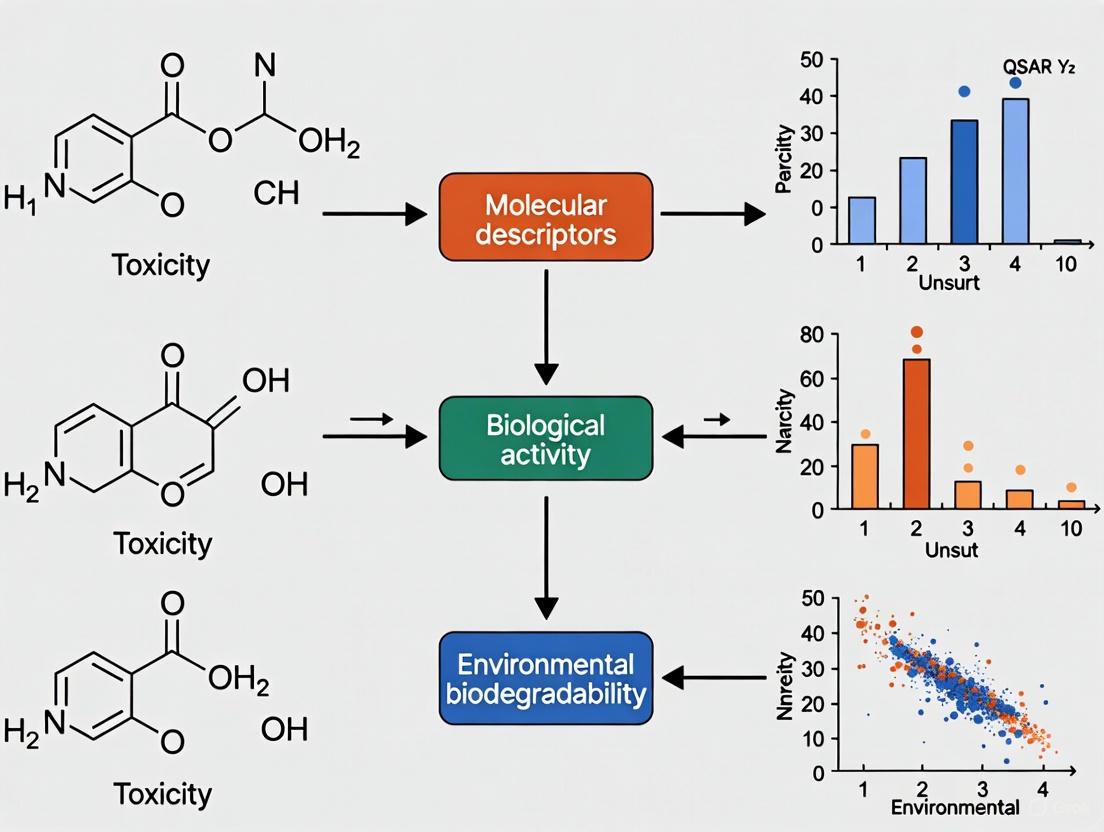
This article provides a comprehensive overview of Quantitative Structure-Activity Relationship (QSAR) models for assessing the environmental impact and toxicity of chemical substances.
QSAR Models for Environmental Chemicals: Principles, Applications, and Regulatory Validation
Abstract
This article provides a comprehensive overview of Quantitative Structure-Activity Relationship (QSAR) models for assessing the environmental impact and toxicity of chemical substances. Tailored for researchers, scientists, and drug development professionals, it explores the foundational principles of QSAR, detailing key methodologies and their practical applications in predicting chemical persistence, bioaccumulation, and toxicity. The content addresses common challenges in model development, such as data quality and applicability domain definition, and outlines the OECD validation framework essential for regulatory acceptance. By synthesizing current research and emerging trends, including machine learning integration, this guide serves as a critical resource for leveraging QSAR in the development of safer chemicals and robust environmental risk assessments.
Understanding QSAR: Core Concepts and the Drive Toward New Approach Methodologies (NAMs)
Quantitative Structure-Activity Relationship (QSAR) modeling represents a cornerstone of computational chemistry and toxicology, establishing statistically significant correlations between chemical structures and their biological activities, physicochemical properties, or environmental fate parameters [1]. These in silico methodologies have gained substantial importance in environmental chemicals research, particularly as regulatory requirements increasingly prioritize animal-free testing approaches under initiatives like the European Chemicals Strategy for Sustainability [2]. The fundamental premise of QSAR is that molecular structure encodes information that determines how chemicals interact with biological systems and environmental compartments, enabling researchers to predict properties of untested compounds based on structural similarities to well-characterized analogues.
The historical development of QSAR dates to the early 1960s, with the pioneering work of Hansch and Fujita establishing the foundation for correlating biological activity with physicochemical parameters [1]. Over nearly five decades of maturation, QSAR modeling has evolved into a disciplined research area characterized by well-defined protocols and procedures for expert application to growing chemical libraries [3]. In environmental research, QSAR approaches are particularly valuable for addressing data gaps for cosmetic ingredients, industrial chemicals, and potential endocrine disruptors where traditional testing may be impractical, ethically concerning, or economically prohibitive [4] [2].
Molecular Descriptors: The Building Blocks of QSAR
Molecular descriptors serve as the quantitative foundation of QSAR models, translating structural information into numerical values that can be correlated with biological activity or chemical properties. These descriptors encompass diverse aspects of molecular structure, from simple atom counts to complex quantum-chemical calculations [5].
Table 1: Categories and Examples of Molecular Descriptors in QSAR Modeling
| Descriptor Category | Representative Examples | Computational Method | Interpretation |
|---|---|---|---|
| Constitutional | Molecular weight, atom counts, H-bond acceptors/donors | Empirical formulas based on structure and connectivity | Molecular size and composition |
| Electronic | HOMO/LUMO energies, dipole moment | Quantum chemical calculations (ab initio, semi-empirical) | Reactivity and charge distribution |
| Geometric | Molecular volume, surface area | Molecular mechanics or semi-empirical methods | Steric properties and shape |
| Topological | Connectivity indices, path counts | Graph theory applied to molecular structure | Branching patterns and molecular complexity |
| Hydrophobic | logP (octanol-water partition coefficient) | Fragment contribution methods (e.g., KOWWIN) | Solubility and membrane permeability |
The HOMO (Highest Occupied Molecular Orbital) and LUMO (Lowest Unoccupied Molecular Orbital) energies represent particularly insightful electronic descriptors according to Frontier Orbital Theory. Molecules with accessible (near-zero) HOMO levels tend to be good nucleophiles, while those with low LUMO energies typically function as good electrophiles [5]. Similarly, polarizability descriptors characterize how readily molecular charge distribution distorts in response to electromagnetic fields, influencing London dispersion forces that affect binding interactions in biological systems [5].
For complex environmental chemicals, descriptor selection must align with the endpoint being modeled. For instance, hydrophobic descriptors like logP prove critical for predicting bioaccumulation potential, while electronic descriptors may better correlate with metabolic persistence or receptor-binding affinity [4] [2].
QSAR Model Development Workflow
The development of robust, predictive QSAR models follows a structured workflow emphasizing statistical rigor and external validation [3]. This process integrates multiple stages from data collection through model deployment, with particular attention to applicability domain definition and uncertainty quantification.
Figure 1: QSAR Model Development and Validation Workflow
Data Preparation and Curation
The initial phase involves assembling a high-quality dataset of chemical structures with associated experimental values for the target endpoint. Data curation addresses structure standardization, identifier conflicts, and outlier detection to ensure dataset consistency [3]. For environmental applications, this may involve compiling biodegradation rates, bioaccumulation factors (BCF), or toxicity values from reliable sources. Dataset balancing techniques address unequal representation of active versus inactive compounds, which can significantly impact model performance [3] [1].
Molecular Descriptor Calculation and Selection
Following data curation, molecular descriptors are calculated using specialized software. These may range from simple constitutional descriptors to quantum-chemical properties requiring substantial computational resources [5]. Descriptor selection techniques identify the most informative, non-redundant parameters to avoid overfitting, especially critical for small datasets common in environmental chemical research [2] [1]. For predicting thyroid hormone system disruption, for example, descriptors reflecting electronic properties and molecular size often prove most relevant to receptor-binding interactions [2].
Model Training and Validation
The core modeling phase applies statistical or machine learning algorithms to establish quantitative relationships between selected descriptors and the target property. Internal validation using techniques like cross-validation assesses model stability, while external validation with completely independent test sets provides the truest measure of predictive power [3]. The applicability domain (AD) definition establishes the chemical space where model predictions can be considered reliable, a critical component for regulatory acceptance [4] [6]. Models must demonstrate both statistical significance and mechanistic interpretability to gain scientific acceptance, particularly for environmental hazard assessment [3] [6].
Experimental Protocols for QSAR Modeling
Protocol: HOMO Energy Calculation for Aromatic Compounds
This protocol details the calculation of HOMO energies as electronic descriptors for QSAR modeling of aromatic environmental chemicals, adapted from computational chemistry tutorials [5].
- Structure Building: Construct the molecular structure using a molecular builder interface (e.g., MOLDEN's ZMAT Editor). For substituted aromatics, build a phenyl ring and use the "Substitute atom by Fragment" function to add specific substituents.
- Quantum Chemical Calculation Setup: Select an ab initio quantum chemistry program (e.g., Gaussian, Firefly/PC GAMESS). Set the calculation method to geometry optimization with a standard basis set (e.g., 6-31G*).
- Job Execution and Monitoring: Submit the calculation job and monitor progress by examining the log file. For aromatic compounds of moderate size, computation typically requires several minutes.
- Result Extraction: Upon completion, open the output file and load the optimized geometry. Access the orbital analysis module to visualize the HOMO and record its energy value (reported in atomic units, typically Hartrees).
- Comparative Analysis: Repeat the procedure for structurally related compounds and compare HOMO energies to determine relative reactivity as electron donors, which may correlate with metabolic transformation rates or electrophilic toxicity.
Protocol: Polarizability Calculation for Bioaccumulation Assessment
Molecular polarizability serves as a valuable descriptor for predicting bioaccumulation potential and hydrophobic interactions in environmental fate modeling [5].
- Initial Structure Preparation: Obtain the 3D structure of the target compound either by building it manually or converting from SMILES notation using online translation tools. Save the structure as a 3D MOL file.
- Semi-empirical Calculation Configuration: Read the structure into computational software (e.g., MOLDEN) and select a semi-empirical method (e.g., MOPAC with PM6 parameter set) for efficient calculation of larger molecules.
- Polarizability-Specific Keywords: Set the calculation task to "Geometry Optimization" and include specific keywords (XYZ, STATIC, POLAR) in the job options to request polarizability calculation.
- Job Execution: Submit the calculation job. For typical drug-sized molecules, semi-empirical calculations generally complete within 20-60 seconds.
- Data Extraction: Examine the output file for the polarizability tensor components. Record the mean polarizability volume, reported in cubic Ångströms (ų), for use as a molecular descriptor in bioaccumulation QSAR models.
Applications in Environmental Chemicals Research
QSAR modeling has become indispensable for environmental hazard assessment, particularly for chemical categories where experimental data is limited or animal testing restrictions apply. The European Union's ban on animal testing for cosmetics has accelerated development and application of QSAR approaches for predicting environmental fate parameters of cosmetic ingredients [4].
Table 2: Recommended QSAR Models for Environmental Fate Assessment of Cosmetic Ingredients
| Environmental Fate Parameter | Recommended QSAR Models | Software Platform | Key Application Notes |
|---|---|---|---|
| Persistence (Biodegradation) | Ready Biodegradability IRFMN | VEGA | Higher performance for qualitative classification |
| BIOWIN | EPISUITE | Quantitative prediction with applicability domain | |
| Leadscope model | Danish QSAR Model | Regulatory acceptance under REACH | |
| Bioaccumulation (log Kow) | ALogP | VEGA | Direct measurement surrogate |
| KOWWIN | EPISUITE | Fragment-based method | |
| ADMETLab 3.0 | Standalone | Integrated platform with multiple descriptors | |
| Bioaccumulation (BCF) | Arnot-Gobas | VEGA | Mechanistic model approach |
| KNN-Read Across | VEGA | Similarity-based prediction | |
| Mobility (log Koc) | OPERA v. 1.0.1 | VEGA | Multiple parameter prediction |
| KOCWIN-Log Kow | VEGA | Hydrophobicity-based estimation |
For persistence assessment, the Ready Biodegradability model (VEGA), Leadscope model (Danish QSAR Database), and BIOWIN (EPISUITE) have demonstrated highest performance for cosmetic ingredients [4]. These models typically provide more reliable qualitative predictions (classifying compounds as biodegradable or persistent) than quantitative degradation rate estimates, especially when predictions fall within well-defined applicability domains [4].
In bioaccumulation assessment, multiple models address different aspects of this complex endpoint. For the log P (log Kow) parameter, ALogP (VEGA), ADMETLab 3.0, and KOWWIN (EPISUITE) models have shown particular relevance for cosmetic ingredients [4]. For bioconcentration factor (BCF) prediction, the Arnot-Gobas model (VEGA) incorporates mechanistic understanding of fish physiology, while the KNN-Read Across model (VEGA) applies similarity-based approaches [4].
For mobility assessment in soil systems, VEGA's OPERA and KOCWIN-Log Kow estimation models provide reliable predictions of the soil organic carbon-water partition coefficient (Koc), a key parameter determining chemical movement in terrestrial environments [4].
Table 3: Essential Software and Databases for Environmental QSAR Research
| Resource Name | Type | Key Functionality | Environmental Application Examples |
|---|---|---|---|
| VEGA | Integrated QSAR Platform | Multiple validated models for toxicity and environmental fate | Persistence, bioaccumulation, and mobility prediction for cosmetic ingredients [4] |
| EPISUITE | Software Suite | Physicochemical property and environmental fate prediction | KOWWIN for log P, BIOWIN for biodegradation prediction [4] |
| Danish QSAR Model | Database | Regulatory-focused QSAR predictions | Leadscope model for persistence assessment [4] |
| ADMETLab 3.0 | Web Platform | Integrated ADMET property prediction | log Kow prediction for bioaccumulation assessment [4] |
| MOLDEN | Visualization Interface | Molecular modeling and quantum chemistry calculations | HOMO/LUMO energy and polarizability calculations for descriptor generation [5] |
| OECD QSAR Toolbox | Regulatory Assessment | Grouping of chemicals and read-across | Regulatory hazard assessment for data-poor chemicals [6] |
Regulatory Framework and Future Perspectives
The regulatory acceptance of QSAR predictions continues to evolve, with the OECD (Q)SAR Assessment Framework (QAF) providing structured guidance for evaluating scientific rigor and establishing confidence in model predictions [6]. The QAF establishes principles for assessing both QSAR models and individual predictions, emphasizing transparent evaluation of uncertainties while maintaining flexibility for different regulatory contexts [6].
Machine learning approaches are increasingly dominating the QSAR landscape, with bibliometric analyses revealing exponential growth in publications since 2015, dominated by environmental science applications [7]. Algorithm development clusters around XGBoost, random forests, and support vector machines, with a distinct risk assessment cluster indicating migration of these tools toward dose-response and regulatory applications [7].
Future directions in environmental QSAR modeling include expanding chemical domain coverage, systematically coupling ML outputs with human health data, adopting explainable artificial intelligence workflows, and fostering international collaboration to translate computational advances into actionable chemical risk assessments [7]. As the field progresses, integration of QSAR with adverse outcome pathway (AOP) frameworks will strengthen mechanistic understanding and regulatory acceptance, particularly for complex endpoints like thyroid hormone system disruption [2].
The European Union's Registration, Evaluation, Authorisation and Restriction of Chemicals (REACH) regulation is undergoing a fundamental transformation, shifting from traditional animal testing toward advanced non-animal methodologies. This paradigm shift is driven by a powerful combination of ethical imperatives, scientific advancements, and regulatory policy changes. Central to this transition are Quantitative Structure-Activity Relationship (QSAR) models and other New Approach Methodologies (NAMs), which enable researchers to predict chemical toxicity and fill critical data gaps without animal use. The European Chemicals Agency (ECHA) has committed to a structured phase-out, with a roadmap aiming to revise REACH information requirements by 2026 to explicitly accept non-animal-derived data [8]. This technical guide examines the regulatory framework, computational tools, and experimental strategies essential for navigating this transition, providing researchers and regulatory professionals with a comprehensive toolkit for implementing animal-free safety assessments compliant with evolving REACH requirements.
The Driving Forces: Regulatory and Ethical Framework
The regulatory landscape for chemical safety assessment is evolving rapidly toward eliminating animal testing, creating both imperatives and opportunities for research and industry professionals.
EU Policy and Legislative Timeline
The European Union has established a long-standing policy of replacing, reducing, and refining animal testing (the 3Rs principles) [9]. Key legislative milestones include Directive 2010/63/EU, which sets the explicit goal of phasing out animal use for research and regulatory purposes in the EU as soon as scientifically possible [9]. The European Commission is now preparing a detailed "Roadmap Towards Phasing Out Animal Testing for Chemical Safety Assessments" with the intention to publish this comprehensive plan by the first quarter of 2026 at the latest [9]. This roadmap will outline specific milestones and actions to be implemented in the short to longer term, serving as a prerequisite for transitioning toward an animal-free regulatory system.
REACH Requirements and Animal Testing as Last Resort
Under REACH, animal tests must be conducted only as a last resort when all other means to generate necessary information have been exhausted [10]. The regulation mandates a specific data gathering strategy where registrants must first collect all available existing information, consider their specific information needs based on tonnage bands, identify missing information (data gaps), and only then generate new information [10]. The practical implementation of this strategy requires that for tests on environmental or human health properties, any new testing must use GLP-certified laboratories if animal testing is ultimately necessary, though this requirement does not apply to physicochemical testing [10].
Global Regulatory Alignment and Initiatives
This transition is not isolated to the EU. The U.S. Food and Drug Administration (FDA) has announced plans to phase out animal testing requirements for monoclonal antibodies and other drugs, promoting the use of AI-based computational models, cell lines, and organoid toxicity testing [11]. Similarly, the U.S. Environmental Protection Agency (EPA) is incorporating NAMs into regulatory decisions, using approaches such as high-throughput transcriptomics, harmful outcome pathways, and high-throughput toxicokinetics for chemical assessments [12]. China has also begun allowing alternative methods for certain product categories, such as imported cosmetics, indicating a global shift in regulatory toxicology paradigms [8].
Computational Tools and QSAR Modeling for Data Gap Filling
Computational methods, particularly QSAR models, provide powerful approaches for filling data gaps without animal testing. These methodologies leverage existing chemical data to predict toxicity endpoints for new substances.
Fundamental Principles of QSAR Modeling
QSAR models mathematically link a chemical compound's structure to its biological activity or properties based on the fundamental principle that structural variations directly influence biological activity [13]. These models use physicochemical properties and molecular descriptors of chemicals as predictor variables, with biological activity or other chemical properties serving as response variables [13]. The general mathematical expression for this relationship is:
Activity = f(descriptors) + ϵ
Where "descriptors" are numerical representations of molecular structures, and "ϵ" represents the error not explained by the model [13]. QSAR modeling plays a crucial role in prioritizing compounds for further development, predicting properties, guiding chemical modifications, and most importantly, reducing animal testing by serving as validated alternatives in regulatory frameworks [13].
QSAR Model Development Workflow
Developing robust QSAR models requires a systematic workflow to ensure predictive reliability and regulatory acceptance:
- Dataset Compilation: Curate a high-quality dataset of chemical structures with associated biological activities from reliable sources, ensuring diversity and relevance to the chemical space of interest [13].
- Descriptor Calculation: Compute molecular descriptors that quantify structural, physicochemical, and electronic properties using software tools such as PaDEL-Descriptor, Dragon, or RDKit [13].
- Feature Selection: Apply selection techniques (filter, wrapper, or embedded methods) to identify the most relevant descriptors and avoid model overfitting [13].
- Model Building: Implement appropriate algorithms including Multiple Linear Regression (MLR), Partial Least Squares (PLS), Support Vector Machines (SVM), or Neural Networks (NN) based on dataset characteristics [13].
- Validation: Assess model performance using internal validation (cross-validation) and external validation with an independent test set [13].
- Applicability Domain: Define the chemical space where the model can make reliable predictions [13].
The following workflow diagram illustrates the QSAR model development process:
The OECD QSAR Toolbox: A Key Regulatory Tool
The OECD QSAR Toolbox is a freely available software application that supports reproducible and transparent chemical hazard assessment [14]. It offers critical functionalities for regulatory compliance under REACH:
- Data Retrieval: Access to approximately 63 databases covering over 155,000 chemicals and 3.3 million experimental data points [14].
- Metabolism Simulation: Capability to simulate metabolism and transformation products across different organisms and conditions [14].
- Analogue Identification: Functionality to find structurally and mechanistically defined analogues for read-across justification [14].
- Category Building: Tools to build and assess chemical categories for read-across and trend analysis [14].
- Data Gap Filling: Modules for filling data gaps using read-across, trend analysis, or external QSAR models [14].
- Reporting: Automated generation of assessment reports to ensure transparency and regulatory acceptance [14].
The Toolbox has been downloaded over 30,000 times globally, with significant adoption across Europe, Asia, and North America, indicating its widespread regulatory acceptance [14].
Advanced Machine Learning Approaches
Beyond traditional QSAR, advanced machine learning solutions like DeepAutoQSAR provide automated, scalable platforms for training and applying predictive machine learning models [15]. These systems offer key capabilities including automated descriptor computation and model building with multiple machine learning architectures, customization with project-specific descriptors, uncertainty estimation for domain of applicability assessment, and visualization of atomic contributions toward target properties [15]. Such advanced platforms support both classical ML methods for smaller datasets and modern deep learning approaches for large-scale QSAR modeling, making them particularly valuable for complex toxicity endpoints [15].
Experimental Protocols and Alternative Methods
While computational approaches are essential, integrated testing strategies often incorporate advanced non-animal experimental methods for toxicity assessment.
Validated Alternative Methods for Key Endpoints
Substantial progress has been made in validating alternative methods for specific toxicity endpoints relevant to REACH. The table below summarizes key validated methods and their regulatory status:
Table 1: Validated Non-Animal Methods for Key Toxicity Endpoints
| Toxicity Endpoint | Method Name | Test Type | Regulatory Acceptance |
|---|---|---|---|
| Skin Corrosion | Reconstructed Human Epidermis (RHE) tests: Episkin, Epiderm, SkinEthic | In vitro | OECD TG 431 [16] |
| Skin Irritation | Reconstructed Human Epidermis methods: Episkin, LabCyte EPI-MODEL24 | In vitro | OECD TG 439 [16] |
| Skin Sensitization | ARE-Nrf2 Luciferase Test (KeratinoSens) | In vitro | OECD TG 442D [16] |
| Skin Sensitization | Direct Peptide Reactivity Assay (DPRA) | In chemico | OECD TG 442C [16] |
| Skin Sensitization | Human Cell Line Activation Test (h-CLAT) | In vitro | OECD TG 442C [16] |
| Developmental Toxicity | Embryonic Stem Cell Test | In vitro | ESAC (2002) [16] |
| Eye Irritation | Bovine Corneal Opacity and Permeability (BCOP) | In vitro | OECD TG 437 [16] |
| Eye Irritation | Isolated Chicken Eye (ICE) | Ex vivo | OECD TG 438 [16] |
Protocol: Skin Sensitization Assessment Using Integrated Testing Strategies
Skin sensitization is one of the most advanced areas for non-animal assessment. The following protocol outlines an integrated approach to skin sensitization testing:
Objective: To assess the skin sensitization potential of a chemical without animal testing, following the Adverse Outcome Pathway (AOP) for skin sensitization.
Principle: This Integrated Approach to Testing and Assessment (IATA) combines multiple non-animal methods to cover key events in the skin sensitization AOP: molecular initiation (protein binding), cellular response (keratinocyte activation), and immune response (dendritic cell activation) [16].
Procedure:
Sample Preparation: Prepare test chemical at appropriate concentrations in suitable solvents based on solubility and chemical stability.
Direct Peptide Reactivity Assay (DPRA):
- Incubate test chemical with synthetic peptides containing either cysteine or lysine.
- Use HPLC to measure peptide depletion after 24 hours.
- Classify reactivity based on mean peptide depletion: <6.38% (low), 6.38-22.62% (moderate), >22.62% (high).
KeratinoSens Assay:
- Expose recombinant KeratinoSens cells (containing an antioxidant response element linked to luciferase reporter) to test chemical.
- Measure luciferase activity after 48 hours.
- Determine EC1.5 value (concentration causing 1.5-fold induction) and evaluate cell viability.
Human Cell Line Activation Test (h-CLAT):
- Expose THP-1 cells (human monocytic leukemia cell line) to test chemical.
- Measure expression of CD86 and CD54 surface markers by flow cytometry after 24 hours.
- Determine CV75 (concentration causing 75% cell viability) and evaluate marker expression.
Data Integration:
- Combine results from all three assays using a predefined decision tree or weight-of-evidence approach.
- Classify chemicals as sensitizers (subcategorized as weak, moderate, or strong) or non-sensitizers.
This integrated approach has been shown to provide accuracy comparable to the traditional Local Lymph Node Assay (LLNA) while eliminating animal use [16].
New Approach Methodologies (NAMs) in Development
Beyond validated methods, numerous NAMs are under development and evaluation for more complex toxicity endpoints:
- Organ-on-a-Chip Systems: Microfluidic devices containing human cells that simulate organ function and response, showing particular promise for repeated dose toxicity assessment [12].
- High-Content Imaging and Transcriptomics: Approaches using high-throughput gene expression profiling to predict toxicological outcomes, with applications in neurodevelopmental toxicity and endocrine disruption [12].
- Stem Cell-Based Assays: Methods using human embryonic stem cells or induced pluripotent stem cells to model developmental toxicity and organ-specific effects [12].
- Computational Toxicokinetics: Approaches like high-throughput toxicokinetic (HTTK) modeling that combine in vitro metabolism data with physiological models to predict in vivo chemical concentrations [12].
The following diagram illustrates the integrated testing strategy for skin sensitization:
The Scientist's Toolkit: Essential Research Reagents and Platforms
Successful implementation of animal-free testing strategies requires specific research tools and platforms. The table below details essential resources for building a non-animal toxicology laboratory:
Table 2: Essential Research Tools for Animal-Free Chemical Assessment
| Tool/Platform | Type | Key Function | Regulatory Relevance |
|---|---|---|---|
| OECD QSAR Toolbox | Software | Data retrieval, read-across, category formation | REACH compliance for data gap filling [14] |
| Reconstructed Human Epidermis (RhE) Models | In vitro test system | Skin corrosion/irritation testing | OECD TG 431, 439 [16] |
| KeratinoSens Cell Line | In vitro test system | Detection of skin sensitizers via Nrf2 activation | OECD TG 442D [16] |
| THP-1 Cell Line | In vitro test system | Detection of dendritic cell activation in skin sensitization | OECD TG 442E [16] |
| DeepAutoQSAR | Machine learning platform | Automated QSAR model training and prediction | Predictive toxicology for complex endpoints [15] |
| Organ-on-a-Chip Systems | Advanced in vitro model | Repeated dose toxicity assessment | Next-generation risk assessment [12] |
| Metabolomic Platforms | Analytical technology | Biomarker discovery and pathway analysis | Mechanistic toxicology [12] |
Implementation Strategy and Change Management
Transitioning to animal-free testing requires careful planning and organizational commitment. ECHA has established a Change Management Working Group (CM WG) specifically to address these implementation challenges [9]. This group develops indicators to monitor progress toward replacing animal testing and creates collaboration models to promote trust among stakeholders and build confidence in non-animal assessment strategies [9].
Data Gathering Strategy Under REACH
A systematic, tiered approach to data gathering ensures compliance with REACH while minimizing animal testing:
- Collect Available Information: Gather all existing study results, scientific literature, and handbook data on the substance [10].
- Evaluate Information Needs: Identify specific information requirements based on tonnage bands and regulatory mandates [10].
- Identify Data Gaps: Compare existing information with requirements to determine missing data [10].
- Prioritize Non-Animal Methods: Implement QSAR, read-across, and in vitro methods before considering any animal testing [10].
This strategy ensures that animal testing remains truly a last resort, as required by REACH legislation.
Read-Across and Category Approaches
Read-across is a powerful data gap filling technique where properties of a data-poor "target" substance are predicted from similar, data-rich "source" substances [14]. The OECD QSAR Toolbox facilitates this approach through:
- Mechanistic Profiling: Identifying chemicals that share the same toxicological mechanisms based on structural alerts [14].
- Metabolic Similitude: Grouping chemicals that share common metabolic pathways or transformation products [14].
- Empirical Data Analysis: Building categories based on experimental data patterns across multiple endpoints [14].
Successful read-across requires rigorous justification of category consistency and documented scientific rationale to ensure regulatory acceptance.
Overcoming Implementation Barriers
The transition to animal-free testing presents several challenges that organizations must address:
- Technical Complexity: Some toxicity endpoints, particularly reproductive toxicity and repeated dose toxicity, involve complex biological interactions that are difficult to model with current non-animal methods [8].
- Regulatory Validation: The process for validating new alternative methods can be time-consuming, though initiatives like the EPA's coordination on NAMs are accelerating this timeline [11].
- Expertise Development: Implementing alternative approaches requires multidisciplinary expertise in computational toxicology, cell biology, and regulatory science [9].
- Cost Considerations: While alternative methods generally reduce long-term testing costs, initial implementation requires investment in technology, training, and method transfer [8].
The regulatory imperative to reduce animal testing under REACH is accelerating, driven by scientific advances and ethical considerations. Several key developments will shape the future landscape:
Roadmap Implementation and Timeline
The EU's detailed roadmap for phasing out animal testing, scheduled for publication by Q1 2026, will establish specific milestones and actions for transitioning to animal-free regulatory systems [9]. This includes the revision of REACH information requirements by 2026 to enable explicit acceptance of non-animal-derived data [8]. While complete elimination of animal testing for complex endpoints may extend into the 2030s, the direction is clear and irreversible [8].
Scientific and Technological Advancements
Emerging technologies will continue to enhance the toolbox available for animal-free safety assessment:
- Advanced Organ-on-a-Chip Systems: Multi-organ platforms that enable the study of complex toxicological interactions [12].
- High-Resolution Transcriptomics: Methods for detecting subtle biological changes that predict adverse outcomes at earlier timepoints [12].
- Artificial Intelligence and Machine Learning: Enhanced prediction models that integrate diverse data sources including chemical structures, biological pathways, and existing toxicological data [15].
- Human Biomonitoring Integration: Approaches that incorporate real-world human exposure data into safety assessment [11].
Global Harmonization
International alignment on alternative methods will be crucial for global chemical management. Organizations such as the OECD play a vital role in harmonizing test guidelines and validation processes across regions [8]. The increasing acceptance of NAMs by regulatory agencies in the United States, Asia, and other regions suggests that the transition away from animal testing will continue to gain global momentum [8] [11].
In conclusion, the regulatory imperative to reduce animal testing under REACH represents both a significant challenge and opportunity for the scientific community. By embracing QSAR modeling, New Approach Methodologies, and integrated testing strategies, researchers can not only meet regulatory requirements but also advance the science of toxicology toward more human-relevant, predictive, and efficient safety assessment. The successful implementation of these approaches requires continued collaboration between researchers, regulators, and industry stakeholders to build confidence in animal-free methods while maintaining rigorous safety standards for chemical protection of human health and the environment.
Quantitative Structure-Activity Relationship (QSAR) modeling represents a computational approach that mathematically links a chemical compound's molecular structure to its biological activity or physicochemical properties [13]. These models operate on the fundamental principle that structural variations directly influence biological activity, enabling researchers to predict the behavior of untested chemicals based on their structural characteristics [13]. In environmental chemicals research, QSAR models have become indispensable tools for screening, ranking, and prioritizing chemicals that may pose hazards to humans and ecosystems, thereby supporting regulatory decision-making while reducing reliance on animal testing [17] [18]. The robustness of QSAR modeling stems from its ability to transform molecular structures into numerical descriptors, establish quantitative relationships between these descriptors and biological endpoints, and apply these relationships for predictive purposes across chemical classes [13].
The evolution of QSAR methodologies has progressed from traditional linear models based solely on chemical descriptors to advanced hybrid approaches that incorporate both chemical and biological information [18]. Recent innovations include Bio-QSARs that exploit biological information for exceptional predictive power in ecotoxicity assessment [18] and QSAR-QSIIR (Quantitative Structure In vitro-In vivo Relationship) models that bridge in vitro and in vivo data for more accurate predictions of parameters like bioconcentration factors [19]. These advancements, coupled with the integration of machine learning algorithms, have significantly expanded the applicability and reliability of QSAR models in environmental research.
Molecular Descriptors in QSAR
Definition and Fundamental Role
Molecular descriptors are numerical representations that quantify the structural, physicochemical, and electronic properties of molecules [13]. They serve as the independent variables in QSAR models, providing the quantitative foundation that links molecular structure to biological activity or environmental behavior. By encoding chemical information into mathematical form, descriptors enable the statistical identification of patterns that would be impossible to discern through chemical intuition alone. The selection and calculation of appropriate descriptors is therefore critical to developing robust QSAR models, as they must capture the structural features relevant to the endpoint being predicted [13].
Comprehensive Classification of Molecular Descriptors
Molecular descriptors can be categorized into several distinct classes based on the molecular properties they represent. The table below summarizes the primary descriptor types used in QSAR modeling for environmental research:
Table 1: Classification of Molecular Descriptor Types in QSAR Modeling
| Descriptor Type | Description | Examples | Applications in Environmental Research |
|---|---|---|---|
| Constitutional | Describe molecular composition without connectivity | Molecular weight, atom counts, bond counts | Preliminary screening of chemical inventories |
| Topological | Based on molecular connectivity and branching patterns | Molecular connectivity indices, Wiener index | Predicting bioavailability and degradation |
| Electronic | Characterize electron distribution and reactivity | Partial charges, HOMO/LUMO energies, dipole moment | Modeling reactivity in toxicological pathways |
| Geometric | Describe 3D molecular shape and size | Molecular volume, surface area, principal moments of inertia | Assessing receptor binding and transport properties |
| Thermodynamic | Quantify energy-related properties | Log P (octanol-water partition coefficient), solubility, vapor pressure | Predicting environmental fate, distribution, and bioaccumulation |
The octanol-water partition coefficient (Log P) exemplifies a critically important thermodynamic descriptor in environmental QSARs, as it directly influences a chemical's potential for bioaccumulation and biomagnification in food chains [4]. Recent studies have highlighted Log P as a key predictor in bioconcentration factor (BCF) models, with tools like ALogP (VEGA), ADMETLab 3.0, and KOWWIN (EPISUITE) showing particularly strong performance for this descriptor [4].
Descriptor Calculation and Selection Methods
The calculation of molecular descriptors employs specialized software tools that transform chemical structures into numerical representations. Commonly used platforms include PaDEL-Descriptor, Dragon, RDKit, Mordred, ChemAxon, and OpenBabel [13]. These tools can generate hundreds to thousands of descriptors for a given molecule, necessitating careful selection to avoid overfitting and improve model interpretability.
Feature selection techniques employed in QSAR modeling include:
- Filter Methods: Descriptors are ranked based on their individual correlation or statistical significance with the endpoint [13].
- Wrapper Methods: The modeling algorithm evaluates different descriptor subsets to identify the most informative combination [13].
- Embedded Methods: Feature selection occurs intrinsically during model training, as implemented in LASSO regression or random forests [13].
Optimized descriptor selection is exemplified in recent QSAR-QSIIR research, where investigators selected 17 traditional molecular descriptors and 5 bioactivity descriptors from an initial pool of more than 200 molecular descriptors and 25 biological activity descriptors to construct highly accurate bioconcentration factor prediction models [19].
Endpoints in Environmental QSAR
Defining Endpoints and Their Regulatory Significance
In QSAR modeling, endpoints represent the measurable biological activities, toxicological effects, or physicochemical properties that models aim to predict [13]. For environmental research, these endpoints typically reflect key processes in chemical fate, transport, exposure, and effects on biological systems. Endpoints serve as the dependent variables in QSAR models and are directly linked to regulatory requirements for chemical risk assessment under frameworks such as REACH (Registration, Evaluation, Authorisation and Restriction of Chemicals) and CLP (Classification, Labeling and Packaging) [4].
Critical Endpoint Categories for Environmental Assessment
Environmental QSAR models address endpoints spanning multiple disciplinary domains, from physicochemical properties to ecological and human health effects. The following table systematizes the primary endpoint categories relevant to environmental chemicals research:
Table 2: Key Endpoint Categories in Environmental QSAR Modeling
| Endpoint Category | Specific Endpoints | Regulatory Relevance | Example Models |
|---|---|---|---|
| Physicochemical Properties | Log P, water solubility, vapor pressure, soil adsorption coefficient (Koc) | Environmental fate assessment, exposure modeling | OPERA, KOCWIN [4] |
| Environmental Fate & Transport | Biodegradation, photodegradation, hydrolysis, persistence | PBT assessment (Persistence, Bioaccumulation, Toxicity) | BIOWIN, Ready Biodegradability IRFMN [4] |
| Bioaccumulation | Bioconcentration Factor (BCF), Bioaccumulation Factor (BAF) | Chemical prioritization, trophic transfer assessment | Arnot-Gobas, KNN-Read Across [4], QSAR-QSIIR [19] |
| Ecotoxicological Effects | Aquatic toxicity (fish, daphnia, algae), terrestrial toxicity | Ecological risk assessment, safety thresholds | Bio-QSAR [18], TEST models [20] |
| Human Health Hazards | Acute toxicity, repeated dose toxicity, mutagenicity, carcinogenicity | Health risk assessment, chemical classification | TEST models [20], QSAR Toolbox profiles [14] |
The QSAR Toolbox exemplifies the comprehensive nature of modern endpoint prediction, incorporating 254 (Q)SAR models spanning 28 for physicochemical properties, 41 for environmental fate and transport, 39 for ecotoxicological information, and 146 for human health hazards [21].
Endpoint-Specific Methodological Considerations
Different endpoints require specialized modeling approaches. For bioaccumulation assessment, recent research demonstrates that hybrid QSAR-QSIIR models combining molecular descriptors with bioactivity descriptors achieve superior prediction accuracy for bioconcentration factors (BCF), with R² values of 0.8575 for verification sets and 0.7924 for test sets [19]. For persistence assessment, models like BIOWIN (EPISUITE) and the Ready Biodegradability IRFMN model (VEGA) have shown particularly strong performance for cosmetic ingredients and other chemical classes [4].
A critical consideration in endpoint prediction is the distinction between qualitative and quantitative predictions. Recent comparative studies suggest that qualitative predictions aligned with REACH and CLP regulatory criteria generally demonstrate higher reliability than quantitative predictions, particularly when the chemical being assessed falls within the model's applicability domain [4].
Biological Basis for QSAR Predictions
Fundamental Principles of Biological Prediction
The biological basis of QSAR predictions rests on the fundamental principle that a chemical's biological activity arises from its molecular structure and properties [13]. This structure-activity relationship enables the extrapolation of biological behavior from chemical characteristics, forming the conceptual foundation for all QSAR modeling. The biological relevance of QSAR predictions has evolved from simple correlative relationships to mechanistically grounded models informed by adverse outcome pathways (AOPs) and mode-of-action classifications [22] [20].
Modern QSAR implementations increasingly incorporate biological context through various strategies. The Bio-QSAR approach enhances predictive power by integrating biological information about target species alongside chemical descriptors, resulting in models with exceptional accuracy (R² up to 0.92) for aquatic toxicity prediction [18]. Similarly, mode-of-action based QSARs first classify chemicals by their toxicological mechanism before applying specific quantitative models, thereby incorporating biological context directly into the prediction framework [20].
Molecular Initiating Events and Adverse Outcome Pathways
At the most fundamental biological level, QSAR predictions often target molecular initiating events (MIEs) within adverse outcome pathways (AOPs) [22]. These MIEs represent the initial interaction between a chemical and biological macromolecules that triggers subsequent cascades of effects at higher levels of biological organization. For endocrine-disrupting chemicals, for instance, MIEs may include binding to hormone receptors, interference with hormone synthesis, or disruption of transport proteins [22].
Recent reviews have identified 86 different QSAR models specifically addressing thyroid hormone system disruption, focusing on MIEs such as receptor binding and transport protein interactions [22]. These models demonstrate the trend toward biologically mechanistic QSAR development that aligns with AOP frameworks to enhance regulatory utility and scientific validity.
Incorporating Biological Complexity in Next-Generation QSAR
Advanced QSAR methodologies now explicitly address biological complexity through several innovative approaches:
- Bio-QSARs: These models incorporate biological descriptors such as species taxonomy, physiological traits, and Dynamic Energy Budget parameters alongside chemical descriptors to enable both cross-chemical and cross-species predictions [18].
- QSAR-QSIIR Hybrid Models: By integrating quantitative structure-in vitro-in vivo relationships, these approaches bridge between high-throughput in vitro data and in vivo outcomes, improving prediction accuracy for complex endpoints like bioconcentration [19].
- Mixed-Effects Modeling: Techniques like Gaussian Process Boosting accommodate biological variability by combining tree-boosting with mixed-effects modeling, allowing for variable test durations and inter-species differences [18].
The biological basis of QSAR predictions continues to expand with the incorporation of metabolomic information, protein-binding specificities, and pathway-level effects, moving beyond single-target approaches to network-based assessments that better reflect biological systems complexity.
Integrated Workflow for QSAR Modeling
Comprehensive QSAR Methodology
The development of robust QSAR models follows a systematic workflow that integrates descriptor calculation, endpoint selection, and biological validation. The following diagram illustrates the key stages in this process:
Figure 1: QSAR Modeling Workflow
Experimental Protocols for Key QSAR Endpoints
Bioconcentration Factor (BCF) Prediction Protocol
The following protocol details the methodology for predicting bioconcentration factors using hybrid QSAR-QSIIR approaches as described in recent literature [19]:
Dataset Compilation: Curate a comprehensive dataset of chemicals with experimentally measured BCF values from peer-reviewed literature and regulatory sources. Ensure representation across diverse chemical classes and taxonomic groups.
Descriptor Calculation and Selection:
- Calculate an initial pool of >200 molecular descriptors using software such as Dragon or PaDEL-Descriptor.
- Compute bioactivity descriptors from high-throughput screening assays where available.
- Apply feature selection algorithms to identify the most predictive descriptor subset (typically 15-25 descriptors).
Model Training:
- Implement optimized machine learning algorithms such as 4-MLP (Multi-Layer Perceptron).
- Partition data into training (≈70%), verification (≈15%), and test sets (≈15%) using stratified sampling.
- Train multiple model architectures and select based on verification set performance.
Validation and Application:
- Perform internal validation through k-fold cross-validation (typically 5-10 folds).
- Conduct external validation using the hold-out test set.
- Calculate performance metrics (R², Q², RMSE) and compare against predefined acceptance criteria.
- Apply validated models to predict BCF for target chemicals (e.g., BTEX compounds in aquatic products).
Environmental Persistence Assessment Protocol
For predicting chemical persistence using QSAR models [4]:
Endpoint Classification: Classify chemicals according to regulatory persistence criteria (e.g., REACH definitions for water, soil, and sediment compartments).
Model Selection: Identify appropriate models based on chemical domain and endpoint specificity:
- Ready Biodegradability IRFMN model (VEGA) for rapid screening.
- BIOWIN model (EPISUITE) for comprehensive persistence assessment.
- Leadscope model (Danish QSAR) for mechanism-based evaluation.
Prediction and Interpretation:
- Execute predictions across multiple models where feasible.
- Apply applicability domain filters to identify reliable predictions.
- Generate consensus predictions from multiple models to reduce uncertainty.
- Classify chemicals according to regulatory thresholds (e.g., persistent, readily biodegradable).
Advanced Machine Learning Approaches in QSAR
Contemporary QSAR modeling employs diverse machine learning algorithms, each with specific strengths for different prediction tasks:
Table 3: Machine Learning Algorithms in QSAR Modeling
| Algorithm Type | Examples | Advantages | Limitations | Typical Applications |
|---|---|---|---|---|
| Linear Methods | Multiple Linear Regression (MLR), Partial Least Squares (PLS) | High interpretability, resistance to overfitting | Limited capacity for complex non-linear relationships | Single-mechanism chemical sets |
| Tree-Based Methods | Random Forest, Gradient Boosting | Handles non-linear relationships, robust to outliers | Lower interpretability, requires careful tuning | Heterogeneous chemical datasets |
| Neural Networks | Multi-Layer Perceptron (MLP), Deep Learning | Captures complex interactions, high predictive power | High computational demand, risk of overfitting | Large-scale chemical datasets |
| Hybrid Methods | Gaussian Process Boosting, Mixed-Effects ML | Accommodates hierarchical data, biological variability | Implementation complexity | Cross-species toxicity prediction [18] |
The hierarchical methodology implemented in the EPA's Toxicity Estimation Software Tool (TEST) exemplifies the integration of multiple algorithms, where predictions are generated through weighted averages of models applied to structurally similar chemical clusters [20].
Research Reagent Solutions: Essential Tools for QSAR Implementation
The practical implementation of QSAR modeling relies on specialized software tools and computational resources that constitute the essential "reagent solutions" for in silico research. The following table details key resources available to researchers:
Table 4: Essential Research Reagent Solutions for QSAR Modeling
| Tool Category | Specific Tools | Key Functionality | Application in Environmental QSAR |
|---|---|---|---|
| Descriptor Calculation | PaDEL-Descriptor, Dragon, RDKit | Generate molecular descriptors from chemical structures | Calculate 1D-3D molecular features for model development |
| Integrated QSAR Platforms | QSAR Toolbox, VEGA, TEST | Comprehensive workflows from data collection to prediction | Regulatory assessment, data gap filling for hazard endpoints [14] [20] |
| Specialized Prediction Tools | EPI Suite, ADMETLab 3.0, Danish QSAR | Endpoint-specific model implementation | Persistence, bioaccumulation, toxicity prediction [4] |
| Model Development Environments | R, Python (scikit-learn), Weka | Custom model building and validation | Algorithm implementation, feature selection, performance evaluation |
| Data Resources | QSAR Toolbox Databases (3.2M+ data points) | Experimental data for training and validation | Read-across, category development, model training [14] |
These tools collectively enable the entire QSAR workflow, from initial data collection and descriptor calculation through model development, validation, and application. The QSAR Toolbox deserves particular emphasis as it provides access to approximately 63 databases containing over 155,000 chemicals and 3.3 million experimental data points, making it an invaluable resource for environmental chemical assessment [14].
Molecular descriptors, biological endpoints, and the mechanistic basis for prediction constitute the foundational triad of QSAR modeling in environmental chemicals research. Molecular descriptors provide the quantitative translation of chemical structure into model-ready parameters, while endpoints represent the biological phenomena and environmental behaviors that models aim to predict. The biological basis connecting these elements continues to evolve from correlative relationships toward mechanistically grounded predictions informed by adverse outcome pathways and mode-of-action classification.
Contemporary QSAR methodologies have achieved significant advances through the integration of machine learning, the development of hybrid QSAR-QSIIR approaches, and the creation of biological-enhanced Bio-QSAR models. These innovations have substantially expanded the applicability domains and predictive power of QSAR models while enhancing their biological relevance. The systematic workflow encompassing data curation, descriptor selection, model training, and rigorous validation remains essential for developing reliable predictions.
As QSAR modeling continues to evolve, emerging trends point toward greater incorporation of biological complexity, expanded applicability domains, and increased integration with new approach methodologies (NAMs). These developments will further solidify the role of QSAR as an indispensable tool in environmental chemical assessment, supporting the transition toward more efficient, ethical, and mechanistically informed chemical safety evaluation.
The challenge of assessing the potential hazards of tens of thousands of chemicals in the environment with limited traditional toxicity data has driven a paradigm shift in toxicology. The Adverse Outcome Pathway (AOP) framework has emerged as a critical tool for organizing biological information to support chemical safety assessment [23] [24]. This conceptual framework provides a structured approach for connecting mechanistic data to adverse outcomes of regulatory concern, thereby enabling more predictive toxicology. Within the context of Quantitative Structure-Activity Relationship (QSAR) modeling for environmental chemicals research, AOPs offer a biologically-grounded scaffold for interpreting computational predictions [25]. By framing chemical perturbations within a causal pathway leading to adverse effects, the AOP framework bridges the gap between molecular interactions predicted by QSAR models and adverse outcomes relevant to risk assessors and regulators.
The AOP concept represents an evolution of prior pathway-based approaches, building upon mode of action (MOA) analysis to create a chemically-agnostic, modular framework for organizing toxicological knowledge [26]. Its development aligns with the vision of "Toxicity Testing in the 21st Century," which emphasizes the use of in vitro methods and computational approaches to increase the depth and breadth of toxicological information while reducing animal testing [26]. For QSAR modelers working with environmental chemicals, the AOP framework provides the contextual basis for relating chemical structure to biological activity across multiple levels of biological organization.
Core Concepts and Principles of the AOP Framework
Foundational Definitions and Components
An Adverse Outcome Pathway is a conceptual construct that depicts a sequential chain of causally linked events beginning with a molecular interaction and culminating in an adverse outcome relevant to risk assessment [23] [27]. The core components of an AOP include:
- Molecular Initiating Event (MIE): The initial point of chemical interaction with a biomolecule within an organism, such as a chemical binding to a specific receptor or enzyme [23] [27]. The MIE represents the direct interaction between a stressor (chemical or non-chemical) and a biological target.
- Key Events (KEs): Measurable biological changes that occur at different levels of biological organization (cellular, tissue, organ) following the MIE [23]. These events are essential for progression along the pathway.
- Key Event Relationships (KERs): Descriptions of the causal or predictive linkages between two key events, explaining how one event leads to the next [23] [27]. KERs are supported by evidence of biological plausibility, empirical support, and quantitative understanding.
- Adverse Outcome (AO): The adverse effect at the individual or population level that is relevant for regulatory decision-making, such as impaired reproduction, organ toxicity, or population decline [23] [27].
The AOP framework is intentionally chemically-agnostic, meaning that it describes biological response pathways that can be initiated by any stressor capable of interacting with the specified MIE [23] [26]. This separation of the biological pathway from specific chemical properties enables broader application and facilitates the use of AOPs for predicting effects of multiple chemicals sharing a common MIE.
The "Biological Dominos" Analogy and AOP Networks
The sequential nature of AOPs is often described using a "biological dominos" analogy [23]. In this analogy, the MIE represents the first domino in a sequence. If this initial interaction is sufficiently strong, it triggers a cascade of subsequent events (key events) at increasingly complex levels of biological organization, ultimately leading to the adverse outcome. Each key event is viewed as "essential," meaning if it does not occur, none of the downstream key events will follow [23].
While individual AOPs are often depicted as linear sequences, the framework accommodates biological complexity through AOP networks [23] [24]. These networks consist of multiple AOPs linked by shared key events and key event relationships, creating a more realistic representation of biological systems where pathways intersect and interact. As more AOPs are developed, these networks become increasingly comprehensive, capturing the complexity of real biological systems and enabling predictions of interactive effects between different stressors [23].
Table 1: Core Components of an Adverse Outcome Pathway
| Component | Definition | Example |
|---|---|---|
| Molecular Initiating Event (MIE) | Initial interaction between stressor and biomolecule | Chemical binding to estrogen receptor |
| Key Event (KE) | Measurable biological change at different organizational levels | Altered gene expression in liver cells |
| Key Event Relationship (KER) | Causal linkage between two key events | How altered gene expression leads to tissue damage |
| Adverse Outcome (AO) | Adverse effect relevant for regulatory decision-making | Impaired reproduction in fish populations |
Fundamental AOP Principles
The development and application of AOPs are guided by five fundamental principles that ensure scientific rigor and practical utility [23] [26]:
- AOPs are not stressor-specific: AOPs depict generalized sequences of biological effects that can be initiated by any stressor capable of interacting with the specified MIE, enabling application to multiple chemicals [23].
- AOPs are modular: Each AOP consists of units (key events) and linkages (key event relationships) that can be reassembled in different configurations, facilitating the construction of AOP networks [23].
- AOPs are living documents: As knowledge evolves, AOPs can be updated, refined, or expanded to incorporate new evidence and understanding [23].
- AOP networks are the functional unit for prediction: Individual AOPs are simplifications of biology, while networks of interconnected AOPs provide more realistic and comprehensive models for prediction [23].
- AOPs are tools for evaluating biological effects, not risk assessments: AOPs inform hazard identification but do not explicitly address exposure, which is required for complete risk assessment [23].
The AOP Framework and QSAR Modeling: A Strategic Integration
Bridging Molecular Interactions and Adverse Outcomes
The integration of QSAR modeling with the AOP framework creates a powerful approach for predicting chemical hazards [25]. QSAR models excel at predicting molecular interactions—precisely the types of events that serve as MIEs in AOPs. By positioning QSAR predictions within the context of an AOP, researchers can establish a causal connection between predicted molecular interactions and adverse outcomes of regulatory concern [25]. This integration addresses a fundamental challenge in computational toxicology: how to interpret molecular-level predictions in terms of meaningful adverse effects at the organism or population level.
The AOP framework simplifies complex systemic endpoints into discrete, measurable events at the molecular and cellular levels [25]. This simplification makes these endpoints more amenable to QSAR modeling, as relationships between chemical structure and these simpler events are often more straightforward to capture than relationships with complex apical outcomes [25]. For environmental chemicals research, this approach enables prioritization of chemicals based on their potential to initiate adverse outcome pathways, guiding targeted testing and risk assessment efforts.
AOP-Informed QSAR Model Development
The development of QSAR models for predicting MIE-related activity involves several methodological considerations [25]:
- Target Selection: AOP knowledge bases identify specific protein targets (receptors, enzymes, transporters) associated with MIEs upstream of adverse outcomes such as liver steatosis, cholestasis, nephrotoxicity, and developmental neurotoxicity [25].
- Bioactivity Data Curation: High-quality bioactivity data from sources like ChEMBL are curated and converted to binary classifications (active/inactive) based on standardized activity thresholds (e.g., 10,000 nM) [25].
- Model Building and Validation: Multiple machine learning algorithms are applied with comprehensive hyperparameter optimization, followed by rigorous external validation to assess predictive performance [25].
This approach has demonstrated strong predictive performance, with balanced accuracy exceeding 0.80 for most MIE targets, highlighting the utility of AOP-informed QSAR models for chemical screening and prioritization [25].
Quantitative AOPs: From Qualitative Description to Predictive Modeling
The Spectrum of Quantitative Approaches
While qualitative AOPs provide valuable conceptual frameworks, the development of quantitative AOPs (qAOPs) represents a critical advancement for predictive toxicology [28]. Quantitative AOPs incorporate mathematical relationships that describe how changes in the magnitude or timing of upstream key events predict changes in downstream events, ultimately enabling prediction of the adverse outcome under specific exposure conditions [28]. The continuum of quantitative approaches includes:
- Quantitative Key Event Relationships (qKERs): Mathematical models describing the relationship between two specific key events, which may take the form of regression equations, response-response relationships, or more complex computational models [28].
- Partial qAOPs: Quantitative models that describe relationships for more than one key event relationship within an AOP but not the entire pathway [28].
- Full qAOP models: Comprehensive mathematical constructs that model the dose-response or response-response relationships for all key event relationships in an AOP [28].
The selection of modeling approaches for qAOP development depends on the available data and the specific questions being addressed. Useful methods range from statistical models and Bayesian networks to ordinary differential equations and individual-based models [28].
Building Quantitative AOP Models
The development of qAOP models follows a systematic process [28]:
- Question Formulation: Clearly define the assessment problem and the level of biological fidelity needed for the model to support decision-making.
- Evaluation of Applicability Domain: Assess whether the biological domain of the AOP (species, life stages, biological organization) aligns with the assessment question.
- Model Structure Development: Define the mathematical relationships between key events based on existing knowledge and data.
- Parameterization: Estimate model parameters using available experimental data.
- Validation and Refinement: Test model predictions against independent data and refine as needed.
Toxicokinetic models play an essential role in qAOPs by linking external exposures to internal doses at the site of the MIE, enabling extrapolation from in vitro to in vivo systems and across species [28].
Table 2: Quantitative Modeling Approaches for AOP Development
| Model Type | Description | Application Context |
|---|---|---|
| Statistical Models | Regression-based relationships between key events | When empirical data are available but mechanistic understanding is limited |
| Bayesian Networks | Probabilistic graphs representing causal relationships | When dealing with uncertainty and multiple influencing factors |
| Ordinary Differential Equations | Systems of equations describing dynamic biological processes | When temporal dynamics and feedback mechanisms are important |
| Toxicokinetic-Toxicodynamic Models | Combined models of chemical disposition and biological effects | When extrapolating across exposure scenarios or species |
Practical Applications and Case Studies
Chemical Prioritization and Screening
The AOP framework provides a biologically-grounded approach for prioritizing chemicals for further testing [23] [24]. By identifying MIEs linked to adverse outcomes of concern, screening programs can focus on detecting these initiating events using efficient in vitro or in silico methods [24]. For example, the U.S. Environmental Protection Agency has used AOPs to prioritize chemicals for endocrine disruptor screening, focusing on MIEs such as estrogen receptor binding and steroidogenesis inhibition [24]. This approach allows thousands of chemicals to be evaluated using high-throughput screening methods, with traditional testing reserved for chemicals that show activity in these initial screens.
In the pharmaceutical sector, AOPs related to organ-specific toxicities (e.g., liver steatosis, cholestasis, nephrotoxicity) support early safety assessment by identifying potential MIEs that can be screened during drug development [25]. QSAR models trained to predict activity against MIE-related targets enable computational screening of compound libraries, flagging structures with potential safety liabilities before significant resources are invested in their development [25].
Cross-Species Extrapolation
A significant challenge in both human health and ecological risk assessment involves extrapolating toxicity data from tested species to untested species [23]. The AOP framework supports cross-species extrapolation by focusing on the conservation of key events and key event relationships across species [23]. Tools such as the U.S. EPA's SeqAPASS can evaluate the structural and functional conservation of proteins involved in MIEs across species, informing the domain of applicability for specific AOPs [23]. For example, if a fish species used in toxicity testing and an untested endangered fish species have conserved estrogen receptors, an AOP linking estrogen receptor activation to reproductive impairment would support extrapolation between these species [23].
Assessment of Chemical Mixtures
Predicting the toxicity of chemical mixtures represents a particular challenge in risk assessment. AOP networks provide insights into mixture effects by identifying points of convergence where chemicals with different MIEs may impact shared key events [23]. If two chemicals affect the same key event through different MIEs, they may exhibit additive effects even if their initial molecular targets differ [23]. This understanding helps design efficient testing strategies for mixtures by focusing on key events where interactions are most likely to occur.
Key Databases and Computational Tools
Successful application of the AOP framework in research and regulatory contexts relies on specialized tools and resources that support AOP development, evaluation, and application:
- AOP-Knowledge Base (AOP-KB): The main AOP database managed by the Organisation for Economic Co-operation and Development (OECD), providing a centralized platform for AOP development and sharing [27]. The AOP-KB includes approximately 460 AOPs, 1,700 key events, and over 2,500 key event relationships [25].
- AOP-Wiki: An interactive, collaborative platform for AOP development where researchers can start building new AOPs, add information to existing AOPs, or find information on established AOPs [23] [25].
- ChEMBL Database: A manually curated database of bioactive molecules with drug-like properties, containing bioactivity data for targets relevant to MIEs [25].
- SeqAPASS Tool: A computational tool developed by the U.S. EPA that evaluates protein sequence similarity across species to inform the domain of applicability for AOPs [23].
Table 3: Essential Research Resources for AOP Development and Application
| Resource Category | Specific Tools/Databases | Primary Function |
|---|---|---|
| AOP Repositories | AOP-KB, AOP-Wiki | Collaborative development and storage of AOPs |
| Bioactivity Data | ChEMBL, ToxCast/Tox21 | Source of MIE-related bioactivity data |
| Chemical Information | PubChem, ACToR | Chemical structure and property data |
| Cross-Species Extrapolation | SeqAPASS | Assessment of functional conservation across species |
| QSAR Modeling | OECD QSAR Toolbox | Chemical category formation and read-across |
Experimental Protocols for AOP Development
The development of scientifically robust AOPs follows systematic protocols for evidence collection and evaluation [29]:
- Weight-of-Evidence Evaluation: A structured approach to evaluating the scientific support for key event relationships using modified Bradford Hill considerations [29]. This includes assessing biological plausibility, essentiality, empirical support, consistency, and analogies.
- Evidence Categorization: Classifying evidence based on study type (in vitro, in vivo, computational) and quality to transparently communicate the strength of support for each key event relationship.
- Uncertainty Characterization: Explicitly documenting uncertainties and knowledge gaps to guide future research and inform appropriate application of the AOP for decision-making.
Case studies illustrate how these protocols are applied in practice. For example, the development of AOPs for skin sensitization involved systematic evaluation of mechanistic data linking covalent protein binding to the activation of inflammatory responses and ultimately allergic responses [24]. This AOP has supported the development and validation of in vitro assays that can now replace traditional animal tests for skin sensitization assessment [24].
The Adverse Outcome Pathway framework represents a transformative approach for organizing toxicological knowledge to support predictive toxicology and risk assessment. By providing a structured representation of the causal connections between molecular initiating events and adverse outcomes, AOPs create a critical bridge between computational predictions (including QSAR models) and regulatory decisions. The integration of QSAR modeling with the AOP framework is particularly powerful for environmental chemicals research, as it enables interpretation of molecular-level predictions in the context of biologically plausible pathways to adverse effects.
As the field advances, several areas represent promising directions for future development. The construction of quantitative AOP models will enhance predictive capability by enabling dose-response predictions and identification of points of departure for risk assessment [28]. The expansion of AOP networks will better capture the complexity of biological systems and support prediction of mixture effects [23]. Continued development of computational tools for AOP development and application will increase accessibility and usability for researchers and regulators [25].
For QSAR modelers working with environmental chemicals, the AOP framework provides both context and direction—context for interpreting model predictions in terms of toxicological significance, and direction for focusing modeling efforts on molecular interactions with established connections to adverse outcomes. As both AOP development and computational modeling capabilities advance, their integration will play an increasingly important role in enabling efficient, mechanistically-informed assessment of chemical hazards.
Building and Applying QSAR Models: From Algorithm Selection to Real-World Use Cases
Quantitative Structure-Activity Relationship (QSAR) modeling represents a cornerstone of modern computational toxicology and environmental chemistry, providing crucial methodologies for predicting the fate and effects of chemicals when experimental data are limited or unavailable. The fundamental principle of QSAR is that the biological activity or physicochemical property of a molecule can be correlated with its structural and molecular features through statistical or machine learning models [30]. In the context of environmental research, this approach has become increasingly vital for regulatory compliance, particularly with growing restrictions on animal testing and the need to assess the thousands of chemicals in commercial use [4]. The European Union's ban on animal testing for cosmetics, for instance, has propelled the adoption of in silico predictive tools like QSAR as essential components for environmental risk assessment of cosmetic ingredients [4].
The evolution of QSAR has progressed from simple regression analyses handling similar compounds to sophisticated machine learning techniques capable of analyzing large, diverse datasets [30]. This transformation has been driven by interdisciplinary breakthroughs and community initiatives, positioning QSAR as a powerful tool for modeling the biophysical properties of numerous chemicals and assessing potential impacts of medicines, chemicals, and nanomaterials on human health and ecosystems [30]. For environmental scientists, QSAR models offer the ability to predict critical endpoints such as chemical persistence, bioaccumulation potential, mobility, and toxicity, thereby enabling proactive risk assessment and informed regulatory decision-making [4].
Traditional QSAR Approaches
Traditional QSAR methodologies established the foundation for correlating molecular structure with biological activity through interpretable mathematical relationships. These approaches typically rely on predefined molecular descriptors and linear statistical methods that provide transparent and mechanistically understandable models.
Historical Development and Fundamental Principles
QSAR was first established by Corwin Hansch as a natural extension of physical chemistry into the field of virtual drug screening [30]. Early QSAR technologies were based on traditional machine learning and interpretive expert features, with limitations in versatility and accuracy across broader chemical domains [30]. The fundamental principle underlying all QSAR approaches is that molecules with similar structural features are expected to exhibit similar biological activities or physicochemical properties—a concept formally known as the similarity principle in chemical modeling [31]. This principle forms the theoretical basis for both traditional and modern QSAR approaches, though implementation strategies have evolved significantly.
Common Traditional Algorithms
Multiple Linear Regression (MLR)
Multiple Linear Regression represents one of the earliest and most straightforward QSAR approaches, establishing a linear relationship between molecular descriptors and the target activity. MLR models are valued for their interpretability, as the coefficient for each descriptor directly indicates its contribution to the activity prediction. The general form of an MLR model is:
Activity = β₀ + β₁D₁ + β₂D₂ + ... + βₙDₙ + ε
Where β₀ is the intercept, β₁...βₙ are coefficients for descriptors D₁...Dₙ, and ε represents the error term. Despite their simplicity, MLR models remain in use, particularly in the novel q-RASAR approach, which combines structural descriptors with similarity-based measures to enhance predictive performance [31].
Partial Least Squares (PLS)
Partial Least Squares regression addresses a key limitation of MLR—multicollinearity among molecular descriptors. PLS projects both descriptor and activity variables to a new coordinate system, creating latent variables that maximize the covariance between descriptors and the target activity. This approach is particularly valuable when descriptors are highly correlated or when the number of descriptors exceeds the number of compounds. The PLS algorithm has demonstrated excellent performance in q-RASAR modeling for toxicity endpoints, providing enhanced predictivity compared to previous QSAR models while maintaining interpretability [31].
Table 1: Comparison of Traditional QSAR Algorithms
| Algorithm | Key Strengths | Limitations | Typical Applications in Environmental Research |
|---|---|---|---|
| Multiple Linear Regression (MLR) | High interpretability, simple implementation | Prone to overfitting with many descriptors, assumes linear relationships | Building interpretable models for regulatory assessment [31] |
| Partial Least Squares (PLS) | Handles correlated descriptors, works with many descriptors | Latent variables may lack clear chemical interpretation | q-RASAR modeling for toxicity prediction [31] |
| Read-Across | Works with small datasets, intuitive approach | Qualitative predictions, subjective implementation | Filling data gaps for chemical risk assessment [31] |
Machine Learning Approaches in QSAR
The integration of machine learning techniques has dramatically expanded the capabilities of QSAR modeling, enabling more accurate predictions for complex chemical endpoints and larger, more diverse chemical datasets. These approaches can capture non-linear relationships and complex descriptor interactions that traditional methods often miss.
Ensemble Learning Methods
Ensemble methods combine multiple base models to produce a single, more accurate and robust prediction than any individual model could achieve. These techniques effectively address challenges such as overfitting and noisy data that commonly plague QSAR modeling [32].
Random Forest
Random Forest constructs numerous decision trees during training and outputs the average prediction (regression) or modal class (classification) of the individual trees. This approach introduces randomness through bagging (bootstrap aggregating) and random feature selection, creating diverse trees that collectively produce more stable and accurate predictions. Random Forest has been widely applied in QSAR studies for various endpoints, including toxicity prediction and physicochemical property estimation [30].
Gradient Boosting and XGBoost
Gradient Boosting builds models sequentially, with each new model correcting errors made by previous ones. Extreme Gradient Boosting (XGBoost) represents an optimized implementation of gradient boosting that incorporates regularization to prevent overfitting and handles missing values efficiently. XGBoost has demonstrated remarkable performance in QSAR modeling; for instance, in HDAC1 inhibitory activity prediction, an XGBoost model achieved exceptional statistical parameters (R²tr = 0.8797, Q²F3 = 0.9474) [33]. The algorithm's efficiency with large datasets and ability to capture complex non-linear relationships make it particularly valuable for environmental chemical research involving diverse compound libraries.
Recent advances have further enhanced XGBoost applications in QSAR. A hybrid approach combining XGBoost with Deep Neural Networks (DNNs) uses XGBoost to process structured data features, then employs DNN to refine and calibrate the probability estimates [34]. This architecture has achieved accuracy improvements of 5-14% across various kinase inhibition datasets compared to standalone XGBoost and other state-of-the-art methods [34].
Table 2: Performance Comparison of Machine Learning Algorithms in QSAR Studies
| Algorithm | Typical Performance Metrics | Advantages | Application Examples |
|---|---|---|---|
| XGBoost | R² = 0.88-0.95 on HDAC1 inhibition [33] | Handles non-linear relationships, robust to outliers | HDAC1 inhibitor prediction, kinase inhibition models [33] [34] |
| Random Forest | Accuracy = 0.89 in CDK fingerprint with SVM [33] | Reduces overfitting, handles high-dimensional data | Androgen receptor binding affinity, cytotoxicity prediction [31] [30] |
| Hybrid XGBoost-DNN | 5-14% accuracy improvement for kinase inhibition [34] | Combines feature engineering with deep learning | Kinase inhibition prediction for antineoplastic therapies [34] |
| Support Vector Machine (SVM) | Accuracy = 0.89 for HDAC1 inhibition [33] | Effective in high-dimensional spaces, memory efficient | HDAC1 inhibition prediction with CDK fingerprints [33] |
Advanced Architectures and Hybrid Approaches
Explainable AI and SHAP Interpretation
The "black box" nature of complex machine learning models has driven the integration of explainable AI techniques in QSAR. Shapley Additive Explanations (SHAP) assign a significant value to each variable in the model, providing mechanistic interpretation of predictions [33]. In HDAC1 inhibitor modeling, SHAP interpretation revealed the critical role of specific molecular descriptors (accN3B, fsp2NringC8B, fsp3NC7B, and sp2Nsp3C3B), providing insight into the function of nitrogen atoms and hybridized carbon atoms in influencing HDAC1 inhibitory activity [33]. This interpretability is particularly valuable in environmental chemical research where understanding mechanism of action is as important as prediction accuracy.
Quantitative Read-Across Structure-Activity Relationship (q-RASAR)
q-RASAR represents an innovative approach that combines the merits of traditional QSAR and Read-Across by incorporating various machine learning-derived similarity functions into the QSAR modeling framework [31]. This method generates similarity and error-based descriptors using three different approaches: Euclidean Distance-based similarity, Gaussian Kernel-based similarity, and Laplacian Kernel-based similarity [31]. The resulting models demonstrate enhanced external predictivity while maintaining interpretability, making them particularly valuable for environmental fate prediction where regulatory acceptance requires transparent methodologies.
Integration with Molecular Dynamics Simulations
Advanced QSAR frameworks now integrate machine learning with molecular dynamics simulations, which provide mechanistic interpretation at the atomic/molecular levels [30]. This integration offers a more comprehensive understanding of chemical-biological interactions, particularly for complex endpoints like toxicity mechanisms and environmental transformation pathways. The synergy between these computational approaches represents a powerful paradigm for predicting the environmental fate and effects of chemicals.
Experimental Protocols and Methodologies
Implementing robust QSAR models requires careful attention to experimental design, data curation, and validation protocols. Standardized methodologies ensure reliable, reproducible models suitable for regulatory decision-making.
Dataset Curation and Division
The foundation of any QSAR model is a high-quality, well-curated dataset. Best practices include:
- Data Collection: Compile experimental data from reliable sources such as the Binding Database or peer-reviewed literature. For environmental applications, key endpoints include persistence, bioaccumulation, toxicity, and mobility parameters [33] [4].
- Data Curation: Address inconsistencies, remove duplicates, and standardize chemical representations (e.g., SMILES notation, InChI keys).
- Dataset Division: Implement appropriate data splitting algorithms such as sorted response-based division to create representative training and test sets [31]. This ensures the test set adequately represents the chemical space of the training set.
Molecular Descriptor Calculation and Selection
Molecular descriptors quantitatively represent structural and physicochemical properties relevant to chemical behavior:
- Descriptor Calculation: Use established tools such as RDKit, PyDescriptor, or specialized software to compute 2D and 3D molecular descriptors [33].
- Descriptor Selection: Apply feature selection techniques like Genetic Algorithms to identify the most relevant descriptors [33]. Genetic Algorithms offer key advantages for this purpose: they support parallel processing, adapt easily across problem domains, and excel at finding global optima while avoiding local traps [33].
Model Training and Validation
Robust model development follows a structured validation protocol:
- Model Training: Implement appropriate machine learning algorithms with careful hyperparameter optimization using cross-validation approaches [31].
- Internal Validation: Assess model performance using metrics such as R² (coefficient of determination) and Q² (cross-validated correlation coefficient) [33].
- External Validation: Evaluate the model on a completely independent test set not used in training or validation.
- Applicability Domain Assessment: Define the chemical space where the model provides reliable predictions using tools like the DTC Applicability Domain Plot to identify prediction confidence outliers [31].
Applications in Environmental Chemicals Research
QSAR modeling has proven particularly valuable in environmental chemistry, where it supports regulatory decision-making and risk assessment for diverse chemical classes.
Persistence, Bioaccumulation, and Mobility Prediction
Comparative studies of QSAR models for predicting the environmental fate of cosmetic ingredients have identified high-performing approaches for key endpoints [4]:
- Persistence Prediction: The Ready Biodegradability IRFMN model (VEGA), Leadscope model (Danish QSAR Model), and BIOWIN model (EPISUITE) showed the most relevant results for predicting chemical persistence [4].
- Bioaccumulation Assessment: The ALogP (VEGA), ADMETLab 3.0, and KOWWIN (EPISUITE) models were most appropriate for Log Kow prediction, while the Arnot-Gobas (VEGA) and KNN-Read Across (VEGA) models performed best for Bioconcentration Factor (BCF) prediction [4].
- Mobility Assessment: The OPERA v. 1.0.1 and the KOCWIN-Log Kow estimation models from VEGA were deemed most relevant for predicting chemical mobility in the environment [4].
These studies consistently demonstrate that qualitative predictions, when classified by regulatory criteria such as REACH and CLP, are generally more reliable than quantitative predictions. Furthermore, the Applicability Domain plays a crucial role in evaluating QSAR model reliability for environmental fate assessment [4].
Integration with Regulatory Frameworks
QSAR models have gained significant traction in regulatory contexts worldwide. The Organization for Economic Co-operation and Development (OECD), United States Environmental Protection Agency (USEPA), United States Food and Drug Administration (US-FDA), and various chemical regulations like EU-REACH encourage using computational tools to reduce animal experimentation [31]. This regulatory acceptance has made QSAR an indispensable tool for environmental risk assessment, particularly for data-poor chemicals where experimental testing is impractical or unethical.
Implementing QSAR models requires specialized software tools and computational resources. The following table summarizes key resources mentioned in the literature.
Table 3: Essential Research Tools for QSAR Modeling
| Tool/Resource | Type | Key Features | Application in Environmental Research |
|---|---|---|---|
| VEGA | Software Platform | Integrates multiple QSAR models, applicability domain assessment | Persistence, bioaccumulation, and mobility prediction for cosmetic ingredients [4] |
| EPI Suite | Software Suite | Comprehensive property estimation modules | Biodegradation (BIOWIN) and partition coefficient (KOWWIN) prediction [4] |
| RASAR-Desc-Calc-v2.0 | Java Tool | Computes similarity and error-based RASAR descriptors | Enhancing external predictivity of QSAR models [31] |
| ADMETLab 3.0 | Web Platform | ADMET property prediction | Log Kow prediction for bioaccumulation assessment [4] |
| Danish QSAR Model | Database | Leadscope model for biodegradation | Persistence prediction of cosmetic ingredients [4] |
| T.E.S.T. | Software Tool | Toxicity estimation software | Comparative model performance evaluation [4] |
| PY-Descriptor | Descriptor Tool | Molecular descriptor calculation | HDAC1 inhibitory activity modeling with GA-XGBoost [33] |
The field of QSAR modeling continues to evolve rapidly, driven by advances in machine learning, increased computational power, and growing availability of high-quality chemical data. Several emerging trends are particularly relevant to environmental chemicals research:
Emerging Trends and Technologies
- Explainable AI Integration: Approaches combining GA-XGBoost with SHAP interpretation are making complex models more interpretable, addressing the "black box" concern that often limits regulatory acceptance [33].
- Hybrid Architectures: Combinations of different machine learning approaches, such as XGBoost with Deep Neural Networks, are achieving significant improvements in prediction accuracy [34].
- Advanced Similarity Methods: q-RASAR and related approaches that integrate traditional QSAR with read-across methodologies are enhancing external predictivity while maintaining interpretability [31].
- Multi-Modal Data Integration: Future QSAR frameworks will increasingly integrate diverse data types, including experimental data, molecular dynamics simulations, and high-throughput screening results [30] [32].
QSAR modeling has transformed from simple regression analyses to sophisticated machine learning frameworks that play a vital role in environmental chemicals research. The progression from traditional algorithms like Multiple Linear Regression to advanced ensemble methods like XGBoost and hybrid architectures has significantly expanded our ability to predict chemical fate and effects accurately. For environmental researchers and regulators, these tools provide scientifically sound, cost-effective approaches for risk assessment and chemical management, particularly in data-poor situations. As QSAR methodologies continue to advance, with increasing emphasis on interpretability, reliability, and regulatory acceptance, their importance in environmental science is poised to grow further, ultimately supporting the development of safer chemicals and more effective environmental protection strategies.
Quantitative Structure-Activity Relationship (QSAR) modeling represents a cornerstone of modern computational toxicology and environmental chemistry, providing a powerful framework for predicting the fate and effects of chemicals based solely on their molecular structures. For environmental research, where experimental testing of thousands of chemicals is impractical, expensive, and raises ethical concerns regarding animal testing, QSAR models offer a viable alternative for priority setting and risk assessment [4] [35]. These models mathematically link molecular descriptors—numerical representations of chemical structures—to biological activities or environmental properties, enabling researchers to predict endpoints such as toxicity, persistence, bioaccumulation, and mobility for new or poorly studied compounds [36] [4]. The European Union's ban on animal testing for cosmetics has further accelerated the adoption of these in silico approaches in regulatory contexts, highlighting their growing importance in environmental safety assessment [4].
The development of reliable QSAR models follows a structured workflow encompassing three critical phases: data curation, descriptor calculation, and model training. This workflow ensures that resulting models are not only statistically sound but also scientifically valid and fit for their intended purpose, whether for scientific investigation or regulatory decision-making. Within environmental research, the applicability of QSAR models has been demonstrated for diverse endpoints, including predicting the endocrine disruption potential of chemicals such as per- and polyfluoroalkyl substances (PFAS) [37] and assessing the environmental fate of cosmetic ingredients [4]. This technical guide provides an in-depth examination of each stage in the QSAR model development workflow, framed within the context of environmental chemicals research.
Data Curation and Preparation
Data curation forms the critical foundation of any robust QSAR model, as the axiom "garbage in, garbage out" is particularly pertinent in computational toxicology. The quality and representativeness of the training data largely determine the model's predictive power and generalization capability [36]. For environmental chemicals, data curation involves collecting, standardizing, and refining chemical structures and their associated experimental endpoint data.
Data Collection and Experimental Endpoints
The initial step involves compiling a dataset of chemical structures and their associated experimental activities or properties from reliable sources. Public databases like AODB (for antioxidant activity) and ChEMBL provide curated biological activity data, while environmental fate data may be sourced from databases like the EPA's ECOTOX [35]. For environmental applications, key endpoints include:
- Persistence: Often measured as ready biodegradability, predicted using models like the Ready Biodegradability IRFMN model (VEGA) and BIOWIN (EPISUITE) [4].
- Bioaccumulation: Typically represented by the bioconcentration factor (BCF) or log Kow (octanol-water partition coefficient). The Arnot-Gobas (VEGA) and KNN-Read Across (VEGA) models have shown relevant performance for BCF prediction, while ALogP (VEGA), ADMETLab 3.0, and KOWWIN (EPISUITE) are appropriate for Log Kow prediction [4].
- Mobility: Often indicated by soil adsorption coefficient (Log Koc), for which VEGA's OPERA and KOCWIN-Log Kow estimation models have been identified as relevant [4].
- Specific Toxicity Endpoints: Such as estrogen receptor binding [38] or human transthyretin disruption [37].
When collecting data, it is crucial to document experimental conditions and metadata thoroughly, as variations in assay protocols can introduce significant noise into the models [35].
Data Cleaning and Standardization
Once collected, chemical data requires rigorous standardization to ensure consistency. This process involves:
- Structure Standardization: Removing salts and counterions, neutralizing structures, and handling tautomers [35]. The Simplified Molecular Input Line Entry System (SMILES) notation is commonly used to represent chemical structures in a standardized alphanumeric format [35] [39].
- Duplicate Removal: Identifying and consolidating duplicate entries. One effective approach involves grouping duplicates using International Chemical Identifiers (InChI) and calculating the coefficient of variation (CV) for associated experimental values, applying a cut-off (e.g., CV < 0.1) to remove entries with high variability while retaining others by averaging the experimental values [35].
- Activity Data Processing: Converting all biological activities to a common unit and scale. For bioactivity data such as IC50 values (half-maximal inhibitory concentration), transformation to negative logarithmic scale (pIC50) often yields a more Gaussian-like distribution, which can improve modeling performance [35].
- Handling Missing Values: Identifying compounds with missing critical data and either removing them or employing imputation techniques when appropriate [13].
Dataset Splitting and Balancing
The curated dataset must be partitioned into training, validation, and external test sets to enable proper model development and validation. A common practice is to allocate approximately 80% of samples to the training set, with the remaining 20% reserved for testing [39]. For environmental datasets, which often contain highly imbalanced classes (e.g., many more inactive than active compounds), strategic approaches to dataset balancing are essential. While traditional best practices recommended balancing datasets through techniques like the Synthetic Minority Oversampling Technique (SMOTE) to enhance balanced accuracy [39], recent research suggests that for virtual screening of large chemical libraries, models trained on imbalanced datasets with high Positive Predictive Value (PPV) may be more effective for identifying active compounds in the top predictions [40].
Table 1: Key Steps in QSAR Data Curation
| Step | Objective | Methods & Techniques |
|---|---|---|
| Data Collection | Compile chemical structures and experimental data | Literature mining, public databases (AODB, ChEMBL, PubChem) [35] [40] |
| Structure Standardization | Ensure consistent molecular representation | SMILES notation, salt removal, neutralization, tautomer handling [35] [39] |
| Duplicate Removal | Eliminate conflicting data points | InChI/SMILES comparison, coefficient of variation analysis (CV < 0.1) [35] |
| Activity Processing | Normalize endpoint data for modeling | Unit conversion, logarithmic transformation (e.g., pIC50) [35] |
| Dataset Splitting | Prepare for model validation | Typical split: 80% training, 20% test; may use Kennard-Stone algorithm [39] [13] |
Molecular Descriptor Calculation
Molecular descriptors are quantitative numerical representations of chemical structures that encode various structural, physicochemical, and electronic properties. They serve as the independent variables in QSAR models, transforming chemical information into a machine-readable format that statistical and machine learning algorithms can process [36] [13].
Types of Molecular Descriptors
Descriptors can be categorized based on the dimensionality of the structural information they capture:
- 1D Descriptors: Derived from the molecular formula alone, including constitutional descriptors such as molecular weight, atom counts, and bond counts [41] [13].
- 2D Descriptors: Based on the molecular topology or 2D structure, including topological indices (e.g., connectivity indices), electronic descriptors (e.g., partial charges), and hydrophobicity parameters (e.g., log P) [41]. 2D-QSAR models have been successfully applied to various endpoints, including the design of BBB-permeable BACE-1 inhibitors for Alzheimer's disease [41].
- 3D Descriptors: Capture spatial molecular features such as molecular surface area, volume, and shape, as well as conformational properties [41]. Machine learning-based 3D-QSAR models have demonstrated superior performance in predicting estrogen receptor-binding activity compared to traditional 2D approaches [38].
- Quantum Chemical Descriptors: Derived from quantum mechanical calculations, including HOMO-LUMO gap, dipole moment, molecular orbital energies, and electrostatic potential surfaces, which are particularly valuable for modeling electronic properties that influence bioactivity [41].
The choice of descriptor type depends on the modeling objective, computational resources, and the complexity of the structure-activity relationship. For environmental applications involving large-scale screening, 2D descriptors often provide a favorable balance between computational efficiency and predictive performance.
Descriptor Calculation and Selection
Numerous software packages are available for calculating molecular descriptors, including:
- Mordred: A Python package capable of calculating over 1800 1D, 2D, and 3D descriptors [35].
- PaDEL-Descriptor: Generates both descriptors and fingerprints for chemical structures [13].
- RDKit: An open-source cheminformatics toolkit with comprehensive descriptor calculation capabilities [13].
- DRAGON: A commercial software offering extensive descriptor calculation features [41].
Given that these tools can generate thousands of descriptors, feature selection becomes crucial to avoid overfitting and improve model interpretability. Effective feature selection methods include:
- Filter Methods: Rank descriptors based on individual correlation with the activity (e.g., correlation coefficients) [13].
- Wrapper Methods: Use the modeling algorithm itself to evaluate descriptor subsets (e.g., genetic algorithms) [13].
- Embedded Methods: Perform feature selection during model training (e.g., LASSO regression, Random Forest feature importance) [41] [13].
- Advanced Selection Algorithms: The R package VSURF employs a Random Forest algorithm in three steps to detect variables related to activity and eliminate redundant or irrelevant ones [39].
Table 2: Common Molecular Descriptor Types and Their Applications in Environmental QSAR
| Descriptor Type | Examples | Environmental Applications |
|---|---|---|
| Constitutional (1D) | Molecular weight, atom counts, bond counts | Preliminary screening, size-related properties [41] [13] |
| Topological (2D) | Connectivity indices, Wiener index, molecular graph descriptors | Modeling absorption, distribution, and toxicity [41] [13] |
| Electronic | Partial charges, HOMO-LUMO energies, dipole moment | Predicting reactivity, interaction with biological targets [41] |
| Geometric (3D) | Molecular surface area, volume, shadow indices | Steric effects in receptor binding [38] [41] |
| Quantum Chemical | HOMO-LUMO gap, electrostatic potential, Fukui indices | Detailed mechanistic studies of chemical reactivity [41] |
Model Training and Validation
The core of QSAR development involves selecting appropriate machine learning algorithms, training models on the curated data and calculated descriptors, and rigorously validating their predictive performance.
Selection of Machine Learning Algorithms
Both classical and advanced machine learning algorithms are employed in QSAR modeling:
- Classical Statistical Methods: Including Multiple Linear Regression (MLR), Partial Least Squares (PLS), and Principal Component Regression (PCR). These methods are valued for their simplicity, speed, and interpretability, particularly when linear relationships exist between descriptors and activity [41] [13].
- Machine Learning Algorithms: Modern QSAR workflows commonly implement a diverse set of algorithms:
- Random Forest (RF): An ensemble method that builds multiple decision trees and aggregates their predictions, known for robustness and built-in feature selection [41] [39].
- Support Vector Machine (SVM): Effective in high-dimensional spaces and for datasets with clear margin separation [38] [39].
- Gradient Boosting (GB) and eXtreme Gradient Boosting (XGBoost): Advanced ensemble methods that sequentially build models to correct errors of previous ones, often achieving high predictive performance [35] [39].
- k-Nearest Neighbors (kNN): A simple instance-based learning algorithm that predicts based on similar compounds in the training set [39].
- Multilayer Perceptron (MLP): A basic neural network architecture capable of learning complex non-linear relationships [38] [39].
Comparative studies often show that ensemble methods like Random Forest and Gradient Boosting achieve superior performance for various endpoints. For instance, in predicting antioxidant activity, Extra Trees (an ensemble method) outperformed other models with an R² of 0.77 on the test set, followed closely by Gradient Boosting and XGBoosting [35].
Hyperparameter Tuning and Cross-Validation
Optimizing model hyperparameters is essential for maximizing predictive performance. This typically involves:
- Grid Search or Bayesian Optimization: Systematically exploring combinations of hyperparameter values [41].
- Cross-Validation: Typically 5-fold cross-validation is used during tuning to avoid overfitting and provide a robust estimate of model performance [39].
For handling class imbalance in training data, techniques like SMOTE (Synthetic Minority Over-sampling Technique) can be implemented to artificially balance the samples between categories [39].
Model Validation and Performance Metrics
Rigorous validation is crucial for assessing model reliability and applicability:
- Internal Validation: Uses the training data to estimate performance through techniques like k-fold cross-validation or leave-one-out (LOO) cross-validation [13].
- External Validation: Assesses model performance on a completely independent test set not used during model development, providing the most realistic estimate of predictive ability [37] [13].
The choice of performance metrics should align with the model's intended application:
- For Regression Models (predicting continuous values):
- For Classification Models (categorizing compounds as active/inactive):
- Balanced Accuracy (BA): Average of sensitivity and specificity, appropriate when class distribution is balanced [39].
- Positive Predictive Value (PPV)/Precision: Particularly important for virtual screening where the goal is to maximize hit rates in the top predictions [40].
- Matthew's Correlation Coefficient (MCC): A balanced measure that accounts for all four confusion matrix categories [39].
Recent research has highlighted that for virtual screening applications, where only a small fraction of top-ranked compounds can be experimentally tested, models with high PPV trained on imbalanced datasets may be more useful than balanced models with high overall accuracy [40].
Applicability Domain and Uncertainty Quantification
Defining the Applicability Domain (AD) is essential for determining the chemical space where the model can make reliable predictions [4] [37]. The AD describes the response and chemical structure space in which the model was trained, and predictions for compounds outside this domain should be treated with caution. For environmental regulatory applications, the AD plays a significant role in evaluating the reliability of (Q)SAR models [4]. Additionally, uncertainty quantification for each prediction enhances the reliability assessment and supports informed decision-making [37].
Experimental Protocols and Workflows
KNIME Workflow for QSAR Model Development
Automated workflows streamline the QSAR development process, ensuring reproducibility and efficiency. The KNIME platform hosts a freely available workflow that implements the complete QSAR modeling process [42] [39]:
- Data Input and Preparation: Load training data containing SMILES structures and activity values. Execute the "Select training data" node to import the dataset [39].
- Column Selection: Specify columns containing SMILES, activity, and numeric ID using the "Select columns" node [39].
- Dataset Configuration:
- Define positive and negative classes for classification models.
- Enable duplicate removal based on SMILES, with activity aggregation and conflict resolution.
- Apply descriptor selection (e.g., VSURF) to reduce dimensionality.
- Split data into training and test sets (default 80/20) [39].
- Machine Learning Settings:
- Optionally apply SMOTE for handling class imbalance.
- Select ML algorithms (kNN, RF, GB, XGB, SVM, MLP).
- Choose optimization parameter (Balanced Accuracy or MCC) for model selection [39].
- Model Training and Validation: Execute the workflow; view validation performance in the "Validation performance" Interactive Table, which displays test set performance and hyperparameter values [39].
- External Prediction: Load external SMILES for prediction using the "Select external data" node; execute prediction nodes to obtain activity predictions with associated probabilities [39].
Protocol for Antioxidant Activity QSAR Modeling
A specific protocol for developing QSAR models predicting antioxidant activity (DPPH radical scavenging) illustrates a complete application [35]:
- Data Collection: Retrieve compounds from AODB database filtered by DPPH assay with experimental IC50 values [35].
- Data Curation:
- Standardize structures: neutralize salts, remove counterions and inorganic elements, remove stereochemistry, canonize SMILES.
- Remove high molecular weight compounds (>1000 Da).
- Eliminate duplicates using InChI and canonical SMILES, calculating coefficient of variation (CV < 0.1) for experimental values.
- Transform IC50 to pIC50 (-logIC50) to achieve Gaussian-like distribution [35].
- Descriptor Calculation: Use Mordred Python package (v1.2.0) to calculate 1D, 2D, and 3D descriptors [35].
- Model Training:
- Apply multiple machine learning algorithms (e.g., Extra Trees, Gradient Boosting, XGBoost).
- Assess goodness-of-fit using R², RMSE, and MAE.
- Perform internal and external validation [35].
- Model Integration: Develop integrated methods that combine predictions from individual models to enhance performance (achieved R² = 0.78 on external test set) [35].
QSAR Model Development Workflow: This diagram illustrates the three core phases of QSAR model development—data curation, descriptor calculation, and model training—highlighting key steps and decision points in the process.
Table 3: Essential Software Tools and Resources for QSAR Modeling
| Tool/Resource | Type | Function in QSAR Workflow |
|---|---|---|
| KNIME [42] [39] | Workflow Platform | Implements automated QSAR workflows integrating data curation, descriptor calculation, and machine learning |
| RDKit [41] [13] | Cheminformatics Library | Open-source toolkit for descriptor calculation, fingerprint generation, and molecular manipulation |
| Mordred [35] | Descriptor Calculator | Python package for calculating 1,800+ 1D, 2D, and 3D molecular descriptors |
| PaDEL-Descriptor [13] | Descriptor Software | Generates molecular descriptors and fingerprints for chemical structures |
| scikit-learn [41] | Machine Learning Library | Python library implementing various ML algorithms for model development |
| VEGA [38] [4] | QSAR Platform | Integrates various QSAR models for toxicity and environmental fate prediction |
| EPI Suite [4] | Predictive System | Estimates physicochemical properties and environmental fate endpoints |
| ADMETLab 3.0 [4] | Web Platform | Predicts ADMET properties and environmental parameters like Log Kow |
The structured workflow for QSAR model development—encompassing rigorous data curation, comprehensive descriptor calculation, and systematic model training—provides a robust framework for predicting the environmental behavior and effects of chemicals. As environmental regulations evolve and the need for efficient chemical safety assessment grows, these in silico approaches will play an increasingly vital role in prioritizing chemicals for further testing and identifying potential hazards. The integration of advanced machine learning methods, coupled with rigorous validation practices and clear definition of applicability domains, continues to enhance the reliability and applicability of QSAR models in environmental research. By adhering to the principles and protocols outlined in this guide, researchers can develop predictive models that contribute meaningfully to the understanding and management of environmental chemicals.
The thyroid hormone (TH) system is essential for regulating critical physiological processes, including metabolism, growth, and brain development [22] [2]. Disruption of this system by environmental chemicals poses a significant threat to human and ecosystem health [43]. Thyroid Hormone System-Disrupting Chemicals (THSDCs) represent a specific class of endocrine disruptors that interfere with the synthesis, secretion, distribution, and metabolism of thyroid hormones [2]. Identifying these chemicals is crucial, particularly given the increasing prevalence of thyroid disorders and cancers [43] [44].
Traditional animal-based testing methods for identifying THSDCs are resource-intensive and raise ethical concerns [22]. This has driven the development of New Approach Methodologies (NAMs), with Quantitative Structure-Activity Relationship (QSAR) models emerging as a powerful in silico tool for rapid chemical hazard assessment [2] [45]. This case study explores the application of QSAR modeling within the Adverse Outcome Pathway (AOP) framework to predict TH system disruption, detailing the methodologies, applications, and research tools essential for this field.
Background and Significance
The Thyroid Hormone System and Disruption Mechanisms
The hypothalamic-pituitary-thyroid (HPT) axis regulates the synthesis and release of thyroxine (T4) and triiodothyronine (T3) [2] [46]. Environmental contaminants can interfere with this system at multiple points. Major classes of THSDCs include polychlorinated biphenyls (PCBs), polybrominated diphenyl ethers (PBDEs), bisphenol A (BPA), phthalates, per- and polyfluoroalkyl substances (PFAS), pesticides, and heavy metals [2] [43] [44].
Exposure to THSDCs is linked to cognitive and neurobehavioral disorders, cancer, and immune, cardiovascular, and reproductive system dysfunctions [2]. The AOP framework conceptualizes the sequence of events from a Molecular Initiating Event (MIE), such as a chemical binding to a receptor, through to adverse outcomes at the organism or population level [22] [2]. Key MIEs for TH system disruption include:
- Inhibition of thyroperoxidase (TPO), a critical enzyme for TH synthesis [2] [47].
- Binding to TH distributor proteins like transthyretin (TTR), disrupting hormone transport [2] [45].
- Direct binding to and activation/inhibition of thyroid receptors (TRs) [2].
The Role of QSAR in Hazard Assessment
QSAR models are computational techniques that predict a chemical's biological activity based on its molecular structure [22]. They are recognized by regulatory bodies like the OECD and promoted under initiatives such as the EU's Chemicals Strategy for Sustainability to accelerate safety assessments and reduce animal testing [2] [45]. A 2025 review identified 86 different QSAR models developed between 2010 and 2024 specifically for predicting TH system disruption, highlighting the active state of research in this field [22] [48].
QSAR Methodology for Thyroid Disruption Endpoints
Model Development Workflow
The development of robust QSAR models follows a structured workflow aligned with OECD principles, which requires a defined endpoint, an unambiguous algorithm, a defined domain of applicability, appropriate measures of goodness-of-fit, robustness, and predictivity, and a mechanistic interpretation, if possible [45].
Key Molecular Initiating Events and Modeling Approaches
QSAR models for thyroid disruption typically target specific MIEs within the AOP network. The table below summarizes the primary endpoints and the modeling approaches used for two well-studied MIEs.
Table 1: Key Molecular Initiating Events for QSAR Modeling of Thyroid Disruption
| Molecular Initiating Event | Biological Significance | Common Assay Types | Representative QSAR Modeling Approaches |
|---|---|---|---|
| Inhibition of Thyroperoxidase (TPO) [2] [47] | TPO catalyzes iodine organification and tyrosine coupling, essential for TH synthesis [47]. Its inhibition reduces TH production. | AmplexUltraRed (AUR) assay [47] | - Classification models to identify TPO inhibitors [47].- Endpoint: Binary (inhibitor/non-inhibitor).- Dataset: 1,519 chemicals [47].- Application: Screened >70,000 REACH and 32,000 U.S. EPA substances [47]. |
| Binding to Transthyretin (TTR) [2] [45] | TTR is a major transport protein for T4. Chemicals displacing T4 disrupt hormone distribution and availability to tissues [45]. | Competitive fluorescence displacement assays; TTR-TRβ CALUX bioassay [45] [49]. | - Classification & Regression models [45] [37].- Endpoint: Binding affinity (e.g., IC50, Relative Potency Factor) [45] [49].- Dataset: 134 PFAS [45].- Application: Identified 49 PFAS with stronger binding affinity than T4 [45]. |
Detailed Experimental Protocols
In Vitro TTR Binding Assay (Competitive Fluorescence Displacement)
This protocol is considered a key method for generating data on this MIE and is under validation by EURL ECVAM [45].
Reagents and Solutions
- Purified human TTR (hTTR): The target protein.
- Fluorescent probe (e.g., 8-Anilino-1-naphthalenesulfonate, ANS): Binds to TTR's T4 binding site and fluoresces.
- Thyroxine (T4): The natural ligand; used as a positive control and reference.
- Test compounds: Dissolved in appropriate solvents (e.g., DMSO), ensuring final solvent concentration does not interfere with the assay (<1%).
- Assay buffer: Phosphate Buffered Saline (PBS), pH 7.4.
Procedure
- Preparation: Dilute hTTR to a working concentration (e.g., 1 µM) in assay buffer. Prepare a serial dilution of the test compounds and T4.
- Incubation:
- Mix hTTR with the fluorescent probe in a microplate. A typical reaction volume is 100-200 µL.
- Add increasing concentrations of the test compound (or T4 for standard curve).
- Incubate the mixture in the dark at room temperature for 1-2 hours to reach equilibrium.
- Detection:
- Measure the fluorescence intensity using a plate reader. For ANS, use excitation/emission wavelengths of ~360/460 nm.
- Data Analysis:
- Plot fluorescence intensity versus log concentration of the test compound.
- Calculate the IC50 value (concentration that displaces 50% of the probe) using a four-parameter logistic curve fit.
- The relative binding affinity can be expressed as a Relative Potency Factor (RPF) compared to a reference compound like T4 or PFOA [49].
QSAR Model Building and Validation Protocol
This general protocol is based on the work of Evangelista et al. (2025) for developing robust QSAR models for hTTR disruption by PFAS [45].
Data Set Preparation
- Curate a dataset of chemicals with consistent experimental data (e.g., IC50 from TTR binding assay). A larger dataset (e.g., n=134) improves model robustness and applicability domain [45].
- Divide the data randomly into a training set (~70-80%) for model development and a test set (~20-30%) for external validation.
Descriptor Calculation and Model Training
- Calculate molecular descriptors using open-source or commercial software (e.g., alvaDesc, Dragon). Use energy-minimized 3D structures.
- Preprocess descriptors: Remove constant/near-constant descriptors, handle missing values.
- Feature selection: Apply methods like Stepwise Selection or Genetic Algorithms to select the most relevant descriptors and avoid overfitting.
- Model training: Use the training set to build models.
- For classification (active/inactive), use algorithms like Partial Least Squares-Discriminant Analysis (PLS-DA).
- For regression (predicting binding affinity), use algorithms like Multiple Linear Regression (MLR).
Model Validation
- Internal Validation: Perform bootstrapping (e.g., 1000 iterations) and randomization (Y-scrambling) to check for overfitting and chance correlation [45].
- External Validation: Use the held-out test set to evaluate predictive performance.
- For classification: Report Accuracy, Sensitivity, Specificity.
- For regression: Report R², Q²F₃, Root Mean Square Error (RMSE) [45].
- Define the Applicability Domain (AD): Use approaches like Leverage to identify chemicals for which predictions are reliable.
Visualization of the Adverse Outcome Pathway Framework
The AOP framework provides a systematic structure for linking a QSAR-predicted MIE to an adverse health outcome. The following diagram illustrates a simplified AOP network for thyroid hormone system disruption.
The Scientist's Toolkit: Research Reagent Solutions
Table 2: Essential Reagents and Materials for Thyroid Disruption Research
| Reagent/Material | Function/Application | Key Characteristics & Examples |
|---|---|---|
| Recombinant Human TTR [45] | Target protein for in vitro binding assays (e.g., fluorescence displacement) to study a key MIE. | High purity (>95%); full-length protein; suitable for activity assays. |
| Thyroperoxidase (TPO) Enzyme [47] | Target enzyme for in vitro inhibition assays (e.g., AmplexUltraRed assay). | Microsomal or purified preparation; maintained enzymatic activity. |
| Thyroxine (T4) & Triiodothyronine (T3) [45] [46] | Natural ligands; used as reference standards in binding and receptor assays. | High-purity analytical standards; used for calibration and competition. |
| Fluorescent Probes (e.g., ANS) [45] | Probe molecules for competitive binding assays with TTR. | High binding affinity to TTR; strong fluorescence signal upon binding. |
| PFAS and EED Chemical Standards [45] [44] | Analytical standards for in vitro and in silico model development and validation. | Certified reference materials (CRMs) for legacy and emerging contaminants. |
| Molecular Descriptor Software (e.g., alvaDesc, Dragon) [45] [49] | Calculates numerical representations of chemical structures for QSAR model development. | Capable of generating thousands of 1D-3D descriptors; allows for mechanistic interpretation. |
This case study demonstrates that QSAR modeling, grounded in the AOP framework, is a mature and effective strategy for predicting thyroid hormone system disruption by environmental chemicals. The development of robust, transparent, and mechanistically interpretable models for MIEs like TPO inhibition and TTR binding allows for the rapid screening of thousands of chemicals, including data-poor substances like emerging PFAS. These computational tools are indispensable for supporting regulatory prioritization, filling data gaps, and advancing chemical safety assessment in line with the 3Rs principles (Replacement, Reduction, and Refinement of animal testing). As the field evolves, future work should focus on developing integrated testing strategies that combine in silico predictions with high-throughput in vitro assays to comprehensively evaluate the potential for thyroid disruption across multiple key events.
The environmental fate of cosmetic ingredients—encompassing their persistence (P), bioaccumulation (B), and mobility (M)—has become a critical area of research within environmental chemistry and toxicology. As the global cosmetics and personal care market continues to expand, with projections surpassing $800 billion by 2030, understanding the ecological impact of these substances is paramount for sustainable development [50]. The intricate pathways through which these chemicals enter and behave in the environment present complex challenges for risk assessment and regulatory oversight.
This case study explores the application of Quantitative Structure-Activity Relationship (QSAR) modeling as a powerful computational tool for predicting the PBM properties of cosmetic ingredients. QSAR models mathematically link the molecular structure of chemicals to their biological activity or environmental properties, enabling researchers to prioritize compounds for testing and identify potentially hazardous substances before they are incorporated into commercial products [13]. The European Union's REACH regulation (Registration, Evaluation, Authorisation and Restriction of Chemicals) has further emphasized the need for such assessment methods, placing the burden of proof on companies to identify and manage risks associated with the substances they manufacture and market [51].
Theoretical Foundation of QSAR Modeling
Basic Principles of QSAR
QSAR modeling operates on the fundamental principle that the biological activity or properties of a chemical compound can be correlated with its molecular structure through mathematical relationships [13]. These models transform chemical structures into numerical descriptors representing various physicochemical properties, enabling the prediction of behavior for untested compounds based on their structural similarity to chemicals with known activities.
The general form of a QSAR model can be represented as:
Biological Activity = f(Σ (Descriptor × Coefficient))
Where descriptors quantify specific molecular characteristics, and coefficients weight their relative importance to the modeled activity [13]. This approach allows researchers to move beyond costly and time-consuming laboratory testing, particularly for the vast number of chemicals used in cosmetic formulations.
QSAR in Regulatory Context
The adoption of QSAR methodologies aligns with global initiatives to reduce animal testing while improving chemical safety assessments. Regulatory frameworks like REACH explicitly promote alternative methods for hazard assessment to reduce the number of tests on animals [51]. For cosmetic ingredients, which number in the thousands across various products, QSAR provides a practical approach for initial screening and prioritization.
The applicability domain of QSAR models—the chemical space within which the model can make reliable predictions—has been identified as a crucial consideration for regulatory acceptance [52]. Understanding the boundaries of a model's predictive capability is essential for justifying its use in environmental fate assessment of cosmetic ingredients.
QSAR Workflow for PBM Assessment
Standardized Modeling Protocol
A systematic approach to QSAR modeling ensures robust and reliable predictions for PBM assessment. The established workflow encompasses multiple stages from data collection to model deployment, each with specific quality control measures.
Diagram 1: Standardized QSAR modeling workflow for cosmetic ingredient assessment, highlighting critical stages from data preparation to prediction.
The initial phase of data collection and curation involves compiling a dataset of chemical structures with known PBM properties from reliable sources such as scientific literature, patents, and chemical databases. Data quality is paramount at this stage, requiring removal of duplicates, standardization of chemical structures, and conversion of biological activities to common units [13]. Subsequent steps include calculating molecular descriptors, selecting the most relevant features to avoid overfitting, and splitting the dataset into training and test sets.
Model training utilizes various algorithms, with choice dependent on the complexity of the structure-activity relationship and dataset size. Linear methods like Multiple Linear Regression (MLR) and Partial Least Squares (PLS) offer interpretability, while non-linear approaches such as Support Vector Machines (SVM) and Neural Networks (NN) can capture more complex patterns but require larger datasets [13]. The final stages involve rigorous validation and assessing the applicability domain to establish the model's reliability for predicting new cosmetic ingredients.
Experimental Design for Model Validation
Internal and External Validation Techniques
Model validation is a critical step in the QSAR workflow to assess predictive performance, robustness, and reliability. Both internal and external validation techniques are employed, each serving distinct purposes in establishing model credibility.
Table 1: QSAR Model Validation Methods and Their Applications
| Validation Type | Method | Procedure | Key Metrics | Regulatory Relevance |
|---|---|---|---|---|
| Internal Validation | k-Fold Cross-Validation | Training set divided into k subsets; model trained on k-1 folds and tested on remaining fold | Q², R² | Initial performance estimate |
| Leave-One-Out (LOO) CV | Each compound sequentially left out as test set | Q², R² | Suitable for small datasets | |
| External Validation | Hold-Out Test Set | Dataset split into training and independent test sets | R²pred, RMSEP | Gold standard for predictive ability |
| Applicability Domain | Assessment of chemical space where reliable predictions can be made | Leverage, Distance | Critical for regulatory acceptance |
Internal validation methods, such as k-fold cross-validation and leave-one-out cross-validation, use the training data to estimate model performance, providing an initial indication of predictive capability [13]. However, these methods may yield optimistic estimates due to the use of the same data for training and validation.
External validation employs an independent test set not used during model development, providing a more realistic estimate of performance on unseen data [13]. This approach is considered the gold standard for evaluating a model's predictive power. The applicability domain assessment determines the chemical space where the model can make reliable predictions, a crucial consideration for regulatory acceptance [52].
Application to Cosmetic Ingredients
Comparative Model Performance
A recent comparative study evaluated popular QSAR tools for predicting the environmental fate of cosmetic ingredients, specifically targeting persistence, bioaccumulation, and mobility properties [52]. The research systematically assessed freeware tools including VEGA and EPI Suite, identifying optimal models for each PBM endpoint.
Table 2: Recommended QSAR Models for Cosmetic Ingredient PBM Assessment
| Environmental Fate Parameter | Recommended Models | Key Endpoints | Regulatory Acceptance |
|---|---|---|---|
| Persistence | VEGA Ready Biodegradability IRFMN | Biodegradation potential | High |
| Danish QSAR | Environmental persistence | Medium-High | |
| Leadscope | Biodegradation pathways | Medium | |
| Bioaccumulation | VEGA ALogP/Arnot-Gobas | Bioconcentration factor (BCF) | High |
| EPI Suite BCFBAF | Bioaccumulation potential | Medium-High | |
| Mobility | VEGA OPERA | Soil adsorption, leaching potential | Medium-High |
| EPI Suite | Transport and distribution | Medium |
For persistence assessment, the study identified VEGA's Ready Biodegradability IRFMN, Danish QSAR, and Leadscope models as particularly effective [52]. These models predict the biodegradation potential of cosmetic ingredients, a key determinant of their environmental persistence. The bioaccumulation potential was most reliably predicted by VEGA's ALogP/Arnot-Gobas model, which estimates the bioconcentration factor (BCF) based on the octanol-water partition coefficient and other molecular descriptors [52]. For mobility assessment, the VEGA OPERA model demonstrated strong performance in predicting soil adsorption and leaching potential, critical factors determining environmental distribution [52].
Integrated Environmental Risk Assessment
The environmental safety assessment for most cosmetics and personal care product ingredients follows a multi-stage approach beginning with data collection and ending with accurate interpretation of results [50]. Screening-level assessments employ models to predict physicochemical properties, including water solubility, volatility, and sorption potential, which govern environmental behavior and partitioning into organisms' fat layers.
Advanced modeling includes assessment of bioconcentration and bioaccumulation as well as toxicity to key ecosystem components: algae, invertebrates, and fish [50]. These comprehensive evaluations help identify ingredients with problematic profiles, such as those classified as PBT (persistent, bioaccumulative, toxic), ED (endocrine disrupting), or PMT (persistent, mobile, toxic) [50]. For cosmetic and personal care product businesses, such assessments provide a roadmap for strategic decisions regarding ingredient selection and formulation.
Technical Protocols and Methodologies
Computational Experimental Framework
Implementing QSAR modeling for cosmetic ingredient assessment requires a structured computational framework with specific technical protocols. The process integrates various software tools and methodologies to ensure scientifically defensible results.
Data Preparation Protocol:
- Dataset Collection: Compile chemical structures and associated PBM properties from reliable sources (e.g., REACH dossiers, scientific literature)
- Structure Standardization: Remove salts, normalize tautomers, handle stereochemistry consistently
- Activity Data Curation: Convert all biological activities to common units (e.g., log-transformed values)
- Dataset Division: Apply algorithms like Kennard-Stone for rational training/test set splitting
Descriptor Calculation and Selection:
- Software Tools: Utilize PaDEL-Descriptor, Dragon, or RDKit to generate molecular descriptors
- Descriptor Types: Calculate constitutional, topological, electronic, and geometric descriptors
- Feature Selection: Apply filter methods (correlation analysis), wrapper methods (genetic algorithms), or embedded methods (LASSO) to identify most relevant descriptors
- Descriptor Preprocessing: Scale descriptors to zero mean and unit variance to ensure equal contribution during model training
Model Building and Validation:
- Algorithm Selection: Choose appropriate algorithms based on dataset size and relationship complexity
- Model Training: Develop models using training set compounds only
- Internal Validation: Perform k-fold cross-validation to optimize parameters and assess robustness
- External Validation: Evaluate final model on completely independent test set
- Applicability Domain: Define using approaches such as leverage, distance-based methods, or PCA-based chemical space mapping
Research Reagent Solutions
The experimental assessment of cosmetic ingredient environmental fate relies on various computational and analytical tools that constitute the essential "research reagents" for this field.
Table 3: Essential Research Reagents and Tools for PBM Assessment
| Tool Category | Specific Solutions | Primary Function | Application in PBM Assessment |
|---|---|---|---|
| QSAR Platforms | VEGA | Integrated QSAR models | Primary tool for PBM prediction of cosmetic ingredients |
| EPI Suite | Property estimation | Screening-level environmental fate assessment | |
| Descriptor Software | PaDEL-Descriptor | Molecular descriptor calculation | Generates 2D/3D molecular descriptors for QSAR |
| Dragon | Comprehensive descriptor calculation | Calculates 5000+ molecular descriptors for modeling | |
| Chemical Databases | REACH Dossiers | Experimental data repository | Source of validated chemical properties for modeling |
| PubChem | Chemical structure database | Source of chemical structures and associated data | |
| Modeling Environments | R with caret package | Statistical modeling | Flexible environment for custom model development |
| Python with scikit-learn | Machine learning | Implementation of advanced ML algorithms for QSAR |
These computational tools serve as fundamental resources for predicting the environmental fate of cosmetic ingredients, enabling researchers to perform assessments without necessarily conducting extensive laboratory testing for every compound [13] [52] [50]. The integration of data from REACH dossiers has been particularly valuable, providing experimentally derived properties for many chemicals used in cosmetic formulations [50].
Regulatory and Industry Implications
Regulatory Frameworks and Compliance
The assessment of cosmetic ingredient environmental fate occurs within a complex regulatory landscape, with REACH serving as the cornerstone legislation in the European Union [51] [53]. REACH places responsibility on companies to identify and manage risks associated with chemical substances they manufacture or import, requiring registration of substances produced in quantities exceeding one ton per year with the European Chemicals Agency (ECHA) [51].
For cosmetic ingredients, REACH can directly restrict substance use to address environmental risks not covered by the EU Cosmetics Regulation, as witnessed with D4, D5, D6 siloxanes and intentionally added microplastics [53]. The regulation also establishes an authorization process for Substances of Very High Concern (SVHC), which may include persistent, bioaccumulative, and toxic cosmetic ingredients [53]. These substances, once included in Annex XIV of REACH, cannot be placed on the EU market after a specified "sunset date" without specific authorization.
The classification and labeling of cosmetic ingredients based on environmental hazards represents another significant regulatory aspect. Properties such as PBT, ED, and PMT can trigger specific labeling requirements and usage restrictions [50]. QSAR models play an increasingly important role in these classifications, particularly for substances with limited experimental data.
Industry Practices and Sustainable Alternatives
Growing consumer awareness and regulatory pressure are driving the cosmetics industry toward more sustainable practices, including the adoption of green chemistry principles and the development of biodegradable alternatives to persistent ingredients [54]. Problematic ingredients such as petrolatum derivatives, silicones, and synthetic polymers are being replaced with plant-based oils, natural esters, and biodegradable polysaccharides [54].
The industry is also embracing circular economy principles, with particular focus on input valorization through the use of agri-food waste and by-products as cosmetic ingredients [55]. This approach not only reduces environmental impact but also addresses resource efficiency throughout the product lifecycle. Additionally, advancements in biotechnology have enabled the development of sustainable alternatives to traditional extraction methods, ensuring high-quality active compounds while minimizing ecological disruption [54].
The application of QSAR modeling for assessing the environmental fate of cosmetic ingredients represents a powerful approach to addressing the ecological impacts of this expanding industry. Through the systematic evaluation of persistence, bioaccumulation, and mobility, researchers and regulators can identify potentially problematic substances before they enter the environment, enabling proactive risk management and the development of safer alternatives.
The comparative analysis of QSAR tools reveals that specialized models within platforms like VEGA and EPI Suite provide reliable predictions for PBM endpoints when applied within their appropriate domains [52]. The integration of these computational approaches with evolving regulatory frameworks like REACH creates a robust system for protecting environmental health while supporting innovation in cosmetic formulation [51] [53].
As the cosmetics industry continues to evolve, the principles of green chemistry, circular economy, and sustainable design will increasingly guide product development [54] [55]. QSAR modeling will play an essential role in this transition, providing the scientific foundation for evidence-based decision-making and the continuous improvement of cosmetic product environmental profiles. Through the ongoing refinement of computational models, expansion of chemical databases, and collaboration between industry, academia, and regulators, the assessment of cosmetic ingredient environmental fate will continue to advance, supporting a more sustainable future for both the cosmetics industry and the planetary ecosystems it affects.
Navigating QSAR Challenges: Data Quality, Domain Applicability, and Model Reliability
In the field of environmental chemicals research, Quantitative Structure-Activity Relationship (QSAR) models have become indispensable tools for predicting chemical toxicity and environmental fate, particularly amid increasing regulatory pressures and bans on animal testing [4]. These computational models relate chemical structures to biological activities or properties through mathematical relationships. However, the performance and reliability of any QSAR model are fundamentally constrained by the quality, quantity, and representativeness of the training data used in its development. As regulatory frameworks like the Frank R. Lautenberg Chemical Safety for the 21st Century Act encourage reduced animal testing, the strategic importance of high-quality training data for filling chemical safety assessment gaps has never been greater [56].
This technical guide examines the critical relationship between training set characteristics and model performance within QSAR development for environmental chemicals research. We explore how variations in data quality propagate through model development pipelines, ultimately determining the predictive accuracy and regulatory acceptance of computational toxicology tools. By examining current methodologies, quantitative benchmarks, and experimental protocols, we provide researchers with a framework for optimizing training sets to enhance model reliability for environmental risk assessment.
Fundamental Principles of QSAR Model Development
QSAR modeling operates on the fundamental principle that structurally similar chemicals exhibit similar biological activities and properties. The development of a robust QSAR model requires several key components working in concert: (1) a curated chemical dataset with associated experimental values, (2) molecular descriptors quantifying structural and physicochemical properties, (3) a statistical or machine learning algorithm to establish the structure-activity relationship, and (4) rigorous validation protocols to assess predictive performance [57].
The applicability domain (AD) represents a critical concept in QSAR development, defining the chemical space area within which the model can make reliable predictions. Models trained on limited or non-representative chemical data will have a restricted AD, limiting their utility for screening diverse chemical libraries [4]. As noted in a comparative study of QSAR models for cosmetic ingredients, "qualitative predictions, as classified by the REACH and CLP regulatory criteria, are more reliable than quantitative predictions based on correlation and the Applicability Domain (AD) plays an important role in evaluating the reliability of a (Q)SAR model" [4].
Traditional QSAR models face significant challenges in predicting complex in vivo endpoints due to the multifactorial nature of toxicity pathways, which involve metabolic activation, tissue distribution, and cellular repair mechanisms. The performance of QSAR models is inversely correlated with endpoint complexity, with higher accuracy typically achieved for predicting in vitro results compared to more complex in vivo endpoints like carcinogenicity [57]. This relationship underscores the importance of training data quality that adequately captures the biological complexity of the endpoint being modeled.
The Training Set: Foundation of Model Performance
Quantitative Impact of Training Set Size
Training set size exerts a direct influence on model predictive performance, with larger datasets generally enabling more robust and accurate models. The relationship between dataset size and model performance can be observed across multiple QSAR studies, though diminishing returns often occur beyond certain dataset sizes.
Table 1: Impact of Training Set Size on QSAR Model Performance for Repeat Dose Toxicity Prediction
| Study | Training Set Size | Endpoint | Algorithm | Performance (R²) | Performance (RMSE log10-mg/kg/day) |
|---|---|---|---|---|---|
| Mumtaz et al. [56] | 234 chemicals | LOAEL | Regression | 0.84 | 0.41 |
| Hisaki et al. [56] | 421 chemicals | NOEL | QSAR | N/R | 0.53 |
| Toropova et al. [56] | 218 chemicals | NOAEL | Monte Carlo | 0.61-0.67 | 0.51-0.63 |
| Veselinovic et al. [56] | 341 chemicals | LOAEL | Monte Carlo | 0.49-0.70 | 0.46-0.76 |
| U.S. EPA Challenge [56] | 1,800 chemicals | LEL | Consensus | 0.31 | 1.12 ± 0.08 |
| Truong et al. [56] | 1,247 chemicals | Effect Levels | Consensus | 0.43 | 0.69 |
| Current Analysis [56] | 3,592 chemicals | POD | Random Forest | 0.53 | 0.71 |
As illustrated in Table 1, models developed on smaller datasets (200-500 chemicals) often report seemingly strong performance metrics but may suffer from limited applicability domains and reduced external predictivity. The U.S. EPA challenge, which utilized 1,800 chemicals, revealed the challenges of modeling complex toxicity endpoints with a consensus model achieving an R² of 0.31 and RMSE of 1.12 log10-mg/kg/day [56]. The most recent analysis incorporating 3,592 chemicals demonstrated improved performance with an R² of 0.53, highlighting how larger datasets can enhance model robustness [56].
Data Quality Dimensions
Beyond sheer volume, several quality dimensions critically impact training set utility:
Data Variability: Experimental toxicity data inherently contains variability from biological differences, experimental protocols, and measurement systems. This variability propagates into model uncertainty. As noted in repeat dose toxicity modeling, "variability in experimental in vivo data can arise from sources including biological variability (test species, environmental conditions, etc.) and/or systematic error (measurement errors, different experimental protocols, or measurement tools and/or metrics, etc.)" [56]. One advanced approach constructs a POD distribution with "a mean equal to the median POD value and a standard deviation of 0.5 log10-mg/kg/day, based on previously published typical study-to-study variability" to account for this uncertainty [56].
Endpoint Consistency: Combining different effect levels (NOAEL, LOAEL, BMD) without standardization introduces noise. Regulatory QSAR applications require careful harmonization of endpoints across studies [4].
Structural Diversity: Chemically heterogeneous training sets expand the applicability domain but may require more complex algorithms to capture diverse structure-activity relationships. Models trained on narrow chemical spaces yield unreliable predictions for structurally distinct compounds [57].
Experimental Reliability: High-quality training data incorporates reliability assessments, with many regulatory models applying Klimisch scores or similar reliability metrics to weight or filter experimental data [4].
Methodologies for Assessing and Ensuring Training Set Quality
Experimental Data Compilation and Curation
The foundation of any QSAR training set is the systematic compilation of experimental data from reliable sources. For environmental chemicals, this typically involves gathering data from public databases such as the U.S. Environmental Protection Agency's Toxicity Value database (ToxValDB), the Distributed Structure-Searchable Toxicity (DSSTox) database, and the European Chemicals Agency (ECHA) registration dossiers [56].
A robust data curation protocol should include:
- Data Extraction: Systematic collection of experimental values, study types, species, and administration routes.
- Unit Standardization: Conversion of all measurements to consistent units (e.g., log10-mg/kg/day for toxicity values).
- Endpoint Harmonization: Categorization of different effect levels (NOAEL, LOAEL, BMDL) with appropriate normalization.
- Quality Filtering: Application of reliability criteria to exclude studies with methodological deficiencies.
- Duplicate Resolution: Identification and reconciliation of multiple values for the same chemical-endpoint combination.
This curation process directly impacts model performance, as demonstrated in a recent QSAR study where a "publicly available in vivo toxicity dataset for 3592 chemicals was compiled using the U.S. Environmental Protection Agency's Toxicity Value database (ToxValDB)" [56]. The rigorous curation enabled development of models with improved predictive performance for repeat dose toxicity.
Chemical Domain Characterization
Defining the chemical space coverage of a training set requires computational characterization of molecular diversity. Standard approaches include:
- Descriptor Calculation: Generation of physicochemical (logP, molecular weight, polar surface area) and topological descriptors to quantify chemical properties.
- Dimensionality Reduction: Application of Principal Component Analysis (PCA) or t-distributed Stochastic Neighbor Embedding (t-SNE) to visualize chemical space coverage.
- Similarity Metrics: Calculation of Tanimoto coefficients or Euclidean distances to assess inter-chemical relationships.
- Applicability Domain Definition: Establishment of boundaries in chemical space using methods such as leverage, distance-based, or probability density approaches.
The critical importance of the applicability domain was highlighted in a comparative study of QSAR models, which found that "qualitative predictions, as classified by the REACH and CLP regulatory criteria, are more reliable than quantitative predictions based on correlation and the Applicability Domain (AD) plays an important role in evaluating the reliability of a (Q)SAR model" [4].
Figure 1: Workflow for chemical space characterization and applicability domain definition in QSAR modeling.
Advanced Hybrid Modeling Approaches
Hybrid QSAR models that integrate chemical structure data with biological activity profiles from in vitro screening or toxicogenomics data represent a promising approach to enhance predictive performance. These methods leverage complementary data types to overcome limitations of structure-only models [57].
The hybrid modeling workflow typically involves:
- Data Integration: Combining chemical descriptors with bioactivity profiles from high-throughput screening (e.g., Tox21) or toxicogenomics data.
- Feature Selection: Identifying the most predictive structural and biological features using statistical or machine learning methods.
- Model Training: Developing predictive models using algorithms capable of handling mixed data types (e.g., random forests, neural networks).
- Validation: Assessing model performance on external test sets with appropriate applicability domain characterization.
As noted in research on hybrid approaches, "the benefits of a hybrid modeling approach, namely improvements in the accuracy of models, enhanced interpretation of the most predictive features, and expanded applicability domain for wider chemical space coverage" make them particularly valuable for complex toxicity endpoints [57].
Quantitative Analysis of Data Quality Impact on Model Performance
Performance Metrics for QSAR Models
Standardized performance metrics are essential for quantifying the relationship between training set quality and model predictivity. The most commonly used metrics in QSAR modeling include:
- Coefficient of Determination (R²): Measures the proportion of variance in the response variable explained by the model.
- Root Mean Square Error (RMSE): Quantifies the average magnitude of prediction errors, typically reported in log10 units for toxicity values.
- Q² (Cross-validated R²): Evaluates model performance through internal validation.
- Concordance Correlation Coefficient (CCC): Assesses agreement between predicted and observed values.
For regulatory applications, additional metrics such as sensitivity, specificity, and balanced accuracy are often employed for classification models [56].
Table 2: Performance Comparison of QSAR Modeling Approaches for Environmental Chemical Assessment
| Modeling Approach | Data Integration Method | Optimal Use Case | Performance Advantages | Limitations |
|---|---|---|---|---|
| Traditional QSAR [57] | Chemical structure only | Homogeneous chemical series | Interpretable, simple implementation | Limited for complex endpoints |
| Hybrid QSAR [57] | Chemical + in vitro bioactivity | Diverse chemical libraries | Improved accuracy, mechanistic insights | Requires additional experimental data |
| Consensus Modeling [56] | Multiple algorithms + descriptors | Regulatory screening | Robust predictions, uncertainty estimation | Computationally intensive |
| Read-Across [4] | Similarity-based extrapolation | Data-poor chemicals | Justifiable for regulators, intuitive | Case-by-case justification needed |
Case Study: Repeat Dose Toxicity Prediction
A compelling case study on training set quality impact comes from recent work on predicting points of departure (PODs) for repeat dose toxicity. Researchers compiled an extensive dataset of 3,592 chemicals with in vivo toxicity data, then developed QSAR models using random forest algorithms with structural and physicochemical descriptors [56].
The study implemented two innovative approaches to address data quality challenges:
- Point Estimate Prediction: Direct prediction of POD values (PODQSAR) using chemical descriptors, achieving an external test set RMSE of 0.71 log10-mg/kg/day and R² of 0.53.
- Uncertainty Quantification: Prediction of 95% confidence intervals for PODQSAR using a constructed POD distribution to account for study-to-study variability.
Enrichment analysis demonstrated that these models successfully identified potent toxicants, with "80% of the 5% most potent chemicals were found in the top 20% of the most potent chemical predictions" [56]. This performance highlights how large, well-curated training sets coupled with appropriate uncertainty quantification can produce models useful for screening-level risk assessment.
Table 3: Key Computational Tools and Resources for QSAR Model Development
| Tool/Resource | Type | Key Features | Application in QSAR |
|---|---|---|---|
| VEGA [4] | Platform | Integrated QSAR models, applicability domain assessment | Predicting persistence, bioaccumulation, mobility of cosmetic ingredients |
| EPI Suite [4] | Software Suite | Physicochemical property prediction | Log Kow estimation using KOWWIN model |
| T.E.S.T. [57] | QSAR Tool | Multiple estimation approaches | Consensus predictions for toxicity endpoints |
| ADMETLab 3.0 [4] | Web Platform | ADMET property prediction | Log Kow parameter estimation for bioaccumulation assessment |
| Danish QSAR Model [4] | Database | Leadscope model implementations | Persistence prediction for cosmetic ingredients |
| OECD QSAR Toolbox [57] | Workflow Tool | Grouping, profiling, read-across | Data gap filling for regulatory submissions |
| OCHEM [57] | Online Platform | Collaborative modeling environment | Model development and sharing |
The critical role of training set quality in determining QSAR model performance cannot be overstated. As regulatory requirements for chemical safety assessment continue to evolve, with increasing emphasis on animal-testing alternatives and new approach methodologies (NAMs), the strategic importance of high-quality training data will only intensify [4] [56]. Through systematic data curation, chemical space characterization, and appropriate uncertainty quantification, researchers can develop more reliable models that support informed decision-making in environmental chemical risk assessment.
The future of QSAR modeling lies in the intelligent integration of diverse data streams—from traditional chemical descriptors to high-throughput screening data and toxicogenomics profiles—coupled with transparent reporting of model limitations and applicability domains. By embracing these principles and leveraging the growing array of computational tools, researchers can maximize the value of existing experimental data while building more predictive models for assessing the environmental fate and health effects of chemicals.
Defining the Applicability Domain (AD) for Reliable Predictions
In the field of environmental chemicals research, the reliability of Quantitative Structure-Activity Relationship (QSAR) models is paramount. These in silico tools are increasingly crucial for assessing the environmental fate of chemicals, particularly with growing regulatory requirements and bans on animal testing, such as those in the European Union [4]. A fundamental concept that underpins the trustworthy application of these models is the Applicability Domain (AD). The AD represents a theoretical region in chemical space that encompasses both the model descriptors and the modeled response, defining the boundaries within which the model makes reliable predictions [58]. According to the Organization for Economic Co-operation and Development (OECD) principles for QSAR validation, defining the AD is a mandatory requirement for regulated models, emphasizing its critical role in estimating prediction uncertainty based on a compound's similarity to those used in model development [59].
For researchers investigating environmental chemicals, understanding and properly applying AD is essential for several reasons. It helps identify when a model is being applied to compounds too dissimilar from its training set, thus flagging potentially unreliable predictions. This is particularly important in environmental fate assessment of cosmetic ingredients [4] and other commercial chemicals, where decisions based on model predictions can have significant ecological and regulatory consequences. The AD acts as a quality control measure, ensuring that predictions for persistence, bioaccumulation, toxicity, and mobility are used appropriately in environmental risk assessments [4] [58].
Core Concepts and Regulatory Framework
Fundamental Principles of Applicability Domain
The AD of a QSAR model is fundamentally based on the principle of similarity, which posits that compounds with similar structural and physicochemical characteristics are likely to exhibit similar biological activities or environmental behaviors [58]. This principle directly informs the conceptual foundation of AD: a model can only be expected to provide reliable predictions for compounds that are sufficiently similar to those in its training set. The AD represents the response and chemical structure space where the model makes predictions with a given reliability [60].
When a query compound falls within a model's AD, its structural features and descriptor values are well-represented in the model's training data, providing greater confidence in the prediction. Conversely, compounds outside the AD may contain structural elements or descriptor values not adequately captured during model development, making predictions less reliable [58]. This distinction is crucial for environmental chemicals research, where models are often applied to diverse chemical classes with potentially limited experimental data.
Regulatory Context and OECD Guidelines
The OECD formally established principles for the validation of QSAR models, making the definition of an AD a regulatory requirement according to Principle 3 [59]. The five OECD principles are:
- A defined endpoint - The biological or environmental effect being modeled must be clearly specified.
- An unambiguous algorithm - The methodology for generating predictions must be transparent and reproducible.
- A defined domain of applicability - The boundaries for reliable prediction must be explicitly stated.
- Appropriate measures of goodness-of-fit, robustness, and predictivity - The model's performance must be properly validated.
- A mechanistic interpretation, if possible - The relationship between structure and activity should be scientifically plausible [61].
These principles ensure that QSAR models used in regulatory decision-making for environmental chemicals meet minimum standards for scientific rigor and transparency. The explicit requirement for AD definition reflects its importance in establishing the boundaries of model validity and identifying potentially unreliable predictions [61] [59].
Quantitative Methods for Defining Applicability Domain
Range-Based and Distance-Based Methods
Range-based methods represent one of the simplest approaches to defining AD, where the permissible range for each descriptor is determined from the training set. A query compound is considered within the AD if all its descriptor values fall within these ranges. While straightforward to implement, this approach has limitations, particularly its tendency to define large, hyper-rectangular regions that may include sparsely populated chemical space with limited training data [58].
Distance-based methods offer a more nuanced approach by quantifying the similarity between a query compound and the training set compounds. The most common implementation uses the Tanimoto distance on Morgan fingerprints (also known as Extended Connectivity Fingerprints or ECFP), which calculates the percentage of molecular fragments present in only one of two molecules being compared [62]. A threshold distance (typically 0.4-0.6) is set, beyond which compounds are considered outside the AD [62]. As illustrated in Figure 1, prediction error increases substantially as the Tanimoto distance to the nearest training set compound increases, demonstrating the validity of this approach [62].
Table 1: Common Distance Metrics for Applicability Domain Assessment
| Metric | Calculation Method | Advantages | Limitations |
|---|---|---|---|
| Tanimoto Distance on Morgan Fingerprints | Percentage of fragments present in only one molecule | Accounts for molecular structure diversity; widely used | May not capture complex physicochemical relationships |
| Mahalanobis Distance | Distance from training set centroid, accounting for covariance structure | Considers correlation between descriptors | Computationally intensive for high-dimensional data |
| Euclidean Distance | Straight-line distance in descriptor space | Simple to calculate and interpret | Sensitive to descriptor scaling and units |
| Leverage (Hat Matrix) | Measures influence of query compound on model fit | Identifies structurally influential compounds | Primarily for linear models; requires model-specific calculation |
Advanced and Density-Based Approaches
More sophisticated approaches have been developed to address limitations of simple distance measures. The standardization approach proposed by Roy et al. offers a straightforward method for identifying outliers in training sets and detecting test compounds outside the AD using the descriptor pool of both training and test sets [59]. This method leverages the basic theory of standardization to flag compounds with unusual descriptor values relative to the training distribution.
Kernel Density Estimation (KDE) has emerged as a powerful approach for domain determination that naturally accounts for data sparsity and can handle arbitrarily complex geometries of data and ID regions [63]. Unlike convex hull methods that may include large empty regions, KDE estimates the probability density function of the training data in feature space, providing a continuous measure of how well a new compound is represented in the training set. Recent research demonstrates that KDE-based dissimilarity measures effectively differentiate chemically unrelated compounds and correlate with poor model performance (high residual magnitudes) and unreliable uncertainty estimation [63].
Table 2: Comparison of Advanced Applicability Domain Methods
| Method | Key Principle | Implementation Complexity | Handling of Complex Geometries |
|---|---|---|---|
| Standardization Approach [59] | Identifies outliers based on standardized descriptor values | Low | Limited to linear descriptor relationships |
| Kernel Density Estimation (KDE) [63] | Estimates probability density of training data in feature space | Moderate | Excellent - handles arbitrary shapes |
| Convex Hull | Defines outermost points of training set in feature space | Moderate to High | Poor - includes empty regions within hull |
| CLASS-LAG Method [61] | Distance between predicted value and class boundary | Model-dependent | Specific to classification models |
| Residual Standard Deviation [58] | Residual variation of descriptor values for test compounds | Moderate | Limited to model descriptor space |
Experimental Protocols and Workflow Implementation
Standardized Workflow for AD Determination
Implementing a robust AD assessment requires a systematic approach. The following workflow provides a standardized protocol for determining whether a query compound falls within a model's AD:
Protocol 1: Distance-Based AD Assessment Using Standardization
This protocol implements the standardization approach for identifying compounds outside the AD [59]:
Materials and Reagents:
- Training set compounds with calculated molecular descriptors
- Test/query compounds for assessment
- Statistical software (R, Python, or standalone tools)
Procedure:
- Calculate molecular descriptors for all training set compounds using appropriate software (e.g., Mordred, Dragon)
- Standardize each descriptor across the training set using the formula: ( Z = (X - μ) / σ ) where X is the descriptor value, μ is the mean, and σ is the standard deviation
- Establish acceptable ranges for each standardized descriptor (typically ±3 standard deviations)
- For each query compound: a. Calculate the same molecular descriptors b. Standardize using the training set μ and σ values c. Flag as outside AD if any descriptor exceeds established ranges
- Calculate leverage values for query compounds using the hat matrix: ( hi = xi^T(X^TX)^{-1}xi ) where ( xi ) is the descriptor vector of the query compound and X is the training set descriptor matrix
- Set leverage threshold as ( 3p/n ), where p is the number of model descriptors and n is the training set size
- Compounds with leverage above threshold are considered outside AD
Validation:
- Apply to test set with known outcomes to verify error rate increases outside AD
- Compare with alternative AD methods for consistency
Protocol 2: Kernel Density Estimation (KDE) Based AD Assessment
This protocol implements the recently developed KDE approach for domain determination [63]:
Materials and Reagents:
- Training set compounds with feature representations
- Query compounds for assessment
- Programming environment with KDE capabilities (Python with scikit-learn)
Procedure:
- Prepare feature matrix from training set compounds using appropriate molecular representations (fingerprints, descriptors, etc.)
- Train KDE model on training set features using optimal bandwidth selection (typically via cross-validation)
- Calculate log-likelihood for each training set compound under the KDE model
- Establish density threshold based on percentile of training set log-likelihoods (e.g., 5th percentile)
- For query compounds: a. Calculate same feature representations b. Compute log-likelihood under trained KDE model c. Compare to established threshold
- Compounds with log-likelihood below threshold are considered outside AD
Validation:
- Assess relationship between KDE log-likelihood and prediction error
- Verify that chemically dissimilar compounds receive low density estimates
- Test on benchmark datasets with known domains
The Scientist's Toolkit: Essential Research Reagents and Computational Tools
Table 3: Essential Computational Tools for AD Assessment in QSAR Modeling
| Tool/Software | Primary Function | AD Capabilities | Access |
|---|---|---|---|
| VEGA Platform [4] | QSAR modeling for environmental fate | Integrated AD assessment for cosmetic ingredients | Freeware |
| EPI Suite [4] | Environmental fate prediction | KOWWIN and BIOWIN models with AD indicators | Freeware |
| Danish QSAR Model [4] | Leadscope model for persistence | Qualitative predictions with AD | Freeware |
| ADMETLab 3.0 [4] | Property prediction platform | Bioaccumulation assessment with AD | Freeware |
| T.E.S.T. [4] | Toxicity estimation software | Multiple AD measures | Freeware |
| AMBIT Disclosure [58] | Chemical safety assessment | Similarity-based AD approaches | Freeware |
| Standardization Tool [59] | AD using standardization | Leverage and descriptor-based outliers | Standalone application |
| Mordred Python Package [35] | Molecular descriptor calculation | Feature generation for AD assessment | Open source |
Performance Benchmarking and Validation Strategies
Comparative Performance of AD Measures
Rigorous benchmarking of different AD measures reveals significant variation in their ability to identify unreliable predictions. A comprehensive study evaluating six classification techniques with ten datasets found that class probability estimates consistently performed best for differentiating between reliable and unreliable predictions [60]. The area under the receiver operating characteristic curve (AUC ROC) served as the primary benchmark criterion, with class probability estimates outperforming alternative measures across most scenarios.
The performance of AD measures shows notable dependence on the classification algorithm employed. For classification random forests, the built-in class probabilities provided the most effective AD measure, while for support vector machines, the distance to the separating hyperplane proved most reliable [60]. Interestingly, the impact of defining an AD depends on the inherent difficulty of the classification problem, with the greatest benefit observed for intermediately difficult problems (AUC ROC range 0.7-0.9) [60].
Validation Framework for AD Methods
Establishing a robust validation framework is essential for confirming that AD methods effectively identify unreliable predictions. The following strategies provide comprehensive validation:
- Scaffold-split validation: Evaluate AD performance on compounds with distinct molecular scaffolds not represented in training data [62]
- Residual magnitude correlation: Verify that AD measures correlate with prediction errors (higher distance = larger residuals) [63]
- Uncertainty estimation reliability: Confirm that uncertainty estimates remain calibrated within AD but become unreliable outside AD [63]
- Chemical intuition alignment: Ensure that compounds flagged as outside AD are chemically dissimilar to training set according to domain knowledge [63]
Recent research demonstrates that proper AD validation should consider multiple domain types, including chemical domains (similarity to training data), residual domains (prediction error thresholds), and uncertainty domains (reliability of uncertainty estimates) [63].
Implementation in Environmental Chemicals Research
Case Study: Environmental Fate Assessment of Cosmetic Ingredients
The application of AD in environmental chemicals research is exemplified by a recent comparative study of QSAR models for predicting the environmental fate of cosmetic ingredients [4]. This research highlighted the importance of AD in assessing persistence, bioaccumulation, and mobility of cosmetic ingredients, particularly given the EU ban on animal testing that has increased reliance on in silico methods.
The study identified optimal models for each environmental fate parameter while emphasizing that qualitative predictions classified by REACH and CLP regulatory criteria are generally more reliable than quantitative predictions [4]. The research demonstrated that the AD plays a "significant role" in evaluating QSAR model reliability, with specific model recommendations for different assessment goals:
- Persistence prediction: Ready Biodegradability IRFMN model (VEGA), Leadscope model (Danish QSAR), and BIOWIN model (EPISUITE)
- Bioaccumulation assessment: ALogP (VEGA), ADMETLab 3.0, and KOWWIN (EPISUITE) for Log Kow; Arnot-Gobas (VEGA) and KNN-Read Across (VEGA) for BCF prediction
- Mobility assessment: OPERA v.1.0.1 and KOCWIN-Log Kow estimation models from VEGA [4]
Emerging Approaches and Future Directions
Recent advances in machine learning are expanding the capabilities of AD assessment. Deep neural networks (DNNs) show promise for overcoming traditional limitations of QSAR modeling, including feature selection challenges and AD determination [64]. Novel approaches include:
- Embedded AD techniques using network output probabilities that provide continuous confidence estimates rather than binary in/out decisions [64]
- Post-hoc interpretability methods that analyze network weights to identify relevant molecular features, enhancing model transparency [64]
- Advanced density estimation methods that better capture complex distributions in chemical space [63]
These approaches represent a shift from traditional similarity-based AD measures toward confidence estimation techniques that more directly quantify prediction uncertainty. As chemical datasets grow and models increase in complexity, these advanced AD methods will become increasingly essential for maintaining reliability in environmental chemicals research.
The relationship between prediction reliability and a compound's position relative to the training set can be visualized as follows:
Defining the Applicability Domain represents a fundamental requirement for the reliable application of QSAR models in environmental chemicals research. As regulatory pressure increases and animal testing restrictions expand, proper AD implementation ensures that in silico predictions for chemical persistence, bioaccumulation, toxicity, and mobility are used appropriately in decision-making processes. The continuing evolution of AD methodologies—from simple range-based approaches to sophisticated density estimation and confidence-based techniques—promises to enhance model reliability and regulatory acceptance, ultimately supporting more effective environmental risk assessment of commercial chemicals.
Quantitative Structure-Activity Relationship (QSAR) models represent invaluable computational tools for predicting the biological effects and physicochemical properties of molecules in environmental chemical research [65]. These models serve as essential components in chemical safety assessment, frequently predicting toxicological outcomes and activities related to toxicokinetics while reducing reliance on animal-based testing methods [66] [22]. The fundamental premise of QSAR modeling hinges upon establishing a reproducible relationship between a chemical's structural descriptors and its biological activity. However, this seemingly straightforward relationship becomes profoundly complex when accounting for real-world chemical behaviors including isomerism, metabolic transformations, and toxicokinetic processes.
The foundational principle of QSAR modeling depends heavily on the quality and scientific validity of the underlying training data. As noted in critical assessments of model performance, "The content and data quality of the database will determine the quality and validity of the model's predictions" [67]. This relationship creates a fundamental dependency where model predictions cannot exceed the informational quality contained within the training datasets. For environmental chemicals, this necessitates careful consideration of complex biochemical behaviors that traditional QSAR development frequently oversimplifies. This technical guide examines these critical complexities within the context of QSAR modeling for environmental chemicals, providing researchers with methodological frameworks to enhance model predictivity and regulatory applicability.
Core Challenges in QSAR Modeling
The Critical Impact of Chemical Isomerism
Isomerism presents a substantial challenge in QSAR modeling, particularly when relying on conventional 2-dimensional structural analyses. Stereoisomers—chemicals with identical atomic connectivity but differing spatial arrangements—can exhibit dramatically different biological activities and toxicological profiles due to enantioselective interactions with biological systems [67]. Despite these critical differences, traditional 2-D QSAR approaches typically fail to distinguish between stereoisomers, treating them as identical structures, which introduces significant prediction errors, especially for endpoints involving specific receptor interactions or enzymatic processing.
The problem extends beyond mere structural representation to fundamental data curation issues. As highlighted in recent literature, "Isomerism needs to be accounted for, which is problematic in 2-D structural analyses" [67]. Many chemical databases either lack stereochemical specifications or contain inconsistent annotations, resulting in training datasets where isomers with different toxicities are treated as identical compounds. This confounding factor substantially compromises model accuracy and reliability, particularly for higher-tier toxicological endpoints where stereochemistry plays a decisive role in biological activity.
Metabolic Transformations and Data Gaps
Metabolism represents another formidable challenge in QSAR modeling, as most parent chemicals undergo enzymatic transformations into metabolites with potentially different toxicological properties. Conventional QSAR approaches typically predict activity based solely on the parent compound's structure, failing to account for bioactivation or detoxification pathways that ultimately determine chemical safety profiles [67] [65]. This limitation becomes particularly problematic for pro-toxins requiring metabolic activation to exert their adverse effects.
The issue of inadequate metabolic consideration was identified as a key factor in poor QSAR performance in recent model evaluations [65]. Many existing models lack comprehensive incorporation of metabolic pathways, creating significant prediction gaps, especially for chemicals that undergo extensive biotransformation. Furthermore, metabolic data remains limited for many environmental chemicals, creating a fundamental knowledge gap that impedes model development. This challenge necessitates innovative approaches to integrate metabolic competence into QSAR predictions, either through computational metabolite prediction or through experimental design incorporating metabolic systems.
Toxicokinetic Complexity (ADME Processes)
Toxicokinetics—encompassing Absorption, Distribution, Metabolism, and Excretion (ADME) processes—introduces additional complexity that profoundly influences chemical toxicity but remains challenging to incorporate into traditional QSAR models. These processes determine the internal concentration of a chemical at its target site, which ultimately drives the toxicological response [66] [68]. QSAR models that focus exclusively on chemical structure-toxicity relationships without considering toxicokinetic behaviors risk generating misleading predictions, as they assume equivalent bioavailabilities across different chemicals.
Two parameters particularly critical for toxicokinetic modeling include the intrinsic metabolic clearance rate (Clint) and the fraction of chemical unbound in plasma (fup) [66]. These parameters serve as essential inputs for physiologically based toxicokinetic (PBTK) models but remain experimentally uncharacterized for thousands of environmental chemicals. While in silico QSAR models offer promise for filling these data gaps, they face significant challenges in accounting for the complex biological processes that govern chemical disposition, including protein binding, membrane permeability, and active transport mechanisms [66] [68]. The integration of TK considerations represents a crucial frontier for enhancing QSAR predictivity in environmental chemical research.
Advanced Methodological Approaches
QSAR Model Development for Toxicokinetic Parameters
Recent research advances have demonstrated the feasibility of developing open-source QSAR models specifically for predicting critical toxicokinetic parameters. The methodological framework for such models involves several carefully designed stages, from data curation to model validation, with particular attention to the unique requirements of TK prediction.
Data Collection and Curation Protocols:
For hepatic clearance (Clint) prediction, in vitro values are collected from manually curated databases such as ChEMBL and the ToxCast screening program [66]. The assembled values include measurements from both hepatic cell assays and microsomal preparations, standardized to units of μL/min/10⁶ cells. Microsomal Clint values require conversion using an extrapolation factor (1 mg/ml microsomal protein to 1 × 10⁶ cells) [66]. Crucially, all values must be corrected for chemical binding interference by applying assay-specific correction factors based on the lipophilicity characteristics of each chemical.
For fraction unbound in plasma (fup), data is typically assembled from literature-curated datasets containing both pharmaceutical compounds and environmental chemicals to ensure broad applicability across chemical domains [66]. This combination approach helps address the historical overemphasis on pharmaceuticals in existing models and enhances predictive capability for environmental contaminants.
Classification-Based Modeling Strategy:
Given the heteroskedastic distributions observed in clearance data, a classification-based approach often outperforms traditional regression modeling [66]. Clint values can be effectively grouped into biologically relevant bins:
- Very slow: < 3.9 μL/min/10⁶ cells
- Slow: 3.9-9.3 μL/min/10⁶ cells
- Fast: 9.3-21.7 μL/min/10⁶ cells
- Very fast: >21.7 μL/min/10⁶ cells
Alternatively, a 3-bin classification combines "fast" and "very fast" categories, with the transition point between slow and fast rates (9.3 μL/min/10⁶ cells) corresponding to the average blood flow rate to the human liver when converted to appropriate units [66]. This biologically grounded classification strategy enhances model performance and interpretability.
Training Set Construction:
Optimal model training requires balanced representation across clearance categories and chemical domains. A recommended approach utilizes a training set with equal representation of ToxCast and ChEMBL data (1600 compounds total), explicitly balanced by clearance rate category and data source [66]. Independent validation sets should include both pharmaceutical-rich databases (e.g., ChEMBL) and environmental chemical collections (e.g., ToxCast) to thoroughly assess domain applicability.
Table 1: Key Toxicokinetic Parameters for QSAR Modeling
| Parameter | Biological Significance | Measurement Units | Data Sources | Modeling Approach |
|---|---|---|---|---|
| Intrinsic Clearance (Clint) | Hepatic metabolic capacity | μL/min/10⁶ cells | ChEMBL, ToxCast | Classification (3-4 bins) |
| Fraction Unbound (fup) | Plasma protein binding | Unitless (0-1) | Literature curation | Regression/Classification |
| Hepatic Blood Flow | Clearance rate limitation | mL/min/kg | Physiological data | Physiologically anchored |
Toxicokinetic-Toxicodynamic (TKTD) Modeling Framework
The General Unified Threshold Model of Survival (GUTS) provides a robust framework for integrating toxicokinetic and toxicodynamic processes in chemical risk assessment [69]. This mechanistic approach offers significant advantages over classical dose-response models by explicitly describing the processes that link external exposure to internal concentration and subsequent toxic effects.
Toxicokinetic Component:
The GUTS model defines a scaled internal concentration, D₍w₎(t), described by the differential equation: dD₍w₎(t)/dt = k₍d₎(C₍w₎(t) - D₍w₎(t)) where k₍d₎ [time⁻¹] represents the dominant rate constant, and C₍w₎(t) denotes the time-variable external concentration [69]. For constant exposure concentrations, the explicit solution becomes: D₍w₎(t) = C₍w₎(1 - e⁻ᵏᵈᵗ) This formulation allows calculation of depuration time (DRTₓ), the period required for an x% reduction in internal concentration after exposure cessation: DRTₓ = -log(x%)/k₍d₎ [69].
Toxicodynamic Components:
GUTS implements two distinct toxicodynamic paradigms:
GUTS-RED-SD (Stochastic Death): Assumes identical sensitivity across individuals, with a shared internal threshold concentration (z). Once exceeded, the instantaneous probability of death (hazard rate h(t)) increases linearly with the internal concentration: h(t) = b₍w₎ × max(D₍w₎(τ) - z, 0) + h₍b₎ [69].
GUTS-RED-IT (Individual Tolerance): Assumes variable sensitivity across individuals, with thresholds following a probability distribution (typically log-logistic or log-normal). Individuals die immediately when their specific threshold is exceeded [69].
Bayesian Framework for Uncertainty Quantification:
Implementing GUTS within a Bayesian framework enables comprehensive uncertainty propagation from parameter estimates to model predictions, including derived toxicity values such as LC(x,t) and multiplication factors MF(x,t) [69]. This approach provides risk assessors with probability distributions rather than point estimates, significantly enhancing decision-making robustness in environmental risk assessment.
Integration of Physiologically Based Kinetic (PBK) Modeling
Physiologically Based Kinetic (PBK) models offer a powerful approach for addressing toxicokinetic complexities in mixture assessments, using mathematical representations of chemical absorption, distribution, metabolism, and excretion processes within a physiological context [68].
Model Structure and Implementation:
PBK models are constructed from mass-balance differential equations describing chemical fate in individual tissue compartments, parameterized using chemical-specific physicochemical properties (e.g., partition coefficients), biochemical parameters (e.g., Vₘₐₓ and Kₘ for metabolic reactions), and species-specific physiological parameters (e.g., blood flow rates, tissue volumes) [68]. These models can simulate internal dose metrics at target sites under various exposure scenarios, providing crucial information for linking external exposures to internal biological effects.
Application to Chemical Mixtures:
PBK modeling approaches for chemical mixtures include:
- Bottom-up approaches: Based on binary interactions between mixture components, typically focusing on competitive inhibition of metabolic enzymes [68].
- Top-down approaches: Utilizing lumping of mixture components with similar toxicokinetic properties [68].
Competitive inhibition represents the most commonly modeled interaction mechanism, potentially leading to either reduced formation of toxic metabolites or increased accumulation of parent compounds, depending on the specific toxicological context [68].
QSAR Integration in PBK Modeling:
QSAR models serve as valuable tools for generating chemical-specific parameter estimates needed for PBK modeling, especially for data-poor chemicals [68]. This integration creates a powerful framework for predicting tissue concentrations and potential interactions in complex chemical mixtures, even with limited experimental data.
Visualization of Methodological Frameworks
QSAR-TK Modeling Workflow
Diagram 1: Integrated QSAR-TK Modeling Workflow
GUTS Model Structure and Prediction
Diagram 2: GUTS Model Framework for TK-TD Integration
Table 2: Key Research Reagents and Computational Tools
| Resource Category | Specific Tools/Reagents | Function/Purpose | Application Context |
|---|---|---|---|
| Chemical Databases | ChEMBL, ToxCast, CompTox | Source of curated chemical structures and experimental data | QSAR model training and validation [66] [70] |
| TK Assay Systems | Hepatocytes, Liver microsomes, Plasma protein binding assays | Experimental measurement of Clint and fup parameters | Generation of training data for TK-QSAR models [66] |
| Modeling Algorithms | Random Forest, Deep Learning, Bayesian inference | Machine learning for pattern recognition and prediction | QSAR model development and uncertainty quantification [65] [69] |
| TKTD Modeling | GUTS framework (GUTS-RED-SD, GUTS-RED-IT) | Mechanistic modeling of survival toxicity | Prediction of time-variable exposure effects [69] |
| PBK Platforms | Open-source PBK modeling software | Physiological based kinetic simulation | Mixture interaction assessment and interspecies extrapolation [68] |
| Descriptor Software | Molecular descriptor calculation packages | Quantitative characterization of chemical structures | Feature generation for QSAR models [65] [22] |
Implementation and Best Practices
Tiered Risk Assessment Framework
Next-Generation Risk Assessment (NGRA) employs a tiered approach that systematically integrates toxicokinetics with new approach methodologies (NAMs) [70]. This framework progresses through sequential tiers of increasing complexity:
Tier 1: Bioactivity Profiling Initial screening using high-throughput in vitro bioactivity data (e.g., ToxCast) to establish tissue-specific and pathway-specific bioactivity indicators [70]. This tier facilitates hypothesis generation regarding potential modes of action and prioritizes chemicals for further assessment.
Tier 2: Combined Risk Assessment Evaluation of relative potencies and mixture effects, testing assumptions of similar mode of action through comparison of in vitro bioactivity patterns with traditional points of departure (NOAELs, ADIs) [70]. This tier identifies inconsistencies requiring further investigation.
Tier 3: Margin of Exposure (MoE) Analysis Integration of TK modeling to refine exposure estimates and calculate MoE values based on internal doses [70]. This tier identifies critical risk drivers through comparison of bioactivity concentrations with estimated internal exposures.
Tier 4: TK-Refined Bioactivity Assessment Refinement of bioactivity indicators using TK modeling to improve in vitro to in vivo extrapolation [70]. This tier addresses uncertainties in intracellular concentration estimates and metabolic competence of test systems.
Tier 5: Integrated Risk Characterization Comprehensive risk evaluation incorporating dietary and non-dietary exposure sources, tissue-specific bioactivity thresholds, and population variability [70]. This final tier supports regulatory decision-making with explicit consideration of uncertainty and variability.
Recommendations for Enhanced Model Performance
Several critical practices emerge from recent evaluations of QSAR performance:
Data Quality and Relevance:
- Rigorously evaluate underlying data quality, consistency, and relevance to the specific endpoint being modeled [65]
- Implement standardized protocols for data curation, including explicit stereochemical representation
- Expand training sets to include diverse chemical domains beyond pharmaceuticals [66]
Mechanistic Interpretability:
- Select molecular descriptors with clear mechanistic interpretations relevant to the toxicological endpoint [65] [22]
- Incorporate adverse outcome pathway (AOP) frameworks to guide descriptor selection for specific molecular initiating events [22]
- Prioritize model interpretability over pure predictive performance for regulatory applications
Applicability Domain Characterization:
- Explicitly define and respect model applicability domains to avoid extrapolation beyond supported chemical space [65]
- Implement uncertainty quantification for individual predictions, particularly for chemicals near domain boundaries
- Develop standardized approaches for applicability domain assessment and reporting
Metabolic Competence:
- Incorporate metabolic transformation predictions into QSAR workflows [67] [65]
- Develop strategies to address the metabolic gap in current models, including integrated bioactivation systems
- Validate metabolite predictions against experimental data when available
Addressing the complexities of isomerism, metabolism, and toxicokinetics represents a critical frontier in QSAR modeling for environmental chemicals. The methodological frameworks presented in this technical guide provide researchers with advanced approaches to enhance model predictivity and regulatory relevance. Through the integration of classification-based TK parameter prediction, mechanistic TK-TD modeling, and tiered risk assessment frameworks, the next generation of QSAR models can more effectively account for the complex biological processes that determine chemical toxicity. The continued refinement of these approaches, coupled with rigorous attention to data quality, mechanistic interpretability, and uncertainty quantification, will significantly advance the application of QSAR models in environmental chemical research and regulation.
The escalating number of industrial and pharmaceutical chemicals necessitates robust computational tools for efficient toxicity and property prediction. While Quantitative Structure-Activity Relationship (QSAR) models have long been a cornerstone in computational toxicology, they can be limited by statistical constraints and predictability for novel compounds. The emerging quantitative Read-Across Structure-Activity Relationship (q-RASAR) approach synergistically combines the strengths of traditional QSAR with the similarity-based principles of read-across. This hybrid methodology enhances predictive accuracy, and interpretability and addresses the challenges of small datasets. This whitepaper details the core principles, development workflow, and superior performance of q-RASAR models, underscoring their significant potential for environmental chemical research and drug development.
The global proliferation of organic chemicals, with over 204 million substances registered by the Chemical Abstracts Service (CAS), presents a monumental challenge for human and ecological risk assessment [71]. Traditional experimental toxicity testing is often resource-intensive, costly, and raises ethical concerns regarding animal use [72] [71]. Consequently, regulatory agencies worldwide, including the U.S. Environmental Protection Agency (EPA) and the European Chemicals Agency (ECHA), actively promote the development and application of New Approach Methodologies (NAMs) [72] [73].
For decades, Quantitative Structure-Activity Relationship (QSAR) modeling has been a pivotal in silico NAM. QSAR establishes a mathematical correlation between descriptors derived from a chemical's structure and its biological activity or property [74]. Despite its utility, conventional QSAR can face limitations in external predictivity and robustness, especially with small or structurally diverse datasets [75].
Read-across is another widely accepted technique that predicts a property for a "target" compound by using data from similar "source" compounds [75]. While powerful for data gap-filling, its predictions can be qualitative and sometimes lack transparent quantitative justification [71].
To bridge this gap, the quantitative Read-Across Structure-Activity Relationship (q-RASAR) framework was developed. This innovative hybrid approach integrates the similarity and error metrics from read-across into a supervised QSAR-like modeling framework, resulting in models that are statistically robust, highly predictive, and mechanistically interpretable [72] [75].
Conceptual Foundation: From QSAR and Read-Across to q-RASAR
Limitations of Standalone Approaches
- QSAR Limitations: Traditional QSAR models rely solely on a compound's intrinsic molecular descriptors. When the dataset is small, building a model with sufficient degrees of freedom becomes challenging. Furthermore, these models may not fully capture the complex relationships encoded in the chemical space of analogous structures [76].
- Read-Across Limitations: While read-across excels at leveraging local similarity, it traditionally lacks a formal quantitative model. This can make it difficult to interpret the precise contribution of structural features to the endpoint and to assess the uncertainty of predictions in a standardized way [71].
The q-RASAR Synthesis
The q-RASAR paradigm, pioneered by researchers like Banerjee and Roy, creates a powerful synthesis [72] [71]. It proceeds by first calculating standard molecular descriptors for all compounds. A read-across analysis is then performed, and novel RASAR descriptors are computed. These are not direct molecular properties but are similarity and error-based metrics derived from the relationship between a compound and its nearest neighbors in the chemical space defined by the initial descriptors [72] [75]. The final q-RASAR model is built using a combination of the most relevant standard descriptors and these new RASAR descriptors.
This approach effectively incorporates "neighborhood information" into the model, allowing it to learn from the behavior of closely related compounds, which leads to enhanced generalization and predictive power for new chemicals [76].
Visualizing the q-RASAR Workflow
The following diagram illustrates the integrated process of developing a q-RASAR model, contrasting it with the traditional QSAR and read-across pathways.
Comparative Analysis: q-RASAR Outperforms Traditional QSAR
Empirical evidence across diverse toxicity endpoints consistently demonstrates that q-RASAR models achieve superior predictive performance compared to their conventional QSAR counterparts.
Table 1: Comparative Performance of QSAR vs. q-RASAR Models Across Various Toxicity Endpoints
| Endpoint | Species | Model Type | Internal Validation (Q²/Accuracy) | External Validation (Q²F1/Accuracy) | Key Metrics | Source |
|---|---|---|---|---|---|---|
| Subchronic Oral Toxicity (NOAEL) | Rat | QSAR | Q²LOO = 0.82 | - | R² = 0.82 | [72] |
| q-RASAR | Q²LOO = 0.82 | Q²F1 = 0.94 | R² = 0.85 | [72] | ||
| Acute Human Toxicity (pTDLo) | Human | QSAR | Q² = 0.658 | Q²F1 = 0.812 | R² = 0.710 | [77] [71] |
| q-RASAR | Q² = 0.658 | Q²F1 = 0.812 | R² = 0.710 | [77] [71] | ||
| Acute Aquatic Toxicity (LC50) | Zebrafish (4h) | QSAR | Q²LOO = 0.82 | Q²F1 = 0.82 | - | [73] |
| q-RASAR | Q²LOO = 0.83 | Q²F1 = 0.85 | - | [73] | ||
| Hepatotoxicity (Classification) | Human | c-RASAR* | - | Accuracy: ~85% | Superior to prior models | [75] |
| Nephrotoxicity (Classification) | Human | c-RASAR* | - | MCC = 0.431 (Test) | Outperformed 18 ML QSAR models | [76] |
Note: c-RASAR is the classification analogue of q-RASAR. MCC: Matthews Correlation Coefficient.
The data in Table 1 reveals a clear trend: the integration of similarity-based descriptors consistently enhances model performance, particularly in external validation, which is the true test of a model's predictive power for new chemicals. For instance, in predicting rat subchronic toxicity, the q-RASAR model achieved a remarkable external validation metric (Q²F1) of 0.94, significantly surpassing the corresponding QSAR model [72].
Protocol for Developing and Validating a q-RASAR Model
This section provides a detailed methodological roadmap for constructing a validated q-RASAR model.
Step 1: Data Acquisition and Curation
A robust model begins with a high-quality dataset. Data is sourced from public databases like the EPA's ToxValDB (for ecotoxicity), the TOXRIC database, or the Open Food Tox database [72] [71] [73]. Curation is critical and involves:
- Removing duplicates and inorganic/metal-containing compounds.
- Checking and standardizing chemical structures (e.g., using KNIME or MarvinSketch).
- Handling mixtures, often by retaining the largest fragment [71] [76].
Step 2: Molecular Descriptor Calculation and Pre-treatment
Calculate a wide array of molecular descriptors encoding structural, topological, and physicochemical information. Commonly used descriptors are 0D-2D descriptors (constitutional, topological, electrostatic) [72]. Data pre-treatment follows to remove noise and redundancy:
- Variance Filtering: Remove descriptors with low variance (e.g., cut-off 0.1).
- Inter-correlation Filtering: Remove highly correlated descriptors (e.g., correlation coefficient >0.5-0.9) to reduce multicollinearity [76].
Step 3: Generation of RASAR Descriptors
This is the hallmark of the q-RASAR approach. Using the pre-treated descriptor matrix:
- For each compound, identify its k-nearest neighbors in the training set based on a defined similarity measure.
- Calculate similarity-based metrics (e.g., average similarity to neighbors, similarity to the closest active/inactive compound).
- Calculate error-based metrics (e.g., standard deviation of the activity of the neighbors, concordance between predicted and actual activity of neighbors) [72] [75].
- This process generates a new matrix of RASAR descriptors for the training set.
Step 4: Feature Selection and Model Development
Combine the pre-treated standard descriptors and the novel RASAR descriptors. Apply feature selection algorithms (e.g., Best Subset Selection, Genetic Algorithm) to identify the most pertinent subset of descriptors for model building [72]. The final model is developed using statistical or machine learning methods. Partial Least Squares (PLS) regression is frequently used due to its handling of correlated descriptors, but other methods like Multiple Linear Regression (MLR) and machine learning algorithms are also employed [72] [76].
Step 5: Rigorous Model Validation
Adherence to the OECD principles for QSAR validation is paramount. Key validation steps include:
- Internal Validation: Assess robustness, typically via Leave-One-Out (LOO) cross-validation (Q²LOO) [72].
- External Validation: The dataset is split into training and test sets. The model built on the training set is used to predict the held-out test set. Metrics like Q²F1 and Q²F2 are calculated [72] [71].
- Y-Randomization: The endpoint values are randomly shuffled to confirm the model is not the result of chance correlation [71].
- Applicability Domain (AD): Define the chemical space region where the model can make reliable predictions [78].
Step 6: Model Interpretation and Application
The validated model can be interpreted to identify key standard and RASAR descriptors driving toxicity. For example, a high coefficient for a "minimum E-state" descriptor might indicate its role in increasing toxicity [71]. The model is then deployed to screen large chemical databases (e.g., DrugBank, PPDB) to identify potentially toxic or safe compounds, effectively filling data gaps [71] [73].
The Scientist's Toolkit: Essential Reagents for q-RASAR Modeling
Table 2: Essential Computational Tools and Databases for q-RASAR Modeling
| Tool/Resource | Type | Primary Function in q-RASAR | Example/Reference |
|---|---|---|---|
| KNIME / MarvinSketch | Cheminformatics Software | Chemical structure curation, drawing, and standardization. | [71] [76] |
| alvaDesc | Descriptor Calculation | Calculates a vast array of molecular descriptors (0D-3D). | [76] |
| Java-based Data Pre-Treatment | Pre-processing Tool | Filters descriptors based on variance and correlation. | [76] |
| PLS Toolbox / R/Python | Statistical Modeling | Develops PLS, MLR, and other machine learning models. | [72] |
| Multiclass ARKA-v1.0 | Specialized Tool | Computes advanced ARKA descriptors for improved RASAR models. | [79] |
| ToxValDB / TOXRIC / Open Food Tox | Toxicity Database | Sources of experimental toxicity data for model training. | [72] [71] [73] |
Applications in Environmental and Health Research
q-RASAR models have demonstrated significant impact in various domains:
- Environmental Toxicology: Successful models have been developed for predicting acute aquatic toxicity in multiple fish species, including zebrafish (Danio rerio), trout, and salmonids [73]. These models help prioritize chemicals for regulatory scrutiny under frameworks like the Toxic Substances Control Act (TSCA) and support green chemistry goals by enabling the early design of safer chemicals.
- Human Health Risk Assessment: The first-ever models for predicting human acute toxicity using the published toxic dose low (pTDLo) endpoint have been established using q-RASAR [71]. Furthermore, classification RASAR (c-RASAR) models show high accuracy in predicting organ-specific toxicity, such as drug-induced liver injury (DILI) and drug-induced kidney injury (DIKI), which are major causes of drug attrition in clinical trials [75] [76].
- Fate of Persistent Organic Pollutants (POPs): The framework has been extended to quantitative Read-Across Structure-Property Relationship (q-RASPR) to predict the environmental partitioning (e.g., log KOA) and degradation rates of POPs like PCBs and PBDEs, informing remediation strategies [78].
The q-RASAR field is dynamically evolving. Future directions include its integration with more advanced machine learning and deep learning algorithms to capture even more complex patterns [76]. The development of the ARKA (Arithmetic Residuals in K-groups Analysis) framework represents a significant advancement, creating even more robust and predictive ARKA-RASAR models by accounting for descriptor contributions across different response value ranges [79]. Furthermore, the principles of Explainable AI (XAI) are being coupled with RASAR to enhance the interpretability of predictions and clarify the rationale behind similarity judgments [75].
The q-RASAR approach represents a paradigm shift in predictive toxicology and cheminformatics. By seamlessly integrating the foundational principles of QSAR with the intuitive power of read-across, it overcomes the limitations of each standalone method. The consistent demonstration of its superior predictive accuracy, robustness, and interpretability across a wide spectrum of endpoints makes q-RASAR a powerful and reliable tool. For researchers and professionals in environmental science and drug development, adopting the q-RASAR framework is a strategic step towards more efficient, ethical, and accurate chemical safety assessment and rational compound design.
Ensuring QSAR Validity: OECD Principles, Regulatory Assessment, and Model Comparison
Quantitative Structure-Activity Relationship (QSAR) models are computational tools that mathematically link the chemical structure of compounds to their biological activity or properties. These models play a crucial role in modern chemical risk assessment and drug discovery by enabling the prediction of compound effects without the need for extensive laboratory testing, thereby reducing costs, time, and animal use [80] [13]. The application of QSAR modeling has expanded significantly, encompassing diverse areas such as predicting the toxicity of environmental contaminants [81], screening for pharmaceutical activity [80], and estimating physicochemical properties.
As QSAR models gained prominence for regulatory decision-making, an international effort led by the Organisation for Economic Co-operation and Development (OECD) established a foundation to ensure these applications rest on a solid scientific basis [82]. The goal was to articulate clear principles for (Q)SAR technology and develop guidance for its use in regulatory contexts. This initiative culminated in the creation of the five OECD principles for the validation of (Q)SAR models, which have become the gold standard for assessing the reliability and relevance of these computational tools [6]. These principles are now central to the (Q)SAR Assessment Framework (QAF), which provides regulators with clear criteria for evaluating (Q)SAR models and their predictions, thereby increasing regulatory uptake of computational approaches [6].
The Five OECD Principles – A Detailed Analysis
The five OECD principles provide a structured framework to ensure that (Q)SAR models are scientifically valid and fit for their intended purpose, particularly in regulatory settings. Adherence to these principles is documented in formats like the QSAR Model Reporting Format (QMRF), which confirms that a model is acceptable from both scientific and regulatory perspectives [83].
Principle 1: A Defined Endpoint
The biological activity, property, or endpoint that the model predicts must be clearly defined and unambiguous. This ensures that the model's purpose is well-understood and its predictions are interpreted correctly.
- Regulatory Context: A defined endpoint is crucial for regulatory acceptance, as it aligns the model's output with a specific hazard or risk assessment question [6].
- Examples in Practice: Endpoints can vary widely, from qualitative toxicity predictions (e.g., mutagenicity, skin sensitization) to quantitative predictions of specific properties (e.g., placental transfer ratio, IC50 values for inhibitory activity) [81] [83]. For instance, a model developed to predict the cord-to-maternal serum concentration ratio for environmental chemicals has a precisely defined endpoint related to placental transfer [81].
Principle 2: An Unambiguous Algorithm
The algorithm used to generate the prediction must be transparent and well-described. This principle demands a clear understanding of how molecular descriptors are processed to produce the final prediction, which is essential for evaluating the model's scientific basis.
- Types of Algorithms: Algorithms can range from simple multiple linear regression (MLR) equations to complex artificial neural networks (ANNs) and self-organizing hypothesis networks (SOHN) [80] [83] [13].
- Implementation: For knowledge-based systems like Derek Nexus, the algorithm may consist of expert-derived structural alerts and reasoning rules. For statistical tools like Sarah Nexus, the algorithm is based on a defined methodology like SOHN for generating and evaluating structure fragment-based hypotheses [83].
Principle 3: A Defined Domain of Applicability
The model must clearly specify the chemical domain for which it is applicable. This principle acknowledges that models are built using specific training data and may not be reliable for compounds structurally different from those in the training set.
- Purpose: The Applicability Domain (AD) identifies the types of compounds for which the model can make reliable predictions, helping users avoid extrapolations beyond the model's scope [80] [83].
- Definition Methods: The domain can be defined by the structural scope of the alerts in a knowledge-based system [83]. For statistical models, it is often defined by comparing the structural features of a query compound to those in the model's training set. The leverage method is one common statistical approach for defining the AD [80].
Principle 4: Appropriate Measures of Goodness-of-Fit, Robustness, and Predictivity
The model must be statistically robust and demonstrate reliable predictive performance. This is assessed through rigorous internal and external validation using appropriate statistical measures.
- Goodness-of-Fit: This evaluates how well the model describes the training data, using metrics like R² (coefficient of determination) for regression models [80] [13].
- Robustness: Typically assessed via internal validation techniques like cross-validation (e.g., leave-one-out, k-fold), which tests the model's stability when portions of the training data are omitted [13].
- Predictivity: The most critical aspect, evaluated by testing the model's performance on an external test set of compounds not used in model development. Metrics include the external R² for regression models or positive predictive value (PPV) for classification models, especially in virtual screening [80] [40].
Principle 5: A Mechanistic Interpretation, If Possible
Whenever feasible, the model should offer a mechanistic interpretation that links chemical structure to the predicted biological activity. While not always mandatory, this greatly increases the biological plausibility and regulatory acceptance of the model.
- Value of Mechanistic Insight: A mechanistic interpretation provides confidence that the model is not merely a statistical correlation but reflects a plausible biological process [6] [83].
- Examples: In Derek Nexus, alerts include comments on the potential mechanism of action and biological target. For mutagenicity models, an interpretation might involve identifying structural features that can be directly reactive with DNA [83].
The following workflow diagram illustrates how these principles are integrated into the practical development and regulatory assessment of a QSAR model.
Experimental Protocols for QSAR Model Development and Validation
Developing a QSAR model that adheres to the OECD principles requires a meticulous, step-by-step experimental protocol. The following section outlines the key methodologies, from initial data collection to final model deployment, providing a practical roadmap for researchers.
Data Compilation and Curation
The foundation of any robust QSAR model is a high-quality, well-curated dataset.
- Dataset Sourcing: Compile chemical structures and their associated biological activities from reliable sources such as scientific literature, patents, and public databases (e.g., ChEMBL, PubChem) [80] [13]. For environmental research, this may involve extracting data from specialized sources, as demonstrated in a study compiling cord-to-maternal serum concentration ratios for 105 environmental chemicals from the literature [81].
- Data Cleaning and Standardization:
- Remove duplicates and erroneous entries.
- Standardize chemical structures: This critical step involves removing salts, normalizing tautomers, and handling stereochemistry consistently [13].
- Standardize biological activity data: Convert all activity values (e.g., IC50, Ki) to a common unit and scale, typically using a negative logarithmic scale (pIC50, pKi) to normalize the distribution [80] [13].
- Dataset Division: Split the cleaned dataset into a training set (for model development) and an external test set (for final validation). A common practice is a random split, often with ~66-80% of compounds for training and the remainder for testing [80]. The external test set must be kept completely separate from the model building and tuning process.
Molecular Descriptor Calculation and Selection
Molecular descriptors are numerical representations of a compound's structural and physicochemical properties.
- Descriptor Calculation: Use software tools such as PaDEL-Descriptor, Dragon, RDKit, or Mordred to generate a wide array of constitutional, topological, electronic, and geometric descriptors for every compound in the dataset [13]. A study on NF-κB inhibitors, for example, calculated numerous descriptors to find those most relevant to the inhibitory activity [80].
- Descriptor Selection and Reduction: To avoid overfitting and create a more interpretable model, reduce the initial pool of descriptors using feature selection techniques.
- Filter Methods: Rank descriptors based on their individual correlation with the activity.
- Wrapper Methods: Use algorithms (e.g., genetic algorithms) to evaluate different descriptor subsets.
- Embedded Methods: Utilize techniques like LASSO regression, which performs feature selection as part of the model training process [13]. An analysis of variance (ANOVA) can also be employed to identify descriptors with high statistical significance [80].
Model Building and Internal Validation
This phase involves selecting algorithms, training the model, and assessing its initial performance.
- Algorithm Selection: Choose modeling techniques based on the complexity of the data.
- Linear Methods: Multiple Linear Regression (MLR) and Partial Least Squares (PLS) are interpretable and work well for simpler relationships. PLS is particularly useful when descriptors are highly correlated [80] [81] [13].
- Non-Linear Methods: Artificial Neural Networks (ANNs) and Support Vector Machines (SVMs) can capture complex, non-linear patterns but require more data and are less interpretable [80] [13].
- Internal Validation via Cross-Validation: Before external testing, estimate the model's predictive performance using the training data alone.
- k-Fold Cross-Validation: The training set is divided into k subsets (e.g., 5 or 10). The model is trained k times, each time using k-1 folds for training and the remaining fold for validation. The average performance across all folds is calculated [13].
- Leave-One-Out (LOO) Cross-Validation: A special case where k equals the number of compounds in the training set. This is computationally intensive but useful for small datasets [13].
The table below summarizes key statistical metrics used to validate QSAR models, aligning with OECD Principle 4.
Table 1: Key Statistical Metrics for QSAR Model Validation (Principle 4)
| Metric | Formula/Description | Interpretation and Ideal Value | Context of Use |
|---|---|---|---|
| R² (Coefficient of Determination) | R² = 1 - (SSres/SStot) | Proportion of variance in the activity explained by the model. Closer to 1 is better. | Goodness-of-fit for regression models [81]. |
| Q² (Cross-validated R²) | Q² = 1 - (PRESS/SStot) | Estimate of model predictivity based on internal cross-validation. Should be >0.5 and close to R² [80]. | Internal validation for robustness [80]. |
| RMSE (Root Mean Square Error) | RMSE = √(Σ(Ŷi - Yi)²/n) | Average magnitude of prediction error. Smaller values indicate better performance. | Compares model performance on training vs. test sets [81]. |
| Positive Predictive Value (PPV) / Precision | PPV = True Positives / (True Positives + False Positives) | Proportion of predicted active compounds that are truly active. High PPV is critical for virtual screening [40]. | Predictive performance for classification models, especially with imbalanced datasets [40]. |
External Validation and Defining the Applicability Domain
The final and most critical test of a model's utility is its performance on completely unseen data.
- External Test Set Validation: Apply the final model, built on the entire training set, to the held-out external test set. Calculate metrics like external R² and RMSE to obtain a realistic estimate of its predictive power [13]. A model for placental transfer, for instance, reported an external R² of 0.73, demonstrating strong predictivity [81].
- Defining the Applicability Domain (OECD Principle 3): Use methods like the leverage method to define the model's chemical domain. This approach calculates the Mahalanobis distance for a query compound to the centroid of the training set data. Compounds with leverage values higher than a critical threshold are considered outside the Applicability Domain, and their predictions should be treated with caution [80]. For fragment-based models, the domain can be defined by checking if all atoms in the query compound are covered by structural fragments from the training set [83].
Case Study: QSAR Modeling of NF-κB Inhibitors
A study focusing on 121 compounds as potent Nuclear Factor-κB (NF-κB) inhibitors provides a clear, practical example of the OECD principles in action [80].
- Defined Endpoint (Principle 1): The endpoint was the experimental half-maximal inhibitory concentration (IC50) against NF-κB.
- Unambiguous Algorithm (Principle 2): The researchers developed and compared models using two distinct algorithms: a simpler Multiple Linear Regression (MLR) model and a more complex Artificial Neural Network (ANN) model with an [8.11.11.1] architecture.
- Appropriate Measures of Predictivity (Principle 4): Both models underwent rigorous internal and external validation. The ANN model demonstrated superior predictive performance, showing higher reliability and correlation coefficients compared to the MLR model.
- Defined Domain of Applicability (Principle 3): The leverage method was employed to define the applicability domain of the developed models, ensuring that predictions were only made for compounds within this defined chemical space.
- Mechanistic Interpretation (Principle 5): The MLR model, through its linear equation, provided direct insight into which molecular descriptors (and therefore which structural or physicochemical properties) had the most significant influence on NF-κB inhibitory activity.
Table 2: Research Reagent Solutions for QSAR Modeling
| Tool / Resource | Type | Primary Function in QSAR Modeling |
|---|---|---|
| PaDEL-Descriptor, Dragon | Software | Calculates a wide range of molecular descriptors from chemical structures [13]. |
| OECD QSAR Toolbox | Software | Facilitates chemical category formation and read-across for regulatory purposes [84]. |
| AutoDock, SwissADME | Software | Used for complementary structure-based screening (docking) and ADMET property prediction [85]. |
| QSAR Model Reporting Format (QMRF) | Reporting Template | A harmonized template for summarizing key information on a QSAR model, including how it meets the OECD principles [83]. |
| CETSA (Cellular Thermal Shift Assay) | Experimental Assay | Provides quantitative, in-cell validation of target engagement, used to confirm QSAR predictions experimentally [85]. |
The five OECD principles for QSAR validation provide an indispensable framework for developing scientifically rigorous and regulatory-ready computational models. By mandating a defined endpoint, an unambiguous algorithm, a clear applicability domain, rigorous statistical validation, and a mechanistic interpretation where possible, these principles ensure that QSAR models are transparent, reliable, and fit-for-purpose. The consistent application of these principles, supported by detailed experimental protocols and robust validation techniques, is crucial for advancing the use of QSAR in environmental chemical research and drug discovery. As the field evolves with larger datasets and more complex AI, the foundational role of the OECD principles in building scientific and regulatory confidence remains more critical than ever [6] [40].
Within environmental chemicals research, the demand for robust Quantitative Structure-Activity Relationship (QSAR) models has intensified due to increasingly stringent regulatory requirements and ethical imperatives to reduce animal testing [4] [86]. These computational tools are crucial for predicting the environmental fate and toxicity of diverse chemicals, from pesticides to cosmetic ingredients [4] [77]. The core principle of QSAR modeling is to establish a mathematical relationship between molecular descriptors—numerical representations of a chemical's structural, physicochemical, and electronic properties—and a biological activity or property of interest [13]. However, the utility of any QSAR model in supporting regulatory decisions or guiding chemical design hinges on a rigorous and critical evaluation of its performance. This evaluation process, centered on statistical metrics and external validation, ensures that models are not only mathematically sound but also possess genuine predictive power for new, untested compounds, thereby providing reliable data for environmental risk assessment [87] [88] [89].
Foundational Statistical Metrics for QSAR Model Evaluation
Evaluating a QSAR model requires a multi-faceted approach, employing a suite of statistical metrics to assess its internal performance, robustness, and most importantly, its predictive capability for external compounds.
Core Metrics for Regression Models
For models predicting continuous values (e.g., log Kow, bioconcentration factor), the following metrics are essential [87] [13]:
- Coefficient of Determination (R²): Measures the proportion of variance in the observed data that is explained by the model. While a fundamental metric, a high R² alone is not sufficient to confirm model validity [87].
- Cross-Validated R² (Q²): Obtained through procedures like leave-one-out (LOO) or k-fold cross-validation, Q² provides a more rigorous assessment of the model's robustness and internal predictive ability by systematically leaving out parts of the training data during model building [13].
- Root Mean Square Error (RMSE): Quantifies the average magnitude of prediction errors, providing an estimate in the same units as the response variable, which makes it highly interpretable.
Advanced and Stringent Validation Metrics
To address the limitations of traditional metrics, more stringent parameters have been developed:
- The rm² Metrics: This group of metrics, including rm²(overall), is considered more stringent because it incorporates the difference between the observed and predicted data more directly [90]. It is calculated based on the correlations between observed and predicted values with (r²) and without (r₀²) intercept for the least squares regression lines:
rm² = r² * (1 - √(r² - r₀²))[90]. Models with rm² > 0.5 are generally considered predictive. - Regression Through Origin (RTO): Some validation criteria, such as those proposed by Golbraikh and Tropsha, are based on regression through the origin for the plot of predicted vs. observed values for the test set [90]. This approach checks if the model exhibits a systematic bias. However, users must be cautious, as different statistical software packages (e.g., Excel, SPSS) can sometimes yield different results for RTO calculations, and validation of the software tool itself is recommended [90].
Table 1: Key Statistical Metrics for QSAR Model Validation
| Metric | Formula/Description | Interpretation & Threshold | Primary Use |
|---|---|---|---|
| R² | R² = 1 - (SS_res/SS_tot) |
Proportion of variance explained; > 0.6 is often acceptable [87]. | Goodness-of-fit |
| Q² | Q² = 1 - (PRESS/SS_tot) |
Estimate of internal predictive ability; > 0.5 is acceptable. | Internal Validation |
| RMSE | RMSE = √(Σ(Pred_i - Obs_i)² / N) |
Average prediction error; lower values indicate better accuracy. | Overall Error |
| rm² | rm² = r² * (1 - √(r² - r₀²)) |
Stringent metric; > 0.5 indicates good predictivity [90]. | Predictive Ability |
The Critical Role of External Validation
Internal validation, such as cross-validation, can sometimes yield over-optimistic results. Therefore, external validation is widely regarded as the most decisive step for establishing the reliability of a QSAR model for predicting new compounds [90] [87]. This process involves testing the model on a fully independent dataset that was not used in any part of the model development or training process [13].
A study analyzing 44 reported QSAR models demonstrated that relying on the coefficient of determination (r²) alone is insufficient to prove a model's validity [87]. The findings revealed that established external validation criteria have individual advantages and disadvantages, and no single method is universally sufficient to indicate a model's validity or invalidity [87]. This underscores the necessity of a multi-metric approach for external validation, incorporating several of the stringent metrics outlined in the previous section.
The Applicability Domain (AD)
A cornerstone of reliable QSAR prediction is the concept of the Applicability Domain (AD) [4] [88]. The AD defines the chemical space within which the model's predictions are considered reliable. Predicting compounds outside this domain, which are structurally or property-wise very different from the chemicals used to train the model, leads to unreliable results. As highlighted in a comparative study of QSAR models for cosmetic ingredients, the applicability domain plays an important role in evaluating the reliability of a (Q)SAR model, and qualitative predictions are generally more reliable than quantitative ones when assessed against regulatory criteria like REACH [4]. The leverage approach is one common method to check the applicability domain and verify prediction reliability [88].
Figure 1: Workflow for External Validation and AD Check
Experimental Protocols for Validation
Adhering to standardized protocols is vital for the development and validation of trustworthy QSAR models. The following methodology outlines the key steps, from data preparation to final model assessment.
Data Preparation and Curation Protocol
The foundation of any robust QSAR model is a high-quality, curated dataset [13] [89].
- Dataset Collection: Compile chemical structures and associated experimental activities from reliable sources (e.g., ChEMBL, ToxRefDB) [86]. The dataset should be representative of the chemical space of interest.
- Data Cleaning:
- Standardize chemical structures (e.g., remove salts, normalize tautomers).
- Remove duplicates and erroneous entries.
- Convert biological activities to a common unit (e.g., pIC50, log units).
- Handling Missing Values: Identify compounds with missing data. Depending on the extent, either remove them or impute values using validated methods (e.g., k-nearest neighbors) [13].
- Data Splitting: Split the curated dataset into a training set (~70-80%) for model development and an external test set (~20-30%) for final validation. Splitting should be strategic (e.g., using the Kennard-Stone algorithm) to ensure both sets adequately cover the chemical space [13]. The external test set must be kept completely separate from the model training and tuning process.
Model Building and Validation Protocol
This protocol details the iterative process of creating and validating the model itself.
- Descriptor Calculation and Selection: Calculate molecular descriptors using software like PaDEL-Descriptor or Dragon [13]. Apply feature selection techniques (e.g., genetic algorithms, LASSO) to identify the most relevant descriptors and avoid overfitting.
- Model Training: Build the QSAR model using the training set and selected descriptors. Employ appropriate algorithms, such as Multiple Linear Regression (MLR), Partial Least Squares (PLS), or machine learning methods like Random Forest [13].
- Internal Validation: Perform k-fold cross-validation (e.g., 5-fold) or leave-one-out (LOO) cross-validation on the training set to estimate the model's robustness and obtain Q² [13].
- External Validation and AD Definition:
- Use the finalized model to predict the activity of the external test set.
- Calculate all relevant external validation metrics (R²ext, RMSEext, rm²(ext)) from these predictions [87].
- Define the model's Applicability Domain using methods like the leverage approach or vicinity of query chemicals to the training set [4] [89].
Table 2: Comparison of Validation Metrics from a Benchmarking Study
| Model/Software | Property Predicted | Internal Q² | External R² | Key Findings |
|---|---|---|---|---|
| Ready Biodegradability IRFMN (VEGA) [4] | Persistence (Biodegradability) | - | High Performance | Identified as a top performer for predicting cosmetic ingredient persistence. |
| Arnot-Gobas (VEGA) [4] | Bioaccumulation (BCF) | - | High Performance | Showed higher performance for BCF prediction of cosmetic ingredients. |
| q-RASAR Model [77] | Acute Human Toxicity (pTDLo) | 0.658 | rm²(test) = 0.741 | Combined QSAR and read-across; outperformed traditional QSAR. |
| OPERA [89] | Various PC/TK Properties | - | R² avg = 0.717 (PC) | Freely available tool with good predictivity and defined AD. |
The Scientist's Toolkit: Essential Reagents for QSAR Modeling
The following table catalogues key software and computational resources essential for conducting QSAR modeling and validation studies in environmental chemical research.
Table 3: Essential Computational Tools for QSAR Modeling & Validation
| Tool/Resource Name | Type | Primary Function in QSAR |
|---|---|---|
| VEGA [4] | Software Platform | A collaborative platform hosting multiple QSAR models for regulatory purposes, including models for persistence, bioaccumulation, and toxicity. |
| EPI Suite [4] | Software Suite | A widely used suite of physical/chemical property and environmental fate estimation models, often used as a benchmark. |
| OPERA [4] [89] | Open-Source QSAR App | A battery of open-source QSAR models for predicting physicochemical properties, environmental fate, and toxicity, with built-in AD assessment. |
| Danish QSAR Model [4] | Online Database | Provides access to (Q)SAR models, including the Leadscope model, for predicting chemical toxicity and fate. |
| RDKit [13] [89] | Cheminformatics Library | An open-source toolkit for cheminformatics, used for standardizing structures, calculating descriptors, and integrating into modeling workflows. |
| PaDEL-Descriptor [13] | Software | Calculates molecular descriptors and fingerprints for chemical structures, facilitating the featurization of datasets. |
The rigorous evaluation of QSAR model performance through comprehensive statistical metrics and robust external validation is not merely a technical exercise but a fundamental requirement for their credible application in environmental chemicals research. The journey from a fitted model to a trusted predictive tool involves moving beyond a single metric like R² and embracing a multi-faceted strategy. This strategy must include stringent metrics like rm², rigorous external validation with an independent test set, and a clear definition of the model's Applicability Domain to ensure reliable predictions. As the field evolves with advanced techniques like quantitative Read-Across Structure-Activity Relationship (q-RASAR)—which integrates traditional QSAR with chemical similarity to enhance predictive accuracy [77] [78]—the underlying principles of transparent and thorough validation remain paramount. Adherence to these principles, as guided by international frameworks like the OECD guidelines, ensures that QSAR models fulfill their potential as reliable, actionable tools for safeguarding environmental and human health.
Quantitative Structure-Activity Relationship (QSAR) models represent a pivotal computational approach in modern environmental chemistry and toxicology, enabling researchers to predict the properties, environmental fate, and biological effects of chemical substances based on their molecular structures. These models are particularly crucial for environmental chemicals research, where experimental data for thousands of industrially relevant compounds may be limited, expensive, or ethically challenging to obtain. The Organisation for Economic Co-operation and Development (OECD) has established fundamental principles for validating QSAR models to ensure their scientific reliability and regulatory acceptability, emphasizing the need for a defined endpoint, an unambiguous algorithm, appropriate measures of goodness-of-fit, robustness, and predictability, and a mechanistic interpretation whenever possible [82].
This analysis examines four prominent QSAR platforms—VEGA, EPI Suite, ADMETLab, and DanishQSAR—each offering distinct capabilities, endpoints, and methodological approaches relevant to environmental chemicals research. These platforms exemplify the evolution of computational toxicology from traditional quantitative structure-property relationship models to sophisticated artificial intelligence-driven platforms that integrate multiple prediction methodologies. Understanding their comparative strengths, limitations, and appropriate application contexts empowers researchers to select optimal tools for assessing chemical risks, prioritizing testing, and supporting regulatory decisions within the framework of environmental protection.
VEGA QSAR
Technical Architecture and Deployment: VEGA QSAR is a stand-alone application that integrates multiple QSAR models for toxicology, ecotoxicology, environmental fate, and physico-chemical property prediction. Built on JAVA technology, it can be deployed on any operating system supporting JAVA, offering significant flexibility for research environments with diverse IT infrastructures [91]. This local execution capability ensures that sensitive chemical data remains on the user's machine without transmission to external servers, making it suitable for proprietary research and batch processing of large chemical datasets [91].
Key Features and Regulatory Application: A distinctive feature of VEGA is its integration with read-across assessment, allowing users to visualize the most structurally similar compounds to their target substance, thereby facilitating the application of read-across techniques to supplement QSAR predictions [92]. The platform provides clear measurements of prediction reliability and has been utilized by the European Chemicals Agency (ECHA) to identify substances suspected of meeting Annex III criteria for REACH registration [92]. The models within VEGA are documented with QSAR Model Reporting Format (QMRF) reports, enhancing their transparency and potential regulatory acceptance [92].
US EPA EPI Suite
Comprehensive Property Prediction: Developed by the United States Environmental Protection Agency in collaboration with Syracuse Research Corporation (SRC), EPI Suite represents one of the most extensively used QSAR toolkits worldwide for predicting physical/chemical properties and environmental fate parameters [93] [94]. This Windows-based suite incorporates multiple individual estimation programs that operate from a single chemical input (name, CAS number, or SMILES notation), generating a comprehensive profile of chemical behavior [93].
Components and Predictive Scope: The suite includes core modules such as KOWWIN for estimating octanol-water partition coefficients (log KOW), AOPWIN for atmospheric oxidation rates, HENRYWIN for Henry's Law constant, MPBPWIN for melting point, boiling point, and vapor pressure, and BIOWIN for aerobic and anaerobic biodegradability [93] [94]. Additional modules predict soil adsorption (KOCWIN), aquatic toxicity (ECOSAR), removal in sewage treatment plants (STPWIN), and environmental partitioning using a Level III fugacity model (LEV3EPI) [94]. It is important to note that EPA has identified technical issues with the downloadable version (v4.11) and currently recommends using the web-based EPI Suite BETA version 1.0 [94].
ADMETLab
Advanced Architecture and Scope: ADMETLab represents a newer generation of QSAR platforms specifically designed for comprehensive absorption, distribution, metabolism, excretion, and toxicity (ADMET) profiling. The current version, ADMETLab 3.0, employs a Directed Message Passing Neural Network (DMPNN) framework that enhances message aggregation and updating by fusing vectors of neighboring bonds in the molecular graph [95]. This advanced deep learning architecture, combined with traditional molecular descriptors, significantly improves model performance and robustness.
Endpoint Coverage and Features: ADMETLab 3.0 provides an extensive array of 119 predictable endpoints spanning 21 physicochemical properties, 19 medicinal chemistry properties, 34 ADME endpoints, 36 toxicity endpoints, and 8 toxicophore rules [95]. Key innovations include an API interface for programmatic access, batch screening capabilities for molecular datasets, and incorporation of uncertainty evaluation to assess prediction confidence [95]. The platform provides intuitive visualization of results with color-coded decision states (green, yellow, red) to help users quickly assess compound suitability [96].
DanishQSAR
Novel Modeling Methodology: DanishQSAR introduces an innovative approach to addressing the fundamental trade-off between chemical domain applicability and prediction accuracy in QSAR modeling [97]. Rather than relying on a single best model, the software generates multiple model hierarchies optimized for sensitivity, specificity, or balanced accuracy across varying levels of chemical coverage.
Prediction Profiles and Implementation: When predicting a query compound, DanishQSAR provides a comprehensive prediction profile containing results from all models in the three hierarchies at user-defined coverage levels, along with individual model performance metrics [97]. This methodology, developed using twenty datasets from the Danish (Q)SAR Database, produces highly accurate binary classification models validated through cross-validation and external validation techniques [97]. The software integrates the complete modeling workflow, including descriptor calculation, selection, model development, validation, and application.
Table 1: Core Technical Specifications of QSAR Platforms
| Platform | Primary Developer | Architecture | Current Version | License Model | System Requirements |
|---|---|---|---|---|---|
| VEGA QSAR | VEGA Hub | Stand-alone JAVA application | October 2024 | Free | Any OS supporting JAVA |
| EPI Suite | US EPA & SRC | Windows-based suite / Web beta | EPI Suite Beta 1.0 (Web) | Free | Windows OS for desktop; Web browser for beta |
| ADMETLab | SCBdd | Web-based platform | ADMETLab 3.0 (2024) | Free with registration | Web browser with JavaScript |
| DanishQSAR | Technical University of Denmark | Not specified | 2025 (Publication) | Free | Not specified |
Comparative Analysis of Predictive Capabilities
Endpoint Coverage and Specialization
Each platform exhibits distinct specialization areas reflecting its developmental context and intended applications. VEGA QSAR provides balanced coverage across toxicity, ecotoxicity, environmental fate, and physico-chemical properties, making it particularly valuable for regulatory compliance under frameworks like REACH [92]. Its models are designed to support weight-of-evidence assessments, often integrating multiple prediction approaches for the same endpoint.
EPI Suite offers the most comprehensive coverage of environmental fate and transport parameters among the platforms analyzed, with its core strength being the prediction of partitioning behavior, persistence, and long-range transport potential [93] [94]. While it includes ecotoxicity prediction via ECOSAR, its primary focus remains on understanding chemical behavior in environmental compartments rather than detailed mammalian toxicology.
ADMETLab demonstrates the most extensive endpoint coverage overall, with particular dominance in pharmacological properties (ADME) and detailed toxicity mechanisms [96] [95]. This reflects its development context within drug discovery, though many endpoints remain relevant to environmental health assessments. DanishQSAR's binary classification approach makes it particularly suitable for hazard identification and prioritization tasks where definitive yes/no predictions about specific toxicological endpoints are required [97].
Table 2: Comparative Endpoint Coverage Across QSAR Platforms
| Endpoint Category | VEGA QSAR | EPI Suite | ADMETLab | DanishQSAR |
|---|---|---|---|---|
| Physicochemical Properties | Yes | Extensive coverage | 21 endpoints | Limited |
| Environmental Fate | Yes | Comprehensive coverage | Limited | Limited |
| Ecotoxicology | Yes | Via ECOSAR | Limited | Yes (binary) |
| Mammalian Toxicity | Yes | Limited | 36 endpoints | Yes (binary) |
| ADME Properties | Limited | Limited | 34 endpoints | Limited |
| Medicinal Chemistry | No | No | 19 endpoints | No |
| Toxicophore Rules | No | No | 8 rules (751 substructures) | No |
Methodological Approaches and Underlying Technologies
The platforms employ diverse methodological approaches reflecting their evolutionary timelines and application priorities. VEGA QSAR typically utilizes established QSAR methodologies complemented by read-across capabilities, providing a bridge between traditional quantitative approaches and similarity-based assessment methods [92]. This hybrid approach enhances the interpretability of predictions, as users can examine structurally analogous compounds with experimental data.
EPI Suite primarily employs fragment-based and group contribution methods that calculate molecular properties by summing contributions from individual atoms or functional groups [93] [94]. For example, KOWWIN uses an atom/fragment contribution method, while HENRYWIN offers both group contribution and bond contribution methods. These mechanistic approaches provide transparency but may struggle with truly novel chemical scaffolds not represented in training datasets.
ADMETLab employs the most advanced computational architecture through its Directed Message Passing Neural Network (DMPNN) framework, which operates directly on molecular graph structures [95]. This representation captures complex topological features and higher-order interactions between functional groups, potentially enabling more accurate predictions for diverse chemical spaces. The multi-task learning paradigm simultaneously models multiple endpoints, leveraging shared underlying molecular representations.
DanishQSAR introduces a unique hierarchical ensemble methodology that systematically addresses the accuracy-coverage trade-off inherent in QSAR modeling [97]. By generating model hierarchies optimized for different performance metrics (sensitivity, specificity, balanced accuracy) and assembling diverse model candidates through post-hoc ensemble modeling, the platform provides multiple prediction perspectives rather than a single output.
Performance and Validation Frameworks
Performance validation approaches vary significantly across the platforms, reflecting their different application contexts. VEGA QSAR models are documented with QMRF reports that detail validation results, applicability domains, and mechanistic interpretability, supporting their use in regulatory decision-making [92]. The platform provides reliability measures for individual predictions, helping users assess confidence in results for specific query compounds.
EPI Suite's component programs have undergone extensive peer review, with individual estimation methods described in numerous scientific publications [94]. The complete suite was reviewed by EPA's Science Advisory Board in 2007, establishing its scientific credibility for screening-level assessments [94]. However, as a screening tool, EPA explicitly recommends that it should not be used when acceptable measured values are available [94].
ADMETLab implements uncertainty quantification as a core feature, providing confidence estimates for each prediction [95]. This represents a significant advancement over traditional QSAR platforms, as it explicitly communicates model uncertainty and helps users identify cases where predictions may be less reliable due to limited training data coverage or ambiguous molecular structures.
DanishQSAR employs rigorous cross-validation and external validation procedures, with demonstrated high accuracy across twenty diverse datasets [97]. Its unique prediction profile output provides transparency about model performance metrics at different coverage levels, enabling users to make informed decisions based on the specific requirements of their application (e.g., prioritizing high sensitivity for hazard screening versus balanced accuracy for risk assessment).
Experimental Protocols and Workflow Implementation
Standardized Workflow for Environmental Chemical Assessment
A systematic workflow for employing QSAR platforms in environmental chemicals research ensures consistent, reproducible results. The process begins with chemical identification and representation, proceeds through platform-specific analysis, and concludes with integrated interpretation of results.
Workflow for Environmental Chemical Assessment
Platform-Specific Experimental Protocols
EPI Suite Implementation Protocol:
- Input Preparation: Obtain canonical SMILES notation for the target chemical using online translators like the National Cancer Institute's service or chemical drawing software [93].
- Data Entry: Launch EPI Suite and input the chemical identifier (name, CAS number, or SMILES) into the main interface [93].
- Execution: Click the "Calculate" button to run all estimation programs simultaneously with a single input [93].
- Result Extraction: Review the summary output for key parameters including log KOW, biodegradability probability, melting point, and Henry's Law constant [93].
- Refinement (Optional): If experimental data are available for specific properties, input these measured values to refine the assessment for fate and partitioning predictions [93].
VEGA QSAR Experimental Methodology:
- Application Setup: Download and install the VEGA QSAR application on a local machine with JAVA support [91].
- Batch Processing: For multiple chemicals, prepare a dataset file in acceptable formats for batch processing capabilities [91].
- Model Selection: Choose appropriate QSAR models for target endpoints (e.g., toxicity, environmental fate) based on the assessment objectives.
- Reliability Assessment: Examine reliability measures provided for each prediction and review similar compounds identified for read-across possibilities [92].
- Documentation: Generate reports incorporating QMRF information for regulatory submissions when required [92].
ADMETLab Screening Protocol:
- Access: Navigate to the ADMETLab web portal and register for a free account [96] [95].
- Input Method: Input single SMILES strings for individual compounds or upload batch files (SDF/TXT/CSV) for high-throughput screening [95].
- Endpoint Selection: Select relevant endpoints from the comprehensive list of 119 available parameters, focusing on priority endpoints for the research context [95].
- Uncertainty Evaluation: Review uncertainty estimates provided with predictions to assess model confidence for each result [95].
- Visual Interpretation: Use color-coded results (green/yellow/red) to quickly identify potential liability compounds requiring further scrutiny [96].
DanishQSAR Classification Protocol:
- Model Application: Input query compounds into the DanishQSAR software environment [97].
- Hierarchy Selection: Choose appropriate model hierarchies based on assessment priorities—sensitivity-optimized for hazard screening, specificity-optimized for confirming negative findings, or balanced-accuracy for general classification [97].
- Coverage Level Adjustment: Set desired coverage levels based on the applicability domain requirements for the specific assessment context [97].
- Prediction Profile Analysis: Review the comprehensive prediction profile containing outputs from all relevant models across the hierarchies rather than a single prediction [97].
- Consensus Interpretation: Identify consensus patterns across the prediction profile to make informed decisions about compound classification [97].
Research Reagent Solutions for QSAR Workflows
Table 3: Essential Research Reagents for QSAR Implementation
| Research Reagent | Function in QSAR Workflow | Example Sources/Platforms |
|---|---|---|
| SMILES Notation | Standardized molecular representation enabling cross-platform compatibility | NCI Translator, Chemical Drawing Software |
| Chemical Databases | Source of experimental data for model training and validation | PHYSPROP (in EPI Suite), Danish (Q)SAR Database |
| QMRF Documents | Standardized reporting format for QSAR model validation | VEGA Model Documentation |
| Applicability Domain Assessment | Defines chemical space where models make reliable predictions | All Platforms (Especially DanishQSAR) |
| Uncertainty Quantification | Estimates confidence in individual predictions | ADMETLab 3.0, DanishQSAR |
| Read-across Analogs | Structurally similar compounds with experimental data | VEGA QSAR |
Application to Environmental Chemicals Research
Strategic Platform Selection for Research Objectives
The optimal selection of QSAR platforms depends significantly on the specific research objectives within environmental chemicals assessment. For comprehensive environmental fate and transport profiling, EPI Suite remains unparalleled due to its specialized modules for partitioning behavior, atmospheric degradation, biodegradability, and multimedia distribution [93] [94]. Its Level III fugacity modeling provides integrated assessments of where chemicals will ultimately accumulate in the environment.
For hazard identification and toxicological prioritization, VEGA QSAR and DanishQSAR offer complementary approaches. VEGA provides quantitative estimates with reliability measures and read-across support [92], while DanishQSAR's hierarchical ensembles optimized for sensitivity are particularly valuable for screening programs where missing potentially hazardous chemicals (false negatives) is more concerning than false alarms [97].
For detailed mechanistic toxicology and ADMET profiling, particularly for chemicals with potential human exposure concerns, ADMETLab's extensive endpoint coverage and advanced neural network architecture provide insights into specific toxicity pathways and pharmacological behaviors [96] [95]. Its uncertainty quantification helps identify less reliable predictions that require additional scrutiny.
Regulatory Acceptance and Compliance Applications
Within regulatory frameworks for environmental chemicals, QSAR platforms face varying levels of acceptance based on their validation histories and documentation. VEGA QSAR has established regulatory credibility through its adoption by ECHA for identifying substances of potential concern under REACH [92]. The availability of QMRF documentation for its models facilitates their use in regulatory dossiers.
EPI Suite enjoys widespread acceptance for screening-level assessments and priority setting within regulatory agencies internationally, with its peer-reviewed methodologies and Science Advisory Board review contributing to its authoritative status [94]. However, its explicit designation as a screening tool that should not replace available experimental data necessitates careful communication of its role in assessments [94].
ADMETLab and DanishQSAR, as more recently developed platforms, are building their regulatory acceptance track records. DanishQSAR's rigorous validation framework and transparent prediction profiles align well with OECD validation principles [97] [82], while ADMETLab's uncertainty quantification addresses an important aspect of model confidence that has historically concerned regulatory reviewers.
Integrated Workflows and Weight-of-Evidence Approaches
Sophisticated environmental chemical assessment increasingly employs integrated workflows that leverage multiple QSAR platforms in a weight-of-evidence framework. A recommended approach begins with EPI Suite for comprehensive environmental fate profiling, followed by VEGA QSAR for toxicological endpoints with regulatory relevance, supplemented with ADMETLab for detailed mechanistic insights, and DanishQSAR for sensitive hazard classification when needed.
This integrated strategy leverages the unique strengths of each platform while mitigating their individual limitations. Consistency in predictions across multiple platforms and methodologies increases confidence in assessment conclusions, while discordant results signal areas requiring additional data or more refined assessment approaches. Such integrated workflows represent the state-of-the-art in computational toxicology for environmental chemicals research, maximizing the information derived from in silico methodologies while transparently acknowledging their limitations.
The comparative analysis of VEGA, EPI Suite, ADMETLab, and DanishQSAR reveals a diverse ecosystem of QSAR platforms with complementary capabilities for environmental chemicals research. Each platform brings distinctive strengths—EPI Suite in environmental fate prediction, VEGA in regulatory toxicology with read-across support, ADMETLab in comprehensive ADMET profiling with advanced machine learning, and DanishQSAR in hierarchical ensemble classification optimized for specific performance metrics.
The optimal application of these tools requires understanding their respective methodologies, validation frameworks, applicability domains, and appropriate use contexts. Rather than representing competing solutions, these platforms offer researchers a toolkit for addressing different assessment needs throughout the chemical evaluation process. Future developments will likely focus on increased integration of advanced deep learning architectures, expanded uncertainty quantification, greater interoperability between platforms, and more sophisticated approaches for extrapolating beyond traditional applicability domains.
As computational methodologies continue to evolve, these QSAR platforms will play increasingly central roles in environmental chemical assessment, enabling more efficient prioritization of testing resources, informing safer chemical design, and supporting evidence-based regulatory decisions that protect human health and ecological systems. Their intelligent application, with awareness of both capabilities and limitations, represents an essential component of modern environmental chemistry research.
The OECD QSAR Assessment Framework (QAF) for Regulatory Submission
The OECD (Q)SAR Assessment Framework (QAF) provides a systematic and harmonized framework for the regulatory assessment of (Quantitative) Structure-Activity Relationship models, their predictions, and results based on multiple predictions [98]. Developed through international collaboration with organizations including the Istituto Superiore di Sanità and the European Chemicals Agency (ECHA), the QAF aims to establish confidence in using (Q)SAR results for regulatory applications [99]. This guidance represents a significant advancement in standardizing the evaluation of computational models for chemical safety assessment, offering a structured approach to validate alternative methods that reduce reliance on animal testing while ensuring scientific rigor [6].
The framework builds upon the longstanding regulatory experience in assessing (Q)SAR predictions and extends these principles to establish new criteria for evaluating both individual predictions and integrated results from multiple computational approaches [6]. Designed for broad applicability, the QAF is intended to be relevant irrespective of the modeling technique used, the predicted endpoint, or the specific regulatory context [98]. This flexibility allows regulatory authorities and their stakeholders to apply consistent assessment criteria across diverse chemical domains and regulatory requirements, promoting greater transparency and reliability in computational chemical safety assessment.
Core Principles and Assessment Elements
Foundational OECD Validation Principles
The QAF builds upon the established OECD principles for (Q)SAR validation, which have served as the international standard for evaluating model credibility since their inception. These foundational principles state that for regulatory consideration, a (Q)SAR model must be associated with the following information [100]:
- A defined endpoint: Clear specification of the biological activity, physicochemical property, or environmental fate parameter being predicted
- An unambiguous algorithm: Transparent description of the mathematical model and calculation procedures
- A defined domain of applicability: Explicit characterization of the chemical structural space and experimental conditions where the model provides reliable predictions
- Appropriate measures of goodness-of-fit, robustness, and predictivity: Comprehensive validation statistics demonstrating model performance
- A mechanistic interpretation, if possible: Theoretical justification linking molecular structure to biological activity or chemical property
Expanded Assessment Framework
The QAF extends these foundational principles by introducing additional assessment elements and criteria specifically designed to evaluate predictions and integrated results from multiple models. This expanded framework includes [6]:
- Assessment elements for existing model evaluation principles with enhanced specificity and practical guidance
- New principles for evaluating predictions derived from (Q)SAR models
- Framework for assessing results based on multiple predictions from different models or approaches
- Standardized reporting templates for consistent documentation and transparency
- Assessment checklists to support regulatory decision-making processes
Table 1: Core Components of the OECD QSAR Assessment Framework
| Component | Purpose | Key Features |
|---|---|---|
| Model Assessment | Evaluate scientific validity of (Q)SAR models | Based on OECD validation principles; assesses defined endpoint, algorithm, applicability domain, validation metrics [100] |
| Prediction Assessment | Evaluate reliability of individual predictions | Considers appropriateness of model for target chemical, applicability domain inclusion, mechanistic plausibility [6] |
| Result Assessment | Evaluate integrated results from multiple predictions | Addresses consistency across predictions, weighting approaches, uncertainty integration [98] |
| Reporting Formats | Standardize documentation | (Q)SAR Model Reporting Format (QMRF), (Q)SAR Prediction Reporting Format (QPRF), (Q)SAR Result Reporting Format (QRRF) [98] [99] |
QAF Assessment Methodology and Workflow
Systematic Assessment Approach
The QAF provides a structured methodology for regulatory assessors to systematically evaluate (Q)SAR models and predictions. The framework outlines specific assessment elements for each principle, offering clear criteria for evaluating scientific validity while maintaining flexibility to adapt to different regulatory contexts and purposes [6]. This systematic approach enables regulators to consistently and transparently evaluate and decide on the acceptability of (Q)SARs for specific regulatory applications, while providing model developers and users with clear requirements to meet for regulatory consideration [6].
The assessment process incorporates standardized checklists that guide evaluators through each critical aspect of model and prediction validation. These checklists ensure comprehensive assessment while promoting harmonized evaluation across different regulatory contexts and geographic regions [99]. For regulatory authorities such as ECHA, the framework provides a practical tool for reviewing (Q)SAR predictions submitted in regulatory dossiers, helping to establish confidence in using these alternative methods for chemical hazard assessment [101].
Experimental Protocol for Model Development and Validation
The following workflow outlines a systematic approach for developing and validating QSAR models compliant with OECD QAF requirements, derived from published case studies on water solubility prediction [100]:
Figure 1: Systematic workflow for QSAR model development and validation aligning with OECD QAF requirements.
Data Assembly and Curation: Compile data from multiple reliable sources such as eChemPortal, AqSolDB, and other public databases. Implement rigorous curation including structure verification, duplicate removal, and standardization of experimental values [100]. This "Principle 0" emphasizes that data quality is foundational to model reliability.
Model Development: Select molecular descriptors with mechanistic relevance to the endpoint. Implement appropriate algorithms (e.g., random forest regression for water solubility) with expert supervision to enhance interpretability [100].
Model Validation: Conduct comprehensive validation using appropriate methods such as 5-fold cross-validation. Calculate multiple performance metrics (R², RMSE) to assess goodness-of-fit, robustness, and predictivity [100].
QAF Assessment: Evaluate the model against all OECD principles. Define applicability domain using appropriate structural and physicochemical parameters. Document the assessment using standardized reporting formats (QMRF) [100] [99].
Implementation in Regulatory Context
Regulatory Application and Examples
The QAF is actively being implemented by regulatory agencies such as the European Chemicals Agency (ECHA) to evaluate (Q)SAR predictions submitted in regulatory dossiers [101]. ECHA's webinar program demonstrates practical application of the framework, including specific case examples for environmental and human health endpoint assessments [101]. These real-world implementations provide valuable insights into how the framework functions in actual regulatory decision-making contexts, highlighting both the benefits and challenges of using standardized assessment criteria for computational predictions.
Regulatory authorities have recognized that the acceptance of alternative methods like (Q)SARs requires established principles for evaluating scientific rigor [6]. The QAF addresses this need by providing regulatory assessors with a consistent methodology for reviewing the use of (Q)SAR predictions, thereby increasing confidence to accept these alternative methods for evaluating chemical hazards [99]. The framework is designed to be applicable across different regulatory contexts, making it valuable for chemical manufacturers, environmental consultants, and risk assessors who need to prepare regulatory submissions that include computational predictions [101].
Table 2: Essential Research Reagent Solutions for QSAR Studies
| Tool/Resource | Function | Regulatory Application |
|---|---|---|
| OECD QSAR Toolbox | Software for grouping chemicals, identifying structural characteristics, and filling data gaps using existing experimental data [102] | Integrated workflow for chemical category formation and read-across; includes adverse outcome pathway approaches for skin sensitization [102] |
| QMRF (QSAR Model Reporting Format) | Standardized template for documenting (Q)SAR model information in transparent and reproducible format [99] | Regulatory assessment of model validity; ensures all OECD principles are adequately addressed and documented [99] |
| QPRF (QSAR Prediction Reporting Format) | Standardized template for reporting individual predictions including applicability domain and uncertainty [99] | Regulatory evaluation of specific predictions for target chemicals; supports reliability determination [98] |
| QRRF (QSAR Result Reporting Format) | Standardized format for reporting results based on multiple predictions (new in second edition) [98] | Regulatory assessment of integrated approaches that combine predictions from multiple models or methods [98] |
Recent Developments and Future Directions
Framework Evolution
The second edition of the QAF introduces significant enhancements, most notably the (Q)SAR Result Reporting Format (QRRF) designed to address the previously identified gap in assessing results based on multiple predictions [98]. This addition reflects the growing regulatory use of integrated approaches that combine predictions from various models and methods to support chemical safety decisions. The framework continues to evolve through stakeholder engagement, including webinars and training sessions that promote consistent implementation across regulatory agencies and regulated industries [101] [99].
The scientific community has begun exploring how the principles embodied in the QAF might be extended to other New Approach Methodologies (NAMs) to facilitate broader regulatory acceptance of alternative methods [6]. This potential expansion represents a significant opportunity to harmonize assessment criteria across different computational approaches and further reduce reliance on animal testing throughout chemical regulatory programs.
Contemporary Applications and Case Studies
Recent scientific literature demonstrates practical application of OECD principles to modern machine learning approaches. One case study involving random forest regression for water solubility prediction of organic compounds illustrates how the principles can be adapted to contemporary modeling techniques [100]. Using a carefully curated data set of 10,200 unique chemical structures, researchers demonstrated how each OECD principle can be methodically applied to complex machine learning models, achieving validated performance metrics (5-fold cross-validated R² = 0.81, RMSE = 0.98) while maintaining interpretability and transparency [100].
Such case studies highlight the ongoing relevance of the OECD principles and the QAF even as modeling techniques grow more sophisticated. They provide valuable templates for researchers developing state-of-the-art QSAR/QSPR models intended for regulatory consideration, demonstrating how to balance model complexity with the need for transparency and mechanistic interpretability in regulatory contexts [100].
Conclusion
QSAR models represent a powerful and evolving toolkit for predicting the environmental and toxicological behavior of chemicals, driven by the need for efficient New Approach Methodologies. The foundational principles of linking structure to activity, when combined with rigorous methodological development, careful troubleshooting of data and applicability domains, and strict adherence to OECD validation principles, create models fit for regulatory purpose. Future directions point toward greater integration of advanced machine learning techniques, expansion of models to cover understudied molecular initiating events and chemical classes, and the systematic use of the AOP framework to enhance mechanistic interpretation. For biomedical and clinical research, these advances will facilitate the early identification of hazardous substances, guide the design of safer alternatives, and ultimately strengthen the scientific basis for chemical risk assessment, protecting both human health and the environment.
References
- 1. The importance of good practices and false hits for QSAR ... [https://www.frontiersin.org/journals/drug-discovery/articles/10.3389/fddsv.2023.1237655/full]
- 2. A Review of Quantitative Structure–Activity Relationship ... [https://pmc.ncbi.nlm.nih.gov/articles/PMC12474327/]
- 3. Best Practices for QSAR Model Development, Validation, ... [https://pubmed.ncbi.nlm.nih.gov/27463326/]
- 4. Comparative Study of (Q)SAR Models for Predicting the ... [https://www.sciencedirect.com/science/article/pii/S3050620425000491]
- 5. Tutorial: Molecular Descriptors in QSAR [https://people.chem.ucsb.edu/kahn/kalju/chem162/public/molecules_qsar.html]
- 6. The OECD (Q)SAR Assessment Framework: A tool for ... [https://www.sciencedirect.com/science/article/pii/S2468111324000288]
- 7. Mapping the Rise in Machine Learning in Environmental ... [https://pmc.ncbi.nlm.nih.gov/articles/PMC12567794/]
- 8. ECHA & REACH: Shifting to animal-free chemical ... [https://efor-group.com/en/echa-animal-free-chemical-testing/]
- 9. Roadmap towards phasing out animal testing [https://single-market-economy.ec.europa.eu/sectors/chemicals/reach/roadmap-towards-phasing-out-animal-testing_en]
- 10. Strategy for gathering your data - ECHA - European Union [https://echa.europa.eu/support/registration/strategy-for-gathering-your-data]
- 11. FDA Announces Plan to Phase Out Animal Testing ... [https://www.fda.gov/news-events/press-announcements/fda-announces-plan-phase-out-animal-testing-requirement-monoclonal-antibodies-and-other-drugs]
- 12. 2021(第五届)毒性测试替代方法与转化毒理学(国际)学术 ... [https://chntox.org/home/xshd/xshd_detailzj/id/432.html]
- 13. A Beginner's Guide to QSAR Modeling in Cheminformatics ... [https://neovarsity.org/blogs/cheminformatics-qsar-beginner-guides]
- 14. QSAR Toolbox [https://qsartoolbox.org/]
- 15. DeepAutoQSAR | Schrödinger Machine Learning Solutions [https://www.schrodinger.com/platform/products/deepautoqsar/]
- 16. 已被验证和接受的替代方法(上接第25期续)_行业新闻_渠道经 [https://www.qudaojing.com/dwxw/23882.html]
- 17. QSAR modeling of cumulative environmental end-points ... [https://pubs.rsc.org/en/content/articlelanding/2018/em/c7em00519a]
- 18. Bio-QSARs 2.0: Unlocking a new level of predictive power ... [https://www.sciencedirect.com/science/article/pii/S0160412024001934]
- 19. QSAR-QSIIR-based prediction of bioconcentration factor ... [https://www.sciencedirect.com/science/article/pii/S0160412023002763]
- 20. Toxicity Estimation Software Tool (TEST) [https://www.epa.gov/comptox-tools/toxicity-estimation-software-tool-test]
- 21. 254 (Q)SAR models for predicting ... [https://qsartoolbox.org/resources/qsars/]
- 22. A Review of Quantitative Structure-Activity Relationship ... [https://pubmed.ncbi.nlm.nih.gov/41012420/]
- 23. Adverse Outcome Pathway (AOP) Research Brief [https://www.epa.gov/chemical-research/adverse-outcome-pathway-aop-research-brief]
- 24. The Adverse Outcome Pathway: A Multifaceted Framework ... [https://pmc.ncbi.nlm.nih.gov/articles/PMC5906804/]
- 25. Quantitative structure–activity relationships of chemical ... [https://jcheminf.biomedcentral.com/articles/10.1186/s13321-024-00917-x]
- 26. Adverse Outcome Pathways—Organizing Toxicological ... [https://www.sciencedirect.com/science/article/abs/pii/S0022356524191926]
- 27. Application of the Adverse Outcome Pathway Framework to ... [https://pmc.ncbi.nlm.nih.gov/articles/PMC6197844/]
- 28. Building and Applying Quantitative Adverse Outcome ... [https://pmc.ncbi.nlm.nih.gov/articles/PMC6771761/]
- 29. Practical approaches to adverse outcome pathway ... [https://academic.oup.com/etc/article/36/6/1429/7740225]
- 30. Comprehensive strategies of machine-learning-based ... [https://pmc.ncbi.nlm.nih.gov/articles/PMC8441174/]
- 31. Machine-learning-based similarity meets traditional QSAR [https://www.sciencedirect.com/science/article/abs/pii/S0169743923000795]
- 32. Ensemble Machine Learning Approach for Quantitative ... [https://heca-analitika.com/ijds/article/view/91]
- 33. Synergizing GA-XGBoost and QSAR modeling [https://www.sciencedirect.com/science/article/abs/pii/S1093326324002158]
- 34. Enhancing predictive modeling with XGBoost-engineered ... [https://pubmed.ncbi.nlm.nih.gov/41218456/]
- 35. QSAR Models for Predicting the Antioxidant Potential of ... [https://pmc.ncbi.nlm.nih.gov/articles/PMC12194667/]
- 36. A review of quantitative structure-activity relationship [https://www.sciencedirect.com/science/article/abs/pii/S0169743924002181]
- 37. New QSAR Models to Predict Human Transthyretin ... [https://pubmed.ncbi.nlm.nih.gov/40711034/]
- 38. Machine learning-based 3D-QSAR models for predicting ... [https://www.sciencedirect.com/science/article/pii/S3050787125000137]
- 39. automated workflow for qsar classification model ... [https://github.com/DGadaleta88/QSAR_development_workflow]
- 40. One size does not fit all: revising traditional paradigms for ... [https://jcheminf.biomedcentral.com/articles/10.1186/s13321-025-00948-y]
- 41. AI-Integrated QSAR Modeling for Enhanced Drug Discovery [https://pmc.ncbi.nlm.nih.gov/articles/PMC12525248/]
- 42. Automated Workflows for Data Curation and Machine ... [https://pubmed.ncbi.nlm.nih.gov/39312162/]
- 43. The impact of environmental factors and contaminants on ... [https://pmc.ncbi.nlm.nih.gov/articles/PMC11219579/]
- 44. Thyroid dysfunction caused by exposure to environmental ... [https://www.sciencedirect.com/science/article/abs/pii/S0009279724000553]
- 45. New QSAR Models to Predict Human Transthyretin ... [https://www.mdpi.com/2305-6304/13/7/590]
- 46. Environmental Factors Affecting Thyroid-Stimulating Hormone ... [https://pmc.ncbi.nlm.nih.gov/articles/PMC8234807/]
- 47. QSAR models for thyroperoxidase inhibition and screening ... [https://www.sciencedirect.com/science/article/pii/S2468111317300373]
- 48. A Review of Quantitative Structure–Activity Relationship ... [https://ui.adsabs.harvard.edu/abs/2025Toxic..13..799E/abstract]
- 49. Identification of new PFAS for severe interference with ... [https://www.sciencedirect.com/science/article/pii/S0304389425008659]
- 50. Examining the Environmental Impact of the Cosmetics and ... [https://waterborne-env.com/modeling/cosmetics-and-personal-care/]
- 51. Understanding REACH - ECHA - European Union [https://echa.europa.eu/regulations/reach/understanding-reach]
- 52. Comparative study of (Q)SAR models for predicting the ... [https://www.linkedin.com/posts/elenafioravanzo_comparative-study-of-qsar-models-for-predicting-activity-7383524398428921856-bD53]
- 53. What is REACH? REACH impact on cosmetic products [https://coslaw.eu/what-is-reach-how-horizontal-legislation-affects-cosmetic-products/]
- 54. Sustainability in Cosmetic Dermatology: Moving Toward an ... [https://pmc.ncbi.nlm.nih.gov/articles/PMC12454804/]
- 55. Exploring circular economy in the cosmetic industry [https://www.sciencedirect.com/science/article/pii/S0195925524000301]
- 56. Structure-based QSAR Models to Predict Repeat Dose ... [https://pmc.ncbi.nlm.nih.gov/articles/PMC8128699/]
- 57. Predictive Modeling of Chemical Hazard by Integrating ... [https://pmc.ncbi.nlm.nih.gov/articles/PMC3327873/]
- 58. Applicability Domain - an overview [https://www.sciencedirect.com/topics/nursing-and-health-professions/applicability-domain]
- 59. On a simple approach for determining applicability domain ... [https://researchers.kean.edu/en/publications/on-a-simple-approach-for-determining-applicability-domain-of-qsar]
- 60. Efficiency of different measures for defining the applicability ... [https://jcheminf.biomedcentral.com/articles/10.1186/s13321-017-0230-2]
- 61. Study of the Applicability Domain of the QSAR ... [https://pmc.ncbi.nlm.nih.gov/articles/PMC6278359/]
- 62. Applicability domains are common in QSAR but irrelevant ... [https://variational.ai/blog/applicability-domains-are-common-in-qsar-but-irrelevant-for-conventional-ml-tasks/]
- 63. A general approach for determining applicability domain of ... [https://www.nature.com/articles/s41524-025-01573-x]
- 64. Neural-based approaches to overcome feature selection ... [https://www.sciencedirect.com/science/article/abs/pii/S1568494619305587]
- 65. The predictivity of QSARs for toxicity [https://www.sciencedirect.com/science/article/pii/S2468111324000409]
- 66. Designing QSARs for parameters of high throughput ... [https://pmc.ncbi.nlm.nih.gov/articles/PMC8548983/]
- 67. How the selection of datasets in QSAR models impacts ... [https://www.sciencedirect.com/science/article/pii/S0273230024001041]
- 68. Role of Physiologically Based Kinetic modelling in addressing ... [https://pmc.ncbi.nlm.nih.gov/articles/PMC6559215/]
- 69. Recommendations to address uncertainties in ... [https://www.nature.com/articles/s41598-019-47698-0]
- 70. A tiered next-generation risk assessment framework ... [https://pmc.ncbi.nlm.nih.gov/articles/PMC12198285/]
- 71. Comparative QSAR and q-RASAR modeling [https://www.sciencedirect.com/science/article/abs/pii/S0378427425001286]
- 72. Quantitative read-across structure-activity relationship (q ... [https://www.sciencedirect.com/science/article/abs/pii/S0300483X24001057]
- 73. Integrative QSAR and q-RASAR Models for Danio rerio ... [https://www.sciencedirect.com/science/article/abs/pii/S0304389425026299]
- 74. Quantitative structure–activity relationship [https://en.wikipedia.org/wiki/Quantitative_structure%E2%80%93activity_relationship]
- 75. The application of chemical similarity measures in an ... [https://www.nature.com/articles/s41598-024-71892-4]
- 76. Machine learning assisted classification RASAR modeling ... [https://www.nature.com/articles/s41598-024-85063-y]
- 77. Comparative QSAR and q-RASAR modeling [https://pubmed.ncbi.nlm.nih.gov/40602695/]
- 78. The q-RASPR approach for predicting the property and fate ... [https://www.nature.com/articles/s41598-024-84778-2]
- 79. The multiclass ARKA framework for developing improved q ... [https://pubs.rsc.org/en/content/articlelanding/2025/em/d5em00068h]
- 80. Advancing QSAR models in drug discovery for best ... [https://www.sciencedirect.com/science/article/abs/pii/S0169743925002291]
- 81. Quantitative Structure-Activity Relationship (QSAR) ... [https://www.sciencedirect.com/science/article/pii/S2468111321000578]
- 82. Guidance Document on the Validation of (Quantitative) ... [https://www.oecd.org/en/publications/guidance-document-on-the-validation-of-quantitative-structure-activity-relationship-q-sar-models_9789264085442-en.html]
- 83. How Derek Nexus And Sarah Nexus Meet The 5 OECD ... [https://www.lhasalimited.org/blog/how-derek-nexus-and-sarah-nexus-meet-the-5-oecd-principles/]
- 84. Quantitative Structure-Activity Relationships Project [https://www.oecd.org/en/topics/sub-issues/assessment-of-chemicals/quantitative-structure-activity-relationships-project.html]
- 85. Top 5 Drug Discovery Trends 2025 Driving Breakthroughs [https://www.pelagobio.com/cetsa-drug-discovery-resources/blog/drug-discovery-trends-2025/]
- 86. From QSAR to QSIIR: Searching for Enhanced ... [https://pmc.ncbi.nlm.nih.gov/articles/PMC5591172/]
- 87. Comparison of various methods for validity evaluation ... [https://pmc.ncbi.nlm.nih.gov/articles/PMC9396839/]
- 88. QSAR prediction of estrogen activity for a large set ... [https://pubmed.ncbi.nlm.nih.gov/17112243/]
- 89. Comprehensive benchmarking of computational tools for ... [https://jcheminf.biomedcentral.com/articles/10.1186/s13321-024-00931-z]
- 90. The rm2 metrics and regression through origin approach [https://www.sciencedirect.com/science/article/abs/pii/S0928098714002243]
- 91. VEGA QSAR [https://www.vegahub.eu/portfolio-item/vega-qsar/]
- 92. Download [https://www.vegahub.eu/download/]
- 93. How to Use US EPA EPI Suite to Predict Chemical ... [https://www.chemsafetypro.com/Topics/CRA/How_to_Use_US_EPA_EPI_Suite_to_Predict_Chemical_Substance_Properties.html]
- 94. EPI Suite™-Estimation Program Interface [https://www.epa.gov/tsca-screening-tools/epi-suitetm-estimation-program-interface]
- 95. ADMETlab 3.0 [https://admetlab3.scbdd.com/]
- 96. ADMETlab 2.0 [https://admetmesh.scbdd.com/]
- 97. DanishQSAR and hierarchies of post-hoc ensemble ... [https://pubmed.ncbi.nlm.nih.gov/40462635/]
- 98. (Q)SAR Assessment Framework: Guidance for the ... [https://www.oecd.org/en/publications/q-sar-assessment-framework-guidance-for-the-regulatory-assessment-of-quantitative-structure-activity-relationship-models-and-predictions-second-edition_bbdac345-en.html]
- 99. (Q)SAR Assessment Framework: Guidance for ... [https://www.oecd.org/en/events/2023/11/qsar-assessment-framework-guidance-for-assessing-qsar-models-and-predictions.html]
- 100. PMC Search Update - PubMed Central [https://pmc.ncbi.nlm.nih.gov/articles/PMC10357388/]
- 101. Applying the (Q)SAR Assessment Framework at ECHA [https://echa.europa.eu/-/applying-the-q-sar-assessment-framework-at-echa]
- 102. OECD QSAR Toolbox [https://www.oecd.org/en/data/tools/oecd-qsar-toolbox.html]