Salting-Out Techniques to Enhance Headspace Sensitivity: A Comprehensive Guide for Biomedical Analysis
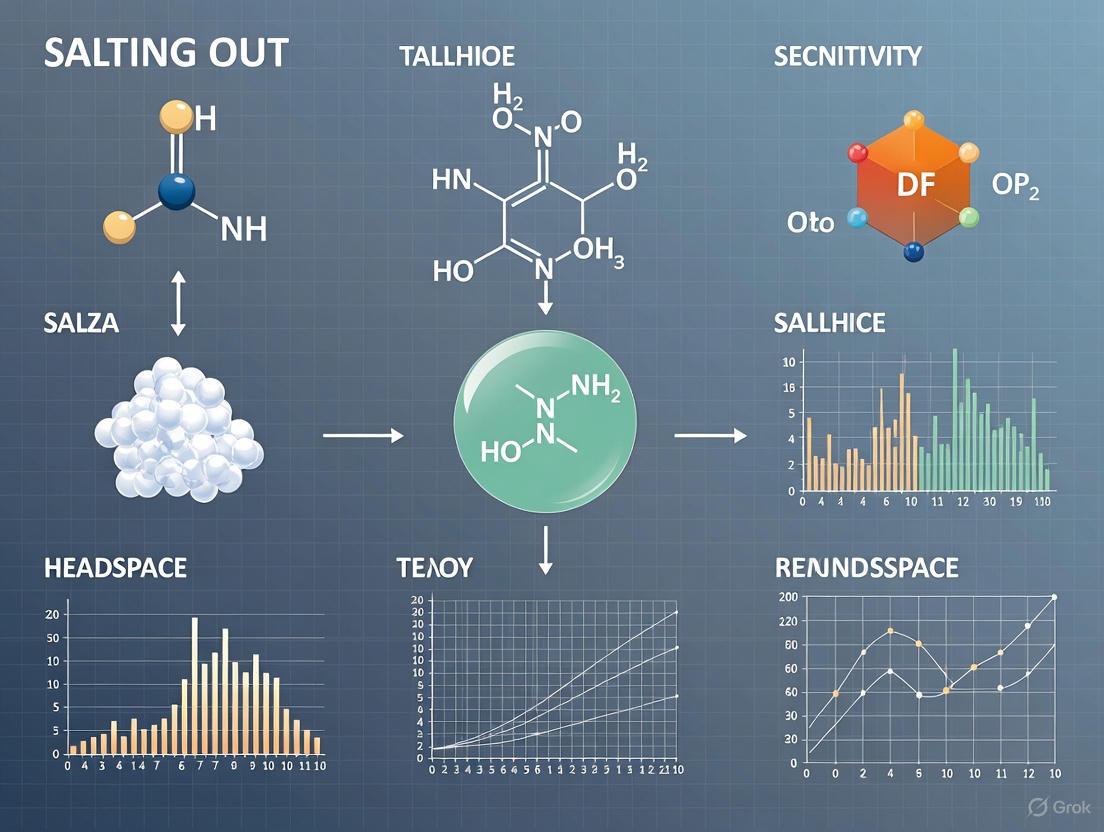
This article provides a comprehensive examination of salting-out techniques as a powerful strategy to enhance sensitivity in headspace analysis.
Salting-Out Techniques to Enhance Headspace Sensitivity: A Comprehensive Guide for Biomedical Analysis
Abstract
This article provides a comprehensive examination of salting-out techniques as a powerful strategy to enhance sensitivity in headspace analysis. Tailored for researchers, scientists, and drug development professionals, it covers the foundational principles of how high ionic strength reduces analyte solubility, forcing volatile and semi-volatile compounds into the headspace for improved detection. The scope extends from core theoretical mechanisms and the Hofmeister series to practical, step-by-step methodological applications across various sample types, including biological fluids and pharmaceuticals. It further delivers critical troubleshooting and optimization guidance for common challenges, and concludes with a validation framework comparing salting-out to alternative techniques, underscoring its significant implications for improving accuracy and detection limits in biomedical and clinical research.
Understanding Salting-Out: The Core Principles for Enhanced Headspace Analysis
FAQs: Core Concepts and Troubleshooting
What is the fundamental difference between salting-in and salting-out? Salting-in and salting-out are two phenomena driven by the effect of ionic strength on protein solubility, but they occur at different salt concentrations. Salting-in occurs at low ionic strength, where added salt ions disrupt attractive electrostatic interactions between protein molecules, increasing solubility. Salting-out occurs at high ionic strength, where an excessive number of salt ions compete with the protein for hydration, reducing solubility and causing precipitation [1] [2].
My protein is not precipitating during a salting-out procedure. What could be wrong?
- Insufficient Salt Concentration: The ionic strength may not be high enough to precipitate your target protein. Refer to the Hofmeister series and gradually increase the concentration of your salt, such as ammonium sulfate [1] [2].
- Incorrect Salt Type: You may be using a salt with low salting-out efficacy. Switch to a more effective salt like ammonium sulfate, which is high on the Hofmeister series [1] [3].
- Protein Concentration Too Low: If the protein solution is too dilute, precipitation may not occur visibly. Try concentrating your sample before attempting salting-out [3].
- Incorrect pH: A protein's solubility is highly dependent on pH. Ensure you are not at your protein's isoelectric point (pI), where solubility is naturally minimal, as salting-out effects are most pronounced away from the pI [2].
How do I choose the right salt for my salting-out experiment? The choice of salt is guided by the Hofmeister series, which ranks ions by their ability to precipitate proteins [1].
- Anions generally have a stronger effect than cations. The typical order for anions is:
F⁻ ≥ SO₄²⁻ > H₂PO₄⁻ > CH₃COO⁻ > Cl⁻ > NO₃⁻ > Br⁻ > I⁻ > ClO₄⁻[1]. - Ammonium sulfate
(NH₄)₂SO₄is most commonly used because both its ions (NH₄⁺ and SO₄²⁻) are high on the Hofmeister series, making it very effective, and it does not typically denature proteins [1] [3] [2].
What is the relationship between salting-out and antisolvent precipitation? Salting-out is a specific form of antisolvent precipitation. In a general antisolvent precipitation, a water-miscible organic solvent is added to an aqueous solution to reduce the solubility of a solute. In salting-out, the "antisolvent" is a high concentration of salt, which reduces the available water for solvation, functioning similarly to an organic antisolvent [3] [4].
I am using salting-out to enhance Headspace Solid-Phase Microextraction (HS-SPME). Why is a salt mixture sometimes more effective?
In HS-SPME, the goal is to drive volatile organic analytes from the liquid phase into the headspace. Using a salt mixture can create a synergistic effect that more effectively reduces the solubility of a wider range of compounds. For instance, a study on free fatty acids found that a combination of ammonium sulfate and sodium dihydrogen phosphate (NH₄)₂SO₄/NaH₂PO₄ in a 3.7:1 ratio provided up to a 4.1-fold increase in extraction efficiency for short-chain fatty acids compared to using sodium chloride alone. This is because different salts can affect the ionic strength and the solution's structure in complementary ways [5].
Quantitative Data and Experimental Protocols
The effectiveness of a salt in precipitating a solute depends on the ionic strength and the specific ion effects described by the Hofmeister series. The following table summarizes key data from research.
Table 1: Salting-Out Effectiveness in Different Applications
| Salt or Salt System | Application Context | Key Finding / Effectiveness Order | Source |
|---|---|---|---|
Ammonium Sulfate (NH₄)₂SO₄ |
General protein precipitation | High efficacy; both ions are high on the Hofmeister series. | [1] [3] |
(NH₄)₂SO₄ / NaH₂PO₄ (3.7:1) |
HS-SPME of Free Fatty Acids (C2-C10) | Up to 4.1-fold increase for C2-C6 vs. NaCl; overall superior performance. | [5] |
Al(NO₃)₃ > Fe(NO₃)₃ > Zn(NO₃)₂ > Cu(NO₃)₂ > LiNO₃ > NaNO₃ |
Metal extraction with TBP | Effectiveness order correlates with ionic potential (charge²/ionic radius). | [4] |
NaH₂PO₄ |
HS-SPME of Free Fatty Acids (C2-C10) | 1.0 to 4.3-fold increase for C2-C6 vs. NaCl. | [5] |
Table 2: The Hofmeister Series of Ions (from strongest to weakest salting-out ion) [1] [2]
| Cations | Anions |
|---|---|
NH₄⁺ |
F⁻ |
K⁺ |
SO₄²⁻ |
Na⁺ |
H₂PO₄⁻ |
Li⁺ |
CH₃COO⁻ (Acetate) |
Mg²⁺ |
Cl⁻ |
Ca²⁺ |
NO₃⁻ |
Br⁻ |
|
I⁻ |
|
ClO₄⁻ |
Detailed Experimental Protocol: HS-SPME with Salting-Out for Free Fatty Acids
This protocol is adapted from a published method for analyzing short and medium-chain free fatty acids (C2-C10) using a salting-out system to enhance sensitivity [5].
1. Reagents and Materials:
- Analytes: Standard solutions of target free fatty acids (e.g., Acetic C2 to Decanoic C10).
- Salting-Out Agent: A mixture of Ammonium Sulfate
(NH₄)₂SO₄and Sodium Dihydrogen Phosphate(NaH₂PO₄)in a 3.7:1 ratio (w/w). - Acid: Sulfuric acid
(H₂SO₄)or another suitable acid to adjust pH. - SPME Fiber: Divinylbenzene/Carboxen/Polydimethylsiloxane (DVB/Car/PDMS), 50/30 μm coating.
- Equipment: Gas Chromatograph coupled with a Mass Spectrometer (GC-MS), headspace vials (e.g., 120 mL), agitator, and heating block.
2. Sample Preparation:
- Adjust the pH of your aqueous sample or standard solution to 3.5 using dilute sulfuric acid. This helps protonate the fatty acids, making them more volatile.
- Weigh a specific total amount of the
(NH₄)₂SO₄/NaH₂PO₄salt mixture (e.g., 6.5 g total) into a headspace vial. - Add a known volume of your pH-adjusted sample to the vial, containing the salts. Seal the vial immediately with a septum cap.
3. HS-SPME Extraction:
- Place the vial in a heating block and condition it at a set temperature (e.g., 60°C) with constant agitation.
- Insert the SPME fiber through the septum and expose it to the headspace of the vial for a predetermined extraction time (e.g., 30-60 minutes). The high ionic strength from the salts reduces the solubility of the fatty acids in the aqueous phase, "salting them out" into the headspace, where they are adsorbed onto the fiber.
4. Desorption and Analysis:
- After the extraction time, retract the fiber and immediately insert it into the injection port of the GC-MS.
- Desorb the analytes from the fiber at a high temperature (e.g., 250°C) for a set time (e.g., 5 minutes) to transfer all compounds to the GC column for separation and detection.
Signaling Pathways and Workflow Visualizations
The Scientist's Toolkit: Research Reagent Solutions
Table 3: Essential Reagents for Salting-Out Experiments
| Reagent | Function / Purpose | Key Considerations |
|---|---|---|
Ammonium Sulfate (NH₄)₂SO₄ |
A highly effective and common salting-out agent for precipitating proteins and enhancing volatility in HS-SPME. | Ions are high on the Hofmeister series. Highly soluble in water. Relatively mild on protein structure [1] [5] [3]. |
| Sodium Chloride (NaCl) | A common, inexpensive salt used for initial experiments and salting-in at lower concentrations. | Chloride ions are mid-series, making it less effective for salting-out than sulfates or phosphates [1] [2]. |
| Sodium Dihydrogen Phosphate (NaH₂PO₄) | Used in salt mixtures to improve HS-SPME efficiency and as a buffer component to control pH during precipitation. | The H₂PO₄⁻ anion is high on the Hofmeister series. Helps maintain a stable pH, critical for protein solubility [1] [5]. |
| Aluminum Nitrate (Al(NO₃)₃) | A very strong salting-out agent in metal extraction systems due to its high ionic potential (trivalent cation). | Very effective at increasing distribution ratios (D) in liquid-liquid extraction. May be too denaturing for sensitive proteins [4]. |
| Carbowax/DVB SPME Fiber | A fiber coating for extracting volatile polar compounds from the headspace (e.g., in salt volatile analysis). | 65 μm thickness is common. Suitable for a range of volatile organic compounds [6]. |
| DVB/CAR/PDMS SPME Fiber | A triple-phase coating for HS-SPME of a wide range of analytes, from volatile to semi-volatile (e.g., C2-C10 fatty acids). | 50/30 μm coating. Divinylbenzene (DVB) and Carboxen (CAR) provide a broad spectrum of adsorption sites [5]. |
Frequently Asked Questions (FAQs)
Q1: What is ionic strength and how is it calculated? Ionic strength (I) is a measure of the total concentration of ions in a solution. It is defined as one-half the sum of the molar concentration of each ion multiplied by the square of its charge. The formula is expressed as: I = ½ Σ cᵢ zᵢ² where cᵢ is the molar concentration of ion i, and zᵢ is its charge number [7] [8]. For a 1:1 electrolyte like NaCl, the ionic strength equals its concentration. However, for multivalent ions, the effect is much greater; a solution of MgSO₄ has an ionic strength four times its molar concentration [7].
Q2: How does increased ionic strength lead to "salting out" and reduced solubility? Increased ionic strength reduces solute solubility primarily through the "salting-out" effect. At high concentrations, ions compete with the solute for available water molecules for solvation [8]. Kosmotropic ions (small, highly charged) strongly interact with and organize water molecules, making less water available to dissolve other solutes. This effectively decreases the solute's activity coefficient and increases its tendency to precipitate or, in the case of volatile analytes, partition into the headspace phase [9] [10].
Q3: In headspace analysis, how does the 'salting-out effect' enhance sensitivity? In headspace analysis, the partition coefficient (K) defines the distribution of an analyte between the sample liquid phase and the gas (headspace) phase [9]. A lower K value means more of the analyte favors the headspace, leading to a greater signal. Adding salt, typically to saturation, induces the salting-out effect, which lowers the K value for many analytes [9]. This reduces the analyte's solubility in the aqueous phase and drives it into the headspace, thereby increasing its concentration above the sample and improving detection sensitivity.
Q4: What are the practical limitations of using salt to manipulate solubility? The salting-out effect has several practical limitations [9]:
- Diminishing Returns: Analytes with already low K values may show little change.
- Matrix Interference: Adding salt can cause unwanted matrix compounds to partition into the headspace, potentially interfering with analysis.
- Solute Specificity: The effect is application-dependent and not equal for all analytes. The choice of salt (e.g., sodium chloride, sulfate, or citrate) can also influence its effectiveness for a specific sample matrix [11] [9].
Troubleshooting Guides
Issue 1: Inconsistent or Insufficient Salting-Out Effect
Problem: The addition of salt does not yield the expected increase in solute precipitation or headspace analyte concentration.
| Possible Cause | Investigation Action | Resolution |
|---|---|---|
| Insufficient Salt | Check if the solution is saturated. There should be undissolved salt at the bottom of the vial. | Continue adding salt with stirring until saturation is achieved [9]. |
| Incorrect Salt Type | Research the kosmotropicity (water-structuring ability) of different salts. | Switch to a more effective kosmotropic salt. Sodium sulfate or citrate often outperforms sodium chloride for some applications [11] [9]. |
| Ionic Strength Too Low | Calculate the ionic strength of your solution. Remember, multivalent ions contribute more strongly [7]. | Use a salt with multivalent ions (e.g., MgSO₄) or increase the concentration of the current salt to raise the ionic strength. |
Issue 2: Unwanted Precipitation of Biomolecules
Problem: A target protein or enzyme precipitates when ionic strength is increased.
| Possible Cause | Investigation Action | Resolution |
|---|---|---|
| Exceeded Solubility Limit | The high ionic strength may have disrupted the hydration shell and neutralized electrostatic repulsions critical for solubility [12] [8]. | Reduce the ionic strength. Find a compromise where the salting-out effect is achieved for the contaminant without precipitating the target biomolecule. |
| Specific Ion Effect | Certain ions may directly affect the protein's stability and solubility. | Change the type of salt used. For example, glutamate is often gentler on proteins than acetate [8]. |
| Solution Conditions | Check the pH relative to the protein's isoelectric point (pI). | Adjust the pH to a value where the protein is more stable and carries a higher net charge, which can improve solubility [12]. |
Key Experimental Protocols
Protocol 1: Determining the Effect of Ionic Strength on Solubility
This protocol outlines a method to measure the solubility of a solute (e.g., a salt or organic compound) at different ionic strengths.
1. Materials and Reagents
- Analyte: The solute whose solubility is being tested.
- Ionic Strength Modifier: A neutral salt such as Sodium Chloride (NaCl) or Ammonium Sulfate ((NH₄)₂SO₄).
- Solvent: Typically water or a buffer.
- Equipment: Analytical balance, heated stir plate, thermometer, glass test tubes, vortex mixer, centrifuge, and equipment for quantifying the analyte (e.g., HPLC, GC, UV-Vis spectrophotometer) [13].
2. Step-by-Step Procedure
- Step 1: Prepare a stock solution of the ionic strength modifier at a high concentration (e.g., 4 M NaCl).
- Step 2: Into a series of test tubes, add a fixed, excessive amount of the solid analyte—enough to ensure saturation at all conditions.
- Step 3: Add a constant volume of solvent to each tube, followed by varying volumes of the ionic strength modifier stock to create a series of solutions with calculated ionic strengths (e.g., 0.5 M, 1.0 M, 1.5 M, 2.0 M) [7].
- Step 4: Seal the tubes and mix thoroughly on a vortex mixer. Equilibrate in a constant temperature water bath for several hours with occasional agitation.
- Step 5: Centrifuge the samples to separate the undissolved solute from the saturated solution.
- Step 6: Carefully withdraw a portion of the clear supernatant from each tube. Dilute if necessary and quantify the concentration of the dissolved analyte using an appropriate analytical method.
- Step 7: Plot the measured solubility (concentration in the supernatant) against the calculated ionic strength to visualize the salting-out effect.
Protocol 2: Enhancing Headspace Sensitivity via Salting-Out
This protocol details the use of ionic strength to improve the detection of volatile analytes in headspace gas chromatography (HS-GC).
1. Materials and Reagents
- Samples: Aqueous solutions containing the target volatile analytes.
- Salt: High-purity Sodium Chloride (NaCl) or an alternative like Sodium Sulfate.
- Equipment: Headspace vials and seals, crimper, headspace sampler coupled to a GC system [9].
2. Step-by-Step Procedure
- Step 1: Pipette a consistent volume of each aqueous sample solution into separate headspace vials.
- Step 2: To each vial, add a weight of salt sufficient to achieve saturation (e.g., ~300-400 mg/mL for NaCl). Consistency in salt addition across samples is critical [9].
- Step 3: Immediately seal the vials with the appropriate septa and crimp caps tightly to ensure no leaks.
- Step 4: Place the vials in the headspace sampler tray. The method should use an oven temperature set appropriately, typically 20 °C below the boiling point of the solvent/sample matrix. The transfer line must be hot enough to prevent condensation [9].
- Step 5: The method should include a pressurization step before injection for consistent and reliable transfer of the headspace gas to the GC column [9].
- Step 6: Run the analysis and compare the peak areas of the target analytes from salted samples versus un-salted controls. A successful salting-out experiment will show a significant increase in peak area.
Data Presentation
Table 1: Impact of Ionic Strength on Solute Solubility
This table summarizes how the solubility of a hypothetical solute changes with increasing ionic strength, adjusted using different salts.
| Ionic Strength (M) | Solubility in NaCl (mg/mL) | Solubility in (NH₄)₂SO₄ (mg/mL) | Solubility in MgCl₂ (mg/mL) | Notes |
|---|---|---|---|---|
| 0.00 | 50.0 | 50.0 | 50.0 | Solubility in pure solvent. |
| 0.50 | 45.5 | 42.1 | 38.0 | Multivalent salts (Mg²⁺) show a stronger effect [7]. |
| 1.00 | 41.0 | 35.0 | 27.5 | Trend of decreasing solubility continues. |
| 1.50 | 36.8 | 28.9 | 19.5 | Salting-out effect is pronounced. |
| 2.00 | 32.8 | 23.8 | 13.0 | Solute may begin to precipitate heavily. |
Table 2: Common Salts for Salting-Out and Their Properties
A list of salts commonly used to manipulate ionic strength, along with their key characteristics.
| Salt | Typical Use Case | Key Characteristic | Consideration |
|---|---|---|---|
| Sodium Chloride | General purpose, headspace analysis [9]. | Low cost, high solubility. | Less effective than multivalent salts. |
| Ammonium Sulfate | Protein precipitation and purification [11]. | Very strong salting-out effect due to SO₄²⁻. | Can interfere with some downstream analyses. |
| Potassium Glutamate | Stabilizing biomolecules in enzymatic reactions [8]. | Good for maintaining protein-nucleic acid interactions. | More expensive than simple salts. |
| Sodium Citrate | Polymer-salt Aqueous Two-Phase Systems (ATPS) [11]. | Effective kosmotrope, can form ATPS with polymers. | Useful for gentle biomolecule partitioning. |
Visualization of Concepts and Workflows
Diagram 1: Mechanism of Solubility Reduction by Ionic Strength
This diagram illustrates how added ions at high ionic strength compete with the solute for water molecules, leading to reduced solvation and eventual precipitation.
Diagram 2: Salting-Out Workflow for Headspace Analysis
This workflow shows the key steps in using the salting-out technique to drive volatile analytes from the liquid sample into the headspace for improved detection.
The Scientist's Toolkit: Research Reagent Solutions
Table 3: Essential Reagents for Ionic Strength and Solubility Experiments
| Reagent | Function/Description | Typical Application |
|---|---|---|
| Sodium Chloride (NaCl) | A neutral, monovalent salt used to increase ionic strength with minimal specific ion effects. | General-purpose salting-out; headspace analysis [9]. |
| Ammonium Sulfate ((NH₄)₂SO₄) | A highly soluble salt with a divalent anion, providing a strong kosmotropic (water-structuring) effect. | Protein precipitation and purification; forming polymer-salt ATPS [11]. |
| Polyethylene Glycol (PEG) | A polymer used to form aqueous two-phase systems (ATPS) with salts or other polymers, creating a low ionic strength environment for biomolecule separation [11]. | Partitioning and purification of sensitive biomolecules like enzymes and proteins [11] [10]. |
| Potassium Glutamate | A salt that provides ionic strength while stabilizing protein structure and promoting favorable protein-nucleic acid interactions [8]. | Cell-free protein expression systems; stabilizing folded proteins and ribosomes [8]. |
Frequently Asked Questions (FAQs)
Q1: What is the Hofmeister Series and why is it important in practical applications? The Hofmeister series is a classification of ions based on their ability to salt out (precipitate) or salt in (solubilize) proteins and other macromolecules [14]. This empirical ranking, discovered by Franz Hofmeister in the 1880s, is crucial because it helps predict how different salts will influence protein stability, solubility, and aggregation in various biomanufacturing processes, from upstream media design to final drug product formulation [15] [16]. Understanding this series allows scientists to selectively use salts to achieve desired outcomes, such as precipitating a target protein or stabilizing it in solution.
Q2: I’ve heard the Hofmeister series can reverse. When does this happen? Yes, reversals of the Hofmeister series are well-documented and often occur due to specific system conditions [17]. Key scenarios include:
- Changes in Surface Charge: The series can reverse when the charge of a protein or polymer surface changes, for instance, by shifting the pH away from its isoelectric point [18] [14].
- Low vs. High Salt Concentrations: At low salt concentrations, electrostatic interactions often dominate and can lead to a reversed order, whereas at high concentrations, the classic Hofmeister (lyotropic) series typically holds [14].
- Polymer-Specific Interactions: For high-viscosity negatively charged polymers like alginate, the standard anion series can behave in a reversed manner [18].
Q3: How do I choose the right salt for salting-out a protein? The general principle is to use salts with ions that are strong kosmotropes (structure-makers), typically found on the left side of the Hofmeister series [16]. These ions enhance the hydrophobic effect and promote protein aggregation and precipitation. As demonstrated in Hofmeister's original work, the salt concentration required to precipitate a protein follows the series order. For example, sulfate and phosphate salts are highly effective for this purpose, which is why ammonium sulfate is a staple in protein purification protocols [14] [16].
Q4: Can the Hofmeister series be applied beyond traditional biochemistry? Absolutely. The principles of the Hofmeister series are observed in a wide range of fields. This includes the design of biomaterials and drug delivery systems for tuning polymer properties and drug release profiles [18], the modification of conducting polymers like PEDOT:PSS for electronic applications [19], and the enhancement of analytical sensitivity in techniques like headspace sampling, where salts can be used to drive volatile analytes from the solution into the vapor phase for analysis [20].
Troubleshooting Guides
Problem: Inconsistent Protein Precipitation during Salting-Out
- Potential Cause 1: Counterion interference. The effect of a salt is not determined by the anion or cation alone but by the specific ion pair [17] [16].
- Solution: Evaluate the complete salt. A kosmotropic anion paired with a kosmotropic cation may have a reduced salting-out effect because the ions pair strongly with each other instead of structuring water [14]. Consider using a salt with a kosmotropic anion and a more chaotropic cation.
- Potential Cause 2: The system is not at equilibrium.
- Solution: Ensure adequate and consistent mixing time after salt addition. The precipitation process is an equilibrium-based phenomenon and requires time to reach a steady state.
Problem: Unexpected Solubility or Aggregation of a Drug Product
- Potential Cause: Unaccounted for specific ion effects in the formulation buffer.
- Solution: Audit the ionic composition of your buffers and excipients. Chaotropic ions (e.g., SCN⁻, I⁻, ClO₄⁻) can bind to proteins and peptide groups, leading to salting-in and potentially causing denaturation or unwanted stabilization of aggregates [14] [16]. Switching to a kosmotropic salt (e.g., sulfate, citrate) can help stabilize the native protein structure and reduce aggregation [15].
Problem: Poor Sensitivity in Headspace Analysis of Volatiles
- Potential Cause: Inefficient transfer of analytes from the liquid phase to the headspace vapor phase [20].
- Solution: Apply the "salting out" effect by adding a kosmotropic salt to your sample. Salts like sulfates, phosphates, or carbonates increase the ionic strength and decrease the solubility of nonpolar volatile molecules in the aqueous phase, forcing more analyte into the headspace and thereby increasing sensitivity [20].
Quantitative Data Tables
Table 1: The Classic Hofmeister Series for Anions and Cations This table lists ions from strongest salting-out (kosmotropic) to strongest salting-in (chaotropic) effects [14] [16].
| Anion Series (Kosmotropic to Chaotropic) | Cation Series (Kosmotropic to Chaotropic) |
|---|---|
| Citrate³⁻ | (CH₃)₄N⁺ (Tetramethylammonium) |
| F⁻ (Fluoride) | NH₄⁺ (Ammonium) |
| PO₄³⁻ (Phosphate) | K⁺ (Potassium) |
| SO₄²⁻ (Sulfate) | Na⁺ (Sodium) |
| CH₃COO⁻ (Acetate) | Cs⁺ (Cesium) |
| Cl⁻ (Chloride) | Li⁺ (Lithium) |
| Br⁻ (Bromide) | Mg²⁺ (Magnesium) |
| I⁻ (Iodide) | Ca²⁺ (Calcium) |
| BF₄⁻ (Tetrafluoroborate) | Ba²⁺ (Barium) |
| SCN⁻ (Thiocyanate) | Guanidinium⁺ |
Table 2: Empirical Guidelines for Ion Selection Based on ion properties and their general effects [16].
| Ion Type | Expected Effect | Examples |
|---|---|---|
| Small, multiply charged "hard" anions | Strong Salt-Out | SO₄²⁻, PO₄³⁻, F⁻, Citrate³⁻ |
| Large, charge-diffuse "soft" anions | Strong Salt-In | SCN⁻, I⁻, ClO₄⁻, BF₄⁻ |
| Large, charge-diffuse "soft" cations | Strong Salt-In | Guanidinium⁺, (CH₃)₄N⁺ |
| Small, "hard" cations | Variable Effect | Li⁺, Mg²⁺, Ca²⁺ (effect is system-dependent) |
Experimental Protocols
Protocol 1: Utilizing the Hofmeister Series in Biomaterial Design This protocol, adapted from research on gelatin-alginate ocular drug delivery, demonstrates how salt addition sequence and ion type tune material properties [18].
- Prepare Polymer Solutions: Dissolve 1% w/v gelatin in water at 40°C, then cool to room temperature. Separately, prepare a solution of high-viscosity sodium alginate.
- Define Addition Sequence: Choose one of two strategies:
- Protocol A (Salt between polymers): Add salt (1% w/v, e.g., Na₂SO₄, CH₃COONa, NaCl, NaNO₃) to the gelatin solution, followed by alginate.
- Protocol B (Salt to mixture): Mix gelatin and alginate first, then add the salt.
- Characterize Interactions: Measure the hydrodynamic radius (RH) and zeta potential of the mixtures after each addition. An increase in RH indicates chain expansion, while a decrease indicates collapse.
- Correlate with Performance: Link the physicochemical data to drug release profiles. For example, kosmotropes may be preferred for Protocol A, while chaotropes may be better for Protocol B [18].
Protocol 2: Enhancing Headspace Sensitivity via Salting Out This protocol uses kosmotropic salts to force volatile organic compounds into the headspace for improved GC analysis [20].
- Sample Preparation: Place the aqueous sample containing volatile analytes into a sealed headspace vial.
- Salt Addition: Add a known amount of a strongly kosmotropic salt (e.g., ammonium sulfate, sodium sulfate) to the vial. The high charge density of these anions increases surface tension and strengthens the hydrophobic effect, reducing analyte solubility in water [20] [16].
- Equilibration: Heat and agitate the vial to achieve a new liquid-vapor equilibrium.
- Sampling and Analysis: Extract a portion of the headspace vapor with a gas-tight syringe and inject it into the GC system. The response for target volatiles will be enhanced compared to the non-salted sample.
Signaling Pathways and Workflows
Diagram Title: Ion Selection Decision Workflow
The Scientist's Toolkit: Research Reagent Solutions
Table 3: Essential Reagents for Hofmeister Series Experiments
| Reagent Category | Example Reagents | Primary Function in Experiment |
|---|---|---|
| Kosmotropic Salts | Ammonium Sulfate ((NH₄)₂SO₄), Sodium Sulfate (Na₂SO₄), Potassium Phosphate (K₃PO₄) | "Salting-out" agents for protein precipitation; increase surface tension and strengthen hydrophobic effect [14] [16]. |
| Chaotropic Salts | Sodium Thiocyanate (NaSCN), Guanidinium HCl (GdnHCl), Sodium Iodide (NaI) | "Salting-in" agents or denaturants; disrupt water structure and bind to macromolecules, increasing solubility or unfolding proteins [14] [16]. |
| Model Proteins | Lysozyme, Hen Egg White Albumin, Bovine Serum Albumin (BSA) | Well-characterized proteins for studying precipitation, solubility, and stability trends [16]. |
| Polyelectrolytes / Polymers | Sodium Alginate, Gelatin, PEDOT:PSS | Model polymers for studying ion-specific effects on viscosity, chain conformation, and material properties in drug delivery or electronics [18] [19]. |
| Buffer Components | TRIS, HEPES, MES, Citrate | Maintain constant pH to isolate ion-specific effects from pH-induced charge changes [18]. |
Troubleshooting Guide: Common HS-GC Issues and Solutions
This guide addresses common problems encountered when using Headspace Gas Chromatography (HS-GC), with a focus on issues related to the salting-out technique.
Table 1: Common HS-GC Problems and Solutions
| Problem & Symptoms | Possible Causes | Recommended Solutions & Preventive Measures |
|---|---|---|
| Poor Repeatability (Large variability in peak area for replicate injections) [21] | • Incomplete gas-liquid equilibrium (insufficient incubation time) [21]• Inconsistent thermostat temperature [21]• Poor vial sealing (worn septa or caps) [21]• Inconsistent sample preparation (volume, salt addition) [21] | • Extend incubation time (often 15-30 min) to ensure equilibrium [21].• Use automated headspace systems for uniform heating/injection [21].• Regularly replace septa and verify cap tightness [21].• Standardize sample prep; use precise weighing/pippeting for salting-out agents [22]. |
| Low Peak Area / Reduced Sensitivity [21] [23] | • Low analyte volatility or strong matrix binding [21]• Leakage in vials, tubing, or injector [21]• Suboptimal incubation temperature [21]• Inefficient salting-out effect | • Use the salting-out effect (e.g., add NaCl, Na₂SO₄) to improve analyte volatility and boost signal [22] [24].• Increase incubation temperature (avoiding degradation) [21].• Check system for leaks, especially around the needle and valves [21].• For flame-based detectors, verify fuel gas ratios and flow rates [23]. |
| High Background or Ghost Peaks (Unexpected peaks or elevated baseline noise) [25] [21] | • Contamination in the injection needle or valves [21]• Carryover from reused or improperly cleaned vials [21]• Contaminated inlet, column, or detector [25]• Contaminated or low-purity salting-out agents | • Run blank samples to identify contamination sources [21].• Clean the injection system regularly and use pre-cleaned vials [21].• Replace inlet liners and condition the column as needed [25].• Ensure high purity of salts used for salting-out. |
| Poor Resolution or Peak Overlap [25] [21] | • Overloaded column due to excessive injection volume [21]• Inappropriate temperature programming [25]• Worn or unsuitable column stationary phase [25] | • Optimize oven temperature program (initial temp, ramp rate) [26].• Select a column with appropriate polarity and phase for your analytes [24].• Consider method translation software to adapt methods for faster analysis and better resolution [26]. |
| Target Volatile Compounds Not Detected [21] | • Low volatility of target compound [21]• Sample matrix suppresses analyte release [21]• Inadequate headspace conditions [21] | • Employ salting-out to enhance the release of volatile compounds from the sample matrix [22] [27].• Adjust pH or add organic solvents to improve release [21].• Increase incubation temperature/time [21].• Switch to solid-phase microextraction (SPME) for higher sensitivity [27] [21]. |
Frequently Asked Questions (FAQs)
Q1: What is the fundamental principle behind the salting-out effect in Headspace-GC? The salting-out technique involves adding inert, high-purity salts (e.g., NaCl, Na₂SO₄) to an aqueous sample. This increases the ionic strength of the solution, which reduces the solubility of hydrophobic volatile compounds in the aqueous phase. As a result, more of the target analytes are forced into the headspace vapor phase, significantly enhancing the detection sensitivity of the GC system [22] [27] [24].
Q2: Which salting-out agents are most effective, and how is the concentration optimized? The choice of salt depends on the target analytes and sample matrix.
- Sodium Chloride (NaCl) is widely used and has been shown to particularly enhance the recovery of alcohols [24].
- Sodium Dihydrogen Phosphate (H₂NaPO₄) may be more effective for extracting acids [24]. Concentration optimization is critical. Studies show that increasing salt concentration (e.g., up to 35%) generally enhances peak intensities. However, precipitation can occur at very high concentrations, so 35% (w/v) is often a practical upper limit that should be determined empirically for each method [24].
Q3: My results are inconsistent, even when using a salting-out agent. What should I check? Poor repeatability is often traced to inconsistencies in sample preparation [21]. When using salts, ensure that:
- The weighing of the salt is precise for every sample.
- The dissolution of the salt is complete and consistent.
- The sample volume and vial headspace volume are kept constant to maintain a reproducible sample-to-headspace ratio, which is critical for equilibrium [27]. Also, check the integrity of the vial septa and the stability of the incubation temperature [21].
Q4: Can the salting-out technique be used with other headspace extraction methods like SPME? Yes, the salting-out effect is fully compatible with and commonly used in Headspace Solid-Phase Microextraction (HS-SPME) to further improve the extraction efficiency of volatile compounds onto the fiber [27] [24]. The principle remains the same: reducing analyte solubility in the liquid phase to increase its concentration in the headspace, where it is available for absorption by the SPME fiber.
Detailed Experimental Protocol: Enhancing Carboxyl Group Analysis via Salting-Out
The following validated protocol demonstrates the application of the salting-out effect for the sensitive determination of carboxyl groups in polyimide (PI) fibers, achieving a limit of quantification (LOQ) of 0.11 μmol [22].
1. Principle: Carboxyl groups in the pretreated PI sample are reacted with sodium bicarbonate (NaHCO₃) to produce carbon dioxide (CO₂). The released CO₂ is measured by Headspace-GC. The addition of a salting-out agent enhances the transfer of CO₂ from the liquid phase to the headspace, boosting detection sensitivity [22].
2. Materials and Reagents:
- PI fiber sample (~0.1 g)
- Sodium Bicarbonate (NaHCO₃) solution
- Salting-out agent: e.g., Sodium Sulfate (Na₂SO₄), Lithium Chloride (LiCl), Potassium Chloride (KCl), or Calcium Chloride (CaCl₂) [22].
- Hydrochloric Acid (HCl), for sample pre-treatment.
- Headspace vials, seals, and caps.
3. Equipment:
- Gas Chromatograph equipped with a Thermal Conductivity Detector (TCD).
- Automated Headspace Sampler.
- GC Column (appropriate for separating CO₂).
4. Procedure:
- Sample Pretreatment: The micro-etched PI fiber is first acidified with HCl to convert -COONa groups into the detectable -COOH form [22].
- Reaction Mixture Preparation: Approximately 0.1 g of the pretreated PI sample is placed in a headspace vial. An appropriate amount of the selected salting-out agent (e.g., Na₂SO₄) is added to the vial [22].
- Addition of Reagent: A solution of NaHCO₃ is added to the vial, which is immediately sealed tightly [22].
- Headspace Incubation: The vial is placed in the headspace sampler and heated at 90°C for 20 minutes to allow the reaction to go to completion and for the CO₂ to equilibrate between the liquid and vapor phases [22].
- GC Analysis: An aliquot of the headspace gas is automatically injected into the GC system. The released CO₂ is separated and quantified by the TCD [22].
5. Key Optimized Parameters [22]:
- Incubation Temperature: 90°C
- Incubation Time: 20 min
- Sample Amount: 0.1 g
6. Performance Metrics [22]:
- Precision: Relative Standard Deviation (RSD) < 1.12%
- Accuracy: Average recovery of 98.8% to 105.5%
- Limit of Quantification (LOQ): 0.11 μmol
Experimental Workflow and Signaling Pathways
The following diagram illustrates the logical workflow of a salting-out assisted HS-GC experiment, from sample preparation to data analysis.
The Scientist's Toolkit: Key Research Reagent Solutions
Table 2: Essential Materials for Salting-Out Assisted HS-GC
| Item | Function & Rationale |
|---|---|
| Inert Salts (NaCl, Na₂SO₄) | The core salting-out agents. They increase the ionic strength of the solution, reducing the solubility of volatile target analytes and driving them into the headspace for detection [22] [24]. |
| Sodium Bicarbonate (NaHCO₃) | A reaction agent used to convert non-volatile acidic species (e.g., carboxyl groups) into volatile carbon dioxide (CO₂) for indirect measurement [22]. |
| DB-624 Capillary Column | A common, versatile GC column specifically designed for the separation of volatile organic compounds, including residual solvents, making it ideal for many HS-GC applications [28]. |
| Divinylbenzene/Carboxen/PDMS (DVB/CAR/PDMS) SPME Fiber | A widely used fiber for Headspace-SPME. It features a mixed coating for extracting a broad range of volatile and semi-volatile compounds, often used in conjunction with salting-out [24]. |
| Dimethyl Sulfoxide (DMSO) | A high-boiling point, aprotic solvent used to dissolve samples. It minimizes solvent interference and is particularly useful for preparing pharmaceutical raw materials for residual solvent analysis [28]. |
Frequently Asked Questions & Troubleshooting
FAQ: What is the fundamental mechanism behind salting out? Salting out is a purification and separation method that utilizes the reduced solubility of certain molecules in a solution of very high ionic strength. When soluble salts are added to an aqueous solution, the ions are hydrated by water molecules. At high concentrations, these ions compete for water molecules, reducing the amount of free water available to dissolve other polar solutes. This effectively decreases the solubility of those solutes, driving them to precipitate (in the case of large biomolecules like proteins) or to partition into a less polar phase, such as an organic solvent or the headspace in a vial [1] [29].
FAQ: Why is salting out particularly suitable for polar compounds? Salting out is highly effective for polar compounds because these molecules rely heavily on hydrogen bonding and other polar interactions with water to remain dissolved. The addition of salts disrupts these interactions. For volatile polar compounds, this technique increases the ionic strength of the aqueous solution, which reduces the solubility of hydrophobic volatile compounds. This leads to an elevated concentration of the target volatile compounds in the headspace, thereby enhancing the sensitivity of analytical techniques like gas chromatography [27].
Troubleshooting: My extraction efficiency is low. What is the first parameter I should investigate? The most common cause is insufficient salt concentration. The salting out effect is highly dependent on ionic strength, which is a function of both the concentration and the charge of the ions used [4] [1]. You should systematically increase the concentration of your chosen salt to ensure the ionic strength is high enough to induce phase separation or the desired partitioning. The effectiveness of the salting-out agent generally increases with its concentration and the valence of its ions [4].
Troubleshooting: I've added salt, but my analytes are not partitioning effectively. What could be wrong? You may be using the wrong type of salt. The ability of a salt to induce salting out varies significantly, and this is guided by the Hofmeister series. This series ranks ions by their ability to salt out (precipitate) proteins and other molecules [1] [29]. In general, multivalent anions are more effective than monovalent ones. For instance, you would achieve a stronger effect with aluminum nitrate (Al(NO₃)₃) or ammonium sulfate ((NH₄)₂SO₄) than with sodium chloride (NaCl) [4] [1].
Troubleshooting: An emulsion formed during my liquid-liquid extraction. How can salting out help? The addition of salt is a well-established technique to break emulsions [29]. By increasing the ionic strength and the density of the aqueous phase, salt addition can help to separate the organic and aqueous layers more cleanly and rapidly.
Experimental Protocol: Enhancing Headspace Sensitivity via Salting Out
This protocol details the use of salting out to improve the detection of volatile compounds in an aqueous sample using headspace analysis coupled with Gas Chromatography-Mass Spectrometry (GC/MS) [27].
1. Principle The addition of a salt to a liquid sample increases its ionic strength. This reduces the solubility of hydrophobic volatile compounds in the aqueous phase, shifting their equilibrium distribution and increasing their concentration in the headspace gas above the sample. This enrichment leads to improved sensitivity and lower detection limits during GC/MS analysis [27] [29].
2. Materials and Reagents
- Aqueous sample containing target volatile compounds.
- Selected salt (e.g., anhydrous Magnesium Sulfate (MgSO₄) or Sodium Chloride (NaCl)).
- Headspace vials with PTFE/silicone septa and crimp caps.
- Vial crimper and decapper.
- Analytical balance.
- Heating block or agitator.
- Gas Chromatograph-Mass Spectrometer (GC/MS).
3. Step-by-Step Procedure Step 1: Sample Preparation. Precisely weigh or measure your aqueous sample (e.g., 5 mL) into a headspace vial. Step 2: Salt Addition. Add a predetermined amount of salt to the vial. A typical starting point is a saturation concentration, such as adding 1-2 g of NaCl or MgSO₄ per 5 mL of sample [27] [29]. Step 3: Vial Sealing. Immediately seal the vial tightly with a septum and crimp cap to prevent any loss of volatiles. Step 4: Equilibrium. Place the sealed vial in a heating agitator. Equilibrate with shaking for a set time (e.g., 15-60 minutes) at a controlled temperature (e.g., 60°C). The temperature and time should be optimized for your specific analytes [27]. Step 5: Sample Injection. Using a heated gas-tight syringe or an automated headspace sampler, withdraw a defined volume of the headspace gas from the vial and inject it into the GC/MS inlet for analysis.
Data & Reagent Tables
Table 1: Effectiveness of Various Salting-Out Agents on Separation Factor (β) in Rare Earth Element Extraction [4]
| Salting-Out Agent | Concentration (mol/L) | Separation Factor (βNd/Pr) |
|---|---|---|
| LiNO₃ | 6.5 | 1.95 |
| NH₄NO₃ | 9.0 | 1.57 |
| Ca(NO₃)₂ | 2.5 | 1.62 |
| Al(NO₃)₃ | 2.5 | 1.68 |
Table 2: The Scientist's Toolkit - Essential Reagents for Salting Out Experiments
| Reagent / Material | Function & Explanation |
|---|---|
| Magnesium Sulfate (MgSO₄) | A very commonly used, highly effective salt due to its divalent anion. It is a key component in QuEChERS methods for pesticide analysis [29]. |
| Sodium Chloride (NaCl) | A common, inexpensive, and readily available salt used to increase ionic strength and induce the salting-out effect in many applications [29]. |
| Ammonium Sulfate ((NH₄)₂SO₄) | Particularly effective for protein precipitation. Both its ions (NH₄⁺ and SO₄²⁻) are high in the Hofmeister series, making it a powerful salting-out agent [1]. |
| Headspace Vial with Septa | A sealed container is essential for maintaining the equilibrium between the sample and its headspace, preventing the loss of volatile analytes [27]. |
Workflow and Mechanism Diagrams
Diagram 1: Salting Out Mechanism Workflow.
Diagram 2: Hofmeister Series for Salt Selection.
Practical Implementation: Salting-Out Methods and Applications in Biomedical Research
Frequently Asked Questions (FAQs)
FAQ 1: What is the "salting-out" effect and how does it improve headspace analysis?
The salting-out effect is a phenomenon where the addition of inorganic salts to an aqueous solution increases its ionic strength, thereby decreasing the solubility of organic compounds and forcing them into the headspace (gas phase) above the solution [5] [30]. This technique significantly enhances the sensitivity of headspace analysis techniques, such as Headspace Solid-Phase Microextraction (HS-SPME), by increasing the concentration of target volatiles available for extraction and detection [5] [30]. The effectiveness of salting-out depends on the specific salt and analyte, with multivalent salts often providing a stronger effect due to their higher ionic strength per mass unit [5] [31].
FAQ 2: When should I choose ammonium sulfate over sodium chloride for my headspace application?
Ammonium sulfate is often a superior choice for salting out short and medium-chain organic acids and for applications requiring a strong salting-out effect. Research has demonstrated that a combination of ammonium sulfate and sodium dihydrogen phosphate significantly outperforms sodium chloride in the HS-SPME of free fatty acids from acetic acid (C2) to decanoic acid (C10), yielding up to a 4.1-fold increase in extraction efficiency for some analytes [5] [32]. Furthermore, a study measuring Setschenow constants (KS) found that values for ammonium sulfate are consistently higher than for sodium chloride for the same compound, indicating a more potent salting-out effect [31]. Sodium chloride remains a common and effective choice, but may be best suited for less volatile analytes or when its milder effect is sufficient [5].
FAQ 3: My sample has a complex matrix (e.g., biological fluids). How does salt selection affect selectivity?
Salt selection can be part of a strategy to improve selectivity in complex matrices. The primary benefit comes from the salting-out effect itself, which helps transfer volatile analytes into the cleaner headspace, reducing interference from non-volatile components in the sample matrix [33] [30]. For instance, headspace techniques are successfully used to avoid interference from colored samples, varying pH, and other ions in biological fluids [33]. Selecting a salt that maximizes the transfer of your target analyte improves the signal-to-noise ratio and minimizes matrix effects during instrumental analysis.
FAQ 4: Are there any physical practical limitations I should consider when using high salt concentrations?
Yes, practical considerations are crucial. The solubility of the salt itself is a primary limiting factor. While highly soluble salts like sodium sulfate allow for very high ionic strength [30], other salts may reach saturation at lower concentrations. The salt must also be compatible with your analytical system; for example, salts that are corrosive or can crystallize inside instrument components should be used with caution. Finally, the volume of the aqueous phase can change upon salt addition, which must be accounted for in quantitative work to ensure accuracy.
Troubleshooting Guides
Problem: Low Recovery of Volatile Analytes in HS-SPME
- Potential Cause 1: Inefficient Salting-Out Agent
- Solution: Re-evaluate your salt choice. For short-chain volatile fatty acids (e.g., C2-C6), replace sodium chloride with a more effective salt system like a combination of ammonium sulfate and sodium dihydrogen phosphate (NaH₂PO₄) in a 3.7:1 ratio [5].
- Potential Cause 2: Insufficient Salt Concentration
- Solution: Systematically test different amounts of your chosen salt. Efficiency often increases with salt amount up to a saturation point. Use the highest feasible amount that remains practical and does not cause precipitation issues [5].
- Potential Cause 3: Suboptimal Sample pH
- Solution: Adjust the pH of your sample. For free fatty acids, a lower pH (e.g., 3.5) suppresses ionization, making the species more volatile and improving headspace concentration [5].
Problem: Inconsistent Results Between Standard and Sample Matrices
- Potential Cause 1: Matrix-Induced Signal Suppression/Enhancement
- Solution: Perform a matrix-matched calibration or use standard addition. The ionic strength and composition of complex samples (feces, cheese, serum) can differ from aqueous standards, altering the salting-out efficiency. Using a salt known to perform well in complex matrices, like (NH₄)₂SO₄/NaH₂PO₄, can mitigate this [5] [33].
- Potential Cause 2: Incomplete Dissolution or Equilibration
- Solution: Ensure the salt is fully dissolved and the sample is thoroughly mixed before headspace analysis. Use consistent vial volumes, incubation times, and shaking/agitation parameters to achieve equilibrium between the liquid and gas phases [34].
Experimental Protocols
Protocol 1: Evaluating Salt Performance for Headspace-SPME of Free Fatty Acids
This protocol is adapted from a study that successfully improved the extraction of short and medium-chain free fatty acids (FFAs) [5].
1. Goal: To compare the salting-out efficiency of different salts for enhancing HS-SPME recovery of FFAs.
2. Materials:
- Analytes: Standard mixture of FFAs from acetic acid (C2) to decanoic acid (C10).
- Salting-Out Agents: Ammonium sulfate ((NH₄)₂SO₄), sodium dihydrogen phosphate (NaH₂PO₄), their combination (3.7:1 ratio), sodium chloride (NaCl), and sodium sulfate (Na₂SO₄) [5].
- Equipment: Headspace vials, SPME fiber (e.g., DVB/Car/PDMS 50/30 μm), Gas Chromatograph with Flame Ionization Detector (GC-FID) or Mass Spectrometer (GC-MS) [5].
- Solutions: Aqueous standard solutions of FFAs, adjusted to pH ~3.5 using dilute sulfuric acid [5].
3. Procedure: 1. Sample Preparation: Prepare a series of aqueous standard solutions containing your target FFAs. 2. Salt Addition: To each vial, add one of the test salts or salt systems in at least four different total amounts to evaluate the effect of concentration. 3. HS-SPME Extraction: Incubate the vials with stirring. After reaching the set temperature, expose the SPME fiber to the headspace for a predetermined extraction time. 4. GC Analysis: Retract the fiber and immediately inject it into the GC inlet for desorption and analysis. 5. Data Analysis: Compare the peak areas obtained for each FFA under the different salt conditions.
4. Expected Outcome: The data will reveal which salt and concentration provides the highest extraction efficiency for your specific target analytes. The study showed that (NH₄)₂SO₄/NaH₂PO₄ and NaH₂PO₄ alone provided significantly higher recovery for C2-C6 acids compared to saturated NaCl [5].
Quantitative Comparison of Salt Performance for Free Fatty Acid Extraction
| Free Fatty Acid (FFA) | Performance of (NH₄)₂SO₄/NaH₂PO₄ vs. NaCl | Performance of NaH₂PO₄ vs. NaCl |
|---|---|---|
| Acetic (C2) - Decanoic (C10) | Overall improvement, confirmed on biological and food samples [5] | Not Specified |
| C2 - C6 | 1.2 to 4.1-fold increase in extraction [5] | 1.0 to 4.3-fold increase in extraction [5] |
| C8 - C10 | NaCl gave "interesting results" [5] | Not Specified |
Protocol 2: Generic Workflow for Headspace Method Development with Salting-Out
This general workflow outlines key decision points for optimizing a headspace method.
The Scientist's Toolkit: Key Research Reagent Solutions
Essential Materials for Salting-Out Experiments
| Reagent / Material | Function in Experiment |
|---|---|
| Ammonium Sulfate ((NH₄)₂SO₄) | A highly effective salting-out agent, often providing a stronger effect than NaCl. Frequently used in combination with other salts [5] [31]. |
| Sodium Dihydrogen Phosphate (NaH₂PO₄) | Used as a buffering agent and, notably, as an effective salting-out agent on its own or in combination with (NH₄)₂SO₄ for volatile acids [5]. |
| Sodium Chloride (NaCl) | The most common and widely used salting-out agent. It is a good baseline choice, though it may be less effective for very polar or short-chain volatiles [5] [35] [30]. |
| SPME Fiber (e.g., DVB/Car/PDMS) | The extraction device for HS-SPME. The fiber coating absorbs/adsorbs volatile analytes from the headspace for subsequent transfer to a GC [5]. |
| Headspace Vials | Specialized glass vials designed to maintain a sealed and consistent headspace environment for equilibration and sampling [34]. |
| Water-Miscible Organic Solvents (e.g., Acetonitrile) | Used in Salting-Out Liquid-Liquid Extraction (SALLE). The salt causes the solvent to separate from the aqueous phase, concentrating analytes [30]. |
Salt Selection Decision Guide
What is the salting-out effect and how does it enhance detection sensitivity?
The salting-out effect describes a phenomenon where adding high concentrations of salt to an aqueous solution decreases the solubility of certain molecules, such as proteins, polymers, or volatile organic compounds. This occurs because salt ions compete for water molecules, reducing the water available to solvate other substances. In analytical chemistry, this principle is strategically used to improve the detection of target compounds by forcing them out of the aqueous phase and into a separate organic phase or the headspace above a solution for easier analysis [36] [20].
For headspace techniques like gas chromatography (GC), salting out enhances sensitivity by increasing the concentration of volatile analytes in the vapor phase. The salt ions preferentially interact with water molecules, which disrupts the solvation of the organic analytes. This makes the volatile compounds "less soluble" and drives them into the headspace, resulting in a stronger signal for the detector [22] [20]. The extent of this enhancement depends critically on the type of salt used, its concentration, and the nature of the target analyte [37].
Detailed Experimental Protocols
Protocol 1: Salting-Out Assisted Headspace Gas Chromatography (HS-GC) for Carboxyl Group Determination
This protocol, adapted from a method for analyzing polyimide fibers, is effective for quantifying carboxyl groups by measuring the CO₂ released from their reaction with sodium bicarbonate [22].
- 1. Principle: Carboxyl groups (-COOH) in the sample are reacted with a base agent (sodium bicarbonate, NaHCO₃) to produce carbon dioxide (CO₂). The released CO₂ is then measured by headspace gas chromatography with a thermal conductivity detector (TCD) [22].
- 2. Materials:
- Headspace Autosampler and GC-TCD system
- Reaction vials and caps
- Sodium bicarbonate (NaHCO₃)
- Inert electrolyte for salting-out effect (e.g., Na₂SO₄, LiCl, KCl, CaCl₂)
- Hydrochloric acid for sample pre-treatment
- 3. Step-by-Step Procedure:
- Sample Pretreatment: If necessary, acidify the solid or liquid sample to ensure carboxyl groups are in their -COOH form [22].
- Vial Preparation: Weigh approximately 0.1 g of sample into a headspace vial.
- Reagent Addition: Add a solution of NaHCO₃ and a selected salt (e.g., Na₂SO₄) to create the salting-out effect. The exact concentration should be optimized.
- Reaction: Seal the vial and place it in the headspace sampler. Heat at 90°C for 20 minutes to allow the reaction to go to completion and for the system to reach equilibrium [22].
- Analysis: Automatically inject the headspace gas from the vial into the GC system for separation and quantification of CO₂.
- 4. Optimization Notes:
Protocol 2: Optimizing Salting-Out for Volatile Compound Profiling in Fermentation Broths
This protocol is ideal for analyzing volatile metabolites (e.g., alcohols, esters) from microbial cultures using Headspace Solid-Phase Microextraction (HS-SPME) [37].
- 1. Principle: A salting-out agent is added to a liquid sample (e.g., culture supernatant) to increase the ionic strength. This reduces the solubility of volatile organic compounds, driving them into the headspace where they are absorbed by an SPME fiber and subsequently desorbed in the GC inlet for analysis [37].
- 2. Materials:
- GC-MS system with HS-SPME autosampler
- SPME fiber (e.g., 50/30 μm DVB/CAR/PDMS)
- Salting-out agents: Sodium chloride (NaCl) or Sodium phosphate monobasic (H₂NaPO₄)
- Centrifuge for sample clarification
- 3. Step-by-Step Procedure:
- Sample Preparation: Centrifuge the culture broth and transfer 3 mL of the clear supernatant to a 20 mL SPME vial [37].
- Salting Out: Add a predetermined amount of salt to achieve the optimal concentration. The study found 35% (w/v) to be effective for both NaCl and H₂NaPO₄ [37].
- Equilibration: Incubate the vial at 40°C for 10 minutes with constant agitation to accelerate partitioning [37].
- Extraction: Expose the SPME fiber to the vial headspace for 30 minutes at 40°C to adsorb the volatile compounds.
- Desorption and Analysis: Retract the fiber and immediately inject it into the hot GC injector for thermal desorption (e.g., 2 minutes at 220°C in splitless mode) [37].
- 4. Optimization Notes:
- Salt Selection: The choice of salt is analyte-dependent. One study showed that NaCl enhanced the extraction of alcohols, while H₂NaPO₄ was superior for extracting acids [37].
- Concentration is critical; increasing salt concentration generally enhances peak intensities, but saturation can occur, and precipitation above 35% can complicate analysis [37].
Troubleshooting Common Issues (FAQs)
FAQ 1: I added salt, but my target analyte's recovery did not improve. What could be wrong?
- Incorrect Salt Type (Hofmeister Series): The effectiveness of ions follows the Hofmeister series. You may be using a salt with a low "salting-out" potency. For high salting-out potency, choose salts with highly charged ions like sulfates (SO₄²⁻) or phosphates (e.g., H₂NaPO₄). For less aggressive salting out, chlorides (Cl⁻) are common. The specific interaction between the salt ion and your analyte matters [36] [37].
- Insufficient Salt Concentration: The ionic strength may be too low to produce a significant salting-out effect. Systematically test a range of concentrations (e.g., from 5% to 35% w/v) to find the optimum for your system [22] [37].
- pH Incompatibility: The pH of the solution can affect the charge and solubility of your analyte. For instance, the solubility of proteins is highly dependent on pH. Ensure the solution pH is optimized so that the salting-out effect can work effectively [38].
FAQ 2: My sample is forming a precipitate or becoming cloudy after salting out. Is this a problem?
- Expected Precipitation: In some protocols, precipitation is the goal, such as in protein purification using ammonium sulfate cuts to selectively precipitate different proteins [36].
- Unintended Precipitation: If precipitation is undesirable for your analysis (e.g., it clogs instrumentation or co-precipitates the analyte), it may indicate:
- Excessive Salt Concentration: The salt concentration may be far beyond the saturation point of your analyte or matrix components. Try reducing the salt concentration [37].
- Analyte Loss: Your target analyte might itself be precipitating. This requires re-optimizing the salt concentration and type to a level that enhances volatilization or extraction without causing full precipitation [36].
FAQ 3: How do I choose the right salt and solvent for my application?
The choice depends on your analytical technique and the analyte's properties. The table below summarizes common choices.
Table 1: Guide to Selecting Salts and Solvents for Salting-Out Applications
| Application | Recommended Salts | Recommended Solvents | Key Considerations |
|---|---|---|---|
| HS-GC for Gaseous Analytes [22] | Na₂SO₄, LiCl, KCl, CaCl₂ | Aqueous solution | High solubility and strong salting-out potency to drive gaseous products like CO₂ into the headspace. |
| HS-SPME of Volatiles [37] | NaCl (for alcohols), H₂NaPO₄ (for acids) | Aqueous sample (e.g., supernatant) | Select salt based on the target volatile compound class. Concentration is critical for sensitivity. |
| SALLE (Liquid-Liquid Extraction) [38] | MgSO₄, (NH₄)₂SO₄, NaCl | Acetonitrile (ACN) | The solvent must be miscible with water initially but separate upon salt addition. ACN is most common. |
The Scientist's Toolkit: Essential Research Reagent Solutions
Table 2: Key Reagents for Salting-Out Experiments
| Reagent | Function & Mechanism | Common Applications |
|---|---|---|
| Sodium Sulfate (Na₂SO₄) | Provides high ionic strength with multi-valent anions, offering strong salting-out effect. | Enhancing CO₂ detection in HS-GC; general salting-out in various aqueous systems [22]. |
| Ammonium Sulfate ((NH₄)₂SO₄) | A classic, highly effective salt for precipitating proteins via "salting out" at high concentrations. | Protein purification and fractionation; precipitation of antibodies [36] [38]. |
| Sodium Chloride (NaCl) | A monovalent salt with a moderate salting-out effect. Its effects are specific to the analyte. | HS-SPME of volatile compounds, particularly effective for enhancing alcohol recovery [37]. |
| Sodium Phosphate (H₂NaPO₄) | Provides buffering capacity while acting as a salting-out agent. Anion type influences efficiency. | HS-SPME where pH control is beneficial; shown to enhance acid extraction [37]. |
| Acetonitrile (ACN) | A water-miscible organic solvent that is effectively separated from water upon the addition of salt. | Primary solvent in Salting-out Assisted Liquid-Liquid Extraction (SALLE) [38]. |
Visual Guide: The Salting-Out Workflow
The diagram below illustrates the decision-making process for optimizing a salting-out experiment, integrating the key factors discussed.
Diagram: A workflow for optimizing salting-out parameters, showing the path from technique selection through to troubleshooting.
The diagram below illustrates the general workflow for a Salting-Out Assisted Liquid-Liquid Extraction (SALLE) procedure.
Detailed SALLE Protocol
The following table outlines a detailed step-by-step procedure for performing SALLE, adaptable for various sample matrices such as biological fluids, food, or environmental water.
| Step | Procedure | Key Parameters & Tips |
|---|---|---|
| 1. Sample Preparation | Weigh or measure the sample into a centrifuge tube (e.g., 1 g of honey or <100 µL of plasma). Dilute with an aqueous solution [39] [40]. | For complex matrices, an initial dilution or homogenization may be necessary. |
| 2. pH Adjustment | Adjust the pH of the aqueous solution to a value optimal for the target analytes using an acid or base (e.g., NaOH or HCl) [39] [40]. | The optimal pH ensures analytes are in an uncharged state for efficient extraction into the organic solvent. |
| 3. Salt Addition | Add a specific amount of inorganic salt to the solution. Common salts include NaCl, MgSO₄, or (NH₄)₂SO₄ [30] [39] [40]. | A typical concentration is 25% NaCl (w/v) [39]. Salt selection and concentration significantly impact extraction efficiency [30]. |
| 4. Solvent Addition | Add a water-miscible organic solvent (e.g., Acetonitrile (ACN)). Typical volumes range from 2 mL to over 150 mL depending on sample size [30] [39]. | Acetonitrile is a common choice. The solvent must be miscible with water before salt addition [30]. |
| 5. Mixing | Vortex or shake the mixture vigorously for 1-2 minutes to ensure the solvent is fully dispersed in the aqueous solution and analytes are efficiently partitioned [39]. | Ensure thorough mixing but be aware that vigorous shaking can sometimes lead to emulsion formation [41]. |
| 6. Centrifugation | Centrifuge the mixture (e.g., at 13,000 rpm for 5 minutes) to achieve complete phase separation [39]. | Centrifugation accelerates the separation of the organic and aqueous phases, which is induced by the salting-out effect. |
| 7. Phase Collection | Remove the lower aqueous phase using a Pasteur pipette. The upper organic phase, containing the target analytes, is then transferred to a clean tube [39]. | For ACN, the organic phase is typically the upper layer. Exercise care to avoid cross-contamination between phases. |
| 8. Analysis | The organic extract can be analyzed directly, evaporated to dryness and reconstituted in a compatible solvent, or injected into an HPLC or GC system [30] [39] [40]. | Reconstitution allows for further preconcentration of analytes. The extract is often compatible with chromatographic analysis [40]. |
Research Reagent Solutions
The table below lists key reagents used in a typical SALLE protocol and explains their primary function in the extraction process.
| Reagent | Function in SALLE |
|---|---|
| Acetonitrile (ACN) | A polar, water-miscible organic solvent that efficiently extracts a wide range of polar to moderately polar analytes. It is separated from the aqueous phase by the salting-out effect [30] [40]. |
| Sodium Chloride (NaCl) | A common salting-out agent. It increases the ionic strength of the aqueous solution, reducing the solubility of organic compounds and the organic solvent itself, thereby inducing phase separation [30] [39]. |
| Ammonium Sulfate ((NH₄)₂SO₄) | A highly effective salting-out salt. Its divalent ions provide high ionic strength, making it very efficient at forcing polar organic solvents like ACN to separate from water [30] [5]. |
| Magnesium Sulfate (MgSO₄) | Used both as a salting-out agent and a drying agent. It absorbs residual water in the organic phase, helping to "force" more analytes into the organic phase and clarifying the extract [30]. |
| pH Adjustment Solutions | Acids (e.g., HCl) or bases (e.g., NaOH) are used to adjust the sample's pH. This ensures that the target analytes are in their neutral form, which favors partitioning into the organic phase over the aqueous phase [39] [40]. |
Troubleshooting Common SALLE Issues
Q1: An emulsion forms during the mixing step, preventing clean phase separation. What can I do? Emulsions are a common challenge in LLE and are often caused by surfactant-like compounds (e.g., phospholipids, proteins) in the sample [41].
- Prevention: Gently swirl or invert the tube instead of shaking it vigorously during the mixing step [41].
- Resolution: If an emulsion forms, you can:
- Add more salt: Saturating the solution further with brine (salt water) can break the emulsion by increasing ionic strength [41].
- Centrifuge: This is the most common and effective method. Centrifugation will force the emulsion to collapse and the phases to separate [39].
- Filter: Passing the mixture through a plug of glass wool or a specialized phase-separation filter paper can isolate the phases [41].
- Change solvent: Adding a small amount of a different organic solvent can adjust the solvent properties and break the emulsion [41].
Q2: My extraction efficiency for my target analytes is low. How can I improve it? Low recovery can stem from several factors. You should systematically optimize these parameters:
- Salt Type and Concentration: Not all salts are equally effective. Divalent salts (e.g., MgSO₄, (NH₄)₂SO₄) are often more effective than monovalent salts (e.g., NaCl) because they provide higher ionic strength [30] [5]. Experiment with different salts and concentrations.
- pH of the Solution: The pH must be adjusted so that your target analytes are not ionized. For acidic compounds, a low pH is needed; for basic compounds, a high pH is required. This ensures they are more soluble in the organic phase [40].
- Type of Extraction Solvent: While acetonitrile is common, other water-miscible solvents like acetone or ethanol can be tested for your specific application [30] [40].
- Solvent-to-Sample Ratio: The volume of organic solvent relative to the sample volume can affect the partitioning equilibrium. A higher solvent volume may improve recovery but could lead to dilution [40].
Q3: The organic phase is cloudy after phase separation. Is this a problem? A cloudy organic phase typically indicates the presence of residual water or fine particulate matter. This can potentially harm chromatographic equipment or affect quantitative analysis.
- Solution: Pass the organic extract through a anhydrous salt bed (e.g., MgSO₄) or a hydrophobic filter. Using a salt like MgSO₄ during the salting-out step serves the dual purpose of inducing separation and binding residual water [30].
Q4: Can SALLE be automated for high-throughput analysis? Yes. The SALLE technique is well-suited for automation. The entire process, including the addition of reagents, mixing, and phase separation, can be performed in 96-well plates using a robotic liquid handling system, dramatically increasing throughput and reproducibility [30].
Application Note: Enhancing Headspace Sensitivity
The salting-out effect is not limited to liquid-liquid extraction. It is also a powerful technique for improving the sensitivity of Headspace Solid-Phase Microextraction (HS-SPME) [30] [5]. Adding salt to an aqueous sample increases the ionic strength, which decreases the solubility of volatile and semi-volatile analytes in the aqueous phase. This "salts them out" into the headspace, resulting in a higher concentration available for extraction by the SPME fiber [30] [5].
Research Insight: A study focused on extracting short and medium-chain free fatty acids (FFAs) found that a combination of ammonium sulfate and sodium dihydrogen phosphate ((NH₄)₂SO₄ / NaH₂PO₄) as a salting-out agent provided a significant improvement in HS-SPME efficiency compared to the commonly used NaCl. This salt mixture yielded up to a 4-fold increase in extraction for some analytes, demonstrating that salt selection is critical for maximizing headspace sensitivity [5]. This approach is directly applicable in food and biological research (e.g., analyzing wine, cheese, or fecal samples) where volatile acid profiles are important [5].
Frequently Asked Questions (FAQs)
FAQ 1: How does salting-out improve the analysis of volatile compounds like Free Fatty Acids (FFAs) in Headspace Solid-Phase Microextraction (HS-SPME)? Salting-out increases the ionic strength of the aqueous solution, which reduces the solubility of apolar analytes. This forces a greater proportion of volatile compounds, such as short and medium-chain FFAs, into the headspace, thereby enhancing their extraction onto the SPME fiber coating and improving detection sensitivity in Gas Chromatography (GC) analysis [5].
FAQ 2: Which salting-out agents are most effective for the HS-SPME of short and medium-chain Free Fatty Acids (C2 to C10)? Research indicates that a combination of ammonium sulfate ((NH4)2SO4) and sodium dihydrogen phosphate (NaH2PO4) in a ratio of 3.7:1 significantly improves extraction efficiency for FFAs from acetic acid (C2) to decanoic acid (C10). This salt mixture outperforms commonly used salts like sodium chloride (NaCl) and sodium sulfate (Na2SO4), providing up to a 4.1-fold increase in extraction for some FFAs [5].
FAQ 3: What is the primary consideration when choosing between salting-out and antisolvent precipitation for a bioactive peptide like vancomycin? The choice depends on the desired qualities of the final product. Salting-out with salts like sodium acetate produces crystalline microparticles with slower dissolution profiles. In contrast, antisolvent precipitation with organic solvents like acetone produces heavy, amorphous precipitates composed of nanoparticles, which have a faster dissolution rate but a much higher 24-hour yield [42].
FAQ 4: How does the choice of precipitation method impact the yield and solid-state form of glycopeptide antibiotics? A comparative study on vancomycin showed that batch antisolvent precipitation achieved a significantly higher 24-hour yield compared to salting-out precipitation. Furthermore, antisolvent precipitation produced heavy amorphous precipitates, while salting-out resulted in crystalline microparticles [42].
Troubleshooting Guides
Problem 1: Low extraction efficiency for volatile Free Fatty Acids (FFAs) in HS-SPME-GC analysis.
- Potential Cause: The salting-out agent is not optimal for the entire range of target FFAs, particularly the more volatile short-chain acids.
- Solution:
- Prevention: Systematically evaluate different salt types and amounts (e.g., (NH4)2SO4, NaH2PO4, Na2SO4) in a model system before analyzing complex biological or food samples [5].
Problem 2: Low yield or undesired crystal morphology during peptide precipitation.
- Potential Cause: Suboptimal operating conditions (pH, precipitant concentration, peptide concentration) for the selected precipitation method.
- Solution:
- For Salting-Out: Use sodium acetate and operate at a pH of 4.6 to promote the formation of more stable, octahedral vancomycin crystals instead of less desirable needle crystals [42].
- For Antisolvent Precipitation: Use acetone and operate at a pH of 3.6 to form heavy precipitates. Conduct a phase behavior study to determine the optimal peptide concentration and antisolvent-to-solution ratio [42].
- Prevention: Perform high-throughput, microliter-scale phase behavior studies to map out stable precipitate formation zones under different conditions before scaling up [42].
Problem 3: Precipitated peptide dissolves too slowly or has stability issues.
- Potential Cause: The solid-state form (amorphous vs. crystalline) of the precipitate influences its dissolution and stability.
- Solution:
- If faster dissolution is required, consider using antisolvent precipitation, which produces amorphous nanoparticles that dissolve more quickly [42].
- If enhanced long-term solid-state stability is required, salting-out precipitation produces crystalline materials, whose dense packing can reduce interaction with environmental stresses like humidity [42].
- Prevention: Characterize the thermal stability and dissolution profile of the precipitate to ensure it meets the requirements for its intended application (e.g., formulation, analysis) [42].
Experimental Protocols & Data
Protocol 1: HS-SPME-GC Analysis of Free Fatty Acids using (NH4)2SO4/NaH2PO4
- Sample Preparation: Adjust the pH of the aqueous sample or standard FFA mixture to 3.5 using sulfuric acid [5].
- Salting-Out: Add the (NH4)2SO4/NaH2PO4 salt combination (3.7:1 ratio) to the sample. The study evaluated four different total amounts, with the highest amount giving the best results for C2-C6 FFAs [5].
- SPME Extraction: Use a DVB/Car/PDMS 50/30 μm fiber for headspace extraction [5].
- GC Analysis: Perform gas chromatographic analysis to separate and quantify the FFAs [5].
Protocol 2: Salting-Out vs. Antisolvent Precipitation of Vancomycin
- Solution Preparation: Prepare an aqueous vancomycin solution.
- Precipitation:
- Incubation: Allow the mixture to incubate at room temperature for the precipitate to form [42].
- Characterization: Isolate the precipitates and analyze yield, morphology (e.g., by microscopy), and dissolution characteristics [42].
Table 1: Comparison of Salting-Out Agents for HS-SPME of FFAs (C2 to C10) [5]
| Salting-Out Agent | Performance for C2-C6 FFAs | Performance for C8-C10 FFAs | Key Findings |
|---|---|---|---|
| NaCl (Saturated) | Less effective | Interesting results | Standard agent; good only for less volatile FFAs. |
| (NH4)2SO4/NaH2PO4 | Best results (1.2 to 4.1-fold increase vs. NaCl) | Good | Most effective system for short and medium-chain FFAs. |
| NaH2PO4 | Good (1.0 to 4.3-fold increase vs. NaCl) | Good | Effective single salt for C2-C6. |
| Na2SO4 | Improved vs. NaCl | Improved vs. NaCl | Bivalent salt; generally improved results. |
Table 2: Comparative Analysis: Salting-Out vs. Antisolvent Precipitation of Vancomycin [42]
| Parameter | Salting-Out Precipitation | Antisolvent Precipitation |
|---|---|---|
| Precipitating Agent | Salt (e.g., Sodium Acetate) | Organic Solvent (Acetone) |
| Predominant Product | Crystalline Microparticles | Heavy Precipitates (Agglomerates of Nanoparticles) |
| 24-Hour Yield | Significantly Lower | Much Higher |
| Dissolution Rate | Slower | Faster |
| Purity & Bioactivity | Comparable | Comparable |
| Optimal pH | 4.6 | 3.6 |
The Scientist's Toolkit: Research Reagent Solutions
Table 3: Essential Materials for Salting-Out Enhanced Analysis & Precipitation
| Reagent / Material | Function / Application |
|---|---|
| Ammonium Sulfate ((NH4)2SO4) | A component of the high-efficiency salt mixture for salting-out in HS-SPME to improve FFA volatility [5]. |
| Sodium Dihydrogen Phosphate (NaH2PO4) | Used in combination with (NH4)2SO4 to create an effective salting-out system for FFAs [5]. |
| DVB/Car/PDMS SPME Fiber | A triple-coating fiber (Divinylbenzene/Carboxen/Polydimethylsiloxane) optimal for extracting a wide range of volatile analytes, including FFAs [5]. |
| Sodium Acetate | A salt used in salting-out precipitation to crystallize peptides like vancomycin [42]. |
| Acetone | An organic solvent used as an antisolvent to precipitate peptides from an aqueous solution [42]. |
Workflow and Relationship Diagrams
Volatile organic compounds (VOCs) emitted by microbial and cell cultures provide valuable insights into cellular metabolism, physiological status, and disease mechanisms. Headspace sampling techniques are indispensable for analyzing these volatile metabolites, and the salting-out technique can significantly enhance detection sensitivity. This guide addresses common experimental challenges and provides optimized protocols for reliable VOC analysis.
Frequently Asked Questions: Troubleshooting Your Experiments
Q1: How can I improve the detection sensitivity for low-concentration volatile metabolites in my cell culture media?
- Challenge: Low sensitivity for intermediate and high boiling point compounds in static headspace gas chromatography (SHS-GC).
- Solution: Implement a salting-out technique by adding salts like sodium chloride or potassium carbonate to your sample. This reduces the solubility of volatile compounds in the aqueous phase, forcing a greater proportion into the headspace and enhancing instrument response [43] [44].
- Protocol: For a 0.5 ml body fluid sample, add an equal volume of internal standard and 1.5 g of sodium chloride in a 15 ml glass vial. Incubate at 55°C for 15 minutes before sampling the headspace [43].
Q2: My analysis shows inconsistent VOC profiles. What could be causing this variability?
- Challenge: Matrix effects and inconsistent sample handling leading to poor reproducibility.
- Solutions:
- Standardize Salt Addition: The salting-out effect varies by matrix and analyte. For instance, three-carbon n-propanol is salted-out more effectively than two-carbon ethanol [43]. Use consistent salt concentrations and types across samples.
- Automate Headspace Sampling: Automated systems provide precise thermostating and timing, ensuring consistent sample processing and reducing operator-induced variability [43].
- Control Flow Characteristics: For dynamic headspace systems, maintain laminar gas flow. Computational modeling confirms laminar flow is maintained at rates ≤20 mL/min in engineered systems like the Biodome culture vessel [45].
Q3: How can I maintain cell viability during continuous VOC sampling for time-series studies?
- Challenge: Traditional sampling methods often disrupt culture viability, preventing long-term monitoring.
- Solution: Use engineered culture systems like the "Biodome" that integrate dynamic headspace sampling while maintaining sterility and cell health [45].
- Protocol: The Biodome system uses borosilicate glass, sterile filters, and compressed gas with precise flow control (e.g., 11.7 mL/min). This allows continuous headspace sampling over 96 hours while supporting mammalian cell growth equivalent to standard T-75 flasks [45].
Q4: What is the most effective extraction method for capturing a comprehensive volatile profile?
- Challenge: Single extraction methods often miss compounds across the volatility spectrum.
- Solution: Combine multiple complementary techniques [46].
- Comparison:
- Purge and Trap/Dynamic Headspace: Excellent for low-boiling point compounds (acetaldehyde, ethyl acetate) and automation [46].
- Liquid-Liquid Extraction: Better for medium to high boiling point compounds (phenylethyl alcohol, hexanoic acid) but requires solvent evaporation which can cause compound loss [46].
- Static Headspace with Salting-Out: Enhanced sensitivity across compound types when combined with salt addition [44].
Experimental Protocols for Enhanced VOC Recovery
Protocol 1: Static Headspace with Salting-Out for Microbial Cultures
This protocol is adapted from forensic ethanol analysis [43] and food flavor analysis [44] for microbial VOC applications.
- Sample Preparation: Transfer 0.5 mL of microbial culture supernatant into a 15 mL glass headspace vial.
- Salting-Out: Add 1.5 g of anhydrous sodium chloride (
NaCl) to the vial. - Internal Standard: Add 0.5 mL of internal standard solution (e.g., 1 mg/mL 2-butanol in distilled water).
- Sealing: Cap the vial securely with a silicon rubber septum and aluminum crimp seal.
- Equilibration: Incubate at 55°C for 15 minutes in a heating block to achieve phase equilibrium.
- Sampling: Extract 1 mL of headspace vapor using a gas-tight syringe and inject into a GC/MS system.
Protocol 2: Dynamic Headspace Sampling Using a Biodome-Inspired System
This protocol is based on the engineered Biodome culture vessel for continuous, non-destructive sampling [45].
- Culture Setup: Seed cells in the borosilicate glass Biodome vessel with appropriate culture media.
- System Assembly: Connect the compressed gas source (e.g., 5%
CO2in air) through a hydrocarbon trap, flow meter (set to 11.7 mL/min), and 0.2 µm sterile filter to the vessel inlet. - VOC Trapping: Connect the vessel outlet to a thermal desorption tube (e.g., packed with Carbopack C, Carbopack B, and Carbosieve SIII sorbents).
- Sampling: Maintain continuous gas flow through the system for the desired duration (up to 96 hours) in a standard incubator.
- Analysis: Transfer the thermal desorption tube to the GC×GC-TOFMS system for VOC analysis.
Data Presentation: Salting-Out Effects on VOC Recovery
The table below summarizes the enhancement of detection sensitivity for different classes of flavor compounds in La France pear juice with the addition of sodium chloride, as determined by Static Headspace Gas Chromatography (SHS-GC) and Solid Phase Microextraction Gas Chromatography (SPME-GC) [44].
| Compound Class | Example Compounds | Trend in Sensitivity Improvement with Salt Addition |
|---|---|---|
| Alcohols | Various alcohols | Improvement increases with increasing molecular weight [44] |
| Esters | Various esters | Improvement increases with decreasing molecular weight [44] |
The Scientist's Toolkit: Essential Research Reagents & Materials
| Item | Function | Example Application |
|---|---|---|
Sodium Chloride (NaCl) |
Salting-out agent to enhance VOC partitioning into headspace [43] [44] | Improving detection sensitivity in SHS-GC and SPME-GC [44] |
| Hydrocarbon Trap | Purifies compressed gas source by removing contaminant VOCs [45] | Ensuring clean baseline in dynamic headspace sampling [45] |
| Thermal Desorption Tube (Carbopack C/B/Carbosieve SIII) | Traps and concentrates VOCs for later thermal desorption and analysis [45] | Dynamic headspace recovery of in vitro volatilomes [45] |
| Internal Standards (e.g., 2-butanol, t-butanol) | Quantification reference to correct for analytical variability [43] | Forensic ethanol analysis and method calibration [43] |
| Borosilicate Glass Culture Vessel | Biocompatible, sterilizable container with minimal VOC background [45] | Biodome system for maintaining viability during VOC sampling [45] |
Workflow Visualization for VOC Extraction
Diagram 1: Workflow for enhanced VOC extraction from cultures, highlighting the integration of the salting-out technique.
Diagram 2: Dynamic headspace sampling system components and configuration for high-sensitivity VOC analysis.
The salting-out technique, a classic method for biomolecule purification, has emerged as a powerful and cost-effective tool for isolating extracellular vesicles (EVs). This approach utilizes solutions of high ionic strength to reduce the solubility of EVs, causing them to precipitate from complex biological fluids [1]. The precipitation occurs due to the titration of the negatively charged phospholipids on the EV surface, such as phosphatidylserine, neutralizing their charge and leading to aggregation and subsequent precipitation [47]. This method is particularly valuable in a research context focused on enhancing analytical sensitivity, as it provides a rapid, scalable, and instrument-free alternative to more labor-intensive techniques like ultracentrifugation, enabling more efficient downstream analysis of EV cargo [48] [49].
Key Experimental Protocols
Protocol 1: Salting-Out with Acetate for Cell Culture Media
This protocol, adapted from Brownlee et al., is designed for isolating EVs from conditioned cell culture media [47].
- Sample Preparation: Clear conditioned cell culture media of cells, cell debris, and large membrane vesicles by sequential centrifugation at 500 × g for 30 minutes, followed by 12,000 × g for 30 minutes.
- Precipitation: Mix the cleared supernatant with 1/10th volume of 1.0 M sodium acetate buffer (pH 4.75). Incubate the mixture on ice for 30-60 minutes, then transfer it to 37°C for an additional 5 minutes. A turbid suspension will form, indicating EV precipitation.
- Pellet Collection: Centrifuge the suspension at 5,000 × g for 10 minutes to pellet the precipitated EVs.
- Wash and Resuspension: Wash the pellet once with 0.1 M sodium acetate buffer (pH 4.75). Centrifuge again and finally resuspend the purified EV pellet in an acetate-free buffer, such as HEPES-buffered saline (HBS) at neutral pH [47].
Protocol 2: Salting-Out with Ammonium Sulfate for Bovine Milk
This protocol, developed for isolating bovine milk-derived EVs (BM-EVs), uses ammonium sulfate precipitation [49].
- Sample Pre-treatment: Skimmed bovine milk is defatted and acidified to pH 4.6 using 6 M HCl. Centrifuge at 5,000 × g for 60 minutes at 22°C to discard casein aggregates and other debris. The resulting supernatant is the whey.
- Fractional Precipitation: Add fine-powdered ammonium sulfate to the whey to achieve a specific percentage saturation. For BM-EVs, the majority were precipitated between 30% and 40% saturation, with 34% yielding high purity.
- Incubation and Concentration: Incubate the whey with ammonium sulfate at 4°C overnight. Then, centrifuge at 5,000 × g for 60 minutes at 4°C.
- Final Purification: Resuspend the pellets (for the 10-50% saturation fraction) or filter the supernatant (for the 60-90% fraction) and successively filter through 0.45-μm and 0.22-μm membranes. Use centrifugal ultrafiltration devices to desalt and concentrate the final BM-EV fraction [49].
Troubleshooting Guides and FAQs
Frequently Asked Questions
Q1: How does the salting-out technique fit into a broader research project on enhancing headspace analysis sensitivity? The salting-out technique directly improves the pre-concentration step for analytes. In headspace analysis, the presence of salts increases the ionic strength of the solution, reducing the solubility of hydrophobic volatile compounds and driving them into the headspace. This "salting-out" effect significantly enhances the concentration of target volatiles in the gaseous phase, leading to greater extraction efficiency and improved detection sensitivity in techniques like SPME-GC/MS [5] [27].
Q2: What are the main advantages of using salting-out over ultracentrifugation for EV isolation? Salting-out offers several key advantages: it is more cost-effective, does not require expensive ultracentrifugation equipment, allows for processing of large-volume samples, and is significantly faster [48]. Studies have shown that the salting-out method can be more efficient at depleting contaminating proteins than ultracentrifugation [48].
Q3: I am not getting a visible pellet after the precipitation step. What could be wrong? Low yield can be due to several factors:
- Insufficient starting material: Ensure you are using an adequate volume of conditioned media or biological fluid.
- Incorrect pH: The precipitation of EVs with acetate is highly pH-dependent. Verify that the pH of your solution is precisely 4.75 after adding the acetate buffer [47].
- Salt concentration: For ammonium sulfate precipitation, the saturation percentage is critical. Optimization may be required for your specific sample type [49].
Q4: My EV sample seems to be contaminated with proteins. How can I improve purity? Protein co-precipitation is a common challenge. To improve purity:
- Include a wash step: Thoroughly washing the pellet with the appropriate acetate or ammonium sulfate buffer can remove soluble protein contaminants [47] [49].
- Optimize salt saturation: Using a specific, optimized saturation range (e.g., 30-40% for ammonium sulfate) can selectively precipitate EVs while leaving many proteins in solution [49].
- Combine techniques: A final purification step using size-exclusion chromatography (SEC) or density gradient centrifugation can further enhance purity after the initial salting-out precipitation.
Troubleshooting Common Issues
| Problem | Possible Cause | Suggested Solution |
|---|---|---|
| Low Yield | Incorrect pH; Insufficient salt concentration; Low starting EV concentration | Verify pH meter calibration; Optimize salt saturation for your sample; Increase starting sample volume [47] [49]. |
| Protein Contamination | Co-precipitation of soluble proteins | Incorporate a wash step; Optimize the salt saturation window; Add a final purification step (e.g., SEC) [48] [49]. |
| EV Aggregation | Overly harsh precipitation conditions; Incomplete resuspension | Ensure the final resuspension buffer is at a neutral pH and does not contain acetate; Gently pipette and avoid vortexing during resuspension [47]. |
| Inconsistent Results | Variable incubation times/temperatures; Poor sample quality | Standardize incubation times and temperatures; Ensure cell culture media is pre-cleared of serum-derived EVs if using FBS [50]. |
Performance and Optimization Data
Table 1: Comparison of Salting-Out Methods and Ultracentrifugation for EV Isolation
| Method | Typical Yield (Protein) | Purity (Particles/μg protein) | Processing Time | Relative Cost | Key Applications |
|---|---|---|---|---|---|
| Acetate Salting-Out (pH 4.75) | Comparable to UC [47] | More efficient protein depletion than UC [48] | ~2-3 hours | Low | Cell culture media (cancer, healthy cells), human fluids (plasma, urine, saliva) [48] [47] |
| Ammonium Sulfate Salting-Out | Comparable to UC [49] | Higher than polymer-based kits [49] | Overnight incubation + 3-4 hours | Low | Complex biological fluids (e.g., bovine milk) [49] |
| Ultracentrifugation (UC) | Benchmark | High, but can have protein contamination [48] | 4-8 hours (or longer) | High (equipment) | Considered the "gold standard"; widely applicable but can damage EVs [51] |
Table 2: Optimization of Salting-Out Parameters for Different Sample Types
| Parameter | Acetate-Based Method | Ammonium Sulfate-Based Method | Impact on Isolation |
|---|---|---|---|
| Critical Salt | 0.1 M Sodium Acetate [47] | 30-40% saturation (optimized at 34%) [49] | Determines precipitation efficiency and specificity |
| Critical pH | 4.75 [47] | Not a critical parameter (for milk EVs) | Neutralizes EV surface charge for precipitation [47] |
| Temperature | Incubate on ice (30-60 min) then 37°C (5 min) [47] | 4°C (overnight) [49] | Affects aggregation size and kinetics |
| Sample Type | Cell culture media, human fluids [48] | Skimmed milk (whey) [49] | Determines optimal salt, pH, and pre-clearing steps |
The Scientist's Toolkit: Research Reagent Solutions
Table 3: Essential Reagents for Salting-Out EV Isolation
| Reagent | Function | Example Use Case |
|---|---|---|
| Sodium Acetate Buffer | Neutralizes the negative surface charge of EVs via its anion, inducing aggregation and precipitation. | Isolation of tumor-derived exosomes from cell culture media [47]. |
| Ammonium Sulfate | Creates a high-ionic-strength environment that "salis out" EVs, reducing their solubility. | Precipitation of bovine milk-derived EVs from whey [49]. |
| Protease Inhibitors | Prevents degradation of protein cargo within EVs during the isolation process. | Added to lysis or resuspension buffers for downstream protein analysis [52]. |
| HEPES-buffered Saline (HBS) | Provides a neutral, physiologically compatible buffer for resuspending and storing purified EVs. | Resolubilizing EV pellets after acetate precipitation [47]. |
| Density Gradient Medium (e.g., Sucrose) | Further purifies EVs based on buoyant density, removing co-precipitated contaminants. | Combining salting-out with density gradient ultracentrifugation for high-purity isolates [51]. |
Workflow and Pathway Visualizations
EV Salting-Out Workflow
Salting-Out Enhances Headspace Sensitivity
Troubleshooting and Optimization: Maximizing Recovery and Reproducibility
Fundamental Concepts: Salting Out and Precipitation
What is the "salting out" effect and how can it lead to clogging?
The "salting out" effect describes the reduction of solute solubility in solutions of very high ionic strength. While low salt concentrations can increase solubility ("salting in"), high salt concentrations compete with water molecules for hydration, leading to solute precipitation or phase separation [29]. In analytical systems, this precipitated salt can form crystalline deposits that physically obstruct flow paths, frits, and narrow capillaries, leading to increased backpressure, erratic data, and potential instrument damage [53] [54].
What is the fundamental difference between "salting in" and "salting out"?
The following table compares these two phenomena:
| Aspect | Salting In | Salting Out |
|---|---|---|
| Salt Concentration | Low to moderate | Very high |
| Effect on Solubility | Increases solubility | Decreases solubility |
| Molecular Mechanism | Salt ions weaken interactions between polar charged molecules | Salt ions compete with solutes for water molecules, reducing hydration |
| Typical Application | Dissolving biomolecules | Precipitating proteins or driving molecules into organic phase [55] [29] |
Troubleshooting FAQs and Solutions
How can I prevent nebulizer clogging in ICP from high-TDS samples?
Clogging in ICP systems running high-Total Dissolved Solids (TDS) or saline matrices is a common issue. Implement these strategies:
- Use an Argon Humidifier: This helps prevent "salting out" of high TDS samples by hydrating the nebulizer gas stream [54].
- Increase Sample Dilution: Diluting the sample reduces the absolute amount of salt reaching the nebulizer [54].
- Filter Samples: Filter samples prior to introduction to the instrument to remove particulates [54].
- Perform Regular Cleaning: Clean your nebulizer frequently with appropriate cleaning solutions (e.g., 2.5% RBS-25 or dilute acid) if clogs occur. Never clean nebulizers in an ultrasonic bath, as this can damage them [54].
What are the best practices for preventing salt precipitation in HPLC/LC systems?
Salt precipitation can occur in the flow path, particularly at the column inlet frit. The main sources of particulates are the sample, mobile phase, and instrument wear [53].
- Sample Preparation: Always perform proper sample cleanup via centrifugation or filtration prior to analysis. The filtration pore size should be appropriate for the column's particle size [53].
- Mobile Phase Management: Use freshly prepared mobile phases to prevent bacterial growth, a common source of particulates. Avoid conditions that cause buffer salt precipitation, such as mixing buffers with high concentrations of organic solvents like acetonitrile [53].
- Routine Maintenance: Change consumable parts in the flow path regularly on a preventative maintenance schedule as recommended by the instrument manufacturer [53].
How does salt damage surgical instruments, and how can it be prevented?
Stainless steel instruments are highly susceptible to corrosion from salt. When saline solution evaporates, the water content disappears, leaving behind salt crystals that cause pitting corrosion [56].
- Avoid Saline for Cleaning: Do not use saline to clean or soak instruments. Instead, use sterile water for pre-cleaning [56].
- Use Enzymatic Spray: After use, spray instruments with an approved enzymatic pretreatment to break down proteins, lipids, and starches found in blood and bodily fluids, preventing them from drying on the surface [56].
- Prompt Cleaning: Begin the cleaning process immediately after use to prevent saline and biological residues from drying on the instruments [56].
Experimental Protocols for Mitigation
Protocol: Selecting and Using Salts for "Salting Out" Extractions
The following table outlines key reagents for salting out techniques:
| Reagent/Material | Function/Explanation |
|---|---|
| Ammonium Sulfate ((NH₄)₂SO₄) | A highly effective and commonly used salt for protein precipitation due to its high solubility and strong "salting out" effect [55] [29]. |
| Sodium Chloride (NaCl) | Frequently used in applications like QuEChERS for the extraction of polar analytes from aqueous samples [29]. |
| Magnesium Sulfate (MgSO₄) | Often used in combination with other salts (e.g., in QuEChERS) to generate high ionic strength and drive analytes into the organic phase [29]. |
| Hofmeister Series | A guide for salt selection, ranking ions by their ability to precipitate proteins. Kosmotropic anions (e.g., SO₄²⁻, HPO₄²⁻) are strong "salting out" agents [29]. |
Methodology:
- Salt Selection: Choose a salt based on the Hofmeister series and your specific application. Ammonium sulfate is preferred for protein precipitation [55] [29].
- Gradual Addition: Slowly add the salt to your aqueous solution while stirring continuously. This ensures even distribution and prevents localized over-saturation.
- Equilibration: Allow the solution to equilibrate. The high ionic strength will decrease the solubility of the target molecule, causing it to precipitate or partition into a separate phase.
- Separation: Separate the precipitated protein via centrifugation or the partitioned phase via pipetting [55].
Protocol: Minimizing Matrix Effects in Headspace Analysis
Strong intermolecular interactions between volatile metabolites and matrix components (proteins, lipids) can suppress headspace concentration. This is critical for "salting out" techniques aimed at enhancing headspace sensitivity [57].
Methodology:
- Sample Preparation: Prepare test solutions in your desired media (e.g., water, serum, lipid emulsion) fortified with target volatile compounds at equal concentrations [57].
- Temperature Control: Perform headspace analysis at elevated temperatures (60–70°C) to weaken analyte-matrix interactions and maximize the headspace response of volatile metabolites [57].
- SPME-GC-MS Analysis: Use Solid-Phase Microextraction Gas Chromatography-Mass Spectrometry (SPME-GC-MS) for sampling and analysis. Incubate samples at a set temperature (e.g., 40°C) with spinning before extraction [57].
- Data Interpretation: Compare peak responses across different media. Be aware that normalization to an internal standard may not fully account for strong matrix interactions [57].
Visual Guide to Salt Precipitation and Clogging
Flowchart: Salt Precipitation and Clog Formation
This diagram illustrates the common pathway leading to clogging from salt precipitation and other particulates in instrumental systems [53].
Research Reagent Solutions and Materials
| Reagent/Material | Function/Explanation |
|---|---|
| Argon Humidifier | A device added to the nebulizer gas line to hydrate the argon, preventing the evaporation and "salting out" of high-TDS samples within the nebulizer [54]. |
| Online Particle Filter | Installed in the nebulizer gas supply line to prevent particulates from entering and clogging the gas channel [54]. |
| Ceramic Nebulizers/Injectors | Accessories made from materials like ceramic that are more resistant to corrosion and wear from saline matrices [54]. |
| Enzymatic Pretreatment Sprays | Used to break down proteins and other biological residues on instrument surfaces before they can dry and harden, facilitating cleaning [56]. |
| Reverse Osmosis (RO) Water | Water purified via reverse osmosis is recommended for final rinses in cleaning processes and for preparing mobile phases to minimize water staining and mineral deposits [56]. |
| High-Purity Inorganic Salts | Salts like ammonium sulfate, magnesium sulfate, and sodium citrate of high purity are essential for reproducible "salting out" extractions without introducing contaminants [29]. |
Frequently Asked Questions (FAQs)
1. What is the fundamental principle behind "salting out"? Salting out is a purification method that utilizes the reduced solubility of molecules in a solution of high ionic strength. The added salt competes for water molecules, reducing the hydration available for other solutes. This decreases their solubility, often causing precipitation or enhancing their partitioning into a separate phase or the headspace above a solution [1] [30].
2. How does salt choice impact phase separation efficiency?
Not all salts are equally effective. Their ability to induce phase separation follows the Hofmeister series. Generally, salts with multivalent ions or ions with high ionic potential (charge density) are more effective. For example, in headspace analysis, a combination of (NH4)2SO4 and NaH2PO4 was found to be superior to common NaCl for extracting free fatty acids [1] [5].
3. What are the key mixing parameters I need to control? Two critical parameters are agitation speed and mixing time. Research on aqueous two-phase systems shows that both parameters significantly impact partitioning and mass transfer rates. Higher agitation speeds and longer mixing durations generally improve efficiency until equilibrium is reached, which can take 30-50 minutes depending on the system [58].
4. How does temperature affect the salting-out process? Temperature is a major driver in techniques like Lower Critical Solution Temperature (LCST) separation and headspace analysis. Increasing temperature provides the energy to break apart hydrated structures, driving phase separation. However, the optimal temperature balances enhanced separation with the risk of degrading heat-sensitive compounds [59] [60].
Troubleshooting Guides
Problem 1: Low Extraction Efficiency or Poor Recovery
This issue manifests as low analyte signal or yield.
| Possible Cause | Diagnostic Steps | Recommended Solution |
|---|---|---|
| Suboptimal Salt Type/Concentration | Check the ionic strength and position of the salt in the Hofmeister series. | Switch to a more effective salting-out agent (e.g., (NH4)2SO4, NaH2PO4). Ensure the solution is saturated or near-saturated [5] [4]. |
| Insufficient Mixing | Check if the system has reached equilibrium. Analyze concentration over time. | Increase the agitation speed (e.g., from 300 to 600-900 rpm) and/or extend the mixing time until equilibrium is established [58]. |
| Non-Equilibrium Conditions | Verify that incubation time and temperature are stable and consistent. | Standardize and strictly control the equilibration temperature and time. Ensure vials are properly sealed to prevent leakage [59]. |
Problem 2: Slow Phase Separation or Unclear Interface
This issue involves emulsions or delayed separation after mixing.
| Possible Cause | Diagnostic Steps | Recommended Solution |
|---|---|---|
| Incorrect Mixing Energy | Excessive agitation can create stable emulsions. | Optimize agitation speed; high speed is good for mass transfer, but a controlled reduction or rest period may be needed for phase disengagement [58]. |
| Viscous Phases | Check the composition of the phases (e.g., polymer concentration). | Adjust the system composition to reduce viscosity. Increasing the temperature can also lower viscosity and speed up separation [60]. |
| Inadequate Salt | The ionic strength may be too low to effectively dehydress the interface. | Increase the concentration of a multivalent salt like MgSO4 or CaCl2, which can help break emulsions [30] [4]. |
Problem 3: Inconsistent or Irreproducible Results
This refers to high variability between replicate experiments.
| Possible Cause | Diagnostic Steps | Recommended Solution |
|---|---|---|
| Variable Mixing Parameters | Audit the consistency of mixing time and agitation speed. | Use calibrated equipment (e.g., magnetic stirrers with controlled rpm) and implement standardized, timed mixing protocols [58]. |
| Inconsistent Temperature Control | Monitor temperature stability across the sample batch. | Use a calibrated, well-functioning heating bath or oven. Allow sufficient time for all samples to reach the set temperature [59]. |
| Incomplete Phase Separation | Check if the same separation time is used for all samples. | Establish and adhere to a fixed, validated phase separation time. Do not rush this step [58]. |
Experimental Protocols & Data
Protocol: Headspace-SPME with Salting-Out for Free Fatty Acids
This protocol is adapted from a study optimizing the extraction of short and medium-chain free fatty acids (C2-C10) [5].
1. Sample Preparation:
- Prepare your aqueous sample containing the target free fatty acids.
- Adjust the pH to 3.5 using sulfuric acid to protonate the fatty acids and reduce their water solubility.
- Transfer a 3 mL aliquot to a 20 mL headspace vial.
2. Salting Out:
- Add the salt combination of 1.85 g of (NH4)2SO4 and 0.5 g of NaH2PO4 to the vial. This creates a 3.7:1 ratio mixture.
- Immediately seal the vial with a PTFE/silicone septum and an aluminum crimp cap.
3. Equilibration:
- Place the vial in a heating block and condition it at a set temperature (e.g., 40-60°C) for 10-15 minutes with agitation.
4. SPME Extraction:
- Insert a DVB/CAR/PDMS (50/30 μm) SPME fiber into the headspace of the vial.
- Extract the volatile compounds for 30 minutes while maintaining the temperature and agitation.
5. GC Analysis:
- Retract the fiber and immediately inject it into the hot injector port (220°C) of your GC system for 2 minutes in splitless mode to desorb the analytes.
Protocol: Salting-Out Assisted Liquid-Liquid Extraction (SALLE)
This is a general method for extracting polar compounds from aqueous samples, including biological fluids [30].
1. Sample Preparation:
- Place up to 100 μL of plasma (or another aqueous sample) into a microcentrifuge tube.
- Add an internal standard if required for quantification.
2. Solvent and Salt Addition:
- Add 200 μL of a water-miscible solvent (e.g., acetonitrile). Vortex vigorously to precipitate proteins and dissolve analytes.
- Add 50 μL of a concentrated salt solution (e.g., 2 M MgSO4 or a saturated
NaClsolution). Vortex immediately. A cloudy mixture and phase separation should occur.
3. Phase Separation:
- Centrifuge the mixture at high speed (e.g., 10,000 rpm) for 5-10 minutes to complete phase separation.
- The upper organic layer (acetonitrile-rich) will contain your extracted analytes.
4. Analysis:
- Carefully collect the upper organic layer.
- An aliquot can be directly injected into an HPLC or LC-MS system for analysis.
Quantitative Data for Salting-Out Optimization
Table 1: Comparison of Salting-Out Agent Efficiency for Headspace-SPME of Free Fatty Acids (C2-C10) [5]
| Salting-Out Agent | Relative Performance (vs. NaCl) | Key Findings |
|---|---|---|
| NaCl (Saturated) | Baseline | Good for longer chains (C8, C10); poor for short chains (C2-C6). |
| Na₂SO₄ | Improved | Better than NaCl, but not optimal for all chain lengths. |
| (NH₄)₂SO₄ / NaH₂PO₄ (3.7:1) | Best Overall | Up to 4.1-fold increase for C2-C6 acids. Consistently high performance across all chain lengths. |
Table 2: Effect of Mixing Parameters on Mass Transfer in Aqueous Two-Phase Systems [58]
| System | Optimum Mixing Time (min) | Optimum Agitation Speed (rpm) | Mass Transfer Coefficient (min⁻¹) |
|---|---|---|---|
| Acetonitrile + Glucose + Water | ~50 | 900 | 0.093 |
| PEG6000 + Tri-sodium Citrate + Water | ~30 | 900 | 0.0898 |
The Scientist's Toolkit: Key Reagent Solutions
Table 3: Essential Reagents for Salting-Out and Phase Separation Experiments
| Reagent | Function & Application |
|---|---|
| Ammonium Sulfate ((NH₄)₂SO₄) | A highly effective salting-out agent due to its high solubility and position on the Hofmeister series. Used for protein precipitation and to enhance headspace sensitivity [1] [5]. |
| Sodium Dihydrogen Phosphate (NaH₂PO₄) | Often used in combination with (NH₄)₂SO₄. Helps buffer the solution and can further improve the extraction of certain analytes like free fatty acids [5]. |
| Magnesium Sulfate (MgSO₄) | Commonly used in QuEChERS methods. Its divalent ion provides high ionic strength for efficient salting-out and also acts as a drying agent to remove residual water [30]. |
| Sodium Chloride (NaCl) | A common, inexpensive, and readily available salt for basic salting-out applications. Less effective than multivalent salts but useful for initial screening [5] [37]. |
| Tetrabutylphosphonium Salts (e.g., [P₄₄₄₄]⁺) | A class of ionic liquids exhibiting Lower Critical Solution Temperature (LCST) behavior. They form a homogeneous solution with water at low temperatures and separate upon heating, useful for energy-efficient separations [60]. |
Workflow and Mechanism Diagrams
Salting-Out Mechanism and HS-SPME Workflow
LCST Phase Separation Mechanism
## FAQs and Troubleshooting Guides
How do protein and lipid-rich matrices affect my headspace analysis?
Protein and lipid content in your samples can significantly reduce the concentration of volatile compounds in the headspace, impacting detection sensitivity.
- Lipid Impact: Lipids act as a "sink" for hydrophobic volatile compounds due to their non-polar nature. This strong partitioning into the lipid phase reduces the availability of volatiles for transfer into the headspace [57] [61].
- Protein Impact: Proteins can bind with small volatile molecules through strong intermolecular forces. Research has demonstrated that these interactions can include irreversible chemical bonds, effectively trapping analytes and preventing them from reaching the headspace [57].
What practical steps can I take to overcome these matrix effects?
Several proven methodological adjustments and techniques can enhance analyte recovery from complex matrices.
- Temperature Optimization: Conducting headspace analysis at elevated temperatures (typically 60–70°C) can help maximize headspace responses by reducing analyte-matrix interactions [57].
- Salting-Out: The addition of inorganic salts (e.g., sodium sulfate, ammonium sulfate) to aqueous samples increases the ionic strength. This "salts out" volatile compounds by decreasing their solubility in the aqueous phase, pushing them into the headspace [30].
- Advanced Extraction Techniques: Vacuum-Assisted Headspace Solid-Phase Microextraction (Vac-HSSPME) uses reduced pressure to enhance the transfer of volatiles, especially less volatile or matrix-bound compounds, resulting in improved sensitivity and lower detection limits compared to conventional HS-SPME [62].
Which salting-out reagents are most effective?
The effectiveness of a salt depends on its position in the Hofmeister series, which ranks ions by their ability to precipitate (salt out) molecules. Ions that are more strongly hydrated and have higher charge densities are typically more effective [1].
Table: Common Salts for Salting-Out in Headspace Analysis
| Salt | Key Characteristics | Typical Use Cases |
|---|---|---|
| Ammonium Sulfate((NH₄)₂SO₄) | Very high salting-out efficiency; a classic choice for precipitating proteins and enhancing volatility [63] [1]. | General purpose salting-out; protein precipitation. |
| Sodium Chloride(NaCl) | Readily available and commonly used; moderate salting-out effect [30]. | Routine headspace analysis; QuEChERS methods [30]. |
| Potassium Carbonate(K₂CO₃) | Highly effective for salting-out; good solubility [30]. | Headspace techniques for polar analytes. |
| Magnesium Sulfate(MgSO₄) | Provides a high ionic strength due to dissociation into multiple ions; also acts as a drying agent [30]. | QuEChERS methods; salting-out assisted liquid-liquid extraction (SALLE) [30] [64]. |
| Sodium Sulfate(Na₂SO₄) | High solubility and produces a high concentration of ions upon dissociation, enhancing the salting-out effect [30]. | Recommended for samples like wine; used at saturation levels [30]. |
My analysis lacks sensitivity for trace-level volatiles in a complex matrix. What are my options?
For trace-level analysis, consider moving beyond static headspace to more sensitive and comprehensive techniques.
- Dynamic Headspace Sampling (DHS): This technique continuously purges the sample headspace with an inert gas, transferring volatiles onto an adsorbent trap. It does not rely on equilibrium and allows for a larger volume of analytes to be collected, significantly improving sensitivity for trace-level compounds [65].
- Full Evaporative Technique (FET): An advanced DHS variant where the sample is completely evaporated in the vial. This approach is particularly useful for challenging matrices (e.g., viscous liquids, semi-solids) as it fully liberates volatiles, minimizing matrix effects [65].
The following diagram illustrates a strategic workflow for selecting the right technique based on your sample's challenges and analytical goals.
## Experimental Protocols
Protocol 1: Salting-Out Assisted Headspace Analysis for Aqueous Samples
This protocol is designed to enhance the recovery of volatile compounds from protein-rich or lipid-rich aqueous samples, such as serum or milk.
1. Reagent Preparation:
- Sample: 2 mL of aqueous sample (e.g., serum, lipid emulsion) [57].
- Salting-Out Reagent: Anhydrous sodium sulfate (Na₂SO₄). A saturation level of approximately 2.1 g per 6.0 mL sample has been found optimal in studies [30]. Adjust proportionally for your sample volume.
- Internal Standard: A suitable deuterated or otherwise non-interfering volatile compound (e.g., acetophenone-d5) for quantification [57].
2. Procedure: 1. Transfer 2.0 mL of your sample into a standard 20 mL headspace vial [57]. 2. Add the appropriate amount of internal standard. 3. Add 0.7 g of anhydrous sodium sulfate per 2 mL of sample. Securely crimp the vial cap. 4. Vigorously vortex the mixture for 60 seconds to ensure complete dissolution and interaction. 5. Place the vial in the headspace sampler autoshaft. The following are typical instrumental conditions [57]: - Incubation Temperature: 40–70°C (Optimize within this range) - Incubation Time: 10–15 minutes - Agitation Speed: 500 rpm or higher 6. Inject the headspace sample into the GC/MS for analysis.
3. Data Analysis: Compare the peak areas of target analytes, normalized to the internal standard, against a control sample without salt addition. A successful salting-out procedure should show a significant increase in these normalized areas [57].
Protocol 2: Vacuum-Assisted HSSPME (Vac-HSSPME) for Complex Food Matrices
This protocol uses vacuum to improve the extraction of volatiles from challenging solid or semi-solid food matrices with high lipid or protein content [62].
1. Reagent Preparation:
- SPME Fiber: Select an appropriate fiber coating. A DVB/C-WR/PDMS "arrow" fiber is suitable for a broad range of volatiles [57].
- Sample: Homogenized solid food sample (e.g., 1 g of meat, cheese).
2. Procedure: 1. Weigh 1.0 g of homogenized sample into a specialized vacuum-compatible headspace vial. 2. Seal the vial and establish a vacuum according to your system's specifications. The vacuum level is a key parameter to optimize [62]. 3. Incubate the sample with agitation. Vac-HSSPME often allows for effective extraction at lower temperatures (e.g., 40°C) to protect heat-sensitive analytes [62]. 4. Expose the SPME fiber to the pressurized headspace for a predetermined time (e.g., 10-30 min). 5. Retract the fiber and immediately introduce it into the GC injection port for thermal desorption (e.g., 230°C for 2 min) [57].
3. Key Vac-HSSPME Parameters to Optimize [62]:
- Vacuum level
- Extraction time and temperature
- Sample volume and headspace ratio
## The Scientist's Toolkit
Table: Essential Research Reagent Solutions
| Reagent / Material | Function & Application |
|---|---|
| Ammonium Sulfate((NH₄)₂SO₄) | A highly effective salting-out agent for precipitating proteins and enhancing the volatility of organic compounds, ranked high in the Hofmeister series [63] [1]. |
| Anhydrous Sodium Sulfate(Na₂SO₄) | Used for salting-out in headspace analysis due to high solubility and dissociation into multiple ions, effectively reducing analyte solubility in the aqueous phase [30]. |
| Magnesium Sulfate(MgSO₄) | Commonly used in QuEChERS and SALLE methods; acts as both a salting-out agent and a powerful desiccant to remove water and further partition analytes [30] [64]. |
| SPME Fibers(e.g., DVB/C-WR/PDMS) | Solvent-less extraction tools for trapping volatiles from headspace. Different coatings (polar, non-polar) offer selectivity for different analyte classes [62] [57]. |
| Bovine Serum Albumin (BSA) / Fetal Bovine Serum | Used in model systems to simulate and study the binding effects of proteins on volatile compounds during method development [57]. |
| Lipid Emulsions(e.g., 20% Intralipid) | Used in model systems to simulate and study the partitioning effects of lipid phases on hydrophobic volatile compounds [57]. |
| Multi-bed Sorbent Tubes(for DHS) | Contain layers of different adsorbents (e.g., Tenax TA, Carbopack) to trap a wide range of volatile compounds with varying polarities and molecular weights during dynamic headspace sampling [65]. |
Technical Support & Troubleshooting Hub
This section addresses specific, common issues you might encounter when developing and using salting-out techniques to enhance headspace (HS) sensitivity for multi-residue analysis.
#FAQ: How does the salting-out technique enhance sensitivity in headspace analysis?
The salting-out technique enhances sensitivity by increasing the ionic strength of an aqueous sample solution. This addition of salt reduces the solubility of hydrophobic volatile compounds in the aqueous phase, effectively forcing a greater proportion of these target analytes into the headspace gas phase above the sample. This process increases their concentration in the headspace, leading to stronger instrument signals and improved detection limits [55] [27].
#Troubleshooting Guide: Resolving Common Headspace Instrument Errors
Problem 1: Headspace Sampler displays "VIAL EPC FLOW SHUTDOWN" or similar error message.
| Symptoms | Potential Causes | Resolution Steps |
|---|---|---|
| Error message on HS sampler display; analysis will not start [66]. | Incorrect vial pressurization gas pressure; misconfigured gas type; faulty vial sensor [66]. | 1. Verify gas cylinder pressure is 50-60 psig.2. Confirm the correct gas type is configured in the HS method (Config > Vial Gas type).3. Check the vial sensor via the instrument's calibration menu (Options > Calibration > Vial sensor).4. Perform instrument's Restriction and Pressure Decay test [66]. |
Problem 2: Headspace errors out at the beginning of a run with "incorrect voltage" messages.
| Symptoms | Potential Causes | Resolution Steps |
|---|---|---|
| Sampler errors during setup or after a software update/firmware change [67]. | Output voltage setting for the I/O interface is incorrect [67]. | 1. Access the Control Terminal and change the Access Level to "Extended User."2. Navigate to Options/Setup/Modules/IO Interfaces/Input Output 1/PWMOut/.3. Set the Output Voltage to 35 V [67]. |
Problem 3: Sequence aborts with "Data System Not Ready" error.
| Symptoms | Potential Causes | Resolution Steps |
|---|---|---|
| Sequence fails; "Data System Not Ready" message appears on the HS sampler screen [66]. | Gas Chromatograph (GC) cycle time in the method is set too short [66]. | 1. Recalculate the GC cycle time to ensure it is longer than the total GC run time, including post-time.2. Update the GC cycle time in the headspace sampler method [66]. |
Core Concepts: Salting-Out in Headspace Analysis
The Principle of Salting-Out
Salting-out is a purification technique that exploits the differential solubility of analytes at high salt concentrations. The underlying principle is based on the competition for water molecules:
- At low salt concentrations, proteins or other analytes may aggregate due to strong intermolecular interactions [55].
- At moderate concentrations, salt ions can weaken these interactions, potentially increasing solubility (a process known as "salting-in") [55].
- At high concentrations, an excess of salt ions competes directly with the analytes for hydration with water molecules. This deprives the analytes of their water solvent, reducing their solubility and causing them to precipitate or, in the context of headspace analysis, partition more strongly into the gas phase [55].
Application to Headspace-Gas Chromatography (HS-GC)
In HS-GC, the goal is to transfer volatile and semi-volatile analytes from the sample matrix into the headspace for injection. For analytes in an aqueous matrix, salting-out is used to enhance this transfer.
- Mechanism: Adding a salt like sodium chloride (NaCl) or sodium phosphate monobasic (H₂NaPO₄) increases the ionic strength of the solution. This makes the aqueous environment less favorable for hydrophobic organic compounds.
- Result: The equilibrium shifts towards the headspace, increasing the concentration of target volatiles above the sample. This leads to a larger injection volume into the GC, thereby improving method sensitivity and lowering detection limits [27].
Diagram 1: Salting-Out Enhancement Mechanism.
Experimental Protocols & Optimization
This section provides a detailed methodology for optimizing salting-out parameters, based on recent research.
Optimizing Salting-Out Agents for Volatile Compound Analysis
The following protocol is adapted from a 2025 study optimizing the analysis of yeast-derived volatiles using Headspace-Solid Phase Microextraction (HS-SPME) [37].
Aim: To determine the most effective type and concentration of salting-out agent for maximizing the recovery of diverse volatile compounds.
Materials:
- Reagents: Sodium chloride (NaCl, 99.5%), Sodium phosphate monobasic (H₂NaPO₄, >99.0%), LC-MS grade water [37].
- Equipment: GC-MS/MS system, HS-SPME autosampler, 20-mL headspace vials, DVB/CAR/PDMS SPME fiber [37].
Methodology:
- Sample Preparation: Prepare supernatant samples as per the experimental design [37].
- Salt Addition: To 3 mL of each liquid sample, add the salting-out agent (NaCl or H₂NaPO₄) at varying concentrations (e.g., 2%, 5%, 10%, 20%, 30%, 35%, 40% w/v) [37].
- HS-SPME Extraction:
- Incubate samples at 40°C for 10 min with agitation.
- Expose the SPME fiber to the sample headspace for 30 min to extract volatile compounds.
- Inject the fiber into the GC injector port for thermal desorption (2 min, splitless mode, 220°C) [37].
- GC-MS/MS Analysis:
- Column: Use a polar column (e.g., VF-WAX) for separation.
- Oven Program: Hold at 50°C for 2 min, ramp to 185°C at 3°C/min, then to 230°C at 20°C/min, and hold for 7 min.
- Detection: Acquire data in full-scan mode (m/z 35-400) [37].
Key Experimental Data and Findings
Table 1: Impact of Salt Type on Volatile Compound Recovery (Peak Area) [37].
| Volatile Compound Class | Relative Abundance with 35% NaCl | Relative Abundance with 35% H₂NaPO₄ |
|---|---|---|
| Alcohols | High (Notably higher) | Moderate |
| Esters | Considerable | Considerable |
| Acids | Moderate | High (Enhanced extraction) |
| Ketones & Aldehydes | Low levels (Minimal difference) | Low levels (Minimal difference) |
Table 2: Optimization of Salt Concentration [37].
| Parameter | Finding | Recommended Concentration |
|---|---|---|
| Salt Concentration | Peak intensities increased with concentration up to 35%. Precipitation occurred above 35%, which can disrupt analysis. | 35% (w/v) |
Conclusion from Protocol: The choice of salting-out agent is analyte-dependent. NaCl is superior for extracting alcohols, while H₂NaPO₄ is more effective for acids. A concentration of 35% (w/v) was found to be optimal, balancing enhanced extraction against potential matrix issues [37].
The Scientist's Toolkit: Research Reagent Solutions
Table 3: Essential Reagents and Materials for Salting-Out Enhanced Headspace Analysis.
| Item | Function / Application | Example from Literature |
|---|---|---|
| Sodium Chloride (NaCl) | A common salting-out agent that increases ionic strength, particularly effective for enhancing the recovery of alcohol compounds [37]. | Used to boost the extraction of alcohols in yeast volatile profiling [37]. |
| Sodium Phosphate Monobasic (H₂NaPO₄) | A salting-out agent that can be more effective for certain compound classes, such as acids, compared to NaCl [37]. | Led to increased levels of acids in yeast supernatant analysis [37]. |
| Dimethylsulfoxide (DMSO) | A high-boiling point, aprotic polar solvent used as a sample diluent. It minimizes solvent interference and can improve precision and sensitivity for residual solvent analysis [28]. | Selected over water as diluent for analyzing residual solvents in Losartan potassium API due to better precision and sensitivity [28]. |
| Ammonium Sulfate | A highly soluble salt traditionally used in protein "salting-out" precipitation due to its strong effect on solubility without denaturing proteins [55]. | Cited as the common salt used to alter the sedimentation coefficient (s value) of proteins, facilitating precipitation [55]. |
| DB-624 Capillary Column | A mid-polarity GC column specifically designed for the analysis of volatile organic compounds, including residual solvents. | Used for the separation of six residual solvents (methanol, ethyl acetate, IPA, etc.) in a pharmaceutical API [28]. |
| DVB/CAR/PDMS SPME Fiber | A common SPME fiber coating with a mix of divinylbenzene, carboxen, and polydimethylsiloxane. It provides a broad affinity for trapping diverse volatile compounds from the headspace. | Used for the extraction of volatile compounds from yeast samples in an HS-SPME optimization study [37]. |
Diagram 2: Simplified HS-GC Workflow with Salting-Out.
This guide addresses frequently asked questions regarding the critical parameters in salting-out assisted headspace analysis. Proper control of these factors is essential for enhancing the sensitivity and reproducibility of methods used to detect volatile organic compounds in applications ranging from biofluid analysis to drug development.
FAQ: Optimizing Salting-Out for Headspace Analysis
Q1: What is the fundamental mechanism behind "salting-out" in headspace analysis?
Salting-out is a process that uses high ionic strength to reduce the solubility of volatile organic compounds in an aqueous sample, thereby enhancing their transfer into the headspace gas phase for analysis [29] [38]. At a fundamental level, adding a soluble salt increases the ionic strength of the solution. The introduced ions preferentially interact with water molecules through hydration, which disrupts the solvation shell around the analyte molecules [29]. For polar solutes, this leads to a rapid decrease in solubility at high salt concentrations, driving the partitioning of volatile molecules from the liquid sample into the headspace above it [29]. This effect increases the concentration of the target volatiles in the headspace, leading to greater sensitivity in techniques like gas chromatography (GC) [68] [27].
Q2: How does pH adjustment influence the extraction of volatile compounds?
Adjusting the sample's pH is a critical strategy, especially for ionizable analytes. The core principle is to suppress the ionization of target compounds, making them more volatile and less soluble in the aqueous phase.
- For Acidic Volatiles: Acidifying the sample (lowering pH) ensures acidic VOMs are in their protonated, neutral form, facilitating their diffusion into the headspace [69]. One study optimizing urine analysis found that acidification to pH 2 resulted in the highest number of extracted volatiles and total signal intensity compared to neutral or basic conditions [69].
- Matrix Considerations: The chemical nature of your sample must be considered. For instance, the salting-out purification of bio-alcohols like butanol and ethanol from fermentation broths is conducted without notable pH adjustment, as these compounds are neutral [70].
Q3: Which salts are most effective, and how much should I use?
Salt selection and concentration are pivotal for achieving a strong salting-out effect. The following table summarizes key considerations based on recent research and established principles.
Table 1: Salt Selection and Optimization for Salting-Out
| Parameter | Recommendations | Rationale & Evidence |
|---|---|---|
| Salt Type | MgSO₄, NaCl, (NH₄)₂SO₄, and K₃PO₄ are frequently used [29] [38] [70]. | The anion typically has a greater salting-out effect than the cation. The Hofmeister series places SO₄²⁻, CO₃²⁻, and PO₄³⁻ as strong kosmotropes (order-making ions) that promote salting-out [29] [70]. |
| Ionic Strength | Use high, often saturated, concentrations. For NaCl, a concentration of 20-35% (w/v) is common [69] [37]. | Efficiency generally increases with ionic strength. One study found peak response increased up to 20% NaCl, with a slight decrease at 30% [69]. Another demonstrated enhanced peak intensities up to 35% concentration [37]. |
| Selection Criteria | Consider salt solubility, cost, corrosiveness, and green chemistry principles. Small, multiply-charged ions are more effective [29]. | Beyond efficacy, parameters like waste disposal and impact on analytical instrumentation (e.g., MS detectors) should be considered [29] [38]. |
Q4: What is the optimal equilibrium time and temperature?
Equilibrium time and temperature are interdependent parameters that control the kinetics of volatile release into the headspace.
- Temperature: Increasing the temperature accelerates the mass transfer of analytes into the headspace, reducing the time required to reach equilibrium [68] [27]. A typical range is 40-60°C [69]. However, the temperature must be balanced against the risk of analyte degradation or sample decomposition [27]. Testing a range of temperatures is recommended to find the optimum for your specific analytes.
- Equilibrium Time: This is the duration allowed for the system to reach a steady state where the analyte concentrations in the liquid and gas phases are stable. An insufficient equilibration time is a primary cause of poor repeatability [21]. While the optimal time must be determined experimentally, a period of 15-40 minutes is often effective [69] [21]. For a method analyzing urinary volatiles, 40 minutes was found to be optimal [69].
Troubleshooting Common Issues
Q5: I am observing poor repeatability (high variability) in my peak areas. What could be wrong?
Poor repeatability is often traced to inconsistencies in fundamental parameters. Consult the checklist below to diagnose the problem.
Table 2: Troubleshooting Poor Repeatability and Sensitivity
| Symptom | Possible Cause | Solution |
|---|---|---|
| Poor Repeatability | Inconsistent vial sealing [21]. | Regularly replace septa and check cap tightness. |
| Incomplete equilibrium [21]. | Ensure consistent and sufficient incubation time and temperature across all runs. | |
| Variable sample preparation [21]. | Standardize procedures for sample volume, salt weighing, and pH adjustment. Use automation where possible. | |
| Low Sensitivity | Analytes not effectively driven into headspace [21]. | Optimize salting-out (ionic strength) and pH. Increase incubation temperature [21]. |
| Leakage in the vial or sampling system [21]. | Check system for leaks, especially around the needle and valves. | |
| Suboptimal salt choice/concentration [37]. | Re-evaluate salt type and concentration against the Hofmeister series. |
Experimental Protocol: Optimizing Salting-Out Parameters
This protocol provides a framework for systematically optimizing salting-out parameters in a headspace method, using a urine or plasma sample as a model matrix.
Methodology:
- Sample Preparation: Place a fixed volume (e.g., 2-4 mL) of your aqueous sample into a series of headspace vials [69] [37].
- pH Optimization: Adjust the pH of the samples across a range (e.g., 2, 7, 11) using HCl or NaOH. Keep the salt type and concentration constant.
- Salt Type & Concentration: Select 2-3 different salts (e.g., NaCl, MgSO₄, (NH₄)₂SO₄). For each salt, prepare a series of vials with increasing concentrations (e.g., 0%, 10%, 20%, 30% w/v). Keep the pH constant at the optimal value found in step 2.
- Equilibration: Seal the vials and incubate them in the headspace autosampler or a heating block. A starting point of 50°C for 40 minutes is recommended, but this should be optimized [69].
- Analysis and Evaluation: Analyze the samples using your GC-MS method. Compare the total peak area, number of detected volatiles, and peak areas of your key analytes to determine the optimal conditions.
The Scientist's Toolkit: Essential Research Reagents
Table 3: Key Reagents for Salting-Out Assisted Headspace Analysis
| Reagent | Function | Application Example |
|---|---|---|
| Magnesium Sulfate (MgSO₄) | A highly effective, commonly used salting-out agent due to its high solubility and small, doubly-charged ions [29]. | QuEChERS methods for pesticide extraction from food matrices [29]. |
| Sodium Chloride (NaCl) | A common, inexpensive, and effective salt to increase ionic strength [38] [37]. | Enhancing the recovery of alcohol volatiles in yeast cultures [37]. |
| Ammonium Sulfate ((NH₄)₂SO₄) | A strong salting-out salt frequently used in protein precipitation and bioanalysis [38]. | SALLE of various drugs from blood plasma samples [38]. |
| Trisodium Phosphate (K₃PO₄) | A powerful salting-out agent, effective at purifying bio-alcohols [70]. | Purification of iso-butanol to >98% purity from fermentation broth [70]. |
| Hydrochloric Acid (HCl) | Used for acidifying samples to protonate acidic analytes and increase their volatility [69]. | Optimization of urinary volatile profiles for lung cancer biomarker discovery [69]. |
Workflow Diagram: Parameter Optimization Logic
The following diagram outlines the logical decision process for optimizing critical parameters to resolve common issues in salting-out headspace analysis.
Validation and Comparative Analysis: Ensuring Reliability and Choosing the Right Technique
Core Principles of Method Validation
What is method validation and why is it critical for analytical methods using salting-out techniques?
Method validation is the process of demonstrating that an analytical procedure is suitable for its intended purpose by establishing documented evidence that provides a high degree of assurance that the method will consistently yield results that meet predetermined acceptance criteria. For techniques employing salting-out to enhance headspace sensitivity, validation ensures that the addition of salts not only improves volatile compound detection but does so in a reliable, reproducible manner that meets regulatory standards.
The International Council for Harmonisation (ICH) guidelines Q2(R2) and Q14 provide the framework for method validation, which regulatory bodies like the FDA subsequently adopt [71]. This harmonized approach ensures that methods validated in one region are recognized worldwide, streamlining the path from development to market acceptance.
How do the 2023/2024 updated ICH Q2(R2) guidelines impact method validation approaches?
The simultaneous release of ICH Q2(R2) and the new ICH Q14 represents a significant modernization of analytical method guidelines, shifting from a prescriptive, "check-the-box" approach to a more scientific, lifecycle-based model [71]. Key updates include:
- Lifecycle Management: Validation is no longer a one-time event but a continuous process that begins with method development and continues throughout the method's entire lifecycle.
- Analytical Target Profile (ATP): Q14 introduces the ATP as a prospective summary of a method's intended purpose and desired performance characteristics, enabling a risk-based approach to method design and validation planning.
- Enhanced Approach: While maintaining the traditional minimal approach, the enhanced approach allows for more flexibility in post-approval changes through a risk-based control strategy.
- New Technologies: Q2(R2) has been expanded to explicitly include guidance for modern techniques, ensuring guidelines remain relevant amidst rapid technological advancement.
Key Validation Parameters: Assessment Methodologies
How do I assess Limit of Detection (LOD) and Limit of Quantitation (LOQ) for salting-out enhanced headspace methods?
Table 1: LOD and LOQ Assessment Methods
| Parameter | Definition | Assessment Approaches | Salting-Out Considerations |
|---|---|---|---|
| LOD | The lowest amount of analyte that can be detected but not necessarily quantitated [71] | Signal-to-noise ratio (typically 3:1), visual evaluation, or based on standard deviation of the response and the slope [71] | Ensure salting-out agent doesn't introduce interfering peaks that affect baseline noise |
| LOQ | The lowest amount of analyte that can be determined with acceptable accuracy and precision [71] | Signal-to-noise ratio (typically 10:1), visual evaluation, or based on standard deviation of the response and the slope [71] | Verify that salt concentration optimizes sensitivity without causing precipitation or matrix effects [37] |
In salting-out enhanced headspace analysis, the LOQ is particularly important as it represents the lowest concentration where meaningful quantification can occur after sensitivity enhancement. For example, in the analysis of yeast-derived volatile compounds, salting-out agents like NaCl and H₂NaPO₄ were optimized at 35% concentration to enhance detection sensitivity without causing precipitation that could affect reproducibility [37].
What experimental designs effectively demonstrate accuracy and precision?
Table 2: Experimental Designs for Accuracy and Precision
| Parameter | Definition | Experimental Approach | Acceptance Criteria |
|---|---|---|---|
| Accuracy | The closeness of test results to the true value [71] | Analyze a standard of known concentration or spike a placebo with a known amount of analyte [71]; For salting-out: spiked samples across the concentration range | Recovery of 80-110% for most analytes; demonstrated at minimum of 3 concentrations with 3 replicates each [72] |
| Precision | The degree of agreement among individual test results when the procedure is applied repeatedly [71] | 3 replicate measurements at 3 different concentrations (3x3 sample set) [73]; Include different analysts, days, instruments for intermediate precision | RSD ≤ 6.88% for precision in validated methods [72] |
| Repeatability | Precision under the same operating conditions over a short interval [71] | Multiple measurements of homogeneous samples by same analyst, same instrument | RSD meeting pre-defined criteria based on method requirements |
| Intermediate Precision | Precision within-laboratory variations [71] | Different analysts on different instruments measuring the same sample set [73] | Cumulative RSD meeting pre-defined criteria |
A key efficiency strategy is grouping accuracy and precision assessments using a 3x3 sample set (three replicates at three concentrations), which provides data for both parameters simultaneously [73]. This approach can be extended to include the LOQ as one concentration level, further optimizing validation efficiency.
Experimental Protocols and Workflows
Method Validation Workflow
Detailed protocol: Assessing accuracy and precision for salting-out enhanced headspace GC-MS
Application Context: This protocol is adapted from recent research on optimizing salting-out agents for analyzing volatile compounds in yeast samples [37].
Materials and Equipment:
- Gas Chromatography-Mass Spectrometry (GC-MS) system
- Headspace vials (20 mL) with PTFE/silicone septa and crimp caps
- Salting-out agents: NaCl, H₂NaPO₄, or other salts appropriate to your analyte
- Analytical standards of target compounds
- Internal standards (if used)
- Precision balance
- Volumetric pipettes and flasks
Procedure:
- Prepare stock solutions of target analytes at known concentrations in appropriate solvent.
- Spike samples at three concentration levels (LOQ, 100%, and 120-150% of target level) into the sample matrix.
- Add salting-out agent at optimized concentration (e.g., 35% w/v based on preliminary optimization [37]).
- Process and analyze three replicates at each concentration level following the developed method.
- Repeat analysis with a different analyst on a different day (and different instrument if available) for intermediate precision.
- Calculate percent recovery for accuracy: (Measured Concentration / Theoretical Concentration) × 100.
- Calculate relative standard deviation (RSD) for precision: (Standard Deviation / Mean) × 100.
Salting-Out Optimization Note: Prior to validation, optimize salt type and concentration by testing series of concentrations (e.g., 2%, 5%, 10%, 20%, 30%, 35%, 40% w/v) and monitoring for precipitation, which can occur above certain concentrations and affect reproducibility [37].
Troubleshooting Common Issues
Table 3: Troubleshooting Guide for Validation Parameters
| Problem | Potential Causes | Solutions |
|---|---|---|
| High RSD in Precision | Inconsistent salting-out effect; variable salt dissolution; matrix heterogeneity | Standardize salt addition and mixing procedures; ensure complete dissolution; homogenize samples thoroughly before analysis |
| Poor Accuracy (Recovery) | Matrix effects enhanced by salting-out; incomplete extraction; analyte degradation | Use matrix-matched standards; optimize equilibrium time/temperature; verify analyte stability under salting-out conditions |
| LOQ Higher Than Expected | Insensitive detection; high background noise; suboptimal salting-out | Optimize salt type and concentration; confirm detector sensitivity; use different salting-out agents (NaCl for alcohols, H₂NaPO₄ for acids [37]) |
| Inconsistent Linear Range | Saturation of salting-out effect at high concentrations; non-linear partitioning | Test wider concentration range; verify salting-out effect is consistent across range; consider different salt for wider linearity |
| Carryover Between Samples | Salt residues in system; incomplete desorption | Implement thorough cleaning cycles; use needle wash solutions compatible with salts; increase desorption temperature/time |
Research Reagent Solutions for Salting-Out Enhanced Headspace Analysis
Table 4: Essential Materials for Salting-Out Enhanced Headspace Methods
| Reagent/Material | Function | Application Examples |
|---|---|---|
| Sodium Chloride (NaCl) | Increases ionic strength, reduces solubility of hydrophobic compounds in aqueous phase | Enhanced alcohol recovery in yeast volatile analysis [37] |
| Sodium Phosphate Monobasic (H₂NaPO₄) | Salting-out agent with potential pH buffering capacity | Enhanced acid extraction in food matrices [37] |
| Ammonium Sulfate | Strong salting-out effect according to Hofmeister series | Protein precipitation and volatile compound extraction [38] |
| Divinylbenzene/Carboxen/PDMS SPME Fiber | Adsorbs volatile compounds from headspace after salting-out enhancement | Extraction of broad range of volatiles in food and biological samples [62] [37] |
| Internal Standards (Deuterated Analogs) | Corrects for variability in extraction and matrix effects | Improves precision in quantitative analysis |
Frequently Asked Questions
Can we group multiple validation parameters in a single experimental design?
Yes, strategic grouping of validation parameters significantly enhances efficiency. A well-designed 3x3 sample set (three replicates at three concentrations) can provide data for accuracy, repeatability, and LOQ demonstration simultaneously. Expanding this to five concentrations (e.g., LOQ, 50%, 75%, 100%, 120%) enables assessment of linearity and range from the same data set [73]. This approach reduces the total number of samples required while maintaining validation integrity.
How does the salting-out technique specifically affect method validation parameters?
Salting-out enhances headspace sensitivity by decreasing analyte solubility in the aqueous phase, driving more analyte into the headspace [59] [20]. This directly impacts several validation parameters:
- Improved LOD/LOQ: Enhanced headspace concentration allows detection and quantification of lower analyte levels.
- Potential Matrix Effects: Different salt types selectively enhance different compound classes (e.g., NaCl enhances alcohols while H₂NaPO₄ enhances acids [37]), potentially affecting method specificity.
- Precision Considerations: Inconsistent salt addition or incomplete dissolution can increase variability, requiring careful standardization.
- Accuracy Verification: Matrix-matched standards are essential as salting-out effects can vary between sample matrices.
What are the most common pitfalls in validating salting-out enhanced methods and how can we avoid them?
Common pitfalls include:
- Salt Precipitation: High salt concentrations (>35%) can cause precipitation, affecting reproducibility [37]. Solution: Conduct preliminary optimization to identify the maximum soluble concentration.
- Selective Enhancement: Different salts enhance different compound classes, potentially creating bias [37]. Solution: Test multiple salting-out agents or use mixtures for broad-spectrum analysis.
- Matrix Dependency: Salting-out effectiveness can vary with sample composition. Solution: Validate with representative matrix types and use standard addition methods when necessary.
- Carryover: Salt residues can remain in the system. Solution: Implement robust cleaning procedures between samples.
How do we establish system suitability criteria for routine monitoring of validated methods?
System suitability should verify that the complete analytical system, including the salting-out step, is functioning properly at the time of analysis. Parameters should include:
- Reference Standard Precision: RSD ≤ 2% for replicate injections
- Signal-to-Noise Ratio: Verify maintained sensitivity at LOQ level
- Retention Time Stability: ≤ 2% RSD for target analytes
- Salting-out Consistency: Consistent response enhancement factor for quality control samples
These criteria should be established during method validation and monitored with each analytical batch to ensure ongoing method performance.
The isolation of pure biomolecules, such as extracellular vesicles (EVs), is a critical step in downstream diagnostic and therapeutic applications. Among the various methods available, salting-out and ultracentrifugation represent two fundamentally different approaches. This guide provides a technical comparison of these techniques, focusing on their efficiency in biomolecule isolation and their capacity for protein depletion, framed within research on techniques to enhance analytical sensitivity.
Frequently Asked Questions (FAQs)
FAQ 1: What is the fundamental principle behind the salting-out technique for biomolecule isolation?
The salting-out technique is a purification method that utilizes the reduced solubility of certain molecules, such as proteins or extracellular vesicles (EVs), in a solution of very high ionic strength [1] [74]. It works by adding high concentrations of salt to an aqueous solution. The salt ions compete with the biomolecules for hydration, binding to the water molecules and reducing the availability of free water to solvate the target particles [74]. This process disrupts the solvation layer around the biomolecules, effectively reducing their solubility and causing them to aggregate and precipitate out of the solution for subsequent collection [74]. For EVs, the method can also involve neutralizing their negatively charged surface with acetate at a low pH to induce immediate precipitation [48].
FAQ 2: How does ultracentrifugation work, and why is it considered a gold standard?
Ultracentrifugation is a widely adopted "gold standard" method that uses high centrifugal force to separate and purify particles based on their size, density, and shape [51]. The centrifugal force, calculated as F = mrω² (where m is mass, r is radius, and ω is angular velocity), causes denser and larger particles to sediment faster [51]. The two main types are differential centrifugation, which uses a series of increasing centrifugal forces to sequentially pellet different particles, and density gradient centrifugation, which uses a medium like sucrose or iodixanol to separate particles based on their buoyant density [75] [51]. Its status as a benchmark stems from its versatility across different sample types, relatively low cost for consumables, and established reproducibility [51].
FAQ 3: Which method, salting-out or ultracentrifugation, is more effective at removing contaminating proteins?
Comparative studies have demonstrated that the salting-out method can be more efficient at depleting co-isolated proteins than ultracentrifugation. A 2021 study that isolated EVs from diverse samples (cell culture media, human fluids, yeast, and bacteria) showed that the salting-out method had good efficiency in EV separation and was more efficient in protein depletion than ultracentrifugation [76] [48]. This is a significant advantage, as protein contaminants can interfere with subsequent analysis and lead to misinterpretation of data [48].
FAQ 4: What are the main drawbacks of using ultracentrifugation?
Despite its widespread use, ultracentrifugation has several disadvantages [75] [51]:
- Time-Consuming: The process, especially with multiple washing steps or density gradients, can take several hours.
- Instrument-Dependent: It requires access to expensive ultracentrifuge equipment.
- Risk of Damage: The high g-forces can cause damage or deformation to delicate biomolecules like EVs.
- Co-precipitation: It often co-precipitates non-EV materials, such as proteins and lipoprotein particles, which can contaminate the final isolate [75].
FAQ 5: Is the salting-out method suitable for all sample types?
While effective, the salting-out technique may not be universally optimal for all sample types. Some substances present in the sample, such as specific proteins or polysaccharides, can interfere with the precipitation process and affect the yield and purity of the isolated biomolecules [77]. Furthermore, the method requires careful handling of salts, which can be corrosive, and may involve an incubation period for precipitation to occur [77] [74].
Technical Comparison & Data
The following table summarizes a quantitative comparison of salting-out and ultracentrifugation based on a controlled study isolating extracellular vesicles from human serum and other biological samples [76] [48].
Table 1: Quantitative Comparison of Salting-Out and Ultracentrifugation
| Parameter | Salting-Out | Ultracentrifugation | Notes / Source |
|---|---|---|---|
| Protein Depletion Efficiency | Higher | Lower | Measured via colorimetric assay; salting-out was more efficient at removing protein contaminants [76] [48]. |
| Particle Yield | Good efficiency | Variable yield | Yield for ultracentrifugation can be reduced due to particle damage and loss during repeated centrifugation steps [76] [51]. |
| Processing Time | Faster | Time-consuming | Salting-out allows for fast isolation from large-volume samples [48]. Ultracentrifugation, especially with density gradients, is lengthy [51]. |
| Cost per Sample | Negligible / Low | Moderate | Salting-out uses common, affordable reagents [48]. Ultracentrifugation requires expensive instrumentation [48] [51]. |
| Handling of Hazardous Materials | Requires care | Minimal | High salt concentrations used in salting-out can be corrosive and require safety precautions [77] [74]. |
Table 2: Advantages and Disadvantages at a Glance
| Method | Key Advantages | Key Disadvantages |
|---|---|---|
| Salting-Out | Simple protocol; low cost; good protein depletion; fast processing; requires only common lab equipment [48] [77]. | May not be suitable for all sample types; requires handling of corrosive salts; potential for chemical modification of biomolecules [77]. |
| Ultracentrifugation | Considered a gold standard; versatile for various sample types; no chemical additives; good reproducibility [51]. | Time-consuming; requires expensive equipment; risk of particle damage; high co-precipitation of contaminants like proteins [76] [75] [51]. |
Experimental Protocols
Protocol A: Salting-Out for Extracellular Vesicle Isolation
This protocol is adapted from the method described by Serratì et al. (2021) for isolating EVs from cell culture media or human fluids [48].
- Sample Preparation: Collect conditioned cell culture media or biological fluid (e.g., plasma, urine). Centrifuge at 2,000 × g for 20 minutes to remove cells and debris.
- Precipitation: Transfer the supernatant to a new tube. Titrate the supernatant with 0.1 M sodium acetate to a final pH of 4.75. This neutralizes the negative charge on EV surfaces, inducing precipitation.
- Incubation: Incubate the mixture on ice for 30 minutes to allow for complete precipitation.
- Pellet Collection: Centrifuge the sample at 1,500 × g for 30 minutes to pellet the precipitated EVs.
- Wash: Carefully discard the supernatant. Resuspend the EV pellet in an acetate-free buffer (e.g., PBS) at a neutral pH to re-solubilize the EVs.
- Final Pellet: Centrifuge again at 1,500 × g for 5 minutes to remove any residual precipitation reagent. The final pellet contains the isolated EVs and is ready for downstream analysis [48].
Protocol B: Ultracentrifugation for EV Isolation from Human Serum
This protocol is adapted from the comparative study by Serratì et al. (2021) and details for differential centrifugation [76] [51].
- Sample Clarification: Dilute 200 µL of human serum with particle-free PBS to a volume of 250 µL. Centrifuge at 2,000 × g for 20 minutes to pellet cell debris.
- High-Speed Centrifugation: Transfer the supernatant to ultracentrifugation tubes. Ultracentrifuge at 100,000 × g for 90 minutes at 4°C to pellet the EVs and similarly sized particles.
- Wash (Optional): Discard the supernatant and gently resuspend the pellet in a large volume of PBS. This wash step helps remove soluble contaminants.
- Final Ultracentrifugation: Ultracentrifuge the resuspended solution again at 100,000 × g for 90 minutes to obtain a purified EV pellet.
- Resuspension: Finally, discard the supernatant and resuspend the purified EV pellet in a small volume of PBS or a suitable buffer for storage or analysis [76] [75].
Troubleshooting Guides
Table 3: Common Issues and Solutions for Salting-Out and Ultracentrifugation
| Problem | Possible Cause | Suggested Solution |
|---|---|---|
| Low Yield (Salting-Out) | Insufficient salt concentration; Incorrect pH; Incomplete precipitation. | Optimize salt type and concentration using the Hofmeister series [74]. Precisely control pH during titration. Ensure adequate incubation time on ice. |
| High Protein Contamination (Salting-Out) | Co-precipitation of soluble proteins. | Include an additional washing step with a neutral buffer after the initial precipitation to remove residual proteins [48]. |
| Low Yield (Ultracentrifugation) | EVs not efficiently pelleted; Particle loss during wash steps. | Ensure ultracentrifuge is properly calibrated. Use longer centrifugation times or higher g-forces. Be extremely careful when aspirating the supernatant to not disturb the soft pellet. |
| High Protein Contamination (Ultracentrifugation) | Inherent limitation of the technique; Co-precipitation of lipoproteins. | Incorporate a density gradient centrifugation step to better separate EVs from contaminants with similar sedimentation speeds but different densities [75]. This, however, increases processing time. |
| Biomolecule Damage | High g-forces in ultracentrifugation; Harsh chemicals in salting-out. | For ultracentrifugation, avoid excessively high speeds or repeated runs. For salting-out, ensure the chosen salt and pH conditions do not denature or inactivate your target biomolecule [51] [74]. |
The Scientist's Toolkit: Key Research Reagent Solutions
Table 4: Essential Materials and Reagents for Isolation Experiments
| Item | Function / Role in Experiment |
|---|---|
| Sodium Acetate | The key reagent in the salting-out protocol. Used to create a high ionic strength environment and adjust pH, leading to the precipitation of the target biomolecules [48]. |
| Ammonium Sulfate | A common salt used in "salting-out" protein precipitations due to its high solubility and effectiveness, as described by the Hofmeister series [74]. |
| Polyethylene Glycol (PEG) | A volume-excluding polymer used in alternative precipitation kits (e.g., ExoQuick) to reduce the solubility of EVs and cause them to pellet at low centrifugal speeds [75]. |
| Iodixanol | A density gradient medium used in ultracentrifugation. It allows for the separation of particles based on their buoyant density, helping to purify EVs from contaminants like proteins and lipoproteins [75]. |
| PBS (Phosphate Buffered Saline) | A universal buffer used for washing pellets to remove contaminants and for the final resuspension and storage of isolated biomolecules. |
Technique Selection Workflow
The following diagram illustrates a decision-making workflow for selecting and applying these isolation techniques within a research context.
Within the context of research aimed at enhancing headspace sensitivity, sample preparation is paramount. Precipitation techniques serve as a critical first step to isolate and concentrate target analytes from complex matrices. This guide provides a detailed comparison of two fundamental precipitation methods—salting-out and antisolvent precipitation—focusing on their yield, precipitate characteristics, and optimal application in troubleshooting scenarios for researchers and drug development professionals.
Core Concepts and Key Differences
Salting-out precipitation reduces the solubility of a solute (e.g., a protein or peptide) in an aqueous solution by increasing the ionic strength with high salt concentrations. The mechanism involves competition for water molecules between the salt ions and the solute, which dehydrates the solute molecules, reduces their solubility, and promotes aggregation and precipitation [42] [1] [74]. The efficiency of different salts follows the Hofmeister series, with anions like sulfate (SO₄²⁻) and phosphate (H₂PO₄⁻) being particularly effective [1] [74].
Antisolvent precipitation (or solvent displacement) achieves precipitation by adding a water-miscible organic solvent (e.g., acetone or ethanol) to an aqueous solution of the solute. The organic solvent lowers the solution's dielectric constant, reducing the solubility of the solute. It also competes with water to interact with the solute's polar groups, disrupting the solvation shell and leading to precipitation [42] [78].
The table below summarizes their fundamental differences:
| Feature | Salting-Out Precipitation | Antisolvent Precipitation |
|---|---|---|
| Primary Mechanism | Competition for water molecules, dehydration of solute [42] [74] | Reduction of solution dielectric constant, disruption of solvation shell [42] [78] |
| Common Agents | Ammonium sulfate, sodium chloride, sodium sulfate, (NH₄)₂SO₄/NaH₂PO₄ mixture [5] [1] [30] | Acetone, ethanol, acetonitrile [42] [78] |
| Typical Precipitate Form | Crystalline microparticles [42] [78] | Amorphous heavy precipitates/agglomerates of nanoparticles [42] |
| Dominant Application Scope | Protein/peptide purification, inducing phase separation in LLE and SALLE [30] [74] | General biopharmaceutical downstream processing, production of fine particles [42] [78] |
Comparative Data: Yield & Precipitate Characteristics
A direct comparative study using the glycopeptide antibiotic vancomycin as a model provides critical quantitative data.
| Characteristic | Antisolvent Precipitation (Acetone) | Salting-Out Precipitation |
|---|---|---|
| Precipitation Yield (24-hour) | Significantly higher [42] | Lower [42] |
| Particle Morphology | Heavy precipitates composed of agglomerated submicron particles [42] | Microcrystals (octahedral or needle shapes) [42] |
| Dissolution Rate | Faster (due to smaller particle size) [42] | Slower (due to larger crystal size and crystallinity) [42] |
| Purity & Bioactivity | Comparable purity and antimicrobial activity to salting-out precipitate [42] | Comparable purity and antimicrobial activity to antisolvent precipitate [42] |
| Thermal Stability | Comparable thermal stability to salting-out precipitate [42] | Comparable thermal stability to antisolvent precipitate [42] |
Visualizing the Precipitation Workflow and Outcomes
The diagram below illustrates the general workflows and resulting particle characteristics for both methods.
Experimental Protocols
Protocol: Antisolvent Precipitation of Vancomycin
This protocol is adapted from a study comparing the precipitation of the glycopeptide vancomycin [42].
Step 1: Phase Behavior Study (High-Throughput Screening)
- Conduct a preliminary screening in a 96-well plate to determine optimal conditions.
- Investigate variables: pH (e.g., 2.6, 3.6, 4.6, 5.6), vancomycin concentration, and acetone-to-solution volume ratio.
- Mix the aqueous vancomycin solution with acetone at room temperature (22.5 ± 0.5 °C) and observe for stable precipitate formation [42].
Step 2: mL-Scale Batch Precipitation
- Prepare the aqueous vancomycin solution at the desired concentration and pH determined from the screening.
- Under controlled stirring, add the calculated volume of acetone (the antisolvent) to the solution in one portion ("one-shot" mode) or in a controlled manner.
- Continue mixing for a set incubation time to allow precipitate formation.
- Recover the precipitate by centrifugation or filtration.
- Wash and dry the precipitate for further analysis [42].
Protocol: Salting-Out for Headspace Sensitivity Enhancement
This protocol is adapted from a method developed to improve the headspace solid-phase microextraction (HS-SPME) of short and medium-chain free fatty acids (FFAs), directly relevant to headspace sensitivity research [5].
Step 1: Sample and Salt Preparation
- Prepare an aqueous standard mixture of the target analytes (e.g., FFAs from acetic acid to decanoic acid).
- Adjust the pH of the solution to 3.5 using a suitable buffer or acid.
- Weigh out the selected salt or salt combination. The study found that a mixture of ammonium sulfate ((NH₄)₂SO₄) and sodium dihydrogen phosphate (NaH₂PO₄) in a ratio of 3.7:1 was highly effective [5].
Step 2: Salting-Out and Extraction
- Add the salt mixture to the aqueous sample in a headspace vial. The study evaluated different total amounts of salt to find an optimum [5].
- Immediately seal the vial.
- For HS-SPME, introduce the SPME fiber (e.g., DVB/Car/PDMS) into the headspace and incubate for a set time and temperature (e.g., 60°C) to extract the volatilized analytes [5].
- The high ionic strength from the salts "salts out" the organic analytes, reducing their solubility in the aqueous phase and increasing their concentration in the headspace, thereby significantly improving SPME extraction efficiency [5] [6].
The Scientist's Toolkit: Research Reagent Solutions
| Reagent / Material | Function / Role | Key Considerations |
|---|---|---|
| Ammonium Sulfate ((NH₄)₂SO₄) | Highly effective salting-out agent for proteins and peptides due to high water solubility and strong precipitating effect [1] [74]. | Corrosive to stainless steel; may require dialysis or desalting for removal post-precipitation [74]. |
| Acetone | Common antisolvent for peptides and organic molecules. Lowers dielectric constant, inducing precipitation [42] [78]. | May produce amorphous, agglomerated nanoparticles. Handle with appropriate ventilation due to flammability [42]. |
| Salt Combination ((NH₄)₂SO₄/NaH₂PO₄) | A highly effective salting-out agent for improving headspace sensitivity of volatile compounds (e.g., FFAs) in SPME [5]. | The 3.7:1 ratio provided up to a 4-fold increase in extraction efficiency for some FFAs compared to NaCl [5]. |
| DVB/Car/PDMS SPME Fiber | A solid-phase microextraction fiber coating used to adsorb and concentrate volatile analytes from the headspace after salting-out [5]. | The choice of fiber coating is analyte-dependent. This triple-phase coating is common for a wide range of volatiles [5]. |
Troubleshooting Guides & FAQs
Troubleshooting Common Precipitation Issues
| Problem | Possible Causes | Solutions |
|---|---|---|
| Low Yield | Insufficient precipitant concentration; Incorrect pH; Solute concentration too low. | Increase salt/organic solvent ratio systematically; Adjust pH towards solute's isoelectric point (for proteins/peptides); Concentrate the initial solution [42] [74]. |
| Slow or No Precipitation | Supersaturation is too low; Nucleation is inhibited. | Increase precipitant concentration; Scratch the vessel wall to induce nucleation; Add seed crystals if available [78]. |
| Precipitate is Oily/Amorphous | Extremely rapid precipitation; Formation of a super-saturated solution without nucleation. | Slow down the addition of the precipitating agent with vigorous stirring; Change the temperature; Switch to a different antisolvent or salt [42] [78]. |
| Needle-Like Crystals (Salting-Out) | Specific operating conditions (pH, salt type) favoring a less stable crystal form. | Optimize pH and salt concentration to favor the desired crystal habit (e.g., octahedral over needle crystals for vancomycin) [42]. |
| Poor Headspace Sensitivity | Inefficient salting-out; Incorrect salt used. | Use a strong salting-out salt combination like (NH₄)₂SO₄/NaH₂PO₄; Ensure salt is fully dissolved and at a high enough concentration [5]. |
Frequently Asked Questions (FAQs)
Q1: For headspace analysis, why would I choose salting-out over a simple liquid-liquid extraction (LLE)? Salting-out liquid-liquid extraction (SALLE) is advantageous when dealing with highly polar analytes that are poorly extracted by traditional immiscible organic solvents. By using a water-miscible solvent (like acetonitrile) and a salt to induce phase separation, you can efficiently extract these challenging polar compounds, which can then be analyzed. This technique is also generally simpler and more amenable to automation than traditional LLE [30].
Q2: My precipitated protein has lost activity. What might have happened? Denaturation is a key risk. In antisolvent precipitation, organic solvents can disrupt the tertiary structure of proteins if used at high concentrations or incorrect conditions [42]. In salting-out, while generally gentler, some salts or very high concentrations can also reduce stability [42] [74]. Troubleshoot by optimizing the precipitant concentration, temperature, and process time, and ensure the pH is appropriately buffered.
Q3: How does the Hofmeister series guide salt selection? The Hofmeister series ranks ions based on their ability to precipitate (salt out) proteins. In general, anions have a stronger effect than cations. The most effective salting-out anions are citrate > sulfate > phosphate, which are strongly hydrated and stabilize protein structure, while chaotropic ions like I⁻ > SCN⁻ can destabilize proteins and are less effective for salting-out [1] [74]. Ammonium sulfate is a classic choice because both ions are high on the Hofmeister series.
Q4: What is the fundamental thermodynamic principle behind salting-out? Salting-out relies on the reduction of a solute's solubility in an aqueous solution at high ionic strength. The Debye-Hückel theory describes how the activity coefficient of a solute increases with ionic strength, which in practical terms means its solubility decreases. This is often represented in a simplified form for solubility (S) relative to solubility at zero ionic strength (S₀): log(S/S₀) = -Kₛ * I, where Kₛ is a constant and I is the ionic strength [1].
Quantifying carboxyl groups in polyimide (PI) fibers is critical for quality assurance in production and for enhancing the performance of subsequent products. The degree of alkali etching on PI fibers, which generates reactive carboxyl groups, directly influences interfacial compatibility with resin matrices and chemical reaction capabilities for functional modification. Accurate quantification of this parameter is therefore essential. However, traditional methods like acid-base titration face significant limitations, particularly for micro-etched PI fibers with extremely low carboxyl group concentrations, due to difficulties in identifying signal transition points and complicated, time-consuming procedures [79].
This case study explores the implementation of a salting-out effect assisted headspace gas chromatography (HS-GC) technique as a solution to these challenges. Framed within broader thesis research on enhancing headspace sensitivity, we examine how this method provides a simple, accurate approach suitable for batch sample analysis of alkaline micro-etched PI fibers with extremely low carboxyl group concentrations [79].
Core Principle: HS-GC with Salting-Out Enhancement
The fundamental principle involves converting carboxyl groups in pretreated PI fibers into measurable carbon dioxide through reaction with sodium bicarbonate. The released CO₂ is then quantified using headspace gas chromatography with a thermal conductivity detector (TCD). The key innovation lies in employing a salting-out effect through the addition of inert electrolytes to enhance detection sensitivity for samples with minimal carboxyl content [79].
Chemical Reaction Workflow:
- Alkaline Hydrolysis: Imide groups on the PI fiber hydrolyze under alkaline conditions to form polyamides with -COONa groups [79].
- Acidification: -COONa groups are converted to -COOH form via acidification with hydrochloric acid [79].
- CO₂ Release: Carboxyl groups react with NaHCO₃, releasing CO₂ [79].
- Detection & Quantification: Released CO₂ is measured by HS-GC, with sensitivity enhanced by the salting-out effect [79].
Research Reagent Solutions
The following reagents are essential for implementing this analytical method:
Table 1: Essential Research Reagents for Carboxyl Group Analysis
| Reagent | Function/Purpose | Specifications/Notes |
|---|---|---|
| Sodium Bicarbonate (NaHCO₃) | Base agent for converting carboxyl groups to CO₂ [79] | Reaction conducted at 90°C for 20 minutes [79] |
| Inert Electrolytes | Create salting-out effect to enhance CO₂ detection sensitivity [79] | Includes Na₂SO₄, LiCl, KCl, CaCl₂ [79] |
| Sodium Hydroxide (NaOH) | Alkaline etching agent for PI fiber surface modification [79] | Used as 0.5 mol/L solution [79] |
| Hydrochloric Acid (HCl) | Acidification agent to convert -COONa to -COOH form [79] | Applied after alkaline hydrolysis [79] |
| N,N-dimethylacetamide (DMAc) | Solvent for preparation of alkaline etching solution [79] | 99% purity [79] |
Experimental Protocol
Sample Pretreatment
- Alkaline Etching: Treat PI fiber samples (0.1 g) with alkaline solution containing sodium hydroxide (0.5 mol/L), benzene sulfonate (SDBS, 95%), and DMAc (99%) to hydrolyze imide groups and generate carboxyl sites [79].
- Acidification: Convert the generated -COONa groups to -COOH form by acidification with hydrochloric acid [79].
- Drying: Dry the pretreated samples to remove residual moisture before HS-GC analysis [79].
HS-GC Analysis with Salting-Out
- Sample Preparation: Weigh 0.1 g of pretreated PI fiber into headspace vials [79].
- Reagent Addition: Add NaHCO₃ solution and selected inert electrolytes (Na₂SO₄, LiCl, KCl, or CaCl₂) to create salting-out conditions [79].
- Equilibration: Heat vials at 90°C for 20 minutes to complete the reaction and achieve headspace equilibrium [79].
- Chromatographic Analysis: Inject headspace gas into GC system with TCD detector for CO₂ quantification [79].
- Quantification: Calculate carboxyl group content based on CO₂ release using appropriate calibration standards [79].
Performance Data and Optimization
Method Performance Metrics
The salting-out assisted HS-GC method demonstrates excellent analytical performance for carboxyl group quantification:
Table 2: Quantitative Performance Metrics of HS-GC Method
| Parameter | Performance Value | Significance |
|---|---|---|
| Analysis Time | 20 minutes at 90°C [79] | Significant reduction compared to 1-2 hours for titration [79] |
| Precision (RSD) | < 1.12% [79] | Excellent method reproducibility |
| Accuracy (Recovery) | 98.8% to 105.5% [79] | High accuracy across validation range |
| Limit of Quantification | 0.11 μmol [79] | Suitable for extremely low carboxyl concentrations |
| Sample Size | 0.1 g [79] | Minimal sample requirement |
Salting-Out Optimization
The salting-out effect significantly enhances detection sensitivity by increasing the ionic strength of the solution, which reduces the solubility of hydrophobic volatile compounds (including CO₂) in the aqueous phase, thereby increasing their concentration in the headspace [27] [37]. Different salts exhibit varying enhancement effects:
Table 3: Salting-Out Agent Performance Comparison
| Salt Type | Enhancement Effect | Application Notes |
|---|---|---|
| Na₂SO₄, LiCl, KCl, CaCl₂ | Significant signal enhancement for CO₂ detection [79] | Specifically used in PI fiber carboxyl analysis [79] |
| NaCl | Increased recovery of alcohols [37] | Effective for volatile compound extraction [37] |
| H₂NaPO₄ | Enhanced extraction of acids [37] | Superior for acidic volatile compounds [37] |
Technical Support Center
Frequently Asked Questions (FAQs)
Q1: Why is the salting-out effect critical for analyzing micro-etched PI fibers?
The salting-out effect is essential because micro-etched PI fibers contain extremely low concentrations of carboxyl groups that would otherwise be undetectable. By adding inert electrolytes, the ionic strength of the solution increases, which reduces the solubility of CO₂ in the aqueous phase and drives more of the generated CO₂ into the headspace. This enhancement provides the necessary detection sensitivity for accurate quantification at trace levels [79] [37].
Q2: How does this HS-GC method compare with traditional titration for carboxyl group analysis?
The HS-GC method offers several advantages over traditional acid-base titration:
- Speed: 20 minutes per sample versus 1-2 hours for titration [79]
- Sensitivity: Capable of detecting extremely low carboxyl concentrations (LOQ: 0.11 μmol) where titration fails due to indistinct endpoint detection [79]
- Precision: RSD < 1.12% compared to larger variance in titration of solid fiber samples [79]
- Accuracy: Recovery rates of 98.8-105.5% demonstrate excellent accuracy [79]
Q3: What are the key parameters to optimize when implementing this method?
Critical parameters to optimize include:
- Equilibrium temperature and time: 90°C for 20 minutes is established as optimal [79]
- Salt selection and concentration: Screening of inert electrolytes (Na₂SO₄, LiCl, KCl, CaCl₂) for maximum enhancement [79]
- Sample size: 0.1 g provides representative sampling without overloading [79]
- Chromatographic conditions: Proper column selection and TCD parameters for CO₂ separation and detection [79]
Q4: Can this method be applied to other polymer systems beyond polyimide fibers?
Yes, the fundamental principle of converting functional groups to volatile species with headspace detection has broad applicability. Similar PRC-HS-GC techniques have been successfully used for determining acid value in cooking oil, titratable acidity in wine, and carboxyl groups in wood pulp fibers [79]. The salting-out enhancement strategy can be adapted to various analytical challenges requiring sensitive detection of volatile species.
Troubleshooting Guide
Table 4: Common Experimental Issues and Solutions
| Problem | Potential Causes | Solutions |
|---|---|---|
| Low CO₂ signal | Incomplete reaction, insufficient salting-out effect, incorrect temperature | Verify reaction temperature (90°C), optimize salt type and concentration, ensure complete acidification |
| Poor reproducibility | Inconsistent sample pretreatment, variable headspace equilibrium | Standardize alkaline etching procedure, maintain consistent equilibration time and temperature |
| Interference peaks in chromatogram | Contaminants in reagents, side reactions | Use high-purity reagents, include blank controls, optimize chromatographic separation parameters |
| Non-linear calibration | Incorrect standard preparation, detector saturation | Prepare fresh calibration standards, verify linear range of TCD detector |
The salting-out effect assisted HS-GC method represents a significant advancement in the quantification of carboxyl groups in micro-etched polyimide fibers. By enhancing detection sensitivity through strategic use of inert electrolytes and leveraging the precision of headspace gas chromatography, this approach overcomes the limitations of traditional methods particularly for samples with extremely low carboxyl concentrations. The technique provides researchers with a robust, efficient analytical tool that delivers excellent precision, accuracy, and sensitivity while significantly reducing analysis time. Integration of this methodology supports broader thesis research on salting-out techniques for headspace sensitivity enhancement, offering practical solutions for challenging analytical problems in polymer characterization.
Experimental Protocols: Key Methodologies
Effervescence-Assisted Salting-Out Liquid-Liquid Extraction (EA-SALLE)
This protocol details a simple, efficient salting-out assisted liquid-liquid extraction method for pyrethroid insecticides in aqueous-based samples [80].
- Materials: Sodium carbonate (Na₂CO₃), sodium dihydrogen phosphate (NaH₂PO₄), anhydrous magnesium sulfate (MgSO₄), acetonitrile (ACN, HPLC-grade), water sample.
- Procedure:
- Place a 10 mL water sample into a suitable extraction vial.
- Add effervescent precursors: 1.0 g of a 1:1 (w/w) mixture of Na₂CO₃ and NaH₂PO₄.
- Add 2.0 mL of acetonitrile as the extraction solvent.
- Rapidly add 1.0 g of anhydrous MgSO₄ to initiate the effervescence reaction and salting-out effect.
- Let the reaction proceed for approximately 3 minutes. The effervescence facilitates mixing and extraction, while the salts induce phase separation.
- Collect the upper organic layer for analysis.
- Compatibility: The extract is compatible with Gas Chromatography with an Electron Capture Detector (GC-ECD) or Liquid Chromatography-Mass Spectrometry (LC-MS/MS). The method achieved limits of detection (LOD) for pyrethroids between 0.03–0.17 ng/mL and recoveries of 83.0–107.9% [80].
Salting-Out Assisted Liquid-Liquid Extraction (SALLE) for Multiclass Pesticides
This method is suitable for extracting a broad range of pesticide polarities from water samples [40].
- Materials: Ammonium sulfate, magnesium sulfate, acetonitrile, water sample.
- Procedure:
- Transfer a water sample into a centrifuge tube.
- Add a salting-out salt, such as ammonium sulfate or magnesium sulfate. The concentration should be optimized; a typical starting point is a saturated solution.
- Add a water-miscible organic solvent (e.g., acetonitrile) and shake vigorously. The high ionic strength from the salt decreases the solubility of the organic solvent in water, leading to the formation of a separate organic phase.
- Centrifuge the mixture to complete phase separation.
- Collect the organic layer. It can often be directly injected into an HPLC system [40].
- Compatibility: Ideal for HPLC-DAD or LC-MS/MS analysis. A validated method for multiclass pesticides reported LODs of 0.58–2.56 ng/mL and excellent precision (RSD < 9%) [40].
Dynamic Headspace Sampling (DHS) for Volatile Pesticides
DHS is recommended for volatile analytes when static headspace sensitivity is insufficient [65] [81].
- Materials: Purge gas (e.g., helium or nitrogen), multi-bed sorbent trap (e.g., Tenax TA), thermal desorption unit.
- Procedure:
- Place the aqueous sample in a sealed headspace vial.
- Connect the vial to a DHS system. A constant flow of inert purge gas is passed through the sample's headspace.
- Volatile compounds are continuously transferred from the headspace and trapped onto a sorbent tube.
- After a set purging time, the sorbent tube is dry-purged to remove residual water.
- The tube is transferred to a thermal desorption unit, where it is heated to release the trapped analytes into the GC inlet.
- Compatibility: GC-MS or GC-ECD. This technique offers higher sensitivity than static headspace for trace-level volatiles because it does not rely on equilibrium and allows for exhaustive extraction [65] [81].
The Scientist's Toolkit: Research Reagent Solutions
Table 1: Key Reagents and Materials for Sample Preparation
| Item | Function & Application | Key Considerations |
|---|---|---|
| Salting-Out Salts (e.g., MgSO₄, (NH₄)₂SO₄, NaCl) | Increases ionic strength of aqueous solution, reducing solubility of organic solvents and target analytes to induce phase separation in SALLE [80] [40]. | Salt purity is critical to avoid contamination. Ammonium sulfate can be more efficient for polar analytes than sodium chloride [81]. |
| Water-Miscible Solvents (e.g., Acetonitrile, Acetone) | Acts as the extraction solvent in SALLE, miscible with water before salt addition [40]. | Acetonitrile is widely used due to its good extraction efficiency for many pesticides and clean-up properties [80] [40]. |
| Effervescent Precursors (e.g., Na₂CO₃ + NaH₂PO₄) | Generates CO₂ bubbles upon contact with water in EA-SALLE, providing efficient, equipment-free mixing and facilitating phase separation [80]. | Must be inert to the target analytes. The reaction should be complete before instrumental analysis. |
| Sorbent Tubes (e.g., multi-bed: Tenax, Carbopack) | Traps and pre-concentrates volatile analytes purged from the sample during Dynamic Headspace Sampling [65]. | Selection depends on analyte volatility and polarity. Multi-bed tubes offer a broader analyte range [65] [81]. |
| Derivatization Reagents | Chemically modifies polar, low-volatility analytes to create more volatile and thermally stable derivatives suitable for GC analysis [82]. | Adds a step to sample prep. The reaction must be quantitative and complete. |
Troubleshooting Guides & FAQs
Low Sensitivity or Poor Recovery
Table 2: Troubleshooting Low Analytical Sensitivity
| Symptom | Possible Cause | Solution |
|---|---|---|
| Low peak area for target pesticides in Headspace-GC. | Low volatility of the target compound or strong matrix binding [65] [21]. | • Increase incubation temperature (avoiding degradation) [21].• Use the salting-out effect by adding salts like NaCl or (NH₄)₂SO₄ to the aqueous sample to improve analyte volatility [82] [21] [81].• Switch to a more sensitive technique like Dynamic Headspace Sampling (DHS) or Solid-Phase Microextraction (SPME) [27] [65] [21]. |
| Low recovery of pesticides in SALLE. | Inefficient phase separation; insufficient salt concentration or incorrect solvent [40]. | • Optimize the type and amount of salt. MgSO₄ and (NH₄)₂SO₄ are common choices [80] [40].• Ensure the organic solvent (e.g., ACN) is appropriate for the target analytes and the salt used [40].• For complex matrices, a dispersive solid-phase extraction (d-SPE) clean-up step can be added after SALLE [83]. |
| Poor sensitivity for a wide range of volatiles. | Static headspace method is not comprehensive enough. | • Implement a Multi-Volatile Method (MVM) using DHS. This involves sequential extractions under different conditions to fractionate and trap a wider range of analytes [65] [81]. |
Poor Method Reproducibility
Q: I am getting large variability in peak areas for my headspace-GC replicates. What could be wrong?
- A: Poor repeatability in headspace analysis is often due to inconsistent equilibrium conditions [21].
- Ensure Complete Equilibrium: Extend the vial incubation time (often 15-30 minutes) to allow the gas-liquid equilibrium to stabilize fully [21].
- Check Vial Integrity: Use new septa and ensure caps are tightly sealed. Worn seals cause leaks and variable pressure [21].
- Standardize Sample Prep: Maintain highly consistent sample volumes, salt addition, and agitation intensity across all vials [21].
- Automate: Use an automated headspace sampler for uniform heating and injection, minimizing human error [65].
- A: Poor repeatability in headspace analysis is often due to inconsistent equilibrium conditions [21].
Q: My SALLE phase separation is inconsistent, leading to varying recoveries. How can I fix this?
- A: Inconsistent separation can stem from the salting-out process itself.
- Control the Effervescence: In EA-SALLE, ensure the effervescent reaction is complete and homogeneous by using finely powdered, well-mixed precursors [80].
- Centrifugation: After salting out, use a brief centrifugation step (e.g., 5 minutes) to ensure complete and clear phase separation before withdrawing the organic layer [40].
- A: Inconsistent separation can stem from the salting-out process itself.
Advanced Technique Selection
Q: When should I move beyond static headspace to a technique like Dynamic Headspace?
- A: Consider DHS when facing [65] [81]:
- Very low analyte concentrations requiring high sensitivity.
- Polar analytes in polar matrices (e.g., water) that are difficult to extract.
- Complex solid matrices that strongly retain volatiles.
- The need for a more comprehensive volatile profile. DHS actively strips volatiles from the headspace, allowing for greater analyte pre-concentration on the trap compared to the equilibrium-based static approach [65].
- A: Consider DHS when facing [65] [81]:
Q: What is the Full Evaporative Technique (FET) and when is it used?
- A: FET is a variant of headspace where a small sample volume (<100 µL) is completely evaporated in a headspace vial [65] [81]. This is ideal for analytes with very high distribution constants that prefer to remain in the sample matrix. By fully evaporating the sample, the matrix's affinity is broken, liberating all volatiles and providing a significant sensitivity boost for less volatile or matrix-bound compounds [65] [81].
Workflow & Technique Selection Diagrams
Inter-laboratory Reproducibility and Guidelines for Standardization
Troubleshooting Guides
Troubleshooting Poor Analytical Sensitivity in Headspace-GC
Problem: Low analyte signal in the gas chromatograph, making detection and quantification difficult, especially for polar or trace-level compounds.
Solutions:
| Problem Area | Specific Issue | Recommended Solution |
|---|---|---|
| Sample Matrix | Polar analytes in aqueous matrices have strong interactions with the solvent, reducing headspace concentration [65]. | Use the salting-out technique by adding high concentrations of salts (e.g., KCl, NaCl) to reduce analyte solubility and push it into the headspace [65] [84]. |
| Partition Coefficient (K) | Analytes with a high K value (~500) have a much greater proportion in the sample phase than in the headspace [84]. | For high K analytes, increase the equilibration temperature to drive more analyte into the vapor phase. For low K analytes, increase the sample volume [84]. |
| Method Parameters | The method is not optimized for the specific analyte-matrix combination, leading to suboptimal extraction [65]. | Optimize temperature, equilibration time, and agitation intensity using a structured experimental design (e.g., Central Composite Design) to understand individual and interactive effects [65] [85]. |
| Instrument Setup | Sample condensation or loss in the transfer line or inlet [84]. | Ensure sample loop, transfer line, and GC inlet temperatures are offset by at least +20 °C relative to the sample vial temperature [84]. |
Troubleshooting Poor Inter-laboratory Reproducibility
Problem: Inconsistent results for the same test method across different laboratories.
Solutions:
| Problem Area | Specific Issue | Recommended Solution |
|---|---|---|
| Method Definition | The test method protocol is not sufficiently detailed, leading to variations in execution between labs [86]. | Develop a rigorous protocol specifying all critical parameters, including exact salt types and concentrations, vial volumes, equilibration times and temperatures, and agitation settings [65] [86]. |
| Environmental Control | Inaccurate control of equilibration temperature, especially for analytes with high K values [84]. | Ensure ovens or heating blocks maintain a highly stable temperature. For analytes with a K of 500, a temperature accuracy of ±0.1 °C is required for a precision of 5% [84]. |
| Matrix Effects | Differences in the sample matrix between labs are ignored, affecting analyte partitioning [65]. | Use matrix-matched calibration standards for instrument calibration to account for matrix effects on the analyte's activity coefficient [84]. |
| Data Consistency | Outlying data from a laboratory is included without investigation, skewing the overall precision statement [86]. | Follow a standard practice (e.g., ASTM E691) to conduct the interlaboratory study, using statistical diagnostics to flag and investigate inconsistent results before calculating final precision measures [86]. |
Frequently Asked Questions (FAQs)
Q1: Is static headspace sampling a quantitative technique? Yes, static headspace gas chromatography is a quantitative technique capable of high accuracy and precision. Its quantitative nature is based on established equilibrium partitioning between the sample and vapor phases, described by defined partition coefficients. The results provide a true measurement of the analyte concentration in the headspace, which can be directly related to its concentration in the original sample [20] [84].
Q2: How does the salting-out technique improve headspace sensitivity? The salting-out technique adds high concentrations of inorganic salts (like potassium carbonate or ammonium sulfate) to an aqueous sample. This increases the ionic strength of the solution, which decreases the solubility of hydrophobic organic compounds in water. With reduced solubility, the activity coefficient of the analyte increases, forcing a greater proportion of the analyte to partition into the headspace vapor, thereby enhancing the signal [65] [30] [20].
Q3: What are the most effective salts to use for salting out? The effectiveness of a salt follows the Hofmeister series (lyotropic series). Salts with multivalent ions are typically more effective. Key salts mentioned in the literature include potassium carbonate (K₂CO₃), ammonium sulfate ((NH₄)₂SO₄), sodium citrate, and magnesium chloride (MgCl₂) [30]. The choice can depend on the specific analyte and matrix.
Q4: Can I automate a headspace method that uses salting out? Yes, the process is amenable to automation. Modern automated headspace samplers can be programmed to add a precise volume of a salt solution to the sample vial before the heating and agitation sequence begins. Furthermore, advanced techniques like Dynamic Headspace Sampling (DHS) that may incorporate salting out are often fully automated, allowing for unattended operation and improved reproducibility [65].
Q5: My method works in one lab but not another. What should I investigate first? First, verify that both laboratories are controlling the equilibration temperature with high accuracy, as this is a critical parameter, especially for analytes soluble in the matrix [84]. Second, ensure both are using an identical sample preparation procedure, including the type, purity, and amount of salt added, as well as the sample volume to headspace volume ratio [65] [86].
Experimental Protocols
Detailed Protocol: Optimizing Salting-Out Headspace-GC using Experimental Design
This protocol uses a structured approach to efficiently find the optimal conditions for headspace analysis of volatile compounds in an aqueous matrix [85].
1. Define Variables and Ranges:
- Factors: Choose critical headspace parameters. For example:
- A: Salt Concentration (e.g., 0-30% w/v)
- B: Equilibration Temperature (e.g., 40-80 °C)
- C: Equilibration Time (e.g., 5-30 min)
- Response: Define a measurable output, such as the total chromatographic peak area of the target analyte(s).
2. Select and Execute an Experimental Design:
- A Central Composite Face-centered (CCF) design is an excellent choice for this optimization [85].
- This design requires running experiments at all combinations of high and low factor levels, plus center points and axial points. Statistical software will generate the specific run table.
- Prepare samples according to the design matrix, ensuring the salt is fully dissolved before vial crimping.
3. Analyze the Data and Build a Model:
- Perform all headspace-GC analyses and record the response (peak area) for each experimental run.
- Input the data into statistical software to perform Analysis of Variance (ANOVA). The goal is to generate a mathematical model (e.g., a quadratic equation) that describes how the factors influence the response.
- The model is evaluated using metrics like the coefficient of determination (R²), Root Mean Square Error (RMSE), and p-values for the model terms [85].
4. Validate the Model and Determine Optimum Conditions:
- The model's significance is confirmed if the p-value is less than 0.05 and the R² value is high (e.g., >85%) [85].
- Use the model's response surface to identify the combination of salt concentration, temperature, and time that predicts the maximum peak area.
- Confirm the prediction by running several validation experiments at the suggested optimum conditions.
Workflow Diagram: Salting-Out Enhanced Headspace-GC
Mechanism Diagram: The Salting-Out Effect
The Scientist's Toolkit: Research Reagent Solutions
| Reagent / Material | Function in Salting-Out Headspace-GC |
|---|---|
| Potassium Chloride (KCl) | A common and effective salt for salting out; often used in standardized methods to reduce the solubility of polar analytes in water, enhancing their headspace concentration [84]. |
| Ammonium Sulfate ((NH₄)₂SO₄) | A highly effective salting-out agent due to the high ionic strength it provides, frequently identified as one of the best salts for enhancing volatile recovery [30]. |
| Sodium Citrate | Another effective salt from the Hofmeister series, useful for modifying the ionic strength of aqueous samples to improve the partitioning of volatiles into the headspace [30]. |
| Magnesium Sulfate (MgSO₄) | Widely used in QuEChERS methods for pesticide analysis, it functions as a salting-out agent and a drying agent to remove water, further forcing organic analytes into the acetonitrile phase [30]. |
| Potassium Carbonate (K₂CO₃) | Noted as one of the most effective salts for salting out in headspace applications, particularly for volatile compounds [30]. |
| ISO 9377-2 Guideline | An international standard that provides a framework for the determination of hydrocarbon content in water, which can guide method development and validation for salting-out headspace-GC [85]. |
| ASTM E691 Standard | A standard practice for conducting an interlaboratory study to determine the precision of a test method. It is essential for designing studies to validate the reproducibility of a salting-out headspace-GC method [86]. |
Conclusion
Salting-out is a robust, versatile, and cost-effective technique that significantly enhances headspace sensitivity by leveraging fundamental solvation chemistry. Its successful application, demonstrated across diverse fields from pharmaceutical analysis to environmental testing, hinges on a clear understanding of the Hofmeister series and careful optimization of parameters like salt type and concentration. When properly validated, it offers excellent precision and accuracy, often outperforming other methods like ultracentrifugation in terms of protein contaminant depletion. Future directions point toward its expanded use in 'liquid biopsy' applications for disease biomarker discovery, the development of greener salt alternatives, and deeper integration with automated analytical platforms. For researchers in drug development and clinical science, mastering salting-out protocols provides a powerful tool to push the boundaries of detection for trace-level analytes in complex biological matrices.
References
- 1. Salting Out - Chemistry LibreTexts [https://chem.libretexts.org/Bookshelves/Physical_and_Theoretical_Chemistry_Textbook_Maps/Supplemental_Modules_(Physical_and_Theoretical_Chemistry)/Thermodynamics/Real_(Non-Ideal)_Systems/Salting_Out]
- 2. Understanding Salting In and Salting Out: Salt as a Protein ... [https://www.goldbio.com/blogs/articles/understanding-salting-in-and-salting-out-salt-as-a-protein-purification-tool?srsltid=AfmBOorhZFok78BMnG9H3Jw0V2NofG4JemAW_G82iUnh0NnEAtSIDAlK]
- 3. Salting out [https://en.wikipedia.org/wiki/Salting_out]
- 4. Salting Out - an overview | ScienceDirect Topics [https://www.sciencedirect.com/topics/chemistry/salting-out]
- 5. A salting out system for improving the efficiency of ... [https://www.sciencedirect.com/science/article/abs/pii/S0021967315010195]
- 6. Headspace solid phase microextraction and gas ... [https://pubmed.ncbi.nlm.nih.gov/19216874/]
- 7. Ionic strength - Wikipedia [https://en.wikipedia.org/wiki/Ionic_strength]
- 8. Ionic Strength - an overview | ScienceDirect Topics [https://www.sciencedirect.com/topics/biochemistry-genetics-and-molecular-biology/ionic-strength]
- 9. Headspace Sampling Optimization [https://scioninstruments.com/us/blog/headspace-sampling-optimization/]
- 10. Advancements in Aqueous Two-Phase Systems for Enzyme ... [https://pmc.ncbi.nlm.nih.gov/articles/PMC11357509/]
- 11. Aqueous two-phase system (ATPS): an overview and ... [https://biologicalproceduresonline.biomedcentral.com/articles/10.1186/s12575-016-0048-8]
- 12. Troubleshooting Guide for Common Protein Solubility Issues [https://synapse.patsnap.com/article/troubleshooting-guide-for-common-protein-solubility-issues]
- 13. 2.2: Solubility Lab [https://chem.libretexts.org/Courses/University_of_Arkansas_Little_Rock/General_Chemistry_Lab_(Fall_2021)/02%3A_Solubility/2.2%3A_Solubility_Lab]
- 14. - Wikipedia Hofmeister series [https://en.wikipedia.org/wiki/Hofmeister_series]
- 15. Improved Biomanufacturing Using Hofmeister Series ... [https://www.cellandgene.com/doc/improved-biomanufacturing-using-hofmeister-series-applications-0001]
- 16. The Hofmeister Series [https://www.elementlabsolutions.com/uk/chromatography-blog/post/the-hofmeister-series]
- 17. Understanding specific ion and the effects ... Hofmeister series [https://pubs.rsc.org/en/content/articlehtml/2022/cp/d2cp00847e]
- 18. Hofmeister series: An insight into its application on gelatin ... [https://www.sciencedirect.com/science/article/pii/S0014305723001441]
- 19. Hofmeister Series for Conducting Polymers [https://pmc.ncbi.nlm.nih.gov/articles/PMC10255087/]
- 20. Is Headspace Sampling Quantitative? [https://www.chromatographyonline.com/view/headspace-sampling-quantitative]
- 21. Common Issues And Solutions in Headspace Sampling ... [https://www.alwsci.com/news/common-issues-and-solutions-in-headspace-sampl-85029965.html]
- 22. Rapid determination of carboxyl groups in micro-etched ... [https://www.sciencedirect.com/science/article/abs/pii/S0026265X25028887]
- 23. Reduced Peak Size (Loss of Sensitivity) | LCGC International [https://www.chromatographyonline.com/view/troubleshooting-gas-chromatography-reduced-peak-size-loss-sensitivity]
- 24. Optimized method for analyzing volatile compounds in ... [https://link.springer.com/article/10.1007/s00216-025-06153-y]
- 25. 7 Common Problems of Gas chromatography (GC) and ... [https://www.drawellanalytical.com/what-are-the-7-common-problems-of-gas-chromatography-gc-and-how-to-troubleshoot/]
- 26. Faster, Smarter Gas Chromatography: The Role of Method ... [https://www.sepscience.com/faster-smarter-gas-chromatography-the-role-of-method-optimization-11658]
- 27. Headspace-based approaches for volatile analysis: A review [https://www.koreascience.kr/article/JAKO202513550406322.page]
- 28. Analytical Method by Headspace‐Gas Chromatography for ... [https://pmc.ncbi.nlm.nih.gov/articles/PMC12614197/]
- 29. Enhancing Extractions by Salting Out | LCGC International [https://www.chromatographyonline.com/view/enhancing-extractions-by-salting-out]
- 30. Salting-out Liquid-Liquid Extraction (SALLE) [https://www.chromatographyonline.com/view/salting-out-liquid-liquid-extraction-salle]
- 31. Measuring and modeling the salting-out effect in ... [https://pubmed.ncbi.nlm.nih.gov/25321609/]
- 32. A salting out system for improving the efficiency of ... [https://pubmed.ncbi.nlm.nih.gov/26210111/]
- 33. Headspace paper-based analytical device for ammonia ... [https://pubs.rsc.org/en/content/articlehtml/2025/sd/d4sd00361f]
- 34. A Generic Headspace GC Method for Residual Solvents in ... [https://www.chromatographyonline.com/view/generic-headspace-gc-method-residual-solvents-pharmaceutical-benefits-rationale-and-adaptations-new]
- 35. The role of sodium chloride in the sensory and physico ... [https://pmc.ncbi.nlm.nih.gov/articles/PMC7817490/]
- 36. Understanding Salting In and Salting Out: Salt as a Protein ... [https://www.goldbio.com/blogs/articles/understanding-salting-in-and-salting-out-salt-as-a-protein-purification-tool?srsltid=AfmBOopazVIq2JYHtPGIWGotJvuiLvqQ24tRLd77Zfg_HQ08bm_PwY4U]
- 37. Optimized method for analyzing volatile compounds in ... [https://pmc.ncbi.nlm.nih.gov/articles/PMC12641049/]
- 38. Salting-out assisted liquid-liquid extraction (SALLE) [https://www.sciencedirect.com/science/article/abs/pii/S0731708525000615]
- 39. 3.3. Salting-Out Assisted Liquid-Liquid Extraction Procedure [https://bio-protocol.org/exchange/minidetail?id=7683336&type=30]
- 40. A Highly Selective Analytical Method Based on Salt-Assisted ... [https://pmc.ncbi.nlm.nih.gov/articles/PMC10558272/]
- 41. Tips for Troubleshooting Liquid–Liquid Extractions [https://www.chromatographyonline.com/view/tips-troubleshooting-liquid-liquid-extractions]
- 42. A comparative study of antisolvent versus salting-out ... [https://www.sciencedirect.com/science/article/abs/pii/S0032591022010622]
- 43. Headspace Technique - an overview | ScienceDirect Topics [https://www.sciencedirect.com/topics/biochemistry-genetics-and-molecular-biology/headspace-technique]
- 44. Effect of Salting-out on the Analysis of Flavor Components in La France Pear Juice and in an Aqueous Solution Containing Alcohols and Esters by Static Headspace Gas Chromatography [https://www.jstage.jst.go.jp/article/jsfe/10/3/10_155/_article/-char/en]
- 45. An engineered culture vessel and flow system to improve ... [https://www.nature.com/articles/s44172-025-00364-y]
- 46. Study of methods for the extraction of volatile compounds ... [https://www.sciencedirect.com/science/article/abs/pii/S0308814605002591]
- 47. A novel “salting-out” procedure for the isolation of tumor ... [https://pmc.ncbi.nlm.nih.gov/articles/PMC4077054/]
- 48. Salting-Out Approach Is Worthy of Comparison with ... [https://pmc.ncbi.nlm.nih.gov/articles/PMC8699204/]
- 49. Skimmed Bovine Milk-Derived Extracellular Vesicles ... [https://www.frontiersin.org/journals/nutrition/articles/10.3389/fnut.2021.769223/full]
- 50. Isolation of extracellular vesicles: Determining the correct ... [https://pmc.ncbi.nlm.nih.gov/articles/PMC4494580/]
- 51. Efficient methods of isolation and purification of extracellular ... [https://nanoconvergencejournal.springeropen.com/articles/10.1186/s40580-025-00509-x]
- 52. A Step-by-Step Guide to (Not) Failing at Extracellular ... [https://www.izon.com/news/a-step-by-step-guide-to-not-failing-at-extracellular-vesicle-western-blotting]
- 53. High Backpressure in LC: You've Got a Clog! [https://www.restek.com/global/en/chromablography/high-backpressure-in-lc-you%E2%80%99ve-got-a-clog?srsltid=AfmBOor4T42WU2vPes90tDsPL1Z1hmSgLeAehZENEftnTUQETVub8q2_]
- 54. Q & A: A Practical Guide to Troubleshooting The Most ... [https://blog.txscientific.com/education/a-practical-guide-to-troubleshooting-the-most-common-icp-oes-icp-ms-problems/]
- 55. Salting Out: Videos & Practice Problems - Pearson [https://www.pearson.com/channels/biochemistry/learn/jason/protein-techniques/salting-out]
- 56. 6 Surgical Instrument Cleaning Tips to Protect Patient ... [https://www.agilitihealth.com/surgical-spd/surgical-instrument-cleaning-and-care-tips-to-protect-patient-safety-and-save-money/]
- 57. Examination of Intermolecular Forces Influencing ... [https://pmc.ncbi.nlm.nih.gov/articles/PMC11943694/]
- 58. Influence of mixing time and agitation speed on partitioning ... [https://www.nature.com/articles/s41598-025-24639-8]
- 59. What Is Headspace Analysis? - Blogs - News [https://www.alwsci.com/news/what-is-headspace-analysis-85293818.html]
- 60. Performance enhancement of aqueous ionic liquids with lower ... [https://pubs.rsc.org/en/content/articlehtml/2025/ta/d4ta07575g]
- 61. Impact of protein, lipid and carbohydrate on the headspace ... [https://link.springer.com/article/10.1007/s00217-012-1776-x]
- 62. Vacuum-Assisted Headspace Solid-Phase Microextraction ... [https://www.sciencedirect.com/science/article/pii/S0003267025013339]
- 63. Understanding Salting In and Salting Out: Salt as a Protein ... [https://www.goldbio.com/blogs/articles/understanding-salting-in-and-salting-out-salt-as-a-protein-purification-tool?srsltid=AfmBOopY92XIhtRtV5vgPggOyEgZ5pXJVsaSpx6sYw8oI46kJ-0KV4Kn]
- 64. Salting-out assisted liquid–liquid extraction for the ... [https://pmc.ncbi.nlm.nih.gov/articles/PMC6661818/]
- 65. Troubleshooting Common Issues in Headspace Sampling ... [https://www.pgeneral.com/news/troubleshooting-common-issues-in-headspace-sampling-for-gas-chromatography-2/]
- 66. 7697A Headspace Sampler Vial EPC Shutdown Error [https://community.agilent.com/knowledge/gc-portal/kmp/gc-articles/kp1425.7697a-headspace-sampler-vial-epc-shutdown-error]
- 67. Headspace errors: Incorrect Voltage Out [https://knowledge1.thermofisher.com/Chromatography/Gas_Chromatography/Gas_Chromatography_Knowledge/Headspace_errors_Incorrect_Voltage_Out]
- 68. Headspace Sampling | LCGC International [https://www.chromatographyonline.com/view/headspace-sampling-0]
- 69. Exploring the potential of NTME/GC-MS, in ... [https://www.nature.com/articles/s41598-018-31380-y]
- 70. Salting-out: A novel purification technique in biorefinery [https://www.sciencedirect.com/science/article/abs/pii/S0011916423004228]
- 71. ICH and FDA Guidelines for Analytical Method Validation [https://www.labmanager.com/ich-and-fda-guidelines-for-analytical-method-validation-34252]
- 72. Salting-out liquid-liquid extraction (SALLE) of phenolic ... [https://www.sciencedirect.com/science/article/abs/pii/S0889157525010294]
- 73. The Key to Optimizing Sample Efficiency in Analytical ... [https://www.mindfulquality.com/post/the-key-to-optimizing-sample-efficiency-in-analytical-method-validation]
- 74. Protein precipitation: A comprehensive guide [https://www.abcam.com/en-us/knowledge-center/proteins-and-protein-analysis/protein-precipitation]
- 75. A comparison of methods for the isolation and separation ... [https://www.nature.com/articles/s41598-020-57497-7]
- 76. Salting-Out Approach Is Worthy of Comparison with ... [https://pubmed.ncbi.nlm.nih.gov/34944501/]
- 77. Discuss the advantages and disadvantages of salting out ... [https://brainly.com/question/35442634]
- 78. The formation of fine particles by salting-out precipitation [https://www.sciencedirect.com/science/article/abs/pii/S0255270104000844]
- 79. Rapid determination of carboxyl groups in micro-etched ... [https://www.sciencedirect.com/science/article/pii/S0026265X25028887]
- 80. Effervescence-assisted salting-out liquid-liquid extraction ... [https://www.sciencedirect.com/science/article/abs/pii/S0039914025001900]
- 81. The LCGC Blog: Thinking Out of the Box on Headspace ... [https://www.chromatographyonline.com/view/lcgc-blog-thinking-out-box-headspace-sampling-gas-chromatography]
- 82. Novel techniques for enhancing sensitivity in static ... [https://www.sciencedirect.com/science/article/abs/pii/S0021967310000166]
- 83. Development and validation of a combined QuEChERS and ... [https://pubs.rsc.org/en/content/articlehtml/2025/ay/d4ay02117g]
- 84. Optimizing Sample Introduction for Headspace GC [https://www.chromatographyonline.com/view/optimizing-sample-introduction-headspace-gc]
- 85. Optimization of headspace extraction conditions for volatile ... [https://pubs.rsc.org/en/content/articlelanding/2025/ay/d5ay01147g]
- 86. Standard Practice for Conducting an Interlaboratory Study ... [https://www.astm.org/e0691-22.html]