Static Headspace GC-FID for Pharmaceutical Analysis: A Guide to Fundamentals, Methods, and Troubleshooting
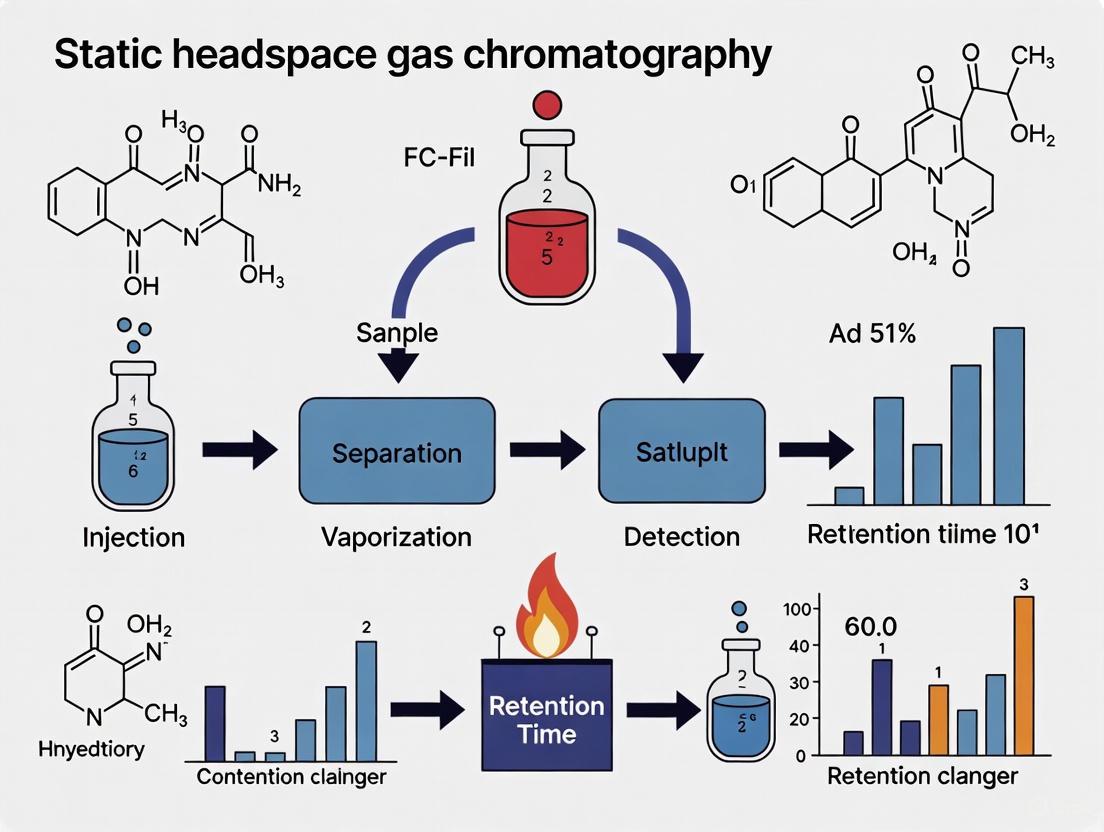
This article provides a comprehensive guide to Static Headspace Gas Chromatography with Flame Ionization Detection (HS-GC-FID) for researchers, scientists, and drug development professionals.
Static Headspace GC-FID for Pharmaceutical Analysis: A Guide to Fundamentals, Methods, and Troubleshooting
Abstract
This article provides a comprehensive guide to Static Headspace Gas Chromatography with Flame Ionization Detection (HS-GC-FID) for researchers, scientists, and drug development professionals. It covers foundational principles, from the equilibrium process and key system components to regulatory frameworks like USP <467> and ICH Q3C. The scope extends to detailed methodological development for residual solvent analysis, including diluent selection and parameter optimization, supported by real-world pharmaceutical applications. The article also offers practical troubleshooting tactics and optimization strategies for common issues, and concludes with a thorough exploration of method validation requirements and a comparative analysis with GC-MS, providing a complete resource for ensuring accuracy, compliance, and robustness in pharmaceutical quality control.
Understanding Static Headspace GC-FID: Core Principles and Regulatory Frameworks
Static Headspace Sampling (SHS) is a sample introduction technique for gas chromatography (GC) that involves analyzing the vapor phase, or the headspace, above a liquid or solid sample contained within a sealed vial [1] [2]. This technique is fundamentally based on the establishment of a partitioning equilibrium between the non-volatile sample matrix and the gaseous phase above it [1]. For pharmaceutical analysis, where complex matrices like active pharmaceutical ingredients (APIs) are common, SHS offers a significant advantage by injecting only the volatile analytes into the gas chromatograph, thereby protecting the instrument from non-volatile residues and minimizing sample preparation [2] [3].
The core principle is that after a sample is placed in a vial and sealed, the system is heated to a controlled temperature and allowed to reach a state of dynamic equilibrium [1] [2]. At this point, the rate at which analyte molecules evaporate from the condensed phase (liquid or solid) into the vapor phase equals the rate at which they condense back into the condensed phase. Once equilibrium is established, a representative aliquot of this vapor is withdrawn, typically using an automated valve and loop system, and transferred to the GC for separation and detection [1]. This makes SHS particularly suited for the determination of volatile and semi-volatile organic compounds in a vast range of matrices, with common pharmaceutical applications including the analysis of residual solvents in drug substances and products [3].
Theoretical Foundation: The Partitioning Equilibrium
The entire quantitative framework of static headspace analysis is governed by the gas-liquid partitioning equilibrium. Understanding this equilibrium is crucial for developing robust and sensitive methods, especially for regulatory applications like pharmaceutical quality control.
The Fundamental Equilibrium Equation
When a volatile analyte is contained within a sealed vial, it distributes itself between the sample phase (s) and the gas phase (g). This distribution is described by the equilibrium [1]: [ \text{Analyte}{\text{(sample)}} \rightleftharpoons \text{Analyte}{\text{(vapor)}} ] The extent of this distribution is quantified by the partition coefficient (K), which is defined as the ratio of the analyte's concentration in the sample phase to its concentration in the gas phase at equilibrium [1] [4]: [ K = \frac{CS}{CG} ] where:
- ( K ) is the partition coefficient,
- ( C_S ) is the equilibrium concentration of the analyte in the sample phase,
- ( C_G ) is the equilibrium concentration of the analyte in the gas phase.
A low value of K indicates that the analyte has a high volatility and a strong tendency to partition into the gas phase, which is ideal for headspace analysis. Conversely, a high K value signifies low volatility and a preference for remaining in the sample matrix [4]. For instance, the K value for ethanol in water is approximately 500 at 40°C, meaning there is 500 times more ethanol in the water than in the headspace, while for a non-polar solvent like n-hexane in water, K can be as low as 0.01, indicating 100 times more hexane in the headspace than in the water [4].
The relationship between the initial concentration of the analyte in the sample (( C0 )) and its concentration in the headspace (( CG )) is given by the fundamental headspace equation [1] [2]: [ CG = \frac{C0}{K + \beta} ] where ( \beta ) is the phase ratio, defined as the ratio of the vapor phase volume (( VG )) to the sample phase volume (( VS )) in the vial (( \beta = VG / VS )) [1] [4].
The detector response (peak area, A) is directly proportional to ( CG ), leading to the practical equation used in method development [2]: [ A \propto CG = \frac{C_0}{K + \beta} ] This equation is the cornerstone of SHS method development. To maximize detector signal, the sum ( K + \beta ) must be minimized. This is achieved by optimizing factors that affect K (like temperature and matrix composition) and β (like sample volume) [2].
Visualizing the Static Headspace Process
The following diagram illustrates the core equilibrium and the automated sampling process in static headspace analysis.
Figure 1: The Static Headspace Equilibrium and Workflow. This diagram depicts the establishment of gas-liquid partitioning equilibrium in a sealed vial and the subsequent automated steps to transfer the headspace aliquot to the GC for analysis.
Key Parameters in Method Development
The sensitivity and reproducibility of a static headspace method are highly dependent on several key experimental parameters. Optimizing these parameters is essential for achieving reliable quantitative results in pharmaceutical analysis.
Table 1: Optimization Parameters for Static Headspace Methods
| Parameter | Definition & Impact | Optimization Guidance for Pharmaceutical Applications |
|---|---|---|
| Temperature [1] [4] [2] | Increases vapor pressure, shifting equilibrium to the gas phase and increasing ( C_G ). | Typically set as high as possible without degrading the sample or causing excessive solvent vaporization. Must be controlled to within ±0.1°C for high-K analytes to ensure precision. For aqueous samples, keep ~20°C below solvent boiling point. |
| Phase Ratio (β) [1] [4] [2] | ( \beta = VG / VS ). A smaller β increases ( C_G ), especially for analytes with low K. | Use a larger sample volume in a given vial size to minimize β. A common practice is to use 10 mL of sample in a 20 mL vial (β=1). Sample volume must be consistent for high precision with volatile analytes (low K). |
| Equilibration Time [4] [2] | Time required for the system to reach full equilibrium. Insufficient time causes poor reproducibility. | Determined experimentally for each analyte/matrix combination. Agitation can significantly reduce the required time. The system must reach equilibrium for reproducible quantitative analysis. |
| Salting Out [4] | Addition of salts (e.g., KCl) to aqueous samples decreases analyte solubility, reducing K and increasing ( C_G ). | Highly effective for polar analytes in polar matrices (e.g., water). The efficiency follows the Hofmeister series (e.g., phosphates > sulfates > acetates > chlorides) [5]. |
| Partition Coefficient (K) [1] [4] | ( K = CS / CG ). Defines the analyte's volatility in a specific matrix. The primary target for optimization via temperature and matrix modification. | High K: Analyte has low volatility (e.g., ethanol in water). Low K: Analyte has high volatility (e.g., hexane in water). Matrix effects (intermolecular interactions) strongly influence K. |
Experimental Protocol: A Pharmaceutical Application
The following detailed methodology for determining residual solvents in cephalosporins, as outlined by Gad et al. (2015), serves as an exemplary protocol for pharmaceutical SHS analysis [3].
Methodology for Residual Solvent Analysis
- Objective: To develop and validate a static headspace gas chromatographic (HS-GC) method for the simultaneous determination of 11 residual solvents in various cephalosporin drug substances.
- Instrumentation: Static Headspace Autosampler coupled to a Gas Chromatograph equipped with a Flame Ionization Detector (FID).
- Chromatographic Column: Capillary column (6% cyanopropyl-phenyl – 94% dimethyl polysiloxane), 30 m × 0.32 mm id × 1.8 μm film thickness.
- Carrier Gas: Helium.
- Sample Preparation: The sample is dissolved in a matrix-matched diluent consisting of dimethylacetamide (DMA) and water in a 1:1 (v/v) ratio. The use of a matrix-matched diluent is critical to ensure that the activity coefficient of the analytes in the standard and sample solutions is identical, which is necessary for accurate quantification [4].
- Headspace Conditions:
- Equilibration Temperature: 120 °C
- Equilibration Time: 5 minutes
- Vial pressurization and loop fill time as per instrument manufacturer's specifications.
- GC Temperature Program: Oven temperature programmed from 40 °C to 155 °C to achieve optimal separation of the 11 target solvents.
- Validation: The method was successfully validated for specificity, sensitivity (detection and quantitation limits), linearity (r = 0.995–1.000 for most analytes), and accuracy, with reported recoveries between 98% and 103% [3].
The Scientist's Toolkit: Essential Materials and Reagents
Table 2: Essential Research Reagent Solutions and Materials
| Item | Function in Static Headspace Analysis |
|---|---|
| Headspace Vials [2] | Sealed containers (typically 10-22 mL) designed to withstand pressure and maintain a gas-tight seal, preventing analyte loss. |
| Inert Sealing Septa & Caps [2] | Ensure no contaminants are introduced and that the vial remains sealed during heating and pressurization. |
| Matrix-Matched Diluent [4] [3] | A solvent or solvent mixture that closely matches the sample matrix to ensure equivalent analyte partitioning between standard and sample solutions (e.g., DMA-water 1:1 for cephalosporins). |
| Salting-Out Agents [4] | Non-volatile salts (e.g., Potassium Chloride, Ammonium Sulfate) added to aqueous samples to reduce analyte solubility and drive it into the headspace. |
| Internal Standards | A compound added in a constant amount to all standards and samples to correct for instrument variability and minor sample preparation errors. |
| Gas-Tight Syringe [1] | For manual sampling or in automated systems for transferring the headspace aliquot. |
| Certified Reference Standards | High-purity solvents used for preparing calibration standards to ensure accurate quantification. |
Advanced Quantitative Techniques
When the sample matrix is complex and a blank matrix is unavailable for calibration, standard external calibration may fail. In such cases, advanced matrix-independent quantification techniques are employed.
- Multiple Headspace Extraction (MHE): This technique involves performing a series of consecutive static headspace extractions from the same sample vial [2] [6]. The peak areas obtained from each extraction form a decreasing exponential curve. By extrapolating this curve back to time zero, the total peak area corresponding to the complete release of the analyte from the sample can be calculated. This total area is then used for quantification, effectively eliminating the influence of the matrix on the result [2].
- Full Evaporation Technique (FET): In FET, a very small sample volume (typically < 100 μL) is introduced into a large headspace vial [6] [5]. The vial is heated at a sufficiently high temperature to completely evaporate both the volatile analytes and the sample matrix. This forces nearly 100% of the analytes into the gas phase, effectively making K approach zero and eliminating matrix effects. The headspace then represents the total analyte content, allowing for straightforward calibration with standard solutions in any convenient solvent [5].
Static Headspace Sampling is a powerful, robust, and primarily quantitative technique when the fundamental principle of gas-liquid partitioning equilibrium is understood and controlled. Its simplicity, derived from the direct analysis of the vapor phase, is its greatest strength, enabling clean injections into the GC and high instrument uptime [2]. For pharmaceutical researchers, mastery of the key parameters—temperature, phase ratio, and equilibration time—is non-negotiable for developing validated methods that meet stringent regulatory requirements for impurity profiling, such as residual solvent analysis per ICH guidelines [3]. By applying the theoretical foundations and experimental protocols outlined in this guide, scientists can effectively leverage SHS-GC to ensure the safety and quality of drug products.
The Flame Ionization Detector (FID) stands as the most prevalent and reliable detection method used in gas chromatography (GC) systems worldwide [7] [8]. Often described as the "workhorse" of GC detectors, its popularity stems from exceptional reliability, versatility, and operational simplicity [7] [8]. The detector operates on a fundamental principle: it decomposes organic solute molecules in a hydrogen-air flame to produce charged ions, then measures the resultant changes in electrical conductivity [7]. This mechanism makes the FID exceptionally responsive to compounds containing carbon-carbon and carbon-hydrogen bonds, while generating minimal to no signal for common carrier gases or inorganic compounds [7] [8]. This specific selectivity, combined with high sensitivity and a wide dynamic range, establishes the FID as the detector of choice for analyzing hydrocarbon-based solvents, particularly in precision-critical fields like pharmaceutical research.
In the pharmaceutical industry, where the detection and quantification of residual solvents in drug substances and products are paramount, Static Headspace-GC-FID has become a cornerstone technique [9]. The United States Pharmacopeia (USP) method <467>, which employs this very technology, exemplifies its critical role in ensuring product safety and regulatory compliance [9]. Static headspace sampling provides the distinct advantage of analyzing the vapor phase above a sample, thereby introducing cleaner samples into the GC system and minimizing the analysis of non-volatile matrix components that could interfere with results or damage the instrumentation [9]. This synergy between headspace sampling and FID detection creates a powerful analytical platform for monitoring hydrocarbon solvents throughout the drug development and manufacturing processes.
Fundamental Operating Principles of FID
Mechanism of Ionization and Detection
The operation of a Flame Ionization Detector is a precisely orchestrated physico-chemical process. The mechanism can be broken down into several key stages, as illustrated in the workflow below:
The process initiates when the column effluent, carrying the separated analytes, is mixed with pure hydrogen gas and introduced into the detector base [7] [10]. This mixture is then combined with air (the oxidant) and ignited at the jet tip, creating a small, stable flame burning at approximately 2100°C [11]. Within this high-temperature environment, organic compounds are pyrolyzed, and the fundamental ionization reaction is believed to involve the formation of CHO⁺ ions from carbon atoms originating from the solute molecules [7]. A critical electrical field, created by applying a polarizing voltage (typically 200-300 V) between the jet tip (which acts as one electrode) and a collector electrode positioned above the flame, drives the resulting ions and electrons toward the collector [11] [10]. As these charged species hit the collector electrode, they generate a minute electrical current on the order of picoamps (10⁻¹² A) [10]. This tiny current is then converted to a voltage by a high-impedance electrometer, electronically amplified, filtered to remove noise, and finally recorded as the signal that produces the chromatographic peaks [7] [10].
The FID as a "Carbon Counter"
The FID is fundamentally a mass-sensitive carbon counter [7]. Its response is directly proportional to the mass of carbon atoms entering the flame per unit time that are capable of being converted into CH radicals, the precursors to the measurable ions [7]. This relationship means that the number of ionized molecules, and consequently the detector signal, is linearly related to the number of carbon atoms present in the analyte molecule.
However, this relationship is nuanced. The detector's response is influenced by a molecule's chemical structure. While it responds excellently to hydrocarbons containing C-C and C-H bonds, the presence of heteroatoms such as oxygen, nitrogen, sulfur, or halogens can reduce the response [7]. This is because these atoms may alter the pathway of the combustion process, potentially leading to the formation of neutral or non-ionized species instead of the detectable CHO⁺ ions. Consequently, under standardized conditions, the FID response for different organic compounds can be predicted with reasonable accuracy based on their carbon number and bonding, a feature that is exceptionally valuable for quantitative analysis of hydrocarbon solvents which are typically composed solely of carbon and hydrogen.
The FID Advantage for Hydrocarbon Solvents
Key Performance Characteristics
The suitability of the FID for analyzing hydrocarbon-based solvents is rooted in its outstanding technical performance metrics, which are summarized in the table below.
Table 1: Key Performance Characteristics of a Flame Ionization Detector
| Performance Parameter | Specification | Implication for Hydrocarbon Solvent Analysis |
|---|---|---|
| Sensitivity | Minimum detectable amounts ~10⁻¹² to 10⁻¹³ g/s [7] [11] | Capable of detecting trace-level residual solvents in pharmaceuticals at parts-per-billion (ppb) levels [8]. |
| Linear Dynamic Range | Up to 10⁶ to 10⁷ orders of magnitude [7] [11] | Allows for the accurate quantification of solvents from low ppm to high percentage levels in a single injection [8]. |
| Selectivity | High for organic compounds (C-C, C-H bonds); little/no response to common inorganic gases (CO, CO₂, H₂O, NH₃) or carrier gases [7] [11] | Minimizes interference from water, air, or carbon dioxide, which are common in sample matrices. |
| Response Factor | Similar for most hydrocarbons on a per-carbon-atom basis [7] | Simplifies quantification; allows for calibration with a surrogate hydrocarbon if response factors are verified. |
Comparative Advantages Over Other Detectors
When placed in the context of alternative GC detectors, the specific advantages of the FID for hydrocarbon analysis become even more pronounced. Its high selectivity for carbon-containing compounds means it is inherently blind to the components of air and water, which are ubiquitous potential contaminants [7]. This eliminates misleading positive readings in the presence of moisture and simplifies method development [1]. Furthermore, the detector's robustness and ease of operation contribute to its status as a "workhorse" in quality control laboratories, where instrument uptime and method reliability are critical [7] [8]. The combination of a wide linear range and high sensitivity is particularly powerful. It enables the auto-ranging FID in modern GC systems to "detect and quantitate from percent levels to parts per billion (ppb) in a single injection," a capability essential for monitoring residual solvents that may be present in vastly different concentrations across various drug substances [8].
Static Headspace GC-FID: A Synergistic Technique
Fundamentals of Static Headspace Extraction
Static Headspace (SHE) extraction is a sample introduction technique specifically designed for GC, which perfectly complements the strengths of FID detection [1] [9]. The technique involves placing a solid or liquid sample in a sealed vial and allowing volatile compounds to partition between the sample matrix (liquid or solid phase) and the gas phase (the "headspace") above it until equilibrium is established [1]. An aliquot of this headspace vapor is then transferred to the GC for separation and detection. The fundamental relationship governing this process is defined by the following equation [9]:
A ∝ CG = C0 / (K + β)
Where:
- A is the chromatographic peak area.
- CG is the concentration of the analyte in the gas phase.
- C0 is the initial concentration of the analyte in the sample.
- K is the partition coefficient (concentration in sample phase / concentration in gas phase).
- β is the phase ratio (volume of gas phase / volume of sample phase).
This equation highlights that to maximize detector response (A), the sum of K and β must be minimized [9]. This is achieved through careful optimization of method parameters.
The Integrated HS-GC-FID Workflow
The complete process of static headspace extraction coupled with GC-FID analysis forms a streamlined workflow ideal for pharmaceutical solvent analysis, as depicted below.
The workflow begins with sample preparation, where a precise amount of the pharmaceutical sample is placed into a headspace vial and immediately crimp-sealed to prevent loss of volatiles [9]. The vial is then transferred to a temperature-controlled oven within the headspace sampler, where it is heated and agitated for a predetermined equilibration time. This heating is a critical step, as it encourages the volatile hydrocarbon solvents to diffuse into the headspace. As shown in Figure 8 of the search results, increasing the equilibration temperature systematically decreases the partition coefficient (K), thereby increasing the amount of analyte in the headspace and boosting the signal [9]. Once equilibrium is reached, the vial is pressurized with carrier gas, and the pressurized vapor is expanded into a sample loop [9]. The contents of the loop are then transferred via a heated line into the GC inlet for chromatographic separation on a suitable column. Finally, the eluted compounds enter the FID, where the hydrocarbon solvents are ionized, detected, and quantified, generating the data for final analysis [7] [9].
Essential Experimental Protocols for HS-GC-FID
Critical Method Parameters and Optimization
Developing a robust and sensitive HS-GC-FID method for pharmaceutical solvents requires the systematic optimization of several key parameters. The following table outlines these critical parameters and provides a practical optimization strategy.
Table 2: Key Method Parameters for HS-GC-FID Analysis of Residual Solvents
| Parameter | Function & Impact | Optimization Strategy |
|---|---|---|
| Equilibration Temperature | Increases vapor pressure of analytes, shifting equilibrium to headspace and increasing signal [9]. | Increase temperature stepwise (e.g., 10°C increments). Monitor signal increase until plateau is reached. Caution: Stay ~20°C below solvent boiling point to avoid excessive vial pressure [9]. |
| Equilibration Time | Time required for the system to reach equilibrium between the sample and vapor phase. | Perform time profiling (e.g., 10, 20, 30, 40 min). Select the shortest time that gives a consistent, maximum peak area. Insufficient time is a primary cause of poor reproducibility [1]. |
| Sample Volume & Phase Ratio (β) | β = Vgas/Vliquid. A smaller β (more sample) increases signal, especially for volatile analytes [9]. | Test different sample volumes in a fixed vial size. For a 20 mL vial, 2-5 mL is typical. Ensure at least 50% headspace remains [9]. |
| FID Gas Flow Rates (H₂ and Air) | Directly impacts flame stability, sensitivity, and linear dynamic range [10]. | Set air:hydrogen ratio at ~10:1. Optimize H₂ flow around 30-45 mL/min, as sensitivity peaks in a narrow window [12] [10]. |
| Vial Pressurization | Affects the transfer of a consistent volume of headspace vapor to the GC [9]. | Follow instrument manufacturer's recommendations. Higher pressure can improve transfer efficiency and reproducibility. |
The Scientist's Toolkit: Essential Research Reagents and Materials
Successful and reproducible HS-GC-FID analysis relies on a set of specific, high-quality materials and reagents.
Table 3: Essential Research Reagents and Materials for HS-GC-FID
| Item | Function / Purpose | Technical Notes |
|---|---|---|
| Headspace Vials | Containment for sample during equilibration; must be sealable. | Common sizes are 10 mL and 20 mL. Use 20 mL vials for larger sample volumes to maintain a favorable phase ratio [9]. |
| PTFE/Silicone Septa & Crimp Caps | Provides a gas-tight seal to prevent loss of volatile analytes during heating and pressurization. | Quality is critical. Must withstand high temperatures and repeated piercing by the sampling needle without coring. |
| Hydrocarbon Solvent Standards | Used for calibration, identification, and quantification. | High-purity reference standards for solvents of interest (e.g., benzene, toluene, xylene, hexane). |
| Internal Standard | Added in a constant amount to all samples and standards to correct for injection variability and matrix effects. | A volatile compound not present in the sample (e.g., deuterated toluene or other suitable deuterated hydrocarbons). |
| High-Purity Hydrogen Gas | Fuel for the FID flame. | Generated on-demand via a hydrogen generator for safety, consistency, and cost-effectiveness [13]. Purity is vital for a low-noise baseline. |
| Zero Air | Oxidant for the FID flame. | Must be hydrocarbon-free. Generated by a dedicated, high-quality air source or generator. |
| Make-up Gas (Nitrogen) | Added to the column effluent to optimize linear velocity through the FID jet, improving sensitivity and peak shape for capillary columns [13] [10]. | High-purity nitrogen is a cost-effective and common choice [13]. |
The Flame Ionization Detector remains the undisputed cornerstone for the analysis of hydrocarbon-based solvents, particularly within the demanding framework of pharmaceutical research. Its fundamental operating principle as a highly sensitive and selective "carbon counter" makes it intrinsically suited for detecting molecules with C-C and C-H bonds, while its exceptional linear dynamic range allows for the quantification of solvents across a vast concentration spectrum. When integrated with Static Headspace sampling, the technique forms a powerful, robust, and reproducible platform for analyzing volatile organics in complex matrices without introducing non-volatile components into the chromatograph. This synergy, governed by well-understood thermodynamic principles, provides pharmaceutical scientists with a reliable methodology to ensure drug safety and compliance with stringent regulatory standards, solidifying the role of HS-GC-FID as an indispensable tool in modern analytical laboratories.
Static Headspace Gas Chromatography coupled with a Flame Ionization Detector (HS-GC-FID) is a powerful analytical technique widely adopted in pharmaceutical laboratories for the determination of volatile impurities. Its primary advantage lies in its ability to analyze complex solid and liquid samples without introducing non-volatile matrix components into the chromatographic system [14] [15]. This is particularly crucial in pharmaceutical analysis, where drug substances and products often contain non-volatile excipients and active ingredients that could contaminate the GC inlet and column, leading to increased downtime and maintenance [16]. The technique focuses on measuring the volatile analytes that partition into the gas phase (the "headspace") above a sample sealed in a vial after reaching equilibrium at a controlled temperature [1]. In the context of pharmaceutical quality control and research, HS-GC-FID is the benchmark method for procedures such as the analysis of residual solvents as per pharmacopeial standards (e.g., USP <467>), ensuring drug safety and efficacy [14] [16].
Fundamental Principles of Static Headspace Analysis
The core principle of static headspace analysis is the equilibrium distribution of volatile analytes between the sample matrix (liquid or solid phase) and the gas phase (headspace) in a sealed vial [14] [1]. The concentration of an analyte in the headspace at equilibrium is directly related to its original concentration in the sample. This relationship is governed by the partition coefficient (K), defined as K = C~S~/C~G~, where C~S~ is the analyte's concentration in the sample phase and C~G~ is its concentration in the gas phase [14]. A smaller K value signifies a greater propensity for the analyte to escape the sample matrix, resulting in a higher concentration in the headspace and, consequently, a stronger detector response [14].
The fundamental equation in headspace analysis describes the detector response (A): A ∝ C~G~ = C~0~/(K + β) Here, C~0~ is the original concentration of the analyte in the sample, and β is the phase ratio, which is the ratio of the headspace volume (V~G~) to the sample volume (V~S~) in the vial (β = V~G~/V~S~) [14] [1]. To maximize sensitivity, the goal is to minimize the denominator (K + β). This is achieved by optimizing factors that affect K (like temperature and sample solvent) and β (via vial size and sample volume) [14].
System Components and Their Functions
The Headspace Sampler
The headspace sampler automates the incubation, pressurization, and transfer of the vapor sample. Its key components and a typical workflow are detailed below.
Table 1: Key Components of a Valve-and-Loop Headspace Sampler [14]
| Component | Function |
|---|---|
| Temperature-Controlled Oven | Incubates sample vials at a constant temperature to ensure rapid and reproducible equilibrium. |
| Sampling Probe/Needle | Pierces the vial septum to perform two functions: adding pressurization gas and transferring the sample. |
| Heated Sampling Loop | A loop of tubing with a fixed volume that is filled with the headspace vapor, ensuring repeatable injection sizes. |
| Heated Sampling Valve | A multi-port valve that controls the flow paths for vial pressurization, loop filling, and injection to the GC. |
| Heated Transfer Line | A thermally controlled tube that carries the sample aliquot from the headspace sampler to the GC inlet. |
Figure 1: Static Headspace Sampling Workflow.
The automated process involves three critical steps after the vial is sealed and placed in the sampler [14]:
- Equilibration: The vial is heated in the sampler oven for a predetermined time to allow the volatile compounds to distribute between the sample and the headspace.
- Pressurization: The sampling needle pierces the vial septum, and carrier gas is introduced to raise the pressure inside the vial above the ambient pressure.
- Loop Filling and Injection: The pressurized headspace vapor is vented through the needle to fill the external sample loop. Finally, the valve position changes, and the carrier gas flushes the entire contents of the loop through the heated transfer line into the GC inlet for analysis.
The Gas Chromatograph (GC) and Column
Once the headspace sample is introduced into the GC system, separation of the volatile mixture occurs in the column. The GC inlet, typically a split/splitless injector, receives the vapor and can be operated in split mode to prevent column overloading or splitless mode for maximum sensitivity [1]. The heart of the separation is the GC column. Capillary columns, made of fused silica, are standard due to their high efficiency [15]. The choice of stationary phase is critical for achieving the necessary separation. For generic pharmaceutical methods, such as the analysis of multiple residual solvents, a mid-polarity column is often employed. A common choice is a 30 m × 0.32 mm I.D., 1.8 µm film thickness DB-624 column or equivalent, which provides an excellent balance of separation efficiency, speed, and sample capacity for volatile organics [16]. The oven temperature program is then optimized to resolve all compounds of interest within a reasonable runtime, often involving a gradient from a low initial temperature (e.g., 35-40°C) to a high final temperature (e.g., 220-240°C) [16] [17].
The Flame Ionization Detector (FID)
The Flame Ionization Detector (FID) is the final and critical component in this analytical chain, prized for its reliability, wide dynamic range, and high sensitivity for organic compounds [18] [19]. The FID operates on the principle of combusting organic molecules in a hydrogen/air flame, which generates ions [18] [19]. Key components of the FID include:
- Jet Tip: Where the column effluent is mixed with hydrogen and combusted in a surrounding air stream.
- Flame: The hydrogen/air flame where combustion and ionization of carbon-containing compounds occur (excluding carbonyl and alcohol groups and carbon disulfide).
- Collector Electrode: Positively charged electrode positioned near the flame that attracts the negatively charged ions.
- Polarizing Electrode: Creates an electrical field for ion collection.
Figure 2: Flame Ionization Detector (FID) Principle.
The magnitude of the generated ion current is directly proportional to the number of carbon atoms entering the flame, making the FID an excellent mass-sensitive detector [18] [19]. This proportionality is the foundation for accurate quantification. The FID is robust and requires relatively low maintenance, but its limitation is that it cannot detect non-combustible compounds, such as inorganic gases (e.g., CO, CO~2~, N~2~, O~2~) or water [19].
Critical Method Parameters and Optimization
Developing a robust static headspace GC-FID method requires systematic optimization of several key parameters to maximize sensitivity, reproducibility, and throughput.
Table 2: Key HS-GC-FID Method Parameters and Optimization Strategies [14] [16] [17]
| Parameter | Impact on Analysis | Optimization Guidance for Pharmaceuticals |
|---|---|---|
| Sample Solvent (Diluent) | Affects solubility (K) and equilibration temperature. | Use high-bo-point, stable solvents like DMSO (b.p. 189 °C) to dissolve APIs and allow high equilibration temperatures [16]. |
| Equilibration Temperature | Directly affects partition coefficient (K). Higher temperature decreases K, increasing headspace concentration. | Increase temperature to improve sensitivity. Maximum temperature should be ~20 °C below solvent boiling point to avoid excessive pressure [14] [16]. |
| Equilibration Time | Time required to reach equilibrium between sample and headspace. | Determine experimentally. Insufficient time causes poor reproducibility. Typical times are 10-30 minutes [16] [17]. |
| Phase Ratio (β) | Ratio of headspace volume to sample volume. Lower β improves sensitivity. | Use larger sample volumes or smaller vials to decrease β. Leave at least 50% headspace in the vial [14]. |
| Vial Pressurization & Loop Fill | Affects the volume and repeatability of sample transfer. | Instrument-controlled parameters are typically optimized for reproducibility once hardware is set [14]. |
| GC Oven Program | Governs the separation of analytes on the column. | Use a temperature gradient. Example: 35 °C (hold 5 min), ramp to 240 °C at 10-40 °C/min [16] [17]. |
| Carrier Gas & Flow | Impacts separation efficiency and speed. | Helium is common. Constant flow mode (e.g., 0.9 mL/min) is typical [15] [17]. |
| FID Temperature | Ensures the detector response is stable and prevents condensation. | Set at a high temperature (e.g., 250-300 °C) [17]. |
Detailed Pharmaceutical Application: A Representative Experimental Protocol
The following protocol, adapted from validated methods in the literature, provides a detailed example of using HS-GC-FID for determining residual solvents in a drug substance [16] [17].
Research Reagent Solutions
Table 3: Essential Materials and Reagents for Residual Solvent Analysis
| Item | Function / Specification |
|---|---|
| Drug Substance | Pharmaceutical material under test. |
| Dimethyl Sulfoxide (DMSO) | High-purity, high-boiling-point solvent for dissolving the drug substance. |
| Residual Solvent Standards | Certified reference materials of target solvents (e.g., Class 2 & 3 ICH solvents). |
| Headspace Vials | 20 mL amber glass vials, certified for headspace analysis. |
| Septa & Caps | Magnetic screw caps with PTFE/silicone septa, certified for headspace. |
| p-Toluenesulfonic Acid | Catalyst for derivatization of specific analytes like formaldehyde [17]. |
Sample and Standard Preparation
- Sample Solution: Accurately weigh approximately 200 mg of drug substance into a 20 mL headspace vial. Add 4 mL of DMSO to the vial, seal immediately with the crimp cap, and vortex until the solid is completely dissolved [16].
- Standard Solutions: Prepare a stock standard solution of the target residual solvents in DMSO at a concentration near the expected limit or working range. Perform serial dilutions with DMSO to prepare a calibration curve. Transfer 4 mL of each standard solution to a headspace vial and seal [16] [17].
Note: For the analysis of formaldehyde, a derivatization step may be required. This involves adding an acidified ethanol solution (e.g., 1% p-toluenesulfonic acid in ethanol) to the sample vial, which converts formaldehyde to a more volatile and detectable derivative, diethoxymethane [17].
Instrumental Conditions
This generic set of conditions is suitable for the determination of a wide range of residual solvents and can be modified for specific applications [16] [17].
- Headspace Sampler Conditions:
- GC Conditions:
- Column: DB-624, 30 m × 0.32 mm I.D., 1.8 µm (or equivalent) [16]
- Carrier Gas: Helium, constant flow, 0.9 - 1.5 mL/min [16] [17]
- Injector Temperature: 170 - 200 °C [17]
- Split Ratio: 1:5 to 1:25 (e.g., 1:10) [16] [17]
- Oven Temperature Program: 35 °C for 5 min, then ramp at 10 °C/min to 240 °C, hold for 1-5 min [16]
- FID Conditions:
- Detector Temperature: 250 - 300 °C (e.g., 280 °C) [17]
- Hydrogen Flow: 30 - 40 mL/min
- Air Flow: 300 - 400 mL/min
- Make-up Gas (Nitrogen or Helium): 20 - 30 mL/min
Data Analysis and Quantification
- Identification: Identify the target solvent peaks in the sample chromatograms by comparing their retention times with those of the standard solutions [15].
- Quantification: Construct a calibration curve by plotting the peak area (or height) of each solvent in the standard solutions against their known concentrations. Use this curve to calculate the concentration of each solvent in the sample solution. External standard calibration is commonly used and has been shown to provide accurate and precise results for residual solvent analysis [16].
The instrumentation of static headspace GC-FID represents a meticulously engineered system where each component—from the headspace sampler's pressurized vial to the FID's hydrogen flame—plays a critical role in generating reliable analytical data. For pharmaceutical researchers, a deep understanding of this instrumentation, coupled with methodical optimization of key parameters such as equilibration temperature, sample solvent, and chromatographic conditions, is fundamental. This knowledge enables the development of robust, sensitive, and reproducible methods that are essential for ensuring the safety and quality of drug products by monitoring volatile impurities like residual solvents. The technique's specificity, automation, and ability to handle complex matrices solidify its status as an indispensable tool in modern pharmaceutical analysis.
Residual solvents are organic volatile chemicals used or produced during the manufacture of drug substances, excipients, or drug products. Since these chemical residues can pose significant risks to human health, regulatory frameworks mandate that manufacturers ensure they are either absent or controlled below safe levels [20]. The United States Pharmacopeia (USP) General Chapter <467> and the International Council for Harmonisation (ICH) Q3C guideline provide the foundational standards for controlling these impurities in pharmaceuticals [21]. These documents classify solvents based on toxicity and establish permitted daily exposure (PDE) limits to ensure patient safety [22].
A crucial distinction lies in their regulatory scope and enforceability. ICH Q3C serves as an international guideline that applies primarily to new drug products [23] [22]. In contrast, USP <467> is a mandatory compendial standard in the United States for all drug substances, excipients, and products covered by a USP or NF monograph, whether new or existing [23] [21]. This means that while the scientific principles and solvent limits are harmonized, USP <467> extends these safety requirements to the entire compendial market, ensuring all relevant pharmaceuticals, regardless of approval date, meet consistent safety standards for residual solvents [22].
Solvent Classifications and Toxicological Basis
Residual solvents are categorized into three classes based on their toxicological risk, a system harmonized between ICH Q3C and USP <467> [21] [20].
- Class 1: Solvents to Be Avoided: These are known or suspected human carcinogens and environmental hazards. Their use in the manufacture of drug substances, excipients, or drug products should be avoided unless strongly justified in a risk-benefit assessment [20]. Class 1 solvents, such as benzene and carbon tetrachloride, have strict concentration limits in the low parts-per-million (ppm) range [21].
- Class 2: Solvents to Be Limited: These solvents are associated with less severe, but reversible, toxicities, such as nongenotoxic animal carcinogenicity or neurotoxicity. They should be limited in pharmaceutical products to protect patients from potential adverse effects [20]. The limits for these solvents are defined by a Permitted Daily Exposure (PDE) value, which is then used to calculate a concentration limit (ppm) based on the product's daily dose [21] [22].
- Class 3: Solvents with Low Toxic Potential: These solvents have low toxic potential to humans and are less hazardous to health than Class 1 or 2 solvents. Solvents in this class may be limited by general quality considerations rather than specific toxicological concerns [20].
Table 1: Examples of Residual Solvent Classifications and Limits
| Solvent | Class | PDE (mg/day) | Concentration Limit (ppm) |
|---|---|---|---|
| Benzene | 1 | - | 2 [21] |
| Carbon Tetrachloride | 1 | - | 4 [21] |
| Acetonitrile | 2 | 4.1 | 410 [21] |
| Toluene | 2 | 8.9 | 890 [21] |
| Ethanol | 3 | - | 5000* [24] |
Note: The value for Ethanol is an example; specific limits for Class 3 solvents can vary.
Compliance Requirements and Testing Options
A foundational principle of both ICH Q3C and USP <467> is that the safety limits for residual solvents apply to the finished drug product [22]. However, compliance is demonstrated through knowledge and control of the drug's components—the active pharmaceutical ingredient (API) and excipients [23] [22]. Manufacturers have several pathways to demonstrate compliance.
Option 1: Component-Level Testing If all components (API and excipients) individually contain Class 2 solvents at levels below the Option 1 limits provided in the guidelines, and the daily dose of the product is 10 grams or less, the drug product is deemed compliant. No further calculation or testing of the final product is required. This option simplifies the compliance process but relies on comprehensive and reliable data from all raw material suppliers [22].
Option 2: Calculation-Based Compliance If one or more components contain a Class 2 solvent above the Option 1 limit, the manufacturer can sum the calculated daily intake of the solvent from all components. If the total is below the solvent's established PDE, the product complies. This approach acknowledges that a component constituting a small fraction of the final product may safely contain a higher solvent concentration [22].
Option 3: Finished Product Testing The final drug product can be tested directly to confirm that residual solvent levels are within the required limits. This method accounts for any solvent loss or introduction during the manufacturing process. However, method development can be complex due to the mixed solubility of various product components [22].
For Class 3 solvents, a cumulative level of 0.5% or less can typically be justified as acceptable. If the level exceeds 0.5%, the specific solvents must be identified and quantified, typically using gas chromatography instead of a non-specific test like Loss on Drying (LOD) [23].
Analytical Methodology: Static Headspace GC-FID
The USP <467> monograph details specific analytical procedures for identifying and quantifying residual solvents, with static headspace gas chromatography coupled with flame ionization detection (HS-GC-FID) being the primary technique [20] [25]. This method is ideal for volatile compounds in complex solid and liquid matrices, as it analyzes the vapor phase above the sample, preventing non-volatile matrix components from contaminating the GC system [26] [25].
USP <467> Procedural Workflow
The official method consists of three sequential procedures designed to provide orthogonal separation and confirmation.
Procedure A: Initial Identification Procedure A is the first step, performed using a (G43) 6% cyanopropylphenyl-94% dimethyl polysiloxane capillary column. Its purpose is to determine if any residual solvents are present at detectable levels. System suitability criteria must be met, including specified signal-to-noise (S/N) ratios for Class 1 solvents and resolution between critical peak pairs like acetonitrile and methylene chloride [20].
Procedure B: Confirmatory Analysis If a solvent is detected above its limit in Procedure A, Procedure B is used for confirmation. This procedure uses a (G16) polyethylene glycol (wax) column, which provides different (orthogonal) selectivity compared to the G43 column. This helps resolve any co-elutions that may have occurred in the first procedure. Procedure B has its own system suitability requirements, such as resolution between acetonitrile and cis-dichloroethene [20].
Procedure C: Quantification Once a residual solvent has been identified and confirmed, Procedure C is used for accurate quantification. Either the G43 or G16 column can be used, depending on which provided better separation and lower co-elution for the analytes of interest [20].
The following diagram illustrates this sequential analytical workflow:
Method Development and Optimization
Developing a robust and sensitive HS-GC-FID method requires careful optimization of several key parameters, which are grounded in the fundamental principles of static headspace extraction.
Sample Diluent and Solubility: The choice of diluent is critical. Water is suitable for water-soluble samples, but many drug substances require a higher-boiling-point solvent like dimethyl sulfoxide (DMSO, BP 189°C) or N, N-dimethylformamide (DMF, BP 153°C) to dissolve a sufficient amount of sample. A good diluent should have high dissolving capacity, a high boiling point, and good stability [16]. The partition coefficient (K), which is the ratio of the analyte's concentration in the sample phase to its concentration in the gas phase at equilibrium, is heavily influenced by the diluent. A smaller K value means more analyte has partitioned into the headspace, leading to higher sensitivity [26].
Equilibration Temperature and Time: Temperature is a primary lever for controlling the partition coefficient. Increasing the vial temperature shifts the equilibrium toward the vapor phase, decreasing K and increasing the analyte signal in the headspace [1] [26]. The temperature must be high enough to facilitate vaporization but kept safely below the boiling point of the diluent to prevent excessive pressure [16]. Equilibration time must be sufficient for the system to reach a stable equilibrium between the sample and vapor phases; failure to do so is a leading cause of poor reproducibility [1].
Phase Ratio (β): The phase ratio is the ratio of the vapor phase volume to the sample solution volume in the headspace vial (β = Vvapor / Vliquid). A smaller β (achieved by using a larger sample volume or a smaller vial) increases the concentration of the analyte in the headspace, thereby improving sensitivity for volatile analytes [1] [26].
Table 2: Key Parameters for HS-GC-FID Method Development
| Parameter | Impact on Analysis | Optimization Consideration |
|---|---|---|
| Sample Diluent | Affects drug solubility, partition coefficient (K), and allowable equilibration temperature. | Use DMSO for high boiling point and stability; use water for clean, low-cost analysis of soluble samples [16]. |
| Equilibration Temperature | Higher temperature decreases K, increasing headspace concentration and sensitivity. | Set high but ~20°C below diluent boiling point. For DMSO, 140–150°C is effective [16] [26]. |
| Equilibration Time | Required for system to reach equilibrium; insufficient time causes poor reproducibility. | Typically 10–30 minutes; must be determined experimentally for each method [1] [16]. |
| Phase Ratio (β) | A smaller β increases headspace concentration of analyte. | Use a larger sample volume or a smaller vial size to reduce β and enhance sensitivity [26]. |
A Generic Static Headspace GC Method
Research has demonstrated the development of a sensitive and efficient generic HS-GC method for 44 ICH Class 2 and 3 solvents [16]. This method utilizes DMSO as the diluent to dissolve 200 mg of a drug substance in a 4 mL sample volume. The headspace conditions were optimized at an equilibration temperature of 140°C for 10 minutes, leveraging DMSO's high boiling point for faster equilibration and improved sensitivity for higher-boiling solvents compared to aqueous methods [16].
Chromatographic separation was achieved using a DB-624 capillary column (30 m x 0.32 mm I.D., 1.8 µm film thickness) with a two-stage temperature gradient from 35°C to 240°C, allowing for the determination of all 44 solvents in approximately 30 minutes. This method was validated to be accurate, precise, linear, and sensitive for the solvents assessed, providing a robust template for routine quality control [16].
The Scientist's Toolkit: Essential Research Reagents and Materials
Successful residual solvent analysis requires not only a well-developed method but also the correct materials and instrumentation. The following table details key solutions and consumables essential for conducting USP <467> compliant analyses.
Table 3: Essential Materials for Residual Solvent Analysis by HS-GC-FID
| Item | Function / Purpose |
|---|---|
| Headspace Vials, Caps, & Septa | Sealed vials to contain the sample and allow for pressurization and vapor sampling. Must provide an inert environment and a tight seal to prevent loss of volatiles [26]. |
| Class 1, 2, and 3 Solvent Reference Standards | High-purity chemical standards used for system suitability testing, identification (via retention time matching), and quantification (calibration) [20]. |
| High-Boiling Point Diluents (e.g., DMSO, DMF) | To dissolve poorly water-soluble drug substances or products, enabling higher equilibration temperatures and improved method sensitivity [16]. |
| GC Capillary Columns (G43 & G16 phases) | The stationary phases for chromatographic separation. A G43 (6% cyanopropylphenyl) and a G16 (polyethylene glycol) column are required for the orthogonal separation specified in USP <467> Procedures A and B [20]. |
| System Suitability Solutions | Standard mixtures containing specific solvents at defined concentrations used to verify that the chromatographic system is operating with adequate sensitivity, resolution, and selectivity before sample analysis [20]. |
Advanced Applications and Future Directions
While HS-GC-FID is the workhorse for targeted residual solvent analysis, advanced techniques address more complex challenges.
- Multiple Headspace Extraction (MHE): For quantitative analysis in complex, non-reproducible, or solid matrices where creating matrix-matched calibration standards is difficult, MHE provides a solution. This technique involves performing multiple consecutive headspace extractions from the same vial. The peak areas form a decreasing exponential profile, which can be extrapolated to calculate the total analyte content in the sample without needing a matching standard matrix [25].
- Dual-Detector Configurations (FID/MS): To confidently identify co-eluting or unexpected (untargeted) volatile impurities, systems can be configured with both an FID and a mass spectrometer (MS). Advanced microfluidic connectors split the column effluent between the two detectors. The FID provides robust quantification, while the MS provides spectral data for identification by searching against mass spectral libraries [25].
The harmonized but distinct frameworks of ICH Q3C and USP <467> establish a comprehensive system for ensuring patient safety by controlling hazardous residual solvents in pharmaceuticals. For researchers and drug development professionals, a deep understanding of both the regulatory scope and the sophisticated analytical technology—particularly static headspace GC-FID—is paramount. Mastery of method development parameters, such as diluent selection, temperature optimization, and phase ratio control, enables the creation of robust, sensitive, and compliant methods. As analytical technology advances with techniques like MHE and GC-MS/FID, the pharmaceutical industry's ability to precisely monitor and control these critical impurities will continue to strengthen, ensuring the ongoing safety and quality of medicinal products worldwide.
Static Headspace Gas Chromatography with Flame Ionization Detection (HS-GC-FID) is a cornerstone technique for analyzing volatile compounds in pharmaceutical products. This sample introduction technique focuses on analyzing the gas layer (the headspace) above a sample in a sealed vial rather than the sample itself [27]. For pharmaceutical laboratories, this approach provides distinct advantages for monitoring residual solvents, impurities, and volatile degradation products that are critical for drug safety and quality. The technique is predicated on the volatility of target analytes, which allows them to partition into the gas phase above solid or liquid samples, while non-volatile matrix components, such as the active pharmaceutical ingredient (API) and most excipients, remain in the sample vial [27] [28]. This fundamental principle enables the core benefits explored in this whitepaper, making HS-GC-FID an indispensable tool for modern drug development and quality control.
Core Advantage 1: Unparalleled Matrix Compatibility
The ability of static headspace to handle a vast array of sample types is one of its most significant strengths in a pharmaceutical laboratory setting.
Handling Diverse Pharmaceutical Matrices
- Solids, Viscous Liquids, and Complex Formulations: HS-GC is inherently compatible with virtually any matrix, provided the analytes of interest are volatile [27]. This is particularly valuable for pharmaceuticals, where samples can range from powdered APIs and solid dosage forms to viscous liquids like syrups or ointments. The sample itself does not need to be volatile or soluble in a liquid appropriate for GC, which bypasses a major hurdle in sample preparation [27] [28].
- Blood and Other Biological Matrices: A widely used application is the determination of ethanol content in blood, where the technique provides the accurate and defensible data required for clinical and forensic contexts [27]. This demonstrates its reliability with complex biological matrices.
- Challenging Solubility Profiles: A key strategy for analyzing drug substances with poor aqueous solubility is the use of high-bopping-point organic solvents as diluents. Dimethyl sulfoxide (DMSO) is frequently selected for its high capacity to dissolve drug substances, stability, and high boiling point, which allows for higher equilibration temperatures and improved sensitivity [16]. This approach enables labs to analyze residual solvents in a wide range of APIs, regardless of their water solubility.
Case Study: Residual Solvents Analysis
The United States Pharmacopeia (USP) method <467> is a canonical application of headspace analysis, detecting and measuring potentially toxic manufacturing solvents in prescription and over-the-counter drugs [27]. A developed and validated generic static HSGC method for 44 ICH Class 2 and 3 solvents successfully used DMSO to dissolve 200 mg of drug substance, demonstrating effective handling of the API matrix [16]. The method validation confirmed that the recoveries for most solvents were greater than 80%, proving the method's accuracy despite the complex matrix [16].
Core Advantage 2: Minimal Sample Preparation
Eliminating complex, multi-step sample preparation is a primary driver of efficiency and data quality in pharmaceutical analysis.
Reducing Steps and Improving Reproducibility
- Direct Analysis: Sample preparation can be as simple as placing a solid sample or transferring a liquid sample directly into a headspace vial and sealing it [27]. This simplicity significantly reduces the opportunities for error introduction.
- Enhanced Reproducibility: Minimal sample preparation leads to more reproducible results because each sample preparation step is a potential source of error and analyte loss [27] [28]. Automated headspace samplers further enhance reproducibility by standardizing the sampling process from the vial [27].
- Derivatization for Enhanced Detection: In some cases, a simple derivatization step within the headspace vial can be employed to make a target analyte amenable to analysis. For example, a robust SHS-GC-FID method was developed for formaldehyde in excipients by derivatizing it with acidified ethanol inside the vial to form diethoxymethane, a volatile compound easily detected by GC-FID [17]. This one-step reaction in the vial avoids tedious extraction procedures.
Workflow Efficiency
The minimal preparation workflow directly translates to higher laboratory productivity. A generic static HSGC method for residual solvents achieved equilibration in just 10 minutes at 140°C, a much shorter time compared to previous methods that required 30–90 minutes [16]. This efficiency allows analytical laboratories to significantly increase sample throughput for routine quality control testing.
Core Advantage 3: Enhanced Instrument Protection and Uptime
Protecting the sensitive and costly GC instrumentation from damage and contamination is a critical economic and operational advantage.
Preventing Non-Volatile Contamination
- Cleaner Inlet and Column: By introducing only the volatile headspace gas into the GC system, the non-volatile components of the sample matrix (e.g., the API, excipients, polymers) are left behind in the vial [27] [28]. This prevents these materials from contaminating the GC inlet liner, fouling the head of the analytical column, or accumulating in the detector.
- Reduced Maintenance and Downtime: The direct result of a cleaner sample introduction is less frequent instrument maintenance, leading to significantly higher instrument uptime [27] [28]. Labs can experience longer column lifetimes, less frequent inlet liner changes, and reduced need for detector cleaning.
- Comparison with Direct Injection: This advantage is stark when compared to direct injection GC, where high-boiling-point or polar sample components may not elute from the column, leading to contamination of the GC injection port and/or column, and eventual degradation of performance [16].
Quantitative Method Optimization Data
Optimizing a static headspace method requires careful attention to several parameters to maximize detector response and reproducibility. The key relationship is described by the equation: A ∝ CG = C0/(K + β), where the detector response (A) is proportional to the gas phase concentration (CG), which is a function of the initial analyte concentration (C0), the partition coefficient (K), and the phase ratio (β) [27]. The following tables summarize critical optimization data.
Table 1: Optimized Experimental Parameters for a Generic Residual Solvents Method [16]
| Parameter Category | Specific Parameter | Optimized Condition |
|---|---|---|
| Sample Preparation | Drug Substance Mass | 200 mg |
| Diluent | Dimethyl sulfoxide (DMSO) | |
| Diluent Volume | 4 mL | |
| Headspace Conditions | Equilibration Temperature | 140 °C |
| Equilibration Time | 10 min | |
| GC Conditions | Column | DB-624 (30 m x 0.32 mm, 1.8 µm) |
| Oven Program | 35°C (hold 15 min) to 90°C @ 10°C/min, then to 200°C @ 45°C/min (hold 5 min) | |
| Carrier Gas & Flow Rate | Helium, Constant Flow | |
| Injection Split Ratio | 1:40 | |
| Inlet Temperature | 160 °C | |
| Detector (FID) Temperature | 250 °C |
Table 2: Impact of Key Factors on Headspace Sensitivity [27] [29]
| Factor | Impact on Sensitivity & Mechanism | Practical Consideration for Pharma Labs |
|---|---|---|
| Equilibration Temperature | Increased temperature decreases the partition coefficient (K), driving more analyte into the gas phase and increasing response. | Maximum temperature is limited by diluent boiling point and API stability. Keep ~20°C below solvent b.p. [27]. |
| Sample Volume (Phase Ratio, β) | Increasing sample volume in a fixed vial size decreases β, increasing sensitivity. | Best practice is to leave at least 50% headspace in the vial. A 20-mL vial allows for larger sample volume than a 10-mL vial [27]. |
| Matrix Effect / Additives | Specific additives can alter intermolecular interactions (e.g., H-bonding), decreasing K and increasing headspace concentration. | Additives like trichlormethiazide in DMSO can enhance sensitivity of solvents (e.g., chloroform +66%, tert-butanol +57%) [29]. |
| Diluent Selection | High-boiling-point diluents (e.g., DMSO) allow for higher equilibration temperatures, improving transfer of analytes to gas phase. | DMSO is preferred for its high dissolving capacity, high boiling point (189°C), and stability [16]. |
The Scientist's Toolkit: Essential Research Reagent Solutions
Table 3: Key Reagents and Materials for Static Headspace GC-FID Analysis
| Item | Function & Importance |
|---|---|
| High-Boiling-Point Diluents (DMSO, NMP, DMF) | Dissolve large amounts of API; allow for high equilibration temperatures without excessive pressure, enhancing sensitivity for a wide range of solvents [16]. |
| Sealed Headspace Vials (10-mL, 20-mL) | Provide a sealed, pressure-tolerant environment for equilibration. Larger vials accommodate larger sample volumes, optimizing the phase ratio (β) for better sensitivity [27] [16]. |
| Caps with PTFE/Silicone Septa | Form a tight, pressure-resistant seal to prevent loss of volatile analytes during incubation, which is critical for reproducible results [27] [17]. |
| "Salting-Out" Reagents (e.g., salts) | Electrolytes added to aqueous solutions decrease the K values of polar compounds, pushing them into the headspace and increasing sensitivity [29]. |
| Derivatization Reagents (e.g., acidified ethanol) | Convert low-volatility or poorly detecting analytes (like formaldehyde) into volatile, detectable derivatives (like diethoxymethane) directly in the headspace vial [17]. |
| Matrix-Modifying Additives | Specific compounds (e.g., trichlormethiazide) that, when added to the diluent, can alter the partition coefficient of target analytes to enhance headspace concentration and sensitivity [29]. |
Experimental Protocol: Determination of Formaldehyde in Excipients via Derivatization
This detailed protocol exemplifies the practical application of minimal sample preparation and matrix compatibility for a challenging analyte [17].
7.1 Sample Preparation:
- Weigh 250 mg of the pharmaceutical excipient (e.g., PVP, PEG) directly into a 20 mL amber headspace vial.
- Add 5 mL of a derivatization reagent (1% w/w p-toluenesulfonic acid in absolute ethanol) to the vial.
- Immediately seal the vial with a magnetic screw cap lined with a butyl/PTFE septum and shake for 2 minutes until the contents are completely dissolved.
7.2 Headspace Sampling Parameters (Agilent System):
- Incubation Temperature: 70 °C
- Incubation Time: 25 min (for PVP) or 15 min (for PEG)
- Agitation Speed: 500 rpm
- Syringe Temperature: 75 °C
- Injection Volume: 800 µL
7.3 GC-FID Conditions:
- Column: ZB-WAX (30 m × 0.25 mm i.d., 0.25 µm film thickness)
- Injector Temperature: 170 °C (Split Ratio 1:25)
- Oven Program: 35 °C for 5 min, then increased at 40 °C/min to 220 °C, held for 1 min.
- Carrier Gas: Helium at a constant flow of 0.9 mL/min
- FID Temperature: 280 °C
Static Headspace GC-FID stands as a powerful, robust, and efficient analytical technique perfectly aligned with the needs of the modern pharmaceutical laboratory. Its core advantages—extensive matrix compatibility, minimal sample preparation, and superior instrument protection—directly address key challenges in drug development and quality control. By enabling the analysis of complex samples with minimal pre-treatment, reducing sources of error, and maximizing instrument uptime, HS-GC-FID provides a compelling solution for ensuring drug product safety, efficacy, and quality. The optimized methodologies and fundamental principles outlined in this guide provide a foundation for scientists to deploy this technique with confidence for a wide range of pharmaceutical applications.
Developing Robust HS-GC-FID Methods for Residual Solvent Analysis
In the analysis of volatile compounds in pharmaceutical products using static headspace gas chromatography with flame ionization detection (HS-GC-FID), the accurate quantification of analytes is governed by the fundamental equilibrium established between the sample liquid and the vapor phase (headspace) above it. Achieving optimal sensitivity and precision requires a deep understanding of three critical methodological parameters: equilibration temperature, equilibration time, and sample volume [30] [1].
The theoretical foundation of static headspace analysis is described by the key relationship in Equation 1, which defines the detector response [30] [1]:
A ∝ CG = C0 / (K + β)
Where:
- A is the chromatographic peak area (detector response).
- CG is the concentration of the analyte in the gas (headspace) phase.
- C0 is the initial concentration of the analyte in the original sample.
- K is the partition coefficient, defined as K = CS / CG (the ratio of the analyte concentration in the sample phase to its concentration in the gas phase at equilibrium) [30].
- β is the phase ratio, defined as β = VG / VL (the ratio of the volume of the headspace gas to the volume of the sample liquid) [30].
The primary goal of method development is to maximize CG, thereby maximizing the detector signal A. This is accomplished by optimizing experimental conditions to minimize the sum of K and β in the denominator of Equation 1 [30]. The parameters of equilibration temperature, equilibration time, and sample volume directly and interactively influence this outcome.
Diagram 1: The relationship between the core headspace equation and the three critical method parameters. The goal of maximizing detector response is achieved by optimizing parameters that affect K and β.
The Scientist's Toolkit: Essential Research Reagents and Materials
Successful development and execution of a static headspace GC-FID method require specific, high-quality materials and reagents to ensure reproducibility, accuracy, and sensitivity.
Table 1: Essential Research Reagents and Materials for HS-GC-FID Method Development
| Item | Function & Importance | Technical Specifications & Examples |
|---|---|---|
| Headspace Vials | Container for sample; must maintain a hermetic seal to prevent volatile loss [30]. | 10–20 mL capacity; glass; sealed with PTFE/silicone septa and aluminum crimp caps [31] [30]. |
| Sample Diluent | Liquid matrix for dissolving/dispersing the sample; critically affects the partition coefficient (K) [32]. | Choice depends on analyte solubility and K. Common options: water [31], dimethyl sulfoxide (DMSO) [32], or acidified ethanol for derivatization [17]. |
| Salt (e.g., NaCl) | Used for "salting out" - reduces solubility of polar analytes in aqueous matrices, decreasing K and enhancing headspace concentration [31] [33]. | High-purity, analytical grade. Consistently added to all samples and standards to maintain ionic strength [31]. |
| Reference Standards | Used for instrument calibration and identification of target analytes [34]. | Certified Reference Materials (CRMs) with documented purity and storage conditions [34] [35]. |
| Internal Standards | Corrects for analytical variability; added in equal amount to all samples, blanks, and standards [34]. | A volatile compound not present in the sample, with similar K value and retention behavior to the analyte. |
| GC Column | Stationary phase for chromatographic separation of volatiles [31] [32]. | Fused-silica capillary columns with non-polar (e.g., DB-1) [31] or mid-polarity (e.g., DB-624) [32] stationary phases. |
Deep Dive into Critical Parameters and Experimental Optimization
Equilibration Temperature
Temperature is one of the most influential parameters, as it directly affects the partition coefficient K. Increasing the temperature increases the vapor pressure of the analyte, driving more molecules from the liquid phase into the headspace, thereby reducing K and increasing the detector response [30] [1]. This effect is particularly strong for analytes with high K values (i.e., those that are more soluble in the sample matrix) [33].
However, temperature increase must be optimized. Excessively high temperatures can cause decomposition of heat-labile analytes or the sample matrix [1]. For aqueous samples, high temperatures can significantly increase the total pressure in the vial, potentially leading to analyte loss or dilution during sampling [33]. A best practice is to keep the oven temperature at least 20 °C below the boiling point of the solvent to avoid excessive pressure and solvent vaporization [30].
Experimental Protocol for Optimizing Equilibration Temperature:
- Preparation: Prepare multiple identical vials of the sample, spiked with the target analyte at a known concentration.
- Equilibration: Equilibrate the vials at a range of temperatures (e.g., 40, 50, 60, 70, 80, 90 °C) for a fixed time that is presumed to be sufficient for equilibrium (e.g., 30 minutes) [32].
- Analysis: Analyze each vial using the GC-FID system, keeping all other parameters (sample volume, injection time, etc.) constant.
- Evaluation: Plot the resulting peak areas of the analyte against the equilibration temperature. The optimal temperature is identified as the point where the response plateaus or begins to decline, balancing signal intensity with safety and reliability [30].
Equilibration Time
Equilibration time is the duration required for the analyte to establish a stable distribution between the liquid and gas phases within the sealed vial. Failure to reach equilibrium is a leading cause of poor precision and inaccuracies in quantitative analysis [1]. The required time depends on several factors, including the analyte's vapor pressure and diffusion coefficient, the sample viscosity, the phase ratio (β), and whether vial agitation is used [33] [30].
Experimental Protocol for Determining Equilibration Time:
- Preparation: Prepare multiple identical vials of the sample.
- Time Series: Place all vials in the headspace autosampler oven at a fixed, optimized temperature. Analyze vials after different equilibration times (e.g., 5, 10, 15, 20, 30, 45, 60 minutes).
- Analysis: Analyze each vial and record the peak area of the analyte.
- Evaluation: Plot the peak area versus equilibration time. The minimum required equilibration time is the point beyond which the peak area shows no statistically significant increase. Modern autosamplers can automate this process to determine the optimal time [30].
Sample Volume
The sample volume directly determines the phase ratio β (VG/VL). In a vial of fixed total volume, increasing the sample volume decreases the headspace volume, thereby decreasing β. According to Equation 1, a smaller β leads to a larger detector response A [30]. The impact of changing the sample volume is highly dependent on the analyte's partition coefficient K [33].
- For analytes with a low
K(high volatility, low solubility), the phase ratioβhas a large impact. Here, increasing the sample volume (decreasingβ) will lead to a significant increase in response. Consequently, sample volume must be carefully controlled for high precision [33] [1]. - For analytes with a high
K(low volatility, high solubility), theKterm dominates the denominator. Changes in sample volume (and thusβ) have a negligible effect on the overall response [33].
A general best practice is to use a sample volume that fills ~50% of the vial's capacity (e.g., 10 mL of sample in a 20 mL vial), which sets a phase ratio β of approximately 1 and simplifies calculations [33] [30].
Experimental Protocol for Optimizing Sample Volume:
- Preparation: Prepare a series of vials with varying sample volumes (e.g., 2, 5, 7, 10, 15 mL) but spiked with the same absolute amount of analyte.
- Analysis: Equilibrate and analyze all vials at a fixed temperature and time.
- Evaluation: Plot the peak area against the sample volume. The curve will typically show a sharp increase at low volumes that plateaus as volume increases. The optimal volume is selected from the plateau region, ensuring maximum signal without risking vial over-pressurization or liquid entry into the sampling needle.
Diagram 2: A sequential workflow for optimizing headspace parameters. A multivariate Design of Experiments (DoE) approach can also be used to study interactions [31].
Quantitative Data and Method Performance
The following tables summarize experimental data from published studies, illustrating the quantitative impact of parameter changes and the resulting method performance.
Table 2: Summary of Parameter Effects from an Optimized HS-GC-FID Study on Volatile Petroleum Hydrocarbons (VPHs) in Water [31]
| Parameter | Studied Range | Observed Effect & Significance | Optimal Condition (from model) |
|---|---|---|---|
| Sample Volume | Not Specified | Strongest negative impact on response; larger volumes decrease phase ratio (β) but may affect other factors. | Defined via model |
| Equilibration Temperature | Not Specified | Significant positive (synergistic) effect; increases vapor pressure, reducing partition coefficient (K). | Defined via model |
| Equilibration Time | Not Specified | Significant effect; required to reach equilibrium between phases. | Defined via model |
| Overall Model | R² = 88.86%, p < 0.0001 | Central Composite Face-centered (CCF) design confirmed global significance and interaction effects. | N/A |
Table 3: Optimized Parameters from a Pharmaceutical Method for Residual Solvents in Losartan Potassium [32]
| Parameter | Optimized Condition | Justification & Note |
|---|---|---|
| Sample Diluent | Dimethylsulfoxide (DMSO) | Provided more precision, sensitivity, and higher recoveries compared to water. |
| Equilibration Temperature | 100 °C | High temperature to effectively volatilize all target solvents. |
| Equilibration Time | 30 min | Sufficient time to reach equilibrium for all six residual solvents. |
| Sample Volume / Vial | 5 mL | Volume of prepared sample solution in a 20 mL headspace vial (β = 3). |
Advanced Technique: Full Evaporation Headspace
For challenging analytes like semi-volatile compounds or complex solid matrices, the Full Evaporation Static Headspace (FE-SHS) technique can be employed. In FE-SHS, a very small sample size (e.g., 50 μL of liquid or ~20 mg of solid powder) is used in conjunction with a high oven temperature [36]. Under these conditions, the entire analyte of interest is transferred into the headspace volume, effectively eliminating the partition coefficient (K) from Equation 1. The term K + β becomes approximately equal to β, as K approaches zero. This simplifies the relationship to A ∝ C0 / β and can lead to a dramatic increase in sensitivity, as demonstrated by the achievement of a 0.25 ppb quantitation limit for NDMA in pharmaceutical products [36]. This approach also simplifies sample preparation for solid dosages by enabling direct analysis of powdered tablets.
In the pharmaceutical industry, ensuring the purity and safety of drug substances is paramount. Static headspace gas chromatography with flame ionization detection (HS-GC-FID) has emerged as a powerful technique for detecting and quantifying volatile impurities, such as residual solvents, in accordance with regulatory guidelines like ICH Q3C [16]. The effectiveness of this analysis is heavily dependent on the meticulous optimization of three core chromatographic parameters: the separation column, the oven temperature program, and the carrier gas flow. Proper selection and tuning of these parameters are not merely procedural steps; they are fundamental to achieving the required resolution, sensitivity, and speed for robust pharmaceutical quality control. This guide provides an in-depth technical overview of optimizing these critical components to develop reliable and efficient HS-GC-FID methods for pharmaceutical analysis.
Column Selection: The Foundation of Separation
The GC column is the heart of the separation process, where the mixture of volatile compounds is resolved into its individual components. Selecting the correct column is the most significant decision in method development, as it directly influences the separation factor (α), which has the greatest impact on resolution [37].
Stationary Phase Polarity and Selectivity
The choice of stationary phase is primarily governed by its polarity and selectivity, which should complement the properties of the target analytes.
- Polarity: In general, a stationary phase with a polarity similar to that of the analytes will result in stronger intermolecular interactions and greater retention. This increased retention can often lead to improved resolution [37]. For residual solvent analysis, which encompasses a wide range of polar and non-polar compounds, intermediate polarity phases are often employed.
- Selectivity: Selectivity refers to the stationary phase's ability to differentiate between different compounds based on specific chemical interactions, such as hydrogen bonding, dipole-dipole, and dispersion forces [37]. For example, a cyanopropylphenyl phase is more selective for polar compounds, while a trifluoropropyl phase is highly selective for analytes with lone pair electrons, such as halogenated compounds [37].
Table 1: Common GC Stationary Phases for Pharmaceutical Analysis
| Stationary Phase Composition (USP Nomenclature) | Relative Polarity | Common Application Examples | Maximum Temperature (°C) |
|---|---|---|---|
| 100% Dimethyl polysiloxane (G1) | Non-polar | Hydrocarbons, solvents, essential oils | 400 |
| 5% Diphenyl/95% dimethyl polysiloxane (G27) | Low-intermediate | Residual solvents, pesticides, drugs | 400 |
| 6% Cyanopropylphenyl/94% dimethyl polysiloxane (G43) | Intermediate | Residual solvents, volatile organic compounds (VOCs) | 280 |
| 50% Cyanopropylmethyl/50% phenylmethyl polysiloxane (G7) | Polar | Solvents, aldehydes, ketones | 240 |
| Polyethylene Glycol (WAX) | Highly polar | Alcohols, flavors, fragrances, formaldehyde derivative | 250 |
Column Dimensions
The physical dimensions of the column—length, inner diameter (ID), and film thickness—profoundly affect separation efficiency and analysis time.
- Column Length: Longer columns generally provide more theoretical plates (N), leading to higher resolution. However, they also increase analysis time and required inlet pressure. A common starting point for residual solvent analysis is a 30-meter column [16].
- Inner Diameter (ID): Narrower columns (e.g., 0.25 mm ID) offer higher efficiency but may have lower sample capacity. Wider columns (e.g., 0.32 mm or 0.53 mm ID) offer higher capacity and are sometimes used in methods with direct injection or for specific applications like the USP <467> residual solvents method [17] [38].
- Film Thickness: A thicker film provides greater retention and resolution for highly volatile analytes, as it increases the interaction time with the stationary phase. For volatile residual solvents, a film thickness of 1.0 µm to 1.8 µm is typical [16]. Thicker films also allow for the use of higher equilibration temperatures in headspace analysis without significant column bleed.
Table 2: Guide to Column Dimensions for Residual Solvent Analysis
| Dimension | Typical Range for HS-GC | Impact on Separation |
|---|---|---|
| Length | 30 - 60 m | Longer columns increase resolution but also analysis time and pressure. |
| Inner Diameter | 0.25 - 0.53 mm | Narrower IDs increase efficiency; wider IDs increase capacity and are more robust for dirty samples. |
| Film Thickness | 1.0 - 3.0 µm | Thicker films retain volatile analytes longer, improving separation, and allow for higher HS oven temperatures. |
For a generic method aimed at separating a wide range of residual solvents, a 30 m x 0.32 mm ID, 1.8 µm column with a 6% cyanopropylphenyl / 94% dimethyl polysiloxane stationary phase (e.g., DB-624, Rtx-624, or ZB-624) has been successfully demonstrated as a robust choice [16] [38]. This configuration provides a good balance of efficiency, retention of volatiles, and analysis time.
Oven Temperature Programming
While the stationary phase provides the primary selectivity, the GC oven temperature program is the key tool for controlling the elution of analytes, balancing resolution and analysis time. Isothermal (constant temperature) runs are simple but often ineffective for complex mixtures with a wide boiling point range. Temperature programming, where the oven temperature is increased at a controlled rate during the run, is the standard approach [16].
Fundamentals of Temperature Programming
A well-designed temperature program will start at a low temperature to resolve the early eluting, highly volatile compounds and then ramp to a higher temperature to elute the less volatile compounds in a reasonable time, ensuring they do not remain on the column and cause peak broadening or carryover.
A generic yet effective temperature program for separating numerous classes 2 and 3 residual solvents might be structured as follows [16]:
- Initial Temperature: 35-40 °C
- Initial Hold: 5-20 minutes
- Ramp 1: 5-10 °C/min to 90-140 °C
- Ramp 2: 10-30 °C/min to a final temperature of 220-240 °C
- Final Hold: 1-6 minutes to ensure all high-boiling solvents and the sample diluent are eluted from the column [16] [38].
This two-stage gradient efficiently separates a broad range of solvents within a 30-minute runtime [16].
Optimizing the Program
- Initial Temperature and Hold: A low initial temperature and a sufficient hold time are critical for achieving baseline resolution of the most volatile solvents, such as dichloromethane, acetone, and ethanol, which often co-elute if the temperature rises too quickly.
- Ramp Rates: The rate of temperature increase controls the compromise between resolution and speed. A slower ramp (e.g., 5 °C/min) will generally improve resolution for mid-eluting compounds, while a faster ramp (e.g., 10-30 °C/min) is used to quickly elute less volatile compounds and reduce the total analysis time.
- Interaction with Headspace Parameters: The oven program must be developed in conjunction with the headspace equilibration temperature. A high headspace oven temperature (e.g., 140 °C) is used to efficiently transfer analytes to the gas phase, but the GC oven must start low enough to re-focus and separate these volatile compounds upon entry onto the column [16].
Carrier Gas Flow Optimization
Precise control of the carrier gas flow is essential for achieving reproducible retention times and maintaining optimal separation efficiency.
Flow Modes and Their Impact
Modern GC systems can operate in constant pressure, constant flow, or advanced flow control modes.
- Constant Flow Mode: This mode maintains a constant volumetric flow rate (e.g., 1-2 mL/min) throughout the temperature program. As the oven temperature increases and the gas viscosity increases, the instrument automatically increases the inlet pressure to maintain the set flow. This mode provides more consistent linear velocity and retention times, which is beneficial for complex methods and is often the preferred choice [39].
- Constant Pressure Mode: The inlet pressure is held constant, causing the flow rate and linear velocity to decrease as the oven temperature rises due to increased gas viscosity. This can lead to broader peaks and longer retention times for later-eluting analytes [39].
Determining Optimal Flow
The relationship between carrier gas flow (or its derived parameter, average linear velocity) and separation efficiency is described by the van Deemter equation. The goal is to operate at or near the optimum linear velocity for the chosen carrier gas and column, which provides the highest efficiency (narrowest peaks).
For a typical 0.32 mm ID column, a constant flow rate of 1.0 to 2.0 mL/min is common. One validated method for 44 ICH solvents uses a helium carrier gas flow rate of 5.0 mL/min on a wider 0.53 mm ID column [38]. The optimal flow can be experimentally determined by measuring the height equivalent to a theoretical plate (HETP) at different flow rates and constructing a van Deemter plot.
The holdup time (tₘ), or the time required for an unretained substance to travel through the column, is fundamental to these calculations. It can be measured by injecting methane or butane (from a gas lighter) and observing its retention time, ensuring the peak is symmetrical to confirm a leak-free system [39].
The HS-GC-FID Process: An Integrated Workflow
A robust static headspace GC-FID method requires the careful integration and optimization of all parameters discussed above. The following diagram and workflow outline the complete analytical process.
Step-by-Step Integrated Protocol:
- Sample Preparation: Weigh approximately 200 mg of the drug substance into a headspace vial. Add a suitable diluent, such as dimethyl sulfoxide (DMSO), which is favored for its high boiling point (189 °C), good solvent capacity, and stability at high temperatures [16]. Seal the vial immediately with a magnetic crimp cap to prevent loss of volatiles.
- Headspace Equilibration: Place the vial in the headspace autosampler oven and incubate at an optimized temperature (e.g., 125-150 °C, typically 140 °C) for a set time (e.g., 10-15 minutes) with vial shaking enabled [16]. During this phase, the volatile solvents partition between the sample matrix and the gas phase (headspace) until equilibrium is reached.
- GC Analysis and Separation:
- Injection: The headspace sampler pressurizes the vial and transfers a precise volume (e.g., 1 mL) of the headspace vapor to the GC inlet. A split injection (e.g., split ratio of 1:2 to 1:25) is often used to avoid column overload and to focus the analyte band at the column head [17] [38].
- Carrier Gas: Use helium as the carrier gas in constant flow mode. A flow rate of 1.0-2.0 mL/min for a 0.32 mm ID column is a standard starting point [16].
- Oven Program: Execute a optimized temperature gradient, such as: hold at 40 °C for 20 min, ramp at 10 °C/min to 140 °C, then at 30 °C/min to 230 °C, and hold for 6 min [38].
- Column: Separation occurs on the selected capillary column (e.g., 30 m x 0.32 mm ID, 1.8 µm, 6% cyanopropylphenyl stationary phase).
- Detection and Quantitation: Analytes eluting from the column are detected by the FID, typically maintained at 250-280 °C [17] [38]. Quantitation is performed by comparing peak areas of samples to those of external standards prepared in the same diluent and matrix.
The Scientist's Toolkit: Essential Research Reagent Solutions
Table 3: Key Materials and Reagents for HS-GC-FID Method Development
| Item | Function / Role | Example from Literature |
|---|---|---|
| DMSO (Dimethyl Sulfoxide) | High-boiling point (189 °C) sample diluent; allows for high HS equilibration temps without excessive vapor pressure, good solvent for many drug substances. | Used as diluent for 44 ICH Class 2 & 3 solvents [16]. |
| DB-624 / Rxi-624Sil MS / ZB-624 | 6% Cyanopropylphenyl / 94% dimethyl polysiloxane column; workhorse for residual solvent analysis, balanced polarity. | 30m x 0.32mm ID, 1.8µm column for generic solvent separation [16] [38]. |
| p-Toluenesulfonic Acid | Acid catalyst used in derivatization reactions for specific impurities like formaldehyde, converting it to a more volatile and detectable derivative (diethoxymethane). | Used in 1% (w/w) ethanolic solution to derivative formaldehyde in excipients [17]. |
| Diethoxymethane | Stable, volatile derivative of formaldehyde; enables specific and sensitive detection of formaldehyde by GC-FID. | Reference standard for formaldehyde quantitation [17]. |
| Helium Carrier Gas | Inert mobile phase; transports vaporized analytes through the column. High purity (99.999%) is essential for consistent performance and low background. | Used as carrier gas in constant flow mode [38]. |
Developing a robust and reliable static headspace GC-FID method for pharmaceutical analysis is a systematic process that hinges on the interdependent optimization of the chromatographic column, oven temperature program, and carrier gas flow. The selection of an intermediate polarity column, such as a 6% cyanopropylphenyl phase, provides a versatile foundation for separating diverse residual solvents. A well-designed multi-ramp temperature program is then critical for resolving a wide boiling point range within a practical analysis time. Finally, operating the carrier gas in a constant flow mode ensures reproducible retention times and consistent performance. By understanding and meticulously applying these principles within an integrated workflow, scientists and researchers can establish powerful analytical methods that effectively safeguard drug product quality and patient safety.
In the field of pharmaceutical analysis, static headspace gas chromatography with flame ionization detection (GC-FID) serves as a pivotal technique for monitoring volatile impurities, including residual solvents and process-related contaminants. The accuracy of these determinations hinges entirely on a robust calibration strategy. Calibration establishes the critical mathematical relationship between the analytical instrument's response and the concentration of the analyte of interest [40] [41]. For pharmaceutical researchers and drug development professionals, selecting the appropriate quantitation method is not merely a technical choice but a fundamental decision that impacts data integrity, regulatory compliance, and patient safety.
Within the specific context of static headspace sampling, the sample matrix exerts a significant influence on the partitioning of volatile compounds between the condensed phase and the headspace gas phase. This phenomenon, described by the partition coefficient (K), is governed by factors such as temperature, sample volume, and the chemical composition of the matrix itself [42] [43]. Consequently, the choice of calibration strategy must account for these matrix effects to avoid substantial quantitation errors. This guide provides an in-depth examination of the three principal calibration methodologies—external standard, internal standard, and standard addition—evaluating their theoretical foundations, implementation protocols, and appropriate applications within pharmaceutical headspace GC-FID analysis.
Core Calibration Methods
External Standard Calibration
The external standard method is the most direct calibration approach, relying on a series of standard solutions prepared in a suitable solvent to construct a calibration curve. The peak area or height of the analyte is plotted against its known concentration, and the resulting relationship is used to determine the concentration in unknown samples [40] [41].
Principle and Workflow: A calibration curve is constructed by analyzing standard solutions containing the target analyte at known concentrations. The instrument's response (peak area or height) is recorded for each standard. A regression line is fitted to the data, typically using the method of least squares, yielding an equation of the form ( y = mx + c ), where ( y ) is the signal, ( x ) is the concentration, ( m ) is the slope, and ( c ) is the intercept [44]. The concentration of an unknown sample is then calculated by measuring its signal and applying the regression equation.
Pharmaceutical Application Example: This method is frequently employed in the analysis of residual solvents in drug substances and products, particularly when the sample matrix is simple and does not significantly suppress or enhance the analyte's headspace concentration. For instance, a method for determining diacetyl in beer using headspace GC-FID was developed using external calibration, with standards prepared in 5% ethanol/water and a linear range established from 25-300 ppm [44].
Figure 1: Workflow diagram of the external standard calibration method.
Internal Standard Calibration
The internal standard method introduces a known amount of a reference compound—the internal standard—to both standard and sample solutions. This technique is designed to correct for variations that can occur during sample preparation and injection, thereby improving analytical precision [40] [41].
Principle and Workflow: A compound that is structurally similar to the analyte but chromatographically resolvable is added at a fixed concentration to all calibration standards and samples. The calibration curve is constructed by plotting the ratio of the analyte peak area to the internal standard peak area against the analyte concentration. Quantitation of the unknown is based on this area ratio, which corrects for losses, volumetric inaccuracies, and instrument fluctuations [41].
Critical Selection Criteria for Internal Standards: The choice of internal standard is paramount to the method's success. An ideal internal standard must [40] [41]:
- Be absent from the native sample.
- Elute near the target analyte(s) but be fully resolved.
- Exhibit chemical and physical properties similar to the analyte.
- Be stable and not react with the sample or system.
- Be available in high purity. In GC-MS applications, a common strategy is to use a deuterated analog of the analyte as the internal standard [40].
Standard Addition Calibration
The method of standard additions (MoSA) is the technique of choice when dealing with complex sample matrices that significantly alter the analyte's headspace partitioning, a phenomenon known as the matrix effect. This method circumvents the need for a matching matrix in the calibration standards by using the sample itself as the calibration medium [45] [46] [41].
Principle and Workflow: The analysis begins by measuring the signal of the unspiked sample. Then, the same sample is spiked with known, increasing amounts of the target analyte, and each spiked sample is re-analyzed. A calibration curve is constructed by plotting the signal against the amount of analyte added. The absolute value of the x-intercept of this curve corresponds to the original concentration of the analyte in the sample [41]. This is graphically represented in Figure 3.
Overcoming Matrix Effects: Standard addition is particularly vital for quantifying volatiles in emulsion-based formulations, such as many cosmetics and personal care products, where simple solvent-based calibration fails due to differential headspace partitioning [46]. A study analyzing formaldehyde in fragrances and benzene in lotions successfully employed MoSA with SIFT-MS (a direct-injection MS technique), highlighting its utility for complex matrices [46]. Furthermore, a new matrix-matched calibration strategy for static headspace GC was developed to combine the advantages of external calibration and standard addition, aiming for full compensation of matrix effects while improving throughput [45].
Figure 2: Workflow diagram of the standard addition calibration method, highlighting the key steps of spiking and extrapolation.
Comparative Analysis and Selection Guide
The choice between external standard, internal standard, and standard addition calibration is dictated by the specific analytical problem, particularly the nature of the sample matrix and the required level of precision. The following table provides a structured comparison to guide this decision-making process.
Table 1: Comprehensive Comparison of GC-FID Calibration Methods
| Feature | External Standard | Internal Standard | Standard Addition |
|---|---|---|---|
| Principle | Direct comparison to external calibration curve [41] | Normalization of signal using an added reference compound [40] [41] | Extrapolation of signal from sample spiked with analyte [41] |
| Key Advantage | Simplicity; requires only the analyte [41] | Corrects for sample prep and injection variability [40] [41] | Fully compensates for matrix effects [45] [46] |
| Primary Disadvantage | Susceptible to injection volume errors and matrix effects [40] [41] | Difficulty in finding a suitable internal standard [40] [41] | Time-consuming; requires more sample and multiple analyses per sample [45] [46] |
| Ideal Use Case | Simple matrices (e.g., solutions), high-precision autosamplers [41] | Complex sample preparation, variable injection volumes, GC-MS with deuterated standards [40] | Complex, irreproducible matrices (e.g., emulsions, lotions, viscous APIs) [46] [41] |
| Throughput | High | Medium | Low (can be improved with modern techniques like SIFT-MS) [46] |
| Data Presentation | Calibration curve of analyte area vs. concentration [44] | Calibration curve of (analyte area/IS area) vs. concentration [41] | Calibration curve of analyte area vs. spike amount; x-intercept gives concentration [41] |
Strategic Selection for Pharmaceutical Analysis
- Use External Standard when the sample matrix is well-defined and does not interfere with the headspace partitioning of the analyte, and when the sample preparation and injection process is highly reproducible. It is suitable for routine quality control of raw materials or finished products with simple formulations [41].
- Use Internal Standard when the analytical procedure involves multiple preparation steps (e.g., extraction, derivatization) or when using manual injection, as it corrects for losses and volume inaccuracies. It is highly recommended for methods requiring high precision and robustness [40].
- Use Standard Addition when analyzing complex, variable, or poorly defined matrices where the sample composition itself affects the volatility of the analyte. This is common for biological samples, suspensions, emulsions, and other complex formulations where creating a matching blank matrix for external calibration is impossible [46] [41]. Its use is also critical during method development to validate the extent of matrix effects for other calibration methods.
Advanced Applications and Experimental Protocols
Detailed Protocol: Standard Addition for Formaldehyde in Excipients
A robust static headspace GC-FID method for determining formaldehyde in pharmaceutical excipients like polyethylene glycol (PEG) and polyvinylpyrrolidone (PVP) provides an excellent case study for standard addition [17].
- Sample Preparation:
- Weigh 250 mg of the excipient into a 20 mL amber headspace vial.
- Add 5 mL of a derivatization reagent (1% w/w p-toluenesulfonic acid in ethanol) to the vial and seal immediately.
- Shake for 2 minutes until the excipient is completely dissolved. The derivatization reaction, which converts formaldehyde to volatile diethoxymethane, occurs in the sealed vial [17].
- Standard Additions Protocol:
- Analyze the Unspiked Sample: The prepared sample vial is incubated at 70°C for 15-25 minutes (matrix-dependent) and analyzed by HS-GC-FID to obtain the initial peak area of diethoxymethane.
- Spike and Analyze: A known volume of a formaldehyde standard solution is added to a separate aliquot of the sample preparation, which is then analyzed under identical conditions. This process is repeated for at least three different spike levels.
- Quantification: A plot of the diethoxymethane peak area versus the amount of formaldehyde added (in µg) is constructed. The absolute value of the x-intercept represents the original amount of formaldehyde in the sample [17].
- Validation: The method was successfully validated for selectivity, linearity, accuracy, and precision, with an LOQ of 8.12 µg/g, demonstrating its suitability for quality control [17].
High-Throughput and Automated Approaches
A significant drawback of the standard addition method is its low throughput. However, modern analytical strategies are mitigating this issue:
- Parallel Analysis with SIFT-MS: The use of selected ion flow tube mass spectrometry (SIFT-MS), which is chromatography-free, drastically reduces runtime. Advanced scheduling software can interleave the incubate-pressurize-analyze-spike cycles of multiple samples, leading to a reported 2.9-fold throughput increase compared to GC-MS approaches [46].
- MoSA Calibration: This hybrid approach involves performing a full standard addition on a few representative samples to establish a matrix-specific calibration. Subsequent samples are then analyzed using a single-point measurement (similar to external standard) and quantified using the established "MoSA calibration" curve. This can be stable for days to weeks, offering an 8- to 30-fold throughput increase over conventional GC-MS with full standard addition [46].
Table 2: Research Reagent Solutions for Headspace GC-FID Calibration
| Reagent / Material | Function / Application | Technical Notes |
|---|---|---|
| p-Toluenesulfonic Acid in Ethanol | Derivatization reagent for formaldehyde analysis [17] | Converts formaldehyde to diethoxymethane for enhanced volatility and detection [17] |
| Diethoxymethane Standard | Primary standard for qualitative and quantitative analysis [17] | Used to identify the formaldehyde derivative and for preparing external calibration curves [17] |
| Deuterated Analogue Standards | Internal standards for GC-MS analysis [40] | Provide nearly identical chemical behavior to the analyte, correcting for losses and variability |
| High-Purity Residual Solvents | Calibration standards for USP <467> compliance [47] [43] | Used to create calibration curves for Class 1, 2, and 3 solvents in drug products |
| Salt Solutions (e.g., NaCl) | Sample matrix modifier [43] | Can be added to aqueous samples to decrease analyte solubility and increase headspace concentration (Salting-out effect) |
The selection of an appropriate quantitation strategy is a cornerstone of generating reliable and defensible data in pharmaceutical headspace GC-FID. External standard calibration offers simplicity and speed for well-behaved systems. Internal standard calibration introduces a layer of robustness, safeguarding against procedural inconsistencies. Finally, the standard addition method stands as the most effective strategy for untangling the complex matrix effects prevalent in sophisticated pharmaceutical formulations like emulsions and solid dosages.
Understanding the principles, advantages, and limitations of each method empowers scientists to make informed decisions that enhance data quality. Furthermore, the ongoing development of automated and high-throughput implementations of these techniques, particularly the standard addition method, promises to expand their utility in fast-paced pharmaceutical quality control and research environments, ensuring both product safety and efficacy.
Static Headspace Gas Chromatography with Flame Ionization Detection (HS-GC-FID) represents a cornerstone technique for pharmaceutical analysis, providing robust, sensitive, and specific determination of volatile organic impurities in Active Pharmaceutical Ingredients (APIs). The control of residual solvents is mandated by international regulatory bodies like the International Council for Harmonisation (ICH) due to the potential toxicological risks these solvents pose to patient safety and their impact on API stability [48] [49]. This technical guide delves into two real-world case studies—Losartan Potassium and Permethrin—to illustrate the practical application, method development, and validation of HS-GC-FID in ensuring drug quality and safety, framed within the fundamental principles of static headspace extraction.
Theoretical Foundations of Static Headspace GC-FID
Static Headspace GC operates on the principle of analyzing the vapor phase in equilibrium with a solid or liquid sample in a sealed vial [1] [50]. This technique is ideally suited for volatile compounds, as it minimizes the introduction of non-volatile sample matrix components into the GC system, thereby reducing instrument maintenance and improving data quality [51].
The fundamental relationship governing the concentration of an analyte in the headspace is described by the equation:
A ∝ CG = C0 / (K + β) [50]
Where:
- A is the chromatographic peak area.
- CG is the concentration of the analyte in the gas phase.
- C0 is the initial concentration of the analyte in the sample.
- K is the partition coefficient, representing the ratio of the analyte's concentration in the sample phase to its concentration in the gas phase at equilibrium.
- β is the phase ratio, defined as the volume of the gas phase (VG) divided by the volume of the sample phase (VS) [1].
The goal of method development is to maximize CG, and thus the detector response, by optimizing temperature, sample volume, and matrix to minimize the sum of (K + β) [50].
The following diagram illustrates the core workflow and the critical method parameters derived from this fundamental equation that require optimization during method development.
Case Study 1: Residual Solvents in Losartan Potassium
Losartan Potassium, an angiotensin II receptor blocker, requires stringent control of residual solvents from its synthesis. A recent study developed a validated HS-GC-FID method for six solvents [48].
Methodology and Experimental Protocol
- API and Diluent: Approximately 200 mg of Losartan Potassium raw material was weighed directly into a headspace vial. Dimethyl sulfoxide (DMSO) was selected as the diluent after evaluation against water, as it demonstrated superior performance [48].
- Headspace Conditions: The vials were incubated at 100°C for 30 minutes in the headspace sampler oven to achieve equilibrium between the sample and vapor phases [48].
- Chromatography:
- Column: DB-624 capillary column.
- Oven Program: The initial oven temperature and ramp rate were optimized to achieve separation, culminating in a total run time of 28 minutes.
- Carrier Gas & Injection: A split injection mode with a split ratio of 1:5 was used [48].
- Detection: Flame Ionization Detector (FID).
Results and Discussion
The method successfully separated and quantified methanol, ethyl acetate, isopropyl alcohol (IPA), triethylamine, chloroform, and toluene. Analysis of a commercial Losartan Potassium batch detected only IPA and triethylamine, confirming the effectiveness of its purification process [48]. The method was validated as per guidelines, proving to be selective, sensitive, precise, linear, accurate, and robust [48].
Table 1: Summary of HS-GC-FID Method for Losartan Potassium
| Parameter | Specification |
|---|---|
| Analytes | Methanol, Ethyl Acetate, Isopropyl Alcohol, Triethylamine, Chloroform, Toluene |
| Sample Diluent | Dimethyl Sulfoxide (DMSO) |
| Headspace Incubation | 100°C for 30 minutes |
| GC Column | DB-624 capillary column |
| Run Time | 28 minutes |
| Injection Mode | Split (1:5 ratio) |
| Key Validation Outcome | Selective, precise (RSD ≤ 10%), accurate (avg. recovery 96-109.5%), and robust [48] |
Case Study 2: Residual Solvents in Permethrin
Permethrin, a synthetic pyrethroid used as an insecticide and pharmaceutical API, presented a more complex challenge with six residual solvents, including three non-ICH listed solvents (2-methylpentane, 3-methylpentane, and methylcyclopentane) [52] [53].
Methodology and Experimental Protocol
- API and Diluent: Permethrin API samples were dissolved in DMSO [52].
- Headspace Conditions: Optimized for complete vaporization of the target solvents.
- Chromatography:
- Column: A short, wide-bore DB-1 column (15 m × 0.53 mm I.D., 3.0 μm film thickness) was used to achieve rapid separation.
- Oven Program: The oven was held at 65°C for 5 minutes, then ramped at 60°C/min to 200°C and held for 3 minutes. This efficient temperature programming enabled a 5-minute separation of all six solvents [52].
- Carrier Gas & Injection: Conditions were optimized for the specific column geometry.
- Quantitation Strategy: A single-point calibration using n-hexane as a universal working standard was employed. The response factor of each solvent relative to n-hexane was determined and used for quantification, significantly simplifying standard preparation and reducing potential cross-contamination [52].
Results and Discussion
This method demonstrated that a fast HS-GC analysis is feasible without compromising separation quality. All six solvents were baseline separated in just 5 minutes, a significant improvement over the 60-minute runtime of the European Pharmacopoeia method [52]. The method was validated per ICH guidelines and successfully transferred to a quality control laboratory. Furthermore, it was evaluated for 26 common solvents, showing potential as a general method for other APIs [52] [53].
Table 2: Summary of Fast HS-GC-FID Method for Permethrin
| Parameter | Specification |
|---|---|
| Analytes | 2-methylpentane, 3-methylpentane, methylcyclopentane, n-hexane, cyclohexane, toluene |
| Sample Diluent | Dimethyl Sulfoxide (DMSO) |
| GC Column | DB-1 (15 m × 0.53 mm I.D., 3.0 μm) |
| Oven Program | 65°C (5 min) → 60°C/min → 200°C (3 min) |
| Analytes Separation | < 5 minutes |
| Quantitation | Using n-hexane standard and relative response factors |
| Key Outcome | Validated per ICH; 5 min runtime vs. 60 min EP method; suitable for QC [52] |
The following diagram synthesizes the experimental workflow from both case studies, highlighting the shared steps and key decision points that lead to a validated analytical method.
The Scientist's Toolkit: Essential Research Reagents and Materials
The development and execution of a robust HS-GC-FID method rely on a set of critical materials and reagents. The following table details key components used in the featured case studies and their general functions in the analytical workflow.
Table 3: Essential Materials and Reagents for HS-GC-FID Analysis of Residual Solvents
| Item | Function & Importance |
|---|---|
| Dimethyl Sulfoxide (DMSO) | A common, high-boiling point diluent that dissolves a wide range of APIs and minimizes solvent interference in the chromatogram [52] [48]. |
| DB-624 / DB-1 GC Columns | Stationary phases designed for separations of volatile organic compounds. DB-624 (mid-polarity) and DB-1 (non-polar) are workhorse columns for residual solvent analysis [52] [48]. |
| Certified Solvent Standards | High-purity reference materials for accurate identification (retention time) and quantification (calibration curves, response factors) of target analytes [52]. |
| Sealed Headspace Vials & Caps | Vials (e.g., 10-22 mL) with airtight septa seals are crucial to prevent loss of volatile analytes and maintain equilibrium pressure before injection [50] [51]. |
| Inert Carrier Gas | High-purity helium, nitrogen, or hydrogen used to transport vaporized analytes through the GC column. Purity is critical for baseline stability and detector performance [54] [51]. |
The case studies of Losartan Potassium and Permethrin exemplify the critical role of well-developed and validated HS-GC-FID methods in modern pharmaceutical analysis. While the Losartan method emphasizes comprehensive validation for regulatory compliance, the Permethrin case highlights a paradigm of efficiency and speed—achieving in 5 minutes what traditional methods do in nearly an hour, without sacrificing data quality [52] [48]. These examples, grounded in the fundamental principles of static headspace extraction, provide a clear roadmap for scientists. They demonstrate that through strategic optimization of parameters like temperature, column selection, and diluent, HS-GC-FID remains an indispensable, versatile, and highly effective technique for ensuring the safety and quality of active pharmaceutical ingredients by monitoring potentially harmful residual solvents.
Troubleshooting Common HS-GC-FID Issues and Advanced Optimization Tactics
Static Headspace Gas Chromatography coupled with Flame Ionization Detection (HS-GC-FID) is a cornerstone technique for analyzing volatile impurities, such as residual solvents, in pharmaceutical products. [17] [55] Its ability to introduce a clean, vapor-phase sample into the chromatograph makes it exceptionally suitable for complex drug substances and excipients. However, analysts often encounter signal anomalies—specifically fading FID response, ghost peaks, and baseline instability—that can compromise data integrity and regulatory compliance. This guide provides an in-depth, technical examination of these issues, offering targeted troubleshooting protocols and preventive strategies tailored for pharmaceutical research and development.
Fundamentals of HS-GC-FID and Signal Generation
A firm grasp of the fundamental principles governing HS-GC-FID is essential for effective troubleshooting. The process begins with the headspace equilibrium in a sealed vial. When a sample is heated, volatile analytes partition between the sample phase (liquid or solid) and the vapor phase (headspace) until equilibrium is reached. [1] [56] The concentration of an analyte in the headspace (C_G) is governed by its original concentration in the sample (C_0), the partition coefficient (K), and the phase ratio (β), as described by the fundamental equation: [56] [42]
A ∝ C_G = C_0 / (K + β)
The Flame Ionization Detector (FID) operates on the principle that organic compounds produce ions when pyrolyzed in a hydrogen-air flame. [57] The current generated by these ions is proportional to the mass of carbon entering the detector, making the FID a mass-sensitive detector. Its response is highly dependent on a consistent flow of pure hydrogen and air, and a clean carrier gas. [57]
The diagram below illustrates the core workflow of a static headspace analysis and the primary points where problems can originate.
Troubleshooting Fading FID Response
A gradual or sudden decrease in FID response for target analytes directly impacts quantitative accuracy, a critical aspect of pharmaceutical analysis.
Root Causes and Diagnostic Procedures
Fading response is primarily linked to compound loss or degradation before reaching the detector.
- Inlet Contamination and Activity: The inlet is a common site for issues. Non-volatile residues from samples or degraded septum particles can accumulate on the inlet liner, gold seal, and the head of the column, creating active sites that adsorb analytes. [58] This is a significant risk in pharmaceutical analysis where complex matrices are common.
- Carrier Gas and Detector Gas Issues: The FID requires a consistent flow of high-purity hydrogen, air, and carrier gas (helium or nitrogen). Contamination or a drop in flow rate of the fuel gases (H₂ or air) will directly reduce the detector's sensitivity and response. [58] [59] A leak in the gas system can also introduce oxygen, which degrades the column stationary phase, leading to increased bleed and further response loss. [59]
- Column Degradation: Exposure to oxygen or inadvertent injection of acids, bases, or derivatization reagents can chemically degrade the column's stationary phase. [59] This degradation creates active sites and increases column bleed, which contributes to a rising baseline and reduced analyte signal.
Experimental Protocol for Diagnosis
- Perform a Condensation Test: This test, as outlined in Agilent's troubleshooting guides, isolates problems to the sample introduction system. [58] It involves running the GC without injecting a sample to see if the baseline issue persists. A stable baseline during this test suggests contamination is from the sample or the introduction process.
- Inject a Known Standard: Analyze a freshly prepared standard of the target analytes. If the response is low, inject the same standard on a different, known-good GC system. A restored response on the second instrument confirms a problem with the first.
- Check Gas Flows and Purity: Use a digital flow meter to verify the carrier, hydrogen, and air flows against the method specifications. Replace gas filters and traps (hydrocarbon, oxygen, moisture) if they are near the end of their service life. [58] [59]
Resolution and Prevention Strategies
- Regular Inlet Maintenance: Replace the inlet liner and gold seal regularly. Trim 10-30 cm from the inlet end of the column to remove contaminated stationary phase. [58] [59] Perform a bake-out of the inlet according to manufacturer instructions to remove volatile contaminants. [58]
- Ensure Gas Quality: Use high-purity gases (99.999% or better) and maintain all gas purifiers. Leak-check the system after any maintenance. [58] [59]
- Proper Column Care: Follow the column manufacturer's recommended pH and temperature limits. Use a guard column or retention gap for dirty samples. Condition new columns properly before use. [59]
Table 1: Troubleshooting Fading FID Response
| Observed Symptom | Potential Root Cause | Corrective Action |
|---|---|---|
| Gradual loss of response for all analytes | Contaminated FID jet; Low fuel gas flow | Clean or replace FID jet; Verify H₂ and air flows and purity [58] |
| Loss of response for active compounds | Active sites in inlet/column | Replace inlet liner and gold seal; Trim column (0.5-1 m) [58] [59] |
| Sudden drop in response | Carrier gas leak; Exhausted gas filter | Perform leak check; Replace gas filters and traps [58] [59] |
| High baseline with fading response | Column degradation due to oxygen or chemical damage | Bake out column at max temperature; If unresolved, replace column [58] [59] |
Resolving Ghost Peaks and Carryover
Ghost peaks—unexpected peaks that appear in blank injections—and carryover from a previous sample are common indicators of contamination.
Root Causes and Diagnostic Procedures
- Septum-Related Issues: A leaking or degraded septum can allow air to enter the inlet or can itself vaporize, producing ghost peaks. [58] High inlet temperatures accelerate septum degradation. These peaks often appear as a cluster of early-eluting compounds.
- Contaminated Inlet Liners and Seals: Sample residues, especially from non-volatile pharmaceutical matrices, can accumulate in the inlet liner. When heated, these residues slowly decompose and release volatile compounds that are detected as ghost peaks or cause carryover. [58] [42]
- Carryover in the Headspace System: In automated headspace samplers, contamination can linger in the transfer line, valve, or sampling needle. For example, a study analyzing solvents in DMSO noted that the diluent peak tailing can overshadow later-eluting analytes, a form of interference. [60]
Experimental Protocol for Diagnosis
- Run a Method Blank: Inject a pure sample of diluent (e.g., NMP or water) prepared and analyzed identically to actual samples. The appearance of peaks in the blank confirms a contaminant is present in the solvent or the instrumental pathway.
- Perform a Sequential Blank Analysis: If ghost peaks appear in the blank, run several blanks in succession. If the ghost peaks diminish, the source is likely contamination in the flow path that is being cleaned out. If they remain constant, the source may be a continuous leak (e.g., septum) or contaminated gas. [58]
- Inspect and Replace Consumables: Visually inspect the septum for damage. Replace the inlet liner and gold seal with new, clean components. For headspace systems, follow manufacturer guidelines for cleaning the needle and transfer line. [58]
Resolution and Prevention Strategies
- Use High-Quality, Low-Bleed Septa: Select septa rated for the maximum temperature of your inlet and replace them regularly. [58]
- Implement Routine Inlet Maintenance: Establish a preventive maintenance schedule for replacing inlet liners and seals based on sample throughput. Use deactivated, non-reactive liner types suitable for your application. [58]
- Optimize Headspace and Inlet Cleaning: Ensure the headspace method includes a sufficient post-injection purge cycle to clean the needle and transfer line. [17] Increase the final oven temperature hold time in the GC method to ensure high-boiling point compounds are fully eluted from the column. [60]
Table 2: Troubleshooting Ghost Peaks and Carryover
| Observed Symptom | Potential Root Cause | Corrective Action |
|---|---|---|
| Early eluting ghost peaks | Septum leak or degradation | Replace septum; Ensure inlet nut is properly tightened [58] |
| Ghost peaks across the chromatogram | Contaminated carrier gas or gas filters | Replace gas filters and purge gas lines [58] [59] |
| Carryover in specific samples | Residual sample in headspace needle/transfer line | Increase flush time for headspace syringe; Clean transfer line [17] |
| High-boiling ghost peaks | Incomplete elution from column | Increase final temperature and hold time of oven program [60] |
Stabilizing Baseline Instability
An unstable, drifting, or noisy baseline complicates integration and reduces the reliability of quantitative results, especially for analytes near the limit of quantification.
Root Causes and Diagnostic Procedures
- Gas System Problems: The most frequent cause of baseline instability is contamination in the gas supply or a minor leak. [58] A leak will introduce oxygen, which damages the column and causes rising baseline drift, while contaminated gas (e.g., hydrocarbons in carrier gas) creates a noisy, elevated baseline.
- Column-Related Issues: A new column that was not conditioned sufficiently, or an old column that is contaminated with non-volatile residues, will exhibit baseline drift and instability. [58] [59] Column bleed, which increases with temperature, is normal but should be stable; an increasing bleed profile indicates column degradation.
- Detector Problems: An FID that has not reached its optimal operating temperature or has a contaminated jet (e.g., from silica deposits from column bleed) will produce an unstable signal. [58]
Experimental Protocol for Diagnosis
- Disconnect the Column: Temporarily disconnect the column from the FID and plug the detector inlet. If the instability persists, the problem is isolated to the detector or its gas supplies. If it resolves, the problem is in the inlet or column. [58]
- Conduct a Column Bake-out: Heat the column to its maximum allowable temperature (isothermal) for 1-2 hours. A stable baseline after this bake-out indicates the column was contaminated with compounds that have now been removed. [58]
- Leak Check the Entire System: Use an electronic leak detector to meticulously check all fittings from the gas lines to the inlet and detector. Pay special attention to the inlet septum and ferrule seals. [58] [59]
Resolution and Prevention Strategies
- Eliminate Leaks and Ensure Gas Purity: After fixing any leak, always re-tighten fittings gently to avoid damage. Use high-quality gas purifiers and change them proactively. [58] [59]
- Properly Condition and Maintain the Column: When installing a new column, condition it by programming from ambient temperature to its maximum temperature at a slow rate (e.g., 2-3°C/min) and hold until the baseline is stable. For contaminated columns, a bake-out is often a successful restorative step. [58]
- Allow Sufficient Detector Equilibrium: After ignition, allow the FID at least 30 minutes to stabilize before beginning analysis.
The following flowchart provides a systematic approach to diagnosing and resolving baseline instability.
The Scientist's Toolkit: Essential Research Reagents and Materials
Proper selection of consumables is critical for robust and reproducible HS-GC-FID methods in pharmaceutical analysis.
Table 3: Key Research Reagents and Consumables for HS-GC-FID
| Item | Function & Importance | Technical Considerations |
|---|---|---|
| Headspace Grade Solvent (e.g., NMP, DMSO) | High-purity diluent for dissolving samples and preparing standards. Minimizes interfering background signals. | Must be low in volatile impurities. NMP is common in residual solvent analysis due to its high boiling point and solvating power. [55] |
| p-Toluenesulfonic Acid (PTSA) | Derivatization catalyst. Converts formaldehyde to volatile diethoxymethane for analysis. | Used in acidified ethanol solution. Allows for specific analysis of reactive impurities in excipients. [17] |
| Custom Stock Standard | Premixed solution of target residual solvents at known concentrations. | Enables high-throughput screening, ensures consistency, and reduces preparation errors. Commercial availability simplifies workflow. [55] |
| Low-Bleed GC Septa | Seals the headspace vial and inlet, preventing leaks and contamination. | Must be compatible with maximum incubation and inlet temperatures. High-temperature, low-bleed septa prevent ghost peaks. [58] [60] |
| Deactivated Inlet Liners | Vaporization chamber for the headspace sample gas. | Proper deactivation prevents catalytic decomposition of analytes. The liner volume and packing should be suited to the injection volume and mode (split/splitless). [58] |
| WAX or Similar Polar Capillary Column | Stationary phase for separating volatile compounds. | A WAX-type column (e.g., ZB-WAX) is often used for separating a wide range of volatile solvents and impurities. [17] [55] |
Maintaining signal fidelity in HS-GC-FID is paramount for generating reliable data in pharmaceutical quality control and research. Fading response, ghost peaks, and baseline instability are not independent problems but are often interconnected symptoms of a few root causes: contamination, leaks, and component degradation. A systematic approach to troubleshooting—starting with the simplest and most probable causes—is the most efficient path to resolution. By integrating a deep understanding of the technique's fundamentals, implementing the diagnostic protocols outlined herein, and adhering to a rigorous preventive maintenance schedule, scientists can ensure their HS-GC-FID systems operate with optimal sensitivity, stability, and reproducibility.
Optimizing the Phase Ratio and Partition Coefficient (K) for Maximum Sensitivity
In the quality control and development of pharmaceuticals, the precise quantification of volatile organic compounds, such as residual solvents from manufacturing, is a non-negotiable requirement for patient safety. Static headspace gas chromatography coupled with flame ionization detection (HS-GC-FID) has emerged as a premier technique for this analysis, prized for its ability to introduce clean samples into the instrument, thereby enhancing sensitivity and reducing maintenance. The core of a robust and sensitive HS-GC-FID method lies in the fundamental understanding and deliberate optimization of two key parameters: the phase ratio (β) and the partition coefficient (K). For pharmaceutical scientists, mastering these parameters is not merely an academic exercise but a practical necessity to develop methods that are capable of detecting trace-level impurities with high precision and accuracy, in alignment with stringent regulatory guidelines such as those outlined in ICH Q3C [61] [62].
The foundational relationship governing the concentration of an analyte in the headspace, and consequently the detector response, is expressed by the equation: A ∝ CG = C0 / (K + β) Where:
- A is the chromatographic peak area (detector response)
- CG is the concentration of the analyte in the gas phase (headspace)
- C0 is the original concentration of the analyte in the sample solution
- K is the partition coefficient (K = CS/CG), representing the distribution of the analyte between the sample (liquid) phase (CS) and the gas phase (CG)
- β is the phase ratio (β = VG/VS), defined as the ratio of the headspace gas volume (VG) to the sample liquid volume (VS) [61] [63] [33].
This equation reveals that to maximize the detector signal (A), the sum (K + β) must be minimized. The following sections will deconstruct this relationship, providing a detailed guide on how to experimentally manipulate and optimize these parameters for maximum sensitivity in pharmaceutical applications.
Theoretical Foundations of Phase Ratio (β) and Partition Coefficient (K)
The Phase Ratio (β): A Geometric Lever for Sensitivity
The phase ratio (β) is a dimensionless parameter that describes the geometry of the headspace vial. It is defined as the volume of the headspace (VG) divided by the volume of the sample (VS). Because it is a ratio, its value is independent of the vial's total size but is directly controlled by how much of the vial's capacity is filled with sample [63].
The impact of the phase ratio on sensitivity is inverse and straightforward: a smaller β value leads to a larger detector response. This is intuitively logical; for a given amount of analyte, a smaller headspace volume (relative to the sample volume) results in a more concentrated vapor phase. The most direct way to achieve a small β is to increase the sample volume within a given vial size. For example, in a 20 mL vial, a 10 mL sample volume creates a phase ratio of β = (10 mL / 10 mL) = 1. Increasing the sample volume to 15 mL reduces β to approximately 0.33, which, according to the fundamental equation, can significantly boost the headspace concentration [63] [33].
Table 1: Impact of Vial Size and Sample Volume on Phase Ratio (β)
| Vial Size (mL) | Sample Volume (VS, mL) | Headspace Volume (VG, mL) | Phase Ratio (β = VG/VS) | Relative Impact on Sensitivity |
|---|---|---|---|---|
| 20 | 5 | 15 | 3.0 | Lower |
| 20 | 10 | 10 | 1.0 | Medium |
| 20 | 15 | 5 | ~0.33 | Higher |
| 10 | 5 | 5 | 1.0 | Medium |
| 10 | 7 | 3 | ~0.43 | Higher |
A critical best practice is to leave at least 50% of the vial's volume as headspace to ensure adequate room for pressurization and sampling by the autosampler needle. Overfilling the vial can lead to pressurization issues and potential contamination of the sampling system [63].
The Partition Coefficient (K): A Thermodynamic Barrier
The partition coefficient (K) is a temperature-dependent equilibrium constant that describes an analyte's preference for the sample phase versus the gas phase. A high K value (e.g., for ethanol in water, K ≈ 1350 at 40°C) indicates that the analyte is highly soluble in the sample matrix and tends to remain there. Conversely, a low K value (e.g., for hexane in water, K ≈ 0.01) signifies low solubility and a strong tendency to partition into the headspace [63] [33].
Unlike the phase ratio, K is a property of the specific analyte-matrix-solvent system. Therefore, its optimization requires chemical or thermal strategies to "coax" the analyte out of the solution. The ultimate goal is to minimize the value of K, which directly increases the CG term in the fundamental equation [63].
The following diagram illustrates the core relationship between K, β, and the resulting headspace concentration, providing a visual model for understanding the optimization targets.
Systematic Optimization Strategies and Experimental Protocols
Optimizing the Partition Coefficient (K)
Minimizing K is often the most impactful lever for increasing sensitivity, particularly for polar analytes in polar matrices like water. The following table summarizes the primary approaches.
Table 2: Strategies for Optimizing the Partition Coefficient (K)
| Strategy | Mechanism of Action | Typical Experimental Conditions | Best For |
|---|---|---|---|
| Temperature Increase | Increases vapor pressure of analytes, reducing solubility and driving them into the headspace. | 70–100 °C; maintain ~20 °C below solvent boiling point. [31] [63] | All analytes, especially those with high K (polar in polar solvents). |
| Salting-Out | Adds high concentration of salt (e.g., KCl, NaCl) to reduce water's ability to solvate polar analytes. | 1–2 g of NaCl per 10 mL sample. [31] [33] | Polar analytes in aqueous matrices (e.g., alcohols). |
| Solvent Manipulation | Changes the sample solvent to one in which the analyte has lower solubility/higher volatility. | Use DMSO, DMF, DMA for insoluble APIs. [61] | Analytes with poor water solubility; solid samples. |
Detailed Experimental Protocol for K Optimization:
Temperature Profiling:
- Prepare a set of identical sample vials spiked with the target analytes at a relevant concentration.
- Using a controlled headspace oven, equilibrate these vials at different temperatures across a practical range (e.g., 50, 60, 70, 80, 90°C). Ensure the maximum temperature remains at least 20°C below the boiling point of the sample solvent to prevent excessive pressure [63] [33].
- Hold the equilibration time constant at a preliminarily generous value (e.g., 30 minutes).
- Analyze the samples and plot the peak area of each analyte against the equilibration temperature. The optimal temperature is typically at the point where the response plateaus, indicating K has been minimized. A study optimizing volatile hydrocarbons found temperature to be a significant factor with a synergistic interaction effect [31].
Salting-Out Evaluation:
- Prepare two sets of identical aqueous standard samples.
- To the test set, add a pre-determined mass of a high-purity salt like sodium chloride or potassium chloride (e.g., 1.8 g per 10 mL sample [31]). The control set should have no salt added.
- Analyze both sets under identical, optimized temperature conditions.
- Compare the peak areas. A significant increase (e.g., 1.5 to 3-fold) in the salted samples confirms the effectiveness of this approach for the specific analytes.
Optimizing the Phase Ratio (β)
Optimizing β is a more straightforward, mechanical process focused on vial geometry.
Detailed Experimental Protocol for β Optimization:
- Sample Volume Selection:
- Select a standard headspace vial (e.g., 20 mL is common).
- Prepare samples at varying volumes that respect the "50% headspace" rule (e.g., 5, 10, and 15 mL for a 20 mL vial). Keep the absolute amount of analyte constant across all vials to isolate the volume effect.
- Analyze the samples under identical, optimized temperature conditions.
- Plot the peak area against the sample volume. The response will typically increase with volume up to a point, after which it may plateau or potentially decline due to other physical limitations. The goal is to identify the volume that provides the highest, most reproducible response [63] [33].
The interplay of these parameters is rarely independent. A modern, efficient approach to optimization leverages Design of Experiments (DoE) to understand both the main and interaction effects of factors like temperature, time, and sample volume simultaneously. This is superior to the traditional "one-variable-at-a-time" (OVAT) approach. For instance, a central composite face-centered (CCF) experimental design was successfully used to optimize HS-GC-FID for volatile petroleum hydrocarbons, with analysis of variance (ANOVA) revealing significant interaction effects between parameters [31]. The workflow for such a systematic optimization is outlined below.
The Scientist's Toolkit: Essential Materials for HS-GC-FID Optimization
Table 3: Key Research Reagent Solutions and Materials
| Item | Function & Rationale |
|---|---|
| Headspace Vials (10, 20 mL) | Containers for sample equilibration. Using the appropriate size is critical for managing the phase ratio (β). [63] |
| Septa & Crimp Caps (PTFE/Silicone) | Ensure an airtight seal to prevent loss of volatile analytes during heating and pressurization. [31] [61] |
| Non-Polar GC Column (e.g., DB-1) | A 5%- diphenyl / 95%- dimethyl polysiloxane column is standard for separating hydrocarbons and residual solvents. [31] [61] |
| Salting-Out Reagents (NaCl, KCl) | High-purity salts used to decrease analyte solubility in aqueous matrices, reducing K and boosting headspace concentration. [31] [33] |
| High-Strength Solvents (DMSO, DMF, DMA) | Used for sample preparation when the active pharmaceutical ingredient (API) has limited solubility in water, ensuring full extraction of residuals. [61] |
| Certified Reference Standards | Essential for accurate calibration and quantification. Must be prepared in the same solvent and matrix as the samples to ensure K and β are matched. [61] |
Integrating GC-FID Instrumental Optimization
While headspace parameters are paramount, final method sensitivity also depends on the proper configuration of the GC-FID system itself. Key considerations include:
- Carrier Gas Mode: Operate the carrier gas (Helium, Hydrogen, or Nitrogen) in constant flow mode, not constant pressure, to maintain a consistent linear velocity throughout the temperature program. This prevents the broadening of later-eluting peaks [64] [65].
- FID Gases Optimization: Systematically optimize the fuel-to-oxidizer ratio. A common starting point is Hydrogen at 35-40 mL/min and Air at 350-400 mL/min (a ~10:1 ratio). Adjust in small steps (±5 mL/min) to find the maximum response for your analytes [66] [65].
- Make-up Gas: The use of nitrogen as a make-up gas is often recommended by manufacturers. It can improve the signal-to-noise ratio by increasing the total flow into the detector, ensuring efficient transport of analytes and stabilizing the flame [66] [65].
In the highly regulated field of pharmaceutical analysis, achieving maximum sensitivity is a systematic science, not an art. By thoroughly understanding the foundational equation CG = C0 / (K + β), researchers can make informed, strategic decisions to minimize both the partition coefficient (K) and the phase ratio (β). This guide has detailed the practical experimental protocols—from temperature profiling and salting-out to sample volume selection and the use of DoE—that enable this optimization. By applying these principles, scientists can develop robust, sensitive, and reliable HS-GC-FID methods that reliably detect and quantify volatile impurities, thereby ensuring the safety and quality of pharmaceutical products in compliance with international regulatory standards.
In the field of pharmaceutical analysis, static headspace gas chromatography with flame ionization detection (HS-GC-FID) is a powerful technique for isolating, identifying, and quantifying volatile and semi-volatile impurities. Two advanced methodologies that significantly enhance the capabilities of static headspace analysis are the 'salting-out' effect and multiple headspace extraction (MHE). These techniques address complex analytical challenges, such as low volatility analytes and complex sample matrices, which are frequently encountered in drug development and quality control.
This article provides an in-depth technical guide on the fundamental principles, method development protocols, and practical applications of these techniques, framed specifically for pharmaceutical research.
The 'Salting-Out' Effect: Principles and Applications
Fundamental Mechanism
The salting-out effect is a phenomenon where the addition of a salt to an aqueous solution reduces the solubility of polar organic compounds, thereby enhancing their partitioning into the organic phase or the headspace above the solution [67]. This process is driven by an increase in the ionic strength of the solution.
At a molecular level, water molecules form hydration spheres around dissolved ions. As salt concentration increases, fewer free water molecules are available to solvate organic analyte molecules. This effectively "squeezes" the organic analytes out of the aqueous phase, a process that can be explained by the Setschenow equation [67]:
[ \log(S0/S) = Ks \cdot I ]
Where:
- ( S_0 ) is the solubility in pure water
- ( S ) is the solubility in the salt solution
- ( K_s ) is the salting-out constant
- ( I ) is the ionic strength
This equation holds for solutions with salt concentrations up to about 0.1 M, with more rigorous treatments required for higher concentrations [67].
Salt Selection and the Hofmeister Series
Salt selection is critical for optimizing the salting-out effect. The Hofmeister series ranks ions based on their ability to salt out (or, in some cases, salt in) organic compounds [67]. Generally, anions exert a stronger salting-out effect than cations.
Kosmotropic ions (order-making, typically on the left of the series) promote salting out, while chaotropic ions (chaos-forming, typically on the right) are more likely to result in salting in [67]. For small molecule analytes, salts with multivalent ions are particularly effective due to their higher charge density.
Table 1: Hofmeister Series for Anions and Cions
| Precipitating Strength | Anions | Cations |
|---|---|---|
| Strongest | CO₃²⁻ | Mg²⁺ |
| SO₄²⁻ | Ca²⁺ | |
| CH₃COO⁻ | Li⁺ | |
| Cl⁻ | Na⁺ | |
| NO₃⁻ | K⁺ | |
| Weakest | SCN⁻ | NH₄⁺ |
Beyond the Hofmeister series, practical considerations for salt selection include human and environmental health, cost, corrosivity, and availability [67].
Experimental Protocol for Salting-Out in HS-SPME
The following protocol details the application of salting-out to enhance the headspace solid-phase microextraction (HS-SPME) of free fatty acids (FFAs), adaptable for pharmaceutical volatiles analysis [68]:
Sample Preparation: Prepare an aqueous standard mixture of target FFAs (acetic acid, C2 to decanoic acid, C10) and adjust the pH to 3.5 using dilute sulfuric acid to protonate the acids and enhance volatility.
Salt Addition: Add the salting-out agent to the solution. For the analysis of FFAs, the optimized salt mixture is ammonium sulfate and sodium dihydrogen phosphate ((NH₄)₂SO₄/NaH₂PO₄) in a 3.7:1 ratio [68]. The total amount of this salt mixture can be evaluated at different levels (e.g., 1.0 g, 1.5 g, 2.0 g, 2.5 g) to determine the optimum for your specific application.
HS-SPME Extraction:
- Use a DVB/Car/PDMS (50/30 μm) SPME fiber.
- Incubate the vial at an optimized temperature (e.g., 60°C) with constant agitation for a defined time (e.g., 30 minutes) to reach equilibrium.
- Expose the fiber to the headspace for extraction.
GC Analysis: Desorb the fiber in the GC injector and analyze using optimized temperature programs.
Table 2: Comparison of Salting-Out Agents for Free Fatty Acid Analysis
| Salt or Salt System | Optimal Amount (g) | Key Improvement Factor (vs. NaCl) |
|---|---|---|
| (NH₄)₂SO₄/NaH₂PO₄ (3.7:1) | 2.5 | 1.2 to 4.1-fold for C2-C6 |
| NaH₂PO₄ | 2.5 | 1.0 to 4.3-fold for C2-C6 |
| (NH₄)₂SO₄ | 2.5 | Up to 3.3-fold for C4 |
| Na₂SO₄ | 2.5 | Up to 2.5-fold for C4 |
| NaCl (saturated) | ~3.0 | Baseline (only effective for C8, C10) |
This protocol demonstrates that the (NH₄)₂SO₄/NaH₂PO₄ combination can significantly improve extraction efficiency for volatile to medium-volatility analytes compared to traditional salts like sodium chloride [68].
Multiple Headspace Extraction (MHE): Principles and Applications
Fundamental Theory
Multiple headspace extraction (MHE) is a quantitative technique designed for analyzing volatile compounds in complex, condensed-phase samples where preparing matrix-matched calibration standards is difficult or impossible [69] [70]. The technique was developed to overcome the challenge of matrix effects that plague conventional headspace analysis.
MHE is based on a stepwise exhaustion principle. A sample is placed in a sealed headspace vial and incubated, and its headspace is sampled and injected into the GC multiple times [70]. After each injection, the headspace in the vial is vented to atmospheric pressure, removing a fraction of the analyte. With each subsequent cycle, the measured peak area decreases. By constructing a regression line from the logarithm of the peak areas versus the extraction step number, the total amount of analyte in the sample can be determined by extrapolation to zero without requiring a identical matrix for calibration [69] [70].
MHE Experimental Workflow
The following diagram illustrates the step-by-step MHE process, from sample preparation to final quantification.
Detailed MHE Protocol for Pharmaceutical Applications
This protocol is adapted from the analysis of N-nitrosodimethylamine (NDMA) in ranitidine products and formaldehyde in gelucire excipient [69].
Sample Preparation:
- For powdered tablets (e.g., ranitidine): Directly weigh the powdered sample into a headspace vial.
- For excipients (e.g., gelucire): Directly weigh the sample into a headspace vial.
- Add a constant volume of a suitable high-boiling solvent (e.g., 10-20 µL) to the vial. This serves as a surface modification agent, forming a thin film that aids in extracting analytes from solid samples [70].
Standard Preparation:
- Prepare standard solutions of the target analyte.
- Transfer a small volume (10-20 µL) to a headspace vial. This standard will be completely vaporized upon incubation, creating a single-phase system for calibration [70].
Headspace Instrument Parameters:
- Incubation Temperature: Optimize for the sample (e.g., 140°C for polystyrene, 70°C for formaldehyde analysis) [69] [17].
- Incubation Time: Allow equilibrium (e.g., 25 min for PVP, 15 min for PEG in formaldehyde analysis) [17].
- Syringe Temperature: Set above incubation temperature (e.g., 75°C).
- Agitation Speed: 500 rpm.
- Injection Volume: (e.g., 800 µL).
GC Instrumental Conditions (Example for Formaldehyde Analysis) [17]:
- Column: ZB-WAX, 30 m × 0.25 mm i.d., 0.25 µm film thickness.
- Injector: 170°C, split ratio 1:25.
- Oven Program: 35°C (hold 5 min), ramp to 220°C at 40°C/min, hold 1 min.
- Carrier Gas: Helium, constant flow 0.9 mL/min.
- FID Temperature: 280°C.
MHE Analysis and Quantification:
- Analyze each sample and standard vial through multiple cycles (typically 4-6) [70].
- For each analyte, plot the logarithm of the peak area versus the injection number.
- The plot must be linear for the analysis to be valid.
- Extrapolate the regression line to injection zero to determine the total peak area that would correspond to complete exhaustive extraction of the analyte.
- Quantify the analyte in the sample by comparing its total area to the total area obtained from the vaporized external standard.
Advantages and Recent Advances in MHE
A significant advancement in MHE is the demonstration of long-term calibration stability. Research has shown that for formaldehyde analysis in a gelucire matrix, the MHE calibration remains stable for at least four weeks, allowing quantitative results to be determined from a single headspace injection during that period without repeating the full MHE calibration [69]. This drastically improves routine analysis throughput.
Furthermore, MHE calibration has been shown to be robust to concentration changes, applying over 1 to 2 orders of magnitude, which further reduces calibration demand [69].
The Scientist's Toolkit: Essential Research Reagents and Materials
Table 3: Key Research Reagent Solutions for Salting-Out and MHE
| Reagent/Material | Function/Application | Technical Notes |
|---|---|---|
| Ammonium Sulfate ((NH₄)₂SO₄) | Salting-out agent | Often used in combination with NaH₂PO₄; highly effective for FFAs [68]. |
| Sodium Dihydrogen Phosphate (NaH₂PO₄) | Salting-out agent | Used in combination with (NH₄)₂SO₄ (3.7:1 ratio) [68]. |
| Magnesium Sulfate (MgSO₄) | Salting-out agent | Common in QuEChERS methods; provides high ionic strength [67]. |
| Sodium Chloride (NaCl) | Salting-out agent | Traditional, widely used salt; less effective for some applications [68]. |
| DVB/Car/PDMS Fiber | HS-SPME extraction | 50/30 μm coating; recommended for Free Fatty Acids and diverse volatiles [68]. |
| p-Toluenesulfonic Acid | Derivatization catalyst | Used in acidified ethanol for formaldehyde derivatization to DEM [17]. |
| Diethoxymethane (DEM) | Analytical Standard | Reference standard for formaldehyde derivative quantification [17]. |
| High-Boiling Solvent (e.g., DMSO) | MHE Surface Modification | Added to sample vial to aid analyte extraction from solid matrices [70]. |
The integration of salting-out and multiple headspace extraction techniques significantly expands the capabilities of static headspace GC-FID in pharmaceutical analysis. Salting-out improves analytical sensitivity by leveraging fundamental physicochemical principles, while MHE provides a robust quantitative framework for challenging matrices where conventional calibration fails.
Methodologies like the (NH₄)₂SO₄/NaH₂PO₄ salt system for extraction and the demonstration of long-term MHE calibration stability represent significant advances. These techniques enable researchers to reliably monitor volatile impurities—such as residual solvents, genotoxic impurities like NDMA, and degradants like formaldehyde—ensuring drug product safety, efficacy, and quality. As the pharmaceutical industry faces increasingly complex analytical challenges, these advanced techniques will remain vital tools in the scientist's arsenal.
In the field of pharmaceutical analysis, static headspace gas chromatography with flame ionization detection (HS-GC-FID) is a cornerstone technique for determining volatile impurities, such as residual solvents, in drug substances and products [17] [71]. The technique's reliability hinges on its ability to deliver precise and accurate quantitative results. However, analysts frequently encounter two persistent challenges that can compromise data integrity: carryover and inconsistent peak areas. These issues are particularly pronounced when analyzing active pharmaceutical ingredients (APIs) and complex formulations, where even trace-level inaccuracies can significantly impact product safety and quality assessments [72] [73].
This guide provides an in-depth examination of these challenges, with a specific focus on the critical roles of the syringe and transfer line. These components are primary suspects in systematic error introduction due to their direct contact with the sample vapor. We will explore a systematic troubleshooting methodology, detail effective maintenance protocols, and present strategic preventive measures. The objective is to equip pharmaceutical scientists with the knowledge to maintain robust HS-GC-FID methods, ensuring compliance with stringent regulatory standards for analytical procedures [17] [73].
Fundamentals of Static Headspace GC-FID and Common Pitfalls
Principles of Static Headspace Sampling
Static headspace analysis operates on the principle of analyzing the vapor phase in equilibrium with a sample in a sealed vial [74] [1]. The fundamental relationship governing the concentration of an analyte in the headspace is given by: [ A \propto CG = \frac{C0}{K + \beta} ] Where:
- A is the detector response (peak area).
- C_G is the concentration of the analyte in the gas phase.
- C_0 is the original concentration of the analyte in the sample.
- K is the partition coefficient, specific to the analyte and matrix.
- β is the phase ratio (the ratio of the vapor phase volume to the sample phase volume in the vial) [74].
The primary goal of sample introduction is to transfer a representative aliquot of C_G to the GC column without alteration. The syringe and transfer line are critical here; any adsorption or desorption within these components directly disturbs the analytical signal [74] [1].
Problematic Analyte and System Characteristics
Certain analytes are inherently prone to causing issues. Chemically active compounds, such as amines and other bases, are notorious for adsorbing to active sites on metal or silica surfaces within the flow path [72]. This adsorption is often the root cause of both high %RSD in replicate injections and classic carryover.
System characteristics that exacerbate these problems include:
- Cold Spots: Temperatures in the syringe or transfer line that fall below the boiling points of higher-boiling analytes or the solvent can cause condensation, leading to peak area inconsistencies and carryover [72].
- Active Surfaces: Deteriorating deactivation or the presence of metallic surfaces provides sites for analyte adsorption [72] [73].
- System Dead Volumes: Imperfectly sealed fittings can create small cavities where sample vapor is trapped and then released in subsequent runs [73].
Systematic Diagnosis and Troubleshooting
Differentiating and Diagnosing the Problem
The first step is to classify the observed issue, as the underlying cause and remedy can differ significantly.
- Classic Carryover: This manifests as the presence of an analyte peak in a blank injection that immediately follows a high-concentration sample. The peak in the blank is smaller and typically continues to diminish over subsequent blank injections [73] [75]. This pattern indicates leftover analyte physically residing in the flow path (e.g., in the syringe needle, a void in a fitting, or the transfer line) that is being progressively diluted out.
- Inconsistent Peak Areas (High %RSD): This is observed as high variability in peak areas for replicate injections of the same standard [72]. This often points to an equilibrium problem, where the analytes are inconsistently transferring from the vial to the GC inlet. Causes can include inconsistent syringe operation (e.g., fill speed, flush time), partial blockages, or competitive adsorption/desorption on active surfaces in the flow path [72].
The following workflow provides a systematic diagnostic approach for these issues.
Figure 1: A systematic diagnostic workflow for identifying and addressing carryover and inconsistency issues.
Pinpointing the Source: Syringe vs. Transfer Line
Once a problem is classified, the next step is to locate its source.
Syringe-Related Issues: The syringe is a primary source of carryover because it repeatedly enters sample vials and can retain material on its internal surfaces (barrel, plunger) and external needle surface [72] [73]. Key parameters to investigate are syringe flush time and the number of fill strokes (pre-injection cycles to pre-load the syringe), as an inadequate flush can leave residual sample [72]. Using a syringe temperature that is too low can also cause high-boiling analytes to condense within the needle [72].
Transfer Line Issues: The transfer line, which connects the headspace sampler to the GC inlet, must be maintained at a sufficiently high temperature to prevent analyte condensation [72]. A common mistake is setting this temperature below the boiling point of all analytes and the solvent [72]. Furthermore, over time, the inertness of the internal surface can degrade, creating active sites that reversibly adsorb analytes, leading to inconsistent areas and tailing peaks [72] [73].
Table 1: Key Differentiating Factors Between Syringe and Transfer Line Problems
| Observation | Likely Primary Source | Supporting Evidence |
|---|---|---|
| High %RSD for specific, chemically active analytes (e.g., amines) while others are stable [72] | Transfer Line / Inlet | Indicates adsorption on active surfaces, which affects problematic compounds more severely. |
| Carryover that diminishes over multiple blank injections [75] | Syringe | Suggests a fixed volume of sample is being diluted out, typical of a syringe flush issue. |
| Consistent carryover that does not diminish (ghost peaks in all runs) [75] | Contaminated System (could be syringe, transfer line, or inlet) | Indicates a constant source of contamination, not just leftover sample from the previous injection. |
| Peak areas increase with consecutive injections [76] | Transfer Line / Inlet | Suggests a "loading" effect where active sites become saturated, releasing more analyte in later runs. |
Maintenance Protocols and Experimental Optimization
Syringe Maintenance and Operation
Proper syringe care and operation are the first line of defense against carryover.
- Routine Cleaning: For persistent carryover, manually flush the syringe with a strong, compatible solvent. The choice of solvent is critical; it must be able to dissolve the stubborn analyte. Isopropanol is often highly effective for a wide range of organic compounds [75].
- Method Parameter Optimization: Directly within the headspace method, adjust key parameters.
- Flush Time: Increase the duration that the syringe is purged with carrier gas between injections to ensure complete clearing of the sample vapor [72].
- Fill Strokes: Implement at least one fill stroke (where the syringe aspirates and dispenses sample vapor within the vial before the final withdrawal for injection). This helps ensure the syringe is equilibrated with the headspace and can improve precision [72].
- Temperature Setting: Ensure the syringe temperature is maintained higher than the incubation oven temperature (as per manufacturer recommendations, often 5-20°C above) to prevent condensation [72]. Do not exceed the syringe's maximum safe temperature.
Transfer Line and Inlet Maintenance
- Temperature Verification: Confirm that the transfer line temperature is set sufficiently high. A best practice is to set it at least 5-10°C above the boiling point of the highest-boiling analyte and the sample solvent to ensure all components remain in the gas phase [72].
- Active Surface Deactivation: If the system shows signs of activity (e.g., for amine analytes), consider performing a conditioning bake-out of the transfer line and inlet without the column installed, following manufacturer guidelines. This can help remove accumulated contaminants that create active sites [72] [76].
- Component Replacement: As a last resort for persistent, irremediable issues, the transfer line itself may need to be replaced, especially if its internal deactivation is permanently compromised [72].
The Scientist's Toolkit: Essential Reagents and Materials
Table 2: Key Research Reagent Solutions for Maintenance and Troubleshooting
| Item | Function / Purpose | Application Notes |
|---|---|---|
| High-Purity Solvents (e.g., Isopropanol, Acetonitrile) [75] | Strong wash solvent for syringe and system flushing to dissolve carried-over analytes. | Isopropanol is particularly effective for non-polar and semi-polar analytes. Use solvents compatible with your system's materials. |
| Deactivated Glass Wool / Liner | Provides a large, inert surface area in the GC inlet to vaporize sample and trap non-volatiles. | Correct choice of liner geometry and wool position is critical to prevent discrimination and decomposition [77]. |
| p-Toluenesulfonic Acid in Ethanol [17] | Derivatization reagent for analyzing reactive impurities like formaldehyde via HS-GC-FID. | Converts formaldehyde to stable, volatile diethoxymethane, enabling analysis in pharmaceutical excipients. |
| Certified Reference Standards | For system qualification, performance testing, and calibration. | Used to verify system sensitivity, precision, and lack of carryover after maintenance [17] [71]. |
| Inert Syringe Seals/Septum | Maintains vial integrity, preventing loss of volatiles and sample contamination. | A compromised vial septum can lead to selective loss of early-eluting, volatile peaks [77]. |
Proactive Prevention and System Suitability
A proactive maintenance strategy is far more efficient than reactive troubleshooting.
- Scheduled Bake-Outs: Implement a routine schedule for baking out the transfer line and inlet at elevated temperatures to volatilize and remove accumulated contaminants [76].
- System Suitability Testing (SST): Regularly run a test mixture containing the problematic analytes to monitor system performance. Key SST criteria include:
- %RSD of Peak Areas: For replicate injections, this should typically be <5% for stable analytes [72] [17].
- Carryover Assessment: The response of an analyte in a blank following a high-concentration standard should be less than 1% of that standard's response [73].
- Peak Shape: Tailing factors should be within specified limits (e.g., <2.0), as tailing can indicate active sites [77].
- Comprehensive Logging: Maintain a log of all maintenance activities, performance test results, and any issues encountered. This history is invaluable for identifying long-term trends and diagnosing recurring problems.
In the highly regulated field of pharmaceutical analysis, the integrity of HS-GC-FID data is non-negotiable. Carryover and inconsistent peak areas are not mere inconveniences; they are symptoms of underlying system issues that can directly impact the assessment of drug product safety and quality. As detailed in this guide, the syringe and transfer line are focal points for these problems.
A methodical approach—combining a clear understanding of headspace fundamentals, systematic diagnostics, rigorous maintenance protocols, and proactive prevention—empowers scientists to achieve and maintain optimal system performance. By mastering the maintenance of these critical hardware components, researchers can ensure their HS-GC-FID methods remain robust, reliable, and fully capable of meeting the stringent demands of modern pharmaceutical development.
The Flame Ionization Detector (FID) is the most common detection method used in Gas Chromatography (GC) for the analysis of organic compounds in pharmaceutical research [78]. Its operational principle relies on a precisely controlled combustion process between hydrogen fuel and air oxidizer, which ionizes carbon-containing analytes emerging from the GC column. These ions produce an electrical signal proportional to the carbon number, enabling accurate quantification essential for pharmaceutical quality control [78] [13]. For researchers utilizing static headspace GC-FID—a technique paramount for analyzing volatile impurities in pharmaceutical excipients such as residual solvents or formaldehyde—understanding and optimizing the combustion process is fundamental to ensuring data reliability, detector sensitivity, and operational safety [17] [79]. This guide details the critical best practices for managing hydrogen and air flow ratios to achieve complete combustion within this specific context.
The combustion process within an FID is a chemical reaction where hydrogen fuel reacts with oxygen from the air. A stoichiometric combustion is the ideal process where fuel is burned completely, with no unburned components left over [80]. For a complete combustion of hydrogen, the stoichiometric chemical reaction can be expressed as: 2H₂ + O₂ → 2H₂O This equation highlights the theoretical molar ratio of hydrogen to oxygen. However, since the oxidizer used is air, which is approximately 21% oxygen and 79% nitrogen, the reaction must account for the presence of nitrogen [80].
Core Principles of FID Combustion Optimization
Stoichiometric Ratios and Operational Ranges
The stoichiometric air-fuel ratio is the ideal theoretical ratio where the chemical mixing proportion is correct for complete combustion, consuming all fuel and air without excess [81] [80]. For hydrogen, this ratio is notably high compared to other fuels.
Table 1: Stoichiometric Air-Fuel Ratios for Common Fuels [81]
| Fuel | Chemical Formula | Stoichiometric Air-Fuel Ratio (mass of air / mass of fuel) |
|---|---|---|
| Hydrogen | H₂ | 34.3 : 1 |
| Methane | CH₄ | 17.19 : 1 |
| Gasoline | C₈H₁₈ | 14.7 : 1 |
| Diesel | C₁₂H₂₃ | 14.5 : 1 |
In practice, FID operation must consider the flammability limits of hydrogen-air mixtures. Hydrogen has wide explosive limits, ranging from a lower flammability limit (LFL) of approximately 4% to an upper flammability limit (UFL) of approximately 77% hydrogen in air at normal temperature and pressure [82]. Operating safely outside these limits is not feasible for an FID, but the principle underscores the necessity of precise flow control. While the stoichiometric ratio is the theoretical ideal, modern FIDs are designed to operate with a specific, optimized flow of hydrogen and zero air (hydrocarbon-free air) to ensure a stable, hot flame that efficiently ionizes analytes while maintaining safety [13].
Consequences of Non-Optimal Flow Ratios
Deviating from the optimal flow ratios can significantly impact detector performance, data integrity, and safety.
- Fuel-Rich Mixtures (Too much hydrogen, or too little air): When the air content is less than the stoichiometric ratio, the mixture is fuel-rich [80]. This leads to incomplete combustion, resulting in the formation of soot and carbon monoxide, which can foul the detector parts [80]. A sooty flame yields poor ionization efficiency, reduced response, unstable signal, and an increased baseline, compromising quantitative accuracy [78].
- Fuel-Lean Mixtures (Too little hydrogen, or too much air): When the air content is higher than the stoichiometric ratio, the mixture is fuel-lean [80]. While safer from a flammability perspective, an overly lean flame will be cooler. This reduces the efficiency of the ionization process for organic compounds, leading to a loss of sensitivity and a lower signal-to-noise ratio [13]. For pharmaceutical applications like tracing residual formaldehyde, this can cause critical impurities to fall below the limit of detection [17].
Practical Implementation for Static Headspace GC-FID
Establishing Optimal Flow Rates and Mixtures
Although the stoichiometric mass ratio for hydrogen-air is 34.3:1, the actual volumetric flow rates delivered to the FID are typically not in this exact proportion. Manufacturers often recommend specific flow rates that ensure a robust, clean flame suitable for the detector's geometry. A common practice is to use a hydrogen flow rate optimized for the specific detector model, supported by a higher flow of zero air to ensure complete combustion.
For instance, a typical setup might use a hydrogen flow rate of 30-40 mL/min and a zero air flow rate of 300-400 mL/min [13]. This provides a substantial excess of air, ensuring combustion is complete and preventing soot formation. The high air flow also aids in maintaining a stable flame and efficient transport of ions to the collector electrode. Furthermore, an inert make-up gas, such as nitrogen, is often used at a flow rate of 20-30 mL/min to improve peak shape and analytical results by ensuring additional gas flow is provided to the sample ions as they move through the detector [13].
Table 2: Key Research Reagent Solutions for FID Operation
| Item | Function in FID / Pharmaceutical Analysis |
|---|---|
| High-Purity Hydrogen (H₂) | Serves as the fuel gas to generate the combustion flame. High purity is essential to prevent impurity buildup and baseline noise. |
| Zero Air | Hydrocarbon-free air used as the oxidizer. The absence of hydrocarbons is critical for a low and stable baseline. |
| Nitrogen Make-up Gas | An inert gas used to optimize the flow of analyte ions to the collector electrode, improving sensitivity and peak shape. |
| p-Toluenesulfonic Acid | A catalyst used in the derivatization of formaldehyde to diethoxymethane in headspace sample preparation [17]. |
| Absolute Ethanol | A solvent used in the derivatization of formaldehyde within the headspace vial for pharmaceutical impurity analysis [17]. |
| High-Purity Helium (He) | Commonly used as the carrier gas to transport the separated analytes through the GC column [17]. |
Integrated Method and Safety Protocol
The following workflow integrates the optimization of FID gas flows with the static headspace process for pharmaceutical analysis.
Diagram 1: Integrated HS-GC-FID Workflow
- Gas Flow Setup and Verification: Before analytical sequences, establish and verify gas flows. Set hydrogen and zero air flows according to instrument manufacturer recommendations (e.g., H₂: 30-40 mL/min, Zero Air: 300-400 mL/min). Visually inspect the flame if possible, or monitor the baseline signal for stability; a properly tuned FID should produce a stable, low-noise baseline. A blue, stable flame indicates complete combustion, while a yellow or flickering flame suggests a fuel-rich (sooty) condition requiring adjustment [78] [13].
- Sample Derivatization and Preparation (Pharmaceutical Context): For analytes like formaldehyde in excipients, perform derivatization directly in the headspace vial. Weigh the excipient (e.g., 250 mg) into a headspace vial. Add a derivatization reagent (e.g., 5 mL of 1% p-toluenesulfonic acid in ethanol). Seal the vial immediately to prevent loss of volatiles [17].
- Static Headspace Incubation: Place the prepared vials in the headspace autosampler. Incubate with agitation at a defined temperature and time (e.g., 70°C for 15-25 minutes, depending on the excipient) to allow the derivatization reaction to complete and for the volatile analyte (diethoxymethane) to reach equilibrium between the sample and the headspace [17] [79].
- Automated Sampling and GC Analysis: The headspace sampler pressurizes the vial, then transfers an aliquot of the vapor phase (e.g., 800 µL) to the GC inlet via a heated transfer line. Separation occurs on a suitable GC column (e.g., a ZB-WAX column) [17] [79].
- Combustion and Detection in FID: The separated analytes enter the FID combustion chamber, where they are mixed with hydrogen and air and ignited. The resulting flame ionizes the carbon-containing compounds, generating a current proportional to their concentration, which is recorded as the chromatographic signal [78] [13].
Advanced Considerations for Method Development
- Impact of Hydrogen Purity and Supply: Using a hydrogen gas generator is recommended over cylinders for a safer, more convenient, and reliable supply of high-purity gas, ensuring consistent flow rates and detector performance [13].
- Role of Matrix Effects: In headspace analysis, the sample matrix can influence the transfer of analytes to the vapor phase. Parameters like incubation temperature, time, and phase ratio (volume of headspace vs. volume of sample) must be optimized to maximize sensitivity and reproducibility, especially for complex pharmaceutical matrices [17] [79].
For pharmaceutical researchers relying on static headspace GC-FID, achieving and maintaining complete combustion is not merely an instrumental setting but a cornerstone of analytical data quality. Adherence to the principles of stoichiometric combustion, implemented through precise control of hydrogen and zero air flow rates, ensures a stable and sensitive detector response. This practice, when integrated with robust sample preparation protocols, forms the foundation for generating reliable, accurate, and defensible data in the analysis of volatile impurities, thereby upholding the stringent quality and safety standards demanded in drug development.
Ensuring Data Integrity: Method Validation and GC-FID vs. GC-MS Comparison
Analytical method validation is the formal process of proving that a laboratory method is suitable for its intended purpose, providing documented evidence that the method consistently delivers reliable results [83]. In the context of pharmaceutical analysis, this process is not merely a scientific best practice but a regulatory requirement for compliance with global standards set by agencies like the FDA, EMA, and ICH [84] [83]. For techniques specifically involving static headspace gas chromatography with flame ionization detection (HS-GC-FID), validation becomes crucial for applications such as monitoring residual solvents in drug substances and excipients, ensuring patient safety, and maintaining product quality and stability [17] [55] [32].
The International Council for Harmonisation (ICH) guideline Q2(R2) serves as the primary global standard for validating analytical procedures [83]. This guide focuses on the five core validation parameters—Specificity, Linearity, Accuracy, Precision, and Limits of Quantitation/Detection (LOQ/LOD)—providing a structured framework for scientists developing and qualifying static headspace GC-FID methods for pharmaceutical research and quality control.
Core Principles of Static Headspace GC-FID
Static Headspace GC-FID is a powerful technique for analyzing volatile compounds in complex pharmaceutical matrices. Its fundamental principle involves heating a sample in a sealed vial to allow volatile analytes to partition into the gas phase (headspace) above the sample, reaching a state of equilibrium [1] [85]. An aliquot of this headspace vapor is then injected into the GC system, where compounds are separated on a capillary column and detected by the Flame Ionization Detector (FID) [85] [47].
The entire process is governed by the equilibrium relationship between the sample (liquid or solid) and the gas phase, which can be described by the equation: A ∝ CG = C0 / (K + β) Where A is the detector response, CG is the analyte concentration in the gas phase, C0 is the initial analyte concentration in the sample, K is the partition coefficient, and β is the phase ratio (the ratio of the vapor phase volume to the sample phase volume in the vial) [1] [85]. Successful method development requires careful optimization of factors that influence this equilibrium, including incubation temperature, incubation time, sample volume (phase ratio), and the composition of the sample diluent [1] [86] [85].
Figure 1: HS-GC-FID Workflow and Critical Parameters. This diagram outlines the key stages of a static headspace GC-FID analysis and the major parameters that require optimization at each step to ensure a robust and valid method.
The Scientist's Toolkit: Essential Reagents and Materials
The following table details key reagents, materials, and instrumentation essential for developing and validating a static headspace GC-FID method.
Table 1: Essential Research Reagent Solutions and Materials for HS-GC-FID Method Validation
| Item | Function & Importance | Examples & Technical Notes |
|---|---|---|
| High-Purity Solvents | Used as sample diluents; purity is critical to prevent FID background noise [32]. | Dimethyl sulfoxide (DMSO), N-Methyl-2-pyrrolidone (NMP), water (headspace grade) [55] [32]. |
| Analytical Standards | Used for calibration, identification (retention time), and determining accuracy/recovery [17]. | Certified reference materials (CRMs) or high-purity solvents (≥99.0%) for target analytes [17] [32]. |
| Derivatization Agents | Chemically modify target analytes to improve volatility, stability, or detectability [17]. | Acidified ethanol converted formaldehyde to diethoxymethane for GC analysis [17]. |
| Headspace Vials/Closures | Provide an inert, sealed environment for sample equilibration and volatile containment [85]. | 10-20 mL amber vials with PTFE/silicone septa and crimp or magnetic caps to prevent volatile loss [17] [85]. |
| GC Capillary Columns | Separate volatile compounds in the mixture based on boiling point and polarity [17] [32]. | Mid-polarity stationary phases (e.g., DB-624, ZB-WAX) are common for residual solvent analysis [17] [32]. |
| Internal Standards | Correct for variability in sample preparation, injection, and detection; improves precision [55]. | A volatile compound not present in the sample, added at a known concentration to all samples and standards. |
Experimental Protocols for Core Validation Parameters
Specificity/Selectivity
Objective: To demonstrate that the method can unequivocally assess the analyte in the presence of other components, such as impurities, degradants, or matrix components [84] [83].
Detailed Protocol:
- Prepare Solutions: Analyze the following solutions separately using the proposed GC method [32]:
- A: Blank preparation (the diluent alone, e.g., DMSO).
- B: Standard solution of the target analyte(s).
- C: Sample matrix (e.g., the drug substance or excipient) without the analyte.
- D: Sample matrix spiked with the target analyte(s).
- Chromatographic Analysis: Inject each solution and record the chromatograms.
- Data Assessment:
- Compare the chromatogram of the blank (A) with that of the standard (B) to ensure the blank does not produce any interfering peaks at the retention time of the analyte.
- Compare the chromatogram of the unspiked sample matrix (C) with the spiked sample matrix (D) to confirm that the matrix components do not co-elute with the analyte [17] [32].
- For GC-FID, specificity is confirmed by the baseline resolution of the analyte peak from the nearest eluting peak. Resolution (R) can be calculated as R = 2(tR2 - tR1) / (w1 + w2), where tR is retention time and w is peak width at baseline. A resolution of R ≥ 1.5 is typically considered acceptable [84].
Linearity and Range
Objective: To demonstrate that the analytical method produces a response that is directly proportional to the concentration of the analyte over a specified range [84].
Detailed Protocol:
- Prepare Standard Solutions: Prepare a minimum of five concentration levels of the analyte across the specified range (e.g., 50%, 80%, 100%, 120%, 150% of the target concentration) [84] [83].
- Analysis: Inject each standard solution in triplicate.
- Data Analysis:
- Plot the average peak area (or peak height) against the known concentration of the standard.
- Calculate the regression line using the least-squares method (y = mx + c, where y is the response, m is the slope, x is the concentration, and c is the y-intercept).
- Calculate the coefficient of determination (r²). An r² ≥ 0.999 is generally expected for a robust GC method in this context [32].
Table 2: Example of Linearity and LOQ/LOD Data from a Validated GC-FID Method
| Analytical Target | Validation Parameter | Reported Result | Reference |
|---|---|---|---|
| Formaldehyde in Excipients | Linearity (Range) | Not specified, but showed good linearity | [17] |
| Limit of Detection (LOD) | 2.44 µg/g | [17] | |
| Limit of Quantitation (LOQ) | 8.12 µg/g | [17] | |
| Residual Solvents in Losartan API | Linearity (r) | r ≥ 0.999 for all 6 solvents | [32] |
| Limit of Quantitation (LOQ) | Below 10% of the ICH specification limit for all solvents | [32] | |
| 27 Residual Solvents in Pharma Materials | Linearity | Fully qualified and linear | [55] |
| Limit of Quantitation (LOQ) | Determined and deemed suitable | [55] |
Accuracy
Objective: To establish the closeness of agreement between the value found by the method and the value accepted as either a conventional true value or an accepted reference value [84] [83].
Detailed Protocol (Recovery Study):
- Sample Preparation: Spike the analyte into the sample matrix (e.g., drug substance or product) at a minimum of three concentration levels (e.g., 80%, 100%, 120% of the target), with a minimum of three replicates per level [84] [83].
- Analysis: Analyze the spiked samples using the validated method.
- Calculation:
- Calculate the recovery for each sample using the formula: Recovery (%) = (Measured Concentration / Spiked Concentration) × 100.
- Calculate the mean recovery and relative standard deviation (%RSD) for each level.
- Acceptance Criteria: The mean recovery at each level should typically be within 98.0–102.0%, with a precision (%RSD) of ≤ 5.0% for the drug substance. For trace impurity analysis, such as residual solvents, recoveries of 95–105% are often acceptable [32].
Precision
Objective: To evaluate the closeness of agreement among a series of measurements obtained from multiple sampling of the same homogeneous sample under prescribed conditions [84]. Precision is typically evaluated at three levels: repeatability, intermediate precision, and reproducibility.
Detailed Protocol:
- Repeatability (Intra-assay Precision):
- Prepare six independent sample preparations from a single, homogeneous sample batch at 100% of the test concentration.
- Analyze all six samples on the same day, by the same analyst, using the same instrument.
- Calculate the %RSD of the measurements. An %RSD ≤ 5.0% is generally acceptable for drug assay, though for impurities, ≤ 10.0% may be acceptable [32].
- Intermediate Precision:
- Demonstrate the impact of random events on the analytical results within the same laboratory.
- Perform the analysis on a different day, with a different analyst, and/or on a different GC instrument.
- Analyze the same sample as in the repeatability study (six preparations).
- The results from the two sets of analyses (e.g., Analyst 1 vs. Analyst 2) should be statistically comparable, often assessed by a Student's t-test, with no significant difference (p < 0.05) between the means [84].
Limits of Detection (LOD) and Quantitation (LOQ)
Objective: To determine the lowest concentration of an analyte that can be detected (LOD) and the lowest that can be quantified with acceptable accuracy and precision (LOQ) [84].
Detailed Protocol (Signal-to-Noise Ratio): This is the most common approach used in chromatographic methods [84].
- Preparation: Prepare an analyte solution at a very low concentration that is known to be near the expected limit.
- Analysis: Inject the solution and record the chromatogram.
- Calculation:
- Measure the height of the analyte peak (H) and the peak-to-peak noise (N) from the baseline in a blank chromatogram or a region of the sample chromatogram close to the analyte peak.
- Calculate the Signal-to-Noise (S/N) ratio as S/N = H / N.
- An S/N ratio of 3:1 is typically accepted for the LOD.
- An S/N ratio of 10:1 is typically accepted for the LOQ [84].
- Confirmation: The LOQ should be confirmed by analyzing a minimum of six samples at the LOQ level. The precision (%RSD) at the LOQ should be ≤ 20% and accuracy (mean recovery) should be within 80–120% [84].
Figure 2: Analytical Method Validation Workflow. This diagram illustrates the logical sequence and key activities for validating an analytical method, highlighting the core parameters and their primary objectives.
The rigorous validation of static headspace GC-FID methods is a cornerstone of modern pharmaceutical analysis, providing the scientific and regulatory foundation for ensuring drug safety and quality. By systematically addressing the core parameters of specificity, linearity, accuracy, precision, LOD, and LOQ, as outlined in this guide, researchers and quality control scientists can generate reliable, defensible, and reproducible data. Adherence to this structured validation framework, aligned with ICH Q2(R2) principles, not only guarantees regulatory compliance but also instills confidence in the analytical results that underpin critical decisions in drug development and manufacturing.
In the highly regulated field of pharmaceutical analysis, the reliability of analytical data is paramount. Robustness testing represents a critical validation parameter that evaluates an analytical method's capacity to remain unaffected by small, deliberate variations in method parameters [87]. For static headspace gas chromatography with flame ionization detection (HS-GC-FID) methods, demonstrating robustness provides scientific evidence that the method will perform reliably when transferred between laboratories, instruments, or analysts [88]. The International Conference on Harmonisation (ICH) defines robustness as "a measure of its capacity to remain unaffected by small but deliberate variations in method parameters and provides an indication of its reliability during normal usage" [89] [88]. This stands in contrast to ruggedness, which the United States Pharmacopeia defines as "the degree of reproducibility of test results obtained by the analysis of the same samples under a variety of normal test conditions, such as different laboratories, different analysts, different instruments," making ruggedness a measure of intermediate precision or reproducibility [88] [87].
This technical guide examines the theoretical foundations, experimental design approaches, and practical implementation strategies for robustness testing of static HS-GC-FID methods within pharmaceutical research and development. By establishing a systematic framework for evaluating method robustness, scientists can ensure the generation of high-quality, defensible data throughout the drug development lifecycle.
Theoretical Foundations of Robustness Testing
Distinction Between Robustness and Ruggedness
A clear understanding of the distinction between robustness and ruggedness is essential for proper study design. While these terms are sometimes used interchangeably, they address different aspects of method reliability [87].
- Robustness focuses on internal method parameters—those variables explicitly defined in the analytical procedure [88]. For an HS-GC-FID method, this includes factors such as oven temperature, headspace equilibration time, mobile phase pH, and flow rate [89] [87]. The investigation occurs within a single laboratory during method development and validation [87].
- Ruggedness addresses external factors not specified in the method procedure, such as different analysts, instruments, laboratories, or reagent lots [88] [87]. This assessment typically occurs later in the method lifecycle, often during method transfer between sites [87].
This guide focuses specifically on robustness testing, as establishing method robustness provides the foundation for subsequent ruggedness assessments.
Role in Method Validation and Regulatory Compliance
Robustness is not merely an academic exercise; it is a practical necessity with significant regulatory implications. While the ICH Q2(R1) guideline does not explicitly list robustness as a required validation parameter, it is widely recognized as a crucial component of method validation [88]. Regulatory bodies expect analytical methods to be suitable for their intended use and to produce reliable results under normal operational variations [87].
A properly executed robustness study serves multiple critical functions:
- Risk Mitigation: Identifies method parameters that require tight control to ensure data integrity.
- System Suitability Criteria: Provides data-driven justification for establishing appropriate system suitability test (SST) limits [89].
- Method Improvement: Reveals opportunities for method optimization to enhance reliability.
- Transfer Efficiency: Facilitates smoother method transfer to quality control laboratories by defining allowable parameter ranges.
Experimental Design for Robustness Studies
Identification of Critical Method Parameters
The first step in designing a robustness study is identifying which parameters to evaluate. For static HS-GC-FID methods, critical parameters typically belong to one of three categories: those related to the headspace process, the gas chromatograph, or the sample itself.
Table 1: Critical Method Parameters for HS-GC-FID Robustness Evaluation
| Category | Parameter | Typical Nominal Value | Expected Variation | Potential Impact |
|---|---|---|---|---|
| Headspace Process | Equilibration Temperature | 70-140°C [17] [16] | ±2-5°C | Partition coefficient, sensitivity [1] |
| Equilibration Time | 10-60 min [86] [16] | ±5-10% | Extraction efficiency, throughput [86] | |
| Vial Pressurization | Varies by system | ±5-10% | Injection volume reproducibility | |
| Sample Volume | 1-5 mL [86] | ±10% | Phase ratio, sensitivity [1] | |
| Chromatographic System | Column Temperature | Method-specific | ±1-2°C | Retention time, resolution |
| Carrier Gas Flow Rate | 1-5 mL/min | ±5% | Retention time, peak shape | |
| Injector Temperature | 150-250°C | ±5°C | Sample transfer, degradation | |
| Split Ratio | Method-specific | ±10% | Sensitivity, linearity | |
| Sample Preparation | Diluent Composition | DMSO, DMF, Water [16] [86] | ±1% organic | Solubility, matrix effects [86] |
| Salt Concentration | 0-10% | ±10% | Salting-out effect [86] | |
| Solution Homogeneity | N/A | Mixing time variations | Extraction reproducibility | |
| Internal Standard | n-propanol [90] | ±5% concentration | Quantification accuracy |
Selection of Experimental Designs
Traditional one-variable-at-a-time (OVAT) approaches to robustness testing are inefficient and fail to detect interactions between parameters. Modern robustness studies employ multivariate statistical designs that evaluate multiple factors simultaneously, providing more information with fewer experiments [88].
Full Factorial Designs
A full factorial design investigates all possible combinations of factors at their specified levels. For k factors each at two levels, this requires 2^k experiments [88]. While comprehensive, full factorial designs become impractical when evaluating more than 4-5 factors due to the exponential increase in required experiments [88].
Fractional Factorial Designs
Fractional factorial designs examine a carefully chosen subset of the full factorial combinations, significantly reducing the number of experiments while still providing information on main effects [88]. These designs are particularly useful when investigating 5 or more factors, as they leverage the "scarcity of effects principle" – the understanding that while many factors may be investigated, only a few will have significant effects [88].
Plackett-Burman Designs
Plackett-Burman designs are highly efficient screening designs that require a number of experiments that are a multiple of four (N=4, 8, 12, 16, 20, etc.) and can evaluate up to N-1 factors [89] [88]. These designs are ideal for initial robustness screening when the number of potentially significant factors is large. The twelve-experiment Plackett-Burman design is particularly popular in chromatographic method validation [89].
Figure 1: Workflow for Designing and Executing a Robustness Study
Practical Implementation for Static HS-GC-FID Methods
Case Study: Robustness Testing of an HS-GC-FID Method for Ethanol in Vitreous Humor
To illustrate practical implementation, consider the development and validation of an HS-GC-FID method for determining ethanol concentration in vitreous humor (VH) as described in the literature [90]. The method employed n-propanol as an internal standard and utilized a Zebra BAC1, 30 m × 0.53 mm ID column with nitrogen carrier gas at 30 mL/min flow rate [90].
Experimental Protocol
Materials and Reagents:
- VH samples (pooled from seven deceased patients with no detected ethanol)
- Ethanol standard solutions (96% purity)
- n-propanol (internal standard)
- Distilled water (LC-MS grade)
- Headspace vials (10-20 mL) with septa and caps
Instrumentation:
- Hewlett Packard 5890 Series II Gas Chromatograph
- Flame Ionization Detector (FID at 2600°C)
- Hewlett Packard HS Sampler 19395A
- Autosampler temperature: 85°C
Sample Preparation:
- Prepare ethanol-loaded VH solutions at concentrations of 0.2, 0.5, 0.75, 1.0, and 2.5 mg/mL
- Aliquot 200 µL of loaded VH solution into 10 mL headspace vial
- Add 2000 µL of internal standard (n-propanol)
- Seal vial hermetically with rubber/metal closure
- Heat samples before injection to establish dynamic equilibrium [90]
Table 2: Scientist's Toolkit - Essential Research Reagent Solutions
| Reagent/Solution | Function/Purpose | Technical Considerations |
|---|---|---|
| Dimethyl Sulfoxide (DMSO) | High-boiling point diluent (b.p. 189°C) for drug substances [16] | Enhances solubility; allows higher equilibration temperatures (125-150°C range) [16] |
| n-Propanol | Internal standard for quantification [90] | Provides consistent vapor pressure with ethanol across temperature variations [90] |
| p-Toluenesulfonic Acid | Acid catalyst for derivatization [17] | Enables formaldehyde determination as diethoxymethane derivative [17] |
| DB-624/DB-1 GC Columns | Stationary phases for residual solvent separation [16] [91] | Mid-polarity (DB-624) for diverse solvents; non-polar (DB-1) for hydrocarbons [91] |
| Salt Solutions (e.g., NaCl) | Modifier for aqueous samples [86] | "Salting-out" effect enhances volatile transfer to headspace via reduced solubility [86] |
Selection of Factors and Levels
For this ethanol determination method, the following factors and levels might be investigated in a robustness study:
Table 3: Example Factors and Levels for HS-GC-FID Robustness Study
| Factor | Nominal Value | Low Level (-) | High Level (+) | Justification |
|---|---|---|---|---|
| Equilibration Temperature | 85°C | 80°C | 90°C | Expected instrument variation |
| Equilibration Time | 15 min | 12 min | 18 min | ±20% typical operational range |
| Column Oven Temperature | 40°C (isothermal) | 38°C | 42°C | ±2°C instrument calibration tolerance |
| Carrier Gas Flow Rate | 30 mL/min | 28.5 mL/min | 31.5 mL/min | ±5% regulator variability |
| Sample Volume | 200 µL | 180 µL | 220 µL | ±10% pipetting precision |
| Injector Split Ratio | 10:1 | 9:1 | 11:1 | ±10% flow controller accuracy |
Data Analysis and Interpretation
Calculation of Factor Effects
The effect of each factor on the response is calculated as the difference between the average responses when the factor is at its high level versus its low level [89]. For a factor X, the effect (Ex) on response Y is calculated as:
Ex = (Average Y at high X) - (Average Y at low X) [89]
Statistical and Graphical Analysis
Effects can be visualized using half-normal probability plots, where insignificant effects tend to fall on a straight line near zero, while significant effects deviate from this line [89]. Statistical significance can also be determined using the algorithm of Dong or by comparing factor effects to the effects from dummy factors included in Plackett-Burman designs [89].
Figure 2: Data Analysis Pathway for Robustness Studies
Case Studies and Applications in Pharmaceutical Analysis
Residual Solvent Analysis in Active Pharmaceutical Ingredients
The application of robustness testing is particularly critical in residual solvent analysis, where HS-GC-FID serves as the primary analytical technique. One study developed a fast static HS-GC method for determining residual solvents in permethrin API, separating six residual solvents within five minutes [91]. The method was validated according to ICH guidelines and demonstrated robustness for parameters including column temperature, carrier gas flow rate, and headspace equilibration time [91].
Determination of Formaldehyde in Pharmaceutical Excipients
Another application involves the determination of formaldehyde in pharmaceutical excipients using derivatization followed by HS-GC-FID analysis [17]. The method employed acidified ethanol to convert formaldehyde to diethoxymethane, which was then analyzed by static headspace GC-FID [17]. Robustness testing evaluated factors such as incubation temperature (70°C ± 5°C), incubation time (varied between 15-25 minutes depending on excipient), and derivatization reagent concentration [17].
Generic Static Headspace Method for ICH Residual Solvents
A generic static HS-GC method was developed for the determination of 44 Class 2 and 3 ICH residual solvents in drug substances [16]. The method employed DMSO as a diluent, allowing higher equilibration temperatures (125-150°C) and shorter equilibration times (8-15 minutes) compared to aqueous systems [16]. Robustness testing investigated the impact of variations in HS equilibration temperature (±5°C), equilibration time (±2 minutes), and GC temperature programming rate [16].
Robustness testing represents a fundamental component of analytical method validation for static HS-GC-FID methods in pharmaceutical analysis. Through carefully designed experiments that evaluate the impact of deliberate, minor method modifications, scientists can establish the operational ranges within which their methods will provide reliable data. The systematic approach outlined in this guide—incorporating appropriate experimental designs, statistical analysis, and practical implementation strategies—ensures that HS-GC-FID methods will perform reliably when transferred to quality control laboratories or subjected to normal operational variations. By demonstrating method robustness, pharmaceutical scientists uphold the fundamental principles of data integrity and quality that underpin drug development and manufacturing.
In the realm of analytical chemistry, particularly for pharmaceutical analysis, gas chromatography (GC) stands as a powerful technique for separating volatile compounds. The selection of an appropriate detector, however, is critical to meeting specific analytical objectives. Two of the most prevalent detection systems are the Flame Ionization Detector (FID) and the Mass Spectrometer (MS), each with distinct capabilities, limitations, and ideal application domains [92]. This technical guide provides an in-depth comparison of GC-FID and GC-MS, framing the discussion within the context of pharmaceutical research and the fundamentals of static headspace sampling. Understanding the core principles, performance characteristics, and workflow implications of these techniques enables scientists and drug development professionals to make informed decisions that optimize efficiency, cost, and data quality in their analytical methods.
Core Principles and Instrumentation
The fundamental difference between these techniques lies in their detection mechanism, which directly dictates their analytical capabilities.
Gas Chromatography with Flame Ionization Detection (GC-FID)
GC-FID operates on the principle of combusting organic compounds in a hydrogen/air flame. As separated analytes exit the GC column, they are burned in the flame, generating ions and electrons. This process creates an electrical current that is proportional to the mass of carbon entering the detector [92]. The FID is known as a "carbon counter," providing robust and highly sensitive quantification for most organic compounds, particularly hydrocarbons [92] [66]. Its key attributes are its simplicity, reliability, and wide linear dynamic range.
Gas Chromatography with Mass Spectrometry (GC-MS)
GC-MS combines the separation power of GC with the identification capabilities of MS. After separation, analytes are ionized (typically by electron impact, EI), and the resulting ions are separated based on their mass-to-charge ratio (m/z) [92]. The output is a mass spectrum that serves as a unique molecular fingerprint, allowing for definitive identification of unknown compounds, confirmation of target analytes, and analysis of complex mixtures [92]. The mass spectrometer is a more complex instrument but provides a much higher degree of specificity.
The Role of Static Headspace Extraction
For pharmaceutical analysis, many samples are not readily amenable to direct liquid injection. Static Headspace Extraction (SHE) is a premier sample introduction technique that analyzes the vapor phase (the "headspace") above a solid or liquid sample in a sealed vial [1] [93]. This technique is ideal for volatile organic compounds (VOCs) and offers significant benefits:
- Minimal Sample Preparation: Reduces labor-intensive extraction steps and potential introduction of errors [93].
- Matrix Tolerance: Compatible with virtually any sample matrix, including viscous liquids, solids, and biological fluids like blood [93].
- Instrument Protection: Results in a cleaner sample being introduced into the GC system, leading to less maintenance and higher uptime [93].
The equilibrium in the vial is governed by the partition coefficient (K), which describes the distribution of an analyte between the sample and the gas phase. Method development involves optimizing parameters like temperature, sample volume (phase ratio, β), and equilibration time to maximize the amount of analyte in the headspace for transfer to the GC [1] [93].
Comparative Analysis: GC-FID vs. GC-MS
The choice between GC-FID and GC-MS involves balancing the need for identification, required sensitivity, operational complexity, and cost.
Table 1: Core Characteristics of GC-FID and GC-MS
| Feature | GC-FID | GC-MS |
|---|---|---|
| Primary Function | Quantification | Identification & Quantification |
| Detection Principle | Combustion in hydrogen flame & ion measurement [92] | Ionization & separation by mass-to-charge ratio [92] |
| Qualitative Power | Low; identification by retention time only [92] | High; identification via spectral fingerprint [92] |
| Sensitivity | Parts-per-million (ppm) range typically [92] | Parts-per-billion (ppb) or parts-per-trillion (ppt) range [92] |
| Linear Dynamic Range | Wide, excellent for quantification [66] | Wide |
| Best For | Routine, high-throughput quantification of known compounds [92] | Identifying unknowns, complex mixtures, trace analysis [92] |
Table 2: Workflow and Economic Considerations
| Aspect | GC-FID | GC-MS |
|---|---|---|
| Instrument & Maintenance Cost | Lower initial purchase and ongoing maintenance [92] | Significantly higher acquisition and maintenance costs [92] |
| Operational Complexity | Low; simpler to operate and maintain [92] | High; requires specialized training and data interpretation skills [92] |
| Analysis Speed | Fast, ideal for routine analysis [92] | Can have longer cycle times, but this is application-dependent |
| Throughput | High for quantitative workflows | Can be high, but may be limited by data processing |
Performance in Pharmaceutical Applications
A direct comparison in pharmaceutical residual solvent analysis (following USP <467>) demonstrates their practical performance. A 2023 study comparing GC-FID to a direct-MS technique (SIFT-MS) highlighted the following for traditional GC [94]:
- Linearity: Both GC-FID and the MS-based technique showed good linearity (R² > 0.94 and > 0.97, respectively).
- Repeatability: Both techniques demonstrated acceptable repeatability (<17% RSD for GC-FID and <10% RSD for the MS method).
- Throughput: Chromatographic separation is the rate-limiting step. MS techniques without chromatography can offer over a 10-fold increase in daily sample throughput [94].
Another study on virgin olive oil volatiles found that GC-FID offered advantages in selectivity and linearity over a wider working range, while GC-MS provided superior sensitivity and lower limits of detection and quantification [95].
Decision Framework and Workflow Integration
Selecting the right detector is a strategic decision that impacts laboratory efficiency and data integrity.
The flowchart above outlines a strategic path for detector selection. GC-MS is indispensable for:
- Identifying unknown compounds in a sample [92].
- Confirming the identity of target analytes with high certainty.
- Analyzing complex mixtures where co-elution may occur (deconvolution is possible with MS) [92].
- Trace analysis requiring the lowest possible detection limits [92].
GC-FID is the superior choice for:
- High-throughput, routine quantification of known compounds, such as in quality control (QC) labs for residual solvents or raw material testing [92] [94].
- Applications where cost-effectiveness and operational simplicity are paramount [92].
- Quantifying hydrocarbons and other organic compounds where its response is robust and predictable [92].
A powerful and common strategy in method development is to leverage the strengths of both techniques: using GC-MS for initial method development and compound identification, followed by the transfer of the method to GC-FID for routine, high-throughput quantification [66]. This hybrid approach balances definitive identification with cost-effective and robust quantitative analysis.
Essential Research Reagents and Materials
Successful implementation of static headspace GC-FID or GC-MS methods requires specific consumables and reagents. The following table details key items essential for pharmaceutical analysis.
Table 3: Key Research Reagent Solutions for Static Headspace GC Analysis
| Item | Function | Application Example |
|---|---|---|
| Headspace Vials | Sealed containers to hold sample and maintain headspace integrity; common sizes are 10 mL and 20 mL [93]. | Universal for all static headspace analyses. |
| DB-FFAP GC Column | Nitroterephthalic acid modified polyethylene glycol stationary phase; polar and ideal for acids and volatiles [96]. | Derivatization-free analysis of fatty acids like oleic acid [96]. |
| VF-624ms GC Column | 6% cyanopropyl phenyl / 94% dimethyl polysiloxane stationary phase; used in USP <467> [94]. | Residual solvent analysis in pharmaceuticals [94]. |
| Dimethyl Acetamide (DMAC) | Low-reactivity solvent for preparing standard solutions and samples [94]. | Dissolving drug products for residual solvent testing [94]. |
| Non-Volatile Salts | Salts like sodium chloride or sodium sulfate; added to sample to reduce solubility of analytes in aqueous matrix [93]. | "Salting-out" volatile organic compounds to enhance headspace concentration. |
| Phosphoric Acid | A low-volatility acid for sample acidification [66]. | Converting organic acid salts into volatile free acids for headspace analysis. |
Optimizing GC-FID Performance
For laboratories utilizing GC-FID, several key parameters can be optimized to achieve maximum sensitivity and robustness [64] [66]:
- Carrier Gas Mode: Operate in constant flow mode, not constant pressure, to ensure consistent linear velocity and optimal detector response throughout the temperature program [64].
- Detector Gases: Systematically optimize the hydrogen (fuel) to air (oxidizer) ratio. A typical starting point is a 10:1 ratio, adjusting in steps of ±5 mL/min [64]. The make-up gas (often nitrogen) flow rate should also be optimized to improve analyte transfer and signal-to-noise ratio [64] [66].
- Injection Parameters: For splitless injection, the splitless time must be experimentally determined. An incorrect time can lead to analyte loss or a broad, noisy solvent front that harms sensitivity [64].
- Column Selection: Using shorter, narrower-bore columns (e.g., 10-15 m x 0.18-0.25 mm) with thin films (<0.3 µm) provides higher peak efficiencies and better signal-to-noise ratios [64].
- Initial Oven Temperature: The initial oven temperature should be held constant at about 20 °C below the solvent's boiling point to ensure effective solvent focusing at the column head [64].
Both GC-FID and GC-MS are powerful analytical techniques with clearly defined roles in the modern pharmaceutical laboratory. GC-FID remains the uncontested champion for robust, cost-effective, and high-throughput quantification of known organic compounds. In contrast, GC-MS is the unrivaled tool for identifying unknowns, elucidating structures, and analyzing complex mixtures at trace levels. The growing adoption of static headspace sampling enhances both techniques by simplifying sample preparation and expanding the range of analyzable matrices. By understanding their fundamental differences, performance characteristics, and relative operational workflows, scientists can strategically select and optimize the right tool, thereby enhancing efficiency, ensuring data quality, and accelerating drug development.
Gas chromatography (GC) is a cornerstone analytical technique within the pharmaceutical industry for the separation and analysis of volatile and semi-volatile compounds. Two of its most powerful detectors, the mass spectrometer (MS) and the flame ionization detector (FID), offer complementary strengths. This whitepaper explores a robust hybrid analytical strategy that leverages the high identification power of GC-MS for method development and impurity identification, alongside the robust, cost-effective quantification capabilities of GC-FID for high-throughput routine analysis. This approach is framed within the context of static headspace (SHS) sampling, a technique particularly suited for analyzing volatile organic compounds (VOCs) in complex pharmaceutical matrices such as drug substances and excipients, as it prevents non-volatile matrix components from contaminating the GC system [16] [97]. By integrating these techniques, laboratories can achieve unprecedented levels of analytical confidence and operational efficiency, ensuring compliance with stringent regulatory guidelines like ICH Q3C for residual solvents [16] [97] and ICH M7 for mutagenic impurities [97].
The Complementary Nature of GC-MS and GC-FID
The synergy between GC-MS and GC-FID stems from the fundamental differences in their detection principles and operational characteristics. A comparative analysis of their capabilities is summarized in the table below.
Table 1: Comparative Analysis of GC-FID and GC-MS Detectors
| Feature | GC-FID | GC-MS |
|---|---|---|
| Detection Principle | Measurement of carbon ions produced in a hydrogen-air flame [17] [98]. | Ionization of molecules and separation based on mass-to-charge ratio (m/z) [97] [98]. |
| Primary Strength | Robust, reliable, and cost-effective quantification [17]. | Powerful, definitive identification and structural elucidation [97]. |
| Sensitivity | High for most hydrocarbons; lower for solvents containing chlorine, oxygen, or nitrogen [97]. | Can be extremely high, especially in Selected Ion Monitoring (SIM) mode for targeted analytes [97]. |
| Selectivity | Low; responds to almost all organic compounds. | Very high; can distinguish compounds based on mass spectra and use SIM to avoid co-eluting interferences [97]. |
| Linear Dynamic Range | Wide (up to 10^7) [17]. | Wide, but can be narrower than FID. |
| Operational Costs | Lower (consumables: hydrogen, air, nitrogen/helium). | Higher (requires high vacuum, more maintenance). |
| Ideal Application | High-precision, high-throughput quantification of major components or known impurities [96] [16]. | Identification of unknowns, method development, and trace-level analysis of targeted impurities [97]. |
GC-FID is renowned for its exceptional reliability and wide dynamic range, making it ideal for the precise quantification of known analytes in a sample. However, its lack of selectivity can be a limitation in complex matrices where peak co-elution may occur [17]. In contrast, GC-MS provides unparalleled selectivity and sensitivity. The mass spectrometer acts as a powerful detector that can identify compounds based on their unique mass spectrum, often using extensive spectral libraries [97] [98]. This makes GC-MS indispensable for confirming the identity of unknown peaks, investigating method specificity, and developing new analytical methods.
A Hybrid Workflow for Pharmaceutical Analysis
The integration of GC-MS and GC-FID into a single workflow maximizes the advantages of both systems. The following diagram illustrates the logical flow of this hybrid approach, from initial sample preparation to final routine quality control.
Diagram 1: Hybrid GC-MS and GC-FID Analysis Workflow
Phase 1: Method Development and Compound Identification with GC-MS
The process begins with sample preparation via static headspace (SHS), a critical step for pharmaceutical analysis. SHS involves incubating a sample in a sealed vial at a controlled temperature, allowing volatile analytes to partition into the gas phase [16] [1]. An aliquot of this headspace vapor is then injected into the GC, preventing non-volatile matrix components (like the active pharmaceutical ingredient or excipients) from entering and contaminating the system [16] [97]. The use of a high-boiling-point diluent like Dimethyl sulfoxide (DMSO) is common, as it enhances the solubility of many drug substances and allows for higher equilibration temperatures, thereby improving method sensitivity for a wide range of solvents [16].
The initial analysis is performed using GC-MS. The mass spectrometer, particularly when operated in Full Scan mode, provides a wealth of information. Each peak in the chromatogram can be associated with a mass spectrum, which is like a molecular fingerprint. This fingerprint can be searched against commercial spectral libraries to achieve definitive identification of unknown impurities, degradation products, or residual solvents [97] [98]. For trace-level analytes, such as Class 1 residual solvents or genotoxic impurities, the MS can be operated in Selected Ion Monitoring (SIM) mode to dramatically enhance sensitivity and selectivity by focusing on a few characteristic ions for the target analyte [97].
Phase 2: Method Transfer and Routine Quantification with GC-FID
Once the analytes of interest have been unequivocally identified and the chromatographic separation optimized using GC-MS, the method is transferred to a GC-FID system. The GC conditions (column, oven temperature program, carrier gas, and flow rate) are kept identical or minimally adjusted. The key change is the replacement of the MS with the FID.
GC-FID is then used for all subsequent routine quantitative analyses. Its superior robustness, wider linear dynamic range, and lower operational cost make it ideal for high-throughput quality control environments [96] [17]. The FID's consistent response to carbon-containing compounds allows for reliable and precise quantification without the need for the more complex and costly MS infrastructure. This phase includes full method validation—demonstrating specificity, linearity, accuracy, precision, and sensitivity—in accordance with ICH Q2(R1) guidelines to ensure the method is fit for its intended purpose [16].
Essential Research Reagent Solutions and Materials
The successful implementation of a hybrid SHS-GC method relies on a suite of specialized reagents and materials. The following table details key items and their functions in the analytical process.
Table 2: Key Research Reagents and Materials for SHS-GC Analysis
| Item | Function/Description | Application Example |
|---|---|---|
| DB-624 Capillary Column | A mid-polarity stationary phase (6% cyanopropylphenyl, 94% dimethylpolysiloxane) ideal for volatile organic compounds [16]. | Separation of 44 ICH Q3C Class 2 and 3 residual solvents [16]. |
| DB-FFAP Capillary Column | A polar nitroterephthalic acid-modified polyethylene glycol stationary phase for acidic analytes [96]. | Derivatization-free analysis of oleic acid and related fatty acids [96]. |
| Dimethyl Sulfoxide (DMSO) | High-boiling-point (189°C) solvent for headspace analysis. Enhances drug substance solubility and allows high HS equilibration temps [16] [97]. | Generic diluent for residual solvent analysis in various drug substances [16]. |
| Derivatization Reagents | Chemicals that react with target analytes to form more volatile and detectable derivatives [97]. | Pentafluorothiophenol for derivatizing sulfonic acid esters (MIs); acidified ethanol for formaldehyde analysis [97] [17]. |
| Headspace Vials/Septa | Specially designed vials and septa that can withstand pressure and temperature during incubation and prevent leakage of volatiles [17] [1]. | Standard 20 mL amber vials with PTFE-lined septa are used for all SHS analyses to ensure integrity [17]. |
Detailed Experimental Protocols and Applications
Protocol 1: Generic Analysis of ICH Residual Solvents
The analysis of residual solvents is a prime application for the hybrid approach. Cheng et al. successfully developed and validated a generic SHS-GC-FID method for 44 Class 2 and 3 solvents [16]. The methodology can be first established and verified using GC-MS.
- Sample Preparation: Dissolve 200 mg of the drug substance in 4 mL of DMSO in a 20 mL headspace vial [16].
- Static Headspace Conditions:
- Equilibration Temperature: 140°C
- Equilibration Time: 10 min
- Agitation: Enabled [16]
- GC-FID Conditions:
- Column: Agilent DB-624, 30 m x 0.32 mm I.D., 1.8 µm film thickness.
- Oven Program: 35°C (hold 10 min) to 240°C at a defined ramp rate.
- Carrier Gas: Helium, constant flow.
- Detection: FID at 280°C [16].
- Method Performance: The method was validated showing recoveries >80% for most solvents, with detection limits (DL) ranging from 0.02-7.41 ppm and quantification limits (QL) from 0.07-24.70 ppm, sufficient for ICH Q3C limits [16] [97]. For more complex samples or to confirm identity, GC-MS is used with the same HS and GC parameters.
Protocol 2: Sensitive Analysis of Formaldehyde in Excipients
For highly reactive or low-MW impurities like formaldehyde, derivatization is required. The following SHS-GC-FID method, adapted from Al-Momani et al., demonstrates this [17].
- Derivatization: Formaldehyde is derivatized in the headspace vial to diethoxymethane using acidified ethanol (1% p-toluenesulfonic acid).
- Sample Preparation: Weigh 250 mg of excipient (e.g., PVP, PEG) into a headspace vial. Add 5 mL of the acidified ethanol solution, seal, and shake to dissolve [17].
- Static Headspace Conditions:
- Incubation Temperature: 70°C
- Incubation Time: 15-25 min (matrix-dependent)
- Syringe Temperature: 75°C
- Injection Volume: 800 µL [17]
- GC-FID Conditions:
- Column: ZB-WAX, 30 m x 0.25 mm I.D., 0.25 µm film.
- Oven Program: 35°C (hold 5 min) to 220°C at 40°C/min.
- Carrier Gas: Helium, 0.9 mL/min constant flow.
- Injector/Detector: 170°C / 280°C [17].
- Method Performance: This validated method achieved a LOD of 2.44 µg/g and a LOQ of 8.12 µg/g for formaldehyde, using simple GC-FID instead of the more complex GC-MS [17]. The identity of the derivative was confirmed by GC-MS prior to FID quantification.
Table 3: Quantitative Performance of Cited Methods
| Analytical Target | Technique | Key Performance Metrics | Reference |
|---|---|---|---|
| 44 ICH Residual Solvents | SHS-GC-FID | Linearity: R² = 0.9990-1.0000Accuracy: Bias ≤ 2.7%QL Range: 0.07 - 24.70 ppm | [16] [97] |
| Formaldehyde in Excipients | SHS-GC-FID (with derivatization) | LOD: 2.44 µg/gLOQ: 8.12 µg/gSpecificity/Precision: Confirmed | [17] |
| Class 1 Residual Solvents | SHS-GC-MS (PTV-fast GC-MS-SIM) | LOD: 4.9 - 7.9 ppt (parts-per-trillion)Precision: ≤12% RSD | [97] |
The hybrid analytical strategy of using GC-MS for definitive identification and method development, coupled with GC-FID for robust, high-precision routine quantification, represents a powerful and efficient paradigm for modern pharmaceutical analysis. When underpinned by static headspace sampling, this approach effectively manages complex matrices and extends the scope of analysis to volatile impurities critical to drug safety and quality, such as residual solvents and mutagenic impurities. By logically segregating the identification and quantification steps, pharmaceutical laboratories can optimize their resources, reduce operational costs, and maintain the highest standards of data quality and regulatory compliance. This synergistic use of complementary technologies ensures that the analytical laboratory is well-equipped to meet the evolving challenges in drug development and quality control.
Static Headspace Gas Chromatography with Flame Ionization Detection (SHS GC-FID) represents a cornerstone technique for analyzing volatile impurities in pharmaceutical products. Its application is mandatory for quality control and regulatory release testing of active pharmaceutical ingredients (APIs), excipients, and finished drug products according to current Good Manufacturing Practices (cGMP) [3]. Regulatory authorities worldwide, including the FDA and EMA, require comprehensive documentation demonstrating control over potential impurities that may affect product safety, efficacy, and quality.
The analysis of residual solvents is particularly critical as these organic volatile chemicals, left over from API synthesis or manufacturing processes, may pose significant toxicity risks [61]. The International Council for Harmonisation (ICH) Q3C guideline establishes permitted daily exposures (PDEs) for these solvents, categorizing them into three classes based on their risk profiles [16]. Class 1 solvents are known human carcinogens or environmental hazards that should be avoided. Class 2 solvents carry reversible toxicity risks, while Class 3 solvents pose lower toxic potential [16]. Static headspace sampling coupled with GC-FID has emerged as the preferred technique for monitoring these impurities due to its robustness, specificity, and ability to quantify individual solvents without introducing non-volatile matrix components into the chromatographic system [61].
This technical guide provides a comprehensive framework for developing, validating, and documenting SHS GC-FID methods to meet rigorous regulatory standards for pharmaceutical submissions. By establishing scientifically sound protocols and thorough documentation practices, manufacturers can ensure patient safety while navigating complex global regulatory requirements.
Fundamental Principles of Static Headspace GC-FID
Theoretical Basis of Static Headspace Extraction
Static headspace extraction operates on the principle of partitioning volatile analytes between a sample phase (liquid or solid) and the vapor phase in a sealed vial under controlled temperature conditions [1]. The fundamental relationship governing this equilibrium is expressed through the partition coefficient (K), defined as K = CS/CG, where CS represents the analyte concentration in the sample phase and CG represents the concentration in the gas phase [61].
The peak area (A) obtained in the final chromatogram is proportional to the original concentration of the solvent in the sample solution (C0) according to the equation derived by Kolb and Ettre [1] [61]:
Where β is the phase ratio (VG/VS), representing the volume of the gas phase divided by the volume of the sample phase [61]. This relationship highlights that method sensitivity depends critically on both the partition coefficient and the phase ratio, providing the scientific foundation for parameter optimization during method development.
Instrumentation and Mechanism
A typical SHS GC-FID system consists of three main components: the headspace autosampler, the gas chromatograph, and the flame ionization detector. The headspace autosampler precisely controls vial temperature, pressure, and agitation to establish equilibrium before transferring a representative aliquot of the vapor phase to the GC system [1]. This transfer occurs through a series of timed valves and a heated transfer line connected to the classical split or splitless inlet of the gas chromatograph [1].
The GC system separates volatile components using a capillary column, typically with a stationary phase such as 6% cyanopropylphenyl–94% dimethylpolysiloxane (USP phase G43 equivalent) [61]. The flame ionization detector then quantifies the eluting compounds through combustion in a hydrogen/air flame, generating a signal proportional to the mass of carbon atoms present [17]. This detection mechanism provides excellent sensitivity for organic compounds while being relatively insensitive to non-combustible gases and water, making it ideally suited for residual solvents analysis [17].
Table 1: Key Regulatory Guidelines for Residual Solvents Analysis
| Guideline | Title | Key Requirements |
|---|---|---|
| ICH Q3C (R8) | Impurities: Guideline for Residual Solvents | Classification of solvents into three categories based on risk; establishes permitted daily exposures (PDEs) |
| USP <467> | Residual Solvents | Compendial procedures for testing Class 1 and Class 2 solvents |
| EP 2.4.24 | Identification and Control of Residual Solvents | European Pharmacopoeia methods for residual solvents analysis |
Method Development and Optimization
Sample Preparation and Derivatization Strategies
Proper sample preparation is fundamental to achieving accurate and reproducible results in SHS GC-FID analysis. The selection of an appropriate diluent represents one of the most critical decisions, with key considerations including sample solubility, stability, and boiling point relative to the planned equilibration temperature [16]. While water is sometimes used for water-soluble samples, high-boiling organic solvents like dimethyl sulfoxide (DMSO, b.p. 189°C) and dimethylacetamide (DMA, b.p. 166°C) offer distinct advantages for many pharmaceutical applications [16]. These solvents enable higher equilibration temperatures (typically 120-140°C), which promotes more efficient transfer of analytes to the vapor phase, particularly for higher-boiling solvents [16].
For certain analytes that demonstrate poor chromatographic behavior or detector response, chemical derivatization may be necessary. For example, formaldehyde can be derivatized to diethoxymethane using acidified ethanol, significantly improving its volatility and detectability by GC-FID [17]. This derivatization approach transforms a problematic analyte into one amenable to routine analysis, with the headspace vial serving as the reaction vessel [17].
Optimization of Headspace Parameters
Method development requires systematic optimization of headspace parameters to achieve the necessary sensitivity, precision, and analysis time. The most influential parameters include:
Equilibration Temperature: Higher temperatures shift the equilibrium toward the vapor phase, increasing sensitivity. However, the temperature must remain below the boiling point of the diluent to prevent excessive pressure buildup and potential system damage [16]. Typical equilibration temperatures range from 70°C for aqueous systems to 140°C when using DMSO as a diluent [17] [16].
Equilibration Time: Sufficient time must be allowed for the system to reach equilibrium between the sample and vapor phases. Inadequate equilibration represents the most common cause of poor method reproducibility [1]. Equilibrium times typically range from 5-25 minutes depending on the vial temperature and sample matrix [17] [91].
Phase Ratio (β): The relationship between vapor volume and sample volume in the headspace vial influences method sensitivity, particularly for analytes with low partition coefficients [1]. For most applications, maintaining consistent sample volumes across standards and samples is critical for accurate quantification.
The following experimental workflow outlines a systematic approach to SHS GC-FID method development:
Chromatographic Conditions Optimization
Chromatographic separation represents another critical aspect of method development. Key parameters requiring optimization include:
Column Selection: The DB-624 column (30 m × 0.32 mm I.D., 1.8 μm film thickness) or equivalent is widely employed for residual solvents analysis due to its intermediate polarity and effectiveness in separating diverse solvent mixtures [16] [61].
Temperature Program: Effective separation of solvent mixtures with varying volatilities typically requires programmed temperature ramps. For example, a method might employ an initial temperature of 35°C held for 5 minutes, followed by an increase to 220°C at 40°C/min [17]. Alternatively, a two-stage gradient from 35°C to 240°C can effectively separate 44 ICH Class 2 and 3 solvents within 30 minutes [16].
Carrier Gas and Flow Rates: Helium is commonly used as a carrier gas at constant flow rates typically between 0.9-1.5 mL/min [17] [61]. The linear velocity should be optimized for the specific column and application, with 30 cm/s representing a common starting point [61].
Table 2: Typical SHS GC-FID Conditions for Pharmaceutical Analysis
| Parameter | Typical Settings | Considerations |
|---|---|---|
| Sample Diluent | DMSO, DMA, or water | Select based on solubility and boiling point |
| Equilibration Temperature | 70-140°C | Higher temperatures increase sensitivity |
| Equilibration Time | 5-25 minutes | Matrix-dependent; ensure equilibrium is reached |
| Column | DB-624, 30 m × 0.32 mm, 1.8 μm | Intermediate polarity for broad solvent coverage |
| Carrier Gas Flow | 0.9-1.5 mL/min (Helium) | Constant flow recommended for retention time stability |
| Oven Program | 35°C (5 min) to 240°C at 10-40°C/min | Balance separation efficiency with analysis time |
| FID Temperature | 250-280°C | Higher temperatures prevent condensation |
Method Validation Protocols
Validation Parameters and Acceptance Criteria
Method validation provides documented evidence that an analytical procedure is suitable for its intended purpose. For SHS GC-FID methods targeting regulatory submissions, validation must address parameters specified in ICH Q2(R1) guidelines, with typical protocols and acceptance criteria summarized below:
Specificity: The method must demonstrate resolution between all analytes and from any interfering peaks originating from the sample matrix. This is typically established by injecting blank samples (diluent alone), spiked samples, and unspiked samples to demonstrate that analyte responses are free from interference [17] [91].
Linearity and Range: Linear relationships between concentration and detector response must be established across the specified range of the method. For residual solvents, the range typically extends from the quantification limit to at least 120% of the specification limit [91]. Correlation coefficients (r) should exceed 0.990 for most solvents, though slightly lower values (e.g., r = 0.980 for n-hexane) may be acceptable with justification [3].
Accuracy: Recovery studies demonstrate method accuracy by comparing measured concentrations to known spiked levels. Acceptance criteria typically require recoveries of 80-120% for each analyte, established across multiple concentration levels using a minimum of nine determinations [17] [16].
Precision: Both repeatability (intra-assay precision) and intermediate precision (inter-day, inter-analyst, inter-instrument) must be established. Precision is expressed as relative standard deviation (RSD), with acceptance criteria generally requiring RSD ≤15% for system suitability and method precision [61].
Limits of Detection and Quantification: The limit of detection (LOD) is typically determined as the concentration yielding a signal-to-noise ratio of 3:1, while the limit of quantification (LOQ) corresponds to a signal-to-noise ratio of 10:1 [17] [61]. For formaldehyde analysis, LOD and LOQ values of 2.44 and 8.12 μg/g, respectively, have been reported [17].
System Suitability Testing
System suitability tests verify that the complete analytical system functions correctly at the time of testing. These tests are performed daily before sample analysis and typically include:
Resolution: Critical peak pairs must demonstrate adequate separation. For example, a method may require resolution ≥0.9 between methyl ethyl ketone and ethyl acetate [61].
Precision: Multiple injections of a standard solution (typically n=6) must demonstrate RSD ≤15% for all target analytes [61].
Signal-to-Noise Ratio: LOQ standards should demonstrate signal-to-noise ratios ≥10:1 to verify adequate sensitivity [61].
Essential Research Reagents and Materials
The following table summarizes critical reagents, reference standards, and consumables required for SHS GC-FID analysis, along with their specifications and functional roles:
Table 3: Essential Research Reagent Solutions for SHS GC-FID Analysis
| Reagent/Material | Specification | Function/Role in Analysis |
|---|---|---|
| Diluent (DMSO/DMA) | Spectrophotometric grade or higher; low volatile impurities | Dissolves sample matrix; enables high-temperature equilibration |
| Residual Solvent Standards | GC-grade or highest purity available; certified concentrations | Preparation of calibration standards for quantification |
| Internal Standards | Deuterated or structurally similar volatiles not present in samples | Correction for injection volume variability and matrix effects |
| Derivatization Reagents | p-Toluenesulfonic acid in ethanol for formaldehyde [17] | Chemical modification of problematic analytes to improve volatility |
| Headspace Vials | 10-20 mL; amber glass when light-sensitive | Containment system for equilibration; prevents photodegradation |
| Septa | PTFE/silicone or butyl/PTFE; low volatile extractables | Maintains vial integrity during heating; prevents analyte loss |
| GC Column | DB-624, 30 m × 0.32 mm, 1.8 μm or equivalent | Chromatographic separation of volatile compounds |
Regulatory Documentation Requirements
Comprehensive Method Documentation
Regulatory submissions must include thorough method documentation that enables trained analysts to reproduce the analysis exactly. This documentation should include:
Detailed Procedure: Step-by-step instructions for standard and sample preparation, including specific equipment, vessels, and mixing procedures [17] [91]. For example, a documented method might specify: "Weigh 250 mg of sample into a 20 mL amber headspace vial. Add 5 mL of acidified ethanol solution (1% w/w p-toluenesulfonic acid in ethanol). Seal immediately with magnetic screw cap lined with butyl/PTFE septum and shake for 2 minutes until completely dissolved." [17]
Instrument Operating Parameters: Complete documentation of all headspace and GC parameters, including equilibration temperature and time, column specifications, temperature program, carrier gas flow rates, and detector settings [17] [16] [61].
System Suitability Criteria: Explicit acceptance criteria for all system suitability tests, including resolution requirements between critical peak pairs, precision limits for standard injections, and sensitivity requirements [61].
Validation Report and Data Integrity
The method validation report represents a critical component of regulatory submissions and must include:
Summary Validation Table: Comprehensive presentation of validation parameters, acceptance criteria, and results for all tested conditions [91].
Representative Chromatograms: Illustrations demonstrating specificity, including blank injections, standard mixtures, and sample analyses with all peaks identified [91].
Statistical Analysis: Calculation of regression parameters, confidence intervals for accuracy and precision studies, and demonstration of statistical significance where required [17].
Robustness Data: Evidence that the method remains unaffected by small, deliberate variations in method parameters, establishing a method operable design region [91].
Data integrity principles (ALCOA+) must be maintained throughout method development, validation, and implementation. This includes maintaining complete, attributable, legible, contemporaneous, and original records with accurate data transcription and verification processes.
Case Studies and Applications
Residual Solvents Analysis in APIs
A generic SHS GC-FID method for determining 44 ICH Class 2 and 3 solvents in drug substances demonstrated effective separation within 30 minutes using DMSO as a diluent and equilibration at 140°C for 10 minutes [16]. The method validation showed accuracy with recoveries >80% for most solvents across four different drug substances, highlighting its broad applicability in pharmaceutical analysis [16]. This approach significantly increased laboratory productivity compared to developing specific methods for each API.
Formaldehyde Determination in Excipients
Formaldehyde represents a particularly challenging impurity due to its high reactivity, low molecular weight, and poor detector response [17]. A validated SHS GC-FID method successfully determined formaldehyde in pharmaceutical excipients through derivatization with acidified ethanol to form diethoxymethane [17]. The method demonstrated specificity, accuracy, and precision with LOD and LOQ values of 2.44 and 8.12 μg/g, respectively, providing a robust quality control tool for this reactive impurity [17].
Fast GC Methods for Routine Analysis
The development of fast SHS GC-FID methods addresses the need for increased throughput in quality control laboratories. One such method for permethrin API achieved baseline separation of six residual solvents within 5 minutes using a short DB-1 column (15 m × 0.53 mm I.D., 3.0 μm film thickness) and a rapid temperature program [91]. This approach maintained compliance with ICH validation guidelines while significantly reducing analysis time, demonstrating that method efficiency can be improved without compromising regulatory compliance [91].
Meeting regulatory compliance for SHS GC-FID analysis requires meticulous method development, comprehensive validation, and thorough documentation. By understanding the fundamental principles of static headspace extraction, applying systematic optimization strategies, and implementing rigorous validation protocols, pharmaceutical scientists can develop robust methods that satisfy global regulatory requirements. The frameworks and protocols presented in this technical guide provide a roadmap for generating submission-ready documentation that demonstrates control over volatile impurities throughout the drug product lifecycle. As regulatory expectations continue to evolve, maintaining current knowledge of guidelines and implementing science-based approaches remains essential for successful regulatory submissions in the pharmaceutical industry.
Conclusion
Static Headspace GC-FID remains an indispensable, robust, and cost-effective technique for monitoring volatile impurities in pharmaceuticals, directly supporting drug safety and quality. By mastering the foundational principles, method development strategies, and troubleshooting tactics outlined, scientists can develop highly reliable and validated methods that ensure regulatory compliance with USP <467> and ICH Q3C. The future of residual solvent analysis will likely see increased use of sophisticated optimization via Design of Experiments (DoE) and a continued strategic partnership between GC-FID for high-throughput quantification and GC-MS for definitive identification. This synergy will further enhance the reliability and efficiency of pharmaceutical quality control, ultimately accelerating the development of safer medicines for patients.
References
- 1. From Gas to Gas: Fundamentals of Static Headspace ... [https://www.chromatographyonline.com/view/from-gas-to-gas-fundamentals-of-static-headspace-extraction-gas-chromatography]
- 2. Headspace Sampling Fundamentals [https://www.agilent.com/en/product/gas-chromatography/gc-sample-preparation-introduction/what-is-headspace?srsltid=AfmBOoo-2k-yHYWzPlkvsEafKIJ96wiRyg2tC6p_nVkunG0wAIqQtgiy]
- 3. Static headspace gas chromatographic method for ... [https://pubs.rsc.org/en/content/articlelanding/2015/ra/c5ra00125k]
- 4. Static Headspace Sampling [https://www.chromatographyonline.com/view/static-headspace-sampling]
- 5. Thinking Outside The Box On Headspace Sampling For ... [https://www.elementlabsolutions.com/uk/chromatography-blog/post/thinking-outside-the-box-on-headspac]
- 6. Methodologies of quantitative headspace analysis using ... [https://www.sciencedirect.com/science/article/abs/pii/S000326700001374X]
- 7. Flame Ionization Detector - an overview [https://www.sciencedirect.com/topics/engineering/flame-ionization-detector]
- 8. Flame ionization detector (FID), most popular GC ... [https://www.agilent.com/en/product/gas-chromatography/gc-detectors/flame-ionization-detector?srsltid=AfmBOoqIBLwcwGuAxOUjUloJjRNmJkvtm48y-MkHLjs0IAblCvAGb7iA]
- 9. Headspace Sampling Fundamentals [https://www.agilent.com/en/product/gas-chromatography/gc-sample-preparation-introduction/what-is-headspace?srsltid=AfmBOorzK1DSYRboMtGE5U2ZdyJU3PwB4PWx7FmJ9cyvjGjNxtDrKEUJ]
- 10. The Flame Ionization Detector | LCGC International [https://www.chromatographyonline.com/view/flame-ionization-detector]
- 11. Detailed Explanation Of Flame Ionization Detector (FID) in ... [https://www.alwsci.com/news/detailed-explanation-of-flame-ionization-detec-84949164.html]
- 12. Flame Ionization Detector (FID) Explained [https://www.chromatographyonline.com/view/flame-ionization-detector-fid-explained-how-to-optimize-sensitivity-troubleshoot-baselines-and-master-gas-chromatography]
- 13. How does a Flame Ionization Detector FID work? [https://www.peakscientific.com/discover/news/how-does-an-fid-work/]
- 14. Headspace Sampling Fundamentals [https://www.agilent.com/en/product/gas-chromatography/gc-sample-preparation-introduction/what-is-headspace?srsltid=AfmBOoqvmOd8iAlys2jknkpZq5L-hz9BDNmDsZSB5C8dyLFRTWHScoaP]
- 15. Headspace Gas Chromatography: Types and Uses [https://www.phenomenex.com/knowledge-center/gc-knowledge-center/headspace-gc-principles-applications?srsltid=AfmBOoqKw5pFQOVNtktCuroJvAczttoxS5yyU41588nrkO4_VtA8zpmq]
- 16. A generic static headspace gas chromatography method ... [https://www.sciencedirect.com/science/article/abs/pii/S002196731001068X]
- 17. A Robust Static Headspace GC-FID Method to Detect and ... [https://pmc.ncbi.nlm.nih.gov/articles/PMC5857322/]
- 18. The Different Types of GC Detectors [https://scioninstruments.com/blog/the-different-types-of-gc-detectors/]
- 19. How to Choose the Best Gas Chromatography Detector: GC ... [https://monadlabtech.com/blogs/how-to-choose-the-best-gas-chromatography-detector-gc-fid-gc-tcd-or-gc-ms]
- 20. Residual Solvents in Drugs [https://www.hta-it.com/support/residual-solvents-in-drugs.html]
- 21. Residual Solvent Analysis Information [https://www.thermofisher.com/us/en/home/industrial/pharma-biopharma/pharma-biopharma-learning-center/pharmaceutical-qa-qc-information/residual-solvent-analysis-information.html]
- 22. Clearing the Air on Residual Solvents [https://www.pharmtech.com/view/clearing-air-residual-solvents]
- 23. FAQs: <467> Residual Solvents [https://www.usp.org/frequently-asked-questions/residual-solvents]
- 24. ICH Q3C Residual Solvents Case Study: Generic Drug ... [https://resolvemass.ca/ich-q3c-residual-solvents-case-study-generic-drug-project/]
- 25. Transforming Organic Volatile Compound Analysis With ... [https://www.labcompare.com/10-Featured-Articles/363484-Transforming-Organic-Volatile-Compound-Analysis-With-Static-Headspace-Workflows-and-Advanced-GC-MS-FID-Technologies/]
- 26. Headspace Sampling Fundamentals [https://www.agilent.com/en/product/gas-chromatography/gc-sample-preparation-introduction/what-is-headspace?srsltid=AfmBOorY5OZlPFHcD9rQDRbSeBgROx-p_m1oT7pc6T4OT4E9EUkuhHPH]
- 27. Headspace Sampling Fundamentals [https://www.agilent.com/en/product/gas-chromatography/gc-sample-preparation-introduction/what-is-headspace?srsltid=AfmBOoqGh5S-zuXmmBK2PkYhdBvcWvYHCo3DzpjqJPQVbQcwPnrAvQFL]
- 28. Headspace Gas Chromatography: Types and Uses [https://www.phenomenex.com/knowledge-center/gc-knowledge-center/headspace-gc-principles-applications?srsltid=AfmBOoqQ_8NSXWSIkFNqA69x9Na6uoFC1gEd1ylJX1lfrwI7QnWuMTrv]
- 29. Utilization of a Matrix Effect to Enhance the Sensitivity of Resi [https://www.longdom.org/open-access/utilization-of-a-matrix-effect-to-enhance-the-sensitivity-of-residual-solvents-in-static-headspace-gas-chromatography-50438.html]
- 30. Headspace Sampling Fundamentals [https://www.agilent.com/en/product/gas-chromatography/gc-sample-preparation-introduction/what-is-headspace?srsltid=AfmBOoqgLxJip0bvaVEPHKf13sc6563voy6H6gwO7DL8wXLanuroDtBC]
- 31. Optimization of headspace extraction conditions for volatile ... [https://pubs.rsc.org/en/content/articlehtml/2025/ay/d5ay01147g]
- 32. Analytical Method by Headspace‐Gas Chromatography for ... [https://pmc.ncbi.nlm.nih.gov/articles/PMC12614197/]
- 33. Optimizing Sample Introduction for Headspace GC [https://www.chromatographyonline.com/view/optimizing-sample-introduction-headspace-gc]
- 34. A Well-Written Analytical Procedure for Regulated HPLC ... [https://www.chromatographyonline.com/view/a-well-written-analytical-procedure-for-regulated-hplc-testing]
- 35. NonClinical Dose Formulation Analysis Method Validation ... [https://pmc.ncbi.nlm.nih.gov/articles/PMC2976985/]
- 36. A Full Evaporation Static Headspace Gas Chromatography ... [https://link.springer.com/article/10.1208/s12248-021-00669-8]
- 37. Guide to GC Column Selection and Optimizing Separations [https://www.restek.com/articles/guide-to-gc-column-selection-and-optimizing-separations?srsltid=AfmBOopAokq_xnyaSVInfhH-HHOUC9fGzvRY8Don1c9mppFa6TXzJxO-]
- 38. Effects of Sample Diluents and Sample Matrices on ... [https://www.chromatographyonline.com/view/effects-of-sample-diluents-and-sample-matrices-on-residual-solvents-in-pharmaceuticals-analyzed-with-static-headspace-gas-chromatography]
- 39. Go With the Flow: Thinking About Carrier Gas Flow in GC [https://www.chromatographyonline.com/view/go-flow-thinking-about-carrier-gas-flow-gc]
- 40. From Detector to Decision, Part III: Fundamentals of ... [https://www.chromatographyonline.com/view/from-detector-to-decision-part-iii-fundamentals-of-calibration-in-gas-chromatography]
- 41. Analysis results of GC [https://www.shimadzu.com/an/service-support/technical-support/analysis-basics/fundamentals/results.html]
- 42. Headspace Sampling | LCGC International [https://www.chromatographyonline.com/view/headspace-sampling-0]
- 43. Headspace Sampling Fundamentals [https://www.agilent.com/en/product/gas-chromatography/gc-sample-preparation-introduction/what-is-headspace?srsltid=AfmBOoqS9EQ6SBvl1NU37IN_rxzLQ44DtnuPx3DDeftPGzxeV2VRojqY]
- 44. Calibration Methods (Gray) [https://chem.libretexts.org/Ancillary_Materials/Worksheets/Worksheets%3A_Analytical_Chemistry_II/Calibration_Methods_(Gray)]
- 45. A new matrix-matched calibration strategy for static ... [https://pubs.rsc.org/en/content/articlelanding/2019/ay/c9ay00400a]
- 46. High-Throughput Headspace Analysis of Volatile Impurities ... [https://www.chromatographyonline.com/view/high-throughput-headspace-analysis-of-volatile-impurities-in-consumer-products-using-standard-additions]
- 47. Headspace GCFID Testing in Pharma: A QA Team's Guide [https://resolvemass.ca/headspace-gcfid-testing-in-pharma-a-qa-teams-guide/]
- 48. Analytical Method by Headspace-Gas Chromatography for ... [https://pubmed.ncbi.nlm.nih.gov/41231401/]
- 49. Analysis of 29 Residual Solvents-Impurities in Five ... [https://revues.imist.ma/index.php/RHAZES/article/view/42362]
- 50. Headspace Sampling Fundamentals [https://www.agilent.com/en/product/gas-chromatography/gc-sample-preparation-introduction/what-is-headspace?srsltid=AfmBOoqO9QneaW1uHNKzY1cc0uL2Nb0ny5M0DHDyt-y_sqibZCPsm-cq]
- 51. Headspace Gas Chromatography: Types and Uses [https://www.phenomenex.com/knowledge-center/gc-knowledge-center/headspace-gc-principles-applications?srsltid=AfmBOorxdX2pHBE4xMWfQSN_4QheZ_X_3RDSW1Cv_T7t3eV4YUK6TxSc]
- 52. Development and validation of a fast static headspace GC ... [https://www.sciencedirect.com/science/article/pii/S0731708516303375]
- 53. Development and validation of a fast static headspace GC ... [https://pubmed.ncbi.nlm.nih.gov/27344630/]
- 54. Gas Chromatography Techniques - an overview [https://www.sciencedirect.com/topics/engineering/gas-chromatography-techniques]
- 55. Platform headspace gas chromatography method for high ... [https://www.sciencedirect.com/science/article/abs/pii/S0731708523001188]
- 56. Headspace Sampling Fundamentals [https://www.agilent.com/en/product/gas-chromatography/gc-sample-preparation-introduction/what-is-headspace?srsltid=AfmBOorcJxTNJ5U8dmmDW0BE1DCB85NZ51MzPfRkowSxQGnJ2y2tRe0S]
- 57. Aspects of the mechanism of the flame ionization detector [https://www.sciencedirect.com/science/article/abs/pii/S0021967398007067]
- 58. Baseline Instability in GC - Articles - GC Portal [https://community.agilent.com/knowledge/gc-portal/kmp/gc-articles/kp531.baseline-instability-in-gc]
- 59. Troubleshooting GC Column Baseline Issues [https://www.restek.com/chromablography/troubleshooting-gc-column-baseline-issues?srsltid=AfmBOop9C6PoqktXLKJvgjual_UA5GnW6hfXy6y9edGods0YteLzsHSi]
- 60. Unstable Baseline using Headspace Injection [http://www.chromforum.org/viewtopic.php?t=3465]
- 61. A Generic Headspace GC Method for Residual Solvents in ... [https://www.chromatographyonline.com/view/generic-headspace-gc-method-residual-solvents-pharmaceutical-benefits-rationale-and-adaptations-new]
- 62. Headspace Gas Chromatography: Types and Uses [https://www.phenomenex.com/knowledge-center/gc-knowledge-center/headspace-gc-principles-applications?srsltid=AfmBOopAjES3N3VXhoMoVpcFoGWPoKnynTLvolWLGBk-EOtidfof5lPp]
- 63. Headspace Sampling Fundamentals [https://www.agilent.com/en/product/gas-chromatography/gc-sample-preparation-introduction/what-is-headspace?srsltid=AfmBOorkPB0Wn3-vzCTP6-VbGdZtzntrKB5jdK14Vguf2j_ZjUdSqhRt]
- 64. Optimizing Sensitivity in GC–FID Analysis [https://www.chromatographyonline.com/view/optimizing-sensitivity-gc-fid-analysis]
- 65. The Essential Guide to Optimizing Sensitivity in GC–FID ... [https://www.chromatographyonline.com/view/essential-guide-optimizing-sensitivity-gc-fid-analysis]
- 66. GC-FID: 5 Must-Know Tactics For Optimal Performance [https://www.sepscience.com/gc-fid-5-must-know-tactics-for-optimal-performance-9386]
- 67. Enhancing Extractions by Salting Out | LCGC International [https://www.chromatographyonline.com/view/enhancing-extractions-by-salting-out]
- 68. A salting out system for improving the efficiency of ... [https://www.sciencedirect.com/science/article/abs/pii/S0021967315010195]
- 69. A Fast, Simplified Approach to Quantitative Headspace ... [https://www.chromatographyonline.com/view/fast-simplified-quantitative-headspace-analysis-volatile-impurities-drug-packaging-products]
- 70. The use of multiple headspace extraction gas ... [https://www.pharmaceutical-technology.com/sponsored/the-use-of-multiple-headspace-extraction-gas-chromatography/]
- 71. Static headspace gas chromatographic method for the ... [https://www.sciencedirect.com/science/article/abs/pii/S0731708510004632]
- 72. Standard Inconsistencies using Headspace Analysis [http://www.chromforum.org/viewtopic.php?t=24529]
- 73. Critical strategies to pinpoint carryover problems in liquid ... [https://www.sciencedirect.com/science/article/abs/pii/S0026265X22002922]
- 74. Headspace Sampling Fundamentals [https://www.agilent.com/en/product/gas-chromatography/gc-sample-preparation-introduction/what-is-headspace?srsltid=AfmBOooH7w7wr-qp0cwnSZG9j1kL36UJ_lgCQOmto0x9jrzGeX2w--Y5]
- 75. Solving Carryover Problems in HPLC [https://www.ssi.shimadzu.com/service-support/faq/liquid-chromatography/knowledge-base/solving-carryover-problems-hplc/index.html]
- 76. Peak area increases with every repeat injection - Forum [https://community.agilent.com/technical/gc/f/forum/9156/peak-area-increases-with-every-repeat-injection]
- 77. Reduced Peak Size (Loss of Sensitivity) | LCGC International [https://www.chromatographyonline.com/view/lcgc-blog-troubleshooting-gas-chromatography-part-ii-reduced-peak-size-loss-sensitivity]
- 78. GC-FID | Gas Chromatography Flame Ionization Detector [https://scioninstruments.com/blog/gc-fid-gas-chromatography-flame-ionization-detector/]
- 79. Headspace Sampling Fundamentals [https://www.agilent.com/en/product/gas-chromatography/gc-sample-preparation-introduction/what-is-headspace?srsltid=AfmBOor1pOS2BMluUgJrcwTcR2emBqnd8gggoa1PlDFDTPva1ZaMktRU]
- 80. Stoichiometric Combustion [https://www.engineeringtoolbox.com/stoichiometric-combustion-d_399.html]
- 81. Air fuel ratio [https://x-engineer.org/air-fuel-ratio/]
- 82. Explosive Characteristics of Hydrogen-Air Mixtures Diluted ... [https://hysafejournal.org/articles/26]
- 83. Analytical Method Validation: A Recipe for Accurate Results [https://certified-laboratories.com/blog/analytical-method-validation-a-recipe-for-accurate-results/]
- 84. Analytical Method Validation: Back to Basics, Part II [https://www.chromatographyonline.com/view/analytical-method-validation-back-basics-part-ii]
- 85. Headspace Sampling Fundamentals [https://www.agilent.com/en/product/gas-chromatography/gc-sample-preparation-introduction/what-is-headspace?srsltid=AfmBOorp7-Fs2ptkA3MLFfI27akQ_relYFgKfbfEHULFIIpNF8RHhRce]
- 86. Experimental Considerations in Headspace Gas ... [https://www.pharmtech.com/view/experimental-considerations-headspace-gas-chromatography]
- 87. Robustness and Ruggedness Testing in Analytical Chemistry [https://www.labmanager.com/robustness-and-ruggedness-testing-in-analytical-chemistry-34247]
- 88. Method Validation and Robustness | LCGC International [https://www.chromatographyonline.com/view/method-validation-and-robustness]
- 89. Robustness Tests | LCGC International [https://www.chromatographyonline.com/view/robustness-tests]
- 90. Development and validation of headspace gas ... [https://pmc.ncbi.nlm.nih.gov/articles/PMC11737362/]
- 91. Development and validation of a fast static headspace GC ... [https://www.sciencedirect.com/science/article/abs/pii/S0731708516303375]
- 92. The Difference Between GC-MS and FID in Gas ... - MONAD [https://monadlabtech.com/blogs/the-difference-between-gc-ms-and-fid-in-gas-chromatography]
- 93. Headspace Sampling Fundamentals [https://www.agilent.com/en/product/gas-chromatography/gc-sample-preparation-introduction/what-is-headspace?srsltid=AfmBOorK9Gtq59O25crOCnuK-xwtOMeQHpI7GvAxxJtyF1zgID5pdJt7]
- 94. A Comparison of GC-FID and SIFT-MS Performance [https://www.mdpi.com/2673-9623/3/2/18]
- 95. GC-FID vs GC-MS [https://pubmed.ncbi.nlm.nih.gov/29853026/]
- 96. Development and validation of a GC–FID method ... [https://www.sciencedirect.com/science/article/pii/S2095177915000179]
- 97. GC-MS applications in pharmaceutical analysis [https://www.europeanpharmaceuticalreview.com/article/77425/gc-ms-applications-in-pharmaceutical-analysis/]
- 98. Analysis by GC-MS and GC-FID [https://6-napse.com/en/technical-means/analysis-gc-ms-gc-fid-gas-chromatography/]