Surface-Modified Chitosan Magnetic Nanoparticles: Advanced Adsorbents for Heavy Metal Removal from Water
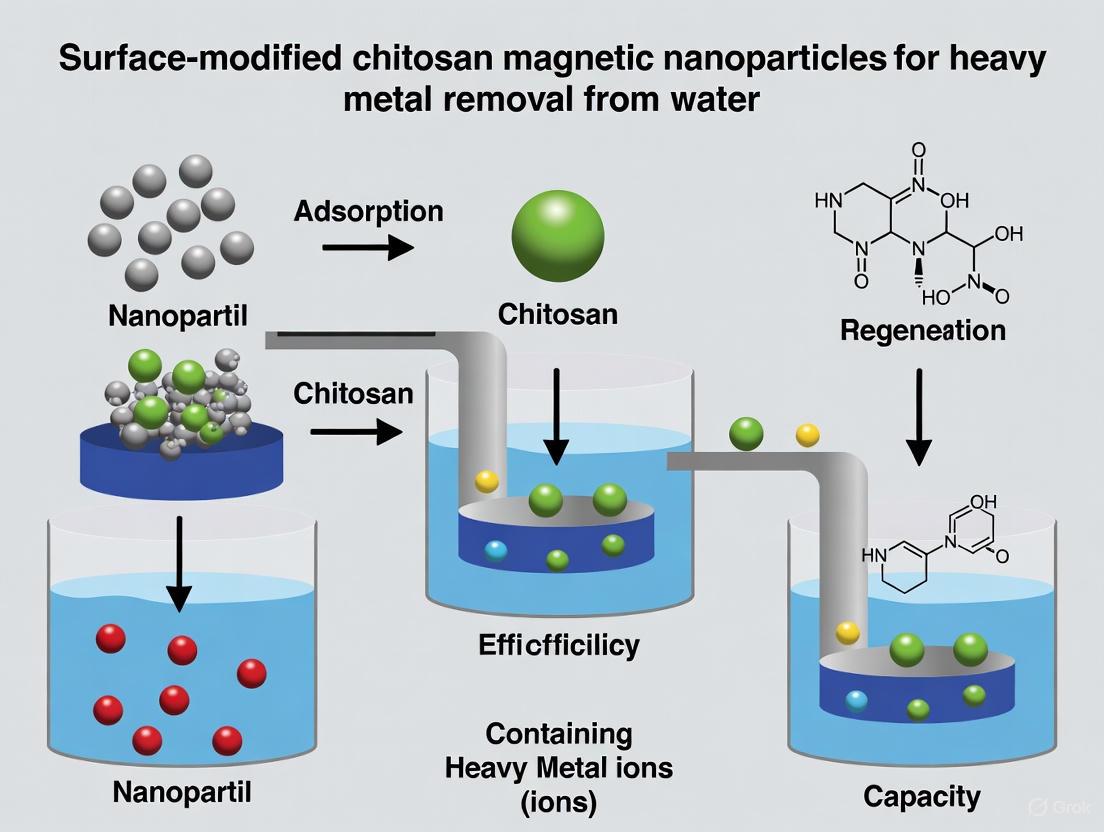
This article comprehensively reviews the development, application, and performance of surface-modified chitosan magnetic nanoparticles for the removal of heavy metal ions from contaminated water.
Surface-Modified Chitosan Magnetic Nanoparticles: Advanced Adsorbents for Heavy Metal Removal from Water
Abstract
This article comprehensively reviews the development, application, and performance of surface-modified chitosan magnetic nanoparticles for the removal of heavy metal ions from contaminated water. Tailored for researchers and scientists in environmental remediation and material science, it covers the foundational science behind chitosan's metal-binding properties and the strategic advantages of magnetic composites. The scope extends to synthesis methodologies, including co-precipitation and cross-linking, and details various surface modification strategies to enhance adsorption capacity and selectivity. It further addresses key operational parameters, troubleshooting for common challenges like aggregation and pH sensitivity, and a comparative validation of performance against other adsorbents. By integrating mechanistic insights, bibliometric trends, and discussions on reusability, this review positions these nano-adsorbents as a sustainable and efficient platform for next-generation water purification technologies.
The Science and Rise of Magnetic Chitosan Nanocomposites
Chitosan is a linear polysaccharide composed of randomly distributed β-(1→4)-linked D-glucosamine (deacetylated unit) and N-acetyl-D-glucosamine (acetylated unit) [1]. As the second most abundant natural biopolymer after cellulose, chitosan is derived from chitin, which is primarily found in the exoskeletons of crustaceans (such as shrimp and crabs), insect cuticles, and fungal cell walls [1] [2]. This biopolymer has garnered significant scientific and industrial interest due to its unique properties, including excellent chelation capabilities, biodegradability, biocompatibility, and non-toxicity [3] [4]. The presence of highly reactive functional groups in its molecular structure enables various chemical modifications and facilitates numerous applications, particularly in heavy metal removal from contaminated water systems, which aligns with the broader research on surface-modified chitosan magnetic nanoparticles for water purification [5] [6].
Structural Characteristics and Functional Groups
Molecular Structure and Composition
Chitosan's molecular structure consists of a linear chain of glycosidic linkages with variable proportions of two primary monomer units: N-acetyl-D-glucosamine (GlcNAc) and D-glucosamine (GlcN) [1] [2]. The ratio of these monomers significantly influences the polymer's properties and functionality. Unlike synthetic polymers with well-defined structures, chitosan represents a family of molecules with variations in molecular weight, composition, and monomer distribution, which fundamentally affects its biological and technological performance [1].
Table 1: Fundamental Structural Parameters of Chitosan
| Parameter | Description | Impact on Properties |
|---|---|---|
| Degree of Deacetylation (DD) | Percentage of D-glucosamine units in the polymer chain | Higher DD increases charge density, solubility in acidic media, and chelation capacity [1] |
| Molecular Weight | Ranges from low (oligomers) to high molecular weight polymers | Lower MW increases solubility range; higher MW affects viscosity and mechanical strength [1] [2] |
| Sequence Distribution | Random or block distribution of GlcNAc and GlcN units | Affects crystallinity, enzymatic degradation, and accessibility to functional groups [1] |
Key Functional Groups
The chelating capability and chemical reactivity of chitosan primarily originate from three key functional groups present on its molecular backbone:
- Primary Amino Groups (-NH₂) at the C-2 position: These groups are the most reactive and primarily responsible for chitosan's cationic nature in acidic conditions and its superior metal chelation capability through coordination bonds [6] [3]. The amino group becomes protonated (-NH₃⁺) in acidic media, enabling electrostatic interactions with anionic species [1].
- Primary Hydroxyl Groups (-OH) at the C-6 position: These groups participate in hydrogen bonding and can be modified for specific applications, though they are less reactive than amino groups [1] [2].
- Secondary Hydroxyl Groups (-OH) at the C-3 position: These groups contribute to the overall hydrophilicity and structural conformation of the polymer chain [2].
The presence of these multiple functional groups makes chitosan a multifunctional ligand capable of forming complexes with various metal ions through different mechanisms, including coordination, ion exchange, and electrostatic interactions [5] [6].
Natural Chelating Properties and Mechanisms
Fundamental Chelation Mechanisms
Chitosan exhibits remarkable chelation properties toward heavy metal ions through several simultaneous mechanisms. The primary amino groups serve as coordination sites for metal ions, forming stable complexes [6] [3]. The chelation capability stems from the lone pair of electrons on the nitrogen atoms, which can coordinate with empty orbitals of metal cations [3]. In acidic environments, the protonated amino groups also facilitate electrostatic attraction between chitosan and metal anions [5]. The hydroxyl groups may participate in metal binding, particularly for metals that prefer oxygen coordination, though this contribution is secondary to that of the amino groups [6].
Quantitative Chelation Performance
Table 2: Chelation Performance of Chitosan and Derivatives for Heavy Metals
| Metal Ion | Adsorption Capacity (μmol/g) | Optimal pH Range | Key Interaction Mechanisms |
|---|---|---|---|
| Copper (Cu²⁺) | Up to 4700 [7] | 4-6 [6] | Coordination with amino groups, chelation [5] |
| Lead (Pb²⁺) | Up to 2700 [7] | 5-7 [6] | Coordination, electrostatic attraction [5] |
| Cadmium (Cd²⁺) | Up to 1800 [7] | 6-8 [6] | Coordination, ion exchange [5] |
| Chromium (Cr⁶⁺) | Varies with derivative [4] | 3-5 [6] | Electrostatic attraction, reduction to Cr³⁺ [4] |
The adsorption performance varies significantly based on the chitosan's physicochemical properties (degree of deacetylation, molecular weight) and environmental conditions (pH, temperature, competing ions) [5] [6]. The adsorption process typically follows pseudo-second-order kinetics and the Langmuir isotherm model, suggesting monolayer adsorption on a homogeneous surface [5] [7].
Experimental Protocols
Protocol 1: Synthesis of Chitosan Nanoparticles via Ionic Gelation
Principle: This method utilizes the electrostatic interaction between positively charged chitosan amino groups and negatively charged polyanions such as tripolyphosphate (TPP) to form nanoparticles through self-assembly [8].
Materials:
- Chitosan (medium molecular weight, >75% deacetylation)
- Sodium tripolyphosphate (TPP)
- Acetic acid (1% v/v)
- Magnetic stirrer with hot plate
- Ultrasonic homogenizer
Procedure:
- Dissolve chitosan powder in 1% acetic acid solution at a concentration of 2 mg/mL under constant magnetic stirring at room temperature for 24 hours to ensure complete dissolution [8].
- Prepare TPP solution in deionized water at a concentration of 1 mg/mL.
- Add TPP solution dropwise into the chitosan solution at a rate of 0.5 mL/min using a burette or syringe pump while homogenizing at 5,000 rpm with a Polytron homogenizer [8].
- Continue stirring for an additional 60 minutes after complete addition of TPP to allow nanoparticle formation.
- Characterize the resulting nanoparticles for size distribution (85-221 nm range expected), zeta potential, and morphology using dynamic light scattering and electron microscopy [8].
Applications: The synthesized chitosan nanoparticles (CNPs) can be used as a final irrigant in root canal treatment with the dual benefit of removing smear layer and inhibiting bacterial recolonization on root dentin, demonstrating a chelation capacity significantly reducing smear layer (p < 0.05) and resisting biofilm formation better than control treatments [8].
Protocol 2: Evaluation of Chelation Capacity Using Batch Equilibrium
Principle: This protocol measures the metal ion adsorption capacity of chitosan materials under controlled conditions to quantify chelation performance [5] [7].
Materials:
- Chitosan-based adsorbent (nanoparticles, films, or beads)
- Metal salt solutions (Pb(NO₃)₂, CuSO₄, CdCl₂, etc.)
- pH meter and buffers
- Orbital shaker incubator
- Atomic Absorption Spectrophotometer (AAS) or ICP-OES
Procedure:
- Prepare standard solutions of target heavy metals (e.g., Pb²⁺, Cu²⁺, Cd²⁺) at concentrations ranging from 50-500 mg/L in deionized water [7].
- Adjust pH of solutions to optimal range (typically 5-6) using dilute HNO₃ or NaOH.
- Add a known quantity of chitosan adsorbent (e.g., 0.1 g) to each metal solution (50 mL) in Erlenmeyer flasks.
- Agitate flasks in an orbital shaker at constant temperature (25±1°C) and speed (150 rpm) for predetermined time intervals (10 min to 24 hours) [7].
- Separate the adsorbent from solution by centrifugation or filtration after equilibration.
- Analyze the supernatant for residual metal concentration using AAS or ICP-OES.
- Calculate adsorption capacity using the formula: [ qe = \frac{(Co - Ce) \times V}{m} ] where ( qe ) = adsorption capacity (mg/g), ( Co ) = initial concentration (mg/L), ( Ce ) = equilibrium concentration (mg/L), V = solution volume (L), and m = adsorbent mass (g) [5].
Applications: This standardized protocol enables comparison of different chitosan-based adsorbents for heavy metal removal from wastewater, with typical equilibrium times of 10-30 minutes and maximum adsorption capacities as indicated in Table 2 [7].
The Scientist's Toolkit
Table 3: Essential Research Reagent Solutions for Chitosan Studies
| Reagent/Material | Function/Application | Notes |
|---|---|---|
| Chitosan (varying DD & MW) | Primary biopolymer for adsorption studies | Select based on application: higher DD for enhanced metal binding [1] |
| Tripolyphosphate (TPP) | Crosslinker for nanoparticle synthesis | Forms ionic bonds with protonated amino groups [8] |
| Acetic Acid (1% v/v) | Solvent for chitosan | Protonates amino groups enabling solubilization [1] |
| Glutaraldehyde | Crosslinking agent for chitosan beads | Enhances mechanical stability in acidic conditions [5] |
| Ethylenediaminetetraacetic Acid (EDTA) | Comparative chelating agent | Reference compound for chelation efficiency studies [8] |
| Magnetic Nanoparticles (Fe₃O₄) | Core for magnetic chitosan composites | Enables magnetic separation after adsorption [7] [4] |
Structural and Chelation Workflow
Chitosan's fundamental structure, characterized by the presence of highly reactive amino and hydroxyl functional groups, establishes its remarkable natural chelating properties toward heavy metal ions. The protocols outlined herein provide standardized methodologies for synthesizing chitosan nanoparticles and evaluating their chelation capacity, essential for advancing research on surface-modified chitosan magnetic nanoparticles for water remediation. The quantitative data presented offers benchmarks for comparing adsorption performance across different chitosan-based materials. As research progresses, the precise understanding of structure-function relationships in chitosan and its derivatives will continue to enable the rational design of more efficient and selective adsorbents for environmental applications.
In the development of surface-modified chitosan magnetic nanoparticles for heavy metal removal, the magnetic core is a foundational component that critically determines the functionality and practicality of the adsorbent. These composites integrate the excellent adsorption properties of chitosan, a biopolymer, with the separation capability and * stability* conferred by magnetic nanoparticles (MNPs) like magnetite (Fe₃O₄) [9]. The magnetic core addresses a key limitation of powdered nano-adsorbents—difficult and costly solid-liquid separation—by enabling rapid retrieval from treated water using an external magnetic field [9] [10]. This application note details the roles, synthesis, and characterization of Fe₃O₄ and other ferrite nanoparticles, providing essential protocols for researchers developing these materials for water purification.
The Magnetic Core: Composition and Function
Common Magnetic Nanoparticles
The most commonly used magnetic materials in chitosan composites are iron oxides, prized for their strong magnetic properties, chemical stability, and biocompatibility [11] [12].
- Magnetite (Fe₃O₄): The predominant choice for magnetic cores due to its high saturation magnetization, superparamagnetism at the nanoscale, and ease of synthesis [11] [12]. Its isoelectric point allows for straightforward surface functionalization.
- Maghemite (γ-Fe₂O₃): Another iron oxide phase often used, though it has a slightly lower magnetic saturation compared to Fe₃O₄ [4].
- Doped Ferrites (MFe₂O₄): Metals such as Mn, Cu, Zn, Ni, or Co can be incorporated into the ferrite structure to form MFe₂O₄, sometimes used to tailor magnetic properties or catalytic activity [9] [4].
Primary Roles of the Magnetic Core
The incorporation of a magnetic core serves two critical functions:
- Facile Separation and Recovery: The primary role is to impart superparamagnetism to the composite material. This allows for near-instantaneous separation from the aqueous phase upon application of an external magnet, eliminating the need for costly or time-intensive filtration or centrifugation steps [9] [10]. This feature is crucial for the economic reusability of the adsorbent.
- Enhanced Stability and Structure: The magnetic nanoparticles can act as a structural scaffold. The chitosan matrix coating the magnetic cores helps to prevent their oxidation and aggregation [9]. In return, the cores can improve the mechanical stability of the chitosan and enhance its resistance in acidic environments, where pure chitosan is often unstable [9] [4].
Diagram 1: Experimental workflow for synthesizing and applying magnetic chitosan nanoparticles for heavy metal removal, highlighting the central role of the magnetic core and its characterization.
Synthesis and Modification Protocols
Synthesis of the Fe₃O₄ Magnetic Core
The co-precipitation method is the most widely used technique for synthesizing Fe₃O₄ nanoparticles due to its simplicity and efficiency [11] [10].
Detailed Protocol: Co-precipitation of Fe₃O₄ Nanoparticles
Research Reagent Solutions:
- 1 M FeCl₃·6H₂O solution: Source of Fe³⁺ ions.
- 1 M FeSO₄·7H₂O solution: Source of Fe²⁺ ions. Critical: Prepare fresh and under an inert atmosphere (e.g., N₂ purge) to prevent oxidation.
- Ammonium Hydroxide (NH₄OH, 28-30%): Precipitating agent.
- Deoxygenated Water: Purge distilled water with N₂ for 30 minutes to remove dissolved oxygen.
Procedure:
- In a three-neck round-bottom flask under a constant N₂ atmosphere and mechanical stirring (500-1000 rpm), mix 100 mL of 1 M FeCl₃ and 50 mL of 1 M FeSO₄. The molar ratio of Fe³⁺:Fe²⁺ should be maintained at 2:1.
- Heat the reaction mixture to 70°C.
- While stirring vigorously, rapidly add 50 mL of NH₄OH dropwise to the solution. The immediate formation of a black precipitate indicates the formation of magnetite.
- Continue stirring for 1 hour at 70°C under N₂ to allow for complete particle growth.
- Cool the mixture to room temperature. Separate the black Fe₃O₄ nanoparticles from the supernatant using a laboratory magnet.
- Wash the nanoparticles repeatedly with deoxygenated water and ethanol until the supernatant reaches a neutral pH.
- Re-disperse the purified Fe₃O₄ nanoparticles in 100 mL of distilled water for immediate use in chitosan coating, or freeze-dry for storage.
Table 1: Common Synthesis Methods for Fe₃O₄ Nanoparticles [11] [12]
| Method | Key Principle | Advantages | Disadvantages |
|---|---|---|---|
| Co-precipitation | Rapid precipitation of Fe²⁺/Fe³⁺ salts in a basic medium. | Simple, efficient, high yield, can be performed in water. | Broad size distribution, control over shape is limited. |
| Thermal Decomposition | Decomposition of organometallic precursors at high temperature. | Excellent control over size and shape, narrow size distribution. | Requires organic solvents, high temperature, complex procedure. |
| Hydrothermal/Solvothermal | Reaction in a sealed vessel at high temperature and pressure. | Good crystallinity, good control over particle morphology. | Requires high pressure/temperature, longer reaction times. |
| Microbial/Green Synthesis | Use of plant extracts or microorganisms to reduce ions. | Environmentally friendly, uses non-toxic chemicals. | Time-consuming fermentation, challenging to control size. |
Protocol: Fabrication of Magnetic Chitosan Composite (MCBMs)
This protocol describes the synthesis of core-shell magnetic chitosan beads via a cross-linking method [13] [10].
Research Reagent Solutions:
- Fe₃O₄ Nanoparticle Dispersion (from Protocol 3.1)
- Chitosan Solution (2% w/v): Dissolve 2 g of medium molecular weight chitosan in 100 mL of aqueous acetic acid (1% v/v).
- Sodium Tripolyphosphate (TPP) Cross-linker Solution (1% w/v)
- Glutaraldehyde Solution (2% v/v) (optional, for additional cross-linking)
Procedure:
- Dispersion: Add 200 mg of the freshly prepared, wet Fe₃O₄ nanoparticles to the 2% chitosan solution. Stir vigorously for 1 hour and then sonicate for 15 minutes to achieve a homogeneous dispersion.
- Droplet Formation: Using a syringe pump with a 21-gauge needle, drop the magnetic chitosan solution into 100 mL of the gently stirred TPP solution. The TPP acts as an ionic cross-linker, instantly gelling the droplets into beads.
- Curing: Allow the beads to cure in the TPP solution for 1 hour under slow stirring.
- Cross-linking (Optional) : For enhanced acid stability, transfer the beads to the glutaraldehyde solution for 30 minutes.
- Washing and Storage: Separate the beads magnetically, wash thoroughly with distilled water until neutral pH, and store in water at 4°C.
Characterization of the Magnetic Core and Composite
Rigorous characterization is essential to confirm the successful synthesis and desired properties of the magnetic core and final composite.
Table 2: Key Characterization Techniques for the Magnetic Core and Composite [13] [11] [14]
| Technique | Information Gained | Ideal Outcome for Application |
|---|---|---|
| X-ray Diffraction (XRD) | Crystal structure, phase purity, and crystallite size of the magnetic core. | Distinct peaks matching the Fe₃O₄ spinel structure, confirming successful synthesis. |
| Fourier-Transform Infrared Spectroscopy (FT-IR) | Chemical bonds and functional groups; confirms chitosan coating and surface modification. | Presence of Fe–O bond (~580 cm⁻¹) and chitosan bands (N-H, C-O), confirming composite formation. |
| Vibrating Sample Magnetometry (VSM) | Magnetic properties: saturation magnetization (M_s), coercivity. | High M_s (e.g., >40 emu/g for pure Fe₃O₄), superparamagnetic behavior (no hysteresis). |
| Transmission Electron Microscopy (TEM) | Particle size, morphology, and core-shell structure. | Clear core-shell structure with well-dispersed, nano-sized particles. |
| Surface Area Analysis (BET) | Specific surface area, pore volume, and pore size distribution. | High surface area (>40 m²/g) to provide abundant adsorption sites. |
Detailed Protocol: Measuring Saturation Magnetization with VSM
- Objective: To quantify the magnetic strength of the synthesized Fe₃O₄ nanoparticles and the final magnetic chitosan composite, which directly impacts separation efficiency.
- Procedure:
- Sample Preparation: Precisely weigh 20-50 mg of the freeze-dried powder sample.
- Loading: Pack the sample securely into a non-magnetic sample holder (e.g., a gelatin capsule or quartz tube).
- Measurement: Place the holder in the VSM. Run the measurement by applying an external magnetic field that sweeps from a large negative value to a large positive value and back (e.g., -20,000 Oe to +20,000 Oe) at room temperature.
- Data Analysis: From the resulting hysteresis loop (M-H curve), determine the saturation magnetization (Ms) value. For effective magnetic separation, the composite should retain a high Ms. For example, a composite might show an M_s of 36 emu/g, which, while lower than pure Fe₃O₄ (~57 emu/g), is still sufficient for rapid magnetic separation [14].
Performance and Stability Data
The performance of magnetic chitosan composites is evaluated based on their adsorption capacity and reusability, both dependent on the magnetic core's properties.
Table 3: Adsorption Performance of Selected Magnetic Chitosan Composites for Heavy Metals [9] [13]
| Magnetic Composite | Target Heavy Metal | Reported Adsorption Capacity | Key Factors Influencing Performance |
|---|---|---|---|
| Nano-Fe₃O₄ coated with Chitosan | Pb(II) | 2700 μmol/g | pH, initial concentration, presence of competing ions. |
| Nano-Fe₃O₄ coated with Chitosan | Cu(II) | 4700 μmol/g | pH, surface modification with functional groups. |
| Nano-Fe₃O₄ coated with Chitosan | Cd(II) | 1800 μmol/g | Solution pH, adsorbent dosage, contact time. |
| MCBMs (General) | Cr(VI) | Varies with modification | Often involves a reduction-coupled adsorption mechanism. |
Stability and Reusability: A critical advantage of MCBMs is their regenerability. Studies show that these composites can often undergo multiple adsorption-desorption cycles (e.g., 5 or more) with only a minor loss in capacity [9] [14]. The magnetic separation capability is key to enabling this reusability without significant material loss.
The Scientist's Toolkit
Table 4: Essential Research Reagent Solutions for Magnetic Core Synthesis and Composite Fabrication
| Reagent / Material | Function / Role | Justification for Use |
|---|---|---|
| FeCl₃·6H₂O / FeSO₄·7H₂O | Fe³⁺ and Fe²⁺ precursors for Fe₃O₄ synthesis. | Standard, high-purity salts for reproducible co-precipitation; 2:1 molar ratio is stoichiometric for magnetite. |
| Ammonium Hydroxide (NH₄OH) | Precipitating and alkalizing agent. | Provides a basic environment (pH ~9-14) required for the instantaneous precipitation of Fe₃O₄. |
| Chitosan (Medium Mol. Wt.) | Biopolymer matrix for coating and functionalization. | Provides amino and hydroxyl groups for metal binding; biocompatible and biodegradable. |
| Sodium Tripolyphosphate (TPP) | Ionic cross-linker. | Forms ionic bonds with protonated NH₃⁺ groups of chitosan, creating stable hydrogel beads. |
| Glutaraldehyde | Covalent cross-linker. | Reacts with amino groups of chitosan, enhancing mechanical and chemical stability in acidic water. |
The magnetic core, predominantly composed of Fe₃O₄, is indispensable for creating practical and effective chitosan-based adsorbents for heavy metal removal. Its roles in enabling rapid magnetic separation and enhancing the structural stability of the composite are crucial for transitioning from laboratory research to real-world water treatment applications. By following the detailed synthesis, modification, and characterization protocols outlined in this application note, researchers can systematically develop and optimize next-generation magnetic chitosan nanomaterials for environmental remediation.
The remediation of heavy metal contamination in water systems represents a significant global challenge, driven by industrial discharges, agricultural runoff, and improper waste disposal [15]. These pollutants, including lead, mercury, cadmium, chromium, and arsenic, pose severe risks to ecosystem integrity and human health due to their toxicity, persistence, and bioaccumulation potential [4] [15]. While various water treatment technologies exist, adsorption-based methods have gained prominence for their operational simplicity, cost-effectiveness, and efficiency across different contaminant concentrations [4] [16].
Among adsorbents, chitosan—a natural polysaccharide derived from chitin—has emerged as a promising candidate due to its abundance, biodegradability, non-toxicity, and exceptional chelating properties attributable to abundant amino (–NH₂) and hydroxyl (–OH) functional groups [16] [17]. However, native chitosan suffers from limitations including solubility in acidic media, limited mechanical strength, and challenging separation from treated water [4] [17].
The integration of chitosan with magnetic nanoparticles creates a composite material that synergizes the superior adsorption capabilities of chitosan with the facile, rapid magnetic separation offered by iron oxide components [4] [18]. This combination addresses key practical limitations and enhances the overall feasibility of water treatment applications. These magnetic chitosan nanoparticles (MCNPs) represent a significant advancement in adsorbent design, enabling efficient heavy metal removal with simplified operational procedures [19].
Synergistic Mechanisms and Functional Advantages
The enhanced performance of magnetic chitosan nanoparticles stems from several interconnected mechanisms that operate synergistically.
Primary Synergistic Mechanisms
- Chelation and Coordination Bonding: The amino and hydroxyl groups on chitosan chains serve as electron donors, forming stable complexes with heavy metal ions through coordination bonds. This mechanism is particularly effective for metals like Cu(II), Cd(II), and Pb(II) [16] [17].
- Electrostatic Interactions: In acidic conditions, chitosan's amino groups undergo protonation, generating positively charged sites that attract anionic metal species such as chromate (CrO₄²⁻) through Coulombic forces [20] [17].
- Surface Adsorption and Ion Exchange: The high surface area-to-volume ratio of nanoparticles provides numerous active sites for metal binding, while functional groups can participate in ion-exchange processes with metal cations in solution [16].
- Magnetic Responsiveness: Incorporated iron oxide cores (typically Fe₃O₄ or γ-Fe₂O₃) impart superparamagnetic properties, enabling rapid separation (<5 minutes) under an external magnetic field without filtration or centrifugation [4] [18].
Material Property Enhancements
- Improved pH Stability: Cross-linking during composite formation reduces chitosan solubility across acidic pH ranges, expanding operational windows for treatment systems [20] [17].
- Enhanced Mechanical Robustness: The composite structure exhibits greater resistance to mechanical degradation compared to pure chitosan, supporting multiple adsorption-desorption cycles [18].
- Increased Surface Reactivity: Nanoscale dimensions and functional group accessibility significantly enhance adsorption kinetics and capacity relative to bulk chitosan materials [16] [19].
The following diagram illustrates the synergistic relationship between chitosan's reactivity and magnetic functionality in the composite material:
Synthesis Protocols and Methodologies
Preparation of Magnetic Chitosan Nanoparticles (MCNPs) via Co-precipitation
The co-precipitation method represents the most widely utilized approach for synthesizing MCNPs due to its simplicity and effectiveness [4] [19].
Reagents and Equipment
Table 1: Reagents for MCNP Synthesis via Co-precipitation
| Reagent | Specification | Purpose |
|---|---|---|
| Chitosan | Low molecular weight (50-190 kDa), >75% deacetylation | Primary adsorbent matrix providing functional groups |
| FeCl₃·6H₂O | Analytical grade ≥98% | Iron source for magnetic component (Fe³⁺) |
| FeSO₄·7H₂O | Analytical grade ≥99% | Iron source for magnetic component (Fe²⁺) |
| Ammonium hydroxide (NH₄OH) | 25-30% solution | Precipitation agent for iron oxides |
| Glacial acetic acid | Analytical grade ≥99% | Solvent for chitosan dissolution |
| Sodium hydroxide (NaOH) | Pellets, analytical grade | pH adjustment |
| Deionized water | Resistivity ≥18 MΩ·cm | Solvent and washing |
Step-by-Step Procedure
Chitosan Solution Preparation: Dissolve 1.0 g of chitosan powder in 100 mL of aqueous acetic acid solution (1% v/v) with continuous mechanical stirring at 40°C for 2 hours until a clear, viscous solution forms [21].
Iron Solution Preparation: Dissolve 2.0 g of FeCl₃·6H₂O and 1.0 g of FeSO₄·7H₂O in 50 mL of deionized water under nitrogen atmosphere with vigorous stirring (molar ratio Fe³⁺:Fe²⁺ = 2:1) [19].
Magnetic Precipitation: Slowly add the iron solution to the chitosan solution while maintaining vigorous stirring (800-1000 rpm) at 40°C. Gradually add ammonium hydroxide (25% solution) until the pH reaches 10-11 to precipitate magnetite nanoparticles within the chitosan matrix [19].
Aging and Washing: Maintain the reaction mixture at 40°C for 1 hour with continuous stirring. Collect the black magnetic chitosan precipitate using a permanent magnet and wash repeatedly with deionized water and ethanol until neutral pH is achieved [18].
Drying: Dry the synthesized MCNPs in a vacuum oven at 50°C for 12 hours. Grind the dried product to obtain a fine powder for characterization and application [20].
Surface Functionalization with Quaternary Ammonium Groups
Quaternary modification enhances adsorption capacity for anionic metal species through increased positive charge density [20] [17].
Additional Reagents
- Glycidyl trimethyl ammonium chloride (GTMAC) ≥95%
- Glutaraldehyde solution (25%) for cross-linking
Functionalization Procedure
Cross-linking: Suspend 2.0 g of prepared MCNPs in 50 mL of deionized water. Add 2 mL of glutaraldehyde solution (25%) and react at 60°C for 3 hours with continuous stirring to enhance chemical stability [20].
Quaternization: Add 3.94 g of GTMAC (2:1 molar ratio to chitosan repeating units) to the cross-linked MCNP suspension. React at 80°C for 8 hours with constant stirring [20].
Purification: Separate the functionalized MCNPs magnetically and wash thoroughly with deionized water and ethanol to remove unreacted reagents.
Drying: Dry the final product (QMCNPs) at 50°C for 12 hours before use [20].
Synthesis Workflow
The complete synthesis process from raw materials to functionalized magnetic chitosan nanoparticles follows this sequential workflow:
Characterization Techniques and Performance Validation
Essential Characterization Methods
Comprehensive characterization ensures successful MCNP synthesis and predicts application performance.
Table 2: Essential Characterization Techniques for MCNPs
| Technique | Parameters Analyzed | Expected Outcomes |
|---|---|---|
| FTIR Spectroscopy | Functional groups, chemical bonds | Presence of characteristic bands: -NH₂ (1650 cm⁻¹), -OH (3450 cm⁻¹), Fe-O (570 cm⁻¹) [21] [20] |
| XRD Analysis | Crystallinity, phase identification | Characteristic peaks for Fe₃O₄ at 2θ = 30.1°, 35.5°, 43.1°, 57.0°, 62.6° [18] [20] |
| SEM/TEM Imaging | Morphology, size distribution, surface topography | Spherical particles with 10-100 nm diameter, chitosan coating on magnetic cores [21] [22] |
| VSM Analysis | Magnetic properties | Saturation magnetization 30-60 emu/g, superparamagnetic behavior [18] [22] |
| BET Surface Area | Specific surface area, porosity | 50-200 m²/g, mesoporous structure [19] |
| Zeta Potential | Surface charge, colloidal stability | Positive charge (+20 to +40 mV) across acidic to neutral pH [21] [20] |
| TGA Analysis | Thermal stability, composition | ≤10% weight loss at 650°C, indicating high thermal stability [18] |
Adsorption Performance Evaluation
Standardized testing protocols evaluate MCNP effectiveness for heavy metal removal.
Batch Adsorption Experiments
Solution Preparation: Prepare stock solutions (1000 mg/L) of target heavy metals (Pb²⁺, Cd²⁺, Cr⁶⁺, etc.) from certified nitrate or chloride salts. Dilute to desired concentrations (10-500 mg/L) for experiments [20] [19].
Effect of pH: Adjust solution pH (2-8) using 0.1M HNO₃ or NaOH. Add 10 mg of MCNPs to 50 mL of metal solution (50 mg/L). Shake at 150 rpm for 120 minutes at 25°C [19].
Adsorption Kinetics: Use fixed pH (optimal for target metal), varying contact time (1-360 minutes). Sample at predetermined intervals, separate MCNPs magnetically (2-5 minutes), and analyze supernatant metal concentration [20] [19].
Adsorption Isotherms: Vary initial metal concentration (10-500 mg/L) with fixed adsorbent dose (0.2 g/L), pH, and contact time (until equilibrium) at different temperatures (15-35°C) [18] [19].
Analytical Methods
- Metal Concentration Analysis: Use atomic absorption spectroscopy (AAS) or inductively coupled plasma optical emission spectrometry (ICP-OES) with appropriate calibration standards [15].
- Adsorption Capacity Calculation: Determine adsorption capacity qₑ (mg/g) using: qₑ = (C₀ - Cₑ)×V/m, where C₀ and Cₑ are initial and equilibrium concentrations (mg/L), V is solution volume (L), and m is adsorbent mass (g) [20] [19].
Quantitative Performance Data
Experimental data from recent studies demonstrates the effectiveness of various magnetic chitosan composites for heavy metal removal.
Table 3: Adsorption Performance of Magnetic Chitosan Composites for Heavy Metals
| Adsorbent Type | Target Heavy Metal | Optimal pH | Equilibrium Time (min) | Maximum Capacity (mg/g) | Adsorption Mechanism | Reference |
|---|---|---|---|---|---|---|
| Quaternized Magnetic Chitosan | Methyl Orange (model anionic compound) | 4.0 | 120 | 486.13 | Electrostatic interaction, ion exchange | [20] |
| Magnetic Chitosan Functionalized with Heterocyclic Compounds | Cd²⁺ | 6.0 | 120 | 270.27 | Chelation, coordination | [19] |
| Chitosan-modified Fe₃O₄ Microspheres | Flavonoids (catechol structure) | - | - | 147.06 | Hydrogen bonding, π-interactions | [18] |
| Cross-linked Magnetic Chitosan | Cr(VI) | 3.0 | 180 | ~200 (estimated) | Electrostatic attraction, reduction to Cr(III) | [17] |
| Magnetic Chitosan Nanoparticles | Various heavy metals in multi-ion systems | Varies by metal | 60-180 | 150-300 | Coordination, ion exchange | [4] |
Regeneration and Reusability Protocols
Sustainable application of MCNPs requires effective regeneration and reuse capabilities.
Desorption and Regeneration Procedure
Metal Desorption: After adsorption, separate MCNPs magnetically and immerse in 50 mL of desorbing agent (0.1M NaOH for anionic species; 0.1M EDTA or 0.1M HNO₃ for cationic metals) for 6 hours with gentle shaking [20] [19].
Washing and Reconditioning: Separate desorbed MCNPs magnetically, wash thoroughly with deionized water until neutral pH, and dry at 50°C for 6 hours before reuse [18].
Performance Monitoring: Track adsorption capacity retention over multiple cycles (typically 5-7 cycles) to assess long-term viability [18] [22].
Regeneration Efficiency Data
Table 4: Regeneration Performance of Magnetic Chitosan Adsorbents
| Adsorbent Type | Heavy Metal | Desorption Agent | Cycles Tested | Capacity Retention | Key Findings |
|---|---|---|---|---|---|
| Chitosan-modified Fe₃O₄ | Flavonoids | 70% Methanol | 3 | >90% | Minimal structural degradation, stable magnetization [18] |
| Fe₃O₄/CHT-Pd Nanocatalyst | (Catalytic application) | - | 7 | No significant loss | Maintained catalytic activity, structural integrity [22] |
| Quaternized Magnetic Chitosan | Methyl Orange | 0.1M NaOH | 5 | >85% | Good chemical stability, sustained positive charge [20] |
| Functionalized Magnetic Chitosan with Heterocyclic Compounds | Cd²⁺ | 0.1M EDTA | 4 | >80% | Effective metal recovery, stable functional groups [19] |
The Researcher's Toolkit: Essential Materials and Reagents
Table 5: Essential Research Reagent Solutions for MCNP Development
| Reagent Solution | Composition | Preparation | Primary Function | Storage Conditions |
|---|---|---|---|---|
| Chitosan Solvent | 1% (v/v) acetic acid in deionized water | Add 10 mL glacial acetic acid to 990 mL DI water | Dissolves chitosan polymer via protonation of amino groups | Room temperature, sealed container |
| Iron Co-precipitation Solution | Fe³⁺:Fe²⁺ (2:1 molar ratio) in DI water | Dissolve FeCl₃·6H₂O (2.0 g) and FeSO₄·7H₂O (1.0 g) in 50 mL DI water under N₂ | Forms magnetite (Fe₃O₄) nanoparticles | Fresh preparation recommended |
| Alkaline Precipitation Agent | 25% NH₄OH solution in DI water | Dilute concentrated NH₄OH (28-30%) with DI water | Increases pH to 10-11 for magnetite precipitation | Room temperature, fume hood |
| Cross-linking Solution | 2.5% glutaraldehyde in DI water | Dilute 25% glutaraldehyde stock 1:10 with DI water | Forms stable Schiff bases with chitosan amino groups | 4°C, dark container |
| Quaternary Modification Reagent | 10% GTMAC in DI water | Dissolve glycidyl trimethyl ammonium chloride in DI water | Introduces quaternary ammonium groups | 4°C, desiccator |
| Desorption Solution | 0.1M NaOH or 0.1M HNO₃ in DI water | Dissolve 4.0 g NaOH or 6.3 mL HNO₃ in 1L DI water | Regenerates spent adsorbent by metal ion release | Room temperature |
Application Notes and Implementation Considerations
Optimization Parameters for Specific Applications
Successful implementation of MCNP technology requires optimization based on specific water treatment scenarios:
pH Optimization: Anionic metal species (CrO₄²⁻) show enhanced adsorption at acidic pH (3-4), while cationic metals (Pb²⁺, Cd²⁺) typically exhibit optimal removal near neutral conditions (pH 5-7) [20] [19].
Dosage Optimization: Effective adsorbent doses typically range from 0.2-2.0 g/L depending on initial metal concentration and required removal efficiency [19].
Interference Management: In multi-metal systems, competitive adsorption occurs, requiring either selective functionalization or pretreatment strategies [4].
Kinetic Considerations: Most systems reach equilibrium within 60-120 minutes, with initial rapid adsorption followed by slower intraparticle diffusion [18] [19].
Scale-up Considerations
Translating laboratory success to practical application involves addressing several key factors:
Magnetic Separation Efficiency: Design magnetic separation systems capable of processing large volumes with minimal retention time (typically <10 minutes) [4] [18].
Mass Transfer Limitations: Optimize mixing conditions to ensure sufficient contact between adsorbents and contaminants while avoiding excessive shear forces that could damage nanoparticles [16].
Regeneration Infrastructure: Implement efficient adsorbent regeneration systems compatible with continuous or semi-continuous operation [18] [20].
Lifecycle Management: Develop protocols for eventual replacement and environmentally responsible disposal of spent adsorbent materials [16].
The synergistic combination of chitosan's reactivity and magnetic functionality creates a versatile platform for advanced water treatment applications, offering efficient heavy metal removal coupled with practical operational advantages. Continued research focuses on enhancing selectivity, capacity, and long-term stability under diverse application conditions.
The field of nano-chitosan research represents a dynamic and rapidly evolving scientific domain, positioned at the intersection of materials science, environmental technology, and nanotechnology. Chitosan, a linear polysaccharide derived from the deacetylation of chitin, has emerged as a pivotal biomaterial due to its exceptional properties, including biocompatibility, biodegradability, and low toxicity [23] [24]. The transformation of chitosan into nano-scale formulations has significantly amplified its functional attributes, leading to expanded applications across diverse sectors with particular emphasis on environmental remediation, specifically heavy metal removal from water systems [16] [25].
This analysis employs bibliometric methodologies to quantitatively assess the growth trajectories, collaborative networks, and research fronts within the nano-chitosan domain. The insights generated are contextualized within a broader thesis framework investigating surface-modified chitosan magnetic nanoparticles for aquatic heavy metal remediation, providing both a macroscopic overview of the research landscape and microscopic technical protocols essential for experimental implementation.
Global Research Landscape and Growth Trajectory
The nano-chitosan research domain has experienced exponential growth over the past decade, reflecting its increasing importance as a sustainable material solution. Bibliometric data reveals a substantial publication output, with the broader chitosan field encompassing 8,002 documents related to sustainable development alone as of 2023 [23]. This substantial body of literature underscores the global scientific interest in leveraging chitosan's unique properties for addressing contemporary environmental challenges.
Table 1: Global Publication Metrics in Chitosan Research
| Bibliometric Indicator | Value | Time Period | Data Source |
|---|---|---|---|
| Total documents on chitosan for sustainable development | 8,002 | 1976-2023 | Scopus [23] |
| Annual publication peak | 1,178 | 2022 | Scopus [23] |
| Documents on magnetic chitosan adsorption | 1,046 | Last 5 years | Web of Science [9] |
| Documents on "magnetic chitosan" + "adsorption" | 1,316 | Last 5 years | Web of Science [4] |
| Documents specifically on MCBMs for heavy metals | >250 | As of 2024 | Web of Science [9] |
Geographically, research productivity and impact demonstrate distinct patterns. China leads in quantitative output with 1,560 total documents on chitosan for sustainable development, while the United States produces the most impactful research with 55,019 total citations and an h-index of 110 [23]. International collaboration is a defining characteristic of the field, with India exhibiting the highest level of cooperative research engagement with 572 total link strength in international partnerships [23].
Table 2: National Research Output and Impact in Chitosan Research
| Country | Total Documents | Total Citations | h-index | International Collaboration |
|---|---|---|---|---|
| China | 1,560 | Not specified | Not specified | Moderate |
| United States | Not specified | 55,019 | 110 | Not specified |
| India | Not specified | Not specified | Not specified | 572 (link strength) |
| European Nations | Not specified | Not specified | Not specified | Moderate |
The market projections for chitosan nanoparticles further substantiate the field's robust growth potential. The global market is poised to reach an estimated $1.5 billion by 2025, with a projected Compound Annual Growth Rate (CAGR) of 18% through 2033 [26]. In the United States specifically, the chitosan market is expected to grow at a CAGR of 7.4% from 2025 to 2035, potentially reaching $909.9 million by 2035 [27]. This commercial expansion is critically underpinned by sustained research activity and technological innovation in the nano-chitosan domain.
Intellectual Structure and Research Fronts
Co-word analysis and keyword mapping reveal the intellectual structure of nano-chitosan research, highlighting both established and emerging thematic concentrations. The strongest keyword associations include "adsorption," "heavy metal," "heavy metal ion," and "dye" in relation to magnetic chitosan [9]. These associations clearly indicate that environmental applications, particularly water purification, constitute a central research front.
The analytical focus on heavy metal removal is further refined to specific metallic contaminants, with significant research attention dedicated to Cu(II), Cr(VI), Cd(II), Pb(II), and Hg(II) [9]. The adsorption mechanisms for these contaminants vary, with high-valence heavy metals such as Cr(VI) undergoing a process of "reduction followed by adsorption" [9]. The research landscape also reveals growing interest in multi-metal coexistence systems and their associated synergistic/competitive effects on adsorption efficiency [4].
Beyond environmental applications, emerging research fronts include:
- Pharmaceutical applications: Particularly drug delivery systems, wound healing, and tissue engineering [28] [29] [24]
- Advanced materials development: Including stimuli-responsive nanoparticles and functionalized composites [26]
- Sustainable packaging: Leveraging chitosan's biodegradable and antimicrobial properties [27]
The concentration of research activity is evidenced by the identification of core publication venues, with "International Journal of Biological Macromolecules," "Carbohydrate Polymers," and "Polymers" emerging as the leading journals publishing chitosan-related research [23].
Experimental Protocols for Magnetic Chitosan Nanoparticles
Synthesis of Magnetic Chitosan-Based Materials (MCBMs)
The synthesis of magnetic chitosan nanoparticles for heavy metal adsorption employs several well-established methodologies, each with distinct advantages and limitations.
Table 3: Standard Methods for Chitosan Nanoparticle Synthesis
| Synthesis Method | Key Features | Typical Particle Size | Common Cross-linkers/Agents |
|---|---|---|---|
| Covalent Cross-Linking | Enhanced structural integrity; controlled particle size | 30-300 nm | Glutaraldehyde [25] |
| Ionic Gelation | Mild conditions; simple process | 100-500 nm | Tripolyphosphate (TPP) [25] |
| Co-precipitation | Direct magnetization; high efficiency | 50-200 nm | Fe₃O₄, Fe₂O₃, MFe₂O₄ (M = Mn, Cu, Zn, Co) [9] [4] |
| Reverse Micelle | Narrow size distribution | 30-100 nm | Sodium bis(ethylhexyl) sulfosuccinate [25] |
Protocol 1: Co-precipitation Synthesis of Magnetic Chitosan Nanoparticles
Materials:
- Chitosan (medium molecular weight, 75-85% deacetylation)
- Ferric chloride hexahydrate (FeCl₃·6H₂O) and ferrous chloride tetrahydrate (FeCl₂·4H₂O)
- Ammonium hydroxide (NH₄OH, 25-28%)
- Acetic acid (glacial, 99-100%)
- Tripolyphosphate (TPP) solution (1.0 mg/mL)
- Deionized water and nitrogen gas
Procedure:
- Chitosan Solution Preparation: Dissolve 1.0 g of chitosan in 100 mL of aqueous acetic acid solution (1% v/v) with continuous stirring for 4 hours at room temperature until complete dissolution.
- Iron Solution Preparation: Prepare a mixture of FeCl₃·6H₂O (2.4 g) and FeCl₂·4H₂O (1.0 g) in 50 mL deionized water under nitrogen atmosphere with vigorous stirring.
- Co-precipitation: Gradually add 15 mL of ammonium hydroxide to the iron solution over 30 minutes while maintaining pH at 10-11 and temperature at 60°C.
- Magnetite Formation: Continue stirring for 1 hour until black magnetite (Fe₃O₄) precipitates form.
- Chitosan Incorporation: Slowly add the chitosan solution to the magnetite suspension and maintain at 60°C for 2 hours with continuous stirring.
- Cross-linking: Add 50 mL of TPP solution dropwise to form stable nanoparticles.
- Separation and Washing: Recover nanoparticles using an external magnet and wash repeatedly with deionized water until neutral pH.
- Drying: Lyophilize the nanoparticles for 24 hours to obtain dry powder [9] [4] [25].
Critical Parameters:
- Maintain nitrogen atmosphere throughout to prevent oxidation of Fe²⁺ to Fe³⁺
- Control precipitation rate to ensure uniform nanoparticle size
- Optimize chitosan-to-magnetite ratio for maximum adsorption capacity and magnetic responsiveness
Surface Modification for Enhanced Heavy Metal Removal
Surface modification of magnetic chitosan nanoparticles significantly enhances their selectivity and adsorption capacity for specific heavy metals.
Protocol 2: Thiol-Functionalization of Magnetic Chitosan Nanoparticles
Materials:
- Synthesized magnetic chitosan nanoparticles (from Protocol 1)
- Thioglycolic acid (TGA) or 2-mercaptosuccinic acid
- 1-Ethyl-3-(3-dimethylaminopropyl)carbodiimide (EDC)
- N-Hydroxysuccinimide (NHS)
- Ethanol and deionized water
Procedure:
- Activation: Disperse 1.0 g of magnetic chitosan nanoparticles in 50 mL of deionized water.
- Cross-linker Addition: Add EDC (0.5 g) and NHS (0.3 g) to the suspension and stir for 30 minutes at room temperature to activate carboxylic groups.
- Thiol Incorporation: Add 1.0 mL of thioglycolic acid dropwise and maintain the reaction at 40°C for 6 hours with continuous stirring.
- Purification: Separate thiol-functionalized nanoparticles using an external magnet and wash repeatedly with ethanol-water mixture (1:1 v/v).
- Drying: Lyophilize for 24 hours and store in airtight containers [4] [25].
Characterization:
- Confirm thiol functionalization using Fourier-transform infrared spectroscopy (FTIR) peaks at 2570 cm⁻¹ (S-H stretch)
- Quantify thiol group density using Ellman's reagent assay
- Verify magnetic properties using vibrating sample magnetometry (VSM)
Synthesis workflow for magnetic chitosan nanoparticles
Adsorption Performance and Mechanism Analysis
The adsorption performance of magnetic chitosan nanoparticles varies significantly based on their structural characteristics and the specific heavy metal targeted.
Table 4: Adsorption Performance of MCBMs for Various Heavy Metals
| Heavy Metal | Adsorption Mechanisms | Key Influencing Factors | Reported Adsorption Capacity Range |
|---|---|---|---|
| Pb(II) | Ion exchange, coordination, electrostatic interaction | pH, competing ions, surface functionalization | High (Varies with modification) [9] |
| Cr(VI) | Reduction to Cr(III) followed by adsorption, electrostatic attraction | pH, redox potential, surface charge | Medium to High [9] |
| Cd(II) | Coordination, ion exchange, complexation | pH, ionic strength, amino group density | Medium [9] [4] |
| Hg(II) | Complexation, chelation, electrostatic interaction | pH, thiol functionalization, chloride ions | High (especially with thiol modification) [9] |
| Cu(II) | Coordination, chelation, ion exchange | pH, amine group availability, competing ions | Medium to High [9] |
Protocol 3: Batch Adsorption Experiments for Heavy Metal Removal
Materials:
- Synthesized magnetic chitosan nanoparticles (MCBMs)
- Standard heavy metal solutions (1000 mg/L)
- pH meter and buffer solutions
- Orbital shaker or temperature-controlled agitator
- Atomic Absorption Spectrophotometer or ICP-MS
Procedure:
- Stock Solution Preparation: Prepare heavy metal stock solutions at 1000 mg/L using analytical grade salts.
- Experimental Setup: Add 0.05 g of MCBMs to 50 mL of heavy metal solution at desired concentration in 100 mL Erlenmeyer flasks.
- pH Adjustment: Adjust pH to predetermined value (typically 2-7) using 0.1M HNO₃ or NaOH.
- Agitation: Agitate the mixture at constant temperature (25±1°C) at 150 rpm for specified contact time.
- Sampling: Withdraw samples at predetermined time intervals and separate nanoparticles using external magnet.
- Analysis: Measure residual heavy metal concentration in supernatant using AAS or ICP-MS.
- Calculation: Calculate adsorption capacity using the formula: [ qe = \frac{(C0 - Ce) \times V}{m} ] where ( qe ) = adsorption capacity (mg/g), ( C0 ) = initial concentration (mg/L), ( Ce ) = equilibrium concentration (mg/L), V = solution volume (L), m = adsorbent mass (g) [9] [4] [25].
Optimization Parameters:
- Contact time (5 minutes to 24 hours)
- Initial metal concentration (10-500 mg/L)
- pH (2.0-7.0)
- Temperature (25-45°C)
- Adsorbent dosage (0.2-2.0 g/L)
The Scientist's Toolkit: Essential Research Reagents and Materials
Table 5: Essential Research Reagents for MCBM Development and Testing
| Reagent/Material | Function/Application | Specification Guidelines |
|---|---|---|
| Chitosan | Primary biopolymer matrix | Degree of deacetylation >75%, medium molecular weight [16] [25] |
| Fe₃O₄ Nanoparticles | Magnetic core component | Particle size <50 nm, superparamagnetic behavior [9] [4] |
| Glutaraldehyde | Cross-linking agent | 25% aqueous solution, molecular biology grade [25] |
| Tripolyphosphate (TPP) | Ionic cross-linker | ≥99% purity, for nanoparticle stabilization [25] |
| Thioglycolic Acid | Thiol functionalization | ≥98% purity, for enhanced Hg adsorption [4] [25] |
| EDC/NHS | Carboxyl group activation | ≥98% purity, for covalent conjugation [25] |
Adsorption mechanisms of heavy metals on MCBMs
Regeneration and Reusability Protocols
The economic viability and practical application of magnetic chitosan nanoparticles depend significantly on their regeneration capacity and reusability.
Protocol 4: Regeneration of Spent Magnetic Chitosan Nanoparticles
Materials:
- Metal-loaded magnetic chitosan nanoparticles
- Eluent solutions (acidic, basic, or chelating)
- Deionized water
- pH meter
Procedure:
- Eluent Selection: Choose appropriate eluent based on heavy metal type:
- Acidic eluent (0.1M HNO₃ or HCl) for most heavy metals
- Basic eluent (0.1M NaOH) for anionic metal species
- Chelating eluent (0.01M EDTA) for strong complexes
- Desorption: Add 0.1 g of metal-loaded nanoparticles to 50 mL of eluent solution.
- Agitation: Agitate at 150 rpm for 60 minutes at room temperature.
- Separation: Separate nanoparticles using external magnet and collect supernatant.
- Neutralization: Wash nanoparticles repeatedly with deionized water until neutral pH.
- Reactivation: If necessary, recondition nanoparticles in mild acid solution (0.001M acetic acid) to protonate amino groups.
- Drying: Air-dry or lyophilize for subsequent reuse [9] [4].
Performance Assessment:
- Monitor adsorption capacity retention over multiple cycles (typically 3-10 cycles)
- Evaluate structural integrity via SEM and FTIR after regeneration
- Assess magnetic separation efficiency after each cycle
Research indicates properly regenerated MCBMs can maintain 70-90% of initial adsorption capacity after 4-5 cycles, with performance reduction attributed to mass loss during regeneration and partial deactivation of functional groups [9].
The bibliometric analysis reveals several emerging frontiers in nano-chitosan research that warrant increased investigative attention:
- Advanced Material Architectures: Development of multi-functional composites with enhanced selectivity through molecular imprinting technologies [9]
- Process Optimization: Application of machine learning algorithms for predictive modeling of adsorption behavior and material optimization [9]
- Circular Economy Integration: Implementation of "close-loop" technologies for simultaneous heavy metal recovery and material regeneration [25]
- Scalability Solutions: Addressing challenges in large-scale production uniformity and economic viability [26]
The synthesis of bibliometric insights with experimental protocols presented in this analysis demonstrates the dynamic interplay between basic material research and applied environmental technology in the nano-chitosan domain. The continued evolution of this field remains contingent upon multidisciplinary collaboration, methodological standardization, and translational research bridging laboratory innovation with industrial implementation.
The removal of heavy metals from water using surface-modified chitosan magnetic nanoparticles (CMNPs) is a prominent research focus in environmental science and materials engineering. These bio-based adsorbents combine the excellent metal-binding properties of chitosan, a natural polysaccharide, with the facile magnetic separation capability of iron oxide nanoparticles [9]. The effectiveness of CMNPs hinges on three fundamental mechanisms: electrostatic interaction, chelation, and ion exchange [30]. Understanding these interactions at the molecular level is crucial for optimizing adsorbent design for specific metal ions and environmental conditions. This application note details experimental protocols and methodologies for investigating these core mechanisms, providing researchers with standardized approaches to characterize and quantify the underlying processes governing heavy metal removal.
Core Mechanisms and Experimental Analysis
Electrostatic Interaction
Electrostatic attraction occurs between charged functional groups on the CMNP surface (e.g., protonated amino groups) and dissolved metal ions [9]. The surface charge of the adsorbent, and consequently the electrostatic force, is highly dependent on the solution pH.
- 2.1.1 Protocol: Quantifying pH-Dependent Adsorption
- Objective: To determine the point of zero charge (PZC) of CMNPs and evaluate the effect of pH on adsorption efficiency via electrostatic forces.
- Materials:
- CMNP suspension (1 g/L)
- Heavy metal stock solution (e.g., 1000 mg/L Pb(II) or Cu(II))
- HNO3/NaOH solutions (0.1 M) for pH adjustment
- pH meter
- Thermostatic shaker
- Method:
- Prepare a series of 50 mL metal solutions (initial concentration: 50 mg/L) in conical flasks.
- Adjust the pH of each solution to a value between 3 and 9 using 0.1 M HNO3 or NaOH.
- Add a fixed dose of CMNPs (e.g., 0.5 g/L) to each flask.
- Agitate the flasks in a shaker at a constant speed and temperature (e.g., 150 rpm, 25°C) for 24 hours to ensure equilibrium.
- Measure the final pH and separate the CMNPs using an external magnet.
- Analyze the supernatant for residual metal concentration via Atomic Absorption Spectroscopy (AAS) or Inductively Coupled Plasma Optical Emission Spectrometry (ICP-OES).
- Data Analysis: The pH corresponding to maximum adsorption is identified. The PZC can be determined separately using the solid addition method, where the final pH is plotted against the initial pH after equilibrating CMNPs in 0.01 M NaCl solutions.
Table 1: Exemplary Data for Pb(II) Adsorption on Chitosan-modified γ-Fe₂O₃ at Various pH Levels [31]
| Initial pH | Equilibrium pH | Adsorption Capacity (mg/g) | Removal Efficiency (%) |
|---|---|---|---|
| 3.0 | 3.2 | 1.2 | 24% |
| 5.0 | 5.3 | 2.8 | 56% |
| 7.0 | 7.1 | 4.45 | 89% |
| 9.0 | 8.8 | 3.9 | 78% |
The experimental workflow for studying pH-dependent electrostatic adsorption is outlined below.
Diagram 1: Workflow for pH-dependent adsorption.
Chelation
Chelation involves the formation of stable, ring-like coordination complexes between a metal ion and multiple donor atoms (e.g., N, O) from a single functional group. The iminodiacetic acid (IDA) functional group is a classic tridentate chelator, coordinating metals via its nitrogen and two oxygen atoms [32].
- 2.2.1 Protocol: Investigating Chelation using FT-IR and XPS
- Objective: To confirm chelation as a primary mechanism by identifying shifts in functional group vibrations and changes in elemental binding energies.
- Materials:
- CMNPs before and after metal loading
- Fourier-Transform Infrared (FT-IR) Spectrometer
- X-ray Photoelectron Spectrometer (XPS)
- FT-IR Method:
- Prepare dried samples of pure CMNPs and metal-loaded CMNPs (e.g., after exposure to Cu(II) solution).
- Analyze the samples using FT-IR spectroscopy in the range of 4000-400 cm⁻¹.
- Compare the spectra, focusing on the amine (-NH₂) and hydroxyl (-OH) stretching and bending regions.
- XPS Method:
- Mount dried samples on XPS stubs.
- Acquire high-resolution spectra for key elements: C 1s, O 1s, N 1s, and the target metal (e.g., Cu 2p).
- Analyze the binding energies (BEs) and potential shifts before and after metal complexation.
- Data Analysis: A shift in the -NH₂ or -OH vibration peaks in FT-IR indicates involvement in metal complexation [31]. In XPS, a change in the N 1s BE suggests coordination of the amino nitrogen to the metal, confirming chelation.
Table 2: Characteristic Spectral Shifts Indicative of Chelation [32] [31]
| Analytical Technique | Functional Group | Typical Wavenumber/BE (Pure CMNP) | After Metal Binding | Interpretation |
|---|---|---|---|---|
| FT-IR | -NH₂ bending | ~1590 cm⁻¹ | Shift to lower wavenumber | Coordination of N to metal ion |
| FT-IR | -OH stretching | ~3400 cm⁻¹ | Broadening and shift | Involvement of O in coordination |
| XPS | N 1s | ~399.2 eV | Increase by ~0.5-1.0 eV | Electron donation from N to metal |
Ion Exchange
Ion exchange is a stoichiometric process where metal ions from solution are swapped with similarly charged ions (e.g., H⁺, Na⁺) initially bound to the adsorbent's functional groups. The fixed charge on the adsorbent's matrix facilitates this reversible process.
- 2.3.1 Protocol: Establishing Ion Exchange Stoichiometry
- Objective: To quantify the release of counter-ions (H⁺) during metal adsorption, providing evidence for an ion-exchange mechanism.
- Materials:
- CMNPs (H⁺-saturated form)
- Heavy metal stock solution (e.g., Pb(II))
- pH meter and ion chromatograph (IC)
- Thermostatic shaker
- Method:
- Pre-treat CMNPs with 0.1 M HNO₃, then wash with deionized water to achieve a H⁺-saturated form and neutral pH.
- Prepare 100 mL of metal solution (e.g., 50 mg/L Pb(II)) in a sealed vessel.
- Add a known dose of H⁺-saturated CMNPs.
- Continuously monitor the pH change over time or measure the final pH after equilibrium.
- Separate the CMNPs and analyze the supernatant for released H⁺ concentration via titration or IC.
- Data Analysis: The molar ratio of released H⁺ to adsorbed metal cation is calculated. A ratio of 2:1 (H⁺:M²⁺) strongly indicates an ion-exchange process is a dominant mechanism [33]. The relationship between different adsorption mechanisms and their key features is summarized in the following diagram.
Diagram 2: Key features of adsorption mechanisms.
The Scientist's Toolkit: Research Reagent Solutions
Table 3: Essential Materials for CMNP Synthesis and Application
| Reagent/Material | Function/Application | Key Characteristics |
|---|---|---|
| Chitosan (from shrimp/crab shells) | Bio-polymer matrix for CMNPs; provides amino/hydroxyl groups for metal binding [9] [30] | Degree of deacetylation >75%; medium molecular weight; soluble in dilute acetic acid |
| FeCl₂·4H₂O & FeCl₃ | Precursors for magnetic nanoparticle (Fe₃O₄/γ-Fe₂O₃) synthesis via co-precipitation [31] | Analytical grade; oxygen-free water recommended for Fe₃O₄ synthesis |
| Ammonia Solution (NH₄OH) | Precipitating agent for iron oxide formation during co-precipitation [31] | 25-28% concentration; acts as a base catalyst |
| Glutaraldehyde | Cross-linking agent for chitosan; enhances mechanical/chemical stability in acid [10] | 25% aqueous solution; can cross-link via Schiff base reaction with -NH₂ groups |
| Iminodiacetic Acid (IDA) | Functionalizing agent for introducing high-affinity chelating groups [32] | Tridentate chelator; selective for transition metals (Cu²⁺ > Ni²⁺ > Zn²⁺ > Co²⁺) |
| Acetic Acid (1% v/v) | Solvent for dissolving chitosan polymer [30] | Low concentration protonates -NH₂ groups, enabling chitosan solubility |
Integrated Workflow for Mechanism Elucidation
A comprehensive analysis of heavy metal removal by CMNPs requires the integration of multiple characterization techniques. The following protocol provides a holistic workflow.
- 4.1 Protocol: Multi-technique Mechanistic Study
- Objective: To synergistically employ batch adsorption, kinetics, and material characterization to identify the dominant adsorption mechanism(s).
- Materials: As per previous protocols (AAS/ICP-OES, FT-IR, XPS, pH meter).
- Method:
- Batch Equilibrium Studies: Conduct adsorption isotherm experiments (Langmuir, Freundlich) and kinetic studies (Pseudo-first order, Pseudo-second order) to quantify capacity and rate.
- Solution Analysis: Measure pH change and counter-ion release (H⁺) during adsorption.
- Material Characterization: Analyze pristine and metal-laden CMNPs using FT-IR, XPS, and XRD.
- Data Analysis: Correlate findings from all techniques. A strong fit to the Langmuir isotherm suggests monolayer adsorption. A good fit to the pseudo-second-order kinetic model often indicates chemisorption (e.g., chelation or ion exchange) [31]. FT-IR/XPS data confirms functional group involvement, while ion release data validates ion exchange.
Table 4: Interpreting Multi-technique Data for Mechanism Identification
| Observation | Possible Mechanism Indicated |
|---|---|
| High adsorption at pH > PZC of CMNP | Chelation specific to metal ion speciation |
| Molar ratio of H⁺ released / Metal adsorbed ≈ 2 (for M²⁺) | Cation exchange as dominant mechanism |
| Shift in FT-IR peaks for -NH₂ and -OH groups | Coordination/chelation of metal ions |
| Change in N 1s binding energy in XPS | Electron transfer via chelation |
| Adsorption capacity decreases with high competing ions (e.g., Na⁺, Ca²⁺) | Evidence of ion exchange and electrostatic interaction |
Synthesis, Modification, and Targeted Metal Ion Removal
The development of surface-modified chitosan magnetic nanoparticles (M-Ch-NPs) for heavy metal removal from water relies on precise synthetic control to tailor the material's adsorption capacity, magnetic responsiveness, and stability. The selection of a synthesis method directly influences critical nanoparticle properties, including crystallinity, size distribution, surface functionality, and magnetic saturation. This document details three core synthesis techniques—co-precipitation, crosslinking, and hydrothermal synthesis—within the context of preparing advanced nano-sorbents for water remediation. These methods enable the integration of superparamagnetic iron oxide cores (e.g., magnetite (Fe₃O₄) or maghemite (γ-Fe₂O₃)) with the versatile biopolymer chitosan, creating a composite material that combines excellent heavy metal uptake with facile magnetic separation from treated water [34] [4].
Synthesis Methodologies: Principles and Protocols
Co-precipitation Method
The co-precipitation method is one of the most widely used, cost-effective, and scalable approaches for synthesizing magnetic nanoparticles and their chitosan composites [35] [34]. This technique involves the simultaneous precipitation of Fe²⁺ and Fe³⁺ ions in an aqueous alkaline solution to form magnetic iron oxides, which can be integrated with chitosan in a single pot (in-situ) or in a sequential process (two-step).
Table 1: Key Variations in Co-precipitation Synthesis for M-Ch-NPs
| Variation | Description | Key Features | Typical Chitosan Integration |
|---|---|---|---|
| In-situ Co-precipitation | Chitosan is dissolved in the aqueous solution containing the Fe²⁺ and Fe³⁺ salt precursors before the base is added [4]. | - Single-pot synthesis.- Direct coating during NP formation.- Potentially more homogeneous polymer distribution. | Chitosan acts as a stabilizer during precipitation, leading to immediate functionalization. |
| Two-step Co-precipitation | Magnetic nanoparticles are synthesized first, purified, and then dispersed in a chitosan solution for surface decoration [36]. | - Better control over magnetic core properties.- Allows for separate optimization of core and shell.- More complex procedure. | Chitosan is adsorbed or cross-linked onto pre-formed NPs in a subsequent step. |
Experimental Protocol: In-situ Co-precipitation of Magnetic Chitosan Nanoparticles
This protocol is adapted from procedures described for the fast preparation of magnetite and its functionalization with biopolymers like chitosan [35] [34] [36].
I. Materials and Reagents
- Iron Salts: Ferric chloride hexahydrate (FeCl₃·6H₂O) and Ferrous chloride tetrahydrate (FeCl₂·4H₂O).
- Chitosan (CS): Medium molecular weight, degree of deacetylation >75%.
- Precipitation Agent: Ammonium hydroxide (NH₄OH, 25-28%) or Sodium hydroxide (NaOH, 0.5-1 M).
- Solvent: Deionized water.
- Dispersant/Anti-agglomeration Agent: Acetic acid (for dissolving chitosan).
- Inert Gas: Nitrogen (N₂) or Argon for purging.
II. Procedure
- Solution Preparation: Dissolve 0.5 g of chitosan in 100 mL of deionized water containing 1% (v/v) acetic acid. Stir until completely dissolved.
- Iron Salt Addition: Under a constant N₂ purge and vigorous mechanical stirring (500-1000 rpm), add 2.0 mmol of FeCl₃·6H₂O and 1.0 mmol of FeCl₂·4H₂O to the chitosan solution. Maintain the temperature at 25-30°C. The N₂ atmosphere is crucial to prevent oxidation of Fe²⁺ to Fe³⁺ [35].
- Precipitation: Raise the temperature to 60-80°C. Slowly add the precipitation agent (e.g., NH₄OH) dropwise until the solution pH reaches 10-11. A black precipitate of magnetite will form instantly.
- Maturation: Continue stirring for 60-90 minutes at 60-80°C under N₂ to allow for complete particle growth.
- Sepection and Washing: Separate the black magnetic chitosan nanoparticles using a laboratory magnet. Decant the supernatant and wash the particles 3-4 times with deionized water and ethanol until the washings are neutral (pH ~7).
- Drying: Dry the resulting M-Ch-NPs in a vacuum oven at 50-60°C for 12-24 hours. Alternatively, they can be stored as an aqueous suspension.
III. Critical Parameters
- Fe²⁺/Fe³⁺ Molar Ratio: A stoichiometric ratio of 1:2 is essential for pure magnetite formation [34].
- pH: A pH of 10-11 is critical for complete precipitation of the iron oxides.
- Temperature: Higher reaction temperatures (e.g., 80°C) generally improve crystallinity [35].
- Chitosan Concentration: Affects the thickness of the chitosan shell and the final particle size.
Crosslinking Method
Crosslinking is not typically a standalone method for creating the magnetic core but is a crucial secondary step to stabilize the chitosan shell and enhance the mechanical and chemical robustness of the M-Ch-NPs. It involves forming covalent bonds between chitosan chains using a crosslinking agent, which prevents the polymer from dissolving in acidic media and improves reusability [36] [25].
Experimental Protocol: Glutaraldehyde Crosslinking of Pre-formed M-Ch-NPs
This protocol follows a two-step approach where magnetic nanoparticles are first synthesized (e.g., via co-precipitation) and then crosslinked with chitosan.
I. Materials and Reagents
- Pre-formed Magnetic Nanoparticles: Synthesized via co-precipitation or obtained commercially.
- Chitosan (CS): Low or medium molecular weight.
- Crosslinking Agent: Glutaraldehyde (GA, 25% aqueous solution).
- Solvent: Acetic acid solution (1% v/v) and deionized water.
II. Procedure
- Chitosan Solution: Dissolve 0.5 g of chitosan in 100 mL of 1% (v/v) acetic acid solution.
- M-Ch-NP Dispersion: Disperse 1.0 g of pre-formed magnetic nanoparticles into the chitosan solution. Sonicate for 15-30 minutes to achieve a homogeneous dispersion.
- Crosslinking: Under constant mechanical stirring, add glutaraldehyde dropwise to the dispersion to a final concentration of 0.5-2.0% (v/v). The reaction typically proceeds for 2-4 hours at room temperature.
- Quenching and Washing: To stop the reaction, add a few drops of a glycine solution to quench unreacted glutaraldehyde. Separate the crosslinked M-Ch-NPs magnetically and wash thoroughly with deionized water and ethanol to remove any unreacted reagents.
- Drying: Dry the final product in a vacuum oven at 50°C.
III. Critical Parameters
- Crosslinker Concentration: Higher concentrations lead to a more rigid and dense polymer network but may block active adsorption sites (-NH₂ groups) [36].
- Reaction Time: Longer times ensure more complete crosslinking but must be optimized to avoid excessive reduction in active sites.
- pH: The reaction is most efficient in slightly acidic conditions where chitosan's amine groups are protonated.
Hydrothermal Synthesis
Hydrothermal synthesis involves conducting chemical reactions in a sealed vessel (autoclave) at elevated temperature and pressure. This method facilitates the crystallization of nanoparticles under precisely controlled conditions, typically resulting in products with high crystallinity, uniform morphology, and excellent thermal stability [37]. While less common for pure M-Ch-NPs, it is highly effective for synthesizing the magnetic component or complex nanocomposites.
Experimental Protocol: Hydrothermal Synthesis of Modified Nanotubes (Analogous to M-Ch-NP Synthesis)
This protocol is inspired by the hydrothermal modification of Halloysite nanotubes with metal nanoparticles, illustrating the principles applicable to functionalizing magnetic materials [37].
I. Materials and Reagents
- Magnetic Substrate: Pre-synthesized magnetic nanoparticles or a composite precursor.
- Chitosan Solution: Chitosan dissolved in dilute acetic acid.
- Modifying Agents: As required by the target composite (e.g., metal salts for doping).
- Autoclave: Teflon-lined stainless-steel autoclave.
II. Procedure
- Precursor Mixing: Combine the magnetic nanoparticle suspension, chitosan solution, and any other modifying agents in the Teflon liner of the autoclave. Stir the mixture thoroughly.
- Hydrothermal Reaction: Seal the autoclave and place it in a preheated oven. The typical reaction conditions range from 120-200°C for 6-24 hours. The high temperature and autogenous pressure promote dissolution and recrystallization.
- Cooling and Collection: After the reaction time, remove the autoclave from the oven and allow it to cool naturally to room temperature.
- Washing and Drying: Collect the solid product by magnetic separation or centrifugation. Wash repeatedly with deionized water and ethanol. Dry the final product at 60-80°C.
III. Critical Parameters
- Temperature and Time: Directly control the crystallite size, phase purity, and morphology of the product.
- Fill Factor: The volume of the reaction mixture in the Teflon liner (typically 70-80%) affects the internal pressure.
- Precursor Concentration and pH: Influence nucleation and growth kinetics.
Comparative Analysis of Synthesis Methods
Table 2: Comprehensive Comparison of Core Synthesis Methods for M-Ch-NPs
| Parameter | Co-precipitation | Crosslinking (as a secondary step) | Hydrothermal Synthesis |
|---|---|---|---|
| Principle | Simultaneous precipitation of ions in solution [35]. | Covalent bonding between polymer chains [36]. | Crystallization from solution at high T and P [37]. |
| Complexity & Cost | Low; simple equipment, aqueous-based [34]. | Low to Moderate. | High; requires specialized autoclave equipment. |
| Scalability | Excellent; easily scalable for industrial production [34]. | Good. | Moderate; limited by autoclave size and safety. |
| Typical Particle Size | 10-50 nm, but can be polydisperse [34]. | N/A (modifies shell of existing NPs). | 20-200 nm; often more monodisperse. |
| Crystallinity | Moderate; may require post-annealing [35]. | N/A. | High; direct formation of well-crystallized phases. |
| Key Advantages | - Fast and economical.- High yield.- Amenable to in-situ functionalization. | - Enhances chemical/mechanical stability.- Prevents chitosan dissolution in acid.- Improves reusability. | - Superior control over morphology & size.- High product purity and crystallinity. |
| Key Limitations | - Control over size distribution can be challenging.- May require oxygen exclusion. | - Can reduce the number of active adsorption sites. | - Long synthesis time.- High energy input.- Safety concerns with high pressure. |
The Scientist's Toolkit: Essential Research Reagents
Table 3: Key Reagents for Synthesizing Magnetic Chitosan Nanoparticles
| Reagent Category | Specific Examples | Function in Synthesis |
|---|---|---|
| Iron Precursors | FeCl₂·4H₂O, FeCl₃·6H₂O, FeSO₄·7H₂O [34] [36] | Source of Fe²⁺ and Fe³⁺ ions for the formation of magnetic iron oxide cores (e.g., Fe₃O₄, γ-Fe₂O₃). |
| Biopolymer | Chitosan (varying molecular weights and deacetylation degrees) [36] [4] | Provides a biocompatible, adsorbent shell functionalized with -NH₂ and -OH groups for heavy metal binding and nanoparticle stabilization. |
| Precipitation Agents | NH₄OH (ammonia), NaOH (sodium hydroxide) [35] [34] | Increases pH to initiate the precipitation and co-precipitation of metal hydroxides/oxides. |
| Crosslinking Agents | Glutaraldehyde (GA), Pentaethylenehexamine (PEHA), Tripolyphosphate (TPP) [36] [25] | Forms covalent or ionic bonds between chitosan chains, enhancing the stability and mechanical strength of the composite. |
| Surfactants & Dispersants | Polyvinylpyrrolidone (PVP), Sodium dodecyl sulfate (SDS) [35] [38] | Controls particle growth and agglomeration during synthesis, leading to smaller and more monodisperse nanoparticles. |
| Solvents & Acids | Deionized Water, Acetic Acid [36] | Solvent medium and agent for dissolving chitosan via protonation of amine groups. |
The escalating global challenge of heavy metal water pollution necessitates the development of advanced, efficient, and selective adsorption materials [39]. In this context, chitosan-based magnetic nanoparticles have emerged as a premier platform, synergizing the exceptional metal-binding capacity of chitosan—a natural, biodegradable, and low-cost polysaccharide—with the facile magnetic separability conferred by inorganic magnetic cores like Fe₃O₄ [9] [4]. However, the performance of native chitosan is often hampered by its solubility in acidic media, limited surface area, and lack of specificity [9]. Strategic surface functionalization addresses these limitations by introducing specific chemical groups that enhance stability, increase adsorption capacity, and impart high selectivity for target heavy metal ions. This document provides detailed application notes and experimental protocols for four key functionalization strategies—tripolyphosphate, vanillin, silanol, and carboxymethyl—framed within a research thesis on advanced water remediation technologies.
The following tables summarize the core characteristics and performance metrics of the four surface modification strategies for magnetic chitosan nanoparticles (MCNPs).
Table 1: Characteristics and Primary Interactions of Functionalization Strategies
| Functionalization | Type of Ligand | Key Functional Groups | Primary Interaction with Metals | Stability in Acidic pH |
|---|---|---|---|---|
| Tripolyphosphate (TPP) | Anionic crosslinker | P=O, P–O⁻ | Electrostatic attraction, Ion exchange [4] | Moderate |
| Vanillin | Schiff base ligand | –CH=N– (imine), –OH (phenolic) | Coordination via imine nitrogen, Chelation [40] | Good (if crosslinked) |
| Silanol | Inorganic coating | –Si–O–, –Si–OH | Coordination, Hydrogen bonding [39] | Excellent |
| Carboxymethyl | Anionic ether | –CH₂–COO⁻ | Electrostatic attraction, Chelation [40] | High |
Table 2: Performance Metrics for Heavy Metal Removal
| Functionalization | Target Metal Ions | Reported Adsorption Capacity (mg/g) * | Key Advantage | Regeneration Potential |
|---|---|---|---|---|
| Tripolyphosphate (TPP) | Cu(II), Cd(II), Pb(II) | Varies with base material | Simple, non-toxic cross-linking [4] | Good (using dilute acid or EDTA) |
| Vanillin | Cu(II), Hg(II), Cr(VI) | Varies with base material | Enhanced selectivity via designed chelation | Moderate |
| Silanol | Pb(II), Cd(II), As(V) | Varies with base material | High mechanical and chemical stability [39] | Excellent |
| Carboxymethyl | Trivalent metals (e.g., Cr(III)) | Varies with base material | High hydrophilicity and swelling capacity [40] | Good (using mild acid) |
*Note: Specific capacity values are highly dependent on the base MCNP synthesis, degree of functionalization, and experimental conditions (pH, concentration, temperature). The provided search results emphasize the enhanced performance of modified materials but do not list unified numerical values for all these specific modifications [9] [4] [39].
Experimental Protocols
Protocol 1: Synthesis of Magnetic Chitosan Nanoparticles (MCNPs) via Co-precipitation
This foundational protocol creates the core magnetic adsorbent platform [9] [4].
- Primary Materials: Chitosan (medium molecular weight, >75% deacetylated), FeCl₃·6H₂O, FeCl₂·4H₂O, NH₄OH (25%), Acetic acid (1%), Deionized water.
- Equipment: Three-neck round-bottom flask, Mechanical stirrer with heater, Thermometer, Separating funnel, Ultrasonic bath, Centrifuge, Nitrogen gas cylinder, Oven/vacuum drier, Neodymium magnet.
Procedure:
- Dissolution: Dissolve 1.0 g of chitosan in 100 mL of 1% acetic acid solution overnight with stirring to ensure complete dissolution.
- Iron Solution Preparation: In a three-neck flask, dissolve 2.43 g of FeCl₃·6H₂O and 0.89 g of FeCl₂·4H₂O in 80 mL of deoxygenated water (purged with N₂ for 20 min) under a nitrogen atmosphere.
- Precipitation and Co-precipitation: Heat the iron solution to 60°C with vigorous mechanical stirring (800 rpm). Using a separating funnel, add 20 mL of NH₄OH dropwise over 30 minutes. A black precipitate of Fe₃O₄ will form immediately.
- Chitosan Incorporation: After the ammonia addition is complete, slowly add the dissolved chitosan solution to the reaction flask. Continue the reaction for 1 hour at 60°C to allow the chitosan to coat the magnetic nanoparticles.
- Separation and Washing: Cool the mixture to room temperature. Separate the black MCNPs using an external magnet. Decant the supernatant and wash the particles repeatedly with deionized water and ethanol until the washings are neutral (pH ~7).
- Drying: Dry the resulting MCNPs in a vacuum oven at 50°C for 12 hours. Grind the dried product to a fine powder and store in a desiccator.
Visual Workflow: The synthesis process is illustrated in the following diagram.
Protocol 2: Functionalization of MCNPs with Tripolyphosphate (TPP)
This protocol describes ionic cross-linking to enhance stability and introduce anionic phosphate groups for metal binding [4].
- Primary Materials: Synthesized MCNPs (from Protocol 1), Sodium Tripolyphosphate (TPP, Na₅P₃O₁₀), Deionized water.
- Equipment: Beaker (250 mL), Magnetic stirrer, Ultrasonic bath, pH meter, Centrifuge, Neodymium magnet.
Procedure:
- Dispersion: Disperse 0.5 g of the synthesized MCNPs in 100 mL of deionized water using an ultrasonic bath for 15 minutes to create a homogeneous suspension.
- TPP Solution: Prepare 100 mL of a 2% (w/v) TPP solution in deionized water.
- Cross-linking: Under constant mechanical stirring, add the TPP solution dropwise to the MCNPs suspension over 60 minutes at room temperature.
- Completion and Washing: Continue stirring for an additional 2 hours to ensure complete ionic cross-linking. Separate the TPP-MCNPs using a magnet and wash thoroughly with deionized water to remove unreacted TPP.
- Drying: Dry the final product in a vacuum oven at 40°C overnight.
Protocol 3: Functionalization of MCNPs with Vanillin via Schiff Base Formation
This protocol outlines the grafting of vanillin to introduce aldehyde and phenolic groups, enabling chelation of metal ions [40].
- Primary Materials: Synthesized MCNPs, Vanillin (C₈H₈O₃), Ethanol (absolute), Acetic acid (glacial).
- Equipment: Round-bottom flask (250 mL), Reflux condenser, Heating mantle with stirrer, Separating funnel.
Procedure:
- Dispersion: Disperse 0.5 g of MCNPs in 80 mL of absolute ethanol in a round-bottom flask.
- Vanillin Addition: Add 0.75 g of vanillin (1.5:1 molar ratio relative to chitosan glucosamine units) to the suspension.
- Acid Catalysis: Add 3-5 drops of glacial acetic acid to catalyze the reaction.
- Reflux Reaction: Attach a reflux condenser and heat the mixture to 70°C with continuous stirring for 24 hours. The formation of a yellow-orange solid indicates the creation of the Schiff base.
- Isolation: Cool the mixture to room temperature. Separate the functionalized Vanillin-MCNPs using a magnet.
- Washing and Drying: Wash the product extensively with ethanol to remove any unreacted vanillin, followed by diethyl ether. Dry the product under vacuum at 40°C.
Visual Workflow: The chemical grafting process is illustrated below.
The Scientist's Toolkit: Research Reagent Solutions
Table 3: Essential Materials for Synthesis and Functionalization
| Reagent/Material | Function/Application | Key Characteristics & Notes |
|---|---|---|
| Chitosan | Primary biopolymer matrix for metal adsorption [9] | Source: Crustacean shells. Use medium molecular weight with >75% deacetylation for optimal solubility and functionality. |
| Fe₃O₄ (Magnetite) | Magnetic core for facile separation [9] [4] | Provides superparamagnetism. Sensitivity to oxidation necessitates synthesis under inert atmosphere. |
| Sodium Tripolyphosphate (TPP) | Ionic crosslinker and anionic functional group source [4] | Forms gels with chitosan via electrostatic interaction. Non-toxic. Concentration controls cross-linking density. |
| Vanillin | Schiff base ligand for chelation [40] | Provides aldehyde for imine bond and phenolic -OH for metal binding. Imparts selectivity for specific metals. |
| (3-Aminopropyl)triethoxysilane (APTES) | Precursor for silanol functionalization [39] | Silane coupling agent. Ethoxy groups hydrolyze to form reactive silanols for grafting onto metal oxides. |
| Chloroacetic Acid | Reagent for carboxymethyl functionalization [40] | Introduces -CH₂COO⁻ groups under alkaline conditions. Enhances hydrophilicity and anionic character. |
Adsorption Mechanism and Experimental Workflow
The removal of heavy metals by functionalized MCNPs involves a complex interplay of mechanisms, with the dominant process depending on the specific surface chemistry.
Primary Adsorption Mechanisms:
- Electrostatic Attraction: Positively charged metal ions (e.g., Cu²⁺, Pb²⁺) are attracted to negatively charged surfaces on the adsorbent (e.g., -COO⁻ in carboxymethyl chitosan, -P₃O₁₀⁵⁻ in TPP-MCNPs). This is highly dependent on solution pH [9] [4].
- Chelation/Coordination: Metal ions form coordinate covalent bonds with electron-donating groups on the adsorbent surface. Key functional groups include amino (-NH₂) from chitosan, imine (-C=N-) from vanillin-Schiff base, and hydroxyl (-OH) from silanols [40] [9].
- Ion Exchange: Metal ions in solution replace counter-ions associated with the functionalized matrix (e.g., Na⁺ in carboxymethyl chitosan) [4].
- Chemical Reduction: Specific for certain metals, notably Cr(VI) can be reduced to the less toxic Cr(III) by electron-donating groups like -NH₂ or phenolic -OH, followed by adsorption of the Cr(III) species [9].
Comprehensive Batch Adsorption Workflow: A standard methodology for evaluating the adsorption performance of the synthesized materials is summarized in the following workflow.
Regeneration Protocol:
- Elution: After adsorption, the spent adsorbent is separated and immersed in a desorbing agent (e.g., 0.1 M HNO₃ or 0.01 M EDTA) for 1-2 hours with gentle shaking.
- Washing: The regenerated adsorbent is separated magnetically, washed thoroughly with deionized water until neutral, and dried.
- Reuse: The dried adsorbent is then used in the next adsorption cycle. Adsorption capacity over multiple cycles should be monitored to assess reusability [9] [4].
The contamination of water resources by heavy metals poses a significant threat to global public health and ecological stability. Industries such as mining, metal plating, tanneries, and battery manufacturing release toxic ions including lead (Pb(II)), copper (Cu(II)), cadmium (Cd(II)), chromium (Cr(VI)), and cobalt (Co(II)) into aquatic environments [4] [41]. These elements are characterized by their persistence, bioaccumulation potential, and high toxicity, leading to severe health consequences such as neurological damage, kidney dysfunction, and cancer [42] [17].
In the context of a broader thesis on advanced water treatment technologies, this document highlights the application of surface-modified chitosan magnetic nanoparticles. Magnetic chitosan-based materials (MCBMs) have emerged as a prominent solution, combining the excellent metal-binding capacity of chitosan—a biopolymer derived from chitin—with the facile separation capability provided by embedded magnetic nanoparticles (typically Fe₃O₄) [9] [43]. This synergy addresses key limitations of conventional adsorbents, such as difficult separation and poor reusability, by enabling efficient recovery using an external magnetic field [43] [41]. These materials demonstrate particular effectiveness for the target metal ions, making them a cornerstone of modern adsorption research.
Adsorption Performance Data
The adsorption performance of magnetic chitosan-based sorbents is evaluated through their capacity, measured in milligrams of metal adsorbed per gram of adsorbent (mg/g). The following tables summarize the adsorption capacities for the target metal ions as reported in recent scientific literature.
Table 1: Adsorption capacity of different magnetic chitosan sorbents for Pb(II), Cu(II), Cd(II), and Co(II) ions.
| Adsorbent Material | Pb(II) | Cu(II) | Cd(II) | Co(II) | Reference |
|---|---|---|---|---|---|
| TPP-Crosslinked Magnetic Chitosan (TPP-CMN) | 99.96 mg/g | 87.25 mg/g | 91.75 mg/g | 93.00 mg/g | [44] |
| Vanillin-Modified Magnetic Chitosan (V-CMN) | 99.89 mg/g | 88.75 mg/g | 92.50 mg/g | 94.00 mg/g | [44] |
| AHTT@CS/Fe₃O₄ (Magnetic MOF-Composite) | 791.36 mg/g | - | - | - | [45] |
Table 2: Adsorption capacity and optimal conditions for Cr(VI) and other metal ions on magnetic nano-chitosan (MNC).
| Metal Ion | Adsorption Capacity | Optimal pH | Key Notes | Reference |
|---|---|---|---|---|
| Cr(VI) | Not Specified (Removal efficiency studied) | ~3.0 | Adsorption is endothermic and spontaneous. | [41] |
| Cu(II) | Not Specified (Removal efficiency studied) | >6.0 | Adsorption capacity increases with pH. | [41] |
| Pb(II) | Not Specified (Removal efficiency studied) | >6.0 | Adsorption capacity increases with pH; less affected by temperature. | [41] |
The data indicates that modified magnetic chitosan sorbents exhibit high affinity for Pb(II), Cd(II), and Co(II) ions, with capacities often exceeding 90 mg/g [44]. The exceptionally high capacity of AHTT@CS/Fe₃O₄ for Pb(II) highlights the performance gains achievable through sophisticated composite design [45]. The adsorption of Cr(VI) is highly pH-dependent, with optimal removal occurring in acidic conditions [41].
Experimental Protocols
Synthesis of Magnetic Chitosan Nanoparticles (Co-precipitation Method)
The co-precipitation method is a common and straightforward technique for synthesizing magnetic chitosan composites [43] [41].
- Step 1: Prepare Chitosan Solution. Dissolve 1.0 g of chitosan in 100 mL of aqueous acetic acid solution (1-2% v/v). Stir and/or use ultrasonic vibration until the chitosan is completely dissolved [41].
- Step 2: Synthesize Magnetic Nanoparticles (Fe₃O₄). Weigh and dissolve FeCl₂·4H₂O (2.4 g) and FeCl₃·6H₂O (6.5 g) in 225 mL of deoxygenated ultrapure water under a nitrogen atmosphere. Under vigorous mechanical stirring, add a NaOH solution (e.g., 1 mol/L) dropwise until the pH reaches 11-12. A black precipitate of Fe₃O₄ will form. Age the suspension at 60°C for 1 hour [41].
- Step 3: Combine and Coat. Mix the prepared Fe₃O₄ nanoparticles with the chitosan solution. Dilute the mixture to a desired volume (e.g., 150 mL) with water and sonicate for 30 minutes to achieve a homogeneous dispersion. Continue stirring for 2-4 hours at 30-50°C to facilitate coating [44] [41].
- Step 4: Precipitate and Dry. Add a mild base, such as a 10% NaHCO₃ solution, dropwise to neutralize the solution (pH ~7.0). The magnetic chitosan composite will precipitate. Separate the particles using a magnet, wash with distilled water and ethanol until the washings are neutral, and dry in an oven at 50-60°C [41].
Surface Modification of Magnetic Chitosan (Vanillin Cross-linking)
Surface modification can enhance stability and introduce specific functional groups [44].
- Step 1: Activate Magnetic Chitosan. Suspend the pre-synthesized chitosan-coated Fe₃O₄ nanoparticles (CMN) in a 6% aqueous citric acid solution. Stir the mixture for 18 hours to activate the surface [44].
- Step 2: Cross-link with Vanillin. Add an aqueous solution of vanillin drop-wise to the activated CMN suspension. Sonicate the mixture for 15 minutes and then stir for 5 hours at room temperature [44].
- Step 3: Recover the Product. Separate the vanillin-modified magnetic chitosan (V-CMN) using a magnet. Wash thoroughly with distilled water and ethanol to remove unreacted reagents, and dry at 50-60°C [44].
Batch Adsorption Experiment Protocol
This protocol is used to evaluate the adsorption capacity of the synthesized sorbent for target metal ions [44] [41].
- Step 1: Prepare Stock Solutions. Prepare standard stock solutions (e.g., 1000 mg/L) of the metal ions (Pb(II), Cu(II), Cd(II), Cr(VI), Co(II)) using their soluble salts in distilled water.
- Step 2: Equilibrium Adsorption. In a series of Erlenmeyer flasks, add a fixed mass of the magnetic chitosan sorbent (e.g., 10-50 mg) to a fixed volume (e.g., 50 mL) of the metal ion solution at a known initial concentration. Adjust the initial pH of the solution using dilute NaOH or HNO₃ as required.
- Step 3: Agitate and Sample. Agitate the flasks in a temperature-controlled shaker at a constant speed (e.g., 150 rpm) for a predetermined time (e.g., 30-240 minutes) to reach equilibrium.
- Step 4: Separate and Analyze. After agitation, separate the sorbent from the solution using an external magnet. Analyze the concentration of the metal ion in the supernatant using techniques such as Atomic Absorption Spectroscopy (AAS) or Inductively Coupled Plasma Optical Emission Spectroscopy (ICP-OES).
- Step 5: Calculate Adsorption Capacity. The adsorption capacity at equilibrium, qe (mg/g), is calculated as: ( qe = \frac{(C0 - Ce) V}{m} ) Where ( C0 ) and ( C_e ) are the initial and equilibrium concentrations (mg/L), respectively, ( V ) is the volume of the solution (L), and ( m ) is the mass of the adsorbent used (g).
Workflow and Mechanism Diagrams
Synthesis and adsorption process for magnetic chitosan sorbents.
Primary adsorption mechanisms of heavy metals on magnetic chitosan.
The Scientist's Toolkit: Research Reagent Solutions
Table 3: Essential materials and reagents for synthesizing and testing magnetic chitosan sorbents.
| Reagent/Material | Function/Application | Key Characteristics & Notes |
|---|---|---|
| Chitosan | Primary biosorbent matrix providing adsorption sites. | Source: Crustacean shells. High degree of deacetylation (≥95%) preferred for more -NH₂ groups [41]. |
| FeCl₂·4H₂O & FeCl₃·6H₂O | Iron precursors for the synthesis of magnetic Fe₃O₄ nanoparticles. | Used in a molar ratio of ~1:2 (Fe²⁺:Fe³⁺) in co-precipitation. Purity: Analytical grade [41]. |
| Sodium Hydroxide (NaOH) | Precipitating agent for Fe₃O₄ synthesis; pH adjustment. | Creates alkaline environment necessary for magnetite formation [43] [41]. |
| Acetic Acid (CH₃COOH) | Solvent for dissolving chitosan. | Typically used as a 1-3% (v/v) aqueous solution [41]. |
| Vanillin | Cross-linking agent for surface modification. | Introduces aldehyde groups to form Schiff bases with chitosan amines, enhancing stability [44]. |
| Sodium Tripolyphosphate (TPP) | Cross-linking agent for ionic gelation. | Forms ionic bonds with protonated amino groups of chitosan, improving mechanical strength [44]. |
| Metal Salts | Source of target heavy metal ions for adsorption tests. | e.g., Pb(NO₃)₂, CuCl₂, CdSO₄, K₂Cr₂O₇, CoCl₂. Used to prepare standard stock solutions [44] [41]. |
Surface-modified chitosan magnetic nanoparticles (SM-CMNPs) represent a advanced class of adsorbents for remediating heavy metal-contaminated water. Their efficacy stems from the synergistic combination of chitosan's excellent metal-binding properties and the magnetic core's facilitation of separation. However, the performance of these nanomaterials is profoundly influenced by several operational parameters during the adsorption process. This document provides a detailed examination of how pH, temperature, contact time, and adsorbent dosage impact the removal efficiency of heavy metals by SM-CMNPs, consolidating recent research findings into actionable protocols for researchers and scientists.
The optimization of operational parameters is critical for achieving maximum adsorption capacity and cost-effectiveness. The table below summarizes the optimal ranges and effects of these key parameters based on recent studies.
Table 1: Optimal ranges and influence of key operational parameters on heavy metal adsorption by SM-CMNPs.
| Parameter | Typical Optimal Range | Influence on Adsorption Process | Key Supporting Data |
|---|---|---|---|
| pH | 5.0 - 7.0 | Determines surface charge of adsorbent and speciation of metal ions; profoundly affects electrostatic interactions and complexation [31] [44]. | Max Pb(II) removal at pH 7.0 [31]; Optimal Cu(II) adsorption at pH 5-6 [46]. |
| Adsorbent Dosage | 0.5 - 1.5 g/L | Increasing dosage provides more active sites, but can lead to decreased capacity per unit mass due to particle aggregation [31]. | Optimal Pb(II) removal with 1.5 g/L γ-Fe₂O₃@CS [31]. |
| Contact Time | 10 - 60 min | Rapid initial adsorption due to abundant free sites; equilibrium reached quickly due to nanoscale size and surface phenomena [13] [44]. | Equilibrium for Pb, Cu, Cd in 10-30 min [13]; 15 min for TPP-CMN [44]. |
| Temperature | 25 - 55°C | Increasing temperature often increases capacity, indicating an endothermic process; affects ion mobility and reaction kinetics [13]. | Adsorption capacity increased with temperature (25-55°C) for nano-CI, nano-CIC, nano-CIS [13]. |
Detailed Experimental Protocols
Protocol for Evaluating the Effect of pH
Principle: The solution pH influences the protonation state of functional groups (e.g., -NH₂, -OH) on the SM-CMNPs and the chemical speciation of metal ions, thereby controlling adsorption mechanisms such as electrostatic attraction and complexation [31] [47].
Materials:
- Stock solution of target heavy metal (e.g., 1000 mg/L Pb(II) from Pb(NO₃)₂)
- Prepared SM-CMNPs (e.g., TPP-CMN or V-CMN [44])
- Buffer solutions or reagents for pH adjustment (HNO₃/NaOH)
- Thermostatic shaker
- pH meter
- Atomic Absorption Spectrophotometer (AAS) or ICP-OES
Procedure:
- Prepare a series of 50 mL centrifuge tubes, each containing 20 mL of a fixed concentration of metal ion solution (e.g., 25 mg/L).
- Adjust the initial pH of each solution to a predetermined value across a relevant range (e.g., 3, 4, 5, 6, 7, 8, 9) using dilute HNO₃ or NaOH.
- Add a fixed mass of SM-CMNPs (e.g., 10 mg) to each tube.
- Agitate the tubes in a thermostatic shaker at a constant speed (e.g., 150 rpm) and temperature until equilibrium is reached.
- Separate the adsorbent magnetically and analyze the supernatant for the residual metal ion concentration.
- Calculate the adsorption capacity (q_e, mg/g) or removal efficiency (%) for each pH condition to determine the optimum.
Protocol for Evaluating the Effect of Adsorbent Dosage
Principle: This experiment determines the minimum amount of adsorbent required for the efficient removal of a given metal concentration, balancing efficiency with economic feasibility [31].
Materials:
- As listed in Protocol 3.1.
Procedure:
- Prepare a series of tubes with a fixed volume and concentration of metal ion solution at the optimal pH determined from Protocol 3.1.
- Add varying doses of SM-CMNPs to each tube (e.g., 0.1, 0.25, 0.5, 0.75, 1.0 g/L).
- Agitate the tubes under constant temperature and shaking speed until equilibrium.
- Separate the adsorbent and analyze the supernatant.
- Plot the removal efficiency (%) versus adsorbent dosage. The optimal dosage is typically identified as the point beyond which further addition yields no significant increase in removal efficiency.
Protocol for Kinetic Studies
Principle: Kinetic studies reveal the adsorption rate and the time required to reach equilibrium, which is crucial for designing treatment systems [13] [44].
Materials:
- As listed in Protocol 3.1.
Procedure:
- Prepare a large volume of metal ion solution at optimal pH and concentration in a sealed vessel.
- Add a predetermined mass of SM-CMNPs (based on optimal dosage) to initiate the adsorption process under constant agitation.
- At predetermined time intervals (e.g., 1, 2, 5, 10, 15, 30, 60, 120 min), withdraw samples and immediately separate the adsorbent magnetically.
- Analyze the residual metal concentration in each sample.
- Plot the adsorption capacity (q_t) against time (t). Fit the data to kinetic models (e.g., Pseudo-First-Order, Pseudo-Second-Order) to understand the adsorption mechanism.
Protocol for Evaluating the Effect of Temperature and Thermodynamics
Principle: Temperature studies help assess the endothermic/exothermic nature of adsorption and provide thermodynamic parameters (ΔG°, ΔH°, ΔS°), which are vital for scaling up the process [13].
Materials:
- As listed in Protocol 3.1, with the addition of a temperature-controlled water bath or shaker.
Procedure:
- Carry out batch adsorption experiments (as in Protocol 3.1) at different temperatures (e.g., 25, 35, 45, 55°C) while keeping other parameters optimal.
- Determine the equilibrium adsorption capacity (q_e) at each temperature.
- Use the Van't Hoff equation to calculate thermodynamic parameters from the relationship between the adsorption equilibrium constant and temperature.
The Scientist's Toolkit: Essential Research Reagent Solutions
Table 2: Key reagents and materials for synthesizing and testing surface-modified chitosan magnetic nanoparticles.
| Reagent/Material | Function/Application | Example from Literature |
|---|---|---|
| Chitosan (from shrimp/crab shells) | Primary bio-polymer matrix; provides amino (-NH₂) and hydroxyl (-OH) groups for metal coordination and as sites for chemical modification [4] [44]. | Prepared from waste shrimp/prawn shells [13] [44]. |
| FeCl₃·6H₂O / FeSO₄·7H₂O | Precursors for the synthesis of magnetic Fe₃O₄ core via co-precipitation [13] [44]. | Used in a 1:1 molar ratio for hydrothermal synthesis of Fe₃O4 nanoparticles [44]. |
| Sodium Tripolyphosphate (TPP) | Cross-linking agent; enhances chemical stability and can be used for surface modification of chitosan [44]. | Used to create TPP-modified chitosan magnetic nanoparticles (TPP-CMN) [44]. |
| Succinic Anhydride / Crotonaldehyde | Representative reagents for surface functionalization; introduce carboxylate or Schiff base groups, enhancing selectivity and capacity for specific metals [13]. | Used to create nano-CIS (succinic anhydride) and nano-CIC (crotonaldehyde) adsorbents [13]. |
| Glutaraldehyde | Common cross-linker; reacts with amino groups on chitosan to improve mechanical strength and stability in acidic solutions [20]. | Used in the synthesis of quaternized magnetic chitosan (QMCS) [20]. |
| Glycidyl Trimethyl Ammonium Chloride (GTMAC) | Quaternizing agent; introduces permanent positive charges on the chitosan backbone, enhancing adsorption of anionic pollutants and antibacterial properties [20]. | Used to prepare quaternized magnetic chitosan (QMCS) for dye removal [20]. |
Workflow and Relationship Diagrams
Experimental Workflow for Parameter Optimization
How Parameters Influence Adsorption Performance
Within the broader research on surface-modified chitosan magnetic nanoparticles for heavy metal removal, their application scope effectively extends to the remediation of synthetic dyes and complex, real-world industrial wastewater. Chitosan-based nano-sorbents demonstrate multi-mechanistic functionality, enabling the removal of diverse contaminants through binding actions such as adsorption, chelation, and ion exchange [30]. The integration of magnetic nanoparticles (MNPs), primarily magnetite (Fe₃O₄), facilitates the convenient magnetic separation of spent sorbents from treated water, addressing a key challenge in slurry-based adsorption processes [4] [48]. This application note details the performance, protocols, and tools for utilizing these innovative materials.
Performance Data and Quantitative Analysis
The following tables summarize the documented efficacy of magnetic chitosan nanocomposites in removing various pollutants.
Table 1: Adsorption Performance for Synthetic Dyes
| Dye Name | Adsorbent Type | Maximum Adsorption Capacity (mg/g) | Removal Efficiency (%) | Optimal pH | Reference |
|---|---|---|---|---|---|
| Reactive Red 141 (RR-141) | Magnetic Chitosan Nanoparticles | 98.8 mg/g | 99.5% | Not Specified | [49] |
| Reactive Yellow 14 (RY-14) | Magnetic Chitosan Nanoparticles | 89.7 mg/g | 92.7% | Not Specified | [49] |
| Methylene Blue | Fe₃O₄ Nanoparticles (Adsorption) | Not Specified | 95.1% | 6.5 | [50] |
| Methylene Blue | Fe₃O₄ Nanoparticles (Advanced Oxidation) | Not Specified | 98.5% | 11.0 | [50] |
Table 2: Adsorption Performance for Heavy Metal Ions
| Heavy Metal Ion | Adsorbent Type | Sorption Capacity (mg/g) | Time to Equilibrium | Reference |
|---|---|---|---|---|
| Pb (II) | TPP-crosslinked Magnetic Chitosan (TPP-CMN) | 99.96 mg/g | 15 minutes | [44] |
| Pb (II) | Vanillin-modified Magnetic Chitosan (V-CMN) | 99.89 mg/g | 30 minutes | [44] |
| Co (II) | TPP-crosslinked Magnetic Chitosan (TPP-CMN) | 93.00 mg/g | 15 minutes | [44] |
| Co (II) | Vanillin-modified Magnetic Chitosan (V-CMN) | 94.00 mg/g | 30 minutes | [44] |
| Cd (II) | TPP-crosslinked Magnetic Chitosan (TPP-CMN) | 91.75 mg/g | 15 minutes | [44] |
| Cd (II) | Vanillin-modified Magnetic Chitosan (V-CMN) | 92.50 mg/g | 30 minutes | [44] |
| Cu (II) | TPP-crosslinked Magnetic Chitosan (TPP-CMN) | 87.25 mg/g | 15 minutes | [44] |
| Cu (II) | Vanillin-modified Magnetic Chitosan (V-CMN) | 88.75 mg/g | 30 minutes | [44] |
Experimental Protocols
Protocol: Synthesis of Magnetite (Fe₃O₄) Nanoparticles via Co-precipitation
This is a foundational protocol for creating the magnetic core [50].
- Principle: Co-precipitation of ferrous (Fe²⁺) and ferric (Fe³⁺) iron salts in a basic aqueous solution under an inert atmosphere to form magnetite (Fe₃O₄).
- Materials: Ferric sulfate pentahydrate (Fe₂(SO₄)₃·5H₂O), ferrous sulfate heptahydrate (FeSO₄·7H₂O), sodium hydroxide (NaOH) pellets, distilled water, nitrogen gas.
- Equipment: Three-neck round-bottom flask, mechanical stirrer, heating mantle with temperature control, pH meter, dropping funnel, Schlenk line (or nitrogen gas supply), vacuum filtration setup, oven.
- Procedure:
- Dissolve Fe₂(SO₄)₃·5H₂O and FeSO₄·7H₂O in a 2:1 molar ratio in 200 mL of deoxygenated distilled water within the three-neck flask, under a continuous nitrogen blanket.
- Heat the solution to 80°C with constant mechanical stirring at 500 rpm.
- In a separate container, prepare a 1.5 M NaOH solution.
- Using a dropping funnel, add the NaOH solution dropwise to the heated iron salt solution until the pH reaches 11.0. A black precipitate of magnetite will form.
- Continue stirring and heating for 1 hour to allow for crystal growth and maturation.
- Cool the mixture to room temperature. Separate the black magnetite nanoparticles via vacuum filtration.
- Wash the precipitate thoroughly with distilled water until the filtrate reaches a neutral pH (7.0).
- Dry the final product in an oven at 60°C for 12 hours.
- Characterize the resulting Fe₃O₄ powder using XRD and FTIR.
Protocol: Coating Magnetite with Chitosan and Cross-linking (TPP-CMN)
This protocol describes the creation of a cross-linked chitosan shell around the magnetic core [44].
- Principle: Chitosan is physically adsorbed onto magnetite nanoparticles and chemically cross-linked with sodium tripolyphosphate (TPP) to enhance stability.
- Materials: Synthesized Fe₃O₄ nanoparticles, medium molecular weight Chitosan, Acetic acid (glacial, 100%), Sodium tripolyphosphate (TPP), Citric acid monohydrate, Formaldehyde (37%), distilled water.
- Equipment: Ultrasonic bath, magnetic stirrer, beakers, vacuum filtration setup, oven.
- Procedure:
- Prepare a 3% (w/v) chitosan solution by dissolving chitosan in a 2% (v/v) aqueous acetic acid solution. Stir until fully dissolved.
- Disperse the synthesized Fe₃O₄ nanoparticles in the chitosan solution in a mass-to-volume ratio of 1:70. Use an ultrasonic bath for 20 minutes to achieve a homogenous dispersion.
- Add a few drops of formaldehyde (acts as a stabilizer) to the mixture and stir for 4.5 hours. A black gel will form.
- Dry the gel in an oven at 60°C for 12 hours to obtain the base Chitosan-coated Magnetic Nanoparticles (CMN).
- To cross-link, suspend the CMN in a 6% aqueous citric acid solution for 18 hours under magnetic stirring (1000 rpm).
- Add an aqueous TPP solution drop-wise into the suspension. Sonicate for 15 minutes and then stir for an additional 5 hours.
- Filter the resultant product (TPP-CMN) and wash with distilled water.
- Dry the final TPP-CMN nano-sorbent at 50°C for 12 hours before use.
Protocol: Batch Adsorption Experiment for Dyes and Metals
This is a standard procedure for evaluating adsorption performance [49] [44].
- Principle: Determining the adsorption capacity and removal efficiency of the sorbent for a target contaminant under controlled conditions.
- Materials: Stock solution of pollutant (e.g., dye or metal salt), synthesized magnetic chitosan sorbent, buffer solutions for pH adjustment.
- Equipment: Thermostated shaker incubator, centrifuge, UV-Vis Spectrophotometer, Atomic Absorption Spectrometer (AAS) or ICP-MS.
- Procedure:
- Prepare a series of 50 mL centrifuge tubes containing fixed volumes (e.g., 25 mL) of the pollutant solution at varying initial concentrations.
- Adjust the pH of each solution to the desired value using dilute NaOH or HCl.
- Add a precise, pre-weighed mass of the dry magnetic chitosan sorbent to each tube.
- Seal the tubes and place them in a shaker incubator. Agitate at a constant speed and temperature for a predetermined time to reach equilibrium.
- After the contact time, separate the sorbent from the liquid phase using an external magnet or centrifugation.
- Analyze the concentration of the pollutant remaining in the supernatant.
- For dyes: Use a UV-Vis spectrophotometer at the dye's characteristic wavelength (e.g., λmax).
- For heavy metals: Use AAS or ICP-MS.
- Calculate the adsorption capacity (qe in mg/g) and removal efficiency (R%) using the following equations:
- ( qe = \frac{(Ci - Ce) \times V}{m} )
- ( R\% = \frac{(Ci - Ce)}{Ci} \times 100 ) Where ( Ci ) and ( Ce ) are the initial and equilibrium concentrations (mg/L), ( V ) is the volume of solution (L), and ( m ) is the mass of sorbent (g).
The Scientist's Toolkit: Research Reagent Solutions
Table 3: Essential Materials for Synthesizing and Testing Magnetic Chitosan Sorbents
| Reagent/Material | Function/Application | Key Characteristics |
|---|---|---|
| Chitosan | Primary biopolymer matrix for adsorption; provides amino (-NH₂) and hydroxyl (-OH) functional groups for binding pollutants. | Biodegradable, non-toxic, cationic polysaccharide derived from chitin; degree of deacetylation >80% is typical. |
| Ferric & Ferrous Salts | Precursors for the synthesis of the magnetite (Fe₃O₄) core via co-precipitation. | Common examples: FeCl₃/FeSO₄ or Fe₂(SO₄)₃/FeSO₄; high purity (>98%) ensures consistent magnetic properties. |
| Sodium Tripolyphosphate (TPP) | Cross-linking agent for chitosan; enhances the chemical and mechanical stability of the sorbent in aqueous media. | Non-toxic, multi-valent anion; forms ionic bonds with protonated amino groups of chitosan. |
| Vanillin | Surface modification agent; introduces aldehyde and phenolic groups to chitosan, potentially enhancing selectivity for certain metals. | Bio-based aromatic aldehyde; enables Schiff base reaction with chitosan amino groups. |
| Citric Acid | Used as a chelating/modifying agent during cross-linking steps; can introduce additional carboxyl groups to the sorbent surface. | Tricarboxylic acid; can improve hydrophilicity and metal binding capacity. |
Workflow and Mechanism Diagrams
Diagram Title: Synthesis and Application Workflow
Diagram Title: Adsorption Mechanism Breakdown
Surface-modified chitosan magnetic nanoparticles represent a versatile and highly effective technology for advanced wastewater treatment, demonstrating robust performance against both synthetic dyes and heavy metals in real wastewater matrices [44] [51]. Their key advantages—efficient magnetic separation, high adsorption capacity, and the potential for regeneration—position them as a sustainable solution. Future research will focus on optimizing green modification techniques, developing pH-responsive "smart" adsorbents, and integrating these materials into hybrid treatment systems like membrane filtration or photocatalysis to enhance industrial viability and address complex pollutant mixtures [51].
Overcoming Practical Challenges for Enhanced Performance
Nanoparticle aggregation presents a significant challenge in materials science, particularly for applications requiring high surface-area-to-volume ratios and colloidal stability, such as water treatment using surface-modified chitosan magnetic nanoparticles. Aggregation reduces active surface area, decreases reactivity, and impedes performance in heavy metal removal processes. This article details strategic approaches to prevent nanoparticle aggregation, with specific application to chitosan-coated magnetic nanoparticles for aqueous heavy metal remediation. We present quantitative stability data, detailed experimental protocols for key stabilization methods, and essential characterization techniques to validate dispersion effectiveness, providing researchers with practical tools for developing efficient water treatment nanomaterials.
Stabilization Mechanisms and Quantitative Performance
Table 1: Nanoparticle Stabilization Mechanisms and Performance Metrics
| Stabilization Strategy | Mechanism of Action | Key Performance Improvement | Quantitative Stability Assessment |
|---|---|---|---|
| Polymer Coating (Chitosan) | Steric hindrance via macromolecular chains; electrostatic repulsion from protonated amino groups [4] [52] | 3.7x higher colloidal dispersion stability vs. bare MNPs; Enhanced thermal stability [52] | Settlement tests; Zeta potential: +30.78 ± 0.8 mV [52] [53] |
| Surface Functionalization | Introduction of charged/polar groups (e.g., -NH₂, -OH) via doping or chemical treatment [54] [30] | Improved adsorption capacity and selectivity for heavy metals [4] [55] | XPS analysis confirms successful doping [54] |
| Magnetic Core Encapsulation | Physical barrier preventing direct magnetic core contact, reducing magnetically-driven aggregation [53] [56] | Retains superparamagnetic properties for separation while improving dispersion [57] [56] | Retention of magnetic separation capability post-functionalization [57] |
The stabilization of nanoparticles, particularly magnetic nanoparticles (MNPs) for water treatment, relies on mitigating the primary drivers of aggregation: van der Waals forces, high surface energy, and magnetic dipole-dipole interactions [56]. Chitosan, a biopolymer derived from chitin, is highly effective for stabilizing MNPs. Its macromolecular structure provides steric hindrance, while its protonatable amino groups in acidic environments introduce electrostatic repulsion between particles, a mechanism critical for maintaining dispersion in aqueous systems [4] [52]. Research has demonstrated that chitosan coating can enhance the colloidal dispersion stability of MNPs by a factor of 3.7 compared to uncoated particles, as measured by particle settlement tests [52].
Further surface modifications, such as heteroatom doping (e.g., nitrogen, oxygen) or functionalization with specific ligands, can enhance stability and functionality [54]. These modifications improve surface properties and create additional defect sites, which can increase reactivity and selectivity for target contaminants like heavy metals while simultaneously improving colloidal stability through enhanced hydrophilicity or increased surface charge [54] [30]. For chitosan-TiO₂ hybrids, N and O co-doping significantly enhanced catalytic performance, which is intrinsically linked to improved surface properties and stability [54].
Experimental Protocols for Synthesis and Stabilization
Protocol 1: Chitosan-Coating of Magnetic Nanoparticles via Co-precipitation
This protocol outlines the synthesis and chitosan-coating of iron oxide MNPs for enhanced colloidal stability, adapted from established methods [52] [57].
Research Reagent Solutions
| Reagent/Material | Function/Explanation |
|---|---|
| Ferrous Chloride (FeCl₂) & Ferric Chloride (FeCl₃) | Precursors for magnetic Fe₃O₄ (magnetite) core via co-precipitation [57]. |
| Ammonia Solution (NH₄OH) | Alkaline precipitating agent for iron oxide formation. |
| Chitosan (Medium Molecular Weight) | Biopolymer coating providing steric stabilization and functional groups for modification [52]. |
| Acetic Acid (1% v/v) | Solvent for chitosan, protonates amino groups to promote binding to MNP surface. |
| Sodium Tripolyphosphate (TPP) | Ionic cross-linker for chitosan, can be used to form more stable shells. |
Step-by-Step Procedure:
MNP Synthesis by Co-precipitation:
- Dissolve FeCl₂ (1.0 g) and FeCl₃ (2.0 g) in 100 mL of deionized water under an inert nitrogen atmosphere with vigorous mechanical stirring (1000 rpm) at 25°C.
- Heat the solution to 70°C and add 10 mL of NH₄OH (28%) dropwise over 20 minutes. A black precipitate of Fe₃O₄ will form immediately.
- Continue stirring for 1 hour at 70°C for crystal maturation.
- Separate the MNPs using a neodymium magnet and wash the precipitate 3-4 times with deionized water and ethanol until the supernatant reaches neutral pH [57].
Chitosan Coating:
- Dissolve 0.5 g of chitosan in 100 mL of aqueous acetic acid (1% v/v) under stirring until fully dissolved.
- Re-disperse the freshly prepared, washed MNPs in the chitosan solution using probe sonication (100 W, 2 minutes, pulse mode).
- Stir the mixture at 1500 rpm for 12 hours at room temperature to allow chitosan adsorption onto the MNP surface [52].
- Separate the chitosan-coated MNPs (CS-MNPs) magnetically and wash with deionized water to remove unbound polymer.
Stability Assessment:
- Perform a colloidal stability test by dispersing the final CS-MNPs and bare MNPs in identical volumes of water in graduated cylinders.
- Monitor the settlement of particles over time. The chitosan-coated particles should show significantly slower settling, indicating enhanced dispersion stability [52].
Figure 1: Chitosan-Coating Workflow for Magnetic Nanoparticles
Protocol 2: Surface Functionalization via Heteroatom Doping
This protocol describes the nitrogen and oxygen doping of chitosan-based hybrid materials to further enhance surface properties and stability, based on research for catalytic applications [54].
Step-by-Step Procedure:
Base Hybrid Material Preparation:
- Thoroughly mix chitosan powder with TiO₂ nanoparticles (or other metal oxides) in a mass ratio of 1:1 using a spatula.
- Calcinate the mixture in a muffle furnace at 300°C for 2 hours to form a stable chitosan-TiO₂ hybrid base material [54].
Hydrothermal Doping:
- Disperse 1.0 g of the base hybrid material in 50 mL of nitric acid (2M) in a Teflon-lined autoclave.
- Heat the autoclave to 150°C and maintain for 12 hours to facilitate N and O doping.
- Allow the system to cool to room temperature naturally.
- Separate the functionalized particles by centrifugation at 10,000 rpm for 10 minutes.
- Wash with deionized water until neutral pH and dry in an oven at 60°C [54].
Characterization:
- Analyze the successful doping and surface chemistry using X-ray Photoelectron Spectroscopy (XPS). The N 1s and O 1s spectra will show specific peaks confirming the incorporation of nitrogen and oxygen functional groups into the material [54].
Characterization Techniques for Dispersion and Stability
Table 2: Key Characterization Methods for Assessing Nanoparticle Stability
| Characterization Technique | Information Obtained | Target Metrics for Stable Dispersions | ||
|---|---|---|---|---|
| Dynamic Light Scattering (DLS) & Zeta Potential | Hydrodynamic diameter size distribution and surface charge. | High zeta potential magnitude (> | ±30 | mV); consistent particle size over time [39] [53]. |
| Electron Microscopy (SEM/TEM) | Direct visualization of primary particle size, morphology, and degree of aggregation. | Well-separated, discrete particles in micrographs [54] [57]. | ||
| X-ray Photoelectron Spectroscopy (XPS) | Surface elemental composition and chemical states; confirms successful functionalization. | Detection of nitrogen, oxygen, or other dopant atoms on the surface [54] [52]. | ||
| Settlement Tests & Visual Inspection | Macroscopic, time-dependent assessment of colloidal stability. | Slow sedimentation rate and maintained dispersion over days/weeks [52]. | ||
| X-ray Diffraction (XRD) | Crystallinity and phase composition of the nanoparticles. | Sharp diffraction peaks indicating good crystallinity; no peaks from aggregates [54] [57]. |
Effective characterization is crucial for validating the success of stabilization strategies. A multi-technique approach is recommended to obtain a comprehensive understanding of the nanoparticle dispersion state, surface properties, and stability over time.
Zeta potential measurement is a fundamental tool for predicting colloidal stability, where high absolute values (typically > |±30| mV) indicate strong electrostatic repulsion that prevents aggregation [39]. For chitosan-coated MNPs, a positive zeta potential around +30 mV has been reported, confirming the presence of a protonated amine group layer that stabilizes the particles [53]. Dynamic Light Scattering (DLS) provides the hydrodynamic diameter and polydispersity index (PDI), which are sensitive indicators of aggregation; stable dispersions show minimal size increase over time [39].
Microscopy techniques like Scanning Electron Microscopy (SEM) and Transmission Electron Microscopy (TEM) offer direct visual evidence of nanoparticle dispersion and morphology. For instance, TEM analysis of chitosan-TiO₂ hybrids confirmed the successful dispersion of TiO₂ nanoparticles on the chitosan polymer matrix [54]. XPS is indispensable for verifying surface chemical modifications, such as the successful N and O doping of chitosan-based catalysts, which directly correlates with improved surface properties and stability [54]. Finally, simple settlement tests provide a practical, low-cost method for a macroscopic stability assessment, quantitatively demonstrating the enhanced colloidal stability imparted by chitosan coatings [52].
Figure 2: Stability Assessment Methodology for Nanoparticle Dispersions
The efficacy of chitosan-based adsorbents in wastewater treatment is often challenged by their inherent pH sensitivity, particularly in acidic environments where the protonation of amino groups can significantly reduce their capacity for heavy metal removal [4]. For surface-modified chitosan magnetic nanoparticles, which are designed for easy recovery and reusability, managing this pH sensitivity is paramount to establishing efficient and cost-effective adsorption-desorption cycles [9]. This document provides detailed application notes and protocols for optimizing these cycles, enabling researchers to leverage the full potential of magnetic chitosan composites for heavy metal remediation in acidic conditions.
Background and Mechanisms
The Fundamental Challenge: pH-Dependent Adsorption
Chitosan, a linear polysaccharide derived from chitin, possesses amine (-NH₂) and hydroxyl (-OH) functional groups that are primarily responsible for binding heavy metal ions through mechanisms such as chelation and electrostatic interaction [4] [9]. The charge and binding capability of these groups are profoundly influenced by the solution pH.
- In acidic conditions (pH < 6): The amine groups undergo protonation (-NH₃⁺), which favors the adsorption of anionic metal species (e.g., Cr(VI) as chromate) via electrostatic attraction but can hinder the uptake of cationic metals (e.g., Cd(II), Pb(II)) due to electrostatic repulsion [58] [9].
- In near-neutral to basic conditions: The deprotonated amine groups serve as potent electron donors, facilitating the chelation of cationic heavy metals [9].
The incorporation of magnetic nanoparticles (e.g., Fe₃O₄, MnFe₂O₄) facilitates facile separation using an external magnet, addressing the recovery challenges of powdered adsorbents [4] [9]. However, the core challenge of pH-dependent adsorption performance remains. Furthermore, the stability of the magnetic core itself in highly acidic environments must be considered to ensure the material's longevity over multiple cycles [9].
The Role of Surface Modification
Surface modification of magnetic chitosan nanoparticles is a critical strategy to mitigate pH sensitivity. Coating the magnetic core with a silica (SiO₂) layer, as in MnFe₂O₄@SiO₂-chitosan nanocomposites, shields the magnetic material from acid corrosion and provides a robust platform for functionalization [59]. Other modifications, such as grafting with specific organic groups or creating cross-linked networks, can enhance chemical resistance and provide alternative binding sites that are less pH-sensitive [9] [17].
Diagram 1: pH Challenge and Modification Strategies.
Research Reagent Solutions
The table below catalogues essential materials and reagents required for the synthesis, application, and regeneration of surface-modified magnetic chitosan adsorbents.
Table 1: Key Research Reagents for Adsorbent Synthesis and Application.
| Reagent/Material | Function/Application | Key Notes |
|---|---|---|
| Chitosan (Medium/High Mw) | Primary biopolymer matrix for adsorption; source of amino groups. | Degree of deacetylation >80% is typical; determines density of active sites [60]. |
| Fe₃O₄ or MnFe₂O₄ Nanoparticles | Provides magnetic core for facile separation post-adsorption. | Synthesized via co-precipitation; MnFe₂O4 offers magnetic properties for the composite [59] [4]. |
| Tetraethyl orthosilicate (TEOS) | Precursor for silica coating; protects magnetic core from acid leaching. | Critical for enhancing acid stability in harsh environments [59]. |
| Glutaraldehyde | Common cross-linking agent; improves mechanical & chemical stability. | Reduces solubility in acidic solutions by creating a robust network [9]. |
| NaOH Solutions (0.1-0.5 M) | Desorbing agent for cationic metals; also used in precipitation bath. | Effective for eluting adsorbed metals like Cd(II) and Zn(II) by deprotonating amines [59] [61]. |
| H₃PO₄ or Acetic Acid | Activation reagent (H₃PO₄) or solvent for chitosan (Acetic Acid). | H₃PO₄ introduces acidic functional groups on supports like activated carbon [60]. |
Experimental Protocols
Synthesis of Silica-Coated Magnetic Chitosan Nanocomposites
This protocol outlines the synthesis of a core-shell MnFe₂O₄@SiO₂@chitosan nanocomposite, as reported in recent literature [59].
Workflow Overview:
Diagram 2: Adsorbent Synthesis Workflow.
Detailed Methodology:
Step 1: Synthesis of MnFe₂O₄ Magnetic Core
- Prepare aqueous solutions of Mn²⁺ and Fe³⁺ salts (e.g., chlorides or sulfates) in a 1:2 molar ratio.
- Add the mixed salt solution to a vigorously stirring NaOH solution (2-4 M) under a nitrogen atmosphere at 60-80°C.
- Age the black precipitate for 1 hour, then separate using a magnet.
- Wash repeatedly with deionized water and ethanol until neutral pH is achieved. Dry in an oven at 60°C for 12 hours.
Step 2: Silica Coating via Sol-Gel Process
- Disperse 1 g of the synthesized MnFe₂O₄ nanoparticles in a mixture of 160 mL ethanol and 40 mL deionized water.
- Add 4 mL of concentrated ammonia hydroxide (28%) under continuous sonication.
- Dropwise add 2 mL of TEOS and allow the reaction to proceed for 6 hours under constant stirring.
- Collect the SiO₂-coated nanoparticles (MnFe₂O₄@SiO₂) magnetically, wash with ethanol, and dry.
Step 3: Chitosan Functionalization
- Dissolve 2 g of chitosan in 100 mL of aqueous acetic acid (2% v/v) with stirring for 3 hours to form a homogeneous gel [60].
- Add 2 g of the MnFe₂O₄@SiO₂ powder to the chitosan gel and stir continuously for 20 hours at room temperature.
Step 4: Precipitation and Cross-linking
- Transfer the mixture to a syringe and drip it into a precipitation bath containing 0.7 M NaOH. Alternatively, a cross-linking bath of 0.1-0.5% v/v glutaraldehyde in NaOH can be used to enhance stability.
- Allow the beads to cure in the bath for 3 hours.
Step 5: Washing and Drying
- Filter the resulting composite beads and wash copiously with deionized water until the effluent reaches a neutral pH.
- Dry the final MnFe₂O₄@SiO₂@chitosan nanocomposite in an oven at 60°C overnight. Store in a desiccator.
Adsorption-Desorption Cycling Protocol
This protocol describes a standardized procedure for evaluating the adsorption performance and regenerability of the synthesized material in acidic environments, using Zn(II) and Cd(II) as model cationic heavy metals [59].
Workflow Overview:
Diagram 3: Adsorption-Desorption Cycling.
Detailed Methodology:
A. Adsorption Cycle
- Stock Solution Preparation: Prepare 1000 mg/L stock solutions of Cd(II) and Zn(II) from their nitrate or chloride salts. Dilute to desired initial concentrations (20-300 mg/L) for experiments.
- pH Adjustment: Adjust the pH of the metal solution to the optimal value (typically between 5.0 and 7.0 for cationic metals, avoiding excessive acidity) using 0.1 M HNO₃ or NaOH.
- Batch Adsorption: In a series of Erlenmeyer flasks, add 50-100 mL of the metal solution and a known mass of the adsorbent (e.g., 0.5-1.0 g/L). Agitate on an orbital shaker at 200 rpm for a predetermined time (e.g., 500 minutes) to reach equilibrium [59].
- Separation and Analysis: Separate the adsorbent using an external magnet. Analyze the supernatant for residual metal concentration via Atomic Absorption Spectroscopy (AAS) or Inductively Coupled Plasma Optical Emission Spectroscopy (ICP-OES). Calculate adsorption capacity (qₑ, mg/g) using Equation 2 in the cited research [60].
B. Desorption and Regeneration Cycle
- Eluent Selection: Use 0.1-0.5 M NaOH as the primary eluent. This strong base deprotonates the amine groups, weakening the metal-adsorbent bond and facilitating release [61].
- Batch Desorption: Add the metal-loaded adsorbent (after magnetic separation) to the NaOH eluent solution. Agitate for 120-180 minutes.
- Separation and Washing: Magnetically separate the adsorbent from the eluent containing the concentrated metal. Wash the regenerated adsorbent with deionized water several times until the wash water is neutral.
- Reuse: The washed adsorbent is now ready for the next adsorption-desorption cycle. Monitor the adsorption efficiency over multiple cycles (e.g., 5-10 cycles) to assess long-term stability.
Data Presentation and Analysis
Performance Metrics for Magnetic Chitosan Nanocomposites
The following table compiles experimental data from recent studies on magnetic chitosan-based adsorbents, highlighting their performance in removing heavy metals under varying conditions.
Table 2: Adsorption Performance and Regeneration of Chitosan-Based Nanocomposites.
| Adsorbent Material | Target Heavy Metal | Optimal pH | Max. Adsorption Capacity (qₘ, mg/g) | Desorption Efficiency / Reusability | Key Findings |
|---|---|---|---|---|---|
| MnFe₂O₄@SiO₂@Chitosan [59] | Zn(II) | 7.0 | 294.46 (Langmuir) | ~92% after 1st cycle; ~87% after 5 cycles | Pseudo-second-order kinetics; excellent stability. |
| MnFe₂O₄@SiO₂@Chitosan [59] | Cd(II) | 7.0 | 288.18 (Langmuir) | ~86% after 1st cycle; ~78% after 5 cycles | Pseudo-second-order kinetics; efficient in multi-cycle use. |
| Magnetic Chitosan Composite [9] | Cr(VI) | Acidic (≈2) | Varies with modification | Effective with NaOH elution | Mechanism involves reduction of Cr(VI) to Cr(III) followed by adsorption. |
| CH/AC Composite [60] | Methylene Blue (Model) | >pHpzc (4.4) | 22.52 (Langmuir) | -- | Demonstrated enhanced chemical resistance across a broad pH range. |
Interpretation of Experimental Data
- Adsorption Isotherms and Kinetics: Data for Zn(II) and Cd(II) adsorption on the MnFe₂O₄@SiO₂@chitosan composite best fit the Langmuir isotherm model, suggesting monolayer adsorption on a surface with a finite number of identical sites [59] [60]. The adherence to pseudo-second-order kinetics indicates that the rate-limiting step is likely chemisorption [59].
- Impact of Co-existing Ions: In multi-metal systems, competitive adsorption for binding sites occurs. The presence of other cations can reduce the uptake of the target metal, a critical factor to consider when treating real industrial wastewater [4].
- Regeneration Efficiency: The high regeneration efficiency reported for the silica-coated magnetic composite underscores the success of the material design in creating a robust adsorbent capable of withstanding the physical and chemical stresses of repeated adsorption-desorption cycles, particularly in acidic to neutral environments [59].
The presence of multiple heavy metal ions in wastewater represents a common and complex challenge in water purification. In these multi-metal systems, ions do not behave independently; they compete for adsorption sites on the material's surface, leading to selective removal that depends on the physicochemical properties of both the adsorbent and the metal ions [62] [63]. For researchers working with surface-modified chitosan magnetic nanoparticles, understanding and addressing this competitive adsorption is crucial for developing effective remediation strategies for real-world wastewater, which typically contains complex mixtures of contaminants rather than single ions [63].
This application note provides a structured framework for investigating competitive adsorption phenomena in multi-metal systems, with a specific focus on protocols tailored to chitosan-based magnetic nanosorbents. The guidance encompasses material synthesis, experimental design for competitive systems, and data interpretation to elucidate selectivity patterns and underlying mechanisms.
Competitive Adsorption Fundamentals
Interactive Effects in Multicomponent Systems
In a multi-metal solution, the presence of coexisting ions significantly influences the adsorption capacity for any single target metal. These interactions can be categorized into three primary types [63]:
- Antagonism (Competition): The adsorption of one metal ion is inhibited by the presence of another. This is the most commonly observed effect in competitive systems.
- Synergism: The presence of a second metal ion unexpectedly enhances the adsorption of another.
- Non-Interaction: The adsorption of one metal proceeds independently, unaffected by the presence of others.
The affinity sequence of the adsorbent for different metal ions ultimately determines the outcome of these competitive interactions. Studies on chitosan-based adsorbents consistently demonstrate a general order of affinity: Pb(II) > Cu(II) > Cd(II) [13] [44]. For instance, research on chitosan crosslinked with epichlorohydrin-triphosphate showed that the presence of Cu(II) significantly decreased Cd(II) adsorption, indicating a strong competitive effect where the adsorbent exhibited selectivity towards Cu(II) over Cd(II) [62].
Governing Mechanisms
The selectivity in multi-metal systems arises from several interrelated mechanisms [63] [64]:
- Ion Exchange and Complexation: Metal ions compete for active sites like amino (–NH₂) and hydroxyl (–OH) groups on chitosan.
- Electrostatic Attraction: The surface charge of the adsorbent and the ionic properties of the metals influence attraction forces.
- Surface Precipitation: At higher concentrations, metals may form surface complexes or precipitates.
The table below summarizes key mechanisms and the factors that influence competitive adsorption.
Table 1: Key Mechanisms and Factors Influencing Competitive Adsorption
| Aspect | Key Factors | Impact on Competitive Adsorption |
|---|---|---|
| Primary Mechanisms | Ion exchange, complexation, electrostatic attraction, surface precipitation [63] [64] | Determines selectivity and affinity for specific metal ions. |
| Adsorbent Properties | Type/density of surface functional groups, surface area, porosity, surface charge [13] [43] | Functional groups grafted onto chitosan (e.g., carboxyl, amine) increase site density and can tailor selectivity [13]. |
| Metal Ion Properties | Ionic radius, electronegativity, hydration energy, hydrolysis constant, valence [63] | Ions with smaller hydrated radii, higher electronegativity, and greater valence are often preferentially adsorbed. |
| Solution Chemistry | pH, initial concentration, ionic strength, temperature, contact time [63] | Solution pH is critical as it affects metal speciation and adsorbent surface charge. |
Experimental Protocols
Synthesis of Surface-Modified Chitosan Magnetic Nanoparticles
Protocol Objective: To prepare chitosan-coated magnetic nanoparticles (CMNs) with surface modification for enhanced selectivity and stability. This is a foundational step for ensuring the adsorbent has the desired magnetic properties for easy separation and functional groups for metal binding [43].
Method: Co-precipitation Crosslinking Method [13] [43] [44]
Reagents:
- Chitosan (from shrimp shells, ≥80% deacetylated)
- Ferric chloride (FeCl₃) and Ferrous sulfate (FeSO₄·7H₂O or FeSO₄·6H₂O)
- Sodium hydroxide (NaOH) pellets
- Acetic acid (glacial, 100%)
- Cross-linker/Modifier: e.g., Sodium tripolyphosphate (TPP), Vanillin, Succinic anhydride, or Crotonaldehyde
- Formaldehyde (as a stabilizing agent)
- Distilled water / Ethanol (absolute)
Procedure:
- Synthesis of Fe₃O₄ Magnetic Nanoparticles (Two-Step Method) [43] [44]: a. Dissolve FeCl₃ and FeSO₄·7H₂O in a 2:1 molar ratio in deoxygenated distilled water under an inert nitrogen atmosphere to prevent oxidation. b. Heat the mixture to 50-80°C with vigorous mechanical stirring (1000 rpm). c. Slowly add a 10-25% w/v NaOH solution dropwise to the mixture until the pH reaches 10-12, resulting in the formation of a black precipitate of Fe₃O₄. d. Continue stirring for 1-2 hours for crystal maturation. Isolate the black magnetite (Fe₃O₄) nanoparticles using a magnet, wash repeatedly with distilled water and ethanol until the washings are neutral, and dry in an oven at 60-80°C for 6-12 hours.
Chitosan Coating (Formation of CMN) [44]: a. Dissolve 2-3 g of chitosan in 100 mL of aqueous acetic acid (2-3% v/v) to prepare a chitosan solution. b. Disperse the synthesized Fe₃O₄ nanoparticles (1-2 g) into the chitosan solution in a mass ratio of ~1:70 (Fe₃O₄:Chitosan) using ultrasonic vibration for 20-30 minutes to achieve a homogeneous dispersion. c. Add a few drops of formaldehyde as a cross-linker and stir the mixture for 4-6 hours at 40-60°C to form a stable chitosan-coated magnetic nanoparticle (CMN) gel. d. Recover the CMN gel magnetically, wash with diluted acetic acid and distilled water, and dry at 50-70°C.
Surface Functionalization (Example with TPP and Vanillin) [44]: a. For TPP-modified CMN (TPP-CMN): Suspend the CMN in a 6% citric acid solution for 18 hours. Then, add a TPP solution drop-wise under stirring. Sonicate and stir for several hours before magnetic separation and drying. b. For Vanillin-modified CMN (V-CMN): Suspend the CMN in an ethanolic solution of vanillin and stir for 24 hours. Recover the functionalized nanoparticles magnetically and wash with ethanol before drying.
The following workflow diagram illustrates the synthesis and application process.
Batch Adsorption Experiments in Multi-Metal Systems
Protocol Objective: To evaluate the competitive adsorption performance and selectivity of the synthesized sorbent in multi-metal ion solutions.
Method: Batch Equilibrium Technique [62] [63] [44]
Reagents:
- Stock solutions (1000 mg/L) of target metal ions (e.g., Pb(NO₃)₂, CuSO₄·5H₂O, CdSO₄)
- Synthesized functionalized magnetic chitosan sorbent
- HNO₃ or NaOH for pH adjustment
- Buffer solutions for pH control (if required)
- Distilled water
Equipment:
- Orbital shaker incubator
- Atomic Absorption Spectrophotometer (AAS) or ICP-OES/MS
- pH meter
- Centrifuge
- Permanent magnet
- Thermostatic water bath
Procedure:
- Preparation of Multi-Metal Solution: Prepare a binary, ternary, or quaternary metal ion solution by diluting stock solutions to desired initial concentrations (e.g., 50-200 mg/L for each metal). Use a background electrolyte like NaNO₃ (0.01 M) to maintain a constant ionic strength.
pH Optimization: Adjust the initial pH of the metal solution to the optimal value (typically between 5.0 and 6.0 for chitosan-based sorbents to avoid metal precipitation and maximize amine group protonation) using dilute HNO₃ or NaOH [62] [13].
Batch Adsorption Experiment: a. Weigh a specific dosage (e.g., 0.1 g/L) of the dried magnetic chitosan sorbent into a series of Erlenmeyer flasks. b. Add a fixed volume (e.g., 100 mL) of the multi-metal solution to each flask. c. Agitate the flasks in a shaker incubator at a constant speed (e.g., 150-200 rpm) and temperature (e.g., 25°C) for a predetermined contact time. d. To establish sorption kinetics, remove flasks at different time intervals (e.g., 5, 10, 15, 30, 60, 120 min). For equilibrium isotherms, use a contact time confirmed to be sufficient for equilibrium (e.g., 2-24 hours) while varying the initial metal concentration.
Separation and Analysis: a. After the contact time, separate the sorbent from the solution using a permanent magnet or centrifugation. b. Filter the supernatant (using 0.45 μm membrane filters) and acidify with concentrated HNO₃ if needed for preservation. c. Analyze the residual concentration of each metal ion in the supernatant using AAS or ICP-OES. d. Calculate the adsorption capacity ( qe ) (mg/g) for each metal ion using the formula: ( qe = \frac{(C0 - Ce) \times V}{m} ) where ( C0 ) and ( Ce ) are the initial and equilibrium concentrations (mg/L), ( V ) is the solution volume (L), and ( m ) is the mass of the sorbent (g).
Data Analysis and Interpretation
Isotherm Modeling for Competitive Systems
The analysis of equilibrium data requires models developed for multi-component systems. The following table summarizes two key models used to interpret competitive adsorption data.
Table 2: Multicomponent Adsorption Isotherm Models for Data Fitting
| Model Name | Equation | Application and Interpretation |
|---|---|---|
| Extended Langmuir Model | ( q{e,i} = \frac{q{m,i} K{L,i} C{e,i}}{1 + \sum{j=1}^{N} K{L,j} C_{e,j}} ) | Predicts the adsorption of component i in an N-component mixture. Assumes all sites are equivalent and competition occurs without interaction [63]. |
| Modified Competitive Langmuir Model | ( q{e,i} = \frac{q{m,i} (K{L,i} C{e,i})^{ni}}{1 + \sum{j=1}^{N} (K{L,j} C{e,j})^{n_j}} ) | An empirical extension that introduces an exponent n to account for deviations from ideal competition, such as synergistic or antagonistic interactions [63]. |
Quantifying Selectivity and Competition
- Selectivity Coefficient (( K{sel} )): Calculated as ( K{sel} = \frac{q{e,A}/C{e,A}}{q{e,B}/C{e,B}} ) for a binary system of metals A and B. A value >1 indicates preferential adsorption for metal A over B [63].
- Percentage Uptake Reduction: For a target metal, calculate ( \frac{q{e,single} - q{e,multi}}{q{e,single}} \times 100\% ), where ( q{e,single} ) and ( q_{e,multi} ) are the equilibrium capacities in single and multi-metal systems, respectively. This quantifies the competitive inhibition effect [62].
Application Performance and Selectivity Data
The performance of magnetic chitosan sorbents can vary significantly based on the source of chitosan, the type of magnetic nanoparticle, and the surface modification strategy. The table below compiles experimental data from recent studies to illustrate the range of adsorption capacities and the evident selectivity in multi-metal systems.
Table 3: Competitive Adsorption Performance of Various Magnetic Chitosan Sorbents
| Sorbent Description | Metal Ions | Single System Capacity (mg/g) | Multi-system Capacity (mg/g) | Observed Selectivity & Notes | Source |
|---|---|---|---|---|---|
| CTS–ECH–TPP (Chitosan crosslinked with epichlorohydrin–triphosphate) | Cu(II) | 130.72 | N/A | Selectivity: Cu(II) ≫ Cd(II). Presence of Cu(II) strongly suppressed Cd(II) uptake due to significant competition. | [62] |
| Cd(II) | 83.75 | N/A | |||
| Nano-CIS (Chitosan-coated Fe₃O₄ modified with succinic anhydride) | Pb(II) | ~559 | ~2700 (μmol/g) | Selectivity Order: Cu(II) > Pb(II) > Cd(II). Maximum capacities reported in μmol/g for comparison: Cu(II): 4700, Pb(II): 2700, Cd(II): 1800 μmol/g. Fast kinetics (10–30 min). | [13] |
| Cu(II) | ~299 | ~4700 (μmol/g) | |||
| Cd(II) | ~202 | ~1800 (μmol/g) | |||
| TPP-CMN (Tripolyphosphate-modified Chitosan Magnetic Nanoparticles) | Pb(II) | 99.96 | Data from single system shown. High affinity for Pb(II). | Applied to a quaternary system (Cd, Co, Cu, Pb). The high capacity for Pb(II) suggests it is preferentially adsorbed. | [44] |
| Cu(II) | 87.25 | ||||
| Cd(II) | 91.75 | ||||
| Co(II) | 93.00 | ||||
| V-CMN (Vanillin-modified Chitosan Magnetic Nanoparticles) | Pb(II) | 99.89 | Data from single system shown. High affinity for Pb(II). | Applied to a quaternary system (Cd, Co, Cu, Pb). The high capacity for Pb(II) suggests it is preferentially adsorbed. | [44] |
| Cu(II) | 88.75 | ||||
| Cd(II) | 92.50 | ||||
| Co(II) | 94.00 |
The Scientist's Toolkit
Table 4: Essential Research Reagent Solutions for Competitive Adsorption Studies
| Reagent / Material | Typical Specification / Purity | Function in Protocol |
|---|---|---|
| Chitosan | Practical grade, from shrimp shells, ≥80% deacetylated | Primary biopolymer matrix providing amino and hydroxyl functional groups for metal binding [44]. |
| FeCl₃ / FeSO₄·7H₂O | Analytical Reagent Grade (≥98%) | Iron precursors for the synthesis of magnetic Fe₃O₄ nanoparticle cores via co-precipitation [44]. |
| Sodium Tripolyphosphate (TPP) | Anhydrous, extra pure | Ionic cross-linker and surface modifier for chitosan; enhances stability and introduces phosphate groups for metal complexation [44]. |
| Vanillin | Analytical Standard | Organic cross-linker and surface modifier; introduces aldehyde and phenolic groups via Schiff base reaction, potentially enhancing selectivity [44]. |
| Pb(NO₃)₂, CuSO₄·5H₂O, CdSO₄ | Analytical Reagent Grade (≥99%) | Source of Pb(II), Cu(II), and Cd(II) ions for preparing single and multi-metal stock solutions for adsorption experiments [62] [44]. |
| Nitric Acid (HNO₃) | TraceMetal Grade, 65-70% | For acidifying stock metal solutions and sample digests to prevent precipitation and for equipment cleaning to avoid contamination. |
| Sodium Hydroxide (NaOH) | Pellet, Analytical Reagent Grade | To create an alkaline environment for Fe₃O₄ precipitation during synthesis and for pH adjustment during adsorption experiments [44]. |
Competitive adsorption is a pivotal factor determining the efficacy of surface-modified chitosan magnetic nanoparticles in real-world applications. The protocols outlined herein provide a standardized approach for synthesizing advanced sorbents and rigorously evaluating their performance and inherent selectivity in multi-metal systems. The observed selectivity trends, such as Pb(II) > Cu(II) > Cd(II), offer a foundational guideline for predicting sorbent behavior in complex wastewater matrices. Future research should prioritize testing these materials with real industrial effluents and further tailoring surface chemistry to target specific priority metals, bridging the gap between laboratory innovation and field-scale water purification deployment.
In the research on surface-modified chitosan magnetic nanoparticles for heavy metal removal from water, achieving efficient magnetic separation after the adsorption process is a critical technological step. The efficiency of this separation is predominantly governed by the saturation magnetization (Ms) of the nanoparticles. High Ms values ensure a strong response to an external magnetic field, enabling the rapid and complete retrieval of spent nanoparticles from treated water. This protocol details the methods for synthesizing high-performance nanoparticles, quantifying their magnetic properties, and evaluating their separation efficiency, providing a standardized framework for researchers and scientists in environmental technology and drug development.
Core Principles and Quantitative Performance Data
The effectiveness of magnetic separation is a function of the nanoparticle's magnetic properties and its design. Saturation magnetization (Ms) is the primary factor, determining the magnetic force exerted on a particle. A higher Ms allows for faster separation and the use of lower magnetic field gradients. Furthermore, superparamagnetism is essential to prevent particle aggregation after the external magnetic field is removed, ensuring the adsorbent can be re-dispersed for regeneration. The coating of magnetic cores with chitosan, while crucial for heavy metal adsorption, typically creates a magnetic "dilution" effect, reducing the overall M_s of the composite material. Therefore, the synthesis strategy must optimize the balance between adsorption capacity and magnetic responsiveness.
The table below summarizes the magnetic and adsorption characteristics of various chitosan-based magnetic nanoparticles as reported in recent literature.
Table 1: Performance of Chitosan-Based Magnetic Nanoparticles for Heavy Metal Removal
| Material Composition | Saturation Magnetization (M_s, emu/g) | Key Heavy Metals Adsorbed | Adsorption Capacity (mg/g) | Separation Time/Efficiency | Citation |
|---|---|---|---|---|---|
| Fe₃O₄ Nanoparticles (Reference) | 67.8 | (Not the focus) | (Not the focus) | (Baseline) | [65] |
| Chitosan-coated Fe₃O₄ (CMN) | 7.2 - 7.8 | Cd(II), Co(II), Cu(II), Pb(II) | 87 - 99 | ~15-30 minutes (equilibrium) | [65] |
| Carboxymethyl Chitosan-Fe₃O₄ (CMCS-Fe₃O₄) | 65.2 | Mn(II) | 118.3 | Rapid separation demonstrated | [66] |
| Magnetic Chitosan Beads (MCBs) | 8.9 - 50 | Ag(I), Cu(II), Hg(II), Cr(III), Cr(VI) | 10 - 104 | >95% recovery within 210 seconds | [67] |
| Chitosan-coated Co₀.₂Zn₀.₈Fe₂O₄ | 33.4 | (Designed for hyperthermia) | (Not applicable) | High SAR value for magnetic heating | [68] |
The following diagram illustrates the core-per-shell structure of a typical chitosan-coated magnetic nanoparticle and the mechanism of magnetic separation post-adsorption.
Diagram: Structure of the nanoparticle and the magnetic separation process. A high-magnetization core enables rapid separation after heavy metal adsorption.
Detailed Experimental Protocols
Synthesis of Magnetic Nanoparticles via Co-precipitation
This is a standard and cost-effective method for producing magnetite (Fe₃O₄) nanoparticles.
Materials:
- Precursors: Ferric chloride hexahydrate (FeCl₃·6H₂O) and ferrous sulfate heptahydrate (FeSO₄·7H₂O) or ferrous chloride tetrahydrate (FeCl₂·4H₂O).
- Precipitating Agent: Ammonium hydroxide (NH₄OH, 25-28%) or sodium hydroxide (NaOH, 1-2 M).
- Inert Atmosphere: Nitrogen (N₂) or argon (Ar) gas supply.
- Solvent: Deionized water, degassed by bubbling with N₂ for 20-30 minutes.
Procedure:
- Solution Preparation: Dissolve Fe³⁺ and Fe²⁺ salts in a molar ratio of 2:1 in 100 mL of degassed deionized water under constant mechanical stirring (500-700 rpm).
- Inert Atmosphere: Sparge the solution with N₂ gas throughout the reaction to prevent oxidation of Fe²⁺ to Fe³⁺.
- Precipitation: Heat the solution to 70-80°C. Rapidly add the NH₄OH solution dropwise until the pH reaches 10-11. A black precipitate will form immediately.
- Aging: Maintain the temperature and stirring for 60 minutes to allow for complete crystal growth.
- Sepection and Washing: Cool the mixture to room temperature. Separate the black magnetite particles using a laboratory magnet. Wash the precipitate repeatedly with deionized water and ethanol until the supernatant reaches a neutral pH.
- Drying: Dry the resulting Fe₃O� nanoparticles in a vacuum oven at 50-60°C for 6-12 hours. Store in a desiccator.
Coating with Chitosan and Surface Modification
This protocol describes the coating of pre-formed magnetic nanoparticles with chitosan.
Materials:
- Chitosan: Medium molecular weight, deacetylation degree ≥ 95%.
- Cross-linker: Glutaraldehyde (25% solution) or sodium tripolyphosphate (TPP, 1-2% w/v).
- Acidic Solvent: Acetic acid solution (2% v/v).
- Functionalizing Agents: For enhanced adsorption, vanillin or carboxymethyl chitosan (CMCS) can be used [65] [66].
Procedure:
- Chitosan Solution: Dissolve 1.0 g of chitosan in 100 mL of 2% acetic acid solution with stirring until fully dissolved.
- Dispersion: Disperse 0.5 g of the synthesized Fe₃O₄ nanoparticles in 50 mL of deionized water using ultrasonication for 20-30 minutes.
- Coating: Combine the chitosan solution and the nanoparticle dispersion. Stir the mixture vigorously for 4-6 hours at 60°C. To form more stable beads, add the cross-linker (e.g., TPP solution) dropwise into the mixture under continuous stirring.
- Functionalization (Optional): For vanillin modification, add vanillin dissolved in ethanol to the mixture and continue stirring for another 2 hours [65].
- Recovery and Drying: Recover the coated nanoparticles (now Magnetic Chitosan Beads, MCBs) using a magnet. Wash thoroughly with deionized water and ethanol to remove unreacted reagents. Dry in a vacuum oven at 50°C.
Characterization of Magnetic Properties
Protocol: Vibrating Sample Magnetometer (VSM) Analysis
- Sample Preparation: Precisely weigh 20-50 mg of the dry, powdered sample.
- Loading: Pack the sample securely into a standard VSM sample holder or capsule, ensuring it is immobilized.
- Measurement Parameters: Place the holder in the VSM. Run the measurement at room temperature by applying an external magnetic field that sweeps from a large negative value (e.g., -20,000 Oe) to a large positive value (e.g., +20,000 Oe), and back again.
- Data Analysis: From the resulting M-H (Magnetization vs. Field) hysteresis loop, determine the Saturation Magnetization (Ms) as the value where the magnetization plateaus at high fields. The Coercivity (Hc) is the field required to reduce the magnetization to zero. Superparamagnetic particles will exhibit an S-shaped curve with near-zero coercivity.
Evaluating Magnetic Separation Efficiency
This test quantifies how quickly and completely nanoparticles can be retrieved from solution.
Materials: Laboratory magnet (neodymium) or an electromagnetic separator, stopwatch, UV-Vis spectrophotometer or TDS meter.
Procedure:
- Suspension Preparation: Prepare a known concentration (e.g., 1 g/L) of the magnetic chitosan nanoparticles in 100 mL of water in a beaker.
- Initial Measurement: Measure the initial turbidity (using UV-Vis at 600 nm) or total dissolved solids (TDS) of the suspension.
- Application of Magnet: Place the magnet against the side of the beaker and start the stopwatch.
- Monitoring: Record the time taken for the solution to become visually clear. Alternatively, measure the turbidity/TDS at regular time intervals (e.g., every 30 seconds).
- Calculation: The separation efficiency at time t can be calculated as:
- Efficiency (%) = [(C₀ - Ct) / C₀] × 100 where C₀ is the initial turbidity/TDS and Ct is the value at time t. The time required to achieve >98% recovery is a key performance metric [67].
The Scientist's Toolkit: Research Reagent Solutions
Table 2: Essential Materials for Synthesis and Evaluation
| Reagent/Material | Function/Role in Research | Key Considerations |
|---|---|---|
| Ferric/Ferrous Salts | Precursors for the magnetic core (e.g., Fe₃O₄) via co-precipitation. | Use a strict 2:1 Fe³⁺:Fe²⁺ molar ratio. Purity ≥ 98%. |
| Chitosan | Biopolymer shell providing adsorption sites for heavy metals via -NH₂ and -OH groups. | Opt for a high deacetylation degree (≥95%) for more active sites. |
| Sodium Tripolyphosphate (TPP) | Ionic cross-linker to form stable chitosan beads and prevent dissolution in acidic media. | Aqueous solution (1-2% w/v); added dropwise to chitosan solution. |
| Ammonium Hydroxide | Precipitating agent to form magnetite crystals from iron salts during synthesis. | Concentrated (25-28%); handling requires a fume hood. |
| Glutaraldehyde | Covalent cross-linker for chitosan, enhancing mechanical stability. | Typically used as a 25% solution; toxic, handle with care. |
| Vibrating Sample Magnetometer (VSM) | Key instrument for measuring saturation magnetization (Ms) and coercivity (Hc). | Calibrate with a Ni standard. Superparamagnetism is confirmed by H_c ≈ 0. |
Data Analysis and Workflow
The following diagram outlines the complete experimental workflow from synthesis to performance evaluation, highlighting the critical decision points.
Diagram: The iterative research workflow for developing effective nanoparticles, showing the critical role of VSM analysis.
In the context of a broader thesis on surface-modified chitosan magnetic nanoparticles for heavy metal removal from water, enhancing the mechanical strength and reusability of the adsorbent material is a critical research focus. Chitosan, a natural biopolymer, is an ideal base for bio-sorbents due to its abundance of amine (-NH₂) and hydroxyl (-OH) groups, which are effective for heavy metal chelation [34] [16]. However, its practical application is limited by inherent weaknesses, including poor mechanical strength in aqueous environments, pH sensitivity, and difficulties in separation and recovery after use [34] [43] [25].
To overcome these limitations, a dual-strategy approach is employed: cross-linking the chitosan polymer chains to enhance their chemical and mechanical stability, and incorporating magnetic nanoparticles to facilitate easy separation via an external magnetic field, thereby improving reusability [43] [4]. Cross-linking mitigates dissolution in acidic media and strengthens the material's structure, while the magnetic core, typically made from Fe₃O₄ or other ferrites, allows for rapid retrieval from treated wastewater, which is crucial for multiple usage cycles [34] [43]. This protocol details the synthesis, application, and evaluation of these advanced materials, providing a framework for researchers to develop durable and recyclable adsorbents for water purification.
Experimental Protocols
Synthesis of Magnetic Chitosan Nanoparticles (M-Ch-NPs)
Method 1: Two-Step Coprecipitation Cross-Linking Method [43] [25]
This method first synthesizes the magnetic core and subsequently coats it with cross-linked chitosan. It offers good control over the properties of both the magnetic nanoparticles and the polymer shell.
- Primary Reagents: Chitosan (medium molecular weight, deacetylation degree >85%), FeCl₃·6H₂O, FeSO₄·7H₂O, Ammonium hydroxide (25%), Acetic acid (glacial, ≥99%), Sodium Tripolyphosphate (TPP) or Glutaraldehyde (25% aqueous solution).
- Equipment: Three-neck round-bottom flask, Mechanical stirrer with heating mantle, Ultrasonic bath, Separating funnel, Centrifuge, Vacuum oven, Nitrogen gas cylinder.
- Procedure:
- Synthesis of Fe₃O₄ Nanoparticles:
- Dissolve 2.43 g of FeCl₃·6H₂O and 1.67 g of FeSO₄·7H₂O in 100 mL of deoxygenated deionized water under a nitrogen atmosphere with vigorous stirring at 60°C [43].
- Rapidly add 10 mL of ammonium hydroxide to the solution. A black precipitate of magnetite (Fe₃O₄) will form immediately.
- Continue stirring for 1 hour. Separate the nanoparticles using a magnet and wash repeatedly with deionized water and ethanol until the supernatant reaches pH 7. Re-disperse in 50 mL of deionized water.
- Preparation of Chitosan Solution:
- Dissolve 1.0 g of chitosan in 100 mL of aqueous acetic acid solution (2% v/v) and stir until a clear, viscous solution is obtained [69].
- Formation of Cross-Linked Magnetic Chitosan:
- Add the Fe₃O₄ suspension dropwise to the chitosan solution.
- For Ionic Cross-linking: Dissolve 0.5 g of TPP in 20 mL of water. Add the TPP solution dropwise to the magnetite-chitosan mixture under constant stirring to form nanoparticles [25].
- For Covalent Cross-linking: Add 2 mL of glutaraldehyde solution and adjust the pH to 9-10. Stir the mixture for 4 hours at 60°C to complete the cross-linking reaction [43] [25].
- Separate the resulting M-Ch-NPs with a magnet, wash thoroughly with deionized water and ethanol, and dry in a vacuum oven at 50°C for 12 hours.
- Synthesis of Fe₃O₄ Nanoparticles:
Protocol for Adsorption-Desorption Cycling to Assess Reusability
This protocol is critical for evaluating the long-term durability and economic viability of the synthesized M-Ch-NPs.
- Primary Reagents: Stock solution of target heavy metal (e.g., 1000 mg/L Pb²⁺, Cr(VI), or Cu²⁺), Dilute HCl (0.1 M) or EDTA solution (0.01 M), Dilute NaOH (0.1 M).
- Equipment: Shaking incubator, Atomic Absorption Spectrophotometer (AAS) or ICP-MS, pH meter, Neodymium magnet (0.3 T or stronger).
- Procedure:
- Adsorption Cycle:
- Disperse 0.1 g of dry M-Ch-NPs in 100 mL of heavy metal solution (e.g., 100 mg/L) in a 250 mL Erlenmeyer flask.
- Adjust the pH to the optimum value (typically pH 5-6 for most metals) using NaOH or HCl [16] [4].
- Agitate the mixture in a shaking incubator at 150 rpm and 25°C for a predetermined equilibrium time (e.g., 120 minutes).
- Separate the M-Ch-NPs using an external magnet and collect the supernatant for analysis of residual metal concentration via AAS [43].
- Desorption and Regeneration:
- After adsorption, transfer the metal-loaded M-Ch-NPs to a desorption solution. For cationic metals (e.g., Pb²⁺, Cu²⁺), use 50 mL of 0.1 M HCl. For anionic species like Cr(VI), a mild base or EDTA solution may be more effective [69] [4].
- Agitate the mixture for 60 minutes to desorb the metal ions.
- Separate the M-Ch-NPs with a magnet, wash with deionized water until neutral pH, and dry lightly before the next cycle.
- Reusability Assessment:
- Repeat the adsorption-desorption process for a minimum of 5-10 cycles.
- Calculate the adsorption capacity for each cycle to monitor performance loss. A material retaining >90% of its initial capacity after 5-6 cycles is considered to have excellent reusability [69].
- Adsorption Cycle:
Performance Data and Analysis
The efficacy of cross-linking in enhancing mechanical strength and reusability is quantitatively demonstrated through adsorption capacity and cycle stability data.
Table 1: Comparison of Adsorption Performance and Reusability for Different Chitosan-Based Adsorbents
| Material Type | Target Pollutant | Initial Adsorption Capacity (mg/g) | Capacity Retention after 5 Cycles | Key Cross-linking/Modification Agent |
|---|---|---|---|---|
| Unmodified Chitosan [16] | Mixed Heavy Metals | Low (varies widely) | Poor (significant dissolution) | None |
| M-Ch-NPs (Ionic Cross-linked) [25] | Cu(II), Cr(VI) | ~100 - 150 | ~80 - 85% | Sodium Tripolyphosphate (TPP) |
| M-Ch-NPs (Covalent Cross-linked) [43] | Pb(II), Cd(II) | ~150 - 200 | ~85 - 90% | Glutaraldehyde |
| CK–CNF–Fe Cryogel Beads [69] | Methylene Blue (Model pollutant) | 812 | >90% | Genipin |
Table 2: Impact of Key Parameters on Mechanical Durability and Adsorption Efficiency
| Parameter | Optimal Range/Value | Impact on Mechanical Strength & Reusability |
|---|---|---|
| Cross-linker Type | Genipin > Glutaraldehyde > TPP | Genipin offers superior biocompatibility and forms stable, non-toxic cross-links, enhancing durability with less environmental impact [69]. Glutaraldehyde provides strong covalent bonds for high mechanical strength [25]. |
| Cross-linker Concentration | 0.5 - 2.0% (w/w) | Optimal concentration creates a dense, stable network. Too low leads to weak structure; too high can block functional groups, reducing capacity [16] [25]. |
| Magnetic Nanoparticle Loading | 10 - 30% (w/w) | Sufficient loading ensures rapid magnetic separation (< 60 seconds), preventing mass loss during recovery and directly improving reusable potential [43] [69]. |
| Desorption Agent | 0.1 M HCl or EDTA | Effective in stripping metals without severely degrading the chitosan matrix, which is crucial for maintaining performance across multiple cycles [4]. |
The Scientist's Toolkit: Key Research Reagents
Table 3: Essential Reagents for M-Ch-NP Synthesis and Testing
| Reagent / Material | Function and Rationale |
|---|---|
| Chitosan | The foundational biopolymer; provides amine and hydroxyl functional groups that act as primary chelation sites for heavy metal ions [16] [25]. |
| Fe₃O₄ (Magnetite) Nanoparticles | Provides the magnetic core for rapid separation from aqueous solutions using an external magnetic field, a prerequisite for reusability [43] [4]. |
| Glutaraldehyde | A covalent cross-linker that forms Schiff bases with chitosan's amine groups, drastically improving mechanical robustness and resistance to acidic dissolution [43] [25]. |
| Sodium Tripolyphosphate (TPP) | An ionic cross-linker that forms gels with chitosan via electrostatic interaction; commonly used for creating nanoscale particles with high surface area [25]. |
| Genipin | A natural, non-toxic cross-linker extracted from gardenia fruit. It cross-links chitosan effectively, producing stable and biocompatible materials with high durability [69]. |
Workflow and Mechanism Diagrams
Performance Validation, Mechanistic Insights, and Future Directions
Adsorption is a widely used and effective technology for removing heavy metals from water, valued for being eco-friendly, cost-effective, and highly efficient [70]. The process is defined as a surface phenomenon where mass is transferred from a liquid phase to a solid surface, leading to the separation of substances from aqueous media. The substance being adsorbed is termed the adsorbate (e.g., lead or mercury ions), and the adsorbing phase is called the adsorbent (e.g., chitosan magnetic nanoparticles) [70]. Adsorption is broadly classified into two types based on the interaction force: physisorption (physical adsorption, involving weaker van der Waals forces) and chemisorption (chemical adsorption, involving stronger chemical bonding) [70]. Understanding the equilibrium relationship between the adsorbate and adsorbent, as well as the rate of adsorption, is critical for designing and optimizing treatment systems. This is achieved through the application of adsorption isotherms and kinetic models.
Theoretical Background of Isotherm Models
Adsorption isotherm models describe how adsorbates interact with an adsorbent at a constant temperature when the adsorption process reaches a state of dynamic equilibrium [70]. They are essential for predicting the adsorption mechanism, quantifying the maximum adsorption capacity, and understanding the inherent characteristics of the adsorption process [70]. The following are key models applied in heavy metal removal studies.
Langmuir Isotherm Model
The Langmuir model assumes monolayer adsorption onto a surface with a finite number of identical sites, with no transmigration of adsorbate in the plane of the surface [70]. It is expressed as: [ qe = \frac{qm KL Ce}{1 + KL Ce} ] where ( qe ) is the amount of metal adsorbed per unit mass of adsorbent at equilibrium (mg/g), ( Ce ) is the equilibrium concentration of metal in solution (mg/L), ( qm ) is the maximum monolayer adsorption capacity (mg/g), and ( KL ) is the Langmuir constant related to the energy of adsorption (L/mg). The model is the most commonly reported optimum isotherm for heavy metal adsorption, particularly on carbon-based materials and modified chitosan composites [70] [45]. A high ( q_m ) value indicates a superior adsorbent capacity.
Freundlich Isotherm Model
The Freundlich model is an empirical equation used for heterogeneous surfaces and multilayer adsorption [70]. It is given by: [ qe = KF Ce^{1/n} ] where ( KF ) ((mg/g)/(mg/L)(^n)) is the Freundlich constant indicative of the adsorption capacity, and ( 1/n ) is the heterogeneity factor representing adsorption intensity. A value of ( 1/n ) below 1 indicates a normal Langmuir isotherm, while a value above 1 suggests cooperative adsorption [70]. This model is frequently applicable and is often the second-most common optimum model after Langmuir [70].
Langmuir-Freundlich (Sips) Model
For systems exhibiting characteristics of both homogeneous and heterogeneous adsorption, the three-parameter Langmuir-Freundlich model can provide a better fit. It has been successfully applied to describe the adsorption of As³⁺, Pb²⁺, and Hg²⁺ onto layered double hydroxides (LDHs), with reported maximum capacities of 529.63 mg/g, 2741.5 mg/g, and 1852.9 mg/g, respectively [71].
Table 1: Comparison of Key Adsorption Isotherm Models
| Model | Key Assumption | Applicable Conditions | Example Application & Capacity |
|---|---|---|---|
| Langmuir | Monolayer adsorption on a homogeneous surface | High affinity adsorption; solute completely immobilized at sites | Magnetic MOFs-modified chitosan for Pb(II): 791.36 mg/g [45] |
| Freundlich | Multilayer adsorption on a heterogeneous surface | Non-ideal adsorption; diversity of active sites | ZnO-modified date pits for Cu(II): 82.4 mg/g [72] |
| Langmuir-Freundlich | Hybrid model combining Langmuir and Freundlich | Systems with homogeneous and heterogeneous character | Zn-Co-Fe/LDH for Pb(II): 2741.5 mg/g [71] |
Theoretical Background of Kinetic Models
Kinetic models are crucial for understanding the rate of the adsorption process and the potential mechanisms controlling the reaction pathway, which is vital for designing and scaling up treatment systems [73].
Pseudo-First-Order (PFO) Kinetic Model
The PFO model assumes that the rate of adsorption is proportional to the number of unoccupied sites [73]. Its integrated form is: [ \log(qe - qt) = \log(qe) - \frac{k1}{2.303}t ] where ( qe ) and ( qt ) are the amounts adsorbed (mg/g) at equilibrium and time ( t ), respectively, and ( k1 ) is the PFO rate constant (1/min). While commonly used, it often fails to accurately predict ( qe ) across different experimental conditions [74].
Pseudo-Second-Order (PSO) Kinetic Model
The PSO model suggests that the adsorption rate is proportional to the square of the number of unoccupied sites [45] [73]. Its integrated form is: [ \frac{t}{qt} = \frac{1}{k2 qe^2} + \frac{t}{qe} ] where ( k_2 ) is the PSO rate constant (g/mg/min). This model has become extremely popular in adsorption studies, as it often provides a excellent fit for experimental data for heavy metal adsorption onto materials like magnetic chitosan composites [45] [31]. However, its literal mechanistic interpretation requires the assumption that the rate-limiting step involves a "collision" between two unoccupied adsorption sites, which is often physically unrealistic [74]. Good fits to the PSO equation can also arise from diffusion-limited processes in heterogeneous systems [74].
Revised Pseudo-Second-Order (rPSO) Model
A revised PSO model has been developed to address the sensitivity of the traditional PSO rate constant to initial concentrations. The rPSO rate equation is: [ \frac{dqt}{dt} = k' Ct (1 - \frac{qt}{qe})^2 ] where ( k' ) is the revised rate constant. This model provides a more robust way to compare kinetics across different studies, as ( k' ) does not show a counter-intuitive inverse relationship with increasing reaction rates when the initial adsorbate concentration is increased [75].
Elovich Kinetic Model
The Elovich model is applicable to systems with heterogeneous adsorbing surfaces and is expressed as: [ q_t = \frac{1}{\beta} \ln(\alpha \beta) + \frac{1}{\beta} \ln(t) ] where ( \alpha ) is the initial adsorption rate (mg/g/min) and ( \beta ) is the desorption constant (g/mg). This model has been found to accurately describe the adsorption of Pb(II) onto chitosan-modified maghemite nanoparticles, indicating a chemical adsorption process on a heterogeneous surface [31].
Table 2: Comparison of Key Adsorption Kinetic Models
| Model | Rate-Limiting Step Assumption | Best-Suited For | Example Application |
|---|---|---|---|
| Pseudo-First-Order | Proportional to number of unoccupied sites | Physisorption-dominated processes; lower initial concentrations | Often used as a baseline model for comparison [73] |
| Pseudo-Second-Order | Proportional to square of unoccupied sites | Chemisorption involving valence forces (e.g., electron sharing/exchange) | Magnetic MOFs-modified chitosan for Pb(II) [45] |
| Elovich | Heterogeneous surface energy | Chemisorption on a heterogeneous adsorbent surface | Chitosan-modified γ-Fe₂O₃ for Pb(II) [31] |
| Intra-Particle Diffusion | Mass transfer resistance within pores | Multi-step adsorption where pore diffusion is a limiting factor | ZnO-modified date pits for heavy metals [72] |
Experimental Protocols for Isotherm and Kinetic Studies
This section provides a detailed workflow and methodologies for determining adsorption isotherms and kinetics, specifically tailored for research on surface-modified chitosan magnetic nanoparticles for heavy metal removal.
Diagram 1: Experimental workflow for adsorption studies.
Reagents and Materials
Table 3: Essential Research Reagents and Materials
| Item | Specification/Example | Function/Purpose |
|---|---|---|
| Heavy Metal Salts | Pb(NO₃)₂, CuSO₄·5H₂O, Ni(NO₃)₂·6H₂O, ZnSO₄·7H₂O | Source of adsorbate ions (Pb²⁺, Cu²⁺, Ni²⁺, Zn²⁺) for synthetic wastewater preparation. |
| Surface-Modified Chitosan Magnetic Nanoparticles | e.g., γ-Fe₂O₃@CS, AHTT@CS/Fe₃O₄ [45] [31] | The functional adsorbent; provides adsorption sites and allows magnetic separation. |
| pH Adjusters | NaOH (0.1-1 M), HCl (0.1-1 M) | To adjust initial solution pH, a critical parameter affecting metal speciation and adsorbent surface charge. |
| Deionized (DI) Water | Resistivity ≥18 MΩ·cm | Solvent for all solutions to avoid interference from impurities. |
| Desorbing Agents | HCl, EDTA solutions (e.g., 0.1 M HCl [71]) | For regeneration and reusability studies by desorbing bound metals from the spent adsorbent. |
Detailed Protocol for Adsorption Kinetics
- Prepare Adsorbate Solution: Dissolve a known mass of heavy metal salt (e.g., Pb(NO₃)₂) in DI water to prepare a stock solution with a known concentration (e.g., 1000 mg/L). Dilute this stock solution to the desired initial concentration for the experiment (e.g., 50 mg/L for Pb²⁺) [45] [72].
- Adjust pH: Measure the initial pH of the solution and adjust it to the optimum value (typically between 5 and 7 for cationic heavy metals like Pb²⁺) using dilute NaOH or HCl solutions [31] [72].
- Setup Batch Experiments: Into a series of Erlenmeyer flasks (e.g., 100 mL), add a fixed mass of the chitosan magnetic nanoparticle adsorbent (e.g., 1.5 g/L) [31] and a fixed volume (e.g., 50 mL) of the adsorbate solution.
- Agitate and Sample: Place the flasks in a temperature-controlled shaker at a constant shaking speed (e.g., 120-150 rpm). Remove sample flasks at predetermined time intervals (e.g., 5, 10, 20, 30, 60, 120 minutes) [31].
- Separate Adsorbent: Immediately after sampling, separate the adsorbent from the liquid phase using an external magnet (exploiting the magnetic properties of the nanoparticles) or by filtration through a 0.45 µm membrane filter [45].
- Analyze Residual Concentration: Measure the concentration of the heavy metal remaining in the supernatant using an appropriate analytical technique such as Inductively Coupled Plasma Optical Emission Spectrometry (ICP-OES) or Atomic Absorption Spectroscopy (AAS) [71] [72].
- Calculate and Model: For each time point ( t ), calculate the adsorption capacity ( qt ) (mg/g) using the formula: [ qt = \frac{(C0 - Ct) V}{m} ] where ( C0 ) and ( Ct ) are the initial and at-time-( t ) concentrations (mg/L), ( V ) is the volume of the solution (L), and ( m ) is the mass of the adsorbent (g). Fit the ( q_t ) vs. ( t ) data to the PFO, PSO, and Elovich kinetic models using non-linear regression. Prefer nonlinear fitting methods over linearized forms for more accurate parameter estimation [70].
Detailed Protocol for Adsorption Isotherms
- Prepare Concentration Series: From the adsorbate stock solution, prepare a series of solutions with varying initial concentrations (e.g., 5, 10, 20, 50, 100 mg/L) [72].
- Equilibrium Experiments: Into a series of flasks, add a fixed mass of adsorbent and a fixed volume of each concentration solution. The adsorbent dose should be kept constant (e.g., 1 g/L) [71].
- Achieve Equilibrium: Agitate the flasks at a constant temperature until equilibrium is reached. The required time can be determined from the kinetic experiments (e.g., 60-120 minutes) [31].
- Sample and Analyze: After the equilibrium time is reached, separate the adsorbent and analyze the equilibrium concentration ( C_e ) (mg/L) in the supernatant.
- Calculate and Model: For each initial concentration, calculate the equilibrium adsorption capacity ( qe ) (mg/g) using: [ qe = \frac{(C0 - Ce) V}{m} ] Fit the ( qe ) vs. ( Ce ) data to the Langmuir and Freundlich isotherm models. The Langmuir model can also be used to calculate a dimensionless separation factor ( RL = 1 / (1 + KL C0) ), which indicates the favorability of adsorption: ( RL > 1 ) (unfavorable), ( RL = 1 ) (linear), ( 0 < RL < 1 ) (favorable), ( R_L = 0 ) (irreversible) [70].
Data Analysis and Model Validation
Error Analysis and Model Selection
Choosing the best-fit model requires more than just a high coefficient of determination (R²). It is critical to use multiple error functions to validate the models [70]. Common error functions include:
- Residual Sum of Squares (RSS): ( \sum (q{e,calc} - q{e,meas})^2 )
- Root Mean Square Error (RMSE): ( \sqrt{\frac{1}{n} \sum (q{e,calc} - q{e,meas})^2 } )
- Chi-square (χ²): ( \sum \frac{ (q{e,meas} - q{e,calc})^2 }{q_{e,calc}} )
A lower value for these error functions indicates a better fit [70]. The first criterion for selecting an optimum isotherm model is a good match between the model function and the experimental data. The second, crucial criterion is that the chosen model must be thermodynamically feasible [70].
Thermodynamic Studies
To investigate the nature of the adsorption process, experiments can be conducted at different temperatures (e.g., 25, 35, 45, 55 °C). Thermodynamic parameters—the change in Gibbs free energy (ΔG°), enthalpy (ΔH°), and entropy (ΔS°)—can be determined from the temperature dependence of the adsorption equilibrium constant. A negative ΔG° indicates a spontaneous process, while a negative ΔH° confirms an exothermic one, as has been reported for the adsorption of Pb(II) onto magnetic chitosan composites and As³⁺, Pb²⁺, and Hg²⁺ onto LDHs [45] [71].
For researchers focusing on surface-modified chitosan magnetic nanoparticles for heavy metal removal, the following application notes are critical:
- Isotherm Modeling: The Langmuir model is frequently the best fit, suggesting a homogeneous adsorption surface and monolayer coverage. This is consistent with the functionalization of chitosan with specific, uniform active groups (e.g., -NH₂, -SH) for heavy metals [70] [45].
- Kinetic Modeling: The PSO model is often reported as the best-fit kinetic model for these systems, which is commonly interpreted as evidence of chemisorption being the rate-controlling step [45]. However, researchers should be cautious and consider diffusion-based mechanisms and the revised PSO model for a more nuanced understanding [75] [74]. The Elovich model is also highly applicable for describing adsorption onto heterogeneous surfaces [31].
- Protocol Emphasis: When developing protocols, special attention must be paid to key factors affecting equilibrium and kinetics: solution pH (controls metal speciation and adsorbent surface charge), ionic strength (influences competitive effects), temperature, and adsorbent dose [70]. Performance should be evaluated in terms of maximum adsorption capacity (qₘ) from the Langmuir model, removal efficiency (%), and reusability over multiple adsorption-desorption cycles [45] [71].
- Reporting Standards: Always use non-linear regression for fitting model parameters for greater accuracy [70]. Report key parameters alongside error analysis metrics (RSS, RMSE, χ²) to validate model suitability, and compare the thermodynamic feasibility of the selected models [70].
In the field of environmental nanotechnology, the validation of novel adsorbent materials through a suite of characterization techniques is fundamental to establishing their structure-property relationships. For surface-modified chitosan magnetic nanoparticles designed for heavy metal removal from water, comprehensive characterization provides critical insights into their morphology, crystal structure, surface chemistry, textural properties, and magnetic behavior. This protocol details the application of five essential analytical techniques—Scanning Electron Microscopy (SEM), X-Ray Diffraction (XRD), Fourier Transform Infrared Spectroscopy (FTIR), Brunauer-Emmett-Teller (BET) analysis, and Vibrating Sample Magnetometry (VSM)—for the rigorous validation of these multifunctional nanomaterials, enabling researchers to correlate material properties with adsorption performance.
Scanning Electron Microscopy (SEM)
Principle and Application
Scanning Electron Microscopy (SEM) provides high-resolution images of material surfaces by scanning with a focused electron beam. For magnetic chitosan nanoparticles, SEM reveals surface morphology, particle size distribution, and dispersion state of magnetite nanoparticles within the chitosan matrix, which directly influences available surface area for heavy metal adsorption [76].
Experimental Protocol
Sample Preparation:
- Dispersion: Suspend 1-2 mg of magnetic chitosan nanoparticles in 10 mL of ethanol.
- Sonication: Sonicate for 15-20 minutes to ensure complete dispersion.
- Mounting: Deposit a few drops onto a clean aluminum stub and air-dry.
- Coating: Sputter-coat with a thin layer (5-10 nm) of gold or carbon to enhance conductivity.
Instrument Parameters:
- Accelerating voltage: 5-20 kV
- Working distance: 5-15 mm
- Magnification: 10,000X to 50,000X
- Detector: Secondary electron (SE) detector for topography
Data Interpretation: Analyze images for particle aggregation, surface roughness, and uniformity. Confirm successful incorporation of Fe3O4 nanoparticles, which typically appear as spherical particles dispersed within the polymer matrix [76].
X-Ray Diffraction (XRD)
Principle and Application
XRD identifies crystalline phases by measuring diffraction patterns from crystal planes when exposed to X-rays. This technique confirms the successful synthesis of magnetite (Fe3O4) and its crystalline structure within the chitosan matrix, which is essential for magnetic properties [44] [77].
Experimental Protocol
Sample Preparation:
- Grind sample to fine powder using agate mortar and pestle
- Load into sample holder and flatten surface
Instrument Parameters:
- X-ray source: Cu Kα radiation (λ = 1.5406 Å)
- Voltage: 40 kV
- Current: 30 mA
- Scanning range (2θ): 10° to 80°
- Step size: 0.02°
- Scan speed: 2°/minute
Data Analysis:
- Identify characteristic peaks of magnetite at 2θ = 30.1°, 35.5°, 43.1°, 53.4°, 57.0°, and 62.6° corresponding to (220), (311), (400), (422), (511), and (440) crystal planes [44] [77]
- Calculate crystallite size using Scherrer equation: D = Kλ/(βcosθ)
- Note the amorphous halo of chitosan around 2θ = 20°
Table 1: Characteristic XRD Peaks for Magnetic Chitosan Nanoparticles
| 2θ Angle (°) | Miller Indices | Crystalline Phase | Remarks |
|---|---|---|---|
| ~20° | - | Chitosan | Broad amorphous halo |
| 30.1° | (220) | Fe3O4 | Magnetite confirmation |
| 35.5° | (311) | Fe3O4 | Main magnetite peak |
| 43.1° | (400) | Fe3O4 | Magnetite confirmation |
| 57.0° | (511) | Fe3O4 | Magnetite confirmation |
| 62.6° | (440) | Fe3O4 | Magnetite confirmation |
Fourier Transform Infrared Spectroscopy (FTIR)
Principle and Application
FTIR spectroscopy identifies functional groups through their characteristic vibrational frequencies upon infrared radiation absorption. For magnetic chitosan nanoparticles, FTIR confirms chemical bonding between chitosan and Fe3O4, monitors surface modifications, and identifies functional groups responsible for heavy metal binding [78] [44].
Experimental Protocol
Sample Preparation:
- KBr Pellet Method: Mix 1-2 mg sample with 100-200 mg dried KBr
- Grind mixture thoroughly and press under vacuum to form transparent pellet
- ATR Method: Place powder directly on ATR crystal and apply pressure
Instrument Parameters:
- Spectral range: 4000-400 cm⁻¹
- Resolution: 4 cm⁻¹
- Scans: 32-64 accumulations
- Detector: DTGS or MCT
Data Interpretation: Key absorption bands to identify:
- 3200-3500 cm⁻¹: O-H and N-H stretching
- 1630-1650 cm⁻¹: Amide I (C=O stretching)
- 1550-1580 cm⁻¹: N-H bending (amide II)
- 1020-1070 cm⁻¹: C-O stretching
- 570-630 cm⁻¹: Fe-O stretching of magnetite [78]
Brunauer-Emmett-Teller (BET) Analysis
Principle and Application
BET analysis determines specific surface area, pore volume, and pore size distribution through gas adsorption/desorption isotherms. Surface area directly correlates with adsorption capacity for heavy metals, while pore structure affects diffusion and accessibility of metal ions to binding sites [44].
Experimental Protocol
Sample Preparation:
- Degassing: Weigh 0.1-0.2 g sample and degas at 100-120°C under vacuum for 6-12 hours
- Ensure complete moisture removal without degrading chitosan
Measurement Parameters:
- Adsorptive gas: N₂ at 77 K or Ar at 87 K
- Relative pressure (P/P₀) range: 0.01-0.99
- Equilibrium time: 10-15 seconds per point
- Analysis method: Multi-point BET (typically 3-5 points in P/P₀ range 0.05-0.30)
Data Analysis:
- Calculate specific surface area using BET equation
- Determine total pore volume at P/P₀ ≈ 0.99
- Analyze pore size distribution using BJH, DFT, or NLDFT methods
- Classify isotherm type (I-IV) and hysteresis loop type
Table 2: Typical BET Surface Areas of Magnetic Chitosan Composites
| Material Type | Specific Surface Area (m²/g) | Pore Volume (cm³/g) | Reference |
|---|---|---|---|
| TPP-CMN | 8.75 | - | [44] |
| V-CMN | 6.96 | - | [44] |
| Chitosan-coated Fe3O4 | 8.75-6.96 | - | [44] |
| Magnetic chitosan/sludge biochar | Not specified | - | [78] |
Vibrating Sample Magnetometry (VSM)
Principle and Application
VSM measures magnetic properties by detecting induced voltage in pickup coils from a vibrating sample in an applied magnetic field. This technique confirms superparamagnetic behavior essential for magnetic separation and recycling of adsorbents after heavy metal removal [79] [44].
Experimental Protocol
Sample Preparation:
- Weigh 10-50 mg of powder sample
- Secure firmly in non-magnetic sample holder
- Ensure sample is centered and immobilized
Instrument Parameters:
- Temperature: Room temperature (300 K) or specified
- Field range: ±10,000 to ±20,000 Oe
- Step size: 100-500 Oe
- Vibration frequency: 10-100 Hz
Data Analysis:
- Plot magnetization (M) versus applied field (H)
- Determine saturation magnetization (Ms), coercivity (Hc), and remanence (Mr)
- Calculate magnetic separation efficiency
Table 3: Typical Magnetic Properties of Chitosan-Based Adsorbents
| Material | Saturation Magnetization (emu/g) | Coercivity (Oe) | Remanence (emu/g) | Reference |
|---|---|---|---|---|
| Magnetic chitosan nanoparticles | 36 | ~0 | ~0 | [79] |
| Fe3O4 nanoparticles | 67.844 | - | - | [44] |
| TPP-CMN | 7.211 | - | - | [44] |
| V-CMN | 7.772 | - | - | [44] |
| Chitosan | 0.153 | - | - | [44] |
Integrated Workflow and Data Correlation
Complementary Analysis Strategy
For comprehensive material validation, employ these techniques in a complementary workflow where each method addresses specific aspects of characterization while collectively building a complete picture of the material properties and their relationship to heavy metal removal efficiency.
Research Reagent Solutions
Table 4: Essential Research Reagents for Magnetic Chitosan Synthesis and Characterization
| Reagent/Chemical | Function/Purpose | Typical Purity/Form |
|---|---|---|
| Chitosan | Natural polymer matrix providing amine groups for metal chelation | 85% deacetylated, flakes or powder [79] |
| FeCl₃·6H₂O / FeSO₄·7H₂O | Iron precursors for magnetite (Fe₃O₄) synthesis | Analytical grade (>99%) [79] [44] |
| NaOH / NH₄OH | Precipitation agents for magnetite formation | 1M solutions or concentrated [79] [77] |
| Carboxymethyl Chitosan (CMC) | Modified chitosan with enhanced solubility and functionality | Degree of substitution ≥80% [77] |
| Glutaraldehyde | Cross-linking agent for chitosan stabilization | 25-50% aqueous solution [77] |
| Sodium Tripolyphosphate (TPP) | Ionic cross-linker for chitosan nanoparticles | Analytical grade [44] |
| Acetic Acid | Solvent for chitosan dissolution | 1-2% aqueous solution [79] |
| Potassium Bromide (KBr) | FTIR sample preparation | FTIR grade, powder [78] |
The comprehensive characterization of surface-modified chitosan magnetic nanoparticles through this integrated analytical approach provides researchers with robust validation of material properties critical for heavy metal removal applications. The correlation between structural features (SEM, XRD), surface functionality (FTIR), textural properties (BET), and magnetic behavior (VSM) enables rational design and optimization of adsorbents with enhanced performance, selectivity, and reusability for water treatment applications. These standardized protocols ensure reproducibility and facilitate comparative analysis across different research studies in environmental nanotechnology.
The remediation of heavy metal-contaminated water is a critical global challenge, driving the development of advanced adsorption technologies. Among these, nanoscale adsorbents have garnered significant interest due to their high surface area and enhanced reactivity. This application note provides a systematic benchmark of surface-modified chitosan magnetic nanoparticles against other prominent classes of nanomaterial adsorbents. We synthesize recent data to compare adsorption capacities, detail core experimental protocols for evaluating these materials, and provide essential tools for researchers working in water treatment and environmental science. The performance of magnetic chitosan is contextualized within the broader landscape of nanotechnology-based solutions, highlighting its unique advantages in terms of efficiency, selectivity, and practical recovery from treated water [9] [4] [39].
Performance Benchmarking: Adsorption Capacity Comparison
The efficacy of an adsorbent is primarily quantified by its adsorption capacity, typically reported as the maximum amount of pollutant (in milligrams) adsorbed per gram of adsorbent (mg/g). The following tables benchmark surface-modified chitosan magnetic nanoparticles against other nanomaterial categories for the removal of prevalent heavy metals.
Table 1: Adsorption Capacity of Chitosan-Based Magnetic Nanoparticles for Heavy Metals
| Heavy Metal Ion | Adsorbent Material | Maximum Adsorption Capacity (mg/g) | Key Modification/Composite | Reference |
|---|---|---|---|---|
| Zn(II) | MnFe₂O₄@SiO₂-Chitosan | 294.46 mg/g | Silica-coated magnetic core with chitosan functionalization | [59] |
| Cd(II) | MnFe₂O₄@SiO₂-Chitosan | 288.18 mg/g | Silica-coated magnetic core with chitosan functionalization | [59] |
| Zn(II) | MnFe₂O₄@SiO₂-Chitosan | 204.08 mg/g (experimental qₑ) | Silica-coated magnetic core with chitosan functionalization | [59] |
| Cd(II) | MnFe₂O₄@SiO₂-Chitosan | 172.41 mg/g (experimental qₑ) | Silica-coated magnetic core with chitosan functionalization | [59] |
| Pb(II) | Magnetic Chitosan-based composites | ~247.85 mg/g | Various modifications (e.g., montmorillonite/carbon) | [80] |
| Cu(II) | Not Specified | ~161.9 mg/g | nano zero-valent iron on hydrogel-coated sand (NZVI_HCS) | [80] |
Table 2: Comparative Adsorption Capacities of Other Nanomaterial Adsorbents
| Nanomaterial Category | Heavy Metal Ion | Maximum Adsorption Capacity (mg/g) | Key Characteristics | Reference |
|---|---|---|---|---|
| Carbon Nanotubes (CNTs) | Pb(II) | 70.1 mg/g | Large surface area, hollow cylindrical structure | [80] |
| Carbon-layered silicate | Pb(II) | 247.85 mg/g | Montmorillonite/carbon composite, eco-friendly | [80] |
| Graphene Oxide (GO) | Cd(II) | 106.3 mg/g | High presence of oxygen-containing functional groups | [80] |
| Graphene Oxide (GO) | Co(II) | 68.2 mg/g | High presence of oxygen-containing functional groups | [80] |
| nano zero-valent iron (NZVI) | Pb(II) | 807.23 mg/g (at pH 6) | High reactivity, used for a variety of environmental remediations | [80] |
| NZVI_HCS | Pb(II) | 195.1 mg/g | nano zero-valent iron on hydrogel-coated sand | [80] |
| NZVI_HCS | Zn(II) | 109.7 mg/g | nano zero-valent iron on hydrogel-coated sand | [80] |
Experimental Protocols for Adsorption Studies
A standardized experimental approach is crucial for the accurate evaluation and comparison of nanoadsorbents. The following protocol outlines the key steps for batch adsorption studies.
Batch Adsorption Experiment Workflow
Detailed Methodology Steps
Adsorbent Synthesis (Example: Magnetic Chitosan Nanocomposite)
- Co-precipitation Method: Dissolve FeCl₃·6H₂O and FeCl₂·4H₂O in deoxygenated deionized water at a molar ratio of 2:1 under a nitrogen atmosphere and vigorous stirring at 25-50°C.
- Precipitation and Coating: Precipitate magnetic nanoparticles (Fe₃O₄) by adding ammonium hydroxide solution dropwise. Simultaneously, dissolve medium molecular weight chitosan in a dilute acetic acid solution (1-2% v/v).
- Composite Formation: Add the precipitated and washed magnetic nanoparticles to the chitosan solution. Stir for several hours to allow coating.
- Cross-linking (Optional): Add a cross-linker like glutaraldehyde (25% solution) to improve chemical stability.
- Washing and Drying: Separate the composite particles magnetically, wash thoroughly with deionized water and ethanol, and dry in a vacuum oven at 50-60°C [9] [59] [20].
Adsorption Isotherms
- Objective: To model the equilibrium relationship between the concentration of metal in solution and the amount adsorbed on the solid phase.
- Procedure: Conduct batch experiments at a constant temperature, pH, and contact time (ensuring equilibrium is reached), while varying the initial metal ion concentration (e.g., 20-300 mg/L).
- Data Fitting: Fit experimental data to models like the Langmuir model (assumes monolayer adsorption) and Freundlich model (assumes heterogeneous surface) [81] [59]. The Langmuir model is often reported to provide the best fit for magnetic chitosan systems, suggesting monolayer, site-specific adsorption [81] [59].
Adsorption Kinetics
- Objective: To understand the rate of the adsorption process and the potential rate-controlling steps.
- Procedure: Conduct batch experiments where solution samples are taken at different time intervals until equilibrium is reached.
- Data Fitting: Fit the data to kinetic models such as Pseudo-First-Order (PFO) and Pseudo-Second-Order (PSO). The PSO model is frequently reported as the best fit for magnetic chitosan adsorbents, indicating that chemisorption is the primary mechanism [81] [59].
The Scientist's Toolkit: Essential Research Reagents & Materials
Table 3: Key Reagents and Materials for Adsorbent Synthesis and Evaluation
| Category | Item | Function in Research | Typical Specification/Source |
|---|---|---|---|
| Polymer Matrix | Chitosan | Primary biopolymer providing amino and hydroxyl functional groups for metal binding and chemical modification. | Degree of deacetylation >80% [9] |
| Magnetic Core | FeCl₃·6H₂O / FeCl₂·4H₂O | Precursors for the synthesis of magnetite (Fe₃O₄) nanoparticles via co-precipitation. | Analytical Grade (≥99%) [20] |
| Cross-linker | Glutaraldehyde | Cross-links chitosan chains to enhance chemical stability in acidic media. | 25% solution in water [20] |
| Functionalization | Glycidyl Trimethyl Ammonium Chloride (GTMAC) | Introduces quaternary ammonium groups to enhance positive charge density and adsorption of anionic species. | ≥95% Purity [20] |
| Target Analytes | Metal Salts (e.g., Pb(NO₃)₂, CdCl₂, K₂Cr₂O₇) | Used to prepare stock solutions of heavy metal ions for adsorption testing. | Analytical Grade (≥99%) [59] |
| Analysis | --- | Instrumentation for quantifying metal ion concentration before and after adsorption. | Atomic Absorption Spectroscopy (AAS) or Inductively Coupled Plasma (ICP) |
Adsorption Mechanism and Material Synergy
The high adsorption capacity of surface-modified chitosan magnetic nanoparticles stems from synergistic mechanisms between their components.
The core-shell structure is fundamental to its function. The magnetic core (e.g., Fe₃O₄) enables rapid separation from treated water using an external magnet, addressing a key limitation of powdered adsorbents [9] [82]. The chitosan shell provides abundant amino (-NH₂) and hydroxyl (-OH) groups that act as primary coordination sites for heavy metal cations via chelation and electrostatic attraction [9] [17]. Surface modifications, such as grafting with quaternary ammonium groups or coating with silica, further enhance performance by introducing new functional groups for ion exchange, improving stability in acidic conditions, and providing a platform for further chemistry [59] [20]. For high-valence metals like Cr(VI), which typically exists as an oxyanion (e.g., Cr₂O₇²⁻), the mechanism can involve a reduction-adsorption process, where the adsorbent first reduces Cr(VI) to the less toxic Cr(III), which is then adsorbed [9].
Within the research domain of water treatment using surface-modified chitosan magnetic nanoparticles, the superior adsorption capacity for heavy metals is often highlighted. However, for practical and sustainable application, the regeneration and reusability of these nano-sorbents are equally critical parameters. Effective regeneration minimizes operational costs and environmental waste, facilitating the implementation of this technology in continuous treatment systems. This application note details standardized protocols for evaluating desorption efficiency and long-term performance stability, providing researchers with a framework for assessing the economic viability and lifecycle of novel adsorbents.
Quantitative Performance Data
The following tables consolidate experimental data on the regeneration performance of various magnetic chitosan-based sorbents, highlighting their desorption efficiency and stability over multiple adsorption-desorption cycles.
Table 1: Desorption Efficiency and Capacity Retention of Magnetic Chitosan Sorbents
| Sorbent Type | Target Metal(s) | Number of Cycles Tested | Desorption Efficiency (%) | Capacity Retention (%) | Key Observation | Reference |
|---|---|---|---|---|---|---|
| TPP-CMN | Cd(II), Co(II), Cu(II), Pb(II) | 5 | >90% (for all metals) | >90% (for all metals) | High stability and reusability with minimal loss. [44] | |
| V-CMN | Cd(II), Co(II), Cu(II), Pb(II) | 5 | >90% (for all metals) | >90% (for all metals) | Excellent regeneration capability using EDTA. [44] | |
| Nano-CIS | Pb(II), Cu(II), Cd(II) | - | - | Significant retention after 4 cycles | Sorbents maintained significant adsorption capacity. [13] | |
| General MCBMs | Cu(II), Cr(VI), Cd(II), Pb(II) | 4-5 | High for most metals | ~90% after 4 cycles | Frameworks can be reused multiple times with ~90% capacity. [9] |
Table 2: Characteristics of Selected Eluents for Heavy Metal Desorption
| Eluent | Target Metal(s) | Working Concentration | Pros | Cons |
|---|---|---|---|---|
| EDTA | Cd(II), Co(II), Cu(II), Pb(II) [44] | 0.05-0.1 M | High efficiency, chelating action | Cost, potential ligand leakage |
| HCl | Various | 0.1-0.5 M | Strongly protonates sorbent sites | May damage chitosan structure over time [9] |
| HNO₃ | Various | 0.1-0.5 M | Effective for many cations | Similar risks of polymer degradation as HCl |
| CaCl₂ | - | - | Milder, less destructive | May be less effective for strongly bound metals |
Experimental Protocols
Protocol for Adsorption-Desorption Cycle Testing
Principle: This protocol assesses an adsorbent's reusability by subjecting it to repeated cycles of heavy metal loading (adsorption) and metal recovery (desorption), measuring performance changes over time [44].
Materials:
- Regenerated magnetic chitosan sorbent (from Protocol 3.2)
- Heavy metal solution (e.g., 100 mg/L Pb(II) in nitrate salt)
- Desorption eluent (e.g., 0.1 M EDTA or 0.1 M HCl)
- Shaker incubator
- Magnetic separation rack
- Atomic Absorption Spectrophotometer (AAS) or ICP-OES
Workflow:
Procedure:
- Desorption: Begin with a known quantity of metal-saturated sorbent. Add the chosen eluent (e.g., 0.1 M EDTA) at a defined solid-to-liquid ratio. Shake for a predetermined time (e.g., 2-4 hours) to ensure complete desorption [44].
- Separation and Washing: After desorption, separate the sorbent magnetically and decant the eluate. Wash the sorbent thoroughly with distilled water or a mild buffer to neutralize pH and remove residual eluent.
- Drying: Dry the washed sorbent at a low temperature (e.g., 50-60°C) for 6-12 hours before the next cycle.
- Re-adsorption: Use the regenerated sorbent in a standard adsorption experiment with a fresh heavy metal solution under optimal conditions (pH, contact time).
- Analysis: After magnetic separation, analyze the supernatant to determine the remaining metal concentration and calculate the adsorption capacity for that cycle.
- Repetition: Repeat steps 1-5 for the desired number of cycles (typically 4-5).
Calculations:
- Adsorption Capacity in Cycle n (qn): Calculate as per standard adsorption formulas.
- Capacity Retention (%): (qn / q1) × 100, where q1 is the adsorption capacity of the first cycle.
Protocol for Desorption Efficiency Evaluation
Principle: This procedure quantifies the effectiveness of a specific eluent in stripping adsorbed heavy metals from the sorbent, which is crucial for selecting the optimal regeneration agent [44].
Materials:
- Metal-laden sorbent (pre-saturated with a known amount of metal)
- Candidate eluents (e.g., HCl, HNO₃, EDTA, CaCl₂)
- Centrifuge or magnetic separation rack
- AAS/ICP-OES
Procedure:
- Preparation: Preload a known mass of sorbent with a specific heavy metal until saturation is reached. Record the initial amount adsorbed (qinitial, in mg/g).
- Elution: Add the eluent to the metal-laden sorbent. The volume and concentration should be consistent across tests.
- Agitation: Agitate the mixture for a sufficient time to reach desorption equilibrium (typically 2-4 hours).
- Analysis: Separate the sorbent magnetically. Analyze the concentration of metal in the eluate using AAS/ICP-OES.
- Calculation: Calculate the amount of metal desorbed (qdesorbed, in mg/g) and the desorption efficiency.
Calculations:
- Desorption Efficiency (%): (qdesorbed / qinitial) × 100
Protocol for Material Stability Assessment
Principle: This protocol evaluates the physical and chemical stability of the sorbent after multiple regeneration cycles, which is vital for predicting its operational lifespan [9].
Materials:
- Virgin sorbent
- Regenerated sorbent (after multiple cycles)
- FT-IR Spectrometer
- Scanning Electron Microscope (SEM)
- Vibrating Sample Magnetometer (VSM)
Procedure:
- Characterization: Characterize virgin and cycled sorbents using:
- FT-IR: To detect changes or losses in key functional groups (e.g., -NH₂, -OH) on the sorbent surface.
- SEM: To observe morphological changes, such as surface cracking, erosion, or aggregation.
- VSM: To measure magnetic saturation (Ms) and ensure the material remains easily separable after cycles. A significant drop indicates corrosion of the magnetic core.
- Analysis: Compare the results from the cycled sorbent with the virgin material to assess degradation.
The Scientist's Toolkit: Research Reagent Solutions
Table 3: Essential Reagents and Materials for Regeneration Studies
| Item | Function/Description | Example in Context |
|---|---|---|
| Eluents (HCl, HNO₃) | Acidic desorbents protonate amine groups, releasing metal cations via ion exchange [9]. | 0.1 M HCl for desorbing Cu(II) or Pb(II). |
| Chelating Eluents (EDTA) | Forms strong, water-soluble complexes with metal ions, effectively drawing them out of the sorbent's pores and active sites [44]. | 0.05 M EDTA for efficient recovery of various heavy metals. |
| Magnetic Separation Rack | Enables rapid, low-energy separation of sorbent from solution after adsorption/desorption steps. | Critical for efficient phase separation during multi-cycle experiments. |
| Analytical Instrument (AAS/ICP) | Precisely quantifies metal ion concentrations in solution for calculating adsorption/desorption metrics. | ICP-OES for high-sensitivity analysis of multiple metals simultaneously. |
| pH Adjusters (NaOH/HCl) | Used to re-condition the sorbent surface after acidic desorption, restoring its adsorption capability. | Adjusting pH to ~5-6 before starting a new adsorption cycle. |
Critical Factors and Optimization Pathways
The regeneration process is influenced by several interconnected factors. The following diagram outlines the primary desorbent selection criteria and the potential trade-offs involved in the process.
Key Considerations:
- Eluent Selection: The choice of eluent is a balance between efficiency and sorbent preservation. Strong acids can protonate the sorbent's active sites but may accelerate polymer degradation over many cycles, leading to capacity loss [9]. Chelators like EDTA are highly effective but more expensive.
- Material Stability: The core challenge is the inherent stability of the chitosan polymer and the magnetic core under repeated chemical and physical stress. Research focuses on improving cross-linking and using protective coatings to enhance longevity [9].
- Future Outlook: Emerging strategies to enhance regenerability include the application of ion-imprinting technology to create more specific and robust binding sites, and the use of machine learning to predict optimal regeneration conditions and design next-generation sorbents [9].
The contamination of water resources by heavy metals poses a significant threat to global ecosystems and human health. Conventional wastewater treatment technologies often face limitations including moderate efficiency, high operational costs, and potential secondary contamination [83]. In this context, surface-modified chitosan magnetic nanoparticles have emerged as a promising sustainable solution for advanced water remediation, combining the exceptional adsorption properties of chitosan with the facile recovery capability of magnetic materials.
This document provides a comprehensive economic and environmental assessment of these nanomaterials, framed within broader thesis research on their application for heavy metal removal. It synthesizes current scientific knowledge on their cost-effectiveness and biocompatibility, providing detailed application notes and experimental protocols tailored for researchers, scientists, and environmental technology developers working toward sustainable water treatment solutions.
Economic and Performance Analysis of Magnetic Chitosan Nanocomposites
The economic viability of surface-modified chitosan magnetic nanoparticles is demonstrated through their synthesis from low-cost, abundant starting materials and their exceptional performance in heavy metal removal. Chitosan, a primary component, is derived from crustacean shell waste, making it renewable and inexpensive [4] [25]. The magnetic component, typically iron oxide (Fe₃O₄), enables rapid separation using external magnetic fields, significantly reducing operational time and energy consumption compared to traditional filtration or centrifugation methods [34] [83].
Quantitative performance data for heavy metal removal using various magnetic chitosan nano-sorbents is summarized in Table 1, illustrating their effectiveness across multiple pollutant types.
Table 1: Adsorption Performance of Magnetic Chitosan Nano-sorbents for Heavy Metal Removal
| Nano-sorbent Composition | Target Pollutant | Adsorption Capacity (mg/g) | Optimal pH | Equilibrium Time | References |
|---|---|---|---|---|---|
| TPP-CMN* | Cd(II) | 91.75 | - | 15 minutes | [44] |
| TPP-CMN | Co(II) | 93.00 | - | 15 minutes | [44] |
| TPP-CMN | Cu(II) | 87.25 | - | 15 minutes | [44] |
| TPP-CMN | Pb(II) | 99.96 | - | 15 minutes | [44] |
| V-CMN | Cd(II) | 92.50 | - | 30 minutes | [44] |
| V-CMN | Co(II) | 94.00 | - | 30 minutes | [44] |
| V-CMN | Cu(II) | 88.75 | - | 30 minutes | [44] |
| V-CMN | Pb(II) | 99.89 | - | 30 minutes | [44] |
| Chito/Fe₃O₄@NAT | Methyl Orange dye | - | Acidic | 90 minutes | [84] |
| Magnetic Chitosan | Cr(VI) | - | - | - | [34] |
TPP-CMN: Tripolyphosphate-modified Chitosan-coated Magnetic Nanoparticles *V-CMN: Vanillin-modified Chitosan-coated Magnetic Nanoparticles
The reusability and stability of these materials further enhance their economic profile. Research demonstrates that chitosan-natrolite modified magnetite nanocomposite (Chito/Fe₃O₄@NAT) maintains approximately 60% degradation efficiency for methyl orange dye even after six consecutive cycles [84]. This extended operational lifespan distributes initial synthesis costs over multiple treatment cycles, improving long-term cost-effectiveness.
Biocompatibility and Environmental Safety Assessment
The environmental profile of magnetic chitosan nanoparticles is fundamentally stronger than many conventional nanomaterials due to their biological origin and biodegradable nature. Chitosan is widely recognized as biocompatible, biodegradable, and non-toxic [4] [25], significantly reducing concerns about secondary pollution associated with synthetic polymers.
However, comprehensive biocompatibility assessment must extend to the complete composite material. Iron oxide nanoparticles (Fe₃O₄), the typical magnetic component, are generally considered to have low toxicity and are approved for some biomedical applications [83] [85]. Despite this, uncertainties persist regarding their long-term environmental fate and potential ecosystem impacts, particularly in complex soil and water environments [83]. Key considerations include:
- Potential for particle agglomeration which may alter transport and bioavailability
- Oxidative instability under environmental conditions
- Reduced efficacy in multi-pollutant systems commonly found in real wastewater
- Interaction with biological systems after prolonged environmental exposure
These factors necessitate thorough lifecycle analysis and environmental impact assessment before widespread field-scale application. Current research indicates that surface modification with chitosan can enhance the overall biocompatibility of magnetic nanomaterials by providing a protective, biodegradable coating [83].
Detailed Experimental Protocols
Protocol 1: Synthesis of Chitosan-Coated Magnetic Nanoparticles (CMN)
This protocol adapts and synthesizes methods from recent literature for preparing the fundamental magnetic chitosan nanocomposite [44].
Materials and Equipment
- Materials: Anhydrous FeCl₃, FeSO₄·6H₂O, medium molecular weight chitosan, acetic acid (glacial, 100%), NaOH pellets, formaldehyde solution (37%), absolute ethanol, double-distilled water
- Equipment: Ultrasonic bath sonicator, magnetic stirrer with heating capability, Teflon-lined autoclave, vacuum filtration setup, oven, analytical balance
Step-by-Step Procedure
Synthesis of Fe₃O₄ Magnetic Nanoparticles:
- Dissolve anhydrous FeCl₃ (0.01 mol) and FeSO₄·6H₂O (0.01 mol) separately in 50 mL of deoxygenated distilled water.
- Combine the solutions in a 250 mL Erlenmeyer flask and stir for 10 minutes.
- Sonicate the mixture for 10 minutes to ensure good dispersion.
- While stirring continuously, add 10% NaOH solution dropwise until pH reaches 12.0-12.5.
- Continue stirring at 1000 rpm for 1 hour at 50°C.
- Transfer the black suspension to a 200 mL Teflon-lined autoclave and heat at 120°C for 6 hours.
- Allow to cool to room temperature, collect black precipitate by filtration, wash with distilled water and ethanol, and dry at 60°C for 4 hours.
Preparation of Chitosan Solution:
- Dissolve chitosan (3 g) in 100 mL of aqueous acetic acid solution (1% v/v) with stirring until completely dissolved.
Coating Process:
- Disperse the synthesized Fe₃O₄ nanoparticles (43 mg) in the chitosan solution using ultrasonic vibration for 20 minutes.
- Add 0.5 mL of formaldehyde as a cross-linking agent.
- Stir the mixture for 4.5 hours until a black gel forms.
- Dry the gel in an oven at 60°C for 12 hours.
- Wash the resulting product sequentially with 2% acetic acid and distilled water.
- Dry again at 50°C for 12 hours to obtain the final CMN product.
Characterization Parameters
- Structural: XRD for crystal structure, FTIR for functional groups
- Morphological: SEM and TEM for size and surface morphology
- Magnetic Properties: VSM for saturation magnetization (typically 7-8 emu/g for CMN)
- Surface Properties: BET surface area analysis (typically 6-9 m²/g for modified CMN)
Protocol 2: Surface Modification with Tripolyphosphate (TPP-CMN)
This surface modification enhances stability and adsorption capacity through ionic cross-linking [21] [44].
Additional Materials
- Sodium tripolyphosphate (TPP), citric acid
Step-by-Step Procedure
- Suspend CMN (500 mg) in 100 mL of citric acid solution (6% w/v).
- Stir the suspension for 18 hours at 1000 rpm.
- Prepare a TPP solution (2% w/v) in distilled water.
- Add the TPP solution dropwise to the CMN suspension (approximately 1:2 volume ratio).
- Sonicate the mixture for 15 minutes followed by additional stirring for 5 hours.
- Collect the modified nanoparticles (TPP-CMN) by magnetic separation.
- Wash with distilled water and dry at 50°C for 12 hours.
Protocol 3: Adsorption Performance Assessment for Heavy Metals
This standardized protocol evaluates the removal efficiency of the synthesized nano-sorbents for target heavy metals [44].
Materials and Equipment
- Stock solutions of heavy metal ions (Cd(II), Co(II), Cu(II), Pb(II)) at 1000 mg/L
- pH meter and buffer solutions
- Atomic Absorption Spectrophotometer (AAS) or ICP-MS
- Orbital shaker or mechanical stirrer
- Magnetic separation device
Batch Adsorption Procedure
- Prepare heavy metal working solutions (10-50 mg/L) by diluting stock solutions.
- Adjust pH of solutions to optimal range (typically pH 5-6 for most heavy metals) using NaOH or HNO₃.
- Add a precise mass of nano-sorbent (0.01-0.1 g) to 50 mL of metal solution in Erlenmeyer flasks.
- Agitate the flasks at constant speed (150 rpm) for predetermined time intervals (0-60 minutes).
- At designated time points, separate the nano-sorbent using an external magnet.
- Collect supernatant and analyze residual metal concentration using AAS.
- Calculate adsorption capacity using the formula: [ qe = \frac{(C0 - Ce) \times V}{m} ] Where (qe) = adsorption capacity (mg/g), (C0) and (Ce) = initial and equilibrium concentrations (mg/L), V = solution volume (L), m = mass of adsorbent (g).
Quality Control Measures
- Include blank samples (metal solution without sorbent) and control samples (sorbent in distilled water)
- Perform all experiments in triplicate
- Validate analytical methods with certified reference materials
Research Reagent Solutions: Essential Materials
Table 2: Key Research Reagents for Magnetic Chitosan Nanoparticle Synthesis and Application
| Reagent/Material | Function/Application | Specification Guidelines |
|---|---|---|
| Chitosan | Primary biopolymer matrix providing adsorption sites through amine and hydroxyl groups | Low molecular weight recommended for nanoparticle synthesis; Degree of deacetylation >80% |
| Iron Salts (FeCl₃, FeSO₄) | Precursors for magnetic Fe₃O₄ nanoparticles | Anhydrous salts preferred; Store in desiccator to prevent hydration |
| Sodium Tripolyphosphate (TPP) | Ionic cross-linking agent for surface modification | Pharmaceutical grade; Prepare fresh solutions for consistent results |
| Acetic Acid | Solvent for chitosan dissolution | Glacial acetic acid for preparing 1% aqueous solution |
| Sodium Hydroxide | Precipitation agent for Fe₃O₄ synthesis and pH adjustment | Pellet form for precise concentration preparation |
| Heavy Metal Salts | For adsorption performance evaluation | Certified reference materials for accurate calibration |
| Vanillin | Alternative surface modification agent | Pharmaceutical grade for consistent modification |
Visualization of Workflows
Nanoparticle Synthesis and Modification Workflow
Synthesis and Modification Process: This workflow illustrates the sequential process for creating surface-modified chitosan magnetic nanoparticles, from initial synthesis through final application testing.
Assessment Framework for Economic and Environmental Impact
Assessment Methodology: This diagram outlines the comprehensive framework for evaluating both economic and environmental dimensions of magnetic chitosan nanoparticles, highlighting the interconnected assessment criteria.
Surface-modified chitosan magnetic nanoparticles represent a technologically advanced and environmentally conscious approach to water remediation that demonstrates compelling economic advantages through their synthesis from abundant materials, high removal efficiency, and facile magnetic separation. Their inherent biocompatibility profile, derived from natural chitosan, positions them favorably against synthetic alternatives for sustainable application.
Future research should prioritize optimizing synthesis protocols for reduced energy consumption, exploring novel surface modifications for enhanced selectivity in complex multi-pollutant systems, and conducting comprehensive lifecycle assessments to validate long-term environmental safety. The integration of these nanomaterials into continuous flow treatment systems represents a critical step toward practical implementation and commercial viability in environmental biotechnology.
Conclusion
Surface-modified chitosan magnetic nanoparticles represent a cornerstone material in the advancement of sustainable water treatment technologies. Their synthesis, particularly through methods like co-precipitation, allows for the creation of recyclable adsorbents with high removal efficiency for toxic heavy metals, often exceeding 90 mg/g for ions like Pb(II) and Cu(II). The strategic modification of chitosan with groups like tripolyphosphate or silanol not only enhances adsorption capacity and selectivity but also addresses practical challenges of stability and separation. The reversible nature of the adsorption process, facilitated by weak acidic solutions, ensures excellent regenerability, underpinning the economic viability of these materials. Future research should focus on scaling up production using continuous methods like high-gravity reactive precipitation, exploring novel multifunctional modifications for simultaneous pollutant removal, and conducting long-term field studies to validate performance in complex real-world effluents. The integration of these nano-adsorbents into hybrid treatment systems promises a scalable, eco-friendly solution for mitigating global water pollution challenges.
References
- 1. Chitosan: An Overview of Its Properties and Applications - PMC [https://pmc.ncbi.nlm.nih.gov/articles/PMC8512059/]
- 2. Chitosan: An overview of its properties, solubility, functional ... [https://www.sciencedirect.com/science/article/abs/pii/S0008621525000357]
- 3. Chelation capability of chitosan and chitosan derivatives [https://www.sciencedirect.com/science/article/pii/S2666086521001314]
- 4. Application Progress of Magnetic Chitosan in Heavy Metal ... [https://www.mdpi.com/2312-7481/11/9/71]
- 5. Recent advances in heavy metal removal by chitosan ... [https://www.sciencedirect.com/science/article/pii/S0144861720311735]
- 6. Chitosan and its functionalized derivatives for heavy metal ... [https://www.sciencedirect.com/science/article/abs/pii/S000186862500243X]
- 7. Surface modifications of nanochitosan coated magnetic ... [https://www.sciencedirect.com/science/article/pii/S2213343720306655]
- 8. Chelating and antibacterial properties of chitosan ... [https://pmc.ncbi.nlm.nih.gov/articles/PMC4534723/]
- 9. Advancing magnetic chitosan-based materials for ... [https://www.sciencedirect.com/science/article/abs/pii/S1383586625027637]
- 10. Insights of CMNPs in water pollution control - PMC [https://pmc.ncbi.nlm.nih.gov/articles/PMC8675983/]
- 11. Bio and Nanomaterials Based on Fe3O4 - PMC [https://pmc.ncbi.nlm.nih.gov/articles/PMC6271433/]
- 12. Synthesis, properties, and applications of Fe 3 O 4 and ... [https://www.sciencedirect.com/science/article/pii/S2950648425000240]
- 13. Surface modifications of nanochitosan coated magnetic ... [https://www.sciencedirect.com/science/article/abs/pii/S2213343720306655]
- 14. Decoration of silver and silver oxide nanoparticles on a ... [https://www.nature.com/articles/s41598-025-09389-x]
- 15. Nanomaterials for the removal and detection of heavy metals [https://pubs.rsc.org/en/content/articlehtml/2025/en/d4en01041h]
- 16. Chitosan-based materials for heavy metal adsorption [https://www.sciencedirect.com/science/article/abs/pii/S0022286024007452]
- 17. Chitosan-Based Materials as Effective Materials to Remove ... [https://pmc.ncbi.nlm.nih.gov/articles/PMC12473601/]
- 18. Chitosan-modified magnetic particles for efficient extraction ... [https://www.sciencedirect.com/science/article/abs/pii/S0141813025036396]
- 19. New functionalized magnetite chitosan–heterocyclic ... [https://link.springer.com/article/10.1007/s13201-024-02353-6]
- 20. Synthesis of quaternized magnetic chitosan and adsorption ... [https://pubs.rsc.org/en/content/articlehtml/2025/ra/d5ra02862k]
- 21. A simple and user-friendly protocol for chitosan ... [https://pmc.ncbi.nlm.nih.gov/articles/PMC12640302/]
- 22. Chitosan-functionalized magnetic nanoparticles for the ... [https://www.sciencedirect.com/science/article/abs/pii/S0022328X25002864]
- 23. The Studies on Chitosan for Sustainable Development [https://www.mdpi.com/1996-1944/16/7/2857]
- 24. Chitosan-Based (Nano)Materials for Novel Biomedical ... [https://pmc.ncbi.nlm.nih.gov/articles/PMC6572373/]
- 25. Chitosan Nanoparticles as Potential Nano-Sorbent for ... [https://pmc.ncbi.nlm.nih.gov/articles/PMC9920024/]
- 26. Chitosan Nanoparticles 2025-2033 Analysis [https://www.archivemarketresearch.com/reports/chitosan-nanoparticles-417712]
- 27. USA Chitosan Market Demand & Trends 2025-2035 [https://www.futuremarketinsights.com/reports/united-states-chitosan-market]
- 28. Recent advances in engineering chitosan-based ... [https://www.sciencedirect.com/science/article/pii/S2215038225000457]
- 29. Nanochitin and Nanochitosan in Pharmaceutical Applications [https://pmc.ncbi.nlm.nih.gov/articles/PMC12114985/]
- 30. Chitosan nanocomposites for the removal of pollutants ... [https://link.springer.com/article/10.1007/s42452-025-07689-5]
- 31. Chitosan-Modified Maghemite Nanoparticles as an ... [https://www.sciencedirect.com/science/article/abs/pii/S0019452225004789]
- 32. What Is IDA Chelating Resin? Understanding Structure & ... [https://felitecn.com/ix-resin-knowledge/what-is-ida-chelating-resin-understanding-the-structure-and-function-of-fs400/]
- 33. Mechanism of extracellular ion exchange and binding-site ... [https://pmc.ncbi.nlm.nih.gov/articles/PMC4918766/]
- 34. Magnetic chitosan nanoparticles as a potential bio-sorbent ... [https://www.sciencedirect.com/science/article/pii/S1944398624004831]
- 35. Coprecipitation - an overview | ScienceDirect Topics [https://www.sciencedirect.com/topics/engineering/coprecipitation]
- 36. Development of Chitosan Functionalized Magnetic ... [https://pmc.ncbi.nlm.nih.gov/articles/PMC7599998/]
- 37. Hydrothermal synthesis, response surface study, and ... [https://www.sciencedirect.com/science/article/pii/S0167732223021153]
- 38. A simple co-precipitation sorbent-based preconcentration method for the analysis of fungicides in water and juice samples by high-performance liquid chromatography coupled with photodiode array detection | Journal of Analytical Science and Technology | Full Text [https://jast-journal.springeropen.com/articles/10.1186/s40543-022-00356-z]
- 39. Emerging nanotechnology approaches for sustainable water ... [https://pubs.rsc.org/en/content/articlehtml/2025/ra/d5ra06914a?page=search]
- 40. A Comprehensive Review of Polysaccharide-Based ... [https://pmc.ncbi.nlm.nih.gov/articles/PMC10347036/]
- 41. Adsorption and Removal of Cr6+, Cu2+, Pb2+, and Zn2+ from ... [https://pmc.ncbi.nlm.nih.gov/articles/PMC10056453/]
- 42. Heavy Metal Adsorption Using Magnetic Nanoparticles for ... [https://pmc.ncbi.nlm.nih.gov/articles/PMC8707578/]
- 43. Modified magnetic chitosan materials for heavy metal ... [https://pmc.ncbi.nlm.nih.gov/articles/PMC9969337/]
- 44. Chitosan-based nano-sorbents: synthesis, surface ... [https://www.nature.com/articles/s41598-023-32847-3]
- 45. Adsorptive removal of Pb(II) using magnetic MOFs ... [https://www.sciencedirect.com/science/article/abs/pii/S1383586625004472]
- 46. Novel Phosphoric Acid-Modified Biochar–Chitosan ... [https://pmc.ncbi.nlm.nih.gov/articles/PMC12461335/]
- 47. Nano-revolution in heavy metal removal: engineered ... [https://www.frontiersin.org/journals/environmental-science/articles/10.3389/fenvs.2024.1393694/full]
- 48. Synthesis and characterization of magnetic nanoparticles ... [https://www.sciencedirect.com/science/article/pii/S2352186421005721]
- 49. Effective adsorptive removal of reactive dyes by magnetic ... chitosan [https://pubmed.ncbi.nlm.nih.gov/32652150/]
- 50. Preparation of magnetite nanoparticles and their ... [https://www.nature.com/articles/s41598-024-69790-w]
- 51. Chitosan-based adsorbents for water purification [https://www.sciencedirect.com/science/article/pii/S2666523925001126]
- 52. The development and evaluation of chitosan-coated ... [https://www.frontiersin.org/journals/chemical-engineering/articles/10.3389/fceng.2024.1479798/full]
- 53. A Potential Strategy for Colon Cancer Treatment - PMC [https://pmc.ncbi.nlm.nih.gov/articles/PMC12030486/]
- 54. Surface modification strategies for nanoparticles based on ... [https://www.sciencedirect.com/science/article/abs/pii/S001623612302166X]
- 55. Chitosan-based nanomaterials for removal of water pollutants [https://communities.springernature.com/posts/chitosan-based-hybrid-nanomaterials-for-water-pollution-remediation-an-innovative-approach]
- 56. Promising biomedical applications using superparamagnetic ... [https://eurjmedres.biomedcentral.com/articles/10.1186/s40001-025-02696-z]
- 57. Preparation and characterization of a novel magnetic nano ... [https://pmc.ncbi.nlm.nih.gov/articles/PMC12316269/]
- 58. Comprehensive review on pH and temperature-responsive ... [https://www.sciencedirect.com/science/article/abs/pii/S0045653523030710]
- 59. Chitosan Nanocomposite for Efficient Adsorptive Removal ... [https://www.sciencedirect.com/science/article/pii/S1944398625005041]
- 60. Investigation the adsorption mechanisms, chemical ... [https://www.nature.com/articles/s41598-025-21734-8]
- 61. The adsorption-desorption-regeneration pathway to a ... [https://www.sciencedirect.com/science/article/pii/S138358662501593X]
- 62. Competitive adsorption of Cu(II) and Cd(II) ions by chitosan ... [https://www.sciencedirect.com/science/article/pii/S0960852411010078]
- 63. Removal of heavy metals from binary and multicomponent ... [https://pmc.ncbi.nlm.nih.gov/articles/PMC10140672/]
- 64. Adsorption of Heavy Metals: Mechanisms, Kinetics, and ... [https://www.mdpi.com/2813-0391/1/3/46]
- 65. Chitosan-based nano-sorbents: synthesis, surface ... [https://pmc.ncbi.nlm.nih.gov/articles/PMC10101992/]
- 66. Synthesis of carboxymethyl chitosan-coated magnetite ... [https://pmc.ncbi.nlm.nih.gov/articles/PMC12583340/]
- 67. Evaluation of magnetic chitosan beads for adsorption ... [https://www.sciencedirect.com/science/article/abs/pii/S0048969718304212]
- 68. Comprehensive studying the role of coating on structure ... [https://www.sciencedirect.com/science/article/abs/pii/S0304885325004329]
- 69. Magnetic chitosan kaolinite cellulose nanofibril cryogel ... [https://www.nature.com/articles/s41598-025-28126-y]
- 70. Isotherm models for adsorption of heavy metals from water [https://www.sciencedirect.com/science/article/abs/pii/S0045653522020380]
- 71. Investigating adsorption of aqueous heavy metals through ... [https://link.springer.com/article/10.1007/s13201-025-02390-9]
- 72. Bio-adsorption of heavy metals from aqueous solution ... [https://www.nature.com/articles/s41598-023-50278-y]
- 73. Adsorption kinetic modeling using pseudo-first order and ... [https://www.sciencedirect.com/science/article/pii/S266679082030032X]
- 74. Implications of apparent pseudo-second-order adsorption ... [https://bioresources.cnr.ncsu.edu/resources/implications-of-apparent-pseudo-second-order-adsorption-kinetics-onto-cellulosic-materials-a-review/]
- 75. A Revised Pseudo-Second-Order Kinetic Model for ... [https://pubmed.ncbi.nlm.nih.gov/33661645/]
- 76. Fe3O4-chitosan nanocomposite as a magnetic biosorbent ... [https://www.sciencedirect.com/science/article/abs/pii/S0141813023028799]
- 77. One-Step Preparation of Chitosan-Based Magnetic ... [https://pmc.ncbi.nlm.nih.gov/articles/PMC8004736/]
- 78. Preparation and adsorption properties of magnetic ... [https://pmc.ncbi.nlm.nih.gov/articles/PMC10684598/]
- 79. Preparation and characterization of magnetic chitosan ... [https://www.sciencedirect.com/science/article/abs/pii/S1385894711000337]
- 80. Magnetic nanoparticles for efficient heavy metal removal:... [https://www.degruyterbrill.com/document/doi/10.1515/revic-2024-0090/html?lang=en&srsltid=AfmBOopdbX47-dH6SKBwev7qYCQWMyA9RzhH-_9MJWm80huDci3KfBh-]
- 81. Removal of Persistent Heavy Metals using Marine Biomass ... [https://www.sciencedirect.com/science/article/pii/S2590123025043397]
- 82. Advances in Magnetic Nanocomposite Adsorbents for ... [https://pmc.ncbi.nlm.nih.gov/articles/PMC12472344/]
- 83. A Review on the Application of Magnetic Nanomaterials for ... [https://pmc.ncbi.nlm.nih.gov/articles/PMC12567574/]
- 84. Synthesis of Chitosan-Natrolite modified magnetite ... [https://www.sciencedirect.com/science/article/pii/S2468227625004740]
- 85. Advancing Brain Targeting: Cost-Effective Surface-Modified ... [https://pmc.ncbi.nlm.nih.gov/articles/PMC12115355/]